Creative Destruction: May 2010 Archives
 I went to an orchestra concert recently, excited to hear a world-class orchestra playing a program by one of my favorite composers. The featured soloist was legendary, and the concert-hall was second to none. This was going to be a program I wouldn't soon forget.
Beforehand, there was a pre-concert presentation given by a faculty member who taught music theory at a nearby university.
"The form of the first movement is a hybrid between sonata and ritornello," he said. And he went on to explain the movement's key relationships, pointing out many of the unusual structural elements in the work. He had graphs and charts, with colored pencil markings and really interesting shapes which we watched while he played excerpts on the sound-system. It was all nicely organized in a Power-Point presentation. There were pictures of composers, music notated in Finale, and references to other works by the same composer and his contemporaries.
As we exited the room and entered the concert hall, I listened carefully to the comments around me. They were brutally honest. "I didn't get it," one said. "I thought I knew something about music, but I guess I'm wrong. That was a waste of time," sighed a quiet, disappointed voice.
What had just happened that had failed their hopes and expectations so miserably?
Sometimes I challenge young musicians to try to discuss music without using the terminology they have learned. I'll tell them they can use metaphor, but they have to avoid the words they have come to rely upon. They can't use exposition, recapitulation, da capo, modulation, or sequence. No sonata, no ternary, no rondo. They immediately freeze, because, without a shared vocabulary there isn't a way forward. They become mute. After a few moments, they laugh - followed by, "This is hard!"
As field, we either talk down to audiences, or we assume they have the same knowledge base as we do. There's a good rule to live by here. The moment someone feels stupid, they check out. It's over. Think "audience churn" - and you haven't even played the first note!
You would think that a pre-concert talk would always help us build and retain audiences. But we should HEAR that talk as if we were attending for the first time. What if, in our good intentions, we've inadvertently convinced new audiences that they can't possibly enjoy the evening's music?
Imagine you buy a ticket to hear a concert. You arrive early to learn whatever you can to help you really, intensely benefit from the performance. Now, try to really HEAR this sentence, "The form of the first movement is a hybrid between sonata and ritornello."
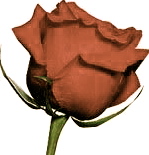
What do you actually have to KNOW to enjoy the scent of a rose?
This isn't to say we shouldn't teach, but it might serve to remind ourselves who is listening.
What if we first gave a pre-concert talk to some non-musicians and had them keep notes on the points in our presentation where we had lost them? I've done that. It's humbling, to say the least. You learn a lot about what doesn't work.
And figuring out what isn't working is already a good start.
Oh, and by the way, it isn't really a hybrid between sonata and ritornello. Actually, its a typical double exposition you would expect in any classical concerto of the late 18th Century, except that the second theme modulates even in the first, orchestral exposition. THAT's rare, although it is surely due to the fact that this concerto is in the minor mode. You would think that instead of modulating from the minor tonic to the major mediant for the second subject, he would choose to use the parallel tonic and simply present the second theme in the major mode, reserving the actual modulation to the mediant for the second, soloist exposition. And that makes you wonder what he might do in the recapitulation: modulate again, or present everything in tonic - first theme in minor, and the second one in the parallel major? After all, he HAS to end in the home tonic, right? So I don't really buy the "hybrid between sonata and ritornello" argument anyway.
I hope you're laughing right now.
Last week, I gave a version of this entry at a fundraising event, and later found myself thinking that its underlying message applies to many arts communities. Perhaps it will remind all of us that the structures of support are now communal. The vision that could be accomplished by one powerful man from over two hundred and fifty years ago, must now belong to the community as a whole.
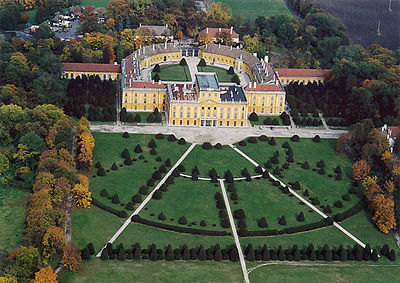
Imagine it is 1766, and you are a prince. You have built a palace in rural Hungary, and you love music. Five years ago, in 1761, your brother had discovered a young, very talented musician and hired him to become Vice-Kapellmeister. Now, in your reign, when the elder Kapellmeister dies, you ensure that the young man assumes the top musical position at the palace.
You have an orchestra, and an opera stage, and you invite musicians from near and far to stop by and visit you, each time telling your Kapellmeister that he should take note of them. He is a composer, this Kapellmeister, and he writes music for you every week. He writes symphonies, operas, and string quartets, and even music for your own favorite instrument, the baryton. He brings glory to your palace because his commitment to music mirrors your own. Having his music in this special place says as much about you and what you value as the beautiful gardens and grand architecture surrounding you.
The symphonies are so incredible that they are published and performed around Europe, and the Kapellmeister's fame grows, along with your palace's reputation.
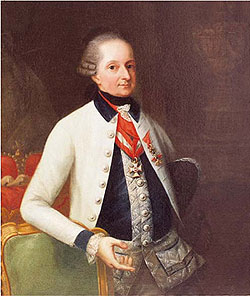 Because of this remarkable musical community, many now know your name, Nikolaus Esterházy, as well as the grand palace you built: Eszterháza. Over the next three decades, your composer-Kapellmeister, Joseph Haydn, will preside over the music in this remarkable place. Since Eszterháza is isolated from Vienna, Haydn will often be lonely for the companionship of other musicians from that city. But, when the palace is closed up at the end of each season, Haydn, like many of the others in your retinue, will return to Vienna, where he lives during the rest of the year. He has friends there, including a young, immensely gifted composer named Mozart. Through their friendship they challenge each other to grow.
Years go by, and you, as the prince, become old and pass away. Your son takes the reins. He cares much less about music, and money is tight. He cuts his expenditures dramatically, and it doesn't take long for Haydn to realize that the magic of Eszterháza has passed on along with you. The entire musical enterprise is closed, and Haydn, released from the terms of his long, exclusive contract, writes music for Paris, and for London, and Vienna too. Later he'll even teach a young, promising composer named Beethoven.
During his lifetime, Haydn will compose over 100 symphonies, develop the new genre of the string quartet, and set the standard against which Mozart will be measured. He'll be the most famous musician of his age, and all of this because of you.
And that leads me to think of ripples.
Each one of us lives a life based on our values. We gradually form them, nurture them, and ultimately, become them. Behind us, we leave ripples of our having been here. Behind us, things happen: Some, because we decide to make a difference; others, the unanticipated results of the things we choose to do.
Because Prince Nikolaus recognized talent and nurtured it, Haydn found his way out of anonymity and into History. The story of music changed. Because of his stature, Haydn would find Mozart, and Beethoven would seek out Haydn. But Prince Esterházy could see none of that. He simply saw that around him he wanted music of the highest order.
We all know that there are no more Eszterháza Palaces and no more people like Prince Nikolaus Esterházy. Well, actually they remain, but in other forms and other roles. The palaces are now tourist spots, and today we have concert halls and auditoriums. There are orchestras in many cities, supported not by princes, but by people like us.
And there are still ripples. Because of the actions behind us, we are here today, and beyond today, our ripples will continue to work their way forward. It seems to be time to throw a stone into the water, believing that you'll leave something behind. We're only part of the story, but we're an essential part. This can't be done by one of us alone. We don't need Prince Nikolaus Esterházy. We need a community of like-minded stone-throwers instead.
Blogroll
AJ Ads
AJ Blogs
AJBlogCentral | rssculture
Terry Teachout on the arts in New York City
Andrew Taylor on the business of arts & culture
rock culture approximately
Laura Collins-Hughes on arts, culture and coverage
Richard Kessler on arts education
Douglas McLennan's blog
Dalouge Smith advocates for the Arts
Art from the American Outback
Chloe Veltman on how culture will save the world
For immediate release: the arts are marketable
No genre is the new genre
David Jays on theatre and dance
Paul Levy measures the Angles
Judith H. Dobrzynski on Culture
John Rockwell on the arts
innovations and impediments in not-for-profit arts
Jan Herman - arts, media & culture with 'tude
dance
Apollinaire Scherr talks about dance
Tobi Tobias on dance et al...
jazz
Howard Mandel's freelance Urban Improvisation
Focus on New Orleans. Jazz and Other Sounds
Doug Ramsey on Jazz and other matters...
media
Jeff Weinstein's Cultural Mixology
Martha Bayles on Film...
classical music
Fresh ideas on building arts communities
Greg Sandow performs a book-in-progress
Harvey Sachs on music, and various digressions
Bruce Brubaker on all things Piano
Kyle Gann on music after the fact
Greg Sandow on the future of Classical Music
Norman Lebrecht on Shifting Sound Worlds
Joe Horowitz on music
publishing
Jerome Weeks on Books
Scott McLemee on books, ideas & trash-culture ephemera
theatre
Wendy Rosenfield: covering drama, onstage and off
visual
Public Art, Public Space
Regina Hackett takes her Art To Go
John Perreault's art diary
Lee Rosenbaum's Cultural Commentary