Creative Destruction: December 2009 Archives
I heard a wonderful concert by The Cleveland Orchestra a few weeks ago.
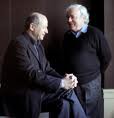 Soloist Richard Goode performed Beethoven's Third Piano Concerto on a program that included Carl Maria von Weber's Overture to Der Freischütz and Rachmaninoff's Second Symphony. Goode was eloquent in the Beethoven, and the orchestra played nuance upon nuance to help create an unforgettable accompaniment. Ivan Fischer conducted, although that hardly seems an adequate term. It might be better to say he prodded, seduced, led and inspired the orchestra - first to remind all of us why Weber's enchanting sound paved the way to a new, Romantic Era, and, later, to show the Rachmaninoff Second, a work that can feel sprawling and amorphous, to be both epic and concise. Since Fischer had collaborated with Goode in recording the complete set of Beethoven concerti, his accompaniment had a quality of calm collaboration, as if to say, "I know how you do that passage, and I'll be right with you throughout." The whole evening was magical, and the audience response was nothing less than electric. I remember thinking, as I joined in the standing ovation, "If you want to really build arts communities, play like THAT!" The comments I heard as I left Severance Hall included, "That was....well, I'm at a loss for words," and a very enthusiastic, beaming woman on the stairwell who, unable to contain herself, exclaimed "That was a revelation!"
And then we all went home.
...or out with friends, off to a restaurant, or to pick up something from the store. What we didn't do was interact with each other.
The Cleveland Orchestra is quietly reinventing itself this year, trying a number of new ideas in programming and ways of relating to their patrons as they deal with a region facing a diminishing population base and an economic environment whose leading business are threatened to the point of questioning their very survival. Historically, Cleveland hasn't been at the forefront of this kind of change, and their willingness to experiment gives other orchestras tacit permission to innovate. So, this new wind they're sailing in matters, not only to Cleveland but to the larger musical community.
Among the many new things its doing this season, The Cleveland Orchestra has created a new series, Fridays @ 7, combining a concert without intermission, with post-concert music. food and drinks. I'm assuming that this was one of the concerts the couple next to me had tried earlier this season. They had been attending The Cleveland Orchestra's concerts for over forty years, and they understood both the extraordinary quality of the orchestra and the acoustic miracle which is Severance Hall. Speaking of one of the Cleveland Friday evenings earlier this year, my neighbor said he really loved the idea of such a concert, but the venue didn't quite work. "When we moved out of the concert hall and into the lobby areas,the crowd was just overwhelming. There wasn't enough room to move," he said. "We stayed a few minutes, but it was so packed that we left." In other words, these audience members wanted to socialize, were even willing to pay to talk, but that desire was so great and the event so well attended that, of all things, the couple went home. I'm guessing that the sheer number of people who wanted this kind of experience exceeded the orchestra's expectations. Obviously, addressing this need isn't as easy as it might seem. Nevertheless, you have to hand it to The Cleveland Orchestra for being willing to experiment, and I have no doubt that they'll tweak the format until it successfully matches their venue to their goals. The good news is that Fridays @ 7 has clearly engendered a lot of interest from the general public.
But since the concert I attended was in a traditional format, I wondered about how you foster community within THAT setting.
When you attend a concert that was a "revelation" the sheer intensity of the experience seems to demand something more than a drive home with a smile on your face, but, it seems that we're at a loss for words partly because we haven't worked out an authentic, workable format for sharing them in the moment. In the final analysis many of us want to discuss, socialize, connect, question or confirm our opinions, share, learn and think about others' viewpoints. We want community, and that seems to mean many different things to each one of us.
The traditional post-concert meeting place has been the Green Room, Cleveland's was empty afterwards. That isn't the right format to meet the public in Cleveland anymore, partly because the soloist was downstairs signing CD's, which was, by the way, precisely where the orchestra members were - talking after the concert, debriefing with friends and letting the energy down gently. And how many people can you put in a Green Room anyway? Personally, I love them, because there are so FEW people who go backstage that you CAN have a meaningful conversation. But they don't work once the scale grows beyond a dozen. The other available location is the lobby, and my own orchestra holds post-concert receptions in just such a location. However, lobbies were designed to handle only a percentage of the audience at one time. They were places for people to pass through, not to congregate afterwards. We built them for a different "society" than the ones we are now serving. We thought of a concert hall as a sacred place for music. What do you do when it also needs to function as a center of community, but your infrastructure was never imagined to assume such a role?
Of course the answer may be found through on-line communities, at least for some people. Like many other orchestras, Cleveland has a blog, but it serves a different purpose. Where would you go after the concert to extend the experience, discuss the music, make new friends, and feel a genuine part of that concert-going community? It may be that the answer won't be "institutional" at all. For all I know, someone who was in that audience that night is already discussing Goode's Beethoven and Fischer's Rachmaninoff on Facebook.
Perhaps some readers will share some successful post-concert experience models or point to some really vibrant on-line communities tied to a specific organization's performances. I, for one, would be interested in hearing about them. Who knows, the next time I ask, "Can we talk?" the answer just might be, "Yes!"
Blogroll
AJ Ads
AJ Blogs
AJBlogCentral | rssculture
Terry Teachout on the arts in New York City
Andrew Taylor on the business of arts & culture
rock culture approximately
Laura Collins-Hughes on arts, culture and coverage
Richard Kessler on arts education
Douglas McLennan's blog
Dalouge Smith advocates for the Arts
Art from the American Outback
Chloe Veltman on how culture will save the world
For immediate release: the arts are marketable
No genre is the new genre
David Jays on theatre and dance
Paul Levy measures the Angles
Judith H. Dobrzynski on Culture
John Rockwell on the arts
innovations and impediments in not-for-profit arts
Jan Herman - arts, media & culture with 'tude
dance
Apollinaire Scherr talks about dance
Tobi Tobias on dance et al...
jazz
Howard Mandel's freelance Urban Improvisation
Focus on New Orleans. Jazz and Other Sounds
Doug Ramsey on Jazz and other matters...
media
Jeff Weinstein's Cultural Mixology
Martha Bayles on Film...
classical music
Fresh ideas on building arts communities
Greg Sandow performs a book-in-progress
Harvey Sachs on music, and various digressions
Bruce Brubaker on all things Piano
Kyle Gann on music after the fact
Greg Sandow on the future of Classical Music
Norman Lebrecht on Shifting Sound Worlds
Joe Horowitz on music
publishing
Jerome Weeks on Books
Scott McLemee on books, ideas & trash-culture ephemera
theatre
Wendy Rosenfield: covering drama, onstage and off
visual
Public Art, Public Space
Regina Hackett takes her Art To Go
John Perreault's art diary
Lee Rosenbaum's Cultural Commentary