Creative Destruction: September 2009 Archives
 In the Epilogue to Alex Ross's marvelous book, The Rest is Noise, he writes "Extremes become their opposites in time." Although he is making a completely different point than I want to focus on, I agree with him entirely.
Opera began in the privacy of the upper crust of society: Baroque Italy's artistic patrons and political leaders provided the settings for the Florentine Camerata and the Italian madrigal to merge into a new genre. Cavalieri led to Peri and Caccini. Monteverdi and Cavalli followed, and in time opera's high production costs (even in its early days) led to the creation of public theaters at which everyday Italians bought tickets to pay for the endeavor. Along the way, they developed a passion for the genre. When it came to the United States, opera was initially perceived as the realm of the wealthy and influential, but later the Met's Texaco broadcasts made Saturday afternoons a time when generations of Americans across the country listened gratis to the likes of Tebaldi, Callas, Pavarotti and Domingo.
In other words, that which was the domain of a small group became beloved by a large one. Extremes do become their opposites in time.
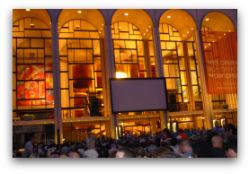
This marvelous dichotomy between opera as an art-form for the few and those valiant attempts to make it one for the many continues to this day. Witness the Metropolitan Opera's recent experiment in providing free opera for the masses in Lincoln Center Plaza.
Earlier this month I saw Gluck's Orfeo ed Euridice and Puccini's Il Trittico over Labor Day weekend as part of a ten-day outdoor festival of Met productions. Each night video from a recent Met production was projected onto a large movie screen. Clearly there was great interest in spending evenings outside enjoying the free events. There were seats for thousands of people, and on both nights I saw latecomers sitting on the walkways at the edges of the seating area.
Honestly, the very best music I heard was a climactic choral moment by Puccini set to a one- minute video clip showing season highlights. The final note was overwhelming - a crescendo to end all crescendos. The voices were at full blast and then, after they cut off the orchestra continued to build and build to an enormous climax. I thought, "This is opera on steroids." This extraordinarily tactile and sensuous music, already larger than life, was pumped up like a body builder just after lifting weights. With a kind of "whoosh" experience that came from MTV-speed video segments combined with such glorious music, the little commercial felt like an epic movie trailer. I remember thinking that it was so big that to hear that passage LIVE might now actually become a disappointment. I don't think I've EVER thought THAT thought a day in my life! So the Metropolitan Opera certainly started off with a WOW moment.
Normally, the Met's productions begin with the chandeliers ascending out of the sightlines into the ceiling. Here, sitting in the plaza, the lobby itself was gradually dimmed in front of us, and, as the colorful Chagall's lost their vibrancy behind the glass facade, a large screen in front of the entryway's pillars lit up with video of those same chandeliers disappearing. It was a nice touch and a clever way to bring us mentally inside the building, even as we continued to sit outside in the Plaza.
Many times, when I see opera on television, I think, "This is just awful." The small screen, the weak sound, the artificiality of the whole thing just makes me think that opera should be experienced live or not at all. Opera is just too grand to be so small. And yet, here in a public space, with all the distractions of New York City around us, the event was compelling. Particular kudos should go to the sound engineers. I was astonished at the aural presence we could experience outside. The sound was warm enough to have resonance, and it lacked the tinny qualities often associated with electronic sound projection. Musically, in other words, it worked.
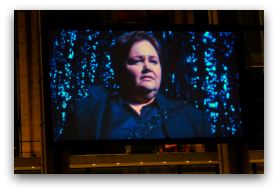 If I were to sit inside the Met and open a plastic candy wrapper I would be admonished all around. Imagine hearing that crackling sound while Anna Netrebko sings La Traviata. I'd be lucky to get out of the room with my life intact! And, as I think about it, there WAS a "shhhh!" moment from a couple in front of me who became annoyed at two friends who suddenly decided this was a good time to hold a private conversation. Having been properly rebuked, the chatty friends went silent immediately. So, to be clear, people were listening attentively. And yet there was a charming passage in the "ballet" section of the Mark Morris production of Gluck's Orfeo ed Euridice when we all seemed to listen past the ambient sounds around us. In the famous Dance of the Furies, the music's role is to mimic a whirlwind of tension representing the states of the myriad number of souls living out their eternity in a constant state of agitation and anger. I noticed that the music took place that kind of quietness which only New York can offer: the sound of anonymous taxis whirring by, the buzz of distant street conversation. And then, during the Dance of the Blessed Spirits, a taxi suddenly honked, an ambulance's siren went off, and I heard voices shouting across the street. The individualized noises cut into the listening experience. You had to NOTICE them. Reading the sub-titles in Stephanie Blythe's Elysium scene, I remember seeing something like "All around me are blissful sounds." As the sirens, car horns and street noises continued, I couldn't help but think that New York's capacity for irony is simply endless. Gluck would have smiled.
Opera, like all good theater, asks us to suspend reality. Instead of talking, people sing. Instead of coughing, sopranos with tuberculosis rise to a high C in a well-controlled pianissimo and then die in front of us, only to re-appear a moment later smiling in triumph while taking a bow. No one laughs at the ridiculousness of the spectacle, often because we are far too busy crying. And THAT is the magic of opera. I'm told that Opening Night at the Met had seats going for well over $1,000. All the better then that earlier in the same month the rest of us could listen for free.
At least for me art is best when experienced in community - even if accompanied by the occasional taxi cab horn or the wail of a distant siren. Bravos to the Met! A great idea, well executed!
Make it a new tradition!
This entry continues my exploration of Bruckner's Fourth as revealed by two recordings by Bruno Walter, along with a little bit of thinking about remembering to keep "art" first in "arts communities." You can read the previous entries on this subject here and here.
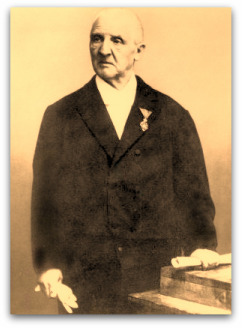
Last time I finished with:
It isn't hard to love Bruno Walter, and the Columbia Symphony Orchestra's recordings reveal him to be a musician in the center of good taste. The tempos are not surprising, nor are the climaxes overblown. The whole CSO series is consistently satisfying, and you would expect to look to others to surprise you with extremes of interpretations.
Or you could look to his 1940 recording of Bruckner's Fourth with the NBC Symphony.
Let's take it from there...
The Bruckner Fourth recording by Walter in 1940 (using the early Löwe/Schalk edition of the symphony) simply teems with ideas.
It's like hearing a man in a forest shouting, "Look at THIS tree! Now, look at THAT one! And how about THIS flower! And did you notice this blade of grass???" Everything is in stark relief. It is almost manic in tempo modifications. The sfortzandi are edgier, the ritardandi broader, and the brass chorales bolder. It is Bruckner Fourth as you might have imagined Mahler conducting it. It is a fascinating reading and it puts the Bruno Walter I thought I knew in an entirely new light. The 1940 Walter can do anything he wants. His technique frees him to move the orchestra's tempi forward and back. His personality is strong. His ideas are as tangible as steel. The emotions are extreme - surprising for a conductor I've come to know as being gentle in so many respects.
And yet, for all of its astonishing aspects, the 1940 performance doesn't quite work. Every lovingly-etched detail competes with the next one. Every tempo modification is too much. Each individual moment is revelatory, and one could wonder if the interpretation is influenced by the cataclysmic events taking place in Europe at the time. Regardless, while the reading is fascinating, it is not satisfying as a whole.
In the 1960 recording Walter revisits the work (with the Haas edition of the score) bringing a kind of wisdom that only two more decades of living with the music could have provided. In this reading the individual trees form a forest. The details serve the entirety. The 1940 recording's raw passion is replaced tenfold with the grandeur and majesty of 1960. As Walter tamed himself he revealed a higher truth hiding in the music he so deeply wanted to serve.
I'm not suggesting that the 1960 Walter version of Bruckner's Fourth is the only one to hear, or the best one, or anything of the like. I could have explored this same subject with Klemperer or others who made multiple recordings of this symphony. Instead I'm thinking about the work of the artist as a magnetizing force - and of the artistic work WE do that brings people around to join the cause over time.
This blog is about building arts communities, and one might wonder why I would share this "coffee with an old conductor" discovery here.
The reason is simply that, in our worries about this season - this REALLY challenging time, when budgets are lean, and every decision - artistic or financial - seems fraught with danger, we need to stop and remember what we're primarily about.
For all that we need to do to figure out how to bring in new monies, how to build new relationships, how to interact with our audiences in order to create more loyal "tribes" around our institutions, we need to remember that those efforts are on the edge of the issue - not at the center of it.
Arts communities are, first and foremost, about art. It's self-evident, but it isn't hard for that idea to get pushed to the side, especially in an environment of economic stress.
I remember hearing recently about one conductor whose Board members suggested changing the programming format for the orchestra to half classical and half pops on each program in order to build audiences. I felt for them, and for their conductor. The Board was worried about the empty house, and the conductor was worried about his own integrity as an artist. The organization had forgotten themselves and their reason for being in the midst of the crisis, and they had lost their way.
This will be "the year that was" in a lot of respects. There are going to be stresses we haven't felt before. The economic models won't be working in the normal ways, and we'll be asked to try new things. In and of itself, that concept is neither good nor bad. Innovation in the arts IS needed, and this season just might provide the crisis necessary for positive re-invention - or it will provide a moment to invite the money changers into the temple.
There's the rub. Can we reinvent ourselves without selling out? And the answer has to be YES.
Artists build their communities through their creations and through their insights. As they grow, as they learn how to navigate through the shoals, they come closer to the ever-elusive ideal, and others follow them. In other words, the older Walter of 1960 - who has the scars of his earlier battles with Bruckner's monumental body of work - is better able to help build an arts community around the composer than the younger Walter. It isn't that he couldn't serve the effort in 1940 - his entire life was devoted to the "cause" of Bruckner. But, as Walter grew in understanding, the rest of the world, the "community" of Bruckner's admirers, could grow alongside him.
Building an arts community in music includes attending to things like community relations, marketing approaches, pricing strategies, programming and soloist choices, graphic design work, and the use of emerging on-line technology. In other disciplines it might include looking hard at the kind of neighborhood your theater is in and thinking about demographics in relationship to programming. Or it might make you ask whether there is a good restaurant near your art gallery and how having one would change the foot traffic on the streets. In other words, the complexity involved in building a successful arts community depends upon MANY things - some of which seem ancillary and some of which are specific to the plays, shows, concerts and other kinds of programs we offer to the public.
Mostly though, building an arts community comes out of making art - growing in understanding - and conveying what we've come to learn to others. It's Bruno Walter in 1940 and 1960, and the hard-fought ground he covered in between.
It might be good to remember that in this particular year. Doing so just might keep us from letting the tail wag the dog.
If we remember to focus on the art while we innovate we'll be fine in the long run.
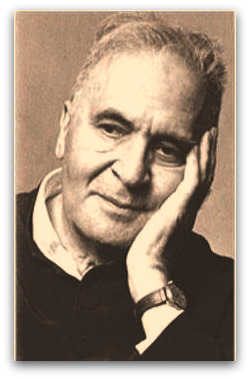 In my last entry I wrote the following:
I want to start this series of blogs on personal artistic development and its relationship to building communities. Naturally, there are many interpretations of the word "community" - ranging from shared geography to any group with a shared interest. Recently, I have been thinking of the community which formed around Bruckner's music - and of one conductor's role in helping establish and foster it over a very long lifetime: Bruno Walter. I've come to understand more clearly what his personal journey entailed. As an interpretive artist Walter grew in understanding Bruckner's music over a lifetime of study, and his own growth helped foster the community that would be formed around the composer.
Today I want to continue exploring the subject
Many hours of score preparation are done in silence.
You sit and stare at a page, imagining the sounds as you look at the notes, articulations, dynamics, tempo indications and all the other myriad details which attempt to indicate the moment-by-moment intricacies and actions of live music-making. To someone looking at you while you are studying, there is nothing to see. You appear as if you are resting, but your mind is active, and your inner ear is working as hard as it can to create a landscape of music that you'll try to help come alive in rehearsal and then later, in concert. As you return to the score, day after day, you not only learn the music, but you begin to get new perspectives on the work as a whole. Sometimes yesterday's question becomes today's answer; sometimes you rethink a tempo or the dimensions of a ritardando, or how loud this forte will be compared to THAT forte.
For some musicians, the score is the only source they want to interact with. I know conductors who actively DON'T listen to other musicians' performances of a work they are studying because they don't want to be influenced, even unconsciously, by someone else's ideas. I respect that viewpoint - in that they are trying to express the composer's ideas, rather than a warmed-over version of Conductor A's interpretation of them. The last thing you want to do as a re-creative artist is to create a Frankenstein-like interpretation, borrowing one moment from this interpretation and the next moment from that one - as if merging different views of a work together would make a satisfying whole.
For myself, after I've done enough work on my own, I love to listen to others' views of the work I'm working on. I confess that sometimes they point out a detail I've missed, but more often, it is a way of "having coffee" with another conductor. You listen to how they approach a problem. You get to see if their answer "works" and you REALLY see their feet of clay when it doesn't. Those moments are cautionary, because a master conductor's failings are telling. You look at the score and think, "If THIS conductor can't solve that problem, how am I supposed to???" And sometimes you hear a performance that, while successful, doesn't represents a vision of the work that matches your own. Those can be fascinating experiences too. You say to yourself something like, "I would never conduct it that way, but it is totally convincing!"
Right now I'm preparing a Bruckner symphony. I've spent much of the summer in silence with it, and now I'm listening to a number of recordings - "having coffee" with the likes of Jochum, Haitink, Sawallisch, Klemperer, Tennstedt, Masur, Kubelik, Karajan, Abbado, Bohm, Celibidache, Chailly, Barenboim and others.
One morning not long ago, I spent 40 minutes on the first movement of Bruckner 's Fourth - "having coffee" with Bruno Walter. Actually, I spent that morning with TWO Bruno Walters.
The experience was revelatory, and it got me thinking about the subject of this series of blogs.
The first Bruno Walter was a middle-aged man. He was guest conducting in 1940 with the newly-created NBC Orchestra, and the orchestra created for Toscannini showed itself to be a truly virtuoso instrument. One of the interesting things about the NBC is that it was made up of extraordinary musicians, but each of the early broadcasts marked the first time THAT particular orchestra had played the work. Because of that fact you get a musical mix of seasoned musicianship and freshness. Walter's recording of the Bruckner Fourth (on the Pearl label) is from a live radio broadcast, and I gathered from reading the CD booklet that the acetate from the radio broadcast, complete with audio pops and a rather "closed" sound from the infamous Studio 8H, formed the basis for the recording. You don't buy this recording for the quality of the sound, but as a way of peering into a moment in time.
The second Bruno Walter I spent the morning with was an older man. In that recording (on Columbia Records) he conducts the Columbia Symphony Orchestra in the early 1960's. The tempos are slower in this recording. Each movement is longer than the earlier performance, but there is more at play here than just speed. The later recording is grand. It holds together as a single unit. It isn't simply the much improved quality of sound, it is the musicianship we experience. The phrases breathe, the a tempos seem natural, and the shape of the dramatic arch seems completely "right". You don't get jostled around listening to this reading. It has majesty to it and a kind of serenity that seems to match the world of the composer, the music itself and its interpreter like a hand in glove. It simply fits.
Like the NBC in the 1940's the Columbia Symphony Orchestra was not an ensemble with a long history. Instead it represented some of the very best studio musicians in the business. Walter made a number of recordings late in his life with this group, and there are even recordings of studio rehearsals. Listening to those sessions shows him to be a gentleman on the podium at the same time that he demands a very clear musical result from his colleagues. His manner of addressing the musicians as "my friends" or even courteously by name was the model of respect from a musician whose storied history and enormous cultural background could have led a lesser man to a very different approach in dealing with his musical colleagues. It isn't hard to love Bruno Walter, and the Columbia Symphony Orchestra's recordings reveal him to be a musician in the center of good taste. The tempos are not surprising, nor are the climaxes overblown. The whole CSO series is consistently satisfying, and you would expect to look to others to surprise you with extremes of interpretations.
Or you could look to his 1940 recording of Bruckner's Fourth with the NBC Symphony.
I'll explore the surprises I found there in the next entry.
 The evening chill announces that the Michigan summer is ending. Even on sunny days there is a little spark in the air that, somehow, connects itself to October more closely than to June.
The economic convulsions of last year are still fresh, but there is hope that, someplace on the horizon, better days are coming. A lot of arts organizations got scared last spring. I read of Boards in a panic, suddenly confronted with no cash, smaller audiences, and dwindling donations. The crisis served as a wake-up call for many, and there were undoubtedly many earnest conversations about getting serious about keeping audience relations warm in this downturn. Budgets were cut, and cut again. Artistic leaders had to weigh conflicting interests as they suggested plans for a season that would take place between last year's chaos and next year's hoped-for recovery.
With the summer's last days come the first hints of the new season. Brochures have been mailed, ticket orders are now being filled, boards are returning to their meetings, and staff members are working to get everything ready. Actor's auditions are scheduled for roles for plays which will soon be in rehearsal. Musicians are practicing, and artists of all types are preparing new projects.
I know that, for myself, this summer I've been working through a pile of scores for the upcoming season. From Mozart and Mendelssohn to Bruckner and Bartok, there is a lot of music to prepare. Summer is not only "off-season", but also time to get ready. The interior work happens long before the exterior work begins.
During this time I've also been thinking about the role of the artist in relationship to building "arts communities". Understanding our latent capacities as artists to help galvanize our communities around the arts seems to be essential at this moment. We sometimes leave this work to the marketing department or the community relations staff. There is a good reason - the work of an artist is to make art, and it CAN seem like an intrusion to look outward instead of inward. But it doesn't have to be that simple. We can make art AND the communities around them. In addition to doing our individual creative work, we can be part of the larger solution in a period of turmoil for all of us.
I want to start this series of blogs on personal artistic development and its relationship to building communities. Naturally, there are many interpretations of the word "community" - ranging from shared geography to any group with a shared interest.
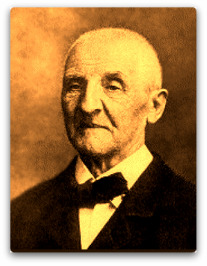
Recently, I have been thinking of the community which formed around Bruckner's music - and of one conductor's role in helping establish and foster it over a very long lifetime: Bruno Walter. I've come to understand more clearly what his personal journey entailed. As an interpretive artist Walter grew in understanding Bruckner's music over a lifetime of study, and his own growth helped foster the community that would be formed around the composer.
More on this subject next time...
Blogroll
AJ Ads
AJ Blogs
AJBlogCentral | rssculture
Terry Teachout on the arts in New York City
Andrew Taylor on the business of arts & culture
rock culture approximately
Laura Collins-Hughes on arts, culture and coverage
Richard Kessler on arts education
Douglas McLennan's blog
Dalouge Smith advocates for the Arts
Art from the American Outback
Chloe Veltman on how culture will save the world
For immediate release: the arts are marketable
No genre is the new genre
David Jays on theatre and dance
Paul Levy measures the Angles
Judith H. Dobrzynski on Culture
John Rockwell on the arts
innovations and impediments in not-for-profit arts
Jan Herman - arts, media & culture with 'tude
dance
Apollinaire Scherr talks about dance
Tobi Tobias on dance et al...
jazz
Howard Mandel's freelance Urban Improvisation
Focus on New Orleans. Jazz and Other Sounds
Doug Ramsey on Jazz and other matters...
media
Jeff Weinstein's Cultural Mixology
Martha Bayles on Film...
classical music
Fresh ideas on building arts communities
Greg Sandow performs a book-in-progress
Harvey Sachs on music, and various digressions
Bruce Brubaker on all things Piano
Kyle Gann on music after the fact
Greg Sandow on the future of Classical Music
Norman Lebrecht on Shifting Sound Worlds
Joe Horowitz on music
publishing
Jerome Weeks on Books
Scott McLemee on books, ideas & trash-culture ephemera
theatre
Wendy Rosenfield: covering drama, onstage and off
visual
Public Art, Public Space
Regina Hackett takes her Art To Go
John Perreault's art diary
Lee Rosenbaum's Cultural Commentary