Creative Destruction: May 2009 Archives
 A few weeks ago I was sitting in a box seat at Carnegie Hall looking down on an empty stage. It was only a few minutes before the concert was to begin and the hall was still half-empty. The orchestra was still waiting in the wings, and I couldn't help noticing the moment.
In just a few minutes the whole room would be changed, the environment transformed, and a new community created. In other words, the event itself had brought people of shared interests together.
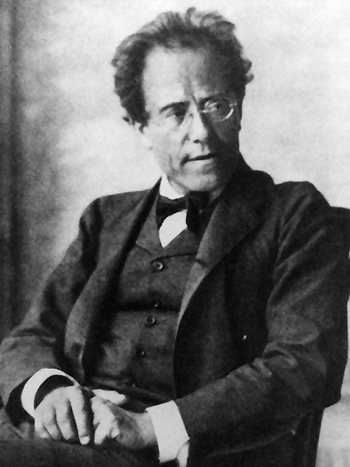
I had flown from the mid-west with this concert as part of my agenda for being in New York. Other friends had come from Santo Domingo in the Dominican Republic to be here for this historic occasion. What we had in common was a love of Mahler's music, and this WAS a rare event celebrating that composer. The Berlin Staatsoper would play all of Mahler's symphonies in order of their composition under two conductors at the top of their game. Barenboim and Boulez couldn't be more opposite in their approaches to performing Mahler, but the audience was united over this concert series from the very first note.
Even the applause for Thomas Quasthoff before Kindertotenlieder began seemed different than virtually any applause I had experienced. This was going to be something special we seemed to say. The hall quieted, and the first notes began. In an instant, the community formed, congealed and unified into one silent mass of listeners.
The magic lasted for two hours and then the hall emptied. I found myself asking what would remain of this newly-founded community. I walked with friends down 57th Street to the Istanbul Café, and we talked about the concert. Over Turkish coffee, a series of spin-off subjects ranging from Bernstein to Mitropoulos kept the magic going for another hour until the rain outside had ended and we hailed a cab to return to the apartment.
Has that community disappeared? I don't think so, at least not yet. It remains in the minds of those who shared the experience. But with each day, the glue that held us together weakens.
I'm told that later in the cycle, on the Mahler 5th concert, representatives from the Gustav Mahler Society of New York were busy on the sidewalks handing out flyers to capitalize on a public already predisposed to the cause.
It occurs to me that Carnegie Hall could have done the same thing capturing e mail addresses for future Mahleriana as part of the ticket sale: "Would you like to be notified anytime there is a concert featuring Mahler here?" would have been tantamount to the old McDonald's money-making phrase, "Do you want fries with that?"
The challenge isn't simply creating communities; it's keeping them alive.
One cellist, thirty passionate people....as much emotional bang as Bruckner Fourth - which makes me think, what are we doing here?
Where do you begin?
This blog won't be all about symphony orchestras, but that IS what I do for a living, and so it should probably start there.
I found myself driving home the other night after an extraordinary evening of music making.
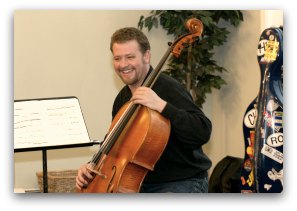
The night had featured a cellist in the orchestra who had been engaged for an "Up Close" event - meaning he played a little bit of unaccompanied cello music (Bach, and Hindemith), talked about his instrument and described his life as a musician. There was also coffee, tea and cookies. Some staff members were introduced, and the whole event lasted about an hour and fifteen minutes. All of this effort was for about 30 people. The "audience" was drawn from our own data base, but not focused on donors. In other words, we were investing in the non-investors. I didn't know most of their names. They attend some concerts each year. That's all. Not the usual suspects...
And yet...
You would have thought, walking into the room mid-way through, that we were dealing with the most passionate people in the world - they were incredibly curious about what was going on. There were questions throughout, and sometimes the audience actually interrupted the musician - how does the bow produce sound, explain how you make those really high pitches (the harmonics), or how much did you practice today? Why do you use your thumb like that? How do you memorize the music?
A little music-making. A lot of life.
In theory, a symphony orchestra is a concert-giving organization, but that is only a small part of what it actually could do.
Should do?
We've been confined by who we think we are, and by what we think we are.
Blogroll
AJ Ads
AJ Blogs
AJBlogCentral | rssculture
Terry Teachout on the arts in New York City
Andrew Taylor on the business of arts & culture
rock culture approximately
Laura Collins-Hughes on arts, culture and coverage
Richard Kessler on arts education
Douglas McLennan's blog
Dalouge Smith advocates for the Arts
Art from the American Outback
Chloe Veltman on how culture will save the world
For immediate release: the arts are marketable
No genre is the new genre
David Jays on theatre and dance
Paul Levy measures the Angles
Judith H. Dobrzynski on Culture
John Rockwell on the arts
innovations and impediments in not-for-profit arts
Jan Herman - arts, media & culture with 'tude
dance
Apollinaire Scherr talks about dance
Tobi Tobias on dance et al...
jazz
Howard Mandel's freelance Urban Improvisation
Focus on New Orleans. Jazz and Other Sounds
Doug Ramsey on Jazz and other matters...
media
Jeff Weinstein's Cultural Mixology
Martha Bayles on Film...
classical music
Fresh ideas on building arts communities
Greg Sandow performs a book-in-progress
Harvey Sachs on music, and various digressions
Bruce Brubaker on all things Piano
Kyle Gann on music after the fact
Greg Sandow on the future of Classical Music
Norman Lebrecht on Shifting Sound Worlds
Joe Horowitz on music
publishing
Jerome Weeks on Books
Scott McLemee on books, ideas & trash-culture ephemera
theatre
Wendy Rosenfield: covering drama, onstage and off
visual
Public Art, Public Space
Regina Hackett takes her Art To Go
John Perreault's art diary
Lee Rosenbaum's Cultural Commentary