<?xml version="1.0" encoding="utf-8"?>
<feed xmlns="http://www.w3.org/2005/Atom">
    <title>book/daddy</title>
    <link rel="alternate" type="text/html" href="http://www.artsjournal.com/bookdaddy/" />
    <link rel="self" type="application/atom+xml" href="http://www.artsjournal.com/bookdaddy/atom.xml" />
    <id>tag:www.artsjournal.com,2008-02-19:/bookdaddy//18</id>
    <updated>2010-06-14T15:21:02Z</updated>
    <subtitle>Jerome Weeks on books</subtitle>
    <generator uri="http://www.sixapart.com/movabletype/">Movable Type 4.31-en</generator>

<entry>
    <title>Or: Stanley Kowalski with a collection of first editions</title>
    <link rel="alternate" type="text/html" href="http://www.artsjournal.com/bookdaddy/2010/01/or_stanley_kowalski_with_a_boo.html" />
    <id>tag:www.artsjournal.com,2010:/bookdaddy//18.24154</id>

    <published>2010-01-07T18:46:37Z</published>
    <updated>2010-06-14T15:21:02Z</updated>

    <summary>It&apos;s taken me awhile to get around to this -- busy, busy, busy -- but Katie Roiphe wrote an essay, &quot;The Naked and Conflicted,&quot; for the cover of last Sunday&apos;s New York Times Book Review. It&apos;s an essay that&apos;s generated...</summary>
    <author>
        <name>book/daddy</name>
        <uri>http://www.artsjournal.com/bookdaddy/</uri>
    </author>
    
        <category term="main" scheme="http://www.sixapart.com/ns/types#category" />
    
    <category term="davidfosterwallace" label="David Foster Wallace" scheme="http://www.sixapart.com/ns/types#tag" />
    <category term="feminism" label="feminism" scheme="http://www.sixapart.com/ns/types#tag" />
    <category term="johnupdike" label="John Updike" scheme="http://www.sixapart.com/ns/types#tag" />
    <category term="katieroiphe" label="Katie Roiphe" scheme="http://www.sixapart.com/ns/types#tag" />
    <category term="masculinesexuality" label="masculine sexuality" scheme="http://www.sixapart.com/ns/types#tag" />
    <category term="newyorktimesbookreview" label="New York Times Book Review" scheme="http://www.sixapart.com/ns/types#tag" />
    <category term="normanmailer" label="Norman Mailer" scheme="http://www.sixapart.com/ns/types#tag" />
    
    <content type="html" xml:lang="en-US" xml:base="http://www.artsjournal.com/bookdaddy/">
        <![CDATA[<p><img alt="e-man_super.jpg" src="http://www.artsjournal.com/bookdaddy/e-man_super.jpg" class="mt-image-left" style="margin: 0pt 20px 20px 0pt; float: left;" width="224" height="220" />It's taken me awhile to get around to this -- busy, busy, busy -- but Katie Roiphe wrote an essay, "The Naked and Conflicted," for the cover of last Sunday's <a href="http://www.nytimes.com/2010/01/03/books/review/Roiphe-t.html?scp=4&amp;sq=katie%20roiphe&amp;st=cse"><i>New York Times Book Review</i></a>. It's an essay that's generated a great deal of online talk because in it, Roiphe looks back with a certain wistful fondness for the old
caveman sexuality of the earlier generation of leading American white male
novelists (Roth, Mailer, Updike). <br /></p><p>They were the boundary-breaking 'bad

boys' who -- however negligible it is as an ontological proposition --
exalted sexual conquest as a defining activity. Let's imagine them all as a kind of writerly version of Jack
Nicholson. In contrast, the newer batch (David Foster Wallace, Michael Chabon, et al) are the
insecure nice guys who doubt that chest-thumping and skirt-chasing
should define their existence as men. They're the self-conscious nice guys
whom feminists like Roiphe now seem a little fed up with. No grand
flights of lust-filled poetic fancy from them. So let's imagine them as John Cusack. </p>
<p>Actually, I would posit a different way of distinguishing Ms. Roiphe's two
groups. The new guys -- at least in their fictional male protagonists --
seem to care about what their female bed-mates think, desire,
hope for, derive pleasure from. The older ones seem far more selfish. In this, Roiphe has missed the crux of David Foster Wallace's attack on John Updike's approach to sex in his male characters. Simply put, the Updike character's crude-ish thinking on sex in no way matches Updike's own super-subtle thinking about other areas. Consequently, Updike's fiction repeatedly conveys the attitude that sex is something a man takes or cheats out of a woman -- for him, sex is barely worth considering in depth outside of his own obsession. Hence, Foster Wallace's conclusion that Updike's (repeated) attitudes toward sex suggest something deeply unpleasant about him.<br /></p><p>Yet Ms. Roiphe
longs for some of that old, lust-filled transcendence,
both emotional and literary, and seems to think this is the only way it arrives. One wonders how such transcendence (literary and sexual) is achieved when it comes with a lack of respect, but then, that's how some people like it. Apparently, though, Ms. Roiphe still wants to be
desired and fought for <i>but not</i> denigrated or dismissed. <br /></p><p>So we're back with what do women want? And for Ms. Roiphe, it
would seem they want that traditional, bifurcated being: a gentleman at the dinner
table, a Visigoth in the bedroom. She wants Nicholson <i>and</i> Cusack.&nbsp; <br /></p>
<p>Good luck finding and keeping such a creature -- because he's more or less a fantasy, much like the male fantasy of the happy, lust-filled bimbo who will deliver a beer and then disappear.&nbsp; There's no problem with fantasy figures provided they're recognized as such and we understand what this fantasy says about us. But Roiphe never recognizes the fantasy element in her argument at all. To put it in a more literary, less Hollywood way, she wants a feminist Philip Roth. As I said, good luck with that. <br /></p><p><br /></p><p><i>A version of this was sent to the NYTimes Paper Cuts blog.</i><br /></p> ]]>
        
    </content>
</entry>

<entry>
    <title>My TV interview with Oscar Casares</title>
    <link rel="alternate" type="text/html" href="http://www.artsjournal.com/bookdaddy/2009/10/my_tv_interview_with_oscar_cas.html" />
    <id>tag:www.artsjournal.com,2009:/bookdaddy//18.22961</id>

    <published>2009-10-27T21:26:30Z</published>
    <updated>2009-10-27T21:33:32Z</updated>

    <summary><![CDATA[Over at Art&amp;Seek, you can watch my Think TV video interview with Texas author Oscar Casares. We talk about family legends, storytelling, his new novel, Amigoland, and&nbsp; how un-exotic and everyday the border is in his fiction -- in contrast...]]></summary>
    <author>
        <name>book/daddy</name>
        <uri>http://www.artsjournal.com/bookdaddy/</uri>
    </author>
    
    <category term="amigoland" label="Amigoland" scheme="http://www.sixapart.com/ns/types#tag" />
    <category term="border" label="border" scheme="http://www.sixapart.com/ns/types#tag" />
    <category term="novel" label="novel" scheme="http://www.sixapart.com/ns/types#tag" />
    <category term="oscarcasares" label="Oscar Casares" scheme="http://www.sixapart.com/ns/types#tag" />
    
    <content type="html" xml:lang="en-US" xml:base="http://www.artsjournal.com/bookdaddy/">
        <![CDATA[<img alt="Oscar casares.jpg" src="http://www.artsjournal.com/bookdaddy/Oscar%20casares.jpg" class="mt-image-left" style="margin: 0pt 20px 20px 0pt; float: left;" width="273" height="295" />Over at <a href="http://www.kera.org/artandseek/content/2009/10/27/artseek-on-think-tv-author-oscar-casares/">Art&amp;Seek,</a> you can watch my Think TV video interview with Texas author Oscar Casares. We talk about family legends, storytelling, his new novel, <a href="http://www.amazon.com/Amigoland-Novel-Oscar-Casares/dp/0316159697/ref=sr_1_1?ie=UTF8&amp;s=books&amp;qid=1256678986&amp;sr=1-1"><i>Amigoland</i></a>, and&nbsp; how un-exotic and everyday the border is in his fiction -- in contrast to, say, Cormac McCarthy's novels, where it's this life-changing moment when a young Anglo crosses it to learn about Love and Death. In <i>Amigoland</i>, two aging, quarreling Mexican-American brothers head south to determine whether if a story their grandfather told is true.&nbsp; ]]>
        
    </content>
</entry>

<entry>
    <title>Big-City Texas in the &apos;80s: Black Water Rising</title>
    <link rel="alternate" type="text/html" href="http://www.artsjournal.com/bookdaddy/2009/08/big-city_texas_in_the_80s_blac.html" />
    <id>tag:www.artsjournal.com,2009:/bookdaddy//18.21645</id>

    <published>2009-08-06T14:15:28Z</published>
    <updated>2009-08-06T14:32:17Z</updated>

    <summary>Attica Locke is a bit of a rarity. She&apos;s an African-American, female novelist from Texas who&apos;s made her debut with a big-city crime novel. It&apos;s called Black Water Rising, and rarer still, Locke is getting compared to such master thriller...</summary>
    <author>
        <name>book/daddy</name>
        <uri>http://www.artsjournal.com/bookdaddy/</uri>
    </author>
    
        <category term="main" scheme="http://www.sixapart.com/ns/types#category" />
    
    
    <content type="html" xml:lang="en-US" xml:base="http://www.artsjournal.com/bookdaddy/">
        <![CDATA[<strong></strong><span class="mt-enclosure mt-enclosure-image" style="display: inline;"><img alt="small locke.jpg" src="http://www.artsjournal.com/bookdaddy/small%20locke.jpg" class="mt-image-left" style="margin: 0pt 20px 20px 0pt; float: left;" width="153" height="225" /></span><p><strong><a href="http://www.atticalocke.com/" target="_blank">Attica Locke</a></strong><a href="http://www.atticalocke.com/" target="_blank"> </a>is
a bit of a rarity. She's an African-American, female novelist from
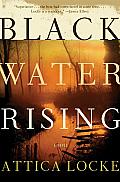
Texas who's made her debut with a big-city crime novel. It's called <em><a href="http://www.amazon.com/Black-Water-Rising-Attica-Locke/dp/0061735868/ref=sr_1_1?ie=UTF8&amp;s=books&amp;qid=1249419122&amp;sr=1-1" target="_blank"><strong>Black Water Rising</strong></a>,</em> and rarer still, Locke is getting compared to such master thriller writers as Dennis Lehane, the author of <a href="http://www.amazon.com/Mystic-River-Dennis-Lehane/dp/0060584750/ref=sr_1_1?ie=UTF8&amp;s=books&amp;qid=1249419174&amp;sr=1-1" target="_blank"><strong><em>Mystic</em><em> River</em>, </strong></a>and <a href="http://www.hachettebookgroup.com/features/georgepelecanos/" target="_blank"><strong>George Pelecanos</strong></a>, who wrote for the HBO series, <a href="http://www.hbo.com/thewire/" target="_blank"><em><strong>The Wire.</strong></em></a></p>
<p>Locke has already been a successful screenwriter in Los Angeles for
more than a decade. But while her scripts got sold they never got made.
Partly, this was just because of the cumbersome economics of
filmmaking. Partly, it's Hollywood's very limited openness to serious
movies about African-Americans.</p>
<p>So Locke decided that this time, she'd write a novel. And she'd set
it in Houston in 1981. She was inspired by an incident that happened
when she grew up there.</p>
<p>ATTICA LOCKE: "My dad, who did not have a lot of money, wanted to do
something for my step-mother, for her birthday. And he knew somebody
who knew somebody who ran boat tours on Buffalo Bayou. And you dock in
downtown Houston which is kind of, you know, city lights and somewhat
picturesque, but the ride takes you into parts of the city that are not
so nice."</p>
<p>Somewhere in the darkness, a woman screamed. Then, gunshots. Locke's
father did not play hero. He wasn't going to endanger his wife and
children by abandoning them to leap unarmed into a swamp at night.</p>In contrast, in the opening of <em>Black Water Rising</em>, Attica's
main character, Jay Porter is in the same situation. But<i> he </i>jumps.]]>
        <![CDATA[

<p>In contrast, in the opening of <em>Black Water Rising</em>, Attica's
main character, Jay Porter is in the same situation. But he jumps. And
he lands in a world of trouble. Real estate swindles and big oil money
and racial violence.</p>

<p>Those are the <em>other </em>reasons that Locke set her novel in Texas in the '80s.</p>

<p>ATTICA LOCKE: "Texas in the '80s, particularly Houston and Dallas
were emblematic of the early optimism about the Reagan '80s - before
people figured out that wasn't going to work out for everybody
[laughs]. There was just a lot of oil money going around, the cities
and the state were getting international attention. Kinda just like a
really interesting time that represented a country trying to transition
from a segregated America into an integrated America."</p>

<span class="mt-enclosure mt-enclosure-image" style="display: inline;"><img alt="black thumb.jpg" src="http://www.artsjournal.com/bookdaddy/black%20thumb.jpg" class="mt-image-right" style="margin: 0pt 0pt 20px 20px; float: right;" width="120" height="182" /></span><p>In <em>Black Water Rising</em>, Jay Porter makes for an unusual hero. He's scared. He was once a black activist, a student associate of<a href="http://www.interchange.org/Kwameture/nytimes111698.html" target="_blank"><strong> Stokely Carmichael.</strong></a>
But then he led a protest that ended in violence - and in his own
trumped-up murder trial. Ever since, Jay has slept with a gun nearby.
He's left the movement, satisfied to scratch out his own legal career
and a married life -- but the fear has never left him that everything
could suddenly be taken away.</p>

<p>Jay's racial paranoia is not true for all African-Americans, Locke says. It reflects her own experience. She grew up<em> bifurcated</em>, as she calls it, bused from a black neighborhood to an integrated school.</p>

<p>ATTICA LOCKE: "Being thrust into a newly integrated American culture
that still had some serious problems, I was always scanning my
environment to figure out who I could trust - because you would make
friends with someone on the playground one week and the next week they
might call you the 'N' word. And I'm not even saying that is genuine
racism - some of that was just <em>kids</em>. But they knew that if you used that word, ooh, you can really hurt somebody."</p>

<span class="mt-enclosure mt-enclosure-image" style="display: inline;"><img alt="genelocke2.jpg" src="http://www.artsjournal.com/bookdaddy/genelocke2.jpg" class="mt-image-left" style="margin: 0pt 20px 20px 0pt; float: left;" width="200" height="266" /></span><p><a href="http://www.genelocke.com/" target="_blank"><strong>Gene Locke</strong></a> is Attica's father. In the '80s, he was a struggling criminal defense attorney, just like Jay Porter in <em>Black Water Rising</em>.
But the similarities don't go much farther. As Attica insists, Gene is
not Jay. Still, reading his daughter's novel took Gene back. And he was
struck by the novel's accuracy in depicting portions of unpleasant,
big-city Texas life that aren't normally found in fiction - like the
labor community and <em>its</em> racial tensions.</p>

<p>GENE LOCKE: "All of that's part of the rich history of change in
Houston, You know, rather than deny it, let's acknowledge it and
acknowledge that it was some of the very struggles that she has in the
book that has given rise to the Houston of today, the Houston we are quite proud of now."</p>

<p>The Lockes themselves embody those changes in Texas' racial history.
Attica Locke's husband is white, and they have a two-year-old biracial
daughter. As for Gene Locke, he's no longer just another criminal
defense attorney. On Monday, it became official.</p>

<p>Gene Locke is running to be the next mayor of Houston.</p><p><i>This story first appeared on <a href="http://www.kera.org/artandseek/content/2009/08/05/big-city-texas-in-the-80s-oil-money-racial-tensions-and-black-water-rising/"><b>Art&amp;Seek</b></a> -- where you can go to hear the podcast version.</i><br /></p>
]]>
    </content>
</entry>

<entry>
    <title>Fluxus in Texas</title>
    <link rel="alternate" type="text/html" href="http://www.artsjournal.com/bookdaddy/2009/07/fluxus_in_texas.html" />
    <id>tag:www.artsjournal.com,2009:/bookdaddy//18.21326</id>

    <published>2009-07-16T03:44:06Z</published>
    <updated>2009-07-18T23:30:33Z</updated>

    <summary> Allison McElroy, 411 #2, rolled-up phonebook pages, wire, black frame, 2009 Anarchic and whimsical, Fluxus was a little-known art movement in the &apos;60s -- little-known, even though Yoko Ono was an occasional and influential Fluxite. (John Lennon once quipped...</summary>
    <author>
        <name>book/daddy</name>
        <uri>http://www.artsjournal.com/bookdaddy/</uri>
    </author>
    
        <category term="main" scheme="http://www.sixapart.com/ns/types#category" />
    
    
    <content type="html" xml:lang="en-US" xml:base="http://www.artsjournal.com/bookdaddy/">
        <![CDATA[<p><a href="http://www.kera.org/artandseek/content/wp-content/uploads/2009/07/fluxexhibit3-allison-McElroy-411-number-2-with-frame-2009-web.jpg" mce_href="http://www.kera.org/artandseek/content/wp-content/uploads/2009/07/fluxexhibit3-allison-McElroy-411-number-2-with-frame-2009-web.jpg"><img class="aligncenter size-full wp-image-5155" title="fluxexhibit3-allison-McElroy-411-number-2-with-frame--2009-web" alt="fluxexhibit3-allison-McElroy-411-number-2-with-frame--2009-web" src="http://www.kera.org/artandseek/content/wp-content/uploads/2009/07/fluxexhibit3-allison-McElroy-411-number-2-with-frame-2009-web.jpg" mce_src="http://www.kera.org/artandseek/content/wp-content/uploads/2009/07/fluxexhibit3-allison-McElroy-411-number-2-with-frame-2009-web.jpg" height="400" width="400" /></a></p>
<p><b><a href="http://www.allisonmcelroy.com/" target="_blank" mce_href="http://www.allisonmcelroy.com/">Allison McElroy</a>, <i>411 #2</i>,</b> rolled-up phonebook pages, wire, black frame, 2009</p>
<p>Anarchic and whimsical, <a href="http://www.artlex.com/ArtLex/f/fluxus.html" target="_blank" mce_href="http://www.artlex.com/ArtLex/f/fluxus.html"><b>Fluxus</b></a> was a little-known art movement in the '60s -- little-known, even though Yoko Ono was an occasional and influential Fluxite. (John Lennon once quipped that everyone knew who Yoko was yet no one knew what she did.) But the movement arguably died out in the '70s -- although a Fort Worth artist, author and home-grown museum curator disagrees. As proof, he has assembled the current show,<a href="http://www.artandseek.org/event.php?id=11306" target="_blank" mce_href="http://www.artandseek.org/event.php?id=11306"> </a><b><i><a href="http://www.artandseek.org/event.php?id=11306" target="_blank" mce_href="http://www.artandseek.org/event.php?id=11306">Fluxhibition #3</a>,</i></b> in the student gallery at the University of Texas at Arlington.</p>
<p>And then there's his living room.</p><p>Most art museum directors would have us believe that running an art museum is an all-consuming job. Yet<a href="http://cecil.touchon.com/" target="_blank" mce_href="http://cecil.touchon.com/"><b> Cecil Touchon</b></a> runs two, three, maybe four -- out of his own living room.</p>
<p style="text-align: left;" mce_style="text-align: left;">TOUCHON: "We're standing in the living room of a three-bedroom, ranch-style house in Fort Worth, and the entire living room is wall-to-wall metal shelving housing boxes, plastic containers full of collages and arts supplies."</p>
<p>These are not just any overflowing shelves. Touchon is a successful artist with his boldly-colored collage works selling in New York and Santa Fe galleries. They've been featured in <i>Interior Design</i> magazine.</p>
<p>&nbsp;</p>
<div class="mceTemp">
<dl class="wp-caption alignleft" id="attachment_5122" style="width: 201px;">
<dt class="wp-caption-dt"><a href="http://www.kera.org/artandseek/content/wp-content/uploads/2009/07/flux-museum.jpg" mce_href="http://www.kera.org/artandseek/content/wp-content/uploads/2009/07/flux-museum.jpg"></a></dt>
<dd class="wp-caption-dd">
<span class="mt-enclosure mt-enclosure-image" style="display: inline;"><img class="mt-image-left" style="margin: 0px 20px 20px 0px; float: left; width: 280px; height: 235px;" alt="flux museum exterior.jpg" src="http://www.artsjournal.com/bookdaddy/flux%20museum%20exterior.jpg" height="819" width="1033" /></span><strong>Official Fluxmuseum exterior</strong></dd></dl></div>
<div class="mceTemp">&nbsp;</div>
<div class="mceTemp">
<p>
</p><p><img class="mt-image-left" style="margin: 0px 20px 20px 0px; float: left; width: 277px; height: 203px;" alt="flux museum.jpg" src="http://www.artsjournal.com/bookdaddy/flux%20museum.jpg" height="710" width="928" /></p>
<p>&nbsp;</p>
<p>&nbsp;</p>
<p>&nbsp;</p>
<p>&nbsp;</p>
<p>&nbsp;</p>
<p>&nbsp;</p>
<p>&nbsp;</p>
<p><strong></strong>&nbsp;</p>
<p><strong>Official Fluxmuseum interior</strong></p>
<p>But what's taking over his house are <i>other</i> people's artworks. For a decade, Touchon has been exchanging pieces through the mail with fellow artists. The resulting collections he's boxed up and crowded into his living room.</p>
<p></p></div>
<div class="mceTemp">&nbsp;</div>
<p>TOUCHON: "It's all part of the <a href="http://ontologicalmuseum.org/" target="_blank" mce_href="http://ontologicalmuseum.org/"><b>Ontological Museum of the International Post-Dogmatist Group</b></a>. There's the <a href="http://fluxmuseum.org/" target="_blank" mce_href="http://fluxmuseum.org/"><b>FluxMuseum</b></a>, the International Museum of Collage, Assemblage and Construction, and then Fluxus Laboratories is here. Oh, and <a href="http://fluxshop.com/" target="_blank" mce_href="http://fluxshop.com/"><b>FluxShop</b></a>. Yeah - you know you've got a real Fluxus product when you have a FluxShop gold stamp on it like these. [laughs]"</p><p>If you want to read a book on Fluxus, I'd recommend <a href="http://www.amazon.com/Fluxus-Codex-Jon-Hendricks/dp/0810909200/ref=pd_ys_qtk_k2a_img?pf_rd_p=233144601&amp;pf_rd_s=center-2&amp;pf_rd_t=1501&amp;pf_rd_i=home&amp;pf_rd_m=ATVPDKIKX0DER&amp;pf_rd_r=1NZNF34734XAQFDT20NR"><b><i>Fluxus Codex</i></b></a>, and there's even an irreverent cartoon history of the movement (<a href="http://www.amazon.com/Flexible-History-Fluxus-Facts-Fictions/dp/0500976643/ref=sr_1_3?ie=UTF8&amp;s=books&amp;qid=1247846488&amp;sr=1-3"><b><i>A Flexible History of Fluxus Facts &amp; Fictions</i></b></a>) by a longtime Fluxite, Emmett Williams<br /></p>]]>
        <![CDATA[<p>In 1961, Fluxus was christened (and loosely organzed) by <a href="http://www.georgemaciunas.com/" target="_blank" mce_href="http://www.georgemaciunas.com/"><b>George Maciunas</b></a>, a Lithuanian-American who eventually worked to establish "Fluxfestivals" in Europe. Paradoxically -- meaning, in this case, fittingly -- the word "flux" refers to both "flowing" (as in water or energy) and "fusing together" (as in soldering metals). Maciunas and his fellow Fluxites were inspired by <a href="http://sdrc.lib.uiowa.edu/dada/index.html" target="_blank" mce_href="http://sdrc.lib.uiowa.edu/dada/index.html"><b>Dada</b></a>, the mocking, anti-traditionalist art movement that came out of World War I, pioneered by artists Tristan Tzara, Marcel Duchamp, Hugo Ball and Jean Arp.</p>
<p><a href="http://www.kera.org/artandseek/content/wp-content/uploads/2009/07/fluxexhibit3-Lis-Gundlach-Sell-A-Heirloom-from-My-Aunt-Augusta2009-web1.jpg" mce_href="http://www.kera.org/artandseek/content/wp-content/uploads/2009/07/fluxexhibit3-Lis-Gundlach-Sell-A-Heirloom-from-My-Aunt-Augusta2009-web1.jpg"><img class="size-medium wp-image-5203 alignleft" title="fluxexhibit3-Lis-Gundlach-Sell-A Heirloom-from-My-Aunt-Augusta2009-web" style="width: 294px; height: 324px;" alt="fluxexhibit3-Lis-Gundlach-Sell-A Heirloom-from-My-Aunt-Augusta2009-web" src="http://www.kera.org/artandseek/content/wp-content/uploads/2009/07/fluxexhibit3-Lis-Gundlach-Sell-A-Heirloom-from-My-Aunt-Augusta2009-web1-265x300.jpg" mce_src="http://www.kera.org/artandseek/content/wp-content/uploads/2009/07/fluxexhibit3-Lis-Gundlach-Sell-A-Heirloom-from-My-Aunt-Augusta2009-web1-265x300.jpg" height="259" width="227" /></a></p>
<p><b><a href="http://www.artslant.com/global/artists/show/59113-lis-gundlach-sell" target="_blank" mce_href="http://www.artslant.com/global/artists/show/59113-lis-gundlach-sell">Lis Gundlach-Sell</a>, <i>An Heirloom from My Aunt Augusta</i></b><i>,</i> brass caster wheel from grand piano, display box, 2009</p>
<p>The apparent irrationality, the deadpan jokes at the expense of the political and art establishments, the use of pointless mechanisms to satirize technology and science, the love of paradox and inversion and mass-manufactured products: All of these Dada traits re-appeared in Fluxus (which was originally termed "Neo-Dada"). Fluxus deliberately set out, Maciunas wrote, to purge the world of "dead art" and "bourgeois sickness" through a "fusion of<a href="http://en.wikipedia.org/wiki/Spike_Jones" target="_blank" mce_href="http://en.wikipedia.org/wiki/Spike_Jones"><b> Spike Jones</b></a>, gags, games, vaudeville, Cage and Duchamp."</p>
<p>In the early '60s, Yoko Ono's performance efforts (what Maciunas called "neo-Haiku theater") and composer John Cage's experimental music -- with his use of random sounds and silence -- were major influences on Fluxus. Flux artists specialize in noise music, brief performance works, puzzles and games, as well as "intermedia." They refuse to conform to the restrictions of paintings or sculptures or theater, preferring to blend or muddle them. Curiously, Fluxus has also been influential on architecture because of Maciunas' early interest in <a href="http://www.metropolismag.com/pov/20080815/the-granddady-of-prefab" target="_blank" mce_href="http://www.metropolismag.com/pov/20080815/the-granddady-of-prefab"><b>prefab buildings</b></a>.</p>
<p><a href="http://www.kera.org/artandseek/content/wp-content/uploads/2009/07/a-yo-fluxrainmachine.jpg" mce_href="http://www.kera.org/artandseek/content/wp-content/uploads/2009/07/a-yo-fluxrainmachine.jpg"></a>
</p><span class="mt-enclosure mt-enclosure-image" style="display: inline;"><img class="mt-image-right" style="margin: 0px 0px 20px 20px; float: right; width: 227px; height: 274px;" alt="a-yo-fluxrainmachine.jpg" src="http://www.artsjournal.com/bookdaddy/a-yo-fluxrainmachine.jpg" height="344" width="267" /></span>A typical Fluxus project was Maciunas' <a href="http://www.artnotart.com/fluxus/a-yo-fluxrainmachine.html" target="_blank" mce_href="http://www.artnotart.com/fluxus/a-yo-fluxrainmachine.html"><b>Flux Rain Machine</b></a> (right), a little, clear plastic box with a bit of water in it. The water condenses and forms droplets on the inside of the box. <i>Voila</i> -- rain.<br /><br />
<p>Another plastic Fluxbox by Keith Buchholz holds a pair of dice. The cover declares, "Roll 13 <i>and Win!</i>" But a pair of dice can only add up to 12. <i>Voila</i> -- futility and the illusion of easy prosperity.</p>
<p>One reason that Fluxus isn't more widely known, I'd suggest, is that its ideas and elements were various (and contradictory) enough that they could easily morph into or be absorbed by the larger waves in '60s art, particularly pop art and conceptual art. To a degree, both of these also had origins in Dada, so the flow of Fluxites into their ranks is not surprising.</p>
<p>Even so, Flux artworks are often distinguished by their manufacture: They're cleverly made from cheap, ordinary, even crappy materials, including human hair, cardboard, string, discarded books, clothing, broken crockery and novelty-store items. These "found objects" are deliberately <i>not</i> employed for museum-quality masterworks. The pieces are ephemeral and disposable, even self-destructive.</p>
<p>They're more like junk. With a sense of humor.</p>
<p>Jon Hendricks is a <a href="http://www.amazon.com/Fluxus-Codex-Jon-Hendricks/dp/0810909200/ref=sr_1_1?ie=UTF8&amp;s=books&amp;qid=1247590526&amp;sr=1-1" target="_blank" mce_href="http://www.amazon.com/Fluxus-Codex-Jon-Hendricks/dp/0810909200/ref=sr_1_1?ie=UTF8&amp;s=books&amp;qid=1247590526&amp;sr=1-1"><b>Fluxus scholar</b></a> and the curator of a major Fluxus archive, <a href="http://www.huliq.com/13/79006/moma-acquires-gilbert-and-lila-silverman-collection" target="_blank" mce_href="http://www.huliq.com/13/79006/moma-acquires-gilbert-and-lila-silverman-collection"><b>the Gilbert and Lila Silverman Collection</b></a>, which was recently donated to the Museum of Modern Art in New York.</p>
<p>HENDRICKS: "Maciunas' idea of Fluxus was to move away from art that was something precious to something where art can become a part of everyday life."</p>
<p>A utopian, Maciunas deemed that the entire 'art industry' -- museums, theaters, galleries, concert halls, everything -- should die and be replaced by radically simple artworks that anyone could do. He also disliked<i> </i>the idea of the heroic individual artist. He preferred collaborative and group efforts. Which inspired his use of boxes. He borrowed the idea from Marcel Duchamp's <a href="http://www.moma.org/collection/object.php?object_id=80890" target="_blank" mce_href="http://www.moma.org/collection/object.php?object_id=80890"><i><b>Boite-en-Valise</b></i></a> and Joseph Cornell's famous <a href="http://www.sfgate.com/cgi-bin/object/article?f=/c/a/2007/10/06/DDA2SKB6J.DTL&amp;o=0" target="_blank" mce_href="http://www.sfgate.com/cgi-bin/object/article?f=/c/a/2007/10/06/DDA2SKB6J.DTL&amp;o=0"><b>shadow boxes</b></a>. But for Maciunas, Hendricks notes, the box isn't a way of framing and fusing together disparate objects through a single artist's sensibility. A box is a way to contain contributions from dozens of artists. They're like little museums that way -- or anthologies. Indeed, Maciunas' first boxes were called "editions" and they were like yearbooks, compiled annually from various efforts by Fluxites.</p>
<p><a href="http://www.kera.org/artandseek/content/wp-content/uploads/2009/07/fluxexhibit3-yoko-ono-wereallwater-360lunchbox-edition-2009-web.jpg" mce_href="http://www.kera.org/artandseek/content/wp-content/uploads/2009/07/fluxexhibit3-yoko-ono-wereallwater-360lunchbox-edition-2009-web.jpg"></a>
</p><span class="mt-enclosure mt-enclosure-image" style="display: inline;"><img class="mt-image-left" style="margin: 0px 20px 20px 0px; float: left; width: 364px; height: 161px;" alt="fluxexhibit3-yoko-ono-wereallwater-360lunchbox-edition-2009-web.jpg" src="http://www.artsjournal.com/bookdaddy/fluxexhibit3-yoko-ono-wereallwater-360lunchbox-edition-2009-web.jpg" height="184" width="400" /></span>In Fort Worth, Touchon's mail exchanges with other artists and his boxed-up collections eventually led to his assembling <i>Fluxhibition #3</i> at UT-Arlington -- which he was able to do very quickly with works submitted from around the world. The show is sub-titled "Thinking Inside of the Box." It features 140 kits, cases, tubes, cans, birdhouses, bottles and containers -- including a piece by Yoko Ono herself, a limited-edition, yellow Japanese box containing a poem, "We're All Water" (above). Through the course of the exhibition, we see the box as utility item and metaphor, the box as a little stage, as board game, toolkit, toy set, parfait glass, map case, juggling pin, animal cage and laboratory sample -- just about everything, perhaps, except the box as coffin. Touchon likes to point out that even a website can be a box -- and he's created several <a href="http://fluxnexus.com/" target="_blank" mce_href="http://fluxnexus.com/"><b>linked, Flux-related "web-boxes."</b></a> In fact, his entire exhibition is mounted to the walls of the gallery on shelves made of the cardboard boxes that will be used to ship it to its next home.<br /><br />
<p>It's a touring show -- in a box.</p>
<p style="text-align: left;" mce_style="text-align: left;"><a href="http://www.kera.org/artandseek/content/wp-content/uploads/2009/07/fluxhibition3-install44.jpg" mce_href="http://www.kera.org/artandseek/content/wp-content/uploads/2009/07/fluxhibition3-install44.jpg"><img class="size-full wp-image-5170 aligncenter" title="fluxhibition3-install44" alt="fluxhibition3-install44" src="http://www.kera.org/artandseek/content/wp-content/uploads/2009/07/fluxhibition3-install44.jpg" mce_src="http://www.kera.org/artandseek/content/wp-content/uploads/2009/07/fluxhibition3-install44.jpg" height="395" width="524" /></a><br mce_bogus="1" /></p>
<p style="text-align: left;" mce_style="text-align: left;">But -- is it Fluxus?</p>
<p style="text-align: left;" mce_style="text-align: left;">Scholars like Hendricks see Fluxus fading after 1978 with Maciunas' death and with the other Flux artists going in new directions (echoing what a number of early Dadaists did when they turned to Surrealism in the '20s). So Fluxus belongs to a specific historic era -- just like Impressionism or Cubism. Today, you could call your artwork Fluxus or Cubist, and Hendricks says, it still could be interesting. But it won't have the same meaning, the same revelation. Times change, people change. What was fresh can now feel repetitive or irrelevant.</p>
<p>HENDRICKS: "Movements do tend to have a kind of time frame, a period when they are essential, when they have to exist."</p>
<p>Touchon argues that this is the way collectors and curators think, not artists. Collectors want movements to be limited to a period, a place, a canon of select works. This increases the value of their own collections. Ironically, Touchon himself is clearly a manic collector. But for him, while Flux artists may <i>play</i> with boxes, Fluxus itself can't be <i>contained </i>in one. The impulses behind Dada and Fluxus, he believes, resurface during certain periods (World War I, the Cold War, the Bush years). Besides, he notes, over the years, Fluxus works have often been produced by artists in their spare time (making an actual living at it would be directly counter to Maciunas' ideas. It should not be a surprise that he died impoverished). For them, Fluxart is a low-cost sideline, as it were, a way to stretch the aesthetic muscles, an intellectual game that doesn't have to pay the bills.</p>
<p>Which means the Fluxkits and Fluxcreations are likely to go on --</p>
<p>[VOICEOVER intercuts with sounds of Touchon picking through the boxes in his house]: </p>
<p>
</p><span class="mt-enclosure mt-enclosure-image" style="display: inline;"><img class="mt-image-right" style="margin: 0px 0px 20px 20px; float: right; width: 256px; height: 153px;" alt="header.jpg" src="http://www.artsjournal.com/bookdaddy/header.jpg" height="251" width="440" /></span>TOUCHON: "So there's more ..." [rummages]
<p>-- and on -</p>
<p>TOUCHON: "This is full ..." [rummages]</p>
<p>And on.</p>
<p>TOUCHON: "I think this is one of them here..."</p>
<p>So -- has Touchon ever thought of <i>rental storage</i>?</p>
<p>TOUCHON: "Well, I'm considering that at this point. But I'm still actually organizing the collection to tell you the truth. [Laughs.]"</p>
<p>Fluxhibition #3<i> runs through July 31 at the E. H. Hereford University Center Gallery at the University of Texas at Arlington. Cecil Touchon has already<a href="http://fluxmuseum.org/calls-for-works-fluxhibition4.html" target="_blank" mce_href="http://fluxmuseum.org/calls-for-works-fluxhibition4.html"><b> posted a call</b></a><b> </b>for contributions to </i>Fluxhibition #4: Fluxus Amusements, Diversions, Games, Tricks and Puzzles.</p>
<p><em>This story originally appeared on <a href="http://www.kera.org/artandseek/content/2009/07/17/fluxus-in-texas/"><strong>Art &amp; Seek</strong>,</a> and you can go there to hear the audio version.&nbsp;</em></p><br />]]>
    </content>
</entry>

<entry>
    <title>All that glitters can be sold</title>
    <link rel="alternate" type="text/html" href="http://www.artsjournal.com/bookdaddy/2009/06/all_that_glitters_can_be_sold.html" />
    <id>tag:www.artsjournal.com,2009:/bookdaddy//18.20698</id>

    <published>2009-06-10T20:00:18Z</published>
    <updated>2009-06-11T13:05:06Z</updated>

    <summary>How to Sell: I love the title with its echoes of business advice books. It&apos;s easy to imagine someone picking up Clancy Martin&apos;s novel to get tips on closing a sale - only to get a shock. But I hope...</summary>
    <author>
        <name>book/daddy</name>
        <uri>http://www.artsjournal.com/bookdaddy/</uri>
    </author>
    
        <category term="main" scheme="http://www.sixapart.com/ns/types#category" />
    
    <category term="clancymartin" label="Clancy Martin" scheme="http://www.sixapart.com/ns/types#tag" />
    <category term="fortworth" label="Fort Worth" scheme="http://www.sixapart.com/ns/types#tag" />
    <category term="howtosell" label="How to Sell" scheme="http://www.sixapart.com/ns/types#tag" />
    <category term="jewelry" label="jewelry" scheme="http://www.sixapart.com/ns/types#tag" />
    <category term="novel" label="novel" scheme="http://www.sixapart.com/ns/types#tag" />
    
    <content type="html" xml:lang="en-US" xml:base="http://www.artsjournal.com/bookdaddy/">
        <![CDATA[<p><img class="size-full wp-image-4415 aligncenter" title="9780374173357" src="http://www.kera.org/artandseek/content/wp-content/uploads/2009/06/9780374173357.jpg" mce_src="http://www.kera.org/artandseek/content/wp-content/uploads/2009/06/9780374173357.jpg" alt="9780374173357" height="444" width="300" /></p><br /><p><i>How to Sell: </i>I love the title with its echoes of business
advice books. It's easy to imagine someone picking up Clancy Martin's
novel to get tips on closing a sale - only to get a shock.</p>
<p>But I hope the book buyer will keep reading. <a href="http://www.amazon.com/How-Sell-Novel-Clancy-Martin/dp/0374173354/ref=sr_1_1?ie=UTF8&amp;s=books&amp;qid=1244661809&amp;sr=1-1" mce_href="http://www.amazon.com/How-Sell-Novel-Clancy-Martin/dp/0374173354/ref=sr_1_1?ie=UTF8&amp;s=books&amp;qid=1244661809&amp;sr=1-1" target="_blank"><b><i>How to Sell</i> </b></a>is
told by a 16-year-old named Bobby Clark. Bobby is expelled from his
Toronto high school and heads for Fort Worth. His brother Jim offered
him a job there in a jewelry emporium. Bobby is naïve but he's also
amoral. He steals his own mother's wedding ring to pawn for cash. But
he does it all for a girl he loves -- who doesn't even care about him.</p>
<p>People mistake Bobby's bewilderment and eagerness for innocence. But
he also has this talent. Working in the Fort Worth jewelry store may
teach Bobby how to fake white gold as platinum, how to pass off a
cheap, used Rolex as a brand new expensive model. And he certainly
learns a lot about using booze, cocaine and crystal meth to get through
the frantic days on the selling floor.</p>
<p>But when it comes to selling, that's an art young Bobby Clark has in
his family DNA.&nbsp; Bobby and Jim's father is an ailing New Age minister,
part guru, part con-man. He keeps popping up whenever his latest church
has failed or whenever he needs serious medical help.&nbsp;Bobby says that
his father had lied to him thousands of times. And if you told him he'd
lied he would deny it with a sincere heart.</p><br />]]>
        <![CDATA[<p>For author Clancy Martin, the art of selling is the art of
storytelling, an act of imagination.&nbsp; While trying to re-set a diamond,
the store has ruined it. And now Bobby must convince a favorite client
that his wife really wants a different diamond for Christmas. The
following is from the <a href="http://www.audible.com/adbl/site/products/ProductDetail.jsp?productID=BK_BLAK_003162&amp;BV_UseBVCookie=Yes" mce_href="http://www.audible.com/adbl/site/products/ProductDetail.jsp?productID=BK_BLAK_003162&amp;BV_UseBVCookie=Yes" target="_blank"><b>audiobook version </b></a>of <i>How to Sell</i>, read by Paul Michael Garcia</p>

<blockquote><p>So I was trying to up-sell Morgan to a much larger
diamond that I did not yet possess but had invented in my
imagination.... Morgan thought his wife did not like ovals, which was
true, but I had confided in him that she had oohed and ahed over a
seven-carat oval that I had in my office (false) that unfortunately was
unavailable (true)... This is how to sell. A golden lie in a nest of
truths.</p></blockquote>

<p>Clancy Martin is an associate professor of philosophy at the <a href="http://cas.umkc.edu/philosophy/CLANCY%20MARTIN.pdf" mce_href="http://cas.umkc.edu/philosophy/CLANCY%20MARTIN.pdf" target="_blank"><b>University of Missouri.</b></a> He's said that <i>How to Sell</i>
is about deception -- which was the topic of his doctoral dissertation
at UT-Austin. Obviously, it is about deception. Bobby and Jim lie to
their customers, their boss, their wives, their meth-addict
girlfriends. But <i>How to Sell</i> is also about betrayal -- mutual
betrayals. An older saleswoman named Lisa, a dream woman Bobby calls
her, takes up with him. But she happens to be Jim's ex-girlfriend. So
Bobby is constantly wondering, does Jim know about them? Does Bobby's
wife know? Are Jim and Lisa conspiring behind his back?</p>

<p>Bobby spends his spare time reading the philosopher Spinoza, specifically his book on <a href="http://www.amazon.com/Ethics-Penguin-Classics-Benedict-Spinoza/dp/0140435719/ref=sr_1_1?ie=UTF8&amp;s=books&amp;qid=1244662138&amp;sr=1-1" mce_href="http://www.amazon.com/Ethics-Penguin-Classics-Benedict-Spinoza/dp/0140435719/ref=sr_1_1?ie=UTF8&amp;s=books&amp;qid=1244662138&amp;sr=1-1" target="_blank"><b>ethics.</b></a>
He learns that there's no such thing as intrinsic value. Ooutside of
its use as a drill bit, a diamond has no real value except for how much
people are willing to pay or it. That's a foundation of free market
capitalism. But there's a flaw in it. Human beings have intrinsic
value. If you believe they don't, then, to a degree, you've stopped
being human. And by the end of <i>How to Sell</i>, that's what Bobby faces. Losing himself or losing others.</p>

<p>With its clipped, deadpan prose and its young, sordid characters, <i>How to Sell</i> reads like <a href="http://www.amazon.com/Jesus-Son-Stories-Denis-Johnson/dp/031242874X/ref=sr_1_4?ie=UTF8&amp;s=books&amp;qid=1244662294&amp;sr=1-4" mce_href="http://www.amazon.com/Jesus-Son-Stories-Denis-Johnson/dp/031242874X/ref=sr_1_4?ie=UTF8&amp;s=books&amp;qid=1244662294&amp;sr=1-4" target="_blank"><b>an early Denis Johnson story</b></a> or a chilled-out crime novel. With everyone betraying everyone else, <i>some</i> sort of caper seems to be gelling. There's real tension and suspicion in the air.</p>

<p>But crime is not actually the novel's concern.</p>

<p>Tragedy is.</p>
<i>First published on Artandseek.org.</i><br />]]>
    </content>
</entry>

<entry>
    <title>Money for Art, Pt. 2: Replaying the &apos;50s and &apos;90s</title>
    <link rel="alternate" type="text/html" href="http://www.artsjournal.com/bookdaddy/2009/06/money_for_art_pt_2_replaying_t.html" />
    <id>tag:www.artsjournal.com,2009:/bookdaddy//18.20508</id>

    <published>2009-06-05T20:25:39Z</published>
    <updated>2009-06-28T21:07:26Z</updated>

    <summary> Justine Smith, Absolute Power, dollar bills, 2005Money for Art, Pt 1: Arts Funding in AmericaDavid A. Smith&apos;s Money for Art: The Tangled Web of Art and Politics in American Democracy recounts the history of federal funding of the arts...</summary>
    <author>
        <name>book/daddy</name>
        <uri>http://www.artsjournal.com/bookdaddy/</uri>
    </author>
    
        <category term="main" scheme="http://www.sixapart.com/ns/types#category" />
    
    <category term="artsfunding" label="arts funding" scheme="http://www.sixapart.com/ns/types#tag" />
    <category term="davidasmith" label="David A. Smith" scheme="http://www.sixapart.com/ns/types#tag" />
    <category term="moneyforart" label="Money for Art" scheme="http://www.sixapart.com/ns/types#tag" />
    <category term="nationalendowmentforthearts" label="National Endowment for the Arts" scheme="http://www.sixapart.com/ns/types#tag" />
    
    <content type="html" xml:lang="en-US" xml:base="http://www.artsjournal.com/bookdaddy/">
        <![CDATA[<p><a href="http://www.kera.org/artandseek/content/wp-content/uploads/2009/02/justine-smith-absolute-power.jpg" mce_href="http://www.kera.org/artandseek/content/wp-content/uploads/2009/02/justine-smith-absolute-power.jpg"><img class="alignleft size-full wp-image-1177" title="justine-smith-absolute-power" src="http://www.kera.org/artandseek/content/wp-content/uploads/2009/02/justine-smith-absolute-power.jpg" mce_src="http://www.kera.org/artandseek/content/wp-content/uploads/2009/02/justine-smith-absolute-power.jpg" alt="" height="280" width="431" /></a></p><p><b></b></p><br />


<p><b>Justine Smith,  <a href="http://www.justinesmith.net/" mce_href="http://www.justinesmith.net/" target="_blank"><i>Absolute Power</i></a>, dollar bills, 2005</b></p><p><b><a href="http://www.artsjournal.com/bookdaddy/2009/05/money_for_art_pt_1_arts_fundin.html">Money for Art, Pt 1</a></b>: Arts Funding in America<br /></p><b><br /></b><p>David A. Smith's<a href="http://www.amazon.com/Money-Art-Politics-American-Democracy/dp/1566637686/ref=pd_bbs_sr_1?ie=UTF8&amp;s=books&amp;qid=1234365854&amp;sr=8-1" mce_href="http://www.amazon.com/Money-Art-Politics-American-Democracy/dp/1566637686/ref=pd_bbs_sr_1?ie=UTF8&amp;s=books&amp;qid=1234365854&amp;sr=8-1" target="_blank"><i><b> Money for Art: The Tangled Web of Art and Politics in American Democracy</b></i></a> recounts the history of federal funding of the arts since 1817 when Congress <b><a href="http://www.aoc.gov/cc/photo-gallery/ptgs_rotunda.cfm" mce_href="http://www.aoc.gov/cc/photo-gallery/ptgs_rotunda.cfm" target="_blank"><b>bought its first set of oil paintings</b></a></b>. But Dr. Smith -- <a href="http://davidasmith.net/" mce_href="http://davidasmith.net/" target="_blank"><b>a senior lecturer in history at Baylor University</b></a>
-- mostly gets through the decades up to the 1960s to set up his
account of the National Endowment for the Arts, which is more or less
the heart of the book. Indeed, it's possible to read <i> Money for Ar</i>t
as an extended preamble to the NEA's culture wars in the '80s and '90s.
The book is an attempt to explain that outbreak by putting it in a
historical context -- to explain it, learn from it and perhaps even get
past it.</p>
<p>Dr. Smith believes that since the '60s, the NEA -- and American
culture in general -- has gone too far in valuing (even celebrating)
the needs and impulses of the individual artist. Built up over the
course of several chapters, Dr. Smith's argument is that by the '80s,
the arts and the NEA had become estranged from much of the American
public (and its political leaders). They had discredited themselves in
the eyes of many by becoming over-intellectualized, over-concerned with
'transgression' and 'revolution' for transgression and revolution's
sake. The NEA was increasingly beholden to a small, insular set of
art-world postures and lefty academic opinions. It had embraced a
multi-cultural pluralism, thereby surrendering whatever authoritative
judgments the endowment made on the artworks it chose to fund.</p>
<p>A backlash from taxpayers and political leaders was bound to happen.</p>
<p>A good case can be made for some of this. Some of it -- no. To take one example: Citing Tom Wolfe's <a href="http://www.amazon.com/Painted-Word-Tom-Wolfe/dp/0312427581/ref=sr_1_1?ie=UTF8&amp;s=book" mce_href="http://www.amazon.com/Painted-Word-Tom-Wolfe/dp/0312427581/ref=sr_1_1?ie=UTF8&amp;s=book" target="_blank"><i><b>The Painted Word</b></i></a>,
Dr. Smith presents the idea that the arts have become increasingly
esoteric, obsessed with critical theory and have deliberately dismissed
a middle-class audience's understanding.</p>
<p>Undoubtedly, some have. But there are two chief weaknesses with this
view. First, as Dr. Smith more or less recognizes, it applies a
situation in the visual arts to all the others. In fact, <i>Money for Art</i>
is often limited by Dr. Smith's reliance on building his case through
the visual arts. Although he makes reference to the other arts, the
great majority of his evidence, his thinking, his history, is derived
from painting and photography.<br /></p>]]>
        <![CDATA[<p>American theater, for example, doesn't really follow this supposed
pattern of "increasingly obscure works deliberately alienating
middle-class understanding or acceptance." Outside of the occasional,
surrealist exception like Suzan-Lori Parks or Sam Shepard, our leading
dramatists -- Eugene O'Neill, Arthur Miller, Tennessee Williams, David
Mamet, Tony Kusher, Wallace Shawn and so on -- have all worked within
the general conventions of stage realism. These playwrights may
aggressively question aspects of American culture, but Shakespeare or
Shaw would have little trouble following their scripts. Much the same
could be said for the contemporary novel. For every difficult
experimentalist or fabulist on the order of Don DeLillo, Kathy Acker or
David Foster Wallace, there have been dozens of Richard Fords, Mary
Gordons, John Irvings, Russell Banks, Grace Paleys, Joyce Carol Oates
and so on.</p>

<p>Second, Dr. Smith's view presupposes as a universal ideal the
aesthetics and accessibility that culminated in 18th-to-19th century
Western realism. A landscape is a landscape, a still life is a still
life, a portrait is a portrait, and it didn't require specialized study
to grasp the subject of a painting -- from the 19th century all the way
back to the Renaissance. Nor was a viewer likely to feel threatened or
disoriented by an artwork. It's only when abstract art and cubism and
Dadaism (and explicit left-wing ideology) enter the field in the
late-19th-early-20th century that the separation between artist and
audience supposedly begins. And it really becomes a divorce with
abstract expressionism, conceptual art, minimalism, post-modernism,
performance art, assemblage, neo-conceptualism and so on.</p>

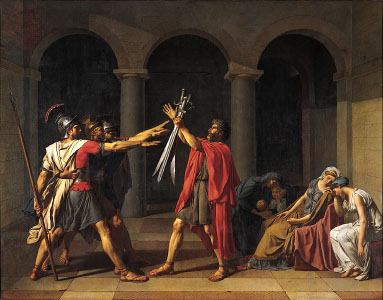
<span class="mt-enclosure mt-enclosure-image" style="display: inline;"><img alt="Oath_of_the_Horatii.jpg" src="http://www.artsjournal.com/bookdaddy/Oath_of_the_Horatii.jpg" class="mt-image-left" style="margin: 0pt 20px 20px 0pt; float: left;" height="300" width="383" /></span><p>But this standard of 'accessible, conventional realism' holds true only
for a portion of art history and only for a portion of the art works
created during that period. I defy anyone -- without some specialized
study -- to decipher the many minor Greek deities and nymphs, the
obscure saints and historical references, the Christian allegories and
Old Testament figures that swarm through Western art up through
19th-century neo-classicism. Set aside something as involved and
crowded with figures as, say, Michelangelo's <i>Last Judgment</i> or the torrents of mythology and royalty in Rubens' works. Let's take a simpler-seeming work. Who were the <a href="http://en.wikipedia.org/wiki/Horatii" mce_href="http://en.wikipedia.org/wiki/Horatii" target="_blank"><b>Horatii </b></a>in Jacques-Louis David's <i>Oath of the Horatii</i>? Did  you know before you ever saw the painting? Yet we need to know who they are in order to understand this dramatic moment.</p>

<p>For centuries, artists served a narrow, highly educated audience.
The idea that a painting should be immediately appreciated by all of us
middle-class sorts only developed after there was an audience made up
of all of us middle-class sorts willing to buy it. Dr. Smith does back
off from the overtly polemical bent of Wolfe's attack against the lefty
thinking embedded in some modern art. Dr. Smith notes that, to a
degree, <i>all </i>art is "aristocratic." It is created by people with
unique talents and a unique vision that may not be embraced by the
mainstream. He might have added that this is often because the art work
in question presents a critique of the mainstream. This doesn't mean
that appalling the majority of ordinary people is a sign of great art,
only an occasional consequence of <i>some </i>great art.</p>

<p>Our feeling alienated by art is not a facetious point but neither is
it a recent phenomenon. Popular support for the Bonfire of the Vanities
-- the 1497 burning of hundreds of artworks and luxury items that was
ordered by the Dominican friar Savonarola -- was partly motivated by
ignorance, by the widespread suspicion that all of these paintings and
sculptures of gods and goddesses were not celebrations of classical
antiquity but simply pagan immorality. Dozens of masterpieces by
artists like Sandro Botticelli were burned because the Italian
Renaissance was an aristocratic affair; thousands of ordinary,
untutored Italians didn't appreciate neo-Platonic theory.</p><p><b><a href="http://www.kera.org/artandseek/content/wp-content/uploads/2009/05/bernierredmoney3.jpg" mce_href="http://www.kera.org/artandseek/content/wp-content/uploads/2009/05/bernierredmoney3.jpg"><img class="alignleft size-full wp-image-4101" title="bernierredmoney3" src="http://www.kera.org/artandseek/content/wp-content/uploads/2009/05/bernierredmoney3.jpg" mce_src="http://www.kera.org/artandseek/content/wp-content/uploads/2009/05/bernierredmoney3.jpg" alt="bernierredmoney3" height="292" width="418" /></a></b></p><b>Roland Bernier, <a href="http://denverarts.org/exhibits/roland_bernier_at_walker_fine_art.html" mce_href="http://denverarts.org/exhibits/roland_bernier_at_walker_fine_art.html" target="_blank"><i>Red Money #3</i></a></b><br /><br /><p>So today, many artworks bewilder or challenge us. I would argue that
this has often been the case. Even so, for several decades now, there
have been various art movements pushing for simplicity or a lack of
irony or a lack of in-your-face transgression, movements extolling a
return to 19th century realism in novels, melodicism in classical music
and the figurative in painting and sculpture. They've been around long
enough already that in some instances, they're cliches. <a href="http://www.amazon.com/Invisible-Dragon-Four-Essays-Beauty/dp/0963726404" mce_href="http://www.amazon.com/Invisible-Dragon-Four-Essays-Beauty/dp/0963726404" target="_blank"><b>Noted art critic Dave Hickey once stated</b></a>
that beauty "remains a potent instrument for change in this
civilization." Simply as an agency of visual pleasure and not of
education or spiritual improvement, beauty, he said, would return as a
central concern for art. Hickey made this now-famous declaration <i>16 years ago.</i></p>

<p>Dr. Smith's point would be that there's nothing wrong with art that
is challenging or bewildering until we ask a democratic government to
justify funding all that challenging, bewildering art. In any
prolonged, public argument over restricting the content of funded art
(which is what the '90s culture war essentially was), artists and arts
supporters will lose. There are far more people bothered or bewildered
by their work (or uncaring of it) than there are admirers of it. Even
with mass media and mass education -- some might say<i> because</i> of them -- the audience for challenging, difficult art work is still, relatively speaking, small.</p>

<p>What's more, Dr. Smith insists, such wars over artistic content run
against the original purpose of the NEA -- which was, in effect, to
unify and uplift us through art, not bedevil or anger us. Yes, uplifting the viewer is a
constricting and old-fashioned notion of art's purpose. Julian Barnes
in <b><a href="http://www.amazon.com/Flauberts-Parrot-Julian-Barnes/dp/0679731369/ref=sr_1_1?ie=UTF8&amp;s=books&amp;qid=1243981255&amp;sr=1-1" mce_href="http://www.amazon.com/Flauberts-Parrot-Julian-Barnes/dp/0679731369/ref=sr_1_1?ie=UTF8&amp;s=books&amp;qid=1243981255&amp;sr=1-1" target="_blank"><i>Flaubert's Parrot</i></a> </b>notes
that all of this talk of "uplift" in art makes it sound like a
brassiere. But as Barnes also notes, "brassiere" is the French word for
"life jacket." These days, art may not don something as highfalutin' as
the mantle of truth, but it still may save us.</p>

<p>Actually, when one considers Dr. Smith's account of the origins of the NEA, it's plain that
the endowment was established not with a single goal but with all sorts of conflicting ideals in
mind. Even so, he's right. Insofar as convincing Congress that arts
patronage is worth the trouble, 'uplift and unify" are the sales
pitches that work. (That, and making sure, as many government agencies
do, to spread the grants around to key Congressional districts.)</p>


<p>In all this, I think Dr. Smith -- as do many others --
understandably pines for the old middlebrow consensus. The term
middlebrow is not a pejorative here. From the '20s to the '70s, there
was a widespread belief that highbrow arts like classical music and
serious literature were good for us ("uplift and unify"). These same
arts could also be made palatable for the great many of us who
typically didn't follow them. And these same arts could even find a
welcome spot in the mass media.</p>

<p>What resulted has often been called a "golden age" for
classical music, live theater and other arts -- considering their
relatively prominent presence in American culture and the American
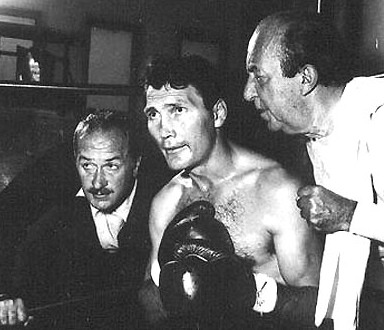
home. The mid-'50s to mid-'60s was the heyday of the <a href="http://www.answers.com/topic/book-of-the-month-club" mce_href="http://www.answers.com/topic/book-of-the-month-club" target="_blank"><b>Book-of-the-Month Club</b></a>, Leonard Bernstein's <a href="http://en.wikipedia.org/wiki/Young_People%27s_Concerts" mce_href="http://en.wikipedia.org/wiki/Young_People%27s_Concerts" target="_blank"><b>Young People's Concerts</b></a> on CBS, <i>Playhouse 90 </i>and <i>Actors Studio</i> presenting <a href="http://www.museum.tv/archives/etv/G/htmlG/goldenage/goldenage.htm" mce_href="http://www.museum.tv/archives/etv/G/htmlG/goldenage/goldenage.htm" target="_blank"><b>TV dramas written by Paddy Chayefsky, Horton Foote, Gore Vidal and Rod Serling </b></a>(that's his <i>Requiem for a Heavyweight</i>, pictured below) This was the era when Salvador Dali appeared on TV's<i> What's My Line?, </i>when Van Cliburn became a national hero for winning the Tchaikovsky Piano Competition in Moscow.</p><img alt="Requiempalance.jpg" src="http://www.artsjournal.com/bookdaddy/Requiempalance.jpg" class="mt-image-right" style="margin: 0pt 0pt 20px 20px; float: right;" height="234" width="272" /><p>But
all these cultural currents came together during the
mid-'50s-to-mid-'60s partly because of large-scale social forces --
like the Cold War, like the GI Bill. Millions of Americans went to
college for the first time, often as the first person in their family
to do so. They were exposed to these arts often for the first time --
or they were educated to appreciate them for the first time. To all of
these college-educated Americans, we must add their immigrant parents
-- with their faith in education -- and we get a middle-class that was
eager to shed any Babbitt-ish self-image (or ghetto-ish 'foreigner'
image), a middle class that believed deeply in education not just to
get ahead but in the <i>idea</i> of the educated, cultured person as a
worthy role to aspire to. What's more, those immigrant parents still
held dear many of the traditional European arts: the symphony, the
stage drama, the large-scale novel of earnest, social concern. They
conveyed their beliefs in the arts as enlightening, as social
betterments, to their children.</p>

<p>Whether all of this was naive or culturally narrow-minded is not the point. Bring all of these currents together and we have what may have been a
unique cultural moment, a moment that led directly to the establishment
of the NEA. And it was the same precise moment that saw all hell break loose
in the arts, in politics, in popular culture -- eventually dooming that
"middlebrow consensus." Dr. Smith recognizes this, noting the irony
that the NEA was seeking to promote the arts as unifying and uplifting
just when they fragmented and shed any claim to universal truth or beauty.</p>

<p>But it wasn't simply those radical artists who brought this upon us
and themselves. Huge changes in the popular entertainment industry --
like the rise of rock 'n' roll, like the TV networks dumping all their
high-culture programming -- played a major role as well. As did
anti-war politics, as did civil rights, which saw middle-class,
middlebrow culture lose much of its authority. Then came the onslaught
of the electronic media, which only increased the fragmentation, first
cable television and then, of course, the thing you're looking at now.</p>

<p>All of this history is relevant to <i>Money for Art </i>because,
one, you can't put the genie back in the bottle. I don't think we'll
ever see a cultural figure like Van Cliburn again. Not just a popular
performer in classical music but a national hero. And I'm not sure
we'll ever see a cultural consensus again like the one that held sway
then -- however shakily, however propped up by Cold War competitions
and fears.</p>

<p>This history is also relevant because Dr. Smith concludes <i>Money for Art</i>
with something like an appeal for a revivified NEA, a call for a
back-to-basic-principles endowment, which he sees Dana Gioia as having
spearheaded in the last administration. But more than this, Dr. Smith essentially wants to
return to that 'unique cultural moment' in the '60s and this time,
wiser and older, we'll get the NEA's purpose right.</p>

<p>To earn federal tax money, Dr. Smith says, it's not unreasonable to
ask of our renewed&nbsp; endowment, "In what way is art good for a democratic
society?" Or more evocatively, he says, "<i>What do the arts provide that America needs?</i>"</p>

<p>And he answers:</p>

<blockquote><p>Exposure to great art keeps healthy individualism from
becoming isolation by reminding people who are exposed to it of their
common humanity. Such art provides a touchstone of familiarity -- and
therefore collegiality if not community -- in an increasingly displaced
society. Great art takes note of those things that are similar, not
different, in all people. Lesser forms of art, not to mention popular
culture, do not do this. Pop culture, so dominant, is ultimately
transient, relentlessly replacing today's art with tomorrow's, watering
down the whole concept of art in the process. The critic Mark Steyn has
noted that as popular culture crowds out other forms, "eventually you
dwindle down to a present-tense culture unable to refer to anything
beyond itself. Folk art and controversial art actually work in a
similar way, each exulting in its own isolation and reinforcing an
identity not of common humanity but only of a compartmentalized block
of it. Multiculturalism, so celebrated in contemporary America, is
guilty of this on a much larger scale. In seeking to celebrate
distinctions it works to calcify those distinctions into divisions. In
the face of this, exposure to great art, it would seem, is needed now
more than ever.</p></blockquote>

<p>I would like to see a revivified NEA, and I could see it defining
itself, to a degree, against popular culture, against the isolation
that modern culture may foster. What, after all, is "non-profit" all about
-- if not giving those arts a hearing that don't easily answer to
corporate culture's bottom line?</p>

<p>But I wouldn't want to see it happening on Dr. Smith's terms. For
starters, the notion that popular culture divides, while "great art"
unites will be news to many great artists -- from Goya to the Romantics
to JMW Turner to the Impressionists to the Symbolists to the
pre-Raphaelites to the pointillists to the Expressionists and so on.
Each of these groups, each of these artists, vigorously defined their
work <i>against </i>prevailing styles and ways of thought.
At first, they didn't unite anything -- except the group of people who
appreciated what these <i>controversial </i>artists were doing.</p>

<p><a href="http://www.kera.org/artandseek/content/wp-content/uploads/2009/06/thai-11.png" mce_href="http://www.kera.org/artandseek/content/wp-content/uploads/2009/06/thai-11.png"><img class="aligncenter size-full wp-image-4373" title="thai-11" src="http://www.kera.org/artandseek/content/wp-content/uploads/2009/06/thai-11.png" mce_src="http://www.kera.org/artandseek/content/wp-content/uploads/2009/06/thai-11.png" alt="thai-11" height="214" width="459" /></a></p>

<p><b><a href="http://weburbanist.com/2008/12/14/art-from-money/" mce_href="http://weburbanist.com/2008/12/14/art-from-money/" target="_blank">Rirkrit Tiravanija</a>,  <i>Untitled</i>, </b>ten dollar bill and ink, 2008</p>

<p>At the same time, the idea that popular culture divides and isolates
people will be news to, say, the 20 million fans of Celine Dion, who
form websites to share information and photos about her, create
Facebook identities to communicate their enthusiasm with like-minded
people, track her every warble through official calendars and sources.
Many artists in any field would <i>love</i> to have that kind of divided, distracted, isolated and alienated audience for their work.</p>

<p>This dismissal of<i> all</i> popular culture is extremely out of
touch with the realities of art and entertainment today -- and not only
for the many ways "high art" and "pop arts" permeate each other. How
shall we consider crossovers? How many CDs or downloads does a serious
classical musician like Yo-Yo Ma have to sell before he ceases to speak
to our "common humanity" and starts "watering down the whole concept of
art" by turning his artistry into another pop culture product (which, apparently, it wasn't beforehand)? It is not possible to be a fine
artist and a tremendously popular one? Then what are we to make of
Charles Dickens or John Singer Sargent? J. D. Salinger and Frank Gehry? I suspect Dr. Smith and Mr. Steyn have very faulty and narrow definitions of what constitutes "popular culture."<br /></p>

<p>Finally, these days, perhaps our
shabbiest, most compromised art form -- television -- has been producing such
programs as <i>The  Sopranos, The Wire, Deadwood, Generation Kill </i>and <i>Breaking Bad</i>.
These are masterworks of serialized dramas, some of the most profound
art works we have right now in any genre. I am hardly alone in seeing <i>The Wire</i> as our modern heir to those grand,
grim, urban novels of the 19th century. Creator David Simon marched
through one city institution after another (schools, real estate
development, elections, media) as they all became warped by the forces
of drugs and crime. This is precisely what Tom Wolfe -- oh, back to him --
believed the contemporary American novel must do in his infamous manifesto, <a href="http://www.lukeford.net/Images/photos3/tomwolfe.pdf" mce_href="http://www.lukeford.net/Images/photos3/tomwolfe.pdf" target="_blank"><b>"Stalking the Billion-Footed Beast":</b></a><b> </b>more reporting, richer, closer, denser examinations of our social institutions.  Laura Miller on <a href="http://www.salon.com/ent/tv/feature/2007/09/15/best_show/index1.html" mce_href="http://www.salon.com/ent/tv/feature/2007/09/15/best_show/index1.html" target="_blank"><b>Salon</b></a> has even compared<i> The Wire</i> to the <i>Iliad</i> for its "classic," tragic sense of people being trapped by fate. Not what we normally expect from "TV."<br /></p>

<p>In America, the former poet laureate Robert Pinsky has said, we
don't have a tradition of "hereditary curators," an aristocratic class
imposing its tastes. For better <i>and </i>worse, this has meant we've had to
improvise our culture, borrowing bits from Europe, Africa, Asia, the Middle East and Latin America -- then
revving them up with new technologies and shady old business practices.
As a result, our impurities, Pinsky declared, have been our glory:
jazz, blues, Hollywood films, Broadway musicals.</p>

<p>Among other things, I'm a theater critic. I love well-done classic
dramas. But ours is the country that invented the tap dance, bluegrass,
the banjo, the sitcom and the comic book. It seems <i>un-American</i>
that our notion of art that's worthy of funding by the federal
government must now be limited to recycled Shakespeare and whatever's
safe for children's classrooms.</p>
]]>
    </content>
</entry>

<entry>
    <title>Money for Art, Pt 1: Arts Funding in America</title>
    <link rel="alternate" type="text/html" href="http://www.artsjournal.com/bookdaddy/2009/05/money_for_art_pt_1_arts_fundin.html" />
    <id>tag:www.artsjournal.com,2009:/bookdaddy//18.20338</id>

    <published>2009-05-30T22:42:44Z</published>
    <updated>2009-06-21T14:59:56Z</updated>

    <summary>It&apos;s dead certain that our culture wars will rage again. David A. Smith, a senior lecturer in history at Baylor University, does not actually make that prediction in his book, Money for Art: The Tangled Web of Art and Politics...</summary>
    <author>
        <name>book/daddy</name>
        <uri>http://www.artsjournal.com/bookdaddy/</uri>
    </author>
    
        <category term="main" scheme="http://www.sixapart.com/ns/types#category" />
    
    <category term="andresserrano" label="Andres Serrano" scheme="http://www.sixapart.com/ns/types#tag" />
    <category term="artsfunding" label="arts funding" scheme="http://www.sixapart.com/ns/types#tag" />
    <category term="davidasmith" label="David A. Smith" scheme="http://www.sixapart.com/ns/types#tag" />
    <category term="moneyforart" label="Money for Art" scheme="http://www.sixapart.com/ns/types#tag" />
    <category term="nationalendowmentforthearts" label="National Endowment for the Arts" scheme="http://www.sixapart.com/ns/types#tag" />
    <category term="robertmapplethorpe" label="Robert Mapplethorpe" scheme="http://www.sixapart.com/ns/types#tag" />
    <category term="scandal" label="scandal" scheme="http://www.sixapart.com/ns/types#tag" />
    <category term="worksprogressadministration" label="Works Progress Administration" scheme="http://www.sixapart.com/ns/types#tag" />
    
    <content type="html" xml:lang="en-US" xml:base="http://www.artsjournal.com/bookdaddy/">
        <![CDATA[<p><a href="http://www.kera.org/artandseek/content/wp-content/uploads/2009/04/art_art_on_money_i_love_america_lg.jpg" mce_href="http://www.kera.org/artandseek/content/wp-content/uploads/2009/04/art_art_on_money_i_love_america_lg.jpg"><img class="size-full wp-image-3191 alignleft" title="art_art_on_money_i_love_america_lg" src="http://www.kera.org/artandseek/content/wp-content/uploads/2009/04/art_art_on_money_i_love_america_lg.jpg" mce_src="http://www.kera.org/artandseek/content/wp-content/uploads/2009/04/art_art_on_money_i_love_america_lg.jpg" alt="art_art_on_money_i_love_america_lg" height="387" width="435" /></a></p><p>It's dead certain that our culture wars will rage again.</p>
<p>David A. Smith, a senior lecturer in history at Baylor University, does not actually make that  prediction in his book,<a href="http://www.kera.org/artandseek/content/wp-content/uploads/2009/02/art_art_on_money_i_love_america_lg.jpg" mce_href="http://www.kera.org/artandseek/content/wp-content/uploads/2009/02/art_art_on_money_i_love_america_lg.jpg"> </a><a href="http://www.amazon.com/Money-Art-Politics-American-Democracy/dp/1566637686/ref=pd_bbs_sr_1?ie=UTF8&amp;s=books&amp;qid=1234365854&amp;sr=8-1" mce_href="http://www.amazon.com/Money-Art-Politics-American-Democracy/dp/1566637686/ref=pd_bbs_sr_1?ie=UTF8&amp;s=books&amp;qid=1234365854&amp;sr=8-1" target="_blank"><i><b>Money for Art: The Tangled Web of Art and Politics in American Democracy</b></i></a>.
But it's there. It's there because, according to Dr. Smith, the culture
wars have never really ceased fire. Federal support of the arts has
been the trigger for an argument, he believes, that has flared on and
off practically since the origins of the republic. Dr. Smith's book is
the first to study government arts funding in this light.</p>
<p>Of course, the tag "culture wars" was originally coined about the
loose but linked political firefights we've had the past two decades.
James Davison Hunter's 1991 book, <a href="http://www.amazon.com/Culture-Wars-Struggle-Define-America/dp/B001KG4F3Q/ref=sr_1_9?ie=UTF8&amp;s=books&amp;qid=1241928004&amp;sr=1-9" mce_href="http://www.amazon.com/Culture-Wars-Struggle-Define-America/dp/B001KG4F3Q/ref=sr_1_9?ie=UTF8&amp;s=books&amp;qid=1241928004&amp;sr=1-9" target="_blank"><i><b>Culture Wars: The Struggle to Define America,</b></i></a>
popularized the term. Dr. Hunter saw Americans as divided into two
polarized moral understandings, the "orthodox" and the "progressive,"
and he tried to make some historical sense of what has been a tangle of
social, political and religious differences, involving creationism,
stem-cell research, gay marriage, abortion -- and federal funding of
the arts.</p>
<p>Specifically, the confrontation over arts funding was launched in
the late '80s by Republicans in Congress. Senator Alphonse D'Amato,
Senator Jesse Helms, Representatives William Dannemayer and Dick Armey
became incensed over government-funded artworks they deemed offensive.
Or to turn that sequence of events around: The National Endowment for
the Arts provoked a public outcry when it began underwriting artworks
that these members of Congress felt went too far. The works, they
charged, exceeded limits of community taste on matters of sexuality and
faith, they explicitly advocated hostility toward Christianity and a
"homosexual agenda" -- and they did all this with tax money.<br /></p><span class="mt-enclosure mt-enclosure-image" style="display: inline;"><img alt="David A Smith Baylor.jpg" src="http://www.artsjournal.com/bookdaddy/David%20A%20Smith%20Baylor.jpg" class="mt-image-left" style="margin: 0pt 20px 20px 0pt; float: left;" height="163" width="126" /></span>
<p>But
while other people might see the history of arts funding as marked by
just these kinds of distinct, historically-bound outcries over decency
or budgets, Dr. Smith sees them connected in a long, knotted thread.
This thread stretches from 1817 -- when Congress paid to have <a href="http://www.aoc.gov/cc/photo-gallery/ptgs_rotunda.cfm" mce_href="http://www.aoc.gov/cc/photo-gallery/ptgs_rotunda.cfm" target="_blank"><b>the first patriotic oil paintings</b></a>
installed in the Capitol Rotunda -- all the way to the just-finished
tenure of Dana Gioia as director of the National Endowment for the Arts.</p>
<p>Dr. Smith offers a welcome and clear-headed analysis. He lends
coherence to the history of arts support in America -- as a clash of
underlying principles about the nature of democracies and government
arts funding.</p>
<p>It's just what's<i> lacking</i> from<i> Money for Art</i> that's so dismaying.</p>]]>
        <![CDATA[<p>For Dr. Smith, our long conflict over federal arts funding has never
fully concluded because bankrolling culture in a democracy rests
uneasily on two unresolved issues: how the arts are funded and why they
are.</p>
<p>First: Who decides which artworks will be backed? The NEA spends our
tax money, so we citizens have a say. But if we want to fund <i>greatness</i> in art, greatness is hardly settled by a popular vote. Conveniently for us,<i> American Idol</i> demonstrates this week after week.</p>
<p>On the other hand, letting "experts" decide which are the deserving
artworks can lead us back to the culture wars of the '90s when elected
officials were outraged by what our experts had chosen. As Dr. Smith
puts it, arts funding in a democracy struggles to balance an "elitism
of creation" with "an egalitarianism of access." It's a combination
that he understandably finds "elusive" -- because both sides, taxpayers
and artists, are armed with legitimate arguments.</p>
<p>The fact is that the public already chooses which artworks we want
to bankroll -- with our wallets. This system is called popular culture,
and whether the entertainment industry's products are good, bad or
indifferent, it does create and distribute everything from books to
songs to films. So if that's <i>direct</i> support (at the cash register), why do we need <i>indir</i><i>ect</i> support (through federal funding)?</p>
<p><a href="http://www.kera.org/artandseek/content/wp-content/uploads/2009/02/jsg-boggs-money.jpg" mce_href="http://www.kera.org/artandseek/content/wp-content/uploads/2009/02/jsg-boggs-money.jpg"><img class="alignleft size-full wp-image-1176" title="jsg-boggs-money" src="http://www.kera.org/artandseek/content/wp-content/uploads/2009/02/jsg-boggs-money.jpg" mce_src="http://www.kera.org/artandseek/content/wp-content/uploads/2009/02/jsg-boggs-money.jpg" alt="" height="380" width="435" /></a></p>
<p><a href="http://www.kera.org/artandseek/content/wp-content/uploads/2009/02/jsg-boggs-money.jpg" mce_href="http://www.kera.org/artandseek/content/wp-content/uploads/2009/02/jsg-boggs-money.jpg"><br />
</a></p>
<p><b>JSG Boggs,</b> <b><a href="http://www.pennylicious.com/2006/08/22/jsg-boggs-art-money/" mce_href="http://www.pennylicious.com/2006/08/22/jsg-boggs-art-money/" target="_blank"><i>Funny money</i>,</a> </b>paper and ink, no date.</p>
<p>Which is the second, more basic conundrum: In a democracy, what's
the purpose for government patronage of the arts? Do taxpayers support
the arts because we see them as a testament to our values? Do we wish
to promote these around the world? Do we pay artists for their work as
a kind of economic assistance program? Do we honor and reward our
'masters' of the arts -- because they express, expand and reflect us in
ways that commercial culture often doesn't? Do we believe that the arts
are beneficial for all?</p>
<p>That doesn't even exhaust the possible goals: Arts funding could simply be aimed at expanding or equalizing our access<i> </i>to
those art forms -- live theater, dance, art museums, classical concerts
-- that are too local, too small-scale or too costly. For those
Americans who don't live near major cultural centers, our federal
dollars can help with "distributing" these arts. It can help fund
national tours, extend museum hours, encourage community efforts,
subsidize arts education.</p>
<p>Faced with such a long shopping list, one may ask,"Why choose? Why
can't the NEA try to meet all these needs?" But of course, the NEA has
never had the budget to fulfill even half of these goals. As Dr. Smith
demonstrates, in trying to meet them, the NEA has found itself yanked
by ideological forces and competing constituencies until it has been
effectively re-shaped and re-defined.</p>
<p><img src="http://www.kera.org/artandseek/content/wp-includes/js/tinymce/plugins/wordpress/img/trans.gif" mce_src="http://www.kera.org/artandseek/content/wp-includes/js/tinymce/plugins/wordpress/img/trans.gif" alt="" class="mceWPmore mceItemNoResize" title="More..." />The
endowment was established in a burst of early '60s idealism and
optimism, driven partly by the desire to create American masterpieces
by underwriting major American artists and institutions. This desire
was whetted by the sense that our culture was finally coming into its
own. Our popular entertainments at the time may have been widely
derided as shallow or crass (formulaic TV westerns, disposable pop
music, campy Broadway musicals). But these were counterweighted by
growing admiration for our new, supposedly more "serious"
accomplishments: jazz, abstract expressionism, modern dance, dramas by
Arthur Miller and Tennessee Williams, music by such composers as Aaron
Copland and Milton Babbitt as well as the Nobel Prize-winning novels of
Ernest Hemingway and William Faulkner.</p>
<p>Indeed, the expressed wish at the time of its establishment was that
the endowment might one day find and fund "the American Shakespeare."
And to this day, the NEA's slogan remains "A great nation deserves
great art."</p>
<p><a href="http://www.kera.org/artandseek/content/wp-content/uploads/2009/05/money-is-the-root-of-all-art.jpg" mce_href="http://www.kera.org/artandseek/content/wp-content/uploads/2009/05/money-is-the-root-of-all-art.jpg"><img class="size-full wp-image-3783 alignleft" title="money-is-the-root-of-all-art" src="http://www.kera.org/artandseek/content/wp-content/uploads/2009/05/money-is-the-root-of-all-art.jpg" mce_src="http://www.kera.org/artandseek/content/wp-content/uploads/2009/05/money-is-the-root-of-all-art.jpg" alt="money-is-the-root-of-all-art" height="301" width="452" /></a></p>
<p><a href="http://www.kera.org/artandseek/content/wp-content/uploads/2009/05/money-is-the-root-of-all-art.jpg" mce_href="http://www.kera.org/artandseek/content/wp-content/uploads/2009/05/money-is-the-root-of-all-art.jpg"><br />
</a></p>
<p style="text-align: center;" mce_style="text-align: center;"><b> </b></p>
<p><b>Ron English, <a href="http://www.graffiti.org/ron_english/agitpopa.html" mce_href="http://www.graffiti.org/ron_english/agitpopa.html" target="_blank"><i>Money is the Root of All Art, </i></a></b>1994</p>
<p>But in the Reagan-Bush '80s, when the NEA came under fire from
fiscal conservatives, and in the Bush and Clinton '90s, when it faced
the wrath of social conservatives, the agency barely survived. It did
so chiefly by emphasizing the goals of education and expanded access.
The NEA shifted its purpose to bringing art (more traditional, more
widely acceptable art) to Americans, especially schoolchildren. It had
been doing this all along, but it redoubled those efforts, and it
reformed its indirect grant procedures. These were too hot, too risky
in the new political climate because of the uproars over <a href="http://en.wikipedia.org/wiki/Robert_Mapplethorpe" mce_href="http://en.wikipedia.org/wiki/Robert_Mapplethorpe" target="_blank"><b>Robert Mapplethorpe's homoerotic photography</b></a> and <a href="http://en.wikipedia.org/wiki/Andres_Serrano" mce_href="http://en.wikipedia.org/wiki/Andres_Serrano" target="_blank"><b>Andres Serrano's urine-soaked crucifix</b></a>. These artists had not actually received <i>direct</i> NEA grants, but that hardly mattered in the fracas that was ignited over their works.</p>
<p>In those uproars in the '90s, Dr. Smith argues -- convincingly, I
believe -- that artists and arts advocates made a serious mistake in
logic, law and public relations by repeatedly proclaiming that their
First Amendment rights against censorship had been violated. An artist
has the right to express himself as he pleases; he hardly has the right
to have that expression automatically funded by the government.</p>
<p>On this point,<a href="http://en.wikipedia.org/wiki/NEA_Four" mce_href="http://en.wikipedia.org/wiki/NEA_Four" target="_blank"><b> the NEA Four</b></a>
-- the performance artists whose projects were vetoed by NEA head John
Frohnmayer in 1990 -- were a different matter precisely because<i> </i>they
had a free speech claim. Their projects had won approval before being
vetoed; they won their court case. But they lost the war. It was the
NEA Four's court case that led an infuriated Congress to kill all
individual grants. And although the case was resolved in the NEA Four's
favor, the Supreme Court also said that the NEA could, in fact, insist
on 'decency standards.'</p>
<p>So this is what the NEA does today: With its very modest budget, it
increases public access to the arts, it researches and documents our
declining literacy rate and in its "<a href="http://www.shakespeareinamericancommunities.org/" mce_href="http://www.shakespeareinamericancommunities.org/" target="_blank"><b>Shakespeare in American Communities</b></a>" program, it  promotes tours of the original (<i>not</i>
the American) Shakespeare. It also insists on decency standards. The
goal of finding and developing new, "great art" by individuals is not
really on the agenda anymore, despite the slogan. As Roger Kimball put
it in the <a href="http://www.nationalreview.com/comment/kimball200401291138.asp" mce_href="http://www.nationalreview.com/comment/kimball200401291138.asp" target="_blank"><i><b>National Review</b></i></a>,
hailing the changes brought about by NEA head Dana Gioia: "Farewell
Mapplethorpe, Hello Shakespeare." To Kimball, this has represented a
victory of hallowed tradition over trendy, "Pomo" transgressions. For
Kimball, it seems, those were the only choices to fund.</p>
<p>Dr. Smith puts this development in a different context, asking, is
the NEA an "I" (created to serve the artist and her art) or is it a
"We" (created to serve the taxpayers and the wider community)? In the
'90s, Dr. Smith notes approvingly, that question was finally settled.
The NEA is a "We."</p>
<p>On the face of it, this is simple common sense. The National Highway
Traffic Safety Administration does not exist for the benefit of guard
rail manufacturers. It exists to improve our chances of surviving a
road trip. But Dr. Smith's polarization of the interests of "I" and
"We" is too easy. The Environmental Protection Agency exists to<i> protect and preserve </i>the environment<i> for the benefit of all Americans</i>.
Ergo, one can make the case that in many instances, helping the "I"
(the artist and her art) can actually serve the greater good of the
"We" (the rest of us).<a href="http://latimesblogs.latimes.com/culturemonster/2009/05/can-rocco-landesman-make-the-nea-relevant-again.html" mce_href="http://latimesblogs.latimes.com/culturemonster/2009/05/can-rocco-landesman-make-the-nea-relevant-again.html" target="_blank"><b><br />
</b></a></p>
<p>Critics and pundits have made a number of these same points before. But <i>Money for Art</i>
is the first book-length study that examines the long course of federal
cultural programs through the lens of these tensions, tensions inherent
in all democratic arts funding: Taxpayers pay, therefore taxpayers
should control. Yet taxpayers are not necessarily in a position to
judge great art. So the NEA is -- and has always been -- in the awkward
position of advocating "elitist" art for "democratic" purposes.</p>

<p>Along with this analysis,<i> Money for Art</i> offers a revisionist
history of the endowment. Dr. Smith clearly seeks to debunk popular
conceptions about presidential administrations and the arts. (Test your
knowledge with the <a href="http://www.kera.org/blogs/culture/2009/06/01/its-a-quiz-test-your-knowledge-of-arts-funding/" mce_href="http://www.kera.org/blogs/culture/2009/06/01/its-a-quiz-test-your-knowledge-of-arts-funding/" target="_blank"><b>Arts Funding Quiz</b></a> on the Art&amp;Seek blog.)<a href="http://www.kera.org/artandseek/content/wp-content/uploads/2009/02/imagedbcgi.jpg" mce_href="http://www.kera.org/artandseek/content/wp-content/uploads/2009/02/imagedbcgi.jpg"><br /></a></p>
<span class="mt-enclosure mt-enclosure-image" style="display: inline;"><img alt="Smith's book.jpg" src="http://www.artsjournal.com/bookdaddy/Smith%27s%20book.jpg" class="mt-image-right" style="margin: 0pt 0pt 20px 20px; float: right;" height="255" width="180" /></span><p>Briefly put: Ever since John Kennedy publicly feted renowned artists
at the White House, Democratic presidents have been greeted with the
expectation that they will usher in a new era of cultural achievement
-- despite evidence to the contrary. Jimmy Carter, for example, had
actually<i> cut </i>the arts budget in Georgia when he was governor. He was still (ultimately) the candidate of the arts establishment.</p>
<p>So it's ironic that Richard Nixon proved to be the endowment's best
friend in the White House. According to Dr. Smith, Nixon hoped the NEA
might counter prevailing cultural currents, which he saw as divisive
and anarchic. In this way, Nixon apparently saw the arts as a vital
cultural force and arts funding as a worthwhile government endeavor,
attitudes Dr. Smith would wish to foster.</p>
<p>In much of this, <i>Money for Art</i> is admirably sensible, trying
to wend its way between conservative and liberal, public and artist,
untangling the claims and counter-claims of each. What is maddening
about the book -- even startling -- are its huge oversights and its
blinkered views about the highly politicized nature of the arts funding
debate in America over the past 70 years.</p>
<p>Chief among the oversights is Dr. Smith's strangely cursory treatment of the arts programs of the <a href="http://en.wikipedia.org/wiki/Works_Progress_Administration" mce_href="http://en.wikipedia.org/wiki/Works_Progress_Administration" target="_blank"><b>Works Progress Administration</b></a>
under Franklin Roosevelt. The Federal Theatre Project, the Music
Project, the Art Project and the Writers' Project were essentially the
NEA's predecessors, yet the primary reason Dr. Smith discusses the WPA
at all is to uncover the source of what he sees as a common
misconception -- the idea that, even today, federal arts funding is a
jobs program. The WPA, he argues convincingly enough, was designed as a
temporary, Depression-era, emergency measure and not a new alignment of
the government with the artist.</p>
<p>What the author fails to recognize is that the fierce partisan
conflicts in the late '30s over the WPA sketched out the battle lines
for the full-bore culture wars of the '80s and '90s.</p>
<p>First, Republicans -- and a sizable number of conservative Southern
Democrats -- vehemently opposed the WPA not simply because it was part
of Roosevelt's economic recovery program. They feared that with the
WPA, Roosevelt was underwriting a new liberal political machine. He was
buying votes with jobs. They also feared that the WPA's arts programs
were little more than a propaganda arm for FDR.</p>
<p>But in opposing the WPA and what it represented, Republicans and
conservative Democrats faced major difficulties -- ones that may sound
rather familiar today. They were tied to what had turned out to be
catastrophic economic policies. They'd been swept out of their
long-held control of Washington and they faced a president who was
personally very popular, who had a sizable mandate for change.</p>
<span class="mt-enclosure mt-enclosure-image" style="display: inline;"><img alt="books.jpg" src="http://www.artsjournal.com/bookdaddy/books.jpg" class="mt-image-left" style="margin: 0pt 20px 20px 0pt; float: left;" height="238" width="158" /></span><p>So
they picked up the only charges they had that gained public attention
and undercut the authority of the Roosevelt administration: government
waste and Communist subversion. And to varying degrees, the WPA was
vulnerable on both charges. I won't go over the protracted in-fighting,
but two histories worth reading, two books with very different
perspectives on this period, are Ted Morgan's<a href="http://www.amazon.com/Reds-McCarthyism-Twentieth-Century-Ted-Morgan/dp/081297302X/ref=sr_1_3?ie=UTF8&amp;s=books&amp;qid=1239651590&amp;sr=1-3" mce_href="http://www.amazon.com/Reds-McCarthyism-Twentieth-Century-Ted-Morgan/dp/081297302X/ref=sr_1_3?ie=UTF8&amp;s=books&amp;qid=1239651590&amp;sr=1-3" target="_blank"><i><b> Reds: McCarthyism in 20th-Century America</b></i></a>, a survey of our government's pursuit of  Communist infiltration, and Nick Taylor's<a href="http://www.amazon.com/American-Made-Enduring-Legacy-When-Nation/dp/0553381326/ref=sr_1_1?ie=UTF8&amp;s=books&amp;qid=1239651697&amp;sr=1-1" mce_href="http://www.amazon.com/American-Made-Enduring-Legacy-When-Nation/dp/0553381326/ref=sr_1_1?ie=UTF8&amp;s=books&amp;qid=1239651697&amp;sr=1-1" target="_blank"><i><b> American Made: The Enduring Legacy of the WPA -- When FDR Put the Nation to Work</b></i></a>.<a href="http://www.amazon.com/American-Made-Enduring-Legacy-When-Nation/dp/0553381326/ref=sr_1_1?ie=UTF8&amp;s=books&amp;qid=1239651697&amp;sr=1-1" mce_href="http://www.amazon.com/American-Made-Enduring-Legacy-When-Nation/dp/0553381326/ref=sr_1_1?ie=UTF8&amp;s=books&amp;qid=1239651697&amp;sr=1-1" target="_blank"><i><b><br />
</b></i></a></p>
<p>Two points need to be made about the WPA battle, however. One, the
attack on federal arts programs had little to do with the arts or with
arts funding. The WPA could have been producing Art Deco-style widgets. The arts --
provided they could be portrayed as wasteful or dangerously
Communist-controlled -- were mostly just a club to use against the New
Deal.</p>
<p>And two, the club was more or less successful. The WPA wasn't
completely disbanded until 1943 when wartime employment rendered it
unnecessary. But before then, Republicans and their Democratic allies
did manage to stall, even derail, the federal arts programs and they
damaged the WPA's effectiveness, blunting some of the administration's
power and authority.</p>
<p>It's certainly true that many people opposed the WPA and its arts
programs out of honest economic and political disagreement. Amity
Shales, author of <a href="http://www.amazon.com/Forgotten-Man-History-Great-Depression/dp/0060936428/ref=sr_1_1?ie=UTF8&amp;s=books&amp;qid=1242338481&amp;sr=1-1" mce_href="http://www.amazon.com/Forgotten-Man-History-Great-Depression/dp/0060936428/ref=sr_1_1?ie=UTF8&amp;s=books&amp;qid=1242338481&amp;sr=1-1" target="_blank"><i><b>The Forgotten Man: A New History of the Great Depression</b></i></a>, argues that <a href="http://www.pbs.org/newshour/video/module.html?mod=0&amp;pkg=newshourart&amp;seg=1" mce_href="http://www.pbs.org/newshour/video/module.html?mod=0&amp;pkg=newshourart&amp;seg=1" target="_blank"><b>the arts are not really the province of government</b> </a>and that what the New Deal accomplished through the WPA could have been done through private sources.</p>
<p>Still, regardless of the economic principles at stake, opposition to the
New Deal at the time devolved into an ugly Congressional investigation led by Texas
Representative Martin Dies' House Un-American Activities Committee. The
committee turned most of its attention on the WPA, calling witnesses to
testify against the agency, especially its arts programs. These charged
the Federal Theater Project with, among other things, whites and blacks
fraternizing under its auspices "like Communists" (certain to rile
Southern segregationists). Then there was the committee's grilling of
FTP leader Hallie Flanagan about a playwright she'd cited in an
article. "Is he a Communist?" a committee member demanded.</p>
<p>"Put it in the record," Flanagan replied patiently, "that
Christopher Marlowe was the greatest dramatist in the period ...
immediately preceding Shakespeare."</p>
<p>Eventually, the HUAC report to Congress denounced "a rather large
number of the employees of the Federal Theatre Project" as either
outright Communist party members or CP sympathizers, although it had
never actually established this. (See Taylor, pp. 409-426.) Congress
was furious at the FTP. It was tired, as well, of finding that on the
Federal Arts Project's many frescoes, artists had painted images of
factory hands holding copies of<i> The Masses</i>. For the 1940
appropriations bill, Congress pointedly "zeroed out" the Federal
Theatre Project. It gave the other arts programs directly over to the
states for sponsorship (where they often languished) and among other
changes, enacted a "loyalty oath" that all WPA employees had to sign. Shades of the "decency" standards NEA grant recipients must agree to now. <br /></p>
<p>In other words, using the WPA's cultural programs against the New
Deal was effective. It inflamed opposition to Roosevelt, created a
counterweight to the administration's promotional efforts at job
creation, sullied New Deal programs as both wasteful and
Communist-influenced. In the end, these efforts inflicted budget cuts
and political losses on the administration. Harry Hopkins, FDR's most powerful and polarizing aide, resigned from running the WPA to become Secretary of Commerce -- a post he also resigned. He'd once been considered FDR's handpicked successor.<br /></p>

<p>These weapons proved effective enough to be picked up and used again
-- a decade later. In the '50s, President Dwight Eisenhower was often
portrayed as culturally clueless in a culturally vapid time. Dr. Smith
devotes much of an engaging and persuasive chapter ("Paint by Numbers")
to rehabilitating Eisenhower's reputation on such matters. Eisenhower,
for instance, was the first president to see the efficacy of "culture
as a weapon" in the Cold War, making the United States appear as a
country worth respecting, even emulating, for something more than our
materialism or military might.</p>
<span class="mt-enclosure mt-enclosure-image" style="display: inline;"><img alt="copland.jpg" src="http://www.artsjournal.com/bookdaddy/copland.jpg" class="mt-image-center" style="margin: 0pt auto 20px; text-align: center; display: block;" height="259" width="450" /></span>Yet Dr. Smith never mentions that for Eisenhower's inauguration, Aaron Copland's <i>Lincoln Portrait</i>
was originally scheduled for a concert. A single, Republican
congressman, Fred Busbey of Illinois, complained that Copland was a
contributor to left-wing (i.e., Communist front) causes. Not wishing to
alienate the conservative bloc that already was deeply suspicious of
him, Eisenhower immediately dropped Copland's music from the program.<br /><br />
<p>This public embarrassment became a public nightmare when Senator
Joseph McCarthy picked up the scent of media attention and subpoenaed
Copland to appear before his investigatory subcommittee. Because some
of McCarthy's Red-bashing was tied to the FBI's "queer-hunting,"
Copland had several reasons to be terrified that his career as one of
America's rare, beloved classical composers was over.<b><br />
</b></p>
<p>The results were more pointless than usual for the subcommittee:
Copland later wrote that he believed McCarthy wasn't even certain who
he was or why he was being questioned. In the end, the composer managed
to appear politically naive before the senators, who saw no threat in
him. Yet Copland still lost paying gigs on political grounds and was
apparently deemed a "security suspect." (See Alex Ross, <a href="http://www.amazon.com/Rest-Noise-Listening-Twentieth-Century/dp/0312427719/ref=sr_1_1?ie=UTF8&amp;s=books&amp;qid=1240333584&amp;sr=1-1" mce_href="http://www.amazon.com/Rest-Noise-Listening-Twentieth-Century/dp/0312427719/ref=sr_1_1?ie=UTF8&amp;s=books&amp;qid=1240333584&amp;sr=1-1" target="_blank"><i><b>The Rest is Noise</b></i></a>, pp. 412-414).</p>
<p>More tellingly, around the same time that Copland faced the Senate
subcommittee, McCarthy called for dismantling the overseas libraries
that the Voice of America ran in Europe. The libraries were an example
of Cold War federal arts patronage: They spread American ideas and
literature abroad. But McCarthy objected to their stocking such
"anti-American" authors as Langston Hughes. During the course of
deliberations with the Eisenhower administration on the issue, McCarthy
aide Roy Cohn suggested that the government shouldn't stop with banning
books. The libraries should ban music as well.</p>
<p>And why not start with Aaron Copland's? (See <i>Reds</i>, pp. 446-447).</p>
<p>Just how instrumental Copland's "Appalachian Spring" might be in
recruiting listeners to Marxist economic theory is difficult to
imagine. But then, that wasn't the concern of the investigations. The
point was to use government powers and public hysteria to punish,
tarnish or intimidate political enemies, including prominent artists.</p>
<p style="text-align: center;" mce_style="text-align: center;"><b> </b></p>
<p><b><a href="http://www.kera.org/artandseek/content/wp-content/uploads/2009/03/445404241.jpg" mce_href="http://www.kera.org/artandseek/content/wp-content/uploads/2009/03/445404241.jpg"><img class="size-full wp-image-1320 alignleft" title="445404241" src="http://www.kera.org/artandseek/content/wp-content/uploads/2009/03/445404241.jpg" mce_src="http://www.kera.org/artandseek/content/wp-content/uploads/2009/03/445404241.jpg" alt="445404241" height="228" width="451" /></a> </b></p>
<p><b>Robert Dowd, <a href="http://www.kcrw.com/etc/programs/at/at090210in_gold_we_trust" mce_href="http://www.kcrw.com/etc/programs/at/at090210in_gold_we_trust" target="_blank"><i>Van Gogh Dollar</i></a></b><a href="http://www.kcrw.com/etc/programs/at/at090210in_gold_we_trust" mce_href="http://www.kcrw.com/etc/programs/at/at090210in_gold_we_trust" target="_blank">, </a> acrylic on canvas, 1965</p>
<p>It could be argued that much of this -- especially the Communist-hunting -- isn't really part of Dr. Smith's purview in <i>Money for Art</i>.
But insofar as the book concerns the relationship between our
government and the artists it funds -- as well as taxpayers' attitudes
towards the arts -- this history is obviously pertinent. The attacks on
the WPA via its arts programs and the McCarthy investigations into
individual artists were deeply anti-intellectual and fearful of the
arts as somehow subversive, elitist, fraudulent (not "real" art),
"provocative" (politically, racially and sexually), dangerously
anti-American and a waste of public money. These suspicions remain
motivating impulses in the arts funding debates today -- even more
evidence, it would seem, for Dr. Smith's contention that the culture
wars existed well before the '90s.</p>
<p>In 1960, it was in light of all this political demonizing -- and in
light of the more infamous case of the Hollywood Ten -- that we can
understand what it meant to artists and the arts establishment when
John Kennedy invited Leonard Bernstein to participate in his
presidential inauguration. Bernstein was an even more publicly
left-wing figure than Copland. He'd been blacklisted by CBS and the
State Department from 1950-'54. It was a sign that McCarthy-ite attacks
on the arts were over -- at least for now.</p>
<p>And then, when Pablo Casals was hosted at the White House, the Kennedys invited Copland, too.</p>

<p>I've lingered over all this political history from the '30s to the
'60s because Dr. Smith devotes entire chapters to the arts policies of
Eisenhower and Kennedy. And he <i>does </i>touch upon the Casals-Copland-Bernstein visits to the Kennedy White House.</p>
<p>Other than that, virtually nothing else I've included here is discussed in <i>Money for Art</i>.</p>
<p>The important conclusion to draw from this history is this: Being
used as a weapon or a whipping boy has been a political function that
the arts have repeatedly been dragged into well before the '90s. Of
course, sometimes artists weren't dragged at all; they joined the fray
willingly, eager to stick a thumb in the eye of the bourgeoisie, and
then demand federal payment for the service. Dr. Smith quotes any
number of artists over the years making inflammatory or confrontational
tirades -- often being their own worst enemies when it came to courting
Congressional or public approval.</p>
<p>Yet such statements only made it easier for politicians to pick up
the weapon that was already there and had been proven effective --
using the arts as a flash point to inflame anger and suspicion against
their political opposition, to punish that opposition. The fact is that
tarring the arts (and arts supporters)<i> </i>has repeatedly worked as
a political attack strategy, especially when artists, arts
organizations and the NEA are used as stand-ins for a supposedly
decadent, educated, effete establishment, whether that's in Hollywood,
New York or Washington, D.C.</p>
<p>So alongside Dr. Smith's contesting democratic principles, I would
place partisan warfare as an explanation for why the arts have been a
persistent but intermittent<a href="http://en.wikipedia.org/wiki/Casus_belli" mce_href="http://en.wikipedia.org/wiki/Casus_belli" target="_blank"><i><b> casus belli</b></i></a>
since the New Deal. When it comes to arts funding, the culture wars
have been a war by proxy, a war fought by liberals and conservatives
for public approval, moral standing, government power and money, a war
fought<i> </i>through the arts and not necessarily because of the arts.</p><p><i>(originally published at <b><a href="http://www.kera.org/artandseek/content/2009/06/01/money-for-art-pt-1-arts-funding-in-america-pt-1/">Artandseek.org.)</a></b></i><br /></p>
<p><b>The conclusion in <a href="http://www.artsjournal.com/bookdaddy/2009/06/money_for_art_pt_2_replaying_t.html">Money for Art, Pt. 2:</a> Re-Playing the '50s and the '90s</b></p>]]>
    </content>
</entry>

<entry>
    <title>Reasons to be cheerful, Part 7</title>
    <link rel="alternate" type="text/html" href="http://www.artsjournal.com/bookdaddy/2009/05/reasons_to_be_cheerful_part_7.html" />
    <id>tag:www.artsjournal.com,2009:/bookdaddy//18.20063</id>

    <published>2009-05-16T15:40:12Z</published>
    <updated>2010-06-15T18:52:18Z</updated>

    <summary> Although Seven Pleasures: Essays on Ordinary Happiness is getting shelved in the &quot;self-help&quot; sections -- and more power to that label if it means the book will sell better than the usual essay collection -- Willard Spiegelman&apos;s new volume...</summary>
    <author>
        <name>book/daddy</name>
        <uri>http://www.artsjournal.com/bookdaddy/</uri>
    </author>
    
        <category term="main" scheme="http://www.sixapart.com/ns/types#category" />
    
    <category term="essaycollection" label="essay collection" scheme="http://www.sixapart.com/ns/types#tag" />
    <category term="essays" label="essays" scheme="http://www.sixapart.com/ns/types#tag" />
    <category term="happiness" label="happiness" scheme="http://www.sixapart.com/ns/types#tag" />
    <category term="sevenpleasures" label="Seven Pleasures" scheme="http://www.sixapart.com/ns/types#tag" />
    <category term="willardspiegelman" label="Willard Spiegelman" scheme="http://www.sixapart.com/ns/types#tag" />
    
    <content type="html" xml:lang="en-US" xml:base="http://www.artsjournal.com/bookdaddy/">
        <![CDATA[
<span class="mt-enclosure mt-enclosure-image" style="display: inline;"><img alt="36800247.JPG" src="http://www.artsjournal.com/bookdaddy/36800247.JPG" class="mt-image-left" style="margin: 0pt 20px 20px 0pt; float: left;" width="134" height="201" /></span><p>Although <strong><a href="http://www.amazon.com/Seven-Pleasures-Essays-Ordinary-Happiness/dp/0374239304/ref=sr_1_1?ie=UTF8&amp;s=books&amp;qid=1242419699&amp;sr=1-1" target="_blank"><strong><em>Seven Pleasures: Essays on Ordinary Happiness</em></strong></a></strong> is getting shelved in the "self-help" sections -- and more power to that label if it means the book<em></em>
will sell better than the usual essay collection -- Willard Spiegelman's new volume is
actually a set of reflections on a set of quotidian activities:
reading, walking, looking, dancing, listening, swimming and writing.
His pieces are&nbsp; classic essays in the humanist tradition that goes back
to <b><a href="http://plato.stanford.edu/entries/montaigne/" target="_blank"><strong>Montaigne</strong></a></b>.
They're part personal memoir, part guide, part explanation, part
appreciation, part conveyor of insight, whether it be practical, moral,
political or philosophical. The essays are all very much in the voice of this Southern Methodist University literature professor and longtime editor of <strong><a href="http://smu.edu/southwestreview/" target="_blank"><strong><em>Southwest Review</em>:</strong></a></strong> elegantly phrased yet seemingly casual, bemused
yet thoughtful. And, of course, literate and learned but not in an
off-putting manner. Think of it as a likable donnishness. It's that
voice, that ruminative process of thinking that is one of the book's
enjoyments. It succeeds so well in leading a reader along.</p>
<p>In his introduction, Spiegelman explains that he comes from cheerful
stock. His outlook on life, as most of ours have, has been shaped by
his genes. As he says in our televised conversation (which you can see at <a href="http://www.kera.org/artandseek/content/2009/05/18/artseek-on-think-tv-what-keeps-willard-spiegelman-cheerful/"><b>Art&amp;Seek</b></a>), he
could do without these activities, these pleasures, and still be
cheerful. This is one of the rare places in <em>Seven Pleasures</em>
that I parted company with the likable don.</p><!-- AddThis Button BEGIN -->
 ]]>
        <![CDATA[<p> I think for many of us our
pleasures are salvations. They're redemptive, rehabilitative. They can
make our miserable lives tolerable. For a time, they take us out of
ourselves, which is the original meaning of the Greek, <em>ekstasis</em>
-- to transport, displace, put into a trance. The brief forgetfulness
caused by the seductions of art, by the concentration required to
complete a task well -- it can be a source of pleasure. As the harried
director says in the stage comedy,<em> Noises Off!</em> (written by the philosopher and journalist, Michael Frayn): "I come to the theater to be taken out of myself. And <em>preferably not put back in</em>."</p>
<p>As he goes on, Spiegelman occasionally does become transported. A <em>little</em>,
anyway, he's a thoroughly rational and grounded individual, but one of
his pleasures, after all, is writing, writing what we're reading, so
inevitably his own pleasure comes through. The simple act of looking,
he declares, can be life saving. "Swimming keeps me happy," it lifts
him into "a higher spiritual realm." And as he points out in his essay
on writing (although the point pops up elsewhere), when done well, when
done with a relaxed awareness, these activities can be meditative, illuminating. They
become akin to a secular version of the <a href="http://www.nwjesuits.org/JesuitSpirituality/SpiritualExercises.html" target="_blank"><strong>Spiritual Exercises of St. Ignatius Loyola</strong></a> (a contemporary of Montaigne, interestingly enough).</p>
<p>OK, so even<em> I</em> think that last claim got a little carried
away. Let's just call these enjoyable essays 'Zen-like, gem-like
contemplations of the everyday.'&nbsp; They can lead you to a degree of
self-awareness.</p>
Whether <em>that</em> makes you happy is up to you and your bad self.]]>
    </content>
</entry>

<entry>
    <title>Horton Foote: An Appreciation</title>
    <link rel="alternate" type="text/html" href="http://www.artsjournal.com/bookdaddy/2009/03/horton_foote_an_appreciation.html" />
    <id>tag:www.artsjournal.com,2009:/bookdaddy//18.18809</id>

    <published>2009-03-06T03:17:45Z</published>
    <updated>2010-06-14T15:24:54Z</updated>

    <summary>Obituaries described Horton Foote, who died Wednesday, as a great storyteller, a writer of ordinary Americans. To me, these sound just a little condescending. For them, Foote is not a great dramatist on par with an Albee or Mamet. He&apos;s...</summary>
    <author>
        <name>book/daddy</name>
        <uri>http://www.artsjournal.com/bookdaddy/</uri>
    </author>
    
        <category term="main" scheme="http://www.sixapart.com/ns/types#category" />
    
    
    <content type="html" xml:lang="en-US" xml:base="http://www.artsjournal.com/bookdaddy/">
        <![CDATA[<span class="mt-enclosure mt-enclosure-image" style="display: inline;"><img alt="H_stream.jpg" src="http://www.artsjournal.com/bookdaddy/H_stream.jpg" class="mt-image-right" style="margin: 0pt 0pt 20px 20px; float: right;" width="236" height="350" /></span><p>Obituaries described Horton Foote, who died Wednesday, as a great
storyteller, a writer of ordinary Americans. To me, these sound just a
little condescending. For them, Foote is not a great dramatist on par with an Albee or Mamet. He's a
great <em>storyteller</em> - as if he were some folksy character on a front porch just spinning yarns about his kin.</p>
<p>It's easy to get this impression. I confess I held it at first. Foote never went to college (although he and his wife did end up running a school in Washington, D.C.) Some of Foote's earliest works - like <em><strong><a href="http://www.imdb.com/title/tt0274991/" target="_blank">The Trip to Bountiful</a> </strong></em>-
were written for television, and they remain some of his most popular.
They're also his most sentimental. The characters here express what
they feel and act on those feelings. End of story. The small town settings, the countryfied language, the homey
qualities: Nothing much will surprise you.</p>
<p>The <i>New York Times</i> obituary claimed, unsurprisingly, that the <i>Times'</i> theater critic Frank Rich was partly responsible for rediscovering and reviving Foote's career. Actually, for anyone who was paying attention, the change was apparent with the 1983 film, <a href="http://www.imdb.com/title/tt0086423/" target="_blank"><em><strong>Tender Mercies,</strong></em></a> in which Robert Duvall plays a washed-up, drunken country singer. And won an Oscar.<br /></p><br /><div><br /></div>]]>
        <![CDATA[<p>In <em>Tender Mercies</em> - and in plays from the same period - Foote's characters often <em>don't know </em>what they want. Or can't express it. So how the plot works out sometimes doesn't reflect what they're telling us. <br /></p>

<p>It's why Foote's later plays can take unexpected turns. And it's why
they suggest these great depths of dammed up, unexpressed feelings. (Mac Sledge, the Duvall character, can sing a plaintive song, but most of the rest of his dialogue comes in two- or three-word sentences.) Foote's mother and father died in 1974-'75 -- his father died in the same room in the same house where Foote's brothers were born. And the loss seemed to open him up as a writer. Soon afterwards, he started writing a
cycle of nine plays called <a href="http://www.amazon.com/Roots-Parched-Ground-Convicts-Claire/dp/080213081X/ref=sr_1_8?ie=UTF8&amp;s=books&amp;qid=1236289544&amp;sr=1-8" target="_blank"><strong><em>Orphans' Home</em></strong></a>.
His writing here is extremely pared away, yet he gives his hometown of Wharton,
outside of Houston, the full Faulkner treatment. He chronicles the
place from convict laborers to local aristocrats in all its complex social and moral interactions.</p>

<p>What I'm saying is that Foote was a much more sophisticated
writer than he's often given credit for. Orphans' Home: Even the title
seems quaint. But it's actually taken from <a href="http://utgift.freehostia.com/Distrust.pl" target="_blank"><strong>a poem by Marianne Moore</strong></a>, and it describes all of our sorry lives on this planet ("The world's an orphans' home"). One of the cycle's plays is called <i>Roots in a Parched Ground.</i> That's a line from William Carlos Williams.<br />
</p>

<p>Whenever I met Foote, he was always the courtly, friendly gentleman
the obituaries describe. But he was also a tougher, more determined
character than that. He won the Pultizer Prize in 1995 - and he hadn't
had a play on Broadway for more than 40 years. And he wouldn't have a full-out Broadway success until this past year. When he died in
Hartford on Wednesday, Foote was working on a stage production for this fall. He was
adapting <em>Orphans' Home</em>. He was 92 and he'd started writing it 35 years ago.</p>

<p>Whenever I met him, Foote was dressed the same way, even standing out in the heat of a Houston street. Navy-blue,
double-breasted blazer, grey slacks, velvet slippers. Simple, dapper
but comfortable. Foote was the son of a haberdasher, so he knew what he
was doing.</p>

<p>And once he found it, he stuck with it.</p><p><br /></p><p><i>You can hear an audio version of this post or watch a video interview of Foote <a href="http://www.kera.org/artandseek/content/2009/03/05/remembering-horton-foote-videoaudio-appreciation/">at my day job.</a></i><br /></p>
]]>
    </content>
</entry>

<entry>
    <title>Review: Germania by Brendan McNally</title>
    <link rel="alternate" type="text/html" href="http://www.artsjournal.com/bookdaddy/2009/02/what_is_it_with_north.html" />
    <id>tag:www.artsjournal.com,2009:/bookdaddy//18.18472</id>

    <published>2009-02-11T16:52:01Z</published>
    <updated>2009-02-11T17:26:57Z</updated>

    <summary> What is it with North Texas novelists making their debuts with really oddball thrillers? Four years ago, Will Clarke appeared with Lord Vishnu&apos;s Love Handles. The novel combines terrorism, Dallas social satire and a Hindu apocalypse. It doesn&apos;t always...</summary>
    <author>
        <name>book/daddy</name>
        <uri>http://www.artsjournal.com/bookdaddy/</uri>
    </author>
    
        <category term="main" scheme="http://www.sixapart.com/ns/types#category" />
    
    
    <content type="html" xml:lang="en-US" xml:base="http://www.artsjournal.com/bookdaddy/">
        <![CDATA[<p>
<span class="mt-enclosure mt-enclosure-image" style="DISPLAY: inline"><img class="mt-image-left" style="FLOAT: left; MARGIN: 0px 20px 20px 0px; WIDTH: 267px; HEIGHT: 361px" height="347" alt="small Germania.jpg" src="http://www.artsjournal.com/bookdaddy/small%20Germania.jpg" width="253" /></span>What is it with North Texas novelists making their debuts with really oddball thrillers?</p>
<p>Four years ago, Will Clarke appeared with<a href="http://www.amazon.com/Lord-Vishnus-Love-Handles-Novel/dp/0743271483/ref=sr_1_1?ie=UTF8&amp;s=books&amp;qid=1234304824&amp;sr=1-1" target="_blank"><em><strong> </strong>Lord Vishnu's Love Handles.</em></a> The novel combines terrorism, Dallas social satire and a Hindu apocalypse. It doesn't always work, but <em>Lord Vishnu</em> surely ranks as one of the stranger, more amusing entertainments by a local writer.</p>
<p>Now comes Brendan McNally (below) with his first novel, <a href="http://www.amazon.com/Germania-Novel-Brendan-McNally/dp/1416558829/ref=sr_1_1?ie=UTF8&amp;s=books&amp;qid=1234304867&amp;sr=1-1" target="_blank"><em>Germania.</em></a> Germania was Adolf Hitler's name for his future world capital in Berlin. It's a terrifically ironic title because McNally's novel is about a German reich very few have ever heard of. Most histories of Nazi Germany end with the complete flameout of the final days in Berlin. They rarely handle what happened next.</p>
<p>A caretaker government was formed in a town called Flensburg. Its basic purpose was to hold on long enough to surrender to somebody. Instead of Hitler's Thousand-Year Reich, Flensburg was the three-week Reich.<a href="http://www.kera.org/artandseek/content/wp-content/uploads/2009/02/brendan-mcnally.jpg"></a></p>
<p>So far, so fascinating.</p>
<p>Writers such as <a href="http://www.amazon.com/s/ref=nb_ss_b?url=search-alias%3Dstripbooks&amp;field-keywords=alan+furst&amp;x=0&amp;y=0" target="_blank">Alan Furst</a> and <a href="http://www.amazon.com/Berlin-Noir-Violets-Criminal-Requiem/dp/0140231706/ref=sr_1_2?ie=UTF8&amp;s=books&amp;qid=1234304944&amp;sr=1-2" target="_blank">Philip Kerr</a> have uncovered these kinds of nuggets to craft superb thrillers about World War II. McNally is a former defense journalist, so the military history is a natural for him.</p><br />
<div><br /></div>]]>
        <![CDATA[<p><br /></p>
<p>Flensburg also provides a remarkable cast of desperate, real-life characters. Several scrambled to escape arrest for their war crimes. But simultaneously -- even bizarrely -- they also hoped to be proclaimed supreme leader of post-war Europe. One of these would-be leaders was <a href="http://en.wikipedia.org/wiki/Albert_Speer" target="_blank">Albert Speer</a>, Hitler's architect and armaments expert. Another was <a href="http://en.wikipedia.org/wiki/Heinrich_Himmler" target="_blank">Heinrich Himmler.</a></p>
<p>That's right. The head of the SS actually believed the Allies wanted him to run Europe. Of course, Himmler was also daffy enough to use his <a href="http://en.wikipedia.org/wiki/Felix_Kersten" target="_blank">massage therapist</a> to try to arrange a peace treaty with Sweden.</p>
<p>All of this is completely true. But as dangerous and farcical as the Flensburg period was, McNally chooses to tell the story by inventing a vaudeville troupe of comic juggler-singer-gymnasts.</p>
<p>The Flying Magical Loerber Brothers. Before the war, they were beloved entertainers. But they're secretly Jewish. And they disappoint their fans by mysteriously disappearing. It's only in these last weeks as Germany falls into chaos that the four Loerbers pop back up in very different roles.</p>
<p>This is author Brendan McNally reading an excerpt from Germania:<a href="http://www.kera.org/artandseek/content/wp-content/uploads/2009/02/brendan-mcnally.jpg"></a></p>
<p>
<span class="mt-enclosure mt-enclosure-image" style="DISPLAY: inline"><img class="mt-image-right" style="FLOAT: right; MARGIN: 0px 0px 20px 20px; WIDTH: 132px; HEIGHT: 127px" height="120" alt="Brendan McNally.jpg" src="http://www.artsjournal.com/bookdaddy/Brendan%20McNally.jpg" width="123" /></span>MCNALLY: "Speer tried to remember what he could about the Flying Magical Loerber Brothers. Like everyone else, he'd seen them perform many times. Still, Speer had been largely bewildered by the Loerber brothers mania. He remembered all the photo and variety magazine covers. Some trademarked picture of their four identical faces arranged like a crescent moon. Which one is your favorite, it always asked. Which to Speer didn't make any sense because they were all indistinguishable from each other. It was like having a favorite corner of a square building."</p>
<p>The Loerber brothers are a quirky, sometimes jarring device for telling the Flensburg story. But they do lead to some marvelous, fictional moments - like when one Loerber teaches Albert Speer how to juggle.</p>
<p>It's when McNally throws in psychic powers that things get out of hand. And get unnecessary. As I said, the Flensburg story is woolly enough as it is. No need for <em>Germania </em>to fall off the trapeze and land in the world of Marvel Comics.</p>
<p>But I confess that <em>Germania</em> - like Will Clarke's <em>Lord Vishnu </em>- can hold your interest.The tonal shifts are distracting, but the books are highly readable. I read them to the end wondering -- what's coming next?</p>
<p>Both Will Clarke and Brendan McNally wrote these thrillers while hanging out in local Starbucks. So perhaps there's something in the coffee they serve around here.</p>
<p>&nbsp;</p>
<p><em>An audio version of this review can be found with the review on <a href="http://www.kera.org/artandseek/content/2009/02/11/book-review-germania-by-brendan-mcnally/">Artandseek.org</a></em></p>]]>
    </content>
</entry>

<entry>
    <title>Review: The Big Rich by Bryan Burrough</title>
    <link rel="alternate" type="text/html" href="http://www.artsjournal.com/bookdaddy/2009/02/review_the_big_rich_by_bryan_b.html" />
    <id>tag:www.artsjournal.com,2009:/bookdaddy//18.18347</id>

    <published>2009-02-03T15:02:02Z</published>
    <updated>2009-02-03T16:00:58Z</updated>

    <summary>To give some notion of just how big the Spindletop oil field near Beaumont, Texas, originally was: When it was tapped in 1901, that single gusher tripled American&apos;s entire production of oil overnight. According to author Bryan Burrough, Spindletop and...</summary>
    <author>
        <name>book/daddy</name>
        <uri>http://www.artsjournal.com/bookdaddy/</uri>
    </author>
    
    
    <content type="html" xml:lang="en-US" xml:base="http://www.artsjournal.com/bookdaddy/">
        <![CDATA[<span class="mt-enclosure mt-enclosure-image" style="display: inline;"><img alt="Big_Web_BackPage.jpg" src="http://www.artsjournal.com/bookdaddy/Big_Web_BackPage.jpg" class="mt-image-left" style="margin: 0pt 10px 10px 0pt; float: left;" width="290" height="465" /></span>To give some notion of just how big the Spindletop oil
field near Beaumont, Texas, originally was: When it was tapped in 1901,
that single gusher <em>tripled</em> American's entire production of oil overnight.
<p class="MsoNormal">According to author Bryan Burrough, Spindletop and
what followed began one of the largest accumulations of private wealth
in history.</p>
<p class="MsoNormal">Burrough grew up in Temple, Texas. And pretty much
anyone who has been raised in Texas knows about Spindletop. So when his
New York editor suggested a book on Texas oil money, Burrough writes
that it took him all of 30 seconds to outline his next work. It's a
lively, epic new history, <a href="http://www.amazon.com/Big-Rich-Greatest-Texas-Fortunes/dp/1594201994/ref=sr_1_1?ie=UTF8&amp;s=books&amp;qid=1233366917&amp;sr=1-1" target="_blank"><strong><em>The Big Rich: The Rise and Fall of the Greatest Texas Oil Fortunes.</em></strong></a></p>
<p class="MsoNormal"><a href="http://www.amazon.com/Big-Rich-Greatest-Texas-Fortunes/dp/1594201994/ref=sr_1_1?ie=UTF8&amp;s=books&amp;qid=1233366917&amp;sr=1-1" target="_blank"><strong><em> </em></strong></a></p>
<p class="MsoNormal">Burrough is best known as the co-author of <a href="http://www.amazon.com/Barbarians-Gate-Fall-RJR-Nabisco/dp/0061655546/ref=sr_1_2?ie=UTF8&amp;s=books&amp;qid=1233366971&amp;sr=1-2" target="_blank"><strong><em>Barbarians at the Gates</em>,</strong></a> his chronicle of the botched, multi-billion-dollar buyout of RJR Nabisco. He also wrote <a href="http://www.amazon.com/Public-Enemies-Americas-Greatest-1933-34/dp/0143035371/ref=sr_1_3?ie=UTF8&amp;s=books&amp;qid=1233366971&amp;sr=1-3" target="_blank"><strong><em>Public Enemies</em></strong></a>,
a slam-bang history of&nbsp; the bank-robbing wave of the 1920s and how J.
Edgar Hoover used it to boost the FBI. Together, those two volumes
required Burrough to research ruthless businessmen, Washington
politics, swaggering egos and hard-scrabble criminals.</p>
<p class="MsoNormal"><em>Excellent</em> preparation for writing about Texas oil.</p>
<p class="MsoNormal">Texas oil, Burrough says, pretty much created our
modern world. Texas oil was so cheap that steamships and railroads
switched from coal to diesel. Cheap oil made the auto industry possible
-- and everything else that followed: freeways, suburbia, jet travel.
Swimming pools, movie stars. The whole wonderful, plentiful,
carbon-burning, ozone-depleting spree that has been modern life.</p><p class="MsoNormal"><br /></p> ]]>
        <![CDATA[<p class="MsoNormal">Burrough concentrates on the Big Four families of
oil: the Cullens in Houston, the combined Richardson and Bass families
in Fort Worth and the Hunts and Murchisons from Dallas. Plenty of books
have been written about these people before. Indeed, many of the
stories of excess are probably familiar to Texans: how hard-living
Houston wildcatter Glenn McCarthy became the inspiration for the James
Dean character in the movie <em>Giant, </em>how Clint Murchison, Jr.,
brought the Cowboys to Dallas, how H. L. Hunt maintained not one, not
two, but three different families and how his son Nelson tried to
corner the silver market for his own strange reasons and just about
wrecked his inheritance.</p>
<p>But Burrough is very good at finding new links between these stories,
putting them into larger contexts. He's also good at digging through
old court records and presidential papers. He wants to provide a more
nuanced, longer-timespan portrait of these men than the usual "rampant vulgarians" that's been popular --
although what he writes is still plenty dark.<br /></p>
<p>Texas oil helped shape our modern world. Texas oil <em>money,</em>
Burrough argues, helped shape modern American politics, especially the
part about briefcases full of cash being delivered in the dead of
night. Texas oil didn't start that particular game, but it took it to
the Super Bowl. The contributions ballooned. As early as 1952, the
biggest single donor in the presidential election was Texas oilman Roy
Cullen.</p>
<p class="MsoNormal">And his money -- unlike that of many Texans then --
went to the Republican Party. According to Burrough, Texas oil money
helped bankroll the modern conservative movement -- and, one might add, helped swing Texas and much of the country into the Republican electoral roster for much of the past 30 years. William F. Buckley,
to give a single example, inspired conservatives with his magazine, <em>National Review</em>.
Despite his air of being born at Yale, Buckley was the son of a Texas
oil millionaire (that didn't help him get any money out of Hunt,
though).<a href="http://www.kera.org/artandseek/content/wp-content/uploads/2009/01/bio_burrough1.jpg"><img class="alignright size-full wp-image-1114" style="margin: 6px; float: right;" title="bio_burrough1" src="http://www.kera.org/artandseek/content/wp-content/uploads/2009/01/bio_burrough1.jpg" alt="" width="207" height="269" /></a></p>
<p class="MsoNormal">Many of the Texas oilmen were diehard anti-Semites
and old-school Southern segregationists. And when they bolted the
Democratic party, first for the Dixiecrats and then for the
Republicans, they brought their angry, combative politics with them.
Texas oil millionaires helped make Joseph McCarthy and his Red-baiting
fury a national force. They fought civil rlghts legislation that would
have made lynching a federal crime.&nbsp; H. L. Hunt syndicated a radio
program across the country in which, when not pitching his diet
products, he argued that rich people who pay more taxes should have
more votes. Burrough even sees some of the oil men's early media
efforts as attempts to create something along the lines of what would
follow much later: FOX News.</p>
<p class="MsoNormal">And over time, even as they preached their ideas
of small government and free markets, Texas oil men used their backroom
influence to stifle competition and snag tremendous federal benefits
for themselves. Some, especially Murchison, didn't really seem to care
which party was in power, as long as the politicians delivered what he
needed.</p>
<p class="MsoNormal">Burrrough (right) argues that all this is why --
when John F. Kennedy was assassinated -- many Americans were already
prepared to think the worst of Dallas.</p>
<p>But<em>The Big Rich</em> is hardly a political indictment. It's a
multi-generational, multi-family saga that traces the transformation of
these fortunes. It's a transformation from nouveau riche wildness to
establishment power (or decline) that Burrough is actually wistful
about. And it's a long enough transformation that it causes his book to
skip and drag towards the end.</p>
<p>Simply put, vulgar, hard-drinking Texas oil millionaires ain't what
they used to be. The heirs of these first headstrong eccentrics,
conservative radicals and near-geniuses grew careless or carefree and
frittered away their fortunes. Or they became more corporate, their
politics turned more careful, more mainstream. And having helped shape
presidents from Johnson through Reagan, they finally gained the White
House with some of their own: the Bushes.</p>
<p class="MsoNormal">in the end, Texas oil men gave our culture a new
icon to stand next to the cowboy: the rootin-tootin, high-livin' rich
guy from the Lone Star State. From <em>Giant</em> to J. R. Ewing, it was always a cartoon, a condescending one, as Burrough notes.</p>
<p class="MsoNormal">
</p><p>But once upon a time, it seemed an innocent, fun-loving cartoon.</p><p><i>Once again, this review can be found at <a href="http://www.kera.org/artandseek/content/2009/02/02/review-the-big-rich-by-bryan-burrough/">Artandseek.org,</a> complete with the audio version and a radio interview with Bryan Burrough.</i><br /></p>]]>
    </content>
</entry>

<entry>
    <title>New book on Texas blues: Just in time for the return of President Bush</title>
    <link rel="alternate" type="text/html" href="http://www.artsjournal.com/bookdaddy/2009/01/new_book_on_texas_blues_--_jus.html" />
    <id>tag:www.artsjournal.com,2009:/bookdaddy//18.18119</id>

    <published>2009-01-16T01:47:30Z</published>
    <updated>2009-01-16T01:53:01Z</updated>

    <summary>&quot;I&apos;ve got the Dallas blues and the Main Street heart disease.&quot; This is &quot;Dallas Blues&quot; sung by Maggie Jones, the &quot;Texas Nightingale&quot; who was born in Hillsboro, Texas. It&apos;s a minor song, but it&apos;s worth taking a look at for...</summary>
    <author>
        <name>book/daddy</name>
        <uri>http://www.artsjournal.com/bookdaddy/</uri>
    </author>
    
    
    <content type="html" xml:lang="en-US" xml:base="http://www.artsjournal.com/bookdaddy/">
        <![CDATA[<p>"I've got the Dallas blues and the Main Street heart disease." This is "Dallas Blues" sung by <a href="http://www.document-records.com/fulldetails.asp?ProdID=DOCD-5349" mce_href="http://www.document-records.com/fulldetails.asp?ProdID=DOCD-5349" target="_blank">Maggie Jones</a>, the "Texas Nightingale" who was born in Hillsboro, Texas.</p>
<p class="MsoNormal">It's a minor song, but it's worth taking a look at for two reasons. First, Alan Govenar in his new book<b>,</b> <a href="http://www.amazon.com/Texas-Blues-Contemporary-Sound-Dickson/dp/158544605X/ref=sr_1_1?ie=UTF8&amp;s=books&amp;qid=1231348248&amp;sr=1-1" mce_href="http://www.amazon.com/Texas-Blues-Contemporary-Sound-Dickson/dp/158544605X/ref=sr_1_1?ie=UTF8&amp;s=books&amp;qid=1231348248&amp;sr=1-1" target="_blank"><i>Texas Blues</i></a>, notes
that "Dallas Blues" first appeared as sheet music in 1912, long before
Maggie Jones recorded it.&nbsp; In fact, it even appeared several months<i> before</i>
W. C. Handy's "Memphis Blues." Many people still cite "Memphis Blues"
as the first blues in print. It was a landmark moment because sheet
music was the chief way songs were popularized then, and Handy, "the
Father of the Blues," did much to give the music a nationwide listening
audience.</p>
<p class="MsoNormal"><a href="http://www.kera.org/artandseek/content/wp-content/uploads/2009/01/small-dallas-blues.jpg" mce_href="http://www.kera.org/artandseek/content/wp-content/uploads/2009/01/small-dallas-blues.jpg"><img class="alignright size-full wp-image-1013" style="margin: 6px; float: right;" mce_style="margin: 6px; float: right;" title="small-dallas-blues" src="http://www.kera.org/artandseek/content/wp-content/uploads/2009/01/small-dallas-blues.jpg" mce_src="http://www.kera.org/artandseek/content/wp-content/uploads/2009/01/small-dallas-blues.jpg" alt="" width="236" height="326" /></a>But&nbsp;
it was "Dallas Blues" that first saw print. And that small fact
highlights a major point made by Govenar: Texas can lay claim to being
one of the birthplaces of the blues -- just like the Mississippi Delta.</p>
<p class="MsoNormal">It's not a contest over who came first. It's a
question of what's been studied, what's gotten more attention. When
Govenar came to Texas in 1974 as a graduate student in folklore, there
was no single history devoted to&nbsp; Texas blues. <span> </span></p>
<p class="MsoNormal">By 1985, Govenar wrote<b> </b><a href="http://www.docarts.com/books/living_texas_blues.html" mce_href="http://www.docarts.com/books/living_texas_blues.html" target="_blank">one of the first</a>.
Since then, he's produced three more - along with documentary films,
videos, oral histories, a children's book and a musical. His
organization, <a href="http://www.docarts.com/about/index.html" mce_href="http://www.docarts.com/about/index.html" target="_blank">Documentary Arts,</a><a href="http://www.docarts.com/about/index.html" mce_href="http://www.docarts.com/about/index.html" target="_blank"> </a>is dedicated to preserving and presenting historically and culturally significant artworks.</p>
<p class="MsoNormal">Govenar's new book, <i>Texas Blues</i>, is a
comprehensive compilation of his 25 years of research. It features more
than one hundred profiles of Texas artists - most often in their own
words -- with more than 500 photos.</p>
<p class="MsoNormal">GOVENAR: "I was surprised that there was so little
written about Texas blues. So much of what had been written up to that
time - and still today - is the Mississippi Delta sound, the Chicago
blues sound. Certainly it was the music that was championed by the
Rolling Stones and other British rock and rollers."</p><br />]]>
        <![CDATA[<p class="MsoNormal">It was the British blues-rock invasion of the '60s
that shone a huge, popular (meaning: mostly white) light on Delta
blues. For his part, Govenar traces his own interest in
African-American music to when he was four years old in Boston. His
father brought home four records -- two of which included the greatest
hits of 1956 and performances by Sarah Vaughan and Charlie Parker</p>
<p class="MsoNormal"><b><a href="http://www.kera.org/artandseek/content/wp-content/uploads/2009/01/alan-small1.jpg" mce_href="http://www.kera.org/artandseek/content/wp-content/uploads/2009/01/alan-small1.jpg"><img class="alignleft size-full wp-image-986" style="margin: 6px; float: left;" mce_style="margin: 6px; float: left;" title="alan-small1" src="http://www.kera.org/artandseek/content/wp-content/uploads/2009/01/alan-small1.jpg" mce_src="http://www.kera.org/artandseek/content/wp-content/uploads/2009/01/alan-small1.jpg" alt="" width="305" height="199" /></a></b>GOVENAR:
"Between those two records, black music became my first music. I
listened to them over and over again. I don't think I got another
record until I was 13."</p>
<p class="MsoNormal">Now, let's go back to "Dallas Blues." The second
reason that recording is noteworthy, at least historically, is that
Maggie Jones' version came out in the mid-1920s. It was part of an
explosion of blues music from Texas artists -- recorded in Texas, New
York or Chicago. And that explosion was triggered by a single performer
-- from Dallas, by way of Wortham, Texas.&nbsp;<span> </span></p>
<p class="MsoNormal">GOVENAR: "The patriarch of Texas blues is<a href="http://www.tshaonline.org/handbook/online/articles/JJ/fje1.html" mce_href="http://www.tshaonline.org/handbook/online/articles/JJ/fje1.html"><b> </b>Blind Lemon Jefferson.</a>
Blind Lemon was the first male blues guitar player to attain national
success. His music during that period of the mid-1920s was immensely
popular."</p>
<p class="MsoNormal">And record executives wanted to repeat his
success, which is why, for a few years, Dallas-Fort Worth became a
national hub for blues music. (Not surprisingly, the famous last songs
of Robert Johnson were recorded here -- in a building on Park Avenue in
downtown Dallas <a href="http://blogs.dallasobserver.com/unfairpark/2009/01/blues_for_508_park_ave_owners.php" mce_href="http://blogs.dallasobserver.com/unfairpark/2009/01/blues_for_508_park_ave_owners.php" target="_blank">that, not surprisingly, may soon be demolished.</a>)<b> </b>In the 600 pages of <i>Texas Blues,</i>
Fort Worth and Dallas&nbsp; account for 118 pages together, almost one-fifth
the entire book. Dallas alone has more pages than any other city.&nbsp; Even
so, the book doesn't encompass the entire land rush of recordings that
Blind Lemon Jefferson set off:<b> </b><a href="http://www.document-records.com/" mce_href="http://www.document-records.com/" target="_blank">Document Records</a>,
based in Vienna, is trying to release all the music that was pressed
then, and so far has unearthed and produced work by some 95 Texas
artists -- in blues and jazz and other styles.</p>
<p class="MsoNormal">All of those Texas-based recordings in the late
'20s included not just minor artists like Maggie Jones. They included
the first record of Aaron "T-Bone" Walker -- when he was still going by
the name "Oak Cliff T-Bone."</p>
<p class="MsoNormal">["I Got the Blues" from T-Bone Walker]<a href="http://www.kera.org/artandseek/content/wp-content/uploads/2009/01/tbonewalkermainimage.jpg" mce_href="http://www.kera.org/artandseek/content/wp-content/uploads/2009/01/tbonewalkermainimage.jpg"><img class="alignright size-full wp-image-937" style="margin: 6px; float: right;" mce_style="margin: 6px; float: right;" title="tbonewalkermainimage" src="http://www.kera.org/artandseek/content/wp-content/uploads/2009/01/tbonewalkermainimage.jpg" mce_src="http://www.kera.org/artandseek/content/wp-content/uploads/2009/01/tbonewalkermainimage.jpg" alt="" width="244" height="244" /></a></p>
<p class="MsoNormal">Walker had known Blind Lemon in the '20s, when he
led the older musician around Deep Ellum. Later on, Walker's pioneering
use of the electric guitar would utterly change American music. That
means there's a direct link between a young man and a blind musician
playing for quarters on the streets of Dallas - and the rock 'n' roll
or rhythm and blues you've got on your iPod.</p>
<p class="MsoNormal">As a style, Govenar says that Texas blues is
lighter, more fluid, more eclectic than Delta blues. From the start, it
contained bits of country, gospel, jazz, Tejano and zydeco. That's why
in his book, Govenar includes such artists as Freddie Fender and
Clifton Chenier. It's also why he sub-titled it: <i>The Rise of a Contemporary Sound.</i></p>
<p class="MsoNormal">
</p><p class="MsoNormal">
</p><p class="MsoNormal">But in today's hip-hop world, blues doesn't seem 'contemporary' at all. Marginal is more like it. <span> </span></p>
<p class="MsoNormal">
</p><p class="MsoNormal">GOVENAR: "You're right, it's overshadowed. But simply put, blues is <i>embedded </i>in
American popular music. African-American music was not really played on
the radio until the end of the 1940s. [But] You look at popular music
today, and the most popular music is rooted in African-American sounds."</p>
<p class="MsoNormal">
</p><p class="MsoNormal">
</p><p class="MsoNormal">Govenar says the blues has retained its hold
all these years because it's not just about misery. The blues was
created by the first generation of African-Americans <i>after</i> slavery. So it <i>is</i> about slavery. But it's also about freedom. The freedom, at last, to express oneself. The freedom to move on down the road.</p>
<p class="MsoNormal">
</p><p class="MsoNormal">Lightnin' Hopkins - who was born in East Texas
and met Blind Lemon when he was only eight years old - Lightnin'
Hopkins would seem to agree.</p>
<p class="MsoNormal">["Good Times" by Lightnin' Hopkins: "Good times, yeah, but it's better down the road."</p>
<p class="MsoNormal"><br /></p><b>This entire entry was first published on <a href="http://www.kera.org/artandseek/content/2009/01/14/texas-blues-part-1-a-new-oral-history/">Artandseek.org.</a> Not only can you hear it there, you can hear excerpts from a great selection of Texas blues, including the songs mentioned here.<br /><br /></b>
<p class="MsoNormal"><b><a href="http://www.kera.org/artandseek/content/wp-content/uploads/2009/01/lighnin1.jpg" mce_href="http://www.kera.org/artandseek/content/wp-content/uploads/2009/01/lighnin1.jpg"><img class="alignleft size-full wp-image-936" title="lighnin1" src="http://www.kera.org/artandseek/content/wp-content/uploads/2009/01/lighnin1.jpg" mce_src="http://www.kera.org/artandseek/content/wp-content/uploads/2009/01/lighnin1.jpg" alt="" width="406" height="308" /></a></b></p>
<p class="MsoNormal">
</p><p class="MsoNormal"><b><b>Lightnin' Hopkins</b>, <b>named by <i>Rolling Stone</i> one of the 100 greatest guitarists </b></b></p>
<p class="MsoNormal"><i>Dallas Blues 1912 sheet music image, courtesy
of Don O. Image of Lightnin' Hopkins from geocities.com. Image of
T-Bone Walker from <a href="http://www.cherrylane.com/News/-%2108-03-10-Cherry-Lane-signs-administration-agreem.aspx" mce_href="http://www.cherrylane.com/News/-!08-03-10-Cherry-Lane-signs-administration-agreem.aspx" target="_blank">cherrylane.com</a></i></p>]]>
    </content>
</entry>

<entry>
    <title>Print arts coverage dwindling away . . . </title>
    <link rel="alternate" type="text/html" href="http://www.artsjournal.com/bookdaddy/2008/12/arts_coverage_going_down.html" />
    <id>tag:www.artsjournal.com,2008:/bookdaddy//18.16073</id>

    <published>2008-12-09T21:46:23Z</published>
    <updated>2008-12-10T15:31:31Z</updated>

    <summary> In the Dallas and Fort Worth daily newspapers, there will no longer be separate reviews of many cultural organizations and events. The two city papers, the Dallas Morning News and the Fort Worth Star-Telegram, have begun running the same...</summary>
    <author>
        <name>book/daddy</name>
        <uri>http://www.artsjournal.com/bookdaddy/</uri>
    </author>
    
        <category term="main" scheme="http://www.sixapart.com/ns/types#category" />
    
    <category term="artscoverage" label="arts coverage" scheme="http://www.sixapart.com/ns/types#tag" />
    <category term="culturalcoverage" label="cultural coverage" scheme="http://www.sixapart.com/ns/types#tag" />
    <category term="cutbacks" label="cutbacks" scheme="http://www.sixapart.com/ns/types#tag" />
    <category term="dallas" label="Dallas" scheme="http://www.sixapart.com/ns/types#tag" />
    <category term="dallasmorningnews" label="Dallas Morning News" scheme="http://www.sixapart.com/ns/types#tag" />
    <category term="fortworth" label="Fort Worth" scheme="http://www.sixapart.com/ns/types#tag" />
    <category term="fortworthstartelegram" label="Fort Worth Star-Telegram" scheme="http://www.sixapart.com/ns/types#tag" />
    <category term="newspaperreviews" label="newspaper reviews" scheme="http://www.sixapart.com/ns/types#tag" />
    
    <content type="html" xml:lang="en-US" xml:base="http://www.artsjournal.com/bookdaddy/">
        <![CDATA[<p></p>
<p><img class="mt-image-left" style="FLOAT: left; MARGIN: 0px 20px 20px 0px; WIDTH: 348px; HEIGHT: 422px" height="461" alt="newspapers.jpg" src="http://www.artsjournal.com/bookdaddy/newspapers.jpg" width="365" />In the Dallas and Fort Worth daily newspapers, there will no longer be separate reviews of many cultural organizations and events. The two city papers, the <i>Dallas Morning News</i> and the <i>Fort Worth Star-Telegram</i>, have begun running the same review by the same writer. It's the latest development in what has been a series of cutbacks affecting area arts reporting and reviewing. With newspapers across the country facing serious financial problems, maintaining an individual, local critic's voice in print is no longer a priority, even when the art under review is locally based. </p>
<p>A month ago, the <a href="http://www.dallasnews.com/sharedcontent/dws/bus/stories/DN-TDMN_08bus.ART.State.Edition1.4aa1b66.html" target="_blank" mce_href="http://www.dallasnews.com/sharedcontent/dws/bus/stories/DN-TDMN_08bus.ART.State.Edition1.4aa1b66.html"><i>Morning News </i></a>and the <i>Star-Telegram</i> announced that the two newspapers<i> </i>may collaborate in unspecified ways -- beyond the joint distribution agreement the companies had already arranged. <a href="http://frontburner.dmagazine.com/2008/11/07/dmn-and-star-t-newsgather-together/" target="_blank" mce_href="http://frontburner.dmagazine.com/2008/11/07/dmn-and-star-t-newsgather-together/">Frontburner</a>, the <i>D </i>Magazine blog, ran a memo by <i>DMN</i> editor Bob Mong that said those unspecified ways would include "a few targeted areas of newsgathering."</p>
<p></p>
<p>It became clear this past weekend what this will entail for North Texas arts: The two papers will run a single, shared review. In effect, there will be a single daily newspaper arts staff unevenly divided between the two newsrooms. </p>]]>
        <![CDATA[<p>The <i>Star-Telegram,</i> for example, doesn't have a classical music critic on staff, but the <i>Morning News</i> does, so the <i>News'</i> critic apparently takes over many of the duties for both cities. In visual arts, on the other hand, the <i>Morning News </i>doesn't have a staff critic, but the Fort Worth paper does -- and so on.</p>
<p>Both dailies have recently undergone buyouts and layoffs that reduced the number of writers and editors in their arts departments. The work of the few staff reviewers who remain are already augmented by a small pool of freelancers. The work of these freelancers, it seems, will also now be shared.</p>
<p>The guinea pig for this collaboration was the <i>Dallas Morning News</i>' classical music critic Scott Cantrell. His <a href="http://www.guidelive.com/sharedcontent/dws/ent/overnight/stories/112208gdfwso.3fce95d.html" target="_blank" mce_href="http://www.guidelive.com/sharedcontent/dws/ent/overnight/stories/112208gdfwso.3fce95d.html">review</a> of the Fort Worth Symphony's November 21 performance ran in <a href="http://www.dfw.com/entertainment/story/65884.html" target="_blank" mce_href="http://www.dfw.com/entertainment/story/65884.html">both papers</a>. Then the <i>News</i>' theater critic Lawson Taitte reviewed Stage West's production of <a href="http://www.artandseek.org/event.php?id=5424" target="_blank" mce_href="http://www.artandseek.org/event.php?id=5424"><i>The Code of the Woosters</i></a> -- with the review appearing in the <a href="http://www.dfw.com/entertainment/story/68831.html" target="_blank" mce_href="http://www.dfw.com/entertainment/story/68831.html"><i>Star-Telegram</i></a> and in the <i><a href="http://www.guidelive.com/sharedcontent/dws/ent/performingarts/stories/DN-stagewest_1201gd.State.Edition1.33cb2d0.html">News.</a></i> The sharing of reviews then went the other direction this past weekend when Fort Worth freelance writer Chris Shull's take on the Texas Ballet Theater's <i>Nutcracker </i>appeared&nbsp;in <a href="http://www.guidelive.com/sharedcontent/dws/ent/performingarts/stories/DN-nutcracker_1208gd.State.Edition1.391e6aa.html" target="_blank" mce_href="http://www.guidelive.com/sharedcontent/dws/ent/performingarts/stories/DN-nutcracker_1208gd.State.Edition1.391e6aa.html">both</a> <a href="http://www.dfw.com/entertainment/story/71454.html" target="_blank" mce_href="http://www.dfw.com/entertainment/story/71454.html">dailies.</a></p>
<p>So the cross-use of reviews has occurred in classical music, theater and dance, and with both staff and freelance writers. In effect, Dallas and Fort Worth arts patrons now have one critic's voice in their two daily papers. As one area arts administrator put it: Amon Carter -- the crusty former owner of the <em>Star-Telegram</em> who supposedly disliked&nbsp;Dallas so much he wouldn't eat lunch there -- is spinning in his grave.</p>
<p>What the amalgamated arts coverage may eventually mean for those arts where both papers currently have staff critics (TV, film and pop music) is not clear. For instance, will the two book sections merge? What happens when a Fort Worth journalist has a scoop about a Fort Worth arts initiative -- does it run simultaneously in the <i>Morning News</i>?</p>
<p>And how soon will this collaborative effort spread to sports? Business news? Crime reporting?</p>
<p class="MsoNormal">In an e-mail answer to these questions, <i>News</i> editor Bob Mong wrote, "We're in a very early experimental period. Police reporting and business [are] not being discussed now."</p>
<p class="MsoNormal">Catherine Mallette, the features editor of the <i>Star-Telegram</i>, echoed Mong's reply: "This is something we are trying out with the <i>Dallas Morning News </i>in our Features sections, and we're still at the beginning stages. Our first meeting with them about the idea was less than 3 weeks ago. Exactly how it works is still a work in progress."</p>
<p class="MsoNormal">Jerry Russell, producing director of&nbsp;Fort Worth's Stage West, argues that sharing a single review in the two papers makes a "huge difference" to the affected arts organizations.</p>
<p class="MsoNormal">"We understand the financial problems that newspapers are facing," he says. "But Lawson's review [of <i>The Code of the Woosters</i>] ran in both papers, meaning there was only one viewpoint in print. And you can't eliminate personal bias from reviews. I can't tell you the number of times we've had diametrically opposed reviews of the same show. This isn't hypothetical. It happens not because of the show but because of people's differing tastes. But now you're stuck with one viewpoint. None of us want the newspapers to fold, but to narrow things to one viewpoint, that's deadly."</p>
<p class="MsoNormal">In contrast, Theatre Three will be facing relatively little change with the collaborative coverage. The Dallas theater company was reviewed by Taitte and will continue to be reviewed by Taitte.</p>
<p class="MsoNormal">"But not always," notes Jac Alder, Theatre Three's executive producer-director. "Lawson's already stretched so thin." There are a number of local theater critics online, but Alder says, "the fact is, we know that playgoers are newspaper readers. They <i>go </i>to the newspapers."</p>
<p class="MsoNormal">The reduction of the newspaper reviews to a single voice will be felt, he says. Perhaps not at the box office. "But the truth is, we depend to a certain degree on critics to evaluate where we are, how we're doing. In the sense that they are part of an ecology that favors the arts, and they're gone, we're going to feel that."</p>
<p class="MsoNormal"></p>
<p class="MsoNormal">The newspapers' need for such cost-cutting measures has become painfully clear in recent days. The <a href="http://www.mcclatchy.com/" target="_blank" mce_href="http://www.mcclatchy.com/">McClatchy Co.</a>, owners of the <i>Star-Telegram</i>, is so financially strapped that it's seeking to sell the <i>Miami Herald</i> -- having already sold the <i>San Jose Mercury News</i> and the <i>Philadelphia Inquirer.</i> In addition, the Tribune Co., owners of the <i>Los Angeles Times </i>and the <i>Chicago Tribune</i>, filed for Chapter 11 protection. In the <a href="http://online.wsj.com/article/SB122876270495988567.html" target="_blank" mce_href="http://online.wsj.com/article/SB122876270495988567.html"><i>Wall Street Journal </i></a>article about the bankruptcy, reporter Shira Ovide wrote:</p>
<blockquote>
<p>Newspapers have cut thousands of jobs this year, slashed stock dividends and taken other cost-saving measures to offset steep revenue declines. Even so, a number of publishers, including <a class="companyRollover link11unvisited" href="http://online.wsj.com/public/quotes/main.html?type=djn&amp;symbol=BLC" mce_href="http://online.wsj.com/public/quotes/main.html?type=djn&amp;symbol=BLC">A.H. Belo</a> Corp. [owners of the <i>Dallas Morning News</i>] and <a class="companyRollover link11unvisited" href="http://online.wsj.com/public/quotes/main.html?type=djn&amp;symbol=SVN" mce_href="http://online.wsj.com/public/quotes/main.html?type=djn&amp;symbol=SVN">Sun-Times Media Group</a>, are unprofitable on a cash-flow basis, a once unthinkable situation in the industry.</p></blockquote>
<blockquote>
<p>At a media conference Monday, <a class="companyRollover link11unvisited" href="http://online.wsj.com/public/quotes/main.html?type=djn&amp;symbol=wpo" mce_href="http://online.wsj.com/public/quotes/main.html?type=djn&amp;symbol=wpo">Washington Post</a> Co. Chief Executive Donald Graham said the company's flagship newspaper will be unprofitable in 2008.</p></blockquote>
<blockquote>
<p>With newspaper revenue declining so quickly and fresh capital so hard to find, some publishers are expected to cut their losses and close their doors. "There's no real light at the end of the tunnel," said Fitch analyst Mike Simonton.</p></blockquote>
<p>In light of this, Douglas Adams, president of the Dallas Symphony, says that if the alternative is <i>no</i> reviews, then he's happy with a reduced selection of critics' voices.</p>
<p>"If this is a creative arrangement that will keep reviews in print, then I think that's wonderful. In the best of all possible worlds, of course, you'd like a lot of different reviews. I understand that completely. And I understand if I were in Fort Worth and now found all the reviews were coming from a Dallas critic. But better this than the alternative of none at all. And with Scott [Cantrell], at least you have someone who by golly knows what he's talking about."</p>
<p><em>This story also ran on </em><a href="http://www.kera.org/artandseek/content/2008/12/09/hearing-fewer-voices-local-dailies-collaborate-to-make-up-for-arts-staff-cutbacks/">Artandseek.org</a></p>
<p><em>Newspaper image from </em><a href="http://www.mediabistro.com/fishbowlLA/newspaper_deathwatch/newspaper_forum_on_britannica_blog_81912.asp" target="_blank" mce_href="http://www.mediabistro.com/fishbowlLA/newspaper_deathwatch/newspaper_forum_on_britannica_blog_81912.asp">mediabistro/fishbowlLA</a></p>]]>
    </content>
</entry>

<entry>
    <title>The Great Sam</title>
    <link rel="alternate" type="text/html" href="http://www.artsjournal.com/bookdaddy/2008/12/sam_1.html" />
    <id>tag:www.artsjournal.com,2008:/bookdaddy//18.16031</id>

    <published>2008-12-06T22:33:21Z</published>
    <updated>2008-12-06T23:07:04Z</updated>

    <summary>Adam Gopnick has written a very fine piece in The New Yorker on two new biographies of Samuel Johnson, the one by Jeffrey Meyers, the other by Peter Martin:&quot;No critic has ever been wiser about the limits of criticism, and...</summary>
    <author>
        <name>book/daddy</name>
        <uri>http://www.artsjournal.com/bookdaddy/</uri>
    </author>
    
        <category term="main" scheme="http://www.sixapart.com/ns/types#category" />
    
    
    <content type="html" xml:lang="en-US" xml:base="http://www.artsjournal.com/bookdaddy/">
        <![CDATA[<span class="mt-enclosure mt-enclosure-image" style="display: inline;"><img alt="samuel_johnson.jpg" src="http://www.artsjournal.com/bookdaddy/samuel_johnson.jpg" class="mt-image-left" style="margin: 0pt 20px 20px 0pt; float: left;" height="231" width="200" /></span>Adam Gopnick has <a href="http://www.newyorker.com/arts/critics/atlarge/2008/12/08/081208crat_atlarge_gopnik">written a very fine piece</a> in <em>The New Yorker </em>on two new biographies of Samuel Johnson, the one by <a href="http://www.amazon.com/">Jeffrey Meyers</a>, the other by <a href="http://www.amazon.com/Samuel-Johnson-Biography-Peter-Martin/dp/0674031601/ref=sr_1_1?ie=UTF8&amp;s=books&amp;qid=1228604131&amp;sr=1-1">Peter Martin:</a><br /><br />"No critic has ever been wiser about the limits of criticism, and about how few rules can ever be made for writing; Johnson is the model of a reactive critic, seeing when a piece of writing was made, and how it works, then and now. His premise was always that something that had long pleased readers must have pleased them for a reason; sometimes it was because of a quality or a problem in their time that had made the work seem briefly pleasing, sometimes it was because of some permanent quality of imagination or truth. The critic's job was to distinguish between what belonged to the history of taste and what belonged to the canon of art, and to try to explain what made the permanently pleasing permanently please. For Johnson's great question is not how to write, or what to write, but why write. His criticism provides a simple answer: to help us enjoy life more, or endure it better."<br /><div><br /></div>]]>
        
    </content>
</entry>

<entry>
    <title>Well ... you know. </title>
    <link rel="alternate" type="text/html" href="http://www.artsjournal.com/bookdaddy/2008/11/well_you_know.html" />
    <id>tag:www.artsjournal.com,2008:/bookdaddy//18.15840</id>

    <published>2008-11-26T20:47:52Z</published>
    <updated>2008-11-26T20:53:41Z</updated>

    <summary>You know that book/daddy hasn&apos;t been posting much lately. Let&apos;s see .... the date on that last one, oh geez, it&apos;s three weeks ago.What can I say? The day job has gone full tilt. And right now, a relative has...</summary>
    <author>
        <name>book/daddy</name>
        <uri>http://www.artsjournal.com/bookdaddy/</uri>
    </author>
    
        <category term="main" scheme="http://www.sixapart.com/ns/types#category" />
    
    
    <content type="html" xml:lang="en-US" xml:base="http://www.artsjournal.com/bookdaddy/">
        <![CDATA[You know that book/daddy hasn't been posting much lately. Let's see .... the date on that last one, oh geez, it's three weeks ago.<br /><br />What can I say? The day job has gone full tilt. And right now, a relative has passed away, and I'm flying to be at the funeral during the worst travel week of the year. So with the ritual Turkey Sacrifice upon us, you shouldn't expect anything new this next week, either. <br /><br />All that tryptophan, book/daddy will be asleep for days. <br /> ]]>
        
    </content>
</entry>

</feed>