
« August 2011 | Main | October 2011 »
September 30, 2011
THE PLAYWRIGHT'S DILEMMA
"Nowadays most educated people would just as soon stay home and watch Breaking Bad as shell out a hundred bucks to see a Broadway play--assuming that there are any plays on Broadway worth seeing, which long ago ceased to be a safe bet. So if you can't make any money writing for the stage, why bother? Putting aside the obvious attraction of being able to make up your own characters, I can think of one excellent reason: You meet the nicest people..."Posted September 30, 12:44 PM
TT: Home is where the hate is
In today's Wall Street Journal I review an important off-Broadway revival, Keen Company's production of Lanford Wilson's Lemon Sky, and take brief but delighted note of the New Haven transfer of the Irish Rep's revival of Brian Friel's Molly Sweeney. Here's an excerpt.
* * *
Lanford Wilson was big in the '70s and '80s, but the author of "The Hot l Baltimore" and "Talley's Folly" had largely faded from view by the time of his death in March. It's been ages since a Wilson play received a high-profile production in New York, and three years since I last reviewed one anywhere in America. For this reason, Keen Company's Off-Broadway revival of "Lemon Sky" is an occasion of no small consequence, an opportunity to take a second look at a once-admired playwright who has fallen out of fashion--and the news is good. Not only does "Lemon Sky" turn out to be a play of exceptional quality, but Jonathan Silverstein's production is an extraordinarily strong and finely acted piece of work.
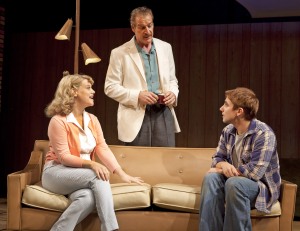
First performed in 1970, revived Off Broadway in 1985 and turned into a TV movie three years after that, "Lemon Sky" is, like so many of Mr. Wilson's plays, a variation on a theme by Tennessee Williams, a memory play about a sensitive teenage boy (Keith Nobbs) and the boorish father (Kevin Kilner) who doesn't understand him. The setting is San Diego in the '50s, that benighted decade of backyard cookouts and wholesome-looking families, and you will not be even slightly surprised to hear that the sensitive teenage boy is gay, while the boorish father turns out to have a few high-voltage kinks of his own. We are, in short, in the land of "The Glass Menagerie," and no sooner does Alan, Wilson's fictional stand-in, inform the audience that "I've been trying to tell this story, to get it down, for a long time" than you roll your eyes and start thinking about where to have dinner after the show.
Well, guess what? You're in for a surprise--a very big surprise. For even though the plot of "Lemon Sky" is well worn and the premise predictable, Alan tells his tale of woe with a transfiguring intensity far removed from the soft-centered sentimentality of such better-known Wilson plays as "Burn This." Perhaps because "Lemon Sky" was explicitly autobiographical, Mr. Wilson got the bit between his teeth and ran hard with it, and the result is a play whose angry portrayal of Eisenhower-era family life has the salty sting of remembered truth...
If you missed the Irish Repertory Theatre's Off-Broadway revival of Brian Friel's "Molly Sweeney" earlier this year, you can now catch it at Long Wharf Theatre, which is remounting Charlotte Moore's production on a larger stage. Two of the three original cast members, Jonathan Hogan and Ciarán O'Reilly, are reprising their roles in New Haven, joined by Simone Kirby, who replaced Geraldine Hughes in the title role later in the New York run. Mr. Friel's masterly play, in which three related monologues are woven around one another like strands of ivy, tells the story of an Irishwoman (Ms. Kirby) who has been blind since childhood and whose sight is miraculously restored by surgery in middle age. What follows is a parable of false hope and devastating disappointment, staged by Ms. Moore with gentle grace, performed to perfection by her cast and lit with special delicacy by Michael Gottlieb and Richard Pilbrow....
* * *
Read the whole thing here.
Posted September 30, 12:00 AM
TT: Why would anybody write a play?
Satchmo at the Waldorf closes in Orlando on Sunday afternoon. Would that I were there! Not surprisingly, the experience of writing my first play and seeing it onto the stage has inspired me to write a "Sightings" column in which I talk about some of the things I learned along the way. Here's an excerpt.
* * *
Tony Kushner can't make a living writing for the stage. America's most prominent playwright confessed in an interview published in Time Out New York earlier this year that "Angels in America" doesn't pay the rent: "I make my living now as a screenwriter! Which I'm surprised and horrified to find myself saying, but I don't think I can support myself as a playwright at this point. I don't think anybody does." So far as I know, Mr. Kushner is right. I don't know of any American playwrights who earn the bulk of their living writing plays. Many of the older ones teach, while a growing number of younger ones write for series TV. Itamar Moses, for instance, has written for "Boardwalk Empire" and "Men of a Certain Age," which isn't stopping him from turning out stage plays (his latest effort, "Completeness," just closed Off Broadway).
The question all but asks itself: Why is anybody still writing plays? Theater, after all, is no longer a central part of the American cultural conversation, the way it was when Arthur Miller and Tennessee Williams walked the earth. Nowadays most educated people would just as soon stay home and watch "Breaking Bad" as shell out a hundred bucks to see a Broadway play--assuming that there are any plays on Broadway worth seeing, which long ago ceased to be a safe bet.
So if you can't make any money writing for the stage, why bother? Putting aside the obvious attraction of being able to make up your own characters, I can think of one excellent reason: You meet the nicest people.
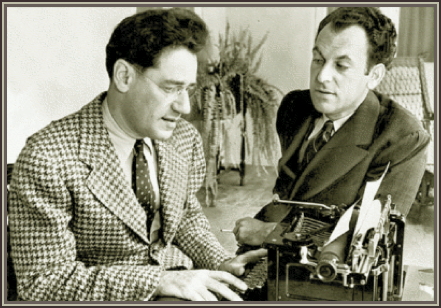
You've probably never thought about it before unless you happen to write for a living, but professional writers are doomed to spend most of their waking hours sitting by themselves at a desk, staring at a blank computer screen and waiting for lightning to strike. It's a lonely business, which explains why a few authors choose to collaborate instead of flying solo. Moss Hart, who wrote his best plays in partnership with George S. Kaufman, explained his decision to write with a partner in "Act One," his 1959 autobiography: "The hardest part of writing by far is the seeming exclusion from all humankind while work is under way, for the writer at work cannot be gregarious....Collaboration cuts this loneliness in half. When one is at a low point of discouragement, the very presence in the room of another human being, even though he too may be sunk in the same state of gloom, very often gives that dash of valor to the spirit that allows confidence to return and work to resume."
To be sure, most playwrights, unlike Hart, write by themselves. Once a script is finished, though, they immediately plunge themselves into the endlessly pleasurable frenzy of a collaborative enterprise....
* * *
Read the whole thing here.
Posted September 30, 12:00 AM
TT: Almanac
"I have never understood this liking for war. It panders to instincts already catered for within the scope of any respectable domestic establishment."
Alan Bennett, Forty Years On
Posted September 30, 12:00 AM
September 29, 2011
TT: So you want to see a show?
Here's my list of recommended Broadway, off-Broadway, and out-of-town shows, updated weekly. In all cases, I gave these shows favorable reviews (if sometimes qualifiedly so) in The Wall Street Journal when they opened. For more information, click on the title.
BROADWAY:
• Anything Goes (musical, G/PG-13, mildly adult subject matter that will be unintelligible to children, closes Apr. 29, most performances sold out last week, reviewed here)
• Follies (musical, PG-13, adult subject matter, extended through Jan. 22, most performances sold out last week, reviewed here)
• How to Succeed in Business Without Really Trying (musical, G/PG-13, perfectly fine for children whose parents aren't actively prudish, reviewed here)
OFF BROADWAY:
• Avenue Q (musical, R, adult subject matter and one show-stopping scene of puppet-on-puppet sex, reviewed here)
• The Fantasticks (musical, G, suitable for children capable of enjoying a love story, reviewed here)
• Million Dollar Quartet (jukebox musical, G, off-Broadway remounting of Broadway production, original run reviewed here)
IN ASHLAND, OREGON:
• August: Osage County (drama, PG-13/R, closes Nov. 5, reviewed here)
• Julius Caesar (Shakespeare, PG-13, closes Nov. 6, reviewed here)
• Measure for Measure (Shakespeare, PG-13, closes Nov. 6, reviewed here)
CLOSING SOON IN WASHINGTON, D.C.:
• The Habit of Art (serious comedy, R, adult subject matter, closes Oct. 16, reviewed here)
CLOSING NEXT WEEK IN ASHLAND, OREGON:
• The Pirates of Penzance (operetta, G, suitable for children, closes Oct. 8, reviewed here)
CLOSING NEXT WEEK IN HARTFORD, CONNECTICUT:
• The Crucible (drama, PG-13, partial nudity, extended through Oct. 6, reviewed here)
CLOSING FRIDAY IN SPRING GREEN, WISCONSIN:
• The Tempest (Shakespeare, G/PG-13, reviewed here)
CLOSING SUNDAY IN WASHINGTON, D.C.:
• Oklahoma! (musical, G, remounting of 2010 production, suitable for children, original run reviewed here)
Posted September 29, 12:00 AM
TT: Almanac
"Standards always are out of date. That is what makes them standards."
Alan Bennett, Forty Years On
Posted September 29, 12:00 AM
September 28, 2011
TT: Off we go
It seems as though Mrs. T and I just unpacked our bags, and now we're hitting the road again. Our first stop is Chicago, where we'll be driving up to Glencoe to see Writers' Theatre's production of Tom Stoppard's The Real Thing, a play that I adore, then spending the night at an airport hotel. Tomorrow we fly to St. Louis and drive from there to Smalltown, U.S.A., to visit my mother and attend the marriage of Lauren Teachout, my beloved niece, who is getting hitched to her longtime boyfriend on Saturday. I don't doubt for a moment that a good time will be had by all.
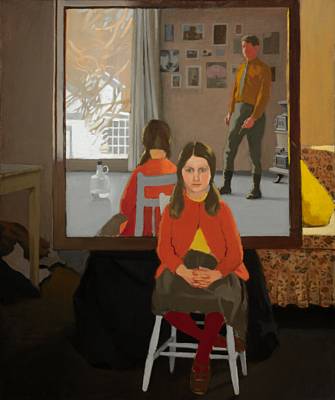
After that we'll spend most of Sunday driving up to Kansas City, where I'm going to deliver a public lecture on Monday at the University of Missouri-Kansas City, about which more here. (Come hear me if you're in the vicinity!) In addition, Mrs. T, who's never been to Kansas City, will join me for her first visit to the Nelson-Atkins Art Museum, a great and insufficiently appreciated institution whose innumerable treasures include one of my all-time favorite American paintings, Fairfield Porter's "The Mirror." I also hope to feed her some authentic Kansas City barbecue chez Arthur Bryant, though I have a sneaking suspicion that all our meals are already spoken for, damn it.
Would that we could spend a few days unwinding in Kansas City, but we have to fly back home the morning after my speech. The theater season is getting underway next week and I'll have four shows to see in New York, two on Broadway and two off, and three Wall Street Journal columns to write.
You can guess the rest. I'll see you when I see you. Until then, whenever "then" ends up being, content yourself with the usual almanac entries and regular theater-related postings, and wish me barbecue-related luck.
Posted September 28, 12:00 AM
TT: Snapshot
Big Joe Turner, live at the Apollo in 1955:
(This is the latest in a weekly series of arts-related videos that appear in this space each Wednesday.)
Posted September 28, 12:00 AM
TT: Almanac
"Kafka could never have written as he did had he lived in a house. His writing is that of someone whose whole life was spent in apartments, with lifts, stairwells, muffled voices behind closed doors, and sounds through walls. Put him in a nice detached villa and he'd never have written a word."
Alan Bennett, Writing Home
Posted September 28, 12:00 AM
September 27, 2011
TT: Almanac
"I have no doubt that in heaven the angels will regard the blessed as a necessary evil."
Alan Bennett, Writing Home
Posted September 27, 12:00 AM
September 26, 2011
TT: A study of reading habits
The Little Professor posted this meme, and I thought I'd play along:
1. Favorite childhood book?
Charlotte's Web (and I still love it).
2. What are you reading right now? David E. Kyvig's Daily Life in the United States, 1920-1940.
3. What books do you have on request at the library? I gave up using libraries years ago. It's far easier and quicker to order a used book from Amazon than it is for me to visit any of Manhattan's public libraries. If I lived elsewhere, though, I'd probably do things differently.
4. Bad book habit? I'm a compulsive dog-earer.
5. What do you currently have checked out at the library? See #3.
6. Do you have an e-reader? No--I ought to buy one, but simply haven't gotten around to it.
7. Do you prefer to read one book at a time, or several at once? It's rarely a matter of preference. Because of the nature of my work, I tend to be reading two or three books at any given time.
8. Have your reading habits changed since starting a blog? No.
9. Least favorite book you read this year (so far)? I stop reading a book as soon as I'm sure that I don't like it--life's too short to finish reading a bad book--so I don't have a good answer to this question. I'm about to review a biography that I disliked, but I can't say what it is until the piece appears.
10. Favorite book you've read this year? John Williams' Stoner, with Wesley Stace's Charles Jessold, Considered as a Murderer running it a close second. (Both of these books, incidentally, were suggested to me by the same person.)
11. How often do you read out of your comfort zone? I don't think I have a "comfort zone." I read whatever interests me, and my tastes wander in all directions.
12. What is your reading comfort zone? See above.
13. Can you read on the bus?
I could read on a roller coaster, so long as I wasn't simultaneously being shot at.
14. Favorite place to read? In bed.
15. What is your policy on book lending? I lend books to good friends. If they don't return them, I stop lending to them.
16. Do you ever dog-ear books? Reflexively.
17. Do you ever write in the margins of your books? I've never written in or highlighted a book in my life. For some inexplicable reason, the very thought of doing so makes me cringe--it borders on a phobia. And yes, I realize that this is irreconcilable with my dog-earing habit. Go figure.
18. Not even with text books? No, never.
19. What is your favorite language to read in? Alas, I'm a monoglot.
20. What makes you love a book? I want it to tell me things I didn't already know, and to do so in a way that I find irresistibly seductive.
21. What will inspire you to recommend a book? The fact that I liked it, so long as I think that the recommendee would be interested in its subject matter.
22. Favorite genre? I don't have one. I suppose biography comes closest, but that's mainly because I write biographies.
23. Genre you rarely read (but wish you did)? I've never been able to get into science fiction, and I suspect I'm missing something as a result.
24. Favorite biography? W. Jackson Bate's Samuel Johnson. Runner-up: David Cairns' Berlioz.
25. Have you ever read a self-help book? I read Dale Carnegie's How to Stop Worrying and Start Living as a boy. (It was on the living-room bookshelf.) Nothing since then, so far as I can recall.
26. Favorite cookbook? I can't cook, but I do love M.F.K. Fisher.
27. Most inspirational book you've read this year (fiction or non-fiction)? I don't read "inspirational" books. Stories of heroism, broadly defined, inspire me, and on occasion certain books inspire me to try to write better.
28. Favorite reading snack? I rarely snack while reading, though I usually read when dining alone.
29. Name a case in which hype ruined your reading experience. It's never happened. As Marlene Dietrich says in Touch of Evil, "What does it matter what you say about people?"
30. How often do you agree with critics about a book? I don't keep track.
31. How do you feel about giving bad/negative reviews? A man's gotta do what a man's gotta do.
32. If you could read in a foreign language, which language would you choose? French. I very much wish I could read Proust in the original.
33. Most intimidating book you've ever read? I don't find books intimidating (or much else, truth to tell).
34. Most intimidating book you're too nervous to begin? See above.
35. Favorite poet? I don't have a favorite poet. I like Yeats, Frost, Hardy, and Larkin, and lately I've gotten interested in Kay Ryan and Samuel Menashe.
36. How many books do you usually have checked out of the library at any given time? See #3.
37. How often have you returned a book to the library unread? Back in my student days, not infrequently.
38. Favorite fictional character? I'd have trouble choosing between Vicky Haven in Dawn Powell's A Time to Be Born and Amanda Turck in James Gould Cozzens' Guard of Honor. In addition, I confess--somewhat reluctantly--to identifying with Charles Gray in John P. Marquand's Point of No Return.
39. Favorite fictional villain? Richard Stark's Parker (if you can call him a villain--it's a slippery proposition). Runners-up: Augustus Melmotte in Trollope's The Way We Live Now and Widmerpool in Anthony Powell's A Dance to the Music of Time.
40. Books I'm most likely to bring on vacation? Whatever I'm reading at the moment.
41. The longest I've gone without reading. I went without reading for a couple of days the last time I was in the hospital.
42. Name a book that you could/would not finish. Erle Stanley Gardner's The Case of the Velvet Claws.
43. What distracts you easily when you're reading? Nothing.
44. Favorite film adaptation of a novel?
Nicholas Ray's In a Lonely Place. I suspect, however, that this question is meant to elicit films made from novels that are distinguished in their own right, in which case I'd single out Stephen Fry's Bright Young Things and Paul Mazursky's Enemies: A Love Story.
45. Most disappointing film adaptation? Otto Preminger's Advise and Consent.
46. The most money I've ever spent in the bookstore at one time? Probably a couple of hundred dollars, but I rarely go to brick-and-mortar bookstores anymore.
47. How often do you skim a book before reading it? Almost never, unless I'm consulting it for purely professional reasons.
48. What would cause you to stop reading a book halfway through? If it bores me, I'll stop after ten pages.
49. Do you like to keep your books organized? Yes, though I'm not excessively finicky about it.
50. Do you prefer to keep books or give them away once you've read them? Living as I do in a New York apartment, I dispose of superfluous books ruthlessly.
51. Are there any books you've been avoiding? No.
52. Name a book that made you angry. That is one long list, baby.
53. A book you didn't expect to like but did? James Gould Cozzens' By Love Possessed. Dwight Macdonald's famous takedown fails altogether to convey its actual quality.
54. A book that you expected to like but didn't? Colette's The Pure and the Impure. I didn't hate it, but I expected to like it a lot more than I did.
55. Favorite guilt-free, pleasure reading? Unless money is changing hands, I always read for pleasure, and I don't do book-related guilt.
Posted September 26, 12:00 AM
TT: Just because
Slim Gaillard and his trio sing "Dunkin' Bagel" in 1946:
Posted September 26, 12:00 AM
TT: Almanac
"The majority of people perform well in a crisis and when the spotlight is on them; it's on the Sunday afternoons of this life, when nobody is looking, that the spirit falters."
Alan Bennett, Writing Home
Posted September 26, 12:00 AM
September 23, 2011
TT: The boys are back
In today's Wall Street Journal I review the American premiere of The Habit of Art, Alan Bennett's latest play, at Washington's Studio Theatre. Here's an excerpt.
* * *
Alan Bennett has a knack for writing big, complicated plays that are, like "The History Boys" and "The Madness of George III," both challenging and entertaining. "The Habit of Art," a fictional portrayal of the uneasy relationship between W.H. Auden and Benjamin Britten, fills the bill on all counts. Though the scale of the play (one set, two acts) is modest, "The Habit of Art" sprawls all over the place. But Mr. Bennett's latest play is so excitingly written that you won't find it hard to forgive its failings, and Washington's Studio Theatre has given it a production so polished that it could open on Broadway as is.
"The Habit of Art" is set at a rehearsal of "Caliban's Day," an imaginary docudrama about Auden, Britten and Humphrey Carpenter, who wrote biographies of both men. In the play-within-the-play, the fictional Carpenter (Cameron Folmar) pays a visit to the fictional Auden (Ted van Griethuysen) to interview him about the fictional Britten (Paxton Whitehead). Then Britten pays a visit to Auden, whom he hasn't seen in person for 20 years, to ask the poet's advice about the operatic version of "Death in Venice" on which he is working. Their awkward reunion is interrupted by the arrival of a young male prostitute (Randy Harrison) who has a date with Auden and in whom Britten takes a furtive interest.
Around this more than sufficiently intriguing situation, Mr. Bennett has wrapped a backstage comedy about the process of rehearsing "Caliban's Day" for production at London's National Theatre. In addition to the cast of "Caliban's Day," we meet the vain, neurotic playwright (Wynn Harmon), the long-suffering stage manager (Margaret Daly) and various other familiar but knowingly drawn theatrical types. Imagine "Noises Off" rewritten by Tom Stoppard and you'll get some notion of the havoc arising from the collision of play and play-within-a-play....
The rehearsal-room sequences of "The Habit of Art" are totally convincing, so much so that the play seems in the end to be more about theater itself than about Auden and Britten. The problem is that the contrast between Auden's self-acceptance and Britten's "occluded sexuality" (in Auden's phrase) is the emotional engine that drives "The Habit of Art," and Mr. Bennett has not made it dramatically compelling. Yet even when it falters, "The Habit of Art" holds your attention, and David Muse's staging is so clearly articulated and full of crisp comic energy that you'll have no difficulty picking your way through the thickets of Mr. Bennett's labyrinthine plot....
* * *
Read the whole thing here.
Posted September 23, 12:00 AM
TT: Almanac
"Argument is generally waste of time and trouble. It is better to present one's opinion and leave it to stick or no as it may happen. If sound, it will probably in the end stick, and the sticking is the main thing."
Samuel Butler, The Note-Books of Samuel Butler
Posted September 23, 12:00 AM
September 22, 2011
TT: So you want to see a show?
Here's my list of recommended Broadway, off-Broadway, and out-of-town shows, updated weekly. In all cases, I gave these shows favorable reviews (if sometimes qualifiedly so) in The Wall Street Journal when they opened. For more information, click on the title.
BROADWAY:
• Anything Goes (musical, G/PG-13, mildly adult subject matter that will be unintelligible to children, closes Jan. 8, most performances sold out last week, reviewed here)
• Follies (musical, PG-13, adult subject matter, closes Jan. 1, most performances sold out last week, reviewed here)
• How to Succeed in Business Without Really Trying (musical, G/PG-13, perfectly fine for children whose parents aren't actively prudish, reviewed here)
OFF BROADWAY:
• Avenue Q (musical, R, adult subject matter and one show-stopping scene of puppet-on-puppet sex, reviewed here)
• The Fantasticks (musical, G, suitable for children capable of enjoying a love story, reviewed here)
• Million Dollar Quartet (jukebox musical, G, off-Broadway remounting of Broadway production, original run reviewed here)
IN ASHLAND, OREGON:
• August: Osage County (drama, PG-13/R, closes Nov. 5, reviewed here)
• Julius Caesar (Shakespeare, PG-13, closes Nov. 6, reviewed here)
• Measure for Measure (Shakespeare, PG-13, closes Nov. 6, reviewed here)
CLOSING SOON IN ASHLAND, OREGON:
• The Pirates of Penzance (operetta, G, suitable for children, closes Oct. 8, reviewed here)
CLOSING SOON IN HARTFORD, CONNECTICUT:
• The Crucible (drama, PG-13, partial nudity, extended through Oct. 6, reviewed here)
CLOSING SOON IN WASHINGTON, D.C.:
• Oklahoma! (musical, G, remounting of 2010 production, suitable for children, closes Oct. 2, original run reviewed here)
CLOSING NEXT WEEK IN SPRING GREEN, WISCONSIN:
• The Tempest (Shakespeare, G/PG-13, closes Sept. 30, reviewed here)
CLOSING SUNDAY IN SPRING GREEN, WISCONSIN:
• The Cure at Troy (Greek tragedy, G, far too intense for children, reviewed here)
Posted September 22, 12:00 AM
TT: Almanac
"Men are seldom more commonplace than on supreme occasions."
Samuel Butler, The Note-Books of Samuel Butler
Posted September 22, 12:00 AM
September 21, 2011
TT: Comfort and joy
This summer has been far too much of a muchness: too much travel, too much work, too much stress. Mrs. T and I had planned to take a week off, but our plan was scrapped when my mother fell ill, and I ended up going straight from reviewing shows all over the country to opening one of my own in Florida. By the time I arrived in Washington, D.C., on Monday, I was as frazzled as I've ever been.
Fortunately, the friend with whom I had dinner that evening took one look at me and insisted that I do something just for fun as soon as humanly possible, so I strolled over to the Phillips Collection the next day and spent an hour looking at paintings. Not only had a month gone by since my last walk--that's how busy I've been--but I hadn't set foot in my favorite museum for two years. It wasn't that I'd forgotten how much I love the Phillips, but I confess to having been startled by how comforting it was for me to visit its galleries after so prolonged an absence. No sooner did I find my way to Paul Klee's Arrival of the Jugglers than I felt the world start to right itself.
Henri Matisse made an oft-quoted remark about his art that deserves closer consideration than it tends to get:
What I dream of is an art of balance, of purity, and tranquility, without any disquieting or preoccupying subject matter, an art that could be for every mental worker, for the businessman as well as the man of letters, for example, a tonic, a cerebral calmative, something like a good armchair that relaxes him from his physical fatigue.
Those of us who spend our lives immersed in the world of art have an unfortunate way of overlooking its unique ability to serve as a remedy for the trials of life. We think of art as something to do, not something to use, and many of us also suffer from the mistaken notion that art must be challenging in order to be good. On some level, of course, that's perfectly true, but there are many different ways of experiencing art, all of which are valid as far as they go. (There are nine and sixty ways of constructing tribal lays,/And every single one of them is right!) To take uncomplicated pleasure from beauty is a wholly worthy activity, and to do it in the hope of finding surcease from whatever may be troubling us is no less worthy.
One of the reasons why I love the Phillips is because it never fails to surprise me. Today I ran across a small untitled painting by Franz Kline that I'd never seen before, and I delighted in its unpredictability. Who knew that Kline, that most monochromatic of modernists, could make such startling use of color? But I'd come to the Phillips to rest my spirit, and as I gazed at The Open Window and The Garden at Les Lauves for the umpteenth time, I felt the calm of which Matisse spoke, the comfort of great art whose idiosyncrasies are as familiar as the quirks of an old friend.
I returned to the hotel refreshed, took a nap, then went to the Studio Theatre to see a new play, one to whose newness I would surely have been unequal had I not spent the afternoon communing with Bonnard and Cézanne. Today I return to Connecticut and Mrs. T, and I dare say I'll appreciate her even more than usual, too. There are worse reasons to go to museums--or to make art.
Posted September 21, 12:00 AM
TT: Snapshot
Home movies of Arnold Schoenberg, taken in 1937 by George Gershwin:
(This is the latest in a weekly series of arts-related videos that appear in this space each Wednesday.)
Posted September 21, 12:00 AM
TT: Almanac
"The composer is seldom a great theorist; the theorist is never a great composer. Each is equally fatal to and essential in the other."
Samuel Butler, The Note-Books of Samuel Butler
Posted September 21, 12:00 AM
September 20, 2011
TT: We should all be so lucky
From the 1976 Tony Awards telecast, the original cast of A Chorus Line performs "I Hope I Get It":
Posted September 20, 12:00 AM
TT: Almanac
"The supposition that the world is ever in league to put a man down is childish. Hardly less childish is it for an author to lay the blame on reviewers. A good sturdy author is a match for a hundred reviewers."
Samuel Butler, The Note-Books of Samuel Butler
Posted September 20, 12:00 AM
September 19, 2011
TT: Waving goodbye
Mrs. T and I saw the Sunday matinee of Satchmo at the Waldorf in Orlando, then joined the cast and crew for homemade gumbo. Today we’ll drive to the Orlando airport and go our (temporarily) separate ways, she to Connecticut and I to Washington, D.C., where I’ll be seeing the American premiere of Alan Bennett’s The Habit of Art on Tuesday. I hate to leave my own show behind, but duty calls, and at least I got to see the first four performances.
I’ve learned a lot in the past week and a half. Watching Rus Blackwell direct my play was an education in itself. I liked what he did so much that I’ve already written into the script several pieces of business that were devised by Rus. William Elliott, who designed the set and lighting, went to enormous trouble to create an evocative space that drew the audience in, and we had the supreme pleasure of working with a fabulous crew. Many, many thanks to Holly Bennett, Cindy Karr, and Jamie Mykins, who made all the rough places plain.
As for Dennis Neal, there aren’t enough words in the English language to describe what he did with the double role of Louis Armstrong and Joe Glaser. All I can say is that as I sat in the theater, I said to myself, “My God, he looks like Satchmo now—and they don’t even look alike!” The last time I saw an actor bring off so radical a transformation was when Frank Langella starred in the Broadway transfer of Frost/Nixon. Dennis is a true artist, and I’ve never been luckier in my life than when Rollins College brought us together in February to do the first public reading of Satchmo at the Waldorf.
Rus and Dennis cut a thousand words out of the play during the first week of rehearsals. I realized as soon as I got to Orlando that the script was much the better for having been tightened up so judiciously. I made some additional cuts of my own, and by the time we opened on Thursday, the pacing was right where I wanted it to be. It was fascinating to see how the audience’s response varied from night to night. The opening-night crowd laughed so loudly at the first act that they could have been watching Noises Off. On Friday, by contrast, the play was received with total seriousness and involvement, as if it were a deadly serious drama (which, of course, it is, the punch lines notwithstanding). Much to my delight, Dennis was quick to pick up the mood of the house each night and shape his performance accordingly. That’s professionalism.
Satchmo at the Waldorf runs through October 2. After that…well, who knows? Dennis and Rus want to produce it elsewhere, which would suit me right down to the ground. But no matter what happens in the future, I can say with pride that in addition to being a critic, biographer, and opera librettist, I’m now a full-fledged professional playwright. I went into the arena and came back in one piece. Like the song says, they can’t take that away from me!
* * *
Here’s a lovely picture of Armstrong’s original All Stars, taken on stage in New Orleans in 1949:

Posted September 19, 12:00 AM
TT: Just because
Frank Sinatra and Peggy Lee sing “Nice Work if You Can Get It”:
Posted September 19, 12:00 AM
TT: Almanac
”Books should be tried by a judge and jury as though they were crimes, and counsel should be heard on both sides.”
Samuel Butler, The Note-Books of Samuel Butler
Posted September 19, 12:00 AM
September 18, 2011
HOW TWO GREAT CRITICS COMPROMISED THEIR POSTHUMOUS REPUTATIONS
“Clement Greenberg and Virgil Thomson were critics of the first rank. Indeed, Mr. Greenberg was one of the most deservedly influential art critics of the 20th century, while Mr. Thomson is generally regarded as the finest classical-music critic ever to have written for a U.S. newspaper. The world of art would be the poorer had they chosen not to write about it—but for as long as their work is read, some people will wonder whether they could be bought…”Posted September 18, 12:45 PM
September 16, 2011
TT: It works
Satchmo at the Waldorf was successful in every way. The house was sold out and the audience gave every indication of loving the show from start to finish. I had no idea that it was so funny. The first act actually played like a comedy. Not so the second half of the second act, which was received in a rapt hush. As for the cheers at the end…well, let’s just call them damned gratifying.
I could spend a lot of time thanking a lot of people, and believe me, I will—but not just yet. I got home a half-hour ago, and I’m so tired I could drop. For now, let me just say that were it not for Hilary Teachout, my beloved Mrs. T, I’d have never worked up the nerve to write my first play, much less to see it through seventeen painstakingly revised drafts and onto the stage of Orlando’s Mandell Theatre. All praise to Dennis Neal, Rus Blackwell, and the rest of my wonderful colleagues, but she comes first.
More anon, but I’ll close with the final speech of the play:
ARMSTRONG (raising his voice) I’m just about done, sugar. (As before) Guess Lucille’s right. Done told my story, said what I gotta say. And now I gotta get to bed, get me some rest like the doc says. Got two shows to play tomorrow, gotta take care of myself. You wanna please the people, get you a good night’s sleep. Playing that pretty music every night take a lot out of an old man.He puts on his glasses and picks up his trumpet case.
You go that way, I go this way. And we gonna do it all over again tomorrow night. Just like always.
He opens the dressing-room door, switches off the light, and exits, closing the door behind him. Blackout.
See you next week.
UPDATE: To view an album of photos shot at the dress rehearsal of Satchmo at the Waldorf, go here.
Posted September 16, 12:16 AM
TT: "When faith draws blood"
In today’s Wall Street Journal drama column I write about Hartford Stage’s revival of The Crucible and the Broadway transfer of the Kennedy Center production of Follies. Here’s an excerpt.
* * *
Time has been unexpectedly kind to “The Crucible.” Arthur Miller’s history play about the Salem witch trials was written at the height of the McCarthy era, and most of the critics who saw it back then found the parallels that Miller drew between Salem in 1693 and Washington, D.C., in 1953 to be grossly heavy-handed. Nor was their displeasure politically motivated. Kenneth Tynan, whose own politics were far to the left of center, wrote that “The Crucible” “has the over-simplifications of poster art.” He was right, too: “The Crucible” is an either/or moral melodrama whose characters are as flat as picket signs. But it is also, like Lillian Hellman’s “The Little Foxes,” a consummately effective piece of theater that carries the emotional charge of a really good B movie. Moreover, the passage of time has made it possible for “The Crucible” to be staged not as a connect-the-dots allegory about McCarthyism but as a cautionary tale of what can happen whenever zealots of any kind—fascists, Communists, religious fanatics, PC enforcers—reach out for the levers of power.
In his riveting Hartford Stage revival of “The Crucible,” Gordon Edelstein has shrewdly cut the play loose from its familiar 17th-century moorings. Ilona Somogyi’s costumes and Eugene Lee’s bare-bones set suggest that the play is taking place early in the 20th century, possibly in the Bible Belt around the time of the Scopes trial. On the other hand, Michael Chybowski has lit the courtroom with fluorescent fixtures that are as modern-looking as a flat-screen TV. The effect is deliberately disorienting, and no sooner is the audience thrown off balance than Mr. Edelstein moves in for the kill. From the slap-in-the-face coup de théâtre that launches the play to the death march that drives it to a thunderous close, this “Crucible” will send your pulse rate shooting through the roof….
This is a banner year for “Follies,” the 1971 Stephen Sondheim-James Goldman musical in which the splintered hopes of two middle-aged married couples are flung against the gaudy backdrop of an old-fashioned bring-on-the-girls revue. Not only is Gary Griffin about to stage a major revival of “Follies” for Chicago Shakespeare, but Eric Schaeffer’s superlative Kennedy Center production, which had a deservedly successful run earlier this year in Washington, has just moved to Broadway with its formidable virtues fully intact. Jan Maxwell, Bernadette Peters, Danny Burstein and Ron Raines, the stars of the Kennedy Center cast, are all present and accounted for. Though Ms. Peters is in fragile voice, her acting is touchingly intense, and her colleagues, Mr. Burstein in particular, give powerhouse performances that couldn’t be bettered….
* * *
Read the whole thing here.
Posted September 16, 12:00 AM
TT: They came bearing gifts
In my “Sightings” column for today’s Wall Street Journal I report on a recent visit to the Portland Art Museum’s Clement Greenberg Collection, and reflect on how Greenberg’s willingness to accept gifts of paintings and sculpture from the artists about whom he wrote has compromised his posthumous reputation. I also have a few sharp words to say about Virgil Thomson, a critic who--unlike Greenberg--really could be bought. Here’s a preview.
* * *
Most critics, like the artists about whom they write, are forgotten soon after they die, if not long before. But Clement Greenberg, whose fervent advocacy put Jackson Pollock on the art-world map, is still well remembered at Oregon’s Portland Art Museum. The Clement Greenberg Collection, on display in Portland since 2001, consists of 155 paintings, sculptures and works on paper by five dozen of the critic’s favorite artists, among them Pollock, Richard Diebenkorn, Helen Frankenthaler, Hans Hofmann, Kenneth Noland, Jules Olitski and David Smith. The installation takes up the better part of a floor, and the best pieces, such as Noland’s “No. One” (1958) and Frankenthaler’s “Spaced Out Orbit” (1973), are spectacular reminders of how Mr. Greenberg, writing in the pages of Partisan Review, The Nation, and other small-press magazines, helped to persuade a generation of Americans that abstract art was the wave of the future.
In his lifetime, Greenberg’s art collection was so admired that Vogue ran a story in 1964 that was illustrated by glossy photographs of his Manhattan apartment, whose walls were covered with paintings. It was quite a sight to see—but it led certain savvy readers to wonder how an art critic, even one as celebrated as Greenberg, had managed to assemble a 155-piece collection of works by some of the most famous American artists of the 20th century. Was he rich? Far from it. The works in his collection were all presented to him as gifts by the grateful artists about whom he wrote. Not only did he accept such gifts, but he sold them whenever he needed money—and after his death in 1994, Greenberg’s widow sold the remaining works in his collection to the Portland Art Museum for two million dollars.
Nobody who knew the famously outspoken Greenberg at all well believed that his critical judgment could be swayed by giving him a painting. Moreover, the now-famous artists whom he championed were unknown when he first wrote about them, meaning that their work had little or no monetary value. But in the hard-nosed world of journalism, appearance and reality are inseparably entwined, and today the Greenberg Collection looks less like an eloquent tribute to the sharp eye of a great critic and more like a glaring conflict of interest….
* * *
Read the whole thing here.
Posted September 16, 12:00 AM
TT: A week with Satchmo (V)
Louis Armstrong, Velma Middleton, and the All Stars perform “St. Louis Blues”:
Posted September 16, 12:00 AM
TT: Almanac
“Do not be an art critic, but paint, therein lies salvation.”
Paul Cézanne, letter to Emile Bernard, July 25, 1904
Posted September 16, 12:00 AM
September 15, 2011
TT: More ink
Here’s another excellent preview piece about Satchmo at the Waldorf, this one written by Al Krulick for the Orlando Weekly:
Maybe the moniker “Satchmo” is one you’ve heard. If you’re a fan of the old black-and-white movie musicals, have seen clips from television’s early days or have any interest in jazz or American popular music, you probably know who Louis Armstrong is. You have a mental picture of a broadly smiling, wide-eyed African-American man, stout but debonair, blasting powerful notes on his trumpet, trading quips with Bing Crosby or Ed Sullivan, or perhaps singing “Hello, Dolly” in a voice that sounds like sandpaper rubbing against a human larynx. But if that’s all you know about one of America’s great musical geniuses, you still have much to learn.Satchmo at the Waldorf, a new play by author and Wall Street Journal theater critic Terry Teachout based on his biography Pops: A Life of Louis Armstrong, intends to flesh out the details of Armstrong’s long and productive musical life and, according to Teachout, “reveal the man behind the smile.”
The one-man, two-character show will have its world premiere this week at the Orlando Shakespeare Theater. Dennis Neal stars as Louis Armstrong and also as his longtime manager and protector, Joe Glaser, with whom Armstrong had a successful, if fractious, 40-year professional relationship. Well-known Orlando actor and director Rus Blackwell, who has worked with Neal for many years and, with Neal, was one of the founders of the Mad Cow Theatre Company, directs the play.
The coming together of these three talented theater pros was a fortuitous event that Neal opines was destined to occur. According to the highly regarded local performer, “Rus and I had been thinking about doing some sort of one-man show for a long time, but it never came together. When I read Terry’s script, I knew I was born to play this part. I almost felt that it had been written for me.”
Read the whole thing here.
Posted September 15, 12:19 PM
TT: This is it
Satchmo at the Waldorf opens tonight in Orlando, Florida. We had a few high-octane technical snafus at Wednesday’s dress rehearsal, but everything got itself worked out by the time we all went home. Now there’s nothing left for me to do but show up and see what happens.
I remember well how I felt on the morning that The Letter opened in Santa Fe, and since I feel much the same way today, I’ll post the same video that I posted two years ago:
May it bring us all…but I’d better not say that out loud!
Posted September 15, 12:00 AM
TT: So you want to see a show?
Here's my list of recommended Broadway, off-Broadway, and out-of-town shows, updated weekly. In all cases, I gave these shows favorable reviews (if sometimes qualifiedly so) in The Wall Street Journal when they opened. For more information, click on the title.
BROADWAY:
• Anything Goes (musical, G/PG-13, mildly adult subject matter that will be unintelligible to children, closes Jan. 8, most performances sold out last week, reviewed here)
• How to Succeed in Business Without Really Trying (musical, G/PG-13, perfectly fine for children whose parents aren't actively prudish, most performances sold out last week, reviewed here)
OFF BROADWAY:
• Avenue Q (musical, R, adult subject matter and one show-stopping scene of puppet-on-puppet sex, reviewed here)
• The Fantasticks (musical, G, suitable for children capable of enjoying a love story, reviewed here)
• Million Dollar Quartet (jukebox musical, G, off-Broadway remounting of Broadway production, original run reviewed here)
IN ASHLAND, OREGON:
• August: Osage County (drama, PG-13/R, closes Nov. 5, reviewed here)
• Julius Caesar (Shakespeare, PG-13, closes Nov. 6, reviewed here)
• Measure for Measure (Shakespeare, PG-13, closes Nov. 6, reviewed here)
CLOSING SOON IN ASHLAND, OREGON:
• The Pirates of Penzance (operetta, G, suitable for children, closes Oct. 8, reviewed here)
CLOSING SOON IN WASHINGTON, D.C.:
• Oklahoma! (musical, G, remounting of 2010 production, suitable for children, closes Oct. 2, original run reviewed here)
CLOSING SOON IN SPRING GREEN, WISCONSIN:
• The Tempest (Shakespeare, G/PG-13, closes Sept. 30, reviewed here)
CLOSING NEXT WEEK IN SPRING GREEN, WISCONSIN:
• The Cure at Troy (Greek tragedy, G, far too intense for children, closes Sept. 25, reviewed here)
CLOSING SATURDAY IN EAST HADDAM, CONNECTICUT:
• Show Boat (musical, G, suitable for bright children, reviewed here)
Posted September 15, 12:00 AM
TT: A week with Satchmo (IV)
From the film Satchmo the Great, narrated by Edward R. Murrow, Louis Armstrong and the All Stars perform “Mack the Knife”:
Posted September 15, 12:00 AM
TT: Almanac
“I think that all ambitions are lawful except those which climb upwards on the miseries or credulities of mankind. All intellectual and artistic ambitions are permissible, up to and even beyond the limit of prudent sanity. They can hurt no one. If they are mad, then so much the worse for the artist. Indeed, as virtue is said to be, such ambitions are their own reward.”
Joseph Conrad, A Personal Record
Posted September 15, 12:00 AM
September 14, 2011
TT: Snapshot
Igor Stravinsky talks about his Variations for Orchestra, then watches George Balanchine making a ballet version of the score. The dancer is Suzanne Farrell:
(This is the latest in a weekly series of arts-related videos that appear in this space each Wednesday.)
Posted September 14, 12:00 AM
TT: A week with Satchmo (III)
From the film New Orleans, Louis Armstrong and Billie Holiday perform “Do You Know What It Means to Miss New Orleans?”:
Posted September 14, 12:00 AM
TT: Almanac
“I had another dream the other day about music critics. They were small and rodent-like with padlocked ears, as if they had stepped out of a painting by Goya.”
Igor Stravinsky, interview, Evening Standard, Oct. 29, 1969
Posted September 14, 12:00 AM
September 13, 2011
TT: On the scene
Here's the scene at tonight's tech rehearsal for Satchmo at the Waldorf. On stage is Dennis Neal, the star, who is sitting at Louis Armstrong's dressing-room table:

Posted September 13, 6:19 PM
TT: A week with Satchmo (II)
Louis Armstrong and the All Stars perform “La Vie en Rose”:
Posted September 13, 12:00 AM
TT: Almanac
“My native habitat is the Theatre—in it I toil not, neither do I spin. I am a critic and commentator. I am essential to the Theatre—as ants to a picnic, as the boll weevil to a cotton field.”
Joseph Mankiewicz, screenplay for All About Eve
Posted September 13, 12:00 AM
September 12, 2011
TT: Countdown
I’m spending the week in Orlando, Florida, having flown down from New York last Saturday to attend the final rehearsals of Satchmo at the Waldorf, my first play, which opens on Thursday. I’ve spent fourteen of the past forty-eight hours sitting in a rehearsal room, watching Dennis Neal and Rus Blackwell, the star and director, pull the script off the page and put it on the stage.
I’m staying in the same Rollins College-owned condo where I wrote the first draft of Satchmo at the Waldorf a year and a half ago during my first stint as a scholar-in-residence at the Winter Park Institute. Except for the (temporary) absence of Mrs. T, it felt like home as soon as I unlocked the front door. Indeed, I know my way around Winter Park so well that I drove to the grocery store two nights ago without benefit of GPS. No sooner did I roll my shopping cart into the store than I heard somebody calling out to me. “Hey, you’re Terry Teachout!” he said. “How’s the play going? I’ll be there on opening night!” That felt good.
Rehearsing a play is a fascinating process, at once grueling and exhilarating—and, in my case, instructive. I already knew how good Dennis was, but Rus’ directorial gifts have proved to be illuminating. He has an uncanny sense of the show’s visual line, and I’m learning something new each time he tinkers with the blocking or gives Dennis a note about his performance.
Tomorrow we load the show into the theater and hang the set. I have to spend the whole morning writing Friday’s Wall Street Journal column, but I’m going to head over and join the crew as soon as the column is filed. I don’t want to miss any of the fun. Needless to say, it’s going to be a busy week, but I’ll do my best to blog between now and then about the process of putting the show on stage. (I’ll also be be tweeting about the rehearsals at @terryteachout and in the “Terry’s Twitters” module of the right-hand column.)
In the meantime, here’s the author’s note that will appear in the printed program:
Louis Armstrong, the greatest jazz musician of the twentieth century, was a deeply happy, fundamentally optimistic man who was rarely seen without a smile—in public. But there was more to him than met the eye. Between 1947 and his death in 1971, Armstrong taped hundreds of after-hours conversations with his wife, friends, and colleagues in which he revealed a very different side of his personality. Some of these tapes are startlingly intimate, and many of them contain language that Armstrong never used on stage. I made use of the tapes in writing Pops: A Life of Louis Armstrong, my 2009 biography, and they later inspired me to write this play, in which Dennis Neal portrays both Armstrong and Joe Glaser, the trumpeter’s longtime manager, who was as complex a character as Armstrong himself.Satchmo at the Waldorf is a work of fiction, but it is based on and informed by the facts of both men’s lives, and though I made up most of the dialogue, it closely resembles the way that Armstrong and Glaser talked in private.
Now, if you’ll excuse me, I’ve got work to do….
* * *
To hear a radio interview in which Dennis Neal and Rus Blackwell talk about Satchmo at the Waldorf, go here.
Posted September 12, 12:00 AM
TT: A week with Satchmo (I)
Louis Armstrong and the All Stars perform “What a Wonderful World”:
Posted September 12, 12:00 AM
TT: Almanac
“CRITIC, n. A person who boasts himself hard to please because nobody tries to please him.”
Ambrose Bierce, The Devil's Dictionary
Posted September 12, 12:00 AM
September 11, 2011
TT: Then and now
Ten years ago I was visiting my mother in Smalltown, U.S.A. I had just delivered the manuscript of a book to my publisher and thought myself in need of a week’s vacation. This is what I did instead.
Today my life is unimaginably different, almost entirely for the better, and I’m grateful for my good fortune. Tomorrow I’ll feel like talking about some of the reasons for that gratitude—but not now. This is a day to remember those whose lives were cut short by an act of foul, unmitigated evil, and those who sacrificed their own lives to save the lives of others on that terrible morning.
We should all be grateful that such courage is still to be found in the world. It was not in short supply on 9/11.
Posted September 11, 12:00 AM
TT: In memoriam
Leonard Bernstein and the Vienna Philharmonic perform the slow movement of Beethoven’s “Eroica” Symphony:
Posted September 11, 12:00 AM
TT: Almanac
“Some men aren't looking for anything logical, like money. They can't be bought, bullied, reasoned, or negotiated with. Some men just want to watch the world burn.”
Jonathan and Christopher Nolan, screenplay for The Dark Knight
Posted September 11, 12:00 AM
September 9, 2011
TT: First out of the box
The Orlando Sentinel’s Matt Palm has written an excellent preview piece about Satchmo at the Waldorf. Here's an excerpt:
Writer and arts critic Terry Teachout first encountered jazz great Louis Armstrong on “The Ed Sullivan Show” — thanks to his mother. It was the mid-1960s, and Armstrong was singing “Hello, Dolly!”He recalls: “My mom called me in and said, ‘This man won’t live forever. I want you to remember him.’”
Teachout remembered, all right.
In 2009, he wrote Pops: A Life of Louis Armstrong, which was lauded by The Washington Post, The Economist and The New York Times Book Review as one of the best books of the year.
Now he has written a play about Armstrong, “Satchmo at the Waldorf,” which will make its world premiere Thursday, Sept. 15, in Orlando. Noted local actor Dennis Neal will star in the one-man show as both Armstrong and his manager, Joe Glaser. Veteran director Rus Blackwell will direct….
Teachout, who has written the librettos for two operas, is excited to see the finished product, especially because it’s his first play. He has critiqued hundreds of plays in his career — but now the shoe is on the other foot.
“I know what it’s like to be on the other side of the machine gun,” he says. “I hope it’s made me a better critic. I think it has. I understand better how the process works.”
He’ll be in the opening-night audience.
Read the whole thing here.
Posted September 09, 9:43 AM
TT: To forgive, divine
In today’s Wall Street Journal drama column, the last of my reports on my recent summer travels, I review American Players Theatre’s productions of The Cure at Troy and The Tempest. Here’s an excerpt.
* * *
Professional productions of the Greek tragedies seem to be growing less common in America—the last time I reviewed one was in 2008—and so American Players Theatre’s revival of “The Cure at Troy,” Seamus Heaney’s adaptation of Sophocles’ “Philoctetes,” is of interest for that reason alone. But APT’s staging, directed by David Frank, the company’s artistic director, is no curiosity. It is, in fact, an overwhelming theatrical experience...
“Philoctetes,” in which Sophocles dramatized the myth of the wounded Greek warrior (David Daniel) who was deserted by Odysseus (Jonathan Smoots) and his comrades, was largely forgotten save by classicists when Mr. Heaney published his English-language adaptation in 1991, four years before he won the Nobel Prize. “The Cure at Troy” is a masterly piece of versification, at once unpretentious in diction and elevated in tone. Without distorting the play’s meaning, Mr. Heaney has subtly emphasized its continuing relevance, placing lines in the mouths of the chorus that liken the furious Philoctetes’ self-consuming desire for revenge to the irredentist madness of Northern Ireland, the land of the poet’s birth…
Three of the cast members are part of APT’s resident ensemble, and they give performances so compelling that you’ll want to hold your breath each time they speak. Mr. Daniel’s Philoctetes is a coolly urbane gentleman-warrior whom pain has reduced to a shrieking shadow of himself. Mr. Smoots’ Odysseus is a rich-voiced cynic who is quick to heed the reassuring call of expediency. And Sarah Day, the leader of the three-woman chorus, narrates the unfolding tragedy with the world-weary wisdom of one who knows in her bones that understanding and forgiveness are not the same thing….
More often than not, incidental music is exactly that, a gloss on a theatrical production that heightens the atmosphere without calling attention to itself. Once in a while, though, a composer makes a uniquely distinctive contribution to a first-rate show, and that’s what Joshua Schmidt has done for James Bohnen’s marvelous outdoor staging of “The Tempest.” Mr. Schmidt, who is best known for his music for “A Minister’s Wife” and “Adding Machine,” has written a score full of delicate, slow-shifting chords that waft through the night air like wispy clouds in a soft breeze, dovetailing them with the natural sounds of the woods that surround APT’s Up-the-Hill Theatre.
Part of what makes this production of “The Tempest” so striking is the contrast between Mr. Schmidt’s magical music and the bluff, deliberately prosy acting of Kenneth Albers as Prospero. Nowadays most actors play Prospero with an elegiac touch, but Mr. Albers (who is also a director of note) has chosen instead to underline the anger that Shakespeare had in mind when he described the old sorcerer as “composed of harshness.” This makes it all the more poignant when the once-vengeful Prospero redeems himself at play’s end by choosing mercy over justice….
* * *
Read the whole thing here.
Posted September 09, 12:00 AM
TT: Almanac
"Disillusionment in living is finding that no one can really ever be agreeing with you completely in anything."
Gertrude Stein, The Making of Americans
Posted September 09, 12:00 AM
September 8, 2011
TT: Closer and closer
Satchmo at the Waldorf, my first play, opens a week from tonight in Orlando, Florida. I’ll be flying down first thing Saturday morning to join Dennis Neal, the star, and Rus Blackwell, the director, for the final rehearsals.
You probably won’t be surprised to hear that I’m finding it difficult to concentrate on anything other than opening night. The funny thing is that I never gave any serious thought to becoming a playwright until I started writing Satchmo at the Waldorf a year and a half ago. Now that it’s happened, though, I’m about as excited as it’s possible to be.
Come Monday, I’ll let you know how things are shaping up in Orlando. In the meantime, I'm pleased to report that Brian Shaw, an assistant professor at Louisiana State University, is currently teaching a seminar on Louis Armstrong that uses Pops, my 2009 Armstrong biography, as its text. He recently posted a Facebook playlist of Armstrong-related recordings and videos, all of them keyed to the text of Pops, that are available on YouTube and will be discussed in his seminar. You can view it by going here. I wish I’d thought of doing something similar when Pops first came out!
Posted September 08, 12:00 AM
TT: So you want to see a show?
Here's my list of recommended Broadway, off-Broadway, and out-of-town shows, updated weekly. In all cases, I gave these shows favorable reviews (if sometimes qualifiedly so) in The Wall Street Journal when they opened. For more information, click on the title.
BROADWAY:
• Anything Goes (musical, G/PG-13, mildly adult subject matter that will be unintelligible to children, closes Jan. 8, most performances sold out last week, reviewed here)
• How to Succeed in Business Without Really Trying (musical, G/PG-13, perfectly fine for children whose parents aren't actively prudish, most performances sold out last week, reviewed here)
OFF BROADWAY:
• Avenue Q (musical, R, adult subject matter and one show-stopping scene of puppet-on-puppet sex, reviewed here)
• The Fantasticks (musical, G, suitable for children capable of enjoying a love story, reviewed here)
• Million Dollar Quartet (jukebox musical, G, off-Broadway remounting of Broadway production, original run reviewed here)
IN ASHLAND, OREGON:
• August: Osage County (drama, PG-13/R, closes Nov. 5, reviewed here)
• Julius Caesar (Shakespeare, PG-13, closes Nov. 6, reviewed here)
• Measure for Measure (Shakespeare, PG-13, closes Nov. 6, reviewed here)
CLOSING SOON IN ASHLAND, OREGON:
• The Pirates of Penzance (operetta, G, suitable for children, closes Oct. 8, reviewed here)
CLOSING SOON IN WASHINGTON, D.C.:
• Oklahoma! (musical, G, remounting of 2010 production, suitable for children, closes Oct. 2, original run reviewed here)
CLOSING NEXT WEEK IN EAST HADDAM, CONNECTICUT:
• Show Boat (musical, G, suitable for bright children, closes Sept. 17, reviewed here)
CLOSING SATURDAY IN SPRING GREEN, WISCONSIN:
• The Critic (comedy, G, too complicated for children, reviewed here)
Posted September 08, 12:00 AM
TT: Almanac
"Everybody knows if you are too careful you are so occupied in being careful that you are sure to stumble over something."
Gertrude Stein, Everybody's Autobiography
Posted September 08, 12:00 AM
September 7, 2011
TT: Snapshot
Aaron Copland leads the New York Philharmonic in the finale of his Third Symphony. The performance was part of a televised “Young People’s Concert” introduced by Leonard Bernstein:
(This is the latest in a weekly series of arts-related videos that appear in this space each Wednesday.)
Posted September 07, 12:00 AM
TT: Almanac
"It takes a lot of time to be a genius, you have to sit around so much doing nothing, really doing nothing."
Gertrude Stein, Everybody's Autobiography
Posted September 07, 12:00 AM
September 6, 2011
TT: Top of the barrel
On Thursday Mrs. T and I returned home from a month-long stretch on the road. Most of it was pretty wonderful, especially our two-day visit to Frank Lloyd Wright’s Seth Peterson Cottage, at which I snapped this candid photo of Mrs. T sleeping on the couch. Not so the travel, which was grueling from start to finish, in part because there was so damned much of it, including two unplanned trips to Smalltown, U.S.A., to see my ailing mother (who is much improved, thank you).
In addition to the Peterson Cottage, the shows we saw, and the (frequently) fabulous meals we ate along the way, we stumbled across a brand-new independent bookstore-café that’s equally deserving of high praise. Arcadia Books is located in Spring Green, the small Wisconsin town that is home to American Players Theatre and Taliesin. It’s owned by James Bohnen, a stage director whose work I admire, and it’s the kind of shop of which serious readers dream. The space is handsome and the choice of books imaginative (I bought a copy of the New York Review Books edition of Murray Kempton’s Part of Our Time there). The food is good, too!
I'm tickled to report, by the way, that my own Pops was on display next to Rosanne Cash’s Composed, a book of which I think highly. It was nice to be in such good company.
When you’re gone for a month, you’ve got a month’s worth of snail mail to open, and that’s what I spent Thursday night and Friday morning doing. Most of it was publicity-type stuff, most of which was a notch up from junk. I did, however, receive a package from the University of Chicago Press that delighted me, containing as it did my copies of Richard Stark’s Flashfire and Firebreak, to which I contributed an introduction of which I’m exceedingly proud.
If you haven’t yet jumped on the Stark/Parker bandwagon, I have good news, which is that the University of Chicago Press is giving away free copies of the e-book version of The Score, the fifth novel in the Parker series, throughout the month of September. You can download your copy by going to the U of C Parker page, and you can also order it directly from Amazon and Barnes & Noble. (If the $0 price hasn’t shown up yet on these sites, come back later today or tomorrow.)
Incidentally, Flashfire is about to be turned into a movie called Parker that will star Jason Statham, Jennifer Lopez, and Nick Nolte. Some of the Parker movies have been much better than others, so I’m hoping that this one, which will be directed by Taylor Hackford, is an improvement on its most recent predecessor.
In addition to Flashfire and Firebreak, I also received an envelope from my theatrical agent that contained a check—the first money I’ve ever earned as a playwright. It was the advance payment for the premiere production of Satchmo at the Waldorf, my first play, which opens next Thursday in Orlando, Florida. It isn’t a big check, but it still means a lot to me. Not only is it a symbol of an achievement that I never envisioned, but I’m allowing myself to think of it as—maybe, just maybe—a down payment on the future. Here’s hoping, anyway….
Posted September 06, 12:00 AM
TT: At last
The trailer for Margaret, Kenneth Lonergan’s long-awaited second film, out September 30 from Fox Searchlight:
Posted September 06, 12:00 AM
TT: Almanac
"A little artist has all the tragic unhappiness and the sorrows of a great artist and he is not a great artist."
Gertrude Stein, The Autobiography of Alice B. Toklas
Posted September 06, 12:00 AM
September 5, 2011
TT: Sufficient unto the day thereof
I'm taking the day off, having labored excessively for the past month. See you tomorrow.
Posted September 05, 12:00 AM
TT: Just because
Fred Allen, who had taken a leave from the panel of What's My Line? because of illness, returns as the show's surprise mystery guest on July 17, 1955:
Posted September 05, 12:00 AM
TT: Almanac
"Whether he knows it or not, the comedian is on a treadmill to oblivion. When a radio comedian's program is finally finished it slinks down Memory Lane into the limbo of yesterday's happy hours. All that the comedian has to show for his years of work and aggravation is the echo of forgotten laughter."
Fred Allen, Treadmill to Oblivion
Posted September 05, 12:00 AM
September 3, 2011
THE RISE AND FALL OF THE ORIGINAL-CAST ALBUM
“Most major labels no longer think Broadway shows are worth bothering with, even though the original-cast album was not only a mainstay of the record business for decades but one of the keys to popularizing the LP in the first place…”Posted September 03, 4:54 PM
September 2, 2011
TT: Those who cannot do...
I just got back from a month on the road, and in today’s Wall Street Journal drama column I report on two of the shows I saw there, American Players Theatre’s The Critic and the Oregon Shakespeare Festival’s August: Osage County. Here’s an excerpt.
* * *
It isn’t quite right to say that nobody does “The Critic” nowadays, but Richard Brinsley Sheridan’s play, written in 1779, is far less familiar to American audiences than “The School for Scandal” and “The Rivals,” the works of his that remain perennially popular. The current revival by Wisconsin’s American Players Theatre appears to be the first professional production of any consequence to be mounted in this country in the past decade. Yet “The Critic” is one of the best comedies ever written, a backstage farce that offers infinite opportunity to a resourceful director and a cast of virtuoso farceurs. Fortunately, APT has both at its disposal, and William Brown has whipped up a staging whose full-tilt frenzy is strong enough to knock down a building or two.
Mr. Puff (Jim DeVita), the play’s central character, is an unashamedly venal press agent who introduces himself as “a practititioner in panegyric, or—to speak more plainly—a professor of the art of puffing, at your service, or anybody else’s.” He also fancies himself a playwright, and approaches the well-heeled Mr. Dangle (Darragh Kennan) and the waspish Mr. Sneer (Jonathan Smoots), a pair of opinionated connoisseurs, in the hopes of enlisting their support for his latest effort…
Mr. Brown has covered Sheridan’s witty cake with a thick and tasty frosting of slapstick so elaborate as to defy any attempt at accurate description. All I can tell you is that I’ve never laughed so hard in my life…
Sometimes a play that makes a strong first impression fails to hold up on repeat acquaintance. Not having seen “August: Osage County” since it opened on Broadway, I was eager to find out whether it was as powerful as I remembered, so I made a point of catching the Oregon Shakespeare Festival’s version. I’m happy to report that it looks as good—maybe even better—the second time around, in part because Christopher Liam Moore’s staging is so satisfying but mostly because the play itself is a wonderfully sound piece of work, a group portrait of collective self-loathing that is all the more devastating for using humor to make its points.
Though the original production was more than funny enough, Mr. Moore and his cast have opted for a more broadly comic portrayal of what one of the members of Mr. Letts’ fictional clan describes as “the creepy character of the Midwest.” If you saw Steppenwolf’s version of the play, you may find this approach to be disconcerting at first, but OSF’s resident ensemble never stoops to caricature, and the results are every bit as effective in their own way….
* * *
Read the whole thing here.
Posted September 02, 12:00 AM
TT: Rewriting Porgy and Bess
Few letters to the editor have stirred up as big a fuss as the one that Stephen Sondheim sent to the New York Times apropos of American Repertory Theater’s new production of Porgy and Bess. In my “Sightings” column for today’s Journal, I talk about that fuss and the reasons for it. Here’s an excerpt.
* * *
Stephen Sondheim pulled the pin on a jumbo hand grenade when he sent a letter to the New York Times last month in which he took issue with American Repertory Theater’s Broadway-bound production of “Porgy and Bess,” which opened this week in Cambridge, Mass. To be sure, Mr. Sondheim hadn’t actually seen the show, but that didn’t stop him from blasting the “arrogance” of Diane Paulus, the show’s director, and Suzan-Lori Parks, a Pulitzer-winning playwright who has done what by all accounts is a drastic rewrite job on the book.
What made Mr. Sondheim’s letter possible was the fact that the creators of the new version had already discussed it at length with reporters. As Ms. Paulus explained to Playbill, their purpose in rewriting DuBose Heyward’s libretto was “to strengthen the piece dramatically….filling out what’s never been explored, taking the characters steps further, completing them, fully realizing them.” Given the fact that “Porgy and Bess” has a long and hugely successful production history, it may come as a surprise to its admirers that it requires strengthening. It certainly surprised Mr. Sondheim: “Ms. Paulus says that in the opera you don’t get to know the characters as people. Putting it kindly, that’s willful ignorance. These characters are as vivid as any ever created for the musical theater, as has been proved over and over in productions that may have cut some dialogue and musical passages but didn’t rewrite and distort them.”
The new “Porgy” is a work in progress that will continue to be revised between now and January, when it’s scheduled to open on Broadway. For this reason, the Journal has decided not to review the show until then, just as we chose not to review “Spider-Man: Turn Off the Dark” while it was still in previews. That said, Mr. Sondheim’s letter set me to thinking about how and why the great Broadway musicals of the past have been revised after the fact.
Rightly or wrongly, it’s become customary for a musical to undergo a fair amount of tinkering prior to being revived on Broadway. The score is usually reorchestrated for today’s smaller pit bands, and it’s equally common for the book to be revised. In most cases the goal of these latter revisions is to make the show more accessible to modern audiences…
“Music has a face: leave it alone. If you don’t like it, don’t play it; but don’t change it.” So said Paul Hindemith, one of the 20th century’s foremost classical composers. That’s what I think, too—up to a point….
* * *
Read the whole thing here.
Posted September 02, 12:00 AM
TT: Almanac
"It is amazing how complete is the delusion that beauty is goodness."
Leo Tolstoy, The Kreutzer Sonata
Posted September 02, 12:00 AM
September 1, 2011
TT: So you want to see a show?
Here's my list of recommended Broadway, off-Broadway, and out-of-town shows, updated weekly. In all cases, I gave these shows favorable reviews (if sometimes qualifiedly so) in The Wall Street Journal when they opened. For more information, click on the title.
BROADWAY:
• Anything Goes (musical, G/PG-13, mildly adult subject matter that will be unintelligible to children, closes Jan. 8, all performances sold out last week, reviewed here)
• How to Succeed in Business Without Really Trying (musical, G/PG-13, perfectly fine for children whose parents aren't actively prudish, all performances sold out last week, reviewed here)
OFF BROADWAY:
• Avenue Q (musical, R, adult subject matter and one show-stopping scene of puppet-on-puppet sex, reviewed here)
• The Fantasticks (musical, G, suitable for children capable of enjoying a love story, reviewed here)
• Million Dollar Quartet (jukebox musical, G, off-Broadway remounting of Broadway production, original run reviewed here)
IN ASHLAND, ORE.:
• Julius Caesar (Shakespeare, PG-13, closes Nov. 6, reviewed here)
• Measure for Measure (Shakespeare, PG-13, closes Nov. 6, reviewed here)
• The Pirates of Penzance (operetta, G, suitable for children, closes Oct. 8, reviewed here)
IN WASHINGTON, D.C.:
• Oklahoma! (musical, G, remounting of 2010 production, suitable for children, closes Oct. 2, original run reviewed here)
CLOSING SOON IN EAST HADDAM, CONN.:
• Show Boat (musical, G, suitable for bright children, closes Sept. 17, reviewed here)
CLOSING SATURDAY IN GARRISON, N.Y.:
• Hamlet (Shakespeare, PG-13, reviewed here)
CLOSING SATURDAY IN LENOX, MASS:
• Romeo and Juliet (Shakespeare, G/PG-13, violence and some adult subject matter, reviewed here)
CLOSING SUNDAY IN GARRISON, N.Y.:
• The Comedy of Errors (Shakespeare, PG-13, suitable for bright children, closes Sept. 4, reviewed here)
CLOSING SUNDAY IN LENOX, MASS:
• As You Like It (Shakespeare, G/PG-13, reviewed here)
• The Memory of Water (serious comedy, PG-13, some adult subject matter, reviewed here)
CLOSING SUNDAY ON BROADWAY:
• Master Class (drama, G/PG-13, not suitable for children, most performances sold out last week, reviewed here)
Posted September 01, 12:00 AM
TT: Almanac
"Beauty is nothing but the beginning of terror, which we still are just able to endure, and we are so awed because it serenely disdains to annihilate us. Every angel is terrifying."
Rainer Maria Rilke, Duino Elegies
Posted September 01, 12:00 AM
