
AJ Logo an ARTSJOURNAL weblog | ArtsJournal Home | AJ Blog Central

« July 2011 | Main | September 2011 »

August 31, 2011

TT: La serenissima

5666411906_78fff0a1eb.jpgA month before I met Mrs. T, I spent a night in Frank Lloyd Wright’s Seth Peterson Cottage, which is located on a bluff overlooking a lake two miles from the Wisconsin Dells and is available for short-term rentals. Not long afterward I wrote a piece about the experience for The Wall Street Journal. No sooner did I discover that my spouse-to-be was equally passionate about Wright’s architecture than I resolved to bring her to the cottage at the earliest opportunity. It wasn’t easy—you have to book your stay a year in advance—but yesterday we finally made it.

I have no words to describe the feeling of tranquility that washed over us as we walked through the door of the Peterson Cottage, knowing that it was to be all ours for the next two days. Entering the cottage is like putting on a piece of exquisitely well-tailored clothing: you feel at one with the house and its surroundings, so much so that you can scarcely tell the difference between indoors and outdoors. To be sure, you wouldn’t want to stay there for more than an hour or two with anyone other than the closest of companions. The two-room cottage is small—880 square feet—and the only interior door is the one that leads to the bathroom. Yet you never feel cramped, precisely because Wright took such great pains to meld the house with its site.
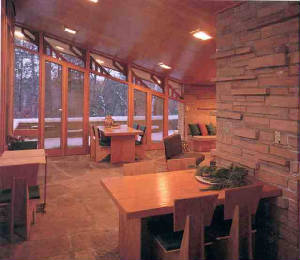
CottageInterior01.jpg.w300h260.jpgNot being a student or critic of architecture, I can’t say anything more informative about the design of the cottage than what Paul Goldberger wrote about it in 1994:

The house is Frank Lloyd Wright boiled down to his essence: Powerful geometric form; low, contained spaces played off against exuberantly high ones; a sense of natural materials put together into a composition that at once seems to hug the earth and blast off from it. From the outside, it is at once serene and energetic. A solid section of stone, barely bigger than a chimney, anchors the center. The low horizontal of the bedroom ceiling comes off from one side, and the high, raked roof of the living-dining room bursts out from the other. The solids and the voids, the lows and the highs, the horizontals and the verticals, are in harmony.

2857971206_5fc36fb57c.jpgThe last word of that passage put me in mind of the exquisite lines from The Merchant of Venice that Ralph Vaughan Williams set in his Serenade to Music: Here will we sit and let the sounds of music/Creep in our ears: soft stillness and the night/Become the touches of sweet harmony. As my beloved spouse and I sat in the soft stillness of the Wisconsin night, we felt the sweet harmony of the Peterson Cottage, in which the built and natural worlds resonate in perfect concord.

Careworn and road-weary though we both are, I doubt that Mrs. T and I have ever been much happier than we are today.

* * *

Sir Henry Wood conducts the BBC Symphony in the first recording of Serenade to Music:

Posted August 31, 12:00 AM

TT: Snapshot

David Cromer, who was named a MacArthur Fellow in 2010, talks about his work as a stage director in a MacArthur Foundation interview:

(This is the latest in a weekly series of arts-related videos that appear in this space each Wednesday.)

Posted August 31, 12:00 AM

TT: Almanac

"Beauty is an ecstasy; it is as simple as hunger. There is really nothing to be said about it."

W. Somerset Maugham, Cakes and Ale

Posted August 31, 12:00 AM

August 30, 2011

TT: The man within

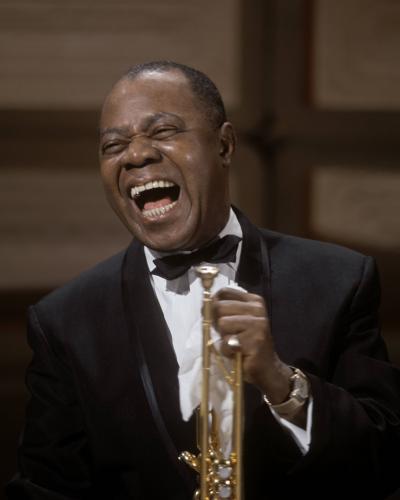
I got an e-mail the other day from Dennis Neal, the Florida actor who is creating the double role of Louis Armstrong and Joe Glaser in Satchmo at the Waldorf, my first play, which opens next month in Orlando. “I have been preparing twenty-five years and a lifetime to tell this story,” he said. “You really can’t imagine how profoundly this has affected me.” Dennis is absolutely right. No matter how hard I try, I know I won’t be able to come close to imagining what it will feel like for him to play Armstrong on stage.

louis-armstrong-KGZN_o_tn.jpgYes, I wrote both the script of the play and the biography on which Satchmo at the Waldorf is loosely based, and I think that I have a pretty good understanding of what made Louis Armstrong tick. Like everyone who knew him, I find his character to be wholly sympathetic, and I believe that my experience as a working jazz musician has given me a solid grasp of the wellsprings of his artistry. That said, I wouldn’t claim to identify with Armstrong in anything more than a superficial way, if only because our lives were so very diffferent. I come from a middle-class family and was born and raised in a small Missouri town. Armstrong was born in black Storyville, the roughest part of turn-of-the-century New Orleans, and was raised by a part-time prostitute. What’s more, Mayann Armstrong was a single mother, for her son’s natural father deserted him when he was a baby.
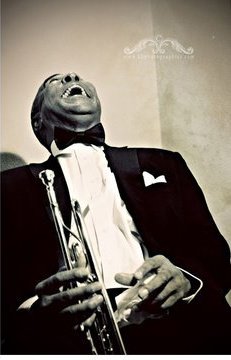
So while I do think that I understand Armstrong reasonably well, I can’t even begin to know what it would have felt like to be him. Not so Dennis. To be sure, he wasn’t born in black Storyville or raised by a whore, but he’s seen things that I’ve only read about in books, and my guess is that this will give him a kind of access to Armstrong’s interior life that I can only attempt to simulate from the outside in.

DENNIS%20PIX%20%283%2C%20LAUGHING%29.jpgWhat makes all this so important is that Dennis’ job is to get up in front of an audience and embody Armstrong. I did a certain amount of acting in my youth, and though I wasn’t particularly good at it, I do know what it feels like to play a part. It’s nothing like putting on a mask: you have to meld with the character you’re playing, using elements of your own experience to bring his personality to life.
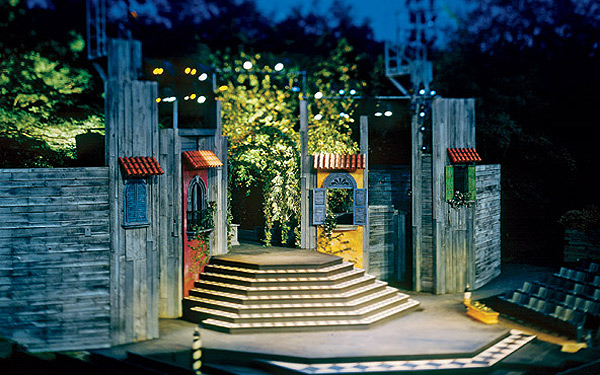
Because I’m so closely acquainted with Armstrong’s habits of speech, I was able to write dialogue for for him that sounds natural, and I think I was also able to create a “voice” for Joe Glaser that is equally convincing. (It helped that I was able to listen to an informal radio interview with Glaser that was taped off the air in the Fifties, the only surviving recording of his speaking voice.) I can assure you, however, that none of the dialogue in Satchmo at the Waldorf sounds at all natural when I read it out loud, and I expect you’d be reduced to helpless laughter were I to stand up in front of you and try to act out a scene from the play. But having watched Dennis perform the first forty-five minutes of Satchmo at the Waldorf in a workshop performance earlier this year, I haven’t the slightest doubt that the only time he’ll make the audience laugh is when he’s supposed to do so.

I hasten to point out that Dennis isn’t going to be impersonating Armstrong or Glaser. That’s not what I want. As I explain in the stage directions:

The roles of Louis Armstrong and Joe Glaser are played by the same actor. He need not resemble either man physically and should suggest Armstrong’s voice rather than imitating it.

“I don’t want you to be Rich Little doing Satchmo,” I said to Dennis when we met for the first time back in February. “I want you to be an actor. I want you to create your Armstrong and your Glaser.”

“That’s just what I wanted to hear,” he replied with a smile. And it’s just what I expect to see when I fly down to Orlando next Saturday and sit in on my first rehearsal of Satchmo at the Waldorf.

Posted August 30, 12:00 AM

TT: Almanac

"Beauty is unbearable, drives us to despair, offering us for a minute the glimpse of an eternity that we should like to stretch out over the whole of time."

Albert Camus, Notebooks 1935-42

Posted August 30, 12:00 AM

August 29, 2011

TT: News of a wandering critic

C0409_Getaways9.jpgMrs. T and I continue to live out of our suitcases. On Friday we made it to Spring Green, Wisconsin, after spending three unscheduled days in Smalltown, U.S.A., with my mother, who is recovering from her third operation in as many months. Her prospects, unlikely as it may sound, are extremely good.
Once it was evident that she was on the mend, we headed north to see three shows at American Players Theatre, a summer festival that specializes in the classics and isn’t nearly as well known as it ought to be. It’s become one of our regular stops, and we were exceedingly glad to get there, partly because we were desperately tired of running around and partly because one of our favorite people, Keiran Murphy, lives in Spring Green and works at Taliesin, Frank Lloyd Wright’s rural Wisconsin estate. We took Keiran to the last of our three shows, The Critic, yesterday afternoon, then staggered back to our hotel and fell into (A) the hot tub and (B) bed.

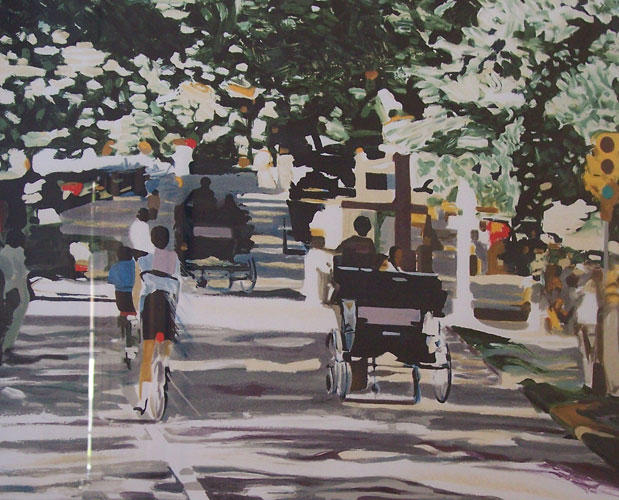
Tony_Bennett_Sunday_In_Central_Park.jpgToday is what theater people call a “dark day,” meaning that we don’t have any shows to see. Mrs. T has the day off, but I have to write, so I got up early, ate breakfast, and knocked out Friday’s Wall Street Journal drama column, after which I started working on a Commentary essay about Tony Bennett, who is the subject of a newly published biography. It happens that Bennett is not only one of the greatest pop singers who ever lived but an amateur painter of no small accomplishment. (The canvas reproduced here, “Sunday in Central Park,” is one of his best efforts.) I plan to say a little something about his work in that area if space permits.

Now I need to get back to work, for Mrs. T and I are pulling up stakes again tomorrow morning, and I want if at all possible to finish the Bennett essay before we leave. I’ll say more about where we’re going when we get there!

Posted August 29, 12:25 PM

TT: Just because

Emil Gilels plays Prokofiev's Third Piano Sonata in concert at the Moscow Conservatory in 1979:

Posted August 29, 12:00 AM

TT: Almanac

"There is a road from the eye to the heart that does not go through the intellect. Men do not quarrel about the meaning of sunsets; they never dispute that the hawthorn says the best and wittiest thing about the spring."

G.K. Chesterton, "A Defence of Heraldry"

Posted August 29, 12:00 AM

August 26, 2011

TT: The glorious tragedy of Julia Caesar

In today’s Wall Street Journal I file the first of two reports from the Oregon Shakespeare Festival. This week I review three shows, Julius Caesar, Measure for Measure, and The Pirates of Penzance. Here’s an excerpt.

* * *

The modern-dress “Julius Caesar” that Orson Welles brought to Broadway in 1937 continues to cast a long shadow. By turning the play into a contemporary parable of fascism on the march, Welles raised the curtain on the high-concept production style that now dominates Shakespeare staging throughout the world. I don’t know whether Amanda Dehnert had Welles in mind when she created her own modern-dress version of “Julius Caesar” for the Oregon Shakespeare Festival, but it’s very much in the tradition of that legendary production, albeit with a few postmodern frills, foremost among them the casting of a woman actor, Vilma Silva, in the title role. It is also the best “Julius Caesar” I’ve ever seen, a stark parable of good intentions run amok that has the attention-grabbing power of a hand grenade lobbed into a crowded room.

JCJCJC.jpgPerformed in the round on a bare stage decorated with crudely lettered agitprop pennants and a few battered kitchen chairs, Ms. Dehnert’s “Julius Caesar” has a deceptively improvisational air. All of the roles are played by a compact ensemble of 11 actors who switch casually from part to part. It’s as if you’re watching a performance that’s been thrown together on the spot—but Robert Peterson’s ultra-meticulous lighting design leaves no doubt of the forethought that has gone into this production. Every detail registers with ideal clarity, yet it never feels as though the play is being bent out of shape to make anachronistic political points….

Bill Rauch, Oregon Shakespeare’s artistic director, is equally enamored of high-concept productions, and no less adept than Ms. Dehnert at charging his concepts with theatrical life—though on paper they sometimes seems obvious to the point of triteness. I mean, who wants to sit through a “Measure for Measure” that’s set in a sterile-looking corporate meeting room at the dawn of the leisure-suit era? Capitalism, boo! Humanism, yay! But Mr. Rauch knows his business, and this smart, swift, refreshingly unpredictable “Measure” is one of his finest efforts yet. Not only is every detail of the transposition from Vienna circa 1600 to corporate America circa 1970 worked out with rigorous comic logic, but the cast is fabulously good, especially Stephanie Beatriz, who plays Isabella with spitfire energy. Mr. Rauch’s Vienna, by the way, is a bilingual border town, and the incidental music is supplied by Las Colibrí, a terrific all-female mariachi trio from Los Angeles whose pungently melancholy songs are a major contribution to the total effect of the production.

Mr. Rauch’s version of “The Pirates of Penzance” is another superior staging, a farcical romp that benefits from the lively choreography of Randy Duncan and the riotously colorful costumes of Deborah M. Dryden. Even the 14-piece orchestra, led by Daniel Gary Busby, plays exceptionally well, a rarity for a regional-theater musical, and the singing, if far from operatic, is more than serviceable….

* * *

Read the whole thing here.

The members of Las Colibrí talk about their contribution to Measure for Measure:

Posted August 26, 12:00 AM

TT: Almanac

"Never mind your happiness; do your duty."

Will Durant, The Story of Philosophy

Posted August 26, 12:00 AM

August 25, 2011

TT: For those who've asked

My mother had two major operations in the past few days to relieve and repair an intestinal blockage. Amazingly--though I guess we shouldn't be surprised at such things anymore--she appears yet again to be recovering with unexpected speed. Indeed, her doctors have assured me that it's now safe for Mrs. T and I to resume our travels, so we'll be heading up to Wisconsin tomorrow to see three performances by American Players Theatre, though you can bet that we'll be keeping our cellphones on.

I'll keep you posted. In the meantime, heartfelt thanks to all those who wrote or posted with good wishes.

Posted August 25, 9:26 AM

TT: So you want to see a show?

Here's my list of recommended Broadway, off-Broadway, and out-of-town shows, updated weekly. In all cases, I gave these shows favorable reviews (if sometimes qualifiedly so) in The Wall Street Journal when they opened. For more information, click on the title.

BROADWAY:
Anything Goes (musical, G/PG-13, mildly adult subject matter that will be unintelligible to children, closes Jan. 8, all performances sold out last week, reviewed here)
How to Succeed in Business Without Really Trying (musical, G/PG-13, perfectly fine for children whose parents aren't actively prudish, all performances sold out last week, reviewed here)

OFF BROADWAY:
Avenue Q (musical, R, adult subject matter and one show-stopping scene of puppet-on-puppet sex, reviewed here)
The Fantasticks (musical, G, suitable for children capable of enjoying a love story, reviewed here)
Million Dollar Quartet (jukebox musical, G, off-Broadway remounting of Broadway production, original run reviewed here)

IN WASHINGTON, D.C.:
Oklahoma! (musical, G, remounting of 2010 production, suitable for children, closes Oct. 2, original run reviewed here)

CLOSING SOON IN EAST HADDAM, CONN.:
Show Boat (musical, G, suitable for bright children, closes Sept. 17, reviewed here)

CLOSING NEXT WEEK IN GARRISON, N.Y.:
The Comedy of Errors (Shakespeare, PG-13, suitable for bright children, closes Sept. 4, reviewed here)
Hamlet (Shakespeare, PG-13, closes Sept. 3, reviewed here)

CLOSING NEXT WEEK IN LENOX, MASS:
As You Like It (Shakespeare, G/PG-13, closes Sept. 4, reviewed here)
The Memory of Water (serious comedy, PG-13, some adult subject matter, closes Sept. 4, reviewed here)
Romeo and Juliet (Shakespeare, G/PG-13, violence and some adult subject matter, closes Sept. 3, reviewed here)

CLOSING NEXT WEEK ON BROADWAY:
Master Class (drama, G/PG-13, not suitable for children, closes Sept. 4, most performances sold out last week, reviewed here)

Posted August 25, 12:00 AM

TT: Almanac

"Large organizations cannot be versatile. A large organization is effective through its mass rather than through its agility. Fleas can jump many times their own height, but not an elephant."

Peter F. Drucker, The Age of Discontinuity

Posted August 25, 12:00 AM

August 24, 2011

TT: Snapshot

A 1937 March of Time feature about the Original Dixieland Jazz Band:

(This is the latest in a weekly series of arts-related videos that appear in this space each Wednesday.)

Posted August 24, 12:00 AM

TT: Almanac

"It's not the tragedies that kill us, it's the messes."

Dorothy Parker, interview, The Paris Review (Summer 1956)

Posted August 24, 12:00 AM

August 23, 2011

TT: Almanac

"A really good picture looks as if it's happened at once."

Helen Frankenthaler (quoted in Barbara Rose, Frankenthaler)

Posted August 23, 12:00 AM

August 22, 2011

TT: We interrupt this program...

128982936420699013.jpgMrs. T and I spent most of last week seeing four plays at the Oregon Shakespeare Festival. Today we drive back to Portland, then fly from there to Chicago. We were supposed to spend the night at an airport hotel, then drive up to Spring Green, Wisconsin, home of American Players Theatre and Frank Lloyd Wright’s Taliesin, there to spend another week seeing another four plays.

Life, however, dealt us a fresh hand: my mother had emergency surgery in Missouri on Sunday afternoon and will likely have a second operation on Tuesday. It isn't easy to get from southern Oregon to southeast Missouri, so we won't be arriving in Smalltown, U.S.A. until well after midnight.

Needless to say, that’s a whole lot of travel, and we expect to be completely worn out by the time we finally get where we’re going, so don’t expect anything more than brief updates for the rest of the week.

For now, I’ll pass on a posting by Levi Stahl, who’s gotten hold of the new University of Chicago Press paperback editions of Richard Stark’s Flashfire and Firebreak and likes my introductions. He’s ahead of me: I’ve been on the road for the past couple of weeks and have yet to see finished copies of either book.

As for the week just past, suffice it to say that I’m exceedingly partial to Ashland, home of the Oregon Shakespeare Festival. The only reason why I’m not sorry to say goodbye is that I like Spring Green just as much, and with a little bit of luck--well, maybe a whole lot of luck--we'll be there by Friday night.

More anon.

330370_10150364411317193_652497192_9733661_3835182_o.jpgP.S. Mrs. T took this photo outside the Oregon Shakespeare Festival's New Theatre, where we saw Amanda Dehnert's production of Julius Caesar on Friday. The courtyard and lobby are decorated with similar posters of various politicians who have been assassinated. It amused Mrs. T to see me standing next to Che Guevara, especially in light of the fact that the city where we saw the play in question is popularly known among its own residents as "The People's Republic of Ashland." (Earlier that day I'd seen a teenage boy wearing a T-shirt emblazoned with that very nickname.)

I really do love Ashland. Mostly. Usually. Frequently.

Posted August 22, 12:00 AM

TT: Just because

Carmen McRae sings Alec Wilder's "Trouble Is a Man" on Jazz Casual, originally telecast in 1962:


Posted August 22, 12:00 AM

TT: Almanac

"As much as gastronomy applauds novelty, it is based in equal part on nostalgia. In the mind, food, being an ephemeral creation prepared from ephemeral materials, is necessarily located in the past, and there is a tendency to believe that the best must behind us; that, in a sort of theory of epicurean entrophy, flavor and goodness are ebbing as time moves forward."

Robert Clark, James Beard: A Biography

Posted August 22, 12:00 AM

August 19, 2011

MAKING SHAKESPEARE SING: A MODEST PROPOSAL FOR A COSTLY FESTIVAL

Sure, it’s interesting to read about how Verdi and Britten turned three of Shakespeare's greatest plays into equally great operas, but wouldn't it be even more interesting to see the plays and operas side by side? Needless to say, such an undertaking would be both cruelly expensive and logistically nightmarish, but it could be done in a festival setting—and New York's Lincoln Center Festival and Washington's Kennedy Center are both capable of making it happen…”

Posted August 19, 2:26 AM

TT: Young prince in a jam

In today's Wall Street Journal I report on two of this summer's Hudson Valley Shakespeare Festival productions, Hamlet and The Comedy of Errors. Here's an excerpt.

* * *

How old is Hamlet? That's neither a joke nor a riddle, but a question that anyone who stages the most celebrated of Shakespeare's tragedies must start by answering. We know that Hamlet is a prince, which presumably (though not necessarily) means that he's a young man. We also know that he's in love with Ophelia, who is clearly a girl on the brink of womanhood. But "Hamlet" poses formidable challenges for the actor who plays the title role, and the play's extreme familiarity makes them all the more daunting. If you cast an experienced performer as Hamlet, you run the risk of lessening the verisimilitude of the production--but no unseasoned actor, however promising, can do much more than sketch the outlines of so complex a part.

HAMPIC.jpgSo what to do? Terrence O'Brien, the artistic director of the Hudson Valley Shakespeare Festival, chose not to split the difference when casting the 25-year-old company's first "Hamlet." Not only is Matthew Amendt very young--this is his second season with the festival--but most of the other parts are played by similarly fresh-looking faces, and Mr. O'Brien underlines their youth by accompanying the show with thunderous heavy-metal rock (plus a regal-sounding fanfare borrowed from William Schuman's "George Washington Bridge"). Yet this is by no means a trendy "Hamlet," for Mr. O'Brien, as is his wont, has steered clear of the conceptual approach beloved of today's Shakespeare directors. His staging is unapologetically, even aggressively plain, and every detail of the play has been rethought from scratch, with ever-surprising results. Even the modern-dress costumes of Charlotte Palmer-Lane have an unexpected touch of dandyishness. The results are a bit raw but altogether involving. I've never seen a more attentive "Hamlet" audience--or heard a quieter one.

Mr. Amendt is already more than good enough to make you wonder what he'll be doing, and where he'll be doing it, five years down the road. He looks more than a bit like Matt Dillon, and he brings to the part a bitingly sarcastic tone that is as contemporary as his physical appearance....

Hudson Valley's institutional knack for zaniness, of which occasional flashes can be seen in "Hamlet," is given free rein in Kurt Rhoads' circus-themed production of "The Comedy of Errors," in which we meet such cartoonish characters as a magenta-bearded lady (Katie Hartke), an eye-shadowed mermaid in a wheelchair (Valeri Mudek) and a three-breasted courtesan (Maura Clement). Looniest of all are the two Dromios, Nance Williamson and Gabra Zackman, whom Mr. Rhoads and Amy Clark, the costume designer, have made over in the surreal image of Pat, the androgyne played by Julia Sweeney on "Saturday Night Live."

All this trickery goes well with the broad-brush slapstick of Shakespeare's most concise comedy...

* * *

Read the whole thing here.

Posted August 19, 12:00 AM

TT: Making Shakespeare sing

While we're on the subject of the immortal bard, my “Sightings” column for today’s Wall Street Journal consists of a modest Shakespeare-related proposal for Lincoln Center and Kennedy Center. Here’s an excerpt.

* * *

thompson2.jpgHow do you write a successful opera? Most well-known operas, like most well-known musicals, are adapted from equally well-known plays or novels. And who is the most famous writer of all time? William Shakespeare! So all you have to do is take a Shakespeare play and turn it into an opera…and what could be easier? Just add great music and you’ve got a hit. Right?

Er, no. Not even close.

Consider the odds. To date, some 200 operas have been based on Shakespeare’s plays. Only two of them, Giuseppe Verdi’s “Otello” (1887) and “Falstaff” (1893, based on “The Merry Wives of Windsor”), are solidly entrenched in the international opera-house repertoire. A handful of others, the best of which are Verdi’s “Macbeth” (1847) and Benjamin Britten’s “A Midsummer Night’s Dream” (1960), are revived with fair frequency. The rest are forgotten. Clearly, anybody who thinks that setting Shakespeare is a sure-fire recipe for success needs to think again—and again and again.

91012-9D.jpgAs for the second part of the “recipe,” you have to do more to a Shakespeare play than add music—even great music—to turn it into a opera that works in the theater….

Writing an opera based on a familiar literary source, be it by Shakespeare or Maugham or Lillian Hellman, demands a far-reaching imaginative transformation of the original text, one that goes beyond the mere setting of old words to new music. In writing the libretti for “Falstaff” and “Otello,” for instance, Arrigo Boito freely translated Shakespeare’s English words into Italian, adding ideas of his own that were inspired by Shakespeare. Sacrilege? Not at all. That very freedom made it possible for Boito to steer clear of a literal approach to “The Merry Wives of Windsor” and “Othello” and write the beautifully crafted libretti that inspired Verdi to compose his two greatest operas….

Are you thinking what I’m thinking? Sure, it’s interesting to read about how Verdi and Britten turned three of Shakespeare’s greatest plays into equally great operas, but wouldn’t it be even more interesting to see the plays and operas side by side? Needless to say, such an undertaking would be both cruelly expensive and logistically nightmarish, but it could be done in a festival setting—and New York’s Lincoln Center Festival and Washington’s Kennedy Center are both capable of making it happen….

* * *

Read the whole thing here.

Posted August 19, 12:00 AM

TT: Almanac

"We only do well the things we like doing."

Colette, Prisons and Paradise

Posted August 19, 12:00 AM

August 18, 2011

TT: Two little tastes

262801_120667591365534_103982393034054_121372_376707_n.jpgAs the September 15 premiere of Satchmo at the Waldorf draws nearer in Orlando, Florida, Dennis Neal, the star, has e-mailed me a copy of the poster that will be used for the show. I know appearances aren’t everything, but I can’t see how anyone wouldn’t want to buy a ticket after seeing this gorgeous piece of work.

I’ve been meaning to post an excerpt from the script, but Satchmo at the Waldorf is not suitable for families--unless, of course, you’re the sort of parent who wouldn’t think twice about taking the kids to see American Buffalo--and this blog has long had a policy of not printing certain high-voltage words. Fortunately, though, there are a couple of speeches that are reasonably clean, so I thought I’d share one of them with you. It comes from the second act, in which Louis Armstrong is looking back on his childhood from the vantage point of old age. (The play is set in a dressing room at the Waldorf-Astoria, where Armstrong played in public for the last time four months before his death in 1971.)

Here it is:

Fragments of Armstrong’s music play softly in the background, as if they were being heard from far off.

ARMSTRONG (over the music) The block in New Orleans where I was born was so tough, they done called it “The Battleground.” One-room shack, outhouse in back, wash in a laundry tub. My sister and me, we use to go through the garbage cans out back of all them fine restaurants, pick through ’em for the taters and onions wasn’t too spoiled, bring ’em home to Mayann. But we didn’t eat ’em. Oh, no—we dressed ’em. Cut off all the spoiled parts, then I go out and sell ’em to them other restaurants, the ones ain’t so fine, bring back a little extra change to go with the coal money.

Sometimes I go to sleep at night and dream about going through them garbage cans, hope to find a couple taters ain’t too rotten to take home. ’Bout riding the junk wagon and driving my mule. Sometimes I dream about the music I heard in the street when I was a kid. Or I dream I’m lying in bed at the Waif’s Home, smelling the magnolias and the honeysuckle through the window after they put the lights out. I can smell ’em now, just like I’m there. Smell ’em in the middle of the night and I say to myself, what’m I doing sleeping in a suite in the Waldorf? How’d I get so lucky?

Luck’s a funny thing. Poor old Joe Oliver, he done run shit outta luck. Teeth went bad on him, couldn’t play his horn no more. Went back down south, busted flat. I was touring with the band in Savannah, walking down the street, see this sad old cat pushing a vegetable cart, and it’s Papa Joe. Like to broke my heart. I gave him all the money I had in my pocket. Boys in the band all did the same. That night he come to this colored dance we playing and he was dressed up fine, looking sharp, holding his head up high.

That was the last time I saw Papa Joe. He died pretty soon after that. Didn’t have no luck. I had all the luck….

If you like how that sounds, come on down to Orlando and see the show!

UPDATE: For those who asked about the poster, the creative director is Bryan Kriekard and the designer is Blake Everingham. Thanks, guys!

* * *

Louis Armstrong and Duke Ellington perform Ellington’s “Azalea” in 1962. The lyrics, also by Ellington, were inspired by Armstrong’s memories of the flowers that bloomed in the New Orleans of his youth:

Posted August 18, 12:00 AM

TT: So you want to see a show?

Here's my list of recommended Broadway, off-Broadway, and out-of-town shows, updated weekly. In all cases, I gave these shows favorable reviews (if sometimes qualifiedly so) in The Wall Street Journal when they opened. For more information, click on the title.

BROADWAY:
Anything Goes (musical, G/PG-13, mildly adult subject matter that will be unintelligible to children, closes Jan. 8, all performances sold out last week, reviewed here)
How to Succeed in Business Without Really Trying (musical, G/PG-13, perfectly fine for children whose parents aren't actively prudish, all performances sold out last week, reviewed here)

OFF BROADWAY:
Avenue Q (musical, R, adult subject matter and one show-stopping scene of puppet-on-puppet sex, reviewed here)
The Fantasticks (musical, G, suitable for children capable of enjoying a love story, reviewed here)
Million Dollar Quartet (jukebox musical, G, off-Broadway remounting of Broadway production, original run reviewed here)

IN EAST HADDAM, CONN.:
Show Boat (musical, G, suitable for bright children, closes Sept. 17, reviewed here)

IN WASHINGTON, D.C.:
Oklahoma! (musical, G, remounting of 2010 production, suitable for children, closes Oct. 2, original run reviewed here)

CLOSING SOON ON BROADWAY:
Master Class (drama, G/PG-13, not suitable for children, closes Sept. 4, most performances sold out last week, reviewed here)

CLOSING SOON IN LENOX, MASS:
As You Like It (Shakespeare, G/PG-13, closes Sept. 4, reviewed here)
The Memory of Water (serious comedy, PG-13, some adult subject matter, closes Sept. 4, reviewed here)
Romeo and Juliet (Shakespeare, G/PG-13, violence and some adult subject matter, closes Sept. 3, reviewed here)

CLOSING SATURDAY IN OGUNQUIT, ME.:
The Music Man (musical, G, suitable for children, reviewed here)

Posted August 18, 12:00 AM

TT: Almanac

"Total absence of humor renders life impossible."

Colette, Chance Acquaintances

Posted August 18, 12:00 AM

August 17, 2011

TT: Family album

WATER%20TOWER%20AND%20ODD%20FELLOWS%20SIGN.jpgI'm relieved to report that Mrs. T and I finally made it to Oregon! Today we're driving from Portland to Ashland, home of the Oregon Shakespeare Festival. We'll spend a week there, after which we fly to Chicago and drive north to American Players Theatre in Spring Green, Wisconsin, about which more in due course.

In the meantime, I thought you might enjoy seeing some pictures of the place where I've been spending the past few days. If, like me, you were born in a small town that never got any bigger, loved your parents in a more or less uncomplicated way, and had a mostly happy childhood, then there's a good chance that you'll spend a fair amount of your middle age remembering with fondness what it felt like to grow up. I did and I do, and I love seeing what my home town looked like when I was young.

Just the other day I joined a Facebook page started by some anonymous benefactor who posted dozens of old photographs of Smalltown. Here are a few of my favorites:

COTTON%20CARNIVAL%20PARADE%2C%20SIXTIES.JPG

ARRIVAL%20OF%20THE%20INDIAN.jpg

EL%20CAPRI%2C%20DINING%20ROOM.jpg

COW%20BELL%20%28INTERIOR%29.jpg

OLD%20METHODIST%20CHURCH%20%28SIDE%20VIEW%29.jpg

DRIVE-IN.jpg

Posted August 17, 12:00 AM

TT: Snapshot

Francia Russell talks about George Balanchine's Concerto Barocco and rehearses it with the Dutch National Ballet:

(This is the latest in a weekly series of arts-related videos that appear in this space each Wednesday.)

Posted August 17, 12:00 AM

TT: Almanac

"Her childhood, then her adolescence, had taught her patience, hope, silence and the easy manipulation of the weapons and virtues of all prisoners."

Colette, Chéri

Posted August 17, 12:00 AM

August 16, 2011

TT: Just because

Anita O'Day and Roy Eldridge perform "Let Me Off Uptown" with the Gene Krupa Orchestra in 1942:

Posted August 16, 12:00 AM

TT: Almanac

"Whether you are dealing with an animal or a child, to convince is to weaken."

Colette, The Pure and the Impure

Posted August 16, 12:00 AM

August 15, 2011

TT: They call it stormy Sunday

peanuts-aargh-baseball.jpgI was supposed to fly from St. Louis to New York on Sunday, collect Mrs. T, then proceed on Monday to the Oregon Shakespeare Festival. Alas, the weather failed to cooperate, and my flight to New York was summarily canceled, forcing me to spend an unscheduled night at an airport hotel, dining on free hot dogs, enjoying Turner Classic Movies and the hot tub, and trying not to think about the next day’s forecast any more than I could help.

Alas, I have no idea where I’ll be by the time you read these words. Should my luck improve significantly, I’ll fly into LaGuardia Airport on Monday morning, take a cab to Kennedy Airport, meet Mrs. T there, and head for Oregon. If not…well, I haven’t a clue. And even if my luck does hold, it means that I’ll be flying halfway across the country in one direction, then turning around and flying all the way across the country in the other direction. The only thing of which I’m sure is that a thoroughly lousy day awaits me.

More as it happens, unless I’m paralyzed by despair and/or exasperation.

Posted August 15, 12:00 AM

TT: Revisiting an old friend

220px-Jacques_Humbert_-_Colette.jpgIt's been quite a while since I last read anything by Colette, one of my favorite writers, so I recently decided to spend some time getting reacquainted with her, and this week's almanac entries will reflect the fruits of my labor (if that's the word for so pleasurable a task).

In addition to being a remarkable writer, Colette was also one of the most photogenic artists of the twentieth century, not merely in her youth but long after arthritis had gnarled her features and condemned her to an indoor life of immobility and pain. The painting that you see above (the artist is Jacques Humbert) dates from 1896, and shows her as a beautiful young woman, teetering on the edge of knowingness. The second image is a reproduction of a photographic portrait of Colette shot by Irving Penn in 1951. Both images capture something of her intriguing, ever-elusive essence.

penn_ss6.jpgI also spent a few minutes trolling through YouTube in search of Colette-related video, and came up with two clips from Colette, a film documentary made in 1951 by Yannick Bellon. (Yes, it's in French, but it's subtitled.) Alas, I can't embed the clips, but you can view them by going here and here. Colette herself appears on camera and can be heard speaking in both sequences, the second of which is a survey of her fascinating career as a music-hall performer.

If you happen to be a Francophone, you can also listen to a 1950 radio program about Colette by going here. The piece of music heard at the beginning is Ravel's Jeux d'eau.

* * *

The Glyndebourne Festival's 1987 production of Maurice Ravel's L'enfant et les sortilèges, designed by Maurice Sendak, directed by Frank Corsaro, and conducted by Simon Rattle. The libretto is by Colette:

Posted August 15, 12:00 AM

TT: Almanac

"To a poet, silence is an acceptable response, even a flattering one."

Colette, Paris from My Window

Posted August 15, 12:00 AM

August 12, 2011

TT: The good old bad old days

In today's Wall Street Journal I report on the new off-Broadway production of Rent. Here's an excerpt.

* * *

Fifteen years ago, Jonathan Larson's "Rent" was the hippest musical on Broadway--which wasn't saying much. Virtually all of the musicals that opened there in the '90s were totally forgettable and are deservedly forgotten. "Rent," on the other hand, is well remembered, partly because it stayed open until 2008 and partly because it was the most influential show of the post-Sondheim era, a rock musical that contrived to put AIDS, drug addiction, drag queenery and homo- and bisexuality onstage without simultaneously putting off the tourist trade. Nor does its 5,123-performance Broadway run appear to have exhausted the marketability of "Rent." A new Off-Broadway production has just opened at New World Stages, the complex to which "Avenue Q" transferred two years ago after its own long run on Broadway.

tumblr_lox5tvNThy1qbrhvdo1_250.jpgDespite the fact that Michael Greif, the show's first director, has restaged it, this "Rent" is not a remounting but a true revival, featuring an all-new cast and freshly designed sets by Mark Wendland whose metal scaffolding echoes the fire-escape motif of Oliver Smith's now-legendary décor for "West Side Story." At the same time, no attempt has been made to update the show, and its overall effect is essentially the same. All that's changed is the people in the audience: They're still young, but precisely because they're so youthful, Mr. Larson's affectionate portrait of bohemian New York in the early '90s clearly comes across to them not as an exercise in nostalgia for the good old bad old days but as a theme-park recreation of a world they never knew. They might as well be watching "Woodstock"--or "West Side Story," for that matter.

And what of the show itself? If you were following the theater scene in 1996, you'll remember the wild hoopla that greeted the opening of "Rent," which snagged the best-musical Tony and even won a Pulitzer Prize. No doubt the fact that Mr. Larson died the day after the dress rehearsal for the original Off-Broadway production had something to do with the show's enthusiastic reception, but to revisit "Rent" a decade and a half after the fact is to suspect that its drag-queens-are-people-too subject matter was the real source of its popularity. Viewed in the harsh light of hindsight, "Rent" is by turns chirpy and sentimental...

* * *

Read the whole thing here.

Posted August 12, 12:00 AM

TT: Almanac

"A sense of security, of well-being, of summer warmth pervades my memory. That robust reality makes a ghost of the present. The mirror brims with brightness; a bumblebee has entered the room and bumps against the ceiling. Everything is as it should be, nothing will ever change, nobody will ever die."

Vladimir Nabokov, Speak, Memory

Posted August 12, 12:00 AM

August 11, 2011

TT: So you want to see a show?

Here's my list of recommended Broadway, off-Broadway, and out-of-town shows, updated weekly. In all cases, I gave these shows favorable reviews (if sometimes qualifiedly so) in The Wall Street Journal when they opened. For more information, click on the title.

BROADWAY:
Anything Goes (musical, G/PG-13, mildly adult subject matter that will be unintelligible to children, closes Jan. 8, all performances sold out last week, reviewed here)
How to Succeed in Business Without Really Trying (musical, G/PG-13, perfectly fine for children whose parents aren't actively prudish, all performances sold out last week, reviewed here)

OFF BROADWAY:
Avenue Q (musical, R, adult subject matter and one show-stopping scene of puppet-on-puppet sex, reviewed here)
The Fantasticks (musical, G, suitable for children capable of enjoying a love story, reviewed here)
Million Dollar Quartet (jukebox musical, G, off-Broadway remounting of Broadway production, original run reviewed here)

IN EAST HADDAM, CONN.:
Show Boat (musical, G, suitable for bright children, closes Sept. 17, reviewed here)

IN WASHINGTON, D.C.:
Oklahoma! (musical, G, remounting of 2010 production, suitable for children, closes Oct. 2, original run reviewed here)

CLOSING SOON ON BROADWAY:
Master Class (drama, G/PG-13, not suitable for children, closes Sept. 4, most performances sold out last week, reviewed here)

CLOSING SOON IN LENOX, MASS:
As You Like It (Shakespeare, G/PG-13, closes Sept. 4, reviewed here)
The Memory of Water (serious comedy, PG-13, some adult subject matter, closes Sept. 4, reviewed here)
Romeo and Juliet (Shakespeare, G/PG-13, violence and some adult subject matter, closes Sept. 3, reviewed here)

CLOSING NEXT WEEK IN OGUNQUIT, ME.:
The Music Man (musical, G, suitable for children, closes Aug. 20, reviewed here)

CLOSING SUNDAY OFF BROADWAY:
As You Like It (Shakespeare, G/PG-13, reviewed here)

Posted August 11, 12:00 AM

TT: Almanac

"We sink too easily into stupid and overfed sensuality, our bodies thickening even more quickly than our minds."

M.F.K. Fisher, Serve It Forth

Posted August 11, 12:00 AM

August 10, 2011

TT: Snapshot

Sean Connery and Zoe Caldwell in a scene from Macbeth, telecast by the CBC in 1961:

(This is the latest in a weekly series of arts-related videos that appear in this space each Wednesday.)

Posted August 10, 12:00 AM

TT: Almanac

"I do not want people to be very agreeable, as it saves me the trouble of liking them a great deal."

Jane Austen, letter to her sister Cassandra (Dec. 24, 1798)

Posted August 10, 12:00 AM

August 9, 2011

TT: A trip to the country

Here's where I took my mother this afternoon:

COVERED%20BRIDGE

Posted August 09, 5:37 PM

TT: Inch by inch

Satchmo at the Waldorf, my first play, opens in Orlando on September 15. Dennis Neal and Rus Blackwell, the star and director, are preparing for the premiere as I write these words. Meanwhile, I'm spending the week in Smalltown, U.S.A., wondering what they're up to.

DENNIS%20AS%20SATCHMO%20%28KRISTEN%20WHEELER%29.jpgYesterday Dennis sent me this wonderfully vivid publicity photo by Kristen Wheeler that shows him in costume as Louis Armstrong, one of the two roles that he'll be playing in Satchmo at the Waldorf (the other is Joe Glaser, Armstrong's manager). No sooner did I open his e-mail than I felt a surge of jealousy sweep through me. How come Dennis and Rus get to have all the fun down there in sunny Florida while I sit around twiddling my thumbs?

Of course, I'm not exactly taking it easy. I'll be flying to the West Coast next Monday to spend a week at the Oregon Shakespeare Festival, after which I head to Wisconsin for a week at Spring Green's American Players Theatre. But as much as I'm looking forward to both trips, what I'd really like to be doing right now is sitting in the Orlando rehearsal room where my colleagues are starting to bring my play to life.

Alas, I can't make it to Florida until a week before opening night, and I expect that the time between now and then will pass with increasingly agonizing slowness. But at least I have this picture to remind me that exciting things are happening, with or without me.

Posted August 09, 12:00 AM

TT: Almanac

"All men are hungry. They always have been. They must eat, and when they deny themselves the pleasures of carrying out that need, they are cutting off part of their possible fullness, their natural realization of life, whether they are rich or poor."

M.F.K. Fisher, How to Cook a Wolf

Posted August 09, 12:00 AM

August 8, 2011

TT: Not while I'm around

I'm headed to Smalltown, U.S.A., to spend the week with my mother, who is recovering from a heart attack. (Yes, she's doing fine.) I have a couple of pieces to write while I'm out there, so don't count on much more than the usual daily stuff in this space. I'll be back when I'm back.

Posted August 08, 12:00 AM

TT: Just because

Mike Nichols and Elaine May perform "Mother and Son":


Posted August 08, 12:00 AM

TT: Almanac

"Home is a notion that only the nations of the homeless fully appreciate and only the uprooted comprehend."

Wallace Stegner, Angle of Repose (courtesy of Mrs. T)

Posted August 08, 12:00 AM

August 7, 2011

HOW A GREAT AMERICAN PAINTER VANISHED FROM THE CRITICAL SCOPE

"To this day there is a noticeable reluctance on the part of native-born art lovers to admit that a quintessentially American composer like Aaron Copland might actually be great, or that a stage actor need not have an English accent to perform the plays of Shakespeare or Stoppard. Could it be that the reputation of John Marin, whose subject matter is as American as his briskly improvisational brushwork, suffers from our nagging sense of cultural inferiority?..."

Posted August 07, 10:31 PM

August 5, 2011

TT: Small boat, big show

In today's Wall Street Journal I report on two out-of-town musical-comedy revivals, Goodspeed Musicals' Show Boat and the Ogunquit Playhouse's The Music Man. Here's an excerpt.

* * *

Everybody wants to do "Show Boat." Who wouldn't? Any musical whose score is festooned with songs as potent as "Can't Help Lovin' Dat Man," "Make Believe," "Ol' Man River" and "Why Do I Love You?" is by definition a crowd-pleaser. But "Show Boat" is also a three-hour-long extravaganza whose elaborate sets include a 19th-century Mississippi River excursion boat and a fancy Chicago nightclub. That spells big bucks, and now that America's financially beleaguered regional theater companies are increasingly turning to small-scale productions of sure-fire shows, revivals of "Show Boat" have become fewer and farther between. When Arlington's Signature Theatre sought in 2009 to beat the shifting odds with a slimmed-down version of the Jerome Kern-Oscar Hammerstein classic, the unhappy result was a cramped-looking, ill-sung staging that failed to convey the show's near-operatic feel.

GOODSPEED.jpgNow Goodspeed Musicals has triumphantly solved the "Show Boat" problem. Rob Ruggiero's heart-lifting new revival succeeds in shoehorning "Show Boat" onto a very small stage without compromising its expansive spirit in any way. The cast is superior, the direction and choreography excitingly immediate, and Michael Schweikardt's compact yet rich-looking sets deserve a prize for sheer ingenuity. Moreover, this "Show Boat" benefits immeasurably from being performed in Goodspeed's century-old 398-seat auditorium. Not only does it overlook the Connecticut River, but the interior is a dead ringer for the inside of a turn-of-the-century show boat, and Mr. Ruggiero has taken maximum advantage of that serendipitous fact by staging "Show Boat" in such a way as to make you feel as though you're actually on board the Cotton Blossom. No sooner do you see Joe (David Aron Damane) polishing the brass rails of the balcony than you surrender happily to the illusion, and from then on you know you're in the best of hands....

In addition to being fine actors, everyone in the cast can sing, not just well enough but outstandingly. Top honors go to the warm and affecting Magnolia of Sarah Uriarte Berry, with the mahogany-voiced Mr. Damane no more than half a step behind....

Unlike "Show Boat, the perennially popular "The Music Man" is all but impossible to foul up. While a creative director can do imaginative things with Meredith Willson's best-known show, as Bill Rauch's non-traditional high-concept Oregon Shakespeare Festival revival proved two seasons ago, all you really need to do to make "The Music Man" work is hire two good stars, put together a strong chorus and play everything straight. Do that and you're sure to send 'em home happy. The Ogunquit Playhouse's new "Music Man," which makes use of Thomas Lynch's old-fashioned storybook sets for Susan Stroman's 2000 Broadway revival, is unabashedly traditional in just about every way, starting with Ray Roderick's briskly efficient staging. The result is a solid and satisfying summer-resort musical, just the kind of show that will delight the kids (and their parents) after a long, hard day on the beach....

* * *

Read the whole thing here.

Posted August 05, 6:44 PM

TT: Whatever happened to John Marin?

A couple of weeks ago I went to the Portland Museum of Art to see its exhibition of paintings and works on paper by John Marin, one of my favorite American modernists. A similar show is currently on view at Atlanta's High Museum. In my "Sightings" column for today's Wall Street Journal I explore the question of why Marin, who was for much of the twentieth century one of America's leading artists, is no longer widely known. Here's an excerpt.

* * *

215.php.jpegSooner or later, everyone who writes about John Marin gets around to mentioning the 1948 Look magazine poll of 68 critics, curators and museum directors who, when asked to name America's greatest living painters, put him at the top of the list. Five years later, the headline of Marin's New York Times obituary described him as "Artist Considered by Many as 'America's No. 1 Master'." No less a highbrow than the art critic Clement Greenberg concurred, predicting that Marin and Jackson Pollock would "compete for recognition as the greatest American painter of the 20th century."

So why does Marin so often get the "John Who?" treatment? For it's better than even money that unless you happen to be a connoisseur of American modernism or an art-history major, his name is unknown to you. It's been 21 years since a major American museum last put together a full-scale retrospective of his work. New York's Museum of Modern Art owns 25 Marins--but not a single one of them is currently on view.

To be sure, Marin has his share of passionate admirers, and important Marin exhibitions have just been simultaneously mounted by two medium-sized American museums, Maine's Portland Museum of Art (up through Oct. 10) and Atlanta's High Museum (up through Sept. 11). The catalogues of both shows are highly impressive pieces of work, and between them they make a powerful case for taking a second look at Marin--but their authors are quick to admit that such a look is now necessary, since Marin has in recent years fallen into something not far removed from obscurity. Indeed, the foreword to Portland's "John Marin: Modernism at Midcentury" catalogue goes so far as to describe him as "the missing man among the pantheon of great American modernists."

Marin_lg.jpgAs I strolled through the Portland show the other day, I found myself wondering yet again how so explosively vital a painter could have dropped off the scope. A bold colorist who viewed the American landscape through the kaleidoscopic prism of cubism, Marin conveyed with identical precision and sympathy the nervous angularity of lower Manhattan ("City Movement," 1940) and the ceaseless turmoil of the waves that break on the coast of Maine ("Outer Sand Island, Maine," 1936). Like all prolific artists, he was uneven in inspiration, but having seen dozens of his watercolors--he painted some 2,500 of them--I'm struck by how many are not just effective but indelibly memorable....

* * *

Read the whole thing here.

Posted August 05, 12:00 AM

TT: Almanac

"Whenever anything is being accomplished, it is being done, I have learned, by a monomaniac with a mission."

Peter F. Drucker, Adventures of a Bystander

Posted August 05, 12:00 AM

August 4, 2011

TT: So you want to see a show?

Here's my list of recommended Broadway, off-Broadway, and out-of-town shows, updated weekly. In all cases, I gave these shows favorable reviews (if sometimes qualifiedly so) in The Wall Street Journal when they opened. For more information, click on the title.

BROADWAY:
Anything Goes (musical, G/PG-13, mildly adult subject matter that will be unintelligible to children, closes Jan. 8, all performances sold out last week, reviewed here)
How to Succeed in Business Without Really Trying (musical, G/PG-13, perfectly fine for children whose parents aren't actively prudish, all performances sold out last week, reviewed here)
Master Class (drama, G/PG-13, not suitable for children, closes Sept. 4, most performances sold out last week, reviewed here)

OFF BROADWAY:
Avenue Q (musical, R, adult subject matter and one show-stopping scene of puppet-on-puppet sex, reviewed here)
The Fantasticks (musical, G, suitable for children capable of enjoying a love story, reviewed here)
Million Dollar Quartet (jukebox musical, G, off-Broadway remounting of Broadway production, original run reviewed here)

IN LENOX, MASS:
As You Like It (Shakespeare, G/PG-13, closes Sept. 4, reviewed here)
The Memory of Water (serious comedy, PG-13, some adult subject matter, closes Sept. 4, reviewed here)
Romeo and Juliet (Shakespeare, G/PG-13, violence and some adult subject matter, closes Sept. 3, reviewed here)

IN WASHINGTON, D.C.:
Oklahoma! (musical, G, remounting of 2010 production, suitable for children, closes Oct. 2, original run reviewed here)

CLOSING NEXT WEEK OFF BROADWAY:
As You Like It (Shakespeare, G/PG-13, closes Aug. 14, reviewed here)

Posted August 04, 12:00 AM

TT: Almanac

"Satire is people as they are; romanticism, people as they would like to be; realism, people as they seem with their insides left out."

Dawn Powell, diary entry (Feb. 26, 1936)

Posted August 04, 12:00 AM

August 3, 2011

TT: Snapshot

Sir Henry Wood conducts Percy Grainger's "Shepherd's Hey" in 1937:

(This is the latest in a weekly series of arts-related videos that appear in this space each Wednesday.)

Posted August 03, 12:00 AM

TT: Almanac

"Ah, the gap between expectation and achieve is filled with the screams of good men, still falling."

Reginald Hill, Arms and the Women

Posted August 03, 12:00 AM

August 2, 2011

TT: Just because

Charles Laughton, Marlene Dietrich, Tyrone Power, and Elsa Lanchester in the denouement of Witness for the Prosecution, Billy Wilder's film version of Agatha Christie's play:


Posted August 02, 12:00 AM

TT: Almanac

"Bach's music is the only argument proving the creation of the Universe cannot be regarded a complete failure."

E.M. Cioran (quoted in Newsweek, Dec. 4, 1989)

Posted August 02, 12:00 AM

August 1, 2011

TT: For your listening pleasure

Mrs. T and I returned to Connecticut yesterday to spend a few days in one place after a long stretch of theater-related travel. Since I have two pieces to write for The Wall Street Journal this week, I'm not going to do any heavy-duty blogging, but I did want to pass on these two noteworthy links:

Snitzer004.jpgSatchmo at the Waldorf, my new play about Louis Armstrong and Joe Glaser, and Pops, my Louis Armstrong biography, are based in part on the six hundred and fifty surviving reel-to-reel tapes of private recordings, some of them astonishingly intimate, made by Armstrong during the last quarter-century of his life. These tapes are now on deposit at Queens College's Armstrong Archives. While anyone can listen to them, you have to go to Queens College to do so--but the BBC just put together an hour-long radio documentary called Satchmo by Satchmo: The Louis Armstrong Tapes that is made up in part of well-chosen excerpts from the tapes. It aired in England last week, and you can listen to it by going here. (The program starts at 2:09.) If you're at all interested in Armstrong, I strongly recommend that you give a listen.

90544-004-128EF4D3.jpg• Two years ago I wrote "The Perfect Film Score," a Journal column about Jerry Goldsmith's wonderful score for Roman Polanski's Chinatown:

The score to "Chinatown" features a highly unorthodox instrumental lineup: one trumpet, four pianos, four harps, two percussionists and a string section. At first glance that looks like the sort of ensemble from which you'd expect to hear a piece of avant-garde classical music, and some parts of the "Chinatown" score are startlingly modern-sounding. But the film opens with an elegiac yet sensuous trumpet solo that floats freely over a cushion of tolling harps and brooding strings, a "love theme" that evokes the doomed romance of Jack Nicholson and Faye Dunaway, the film's stars. Uan Rasey, the celebrated Hollywood studio trumpeter heard on the soundtrack, later told an interviewer that Arthur Morton, Goldsmith's arranger, "told me to play it sexy--but like it's not good sex!"

The tension between the dark romanticism of the string-accompanied love theme and the crisp, bristly clatter of pianos and percussion is what gives Goldsmith's spare score its powerfully individual quality. Though "Chinatown" runs for 131 minutes, it contains only 23 minutes of music--but every note counts. Instead of the usual wall-to-wall underscoring, Goldsmith saves his fire for the film's key moments, allowing most of Robert Towne's Chandleresque dialogue to be heard "in the clear." The result is a score so intense and concentrated that it can be listened to independent of the film with equal pleasure...

Incredibly, the soundtrack CD of Chinatown has been out of print for years, and no one has ever bothered to re-record Goldsmith's score in its entirety. So it's very good news indeed that the Chinatown album is now available as an mp3 download. To order it, go here.

Posted August 01, 12:00 AM

TT: Almanac

"Experience should teach us to be most on our guard to protect liberty when the Government's purposes are beneficent. Men born to freedom are naturally alert to repel invasion of their liberty by evil-minded rulers. The greatest dangers to liberty lurk in insidious encroachment by men of zeal, well-meaning but without understanding."

Justice Louis D. Brandeis, Olmstead v. United States, dissenting opinion

Posted August 01, 12:00 AM

e="application/atom+xml" title="Atom" href="http://www.artsjournal.com/aboutlastnight/atom.xml" /> About Last Night: August 2011 Archives

« July 2011 | Main | September 2011 »

August 2011 Archives

August 1, 2011

TT: Almanac

"Experience should teach us to be most on our guard to protect liberty when the Government's purposes are beneficent. Men born to freedom are naturally alert to repel invasion of their liberty by evil-minded rulers. The greatest dangers to liberty lurk in insidious encroachment by men of zeal, well-meaning but without understanding."

Justice Louis D. Brandeis, Olmstead v. United States, dissenting opinion

TT: For your listening pleasure

Mrs. T and I returned to Connecticut yesterday to spend a few days in one place after a long stretch of theater-related travel. Since I have two pieces to write for The Wall Street Journal this week, I'm not going to do any heavy-duty blogging, but I did want to pass on these two noteworthy links:

Snitzer004.jpgSatchmo at the Waldorf, my new play about Louis Armstrong and Joe Glaser, and Pops, my Louis Armstrong biography, are based in part on the six hundred and fifty surviving reel-to-reel tapes of private recordings, some of them astonishingly intimate, made by Armstrong during the last quarter-century of his life. These tapes are now on deposit at Queens College's Armstrong Archives. While anyone can listen to them, you have to go to Queens College to do so--but the BBC just put together an hour-long radio documentary called Satchmo by Satchmo: The Louis Armstrong Tapes that is made up in part of well-chosen excerpts from the tapes. It aired in England last week, and you can listen to it by going here. (The program starts at 2:09.) If you're at all interested in Armstrong, I strongly recommend that you give a listen.

90544-004-128EF4D3.jpg• Two years ago I wrote "The Perfect Film Score," a Journal column about Jerry Goldsmith's wonderful score for Roman Polanski's Chinatown:

The score to "Chinatown" features a highly unorthodox instrumental lineup: one trumpet, four pianos, four harps, two percussionists and a string section. At first glance that looks like the sort of ensemble from which you'd expect to hear a piece of avant-garde classical music, and some parts of the "Chinatown" score are startlingly modern-sounding. But the film opens with an elegiac yet sensuous trumpet solo that floats freely over a cushion of tolling harps and brooding strings, a "love theme" that evokes the doomed romance of Jack Nicholson and Faye Dunaway, the film's stars. Uan Rasey, the celebrated Hollywood studio trumpeter heard on the soundtrack, later told an interviewer that Arthur Morton, Goldsmith's arranger, "told me to play it sexy--but like it's not good sex!"

The tension between the dark romanticism of the string-accompanied love theme and the crisp, bristly clatter of pianos and percussion is what gives Goldsmith's spare score its powerfully individual quality. Though "Chinatown" runs for 131 minutes, it contains only 23 minutes of music--but every note counts. Instead of the usual wall-to-wall underscoring, Goldsmith saves his fire for the film's key moments, allowing most of Robert Towne's Chandleresque dialogue to be heard "in the clear." The result is a score so intense and concentrated that it can be listened to independent of the film with equal pleasure...

Incredibly, the soundtrack CD of Chinatown has been out of print for years, and no one has ever bothered to re-record Goldsmith's score in its entirety. So it's very good news indeed that the Chinatown album is now available as an mp3 download. To order it, go here.

August 2, 2011

TT: Almanac

"Bach's music is the only argument proving the creation of the Universe cannot be regarded a complete failure."

E.M. Cioran (quoted in Newsweek, Dec. 4, 1989)

TT: Just because

Charles Laughton, Marlene Dietrich, Tyrone Power, and Elsa Lanchester in the denouement of Witness for the Prosecution, Billy Wilder's film version of Agatha Christie's play:


August 3, 2011

TT: Almanac

"Ah, the gap between expectation and achieve is filled with the screams of good men, still falling."

Reginald Hill, Arms and the Women

TT: Snapshot

Sir Henry Wood conducts Percy Grainger's "Shepherd's Hey" in 1937:

(This is the latest in a weekly series of arts-related videos that appear in this space each Wednesday.)

August 4, 2011

TT: Almanac

"Satire is people as they are; romanticism, people as they would like to be; realism, people as they seem with their insides left out."

Dawn Powell, diary entry (Feb. 26, 1936)

TT: So you want to see a show?

Here's my list of recommended Broadway, off-Broadway, and out-of-town shows, updated weekly. In all cases, I gave these shows favorable reviews (if sometimes qualifiedly so) in The Wall Street Journal when they opened. For more information, click on the title.

BROADWAY:
Anything Goes (musical, G/PG-13, mildly adult subject matter that will be unintelligible to children, closes Jan. 8, all performances sold out last week, reviewed here)
How to Succeed in Business Without Really Trying (musical, G/PG-13, perfectly fine for children whose parents aren't actively prudish, all performances sold out last week, reviewed here)
Master Class (drama, G/PG-13, not suitable for children, closes Sept. 4, most performances sold out last week, reviewed here)

OFF BROADWAY:
Avenue Q (musical, R, adult subject matter and one show-stopping scene of puppet-on-puppet sex, reviewed here)
The Fantasticks (musical, G, suitable for children capable of enjoying a love story, reviewed here)
Million Dollar Quartet (jukebox musical, G, off-Broadway remounting of Broadway production, original run reviewed here)

IN LENOX, MASS:
As You Like It (Shakespeare, G/PG-13, closes Sept. 4, reviewed here)
The Memory of Water (serious comedy, PG-13, some adult subject matter, closes Sept. 4, reviewed here)
Romeo and Juliet (Shakespeare, G/PG-13, violence and some adult subject matter, closes Sept. 3, reviewed here)

IN WASHINGTON, D.C.:
Oklahoma! (musical, G, remounting of 2010 production, suitable for children, closes Oct. 2, original run reviewed here)

CLOSING NEXT WEEK OFF BROADWAY:
As You Like It (Shakespeare, G/PG-13, closes Aug. 14, reviewed here)

August 5, 2011

TT: Almanac

"Whenever anything is being accomplished, it is being done, I have learned, by a monomaniac with a mission."

Peter F. Drucker, Adventures of a Bystander

TT: Whatever happened to John Marin?

A couple of weeks ago I went to the Portland Museum of Art to see its exhibition of paintings and works on paper by John Marin, one of my favorite American modernists. A similar show is currently on view at Atlanta's High Museum. In my "Sightings" column for today's Wall Street Journal I explore the question of why Marin, who was for much of the twentieth century one of America's leading artists, is no longer widely known. Here's an excerpt.

* * *

215.php.jpegSooner or later, everyone who writes about John Marin gets around to mentioning the 1948 Look magazine poll of 68 critics, curators and museum directors who, when asked to name America's greatest living painters, put him at the top of the list. Five years later, the headline of Marin's New York Times obituary described him as "Artist Considered by Many as 'America's No. 1 Master'." No less a highbrow than the art critic Clement Greenberg concurred, predicting that Marin and Jackson Pollock would "compete for recognition as the greatest American painter of the 20th century."

So why does Marin so often get the "John Who?" treatment? For it's better than even money that unless you happen to be a connoisseur of American modernism or an art-history major, his name is unknown to you. It's been 21 years since a major American museum last put together a full-scale retrospective of his work. New York's Museum of Modern Art owns 25 Marins--but not a single one of them is currently on view.

To be sure, Marin has his share of passionate admirers, and important Marin exhibitions have just been simultaneously mounted by two medium-sized American museums, Maine's Portland Museum of Art (up through Oct. 10) and Atlanta's High Museum (up through Sept. 11). The catalogues of both shows are highly impressive pieces of work, and between them they make a powerful case for taking a second look at Marin--but their authors are quick to admit that such a look is now necessary, since Marin has in recent years fallen into something not far removed from obscurity. Indeed, the foreword to Portland's "John Marin: Modernism at Midcentury" catalogue goes so far as to describe him as "the missing man among the pantheon of great American modernists."

Marin_lg.jpgAs I strolled through the Portland show the other day, I found myself wondering yet again how so explosively vital a painter could have dropped off the scope. A bold colorist who viewed the American landscape through the kaleidoscopic prism of cubism, Marin conveyed with identical precision and sympathy the nervous angularity of lower Manhattan ("City Movement," 1940) and the ceaseless turmoil of the waves that break on the coast of Maine ("Outer Sand Island, Maine," 1936). Like all prolific artists, he was uneven in inspiration, but having seen dozens of his watercolors--he painted some 2,500 of them--I'm struck by how many are not just effective but indelibly memorable....

* * *

Read the whole thing here.

TT: Small boat, big show

In today's Wall Street Journal I report on two out-of-town musical-comedy revivals, Goodspeed Musicals' Show Boat and the Ogunquit Playhouse's The Music Man. Here's an excerpt.

* * *

Everybody wants to do "Show Boat." Who wouldn't? Any musical whose score is festooned with songs as potent as "Can't Help Lovin' Dat Man," "Make Believe," "Ol' Man River" and "Why Do I Love You?" is by definition a crowd-pleaser. But "Show Boat" is also a three-hour-long extravaganza whose elaborate sets include a 19th-century Mississippi River excursion boat and a fancy Chicago nightclub. That spells big bucks, and now that America's financially beleaguered regional theater companies are increasingly turning to small-scale productions of sure-fire shows, revivals of "Show Boat" have become fewer and farther between. When Arlington's Signature Theatre sought in 2009 to beat the shifting odds with a slimmed-down version of the Jerome Kern-Oscar Hammerstein classic, the unhappy result was a cramped-looking, ill-sung staging that failed to convey the show's near-operatic feel.

GOODSPEED.jpgNow Goodspeed Musicals has triumphantly solved the "Show Boat" problem. Rob Ruggiero's heart-lifting new revival succeeds in shoehorning "Show Boat" onto a very small stage without compromising its expansive spirit in any way. The cast is superior, the direction and choreography excitingly immediate, and Michael Schweikardt's compact yet rich-looking sets deserve a prize for sheer ingenuity. Moreover, this "Show Boat" benefits immeasurably from being performed in Goodspeed's century-old 398-seat auditorium. Not only does it overlook the Connecticut River, but the interior is a dead ringer for the inside of a turn-of-the-century show boat, and Mr. Ruggiero has taken maximum advantage of that serendipitous fact by staging "Show Boat" in such a way as to make you feel as though you're actually on board the Cotton Blossom. No sooner do you see Joe (David Aron Damane) polishing the brass rails of the balcony than you surrender happily to the illusion, and from then on you know you're in the best of hands....

In addition to being fine actors, everyone in the cast can sing, not just well enough but outstandingly. Top honors go to the warm and affecting Magnolia of Sarah Uriarte Berry, with the mahogany-voiced Mr. Damane no more than half a step behind....

Unlike "Show Boat, the perennially popular "The Music Man" is all but impossible to foul up. While a creative director can do imaginative things with Meredith Willson's best-known show, as Bill Rauch's non-traditional high-concept Oregon Shakespeare Festival revival proved two seasons ago, all you really need to do to make "The Music Man" work is hire two good stars, put together a strong chorus and play everything straight. Do that and you're sure to send 'em home happy. The Ogunquit Playhouse's new "Music Man," which makes use of Thomas Lynch's old-fashioned storybook sets for Susan Stroman's 2000 Broadway revival, is unabashedly traditional in just about every way, starting with Ray Roderick's briskly efficient staging. The result is a solid and satisfying summer-resort musical, just the kind of show that will delight the kids (and their parents) after a long, hard day on the beach....

* * *

Read the whole thing here.

August 7, 2011

HOW A GREAT AMERICAN PAINTER VANISHED FROM THE CRITICAL SCOPE

"To this day there is a noticeable reluctance on the part of native-born art lovers to admit that a quintessentially American composer like Aaron Copland might actually be great, or that a stage actor need not have an English accent to perform the plays of Shakespeare or Stoppard. Could it be that the reputation of John Marin, whose subject matter is as American as his briskly improvisational brushwork, suffers from our nagging sense of cultural inferiority?..."

August 8, 2011

TT: Almanac

"Home is a notion that only the nations of the homeless fully appreciate and only the uprooted comprehend."

Wallace Stegner, Angle of Repose (courtesy of Mrs. T)

TT: Just because

Mike Nichols and Elaine May perform "Mother and Son":


TT: Not while I'm around

I'm headed to Smalltown, U.S.A., to spend the week with my mother, who is recovering from a heart attack. (Yes, she's doing fine.) I have a couple of pieces to write while I'm out there, so don't count on much more than the usual daily stuff in this space. I'll be back when I'm back.

August 9, 2011

TT: Almanac

"All men are hungry. They always have been. They must eat, and when they deny themselves the pleasures of carrying out that need, they are cutting off part of their possible fullness, their natural realization of life, whether they are rich or poor."

M.F.K. Fisher, How to Cook a Wolf

TT: Inch by inch

Satchmo at the Waldorf, my first play, opens in Orlando on September 15. Dennis Neal and Rus Blackwell, the star and director, are preparing for the premiere as I write these words. Meanwhile, I'm spending the week in Smalltown, U.S.A., wondering what they're up to.

DENNIS%20AS%20SATCHMO%20%28KRISTEN%20WHEELER%29.jpgYesterday Dennis sent me this wonderfully vivid publicity photo by Kristen Wheeler that shows him in costume as Louis Armstrong, one of the two roles that he'll be playing in Satchmo at the Waldorf (the other is Joe Glaser, Armstrong's manager). No sooner did I open his e-mail than I felt a surge of jealousy sweep through me. How come Dennis and Rus get to have all the fun down there in sunny Florida while I sit around twiddling my thumbs?

Of course, I'm not exactly taking it easy. I'll be flying to the West Coast next Monday to spend a week at the Oregon Shakespeare Festival, after which I head to Wisconsin for a week at Spring Green's American Players Theatre. But as much as I'm looking forward to both trips, what I'd really like to be doing right now is sitting in the Orlando rehearsal room where my colleagues are starting to bring my play to life.

Alas, I can't make it to Florida until a week before opening night, and I expect that the time between now and then will pass with increasingly agonizing slowness. But at least I have this picture to remind me that exciting things are happening, with or without me.

TT: A trip to the country

Here's where I took my mother this afternoon:

COVERED%20BRIDGE

August 10, 2011

TT: Almanac

"I do not want people to be very agreeable, as it saves me the trouble of liking them a great deal."

Jane Austen, letter to her sister Cassandra (Dec. 24, 1798)

TT: Snapshot

Sean Connery and Zoe Caldwell in a scene from Macbeth, telecast by the CBC in 1961:

(This is the latest in a weekly series of arts-related videos that appear in this space each Wednesday.)

August 11, 2011

TT: Almanac

"We sink too easily into stupid and overfed sensuality, our bodies thickening even more quickly than our minds."

M.F.K. Fisher, Serve It Forth

TT: So you want to see a show?

Here's my list of recommended Broadway, off-Broadway, and out-of-town shows, updated weekly. In all cases, I gave these shows favorable reviews (if sometimes qualifiedly so) in The Wall Street Journal when they opened. For more information, click on the title.

BROADWAY:
Anything Goes (musical, G/PG-13, mildly adult subject matter that will be unintelligible to children, closes Jan. 8, all performances sold out last week, reviewed here)
How to Succeed in Business Without Really Trying (musical, G/PG-13, perfectly fine for children whose parents aren't actively prudish, all performances sold out last week, reviewed here)

OFF BROADWAY:
Avenue Q (musical, R, adult subject matter and one show-stopping scene of puppet-on-puppet sex, reviewed here)
The Fantasticks (musical, G, suitable for children capable of enjoying a love story, reviewed here)
Million Dollar Quartet (jukebox musical, G, off-Broadway remounting of Broadway production, original run reviewed here)

IN EAST HADDAM, CONN.:
Show Boat (musical, G, suitable for bright children, closes Sept. 17, reviewed here)

IN WASHINGTON, D.C.:
Oklahoma! (musical, G, remounting of 2010 production, suitable for children, closes Oct. 2, original run reviewed here)

CLOSING SOON ON BROADWAY:
Master Class (drama, G/PG-13, not suitable for children, closes Sept. 4, most performances sold out last week, reviewed here)

CLOSING SOON IN LENOX, MASS:
As You Like It (Shakespeare, G/PG-13, closes Sept. 4, reviewed here)
The Memory of Water (serious comedy, PG-13, some adult subject matter, closes Sept. 4, reviewed here)
Romeo and Juliet (Shakespeare, G/PG-13, violence and some adult subject matter, closes Sept. 3, reviewed here)

CLOSING NEXT WEEK IN OGUNQUIT, ME.:
The Music Man (musical, G, suitable for children, closes Aug. 20, reviewed here)

CLOSING SUNDAY OFF BROADWAY:
As You Like It (Shakespeare, G/PG-13, reviewed here)

August 12, 2011

TT: Almanac

"A sense of security, of well-being, of summer warmth pervades my memory. That robust reality makes a ghost of the present. The mirror brims with brightness; a bumblebee has entered the room and bumps against the ceiling. Everything is as it should be, nothing will ever change, nobody will ever die."

Vladimir Nabokov, Speak, Memory

TT: The good old bad old days

In today's Wall Street Journal I report on the new off-Broadway production of Rent. Here's an excerpt.

* * *

Fifteen years ago, Jonathan Larson's "Rent" was the hippest musical on Broadway--which wasn't saying much. Virtually all of the musicals that opened there in the '90s were totally forgettable and are deservedly forgotten. "Rent," on the other hand, is well remembered, partly because it stayed open until 2008 and partly because it was the most influential show of the post-Sondheim era, a rock musical that contrived to put AIDS, drug addiction, drag queenery and homo- and bisexuality onstage without simultaneously putting off the tourist trade. Nor does its 5,123-performance Broadway run appear to have exhausted the marketability of "Rent." A new Off-Broadway production has just opened at New World Stages, the complex to which "Avenue Q" transferred two years ago after its own long run on Broadway.

tumblr_lox5tvNThy1qbrhvdo1_250.jpgDespite the fact that Michael Greif, the show's first director, has restaged it, this "Rent" is not a remounting but a true revival, featuring an all-new cast and freshly designed sets by Mark Wendland whose metal scaffolding echoes the fire-escape motif of Oliver Smith's now-legendary décor for "West Side Story." At the same time, no attempt has been made to update the show, and its overall effect is essentially the same. All that's changed is the people in the audience: They're still young, but precisely because they're so youthful, Mr. Larson's affectionate portrait of bohemian New York in the early '90s clearly comes across to them not as an exercise in nostalgia for the good old bad old days but as a theme-park recreation of a world they never knew. They might as well be watching "Woodstock"--or "West Side Story," for that matter.

And what of the show itself? If you were following the theater scene in 1996, you'll remember the wild hoopla that greeted the opening of "Rent," which snagged the best-musical Tony and even won a Pulitzer Prize. No doubt the fact that Mr. Larson died the day after the dress rehearsal for the original Off-Broadway production had something to do with the show's enthusiastic reception, but to revisit "Rent" a decade and a half after the fact is to suspect that its drag-queens-are-people-too subject matter was the real source of its popularity. Viewed in the harsh light of hindsight, "Rent" is by turns chirpy and sentimental...

* * *

Read the whole thing here.

August 15, 2011

TT: Almanac

"To a poet, silence is an acceptable response, even a flattering one."

Colette, Paris from My Window

TT: Revisiting an old friend

220px-Jacques_Humbert_-_Colette.jpgIt's been quite a while since I last read anything by Colette, one of my favorite writers, so I recently decided to spend some time getting reacquainted with her, and this week's almanac entries will reflect the fruits of my labor (if that's the word for so pleasurable a task).

In addition to being a remarkable writer, Colette was also one of the most photogenic artists of the twentieth century, not merely in her youth but long after arthritis had gnarled her features and condemned her to an indoor life of immobility and pain. The painting that you see above (the artist is Jacques Humbert) dates from 1896, and shows her as a beautiful young woman, teetering on the edge of knowingness. The second image is a reproduction of a photographic portrait of Colette shot by Irving Penn in 1951. Both images capture something of her intriguing, ever-elusive essence.

penn_ss6.jpgI also spent a few minutes trolling through YouTube in search of Colette-related video, and came up with two clips from Colette, a film documentary made in 1951 by Yannick Bellon. (Yes, it's in French, but it's subtitled.) Alas, I can't embed the clips, but you can view them by going here and here. Colette herself appears on camera and can be heard speaking in both sequences, the second of which is a survey of her fascinating career as a music-hall performer.

If you happen to be a Francophone, you can also listen to a 1950 radio program about Colette by going here. The piece of music heard at the beginning is Ravel's Jeux d'eau.

* * *

The Glyndebourne Festival's 1987 production of Maurice Ravel's L'enfant et les sortilèges, designed by Maurice Sendak, directed by Frank Corsaro, and conducted by Simon Rattle. The libretto is by Colette:

TT: They call it stormy Sunday

peanuts-aargh-baseball.jpgI was supposed to fly from St. Louis to New York on Sunday, collect Mrs. T, then proceed on Monday to the Oregon Shakespeare Festival. Alas, the weather failed to cooperate, and my flight to New York was summarily canceled, forcing me to spend an unscheduled night at an airport hotel, dining on free hot dogs, enjoying Turner Classic Movies and the hot tub, and trying not to think about the next day’s forecast any more than I could help.

Alas, I have no idea where I’ll be by the time you read these words. Should my luck improve significantly, I’ll fly into LaGuardia Airport on Monday morning, take a cab to Kennedy Airport, meet Mrs. T there, and head for Oregon. If not…well, I haven’t a clue. And even if my luck does hold, it means that I’ll be flying halfway across the country in one direction, then turning around and flying all the way across the country in the other direction. The only thing of which I’m sure is that a thoroughly lousy day awaits me.

More as it happens, unless I’m paralyzed by despair and/or exasperation.

August 16, 2011

TT: Almanac

"Whether you are dealing with an animal or a child, to convince is to weaken."

Colette, The Pure and the Impure

TT: Just because

Anita O'Day and Roy Eldridge perform "Let Me Off Uptown" with the Gene Krupa Orchestra in 1942:

August 17, 2011

TT: Almanac

"Her childhood, then her adolescence, had taught her patience, hope, silence and the easy manipulation of the weapons and virtues of all prisoners."

Colette, Chéri

TT: Snapshot

Francia Russell talks about George Balanchine's Concerto Barocco and rehearses it with the Dutch National Ballet:

(This is the latest in a weekly series of arts-related videos that appear in this space each Wednesday.)

TT: Family album

WATER%20TOWER%20AND%20ODD%20FELLOWS%20SIGN.jpgI'm relieved to report that Mrs. T and I finally made it to Oregon! Today we're driving from Portland to Ashland, home of the Oregon Shakespeare Festival. We'll spend a week there, after which we fly to Chicago and drive north to American Players Theatre in Spring Green, Wisconsin, about which more in due course.

In the meantime, I thought you might enjoy seeing some pictures of the place where I've been spending the past few days. If, like me, you were born in a small town that never got any bigger, loved your parents in a more or less uncomplicated way, and had a mostly happy childhood, then there's a good chance that you'll spend a fair amount of your middle age remembering with fondness what it felt like to grow up. I did and I do, and I love seeing what my home town looked like when I was young.

Just the other day I joined a Facebook page started by some anonymous benefactor who posted dozens of old photographs of Smalltown. Here are a few of my favorites:

COTTON%20CARNIVAL%20PARADE%2C%20SIXTIES.JPG

ARRIVAL%20OF%20THE%20INDIAN.jpg

EL%20CAPRI%2C%20DINING%20ROOM.jpg

COW%20BELL%20%28INTERIOR%29.jpg

OLD%20METHODIST%20CHURCH%20%28SIDE%20VIEW%29.jpg

DRIVE-IN.jpg

August 18, 2011

TT: Almanac

"Total absence of humor renders life impossible."

Colette, Chance Acquaintances

TT: So you want to see a show?

Here's my list of recommended Broadway, off-Broadway, and out-of-town shows, updated weekly. In all cases, I gave these shows favorable reviews (if sometimes qualifiedly so) in The Wall Street Journal when they opened. For more information, click on the title.

BROADWAY:
Anything Goes (musical, G/PG-13, mildly adult subject matter that will be unintelligible to children, closes Jan. 8, all performances sold out last week, reviewed here)
How to Succeed in Business Without Really Trying (musical, G/PG-13, perfectly fine for children whose parents aren't actively prudish, all performances sold out last week, reviewed here)

OFF BROADWAY:
Avenue Q (musical, R, adult subject matter and one show-stopping scene of puppet-on-puppet sex, reviewed here)
The Fantasticks (musical, G, suitable for children capable of enjoying a love story, reviewed here)
Million Dollar Quartet (jukebox musical, G, off-Broadway remounting of Broadway production, original run reviewed here)

IN EAST HADDAM, CONN.:
Show Boat (musical, G, suitable for bright children, closes Sept. 17, reviewed here)

IN WASHINGTON, D.C.:
Oklahoma! (musical, G, remounting of 2010 production, suitable for children, closes Oct. 2, original run reviewed here)

CLOSING SOON ON BROADWAY:
Master Class (drama, G/PG-13, not suitable for children, closes Sept. 4, most performances sold out last week, reviewed here)

CLOSING SOON IN LENOX, MASS:
As You Like It (Shakespeare, G/PG-13, closes Sept. 4, reviewed here)
The Memory of Water (serious comedy, PG-13, some adult subject matter, closes Sept. 4, reviewed here)
Romeo and Juliet (Shakespeare, G/PG-13, violence and some adult subject matter, closes Sept. 3, reviewed here)

CLOSING SATURDAY IN OGUNQUIT, ME.:
The Music Man (musical, G, suitable for children, reviewed here)

TT: Two little tastes

262801_120667591365534_103982393034054_121372_376707_n.jpgAs the September 15 premiere of Satchmo at the Waldorf draws nearer in Orlando, Florida, Dennis Neal, the star, has e-mailed me a copy of the poster that will be used for the show. I know appearances aren’t everything, but I can’t see how anyone wouldn’t want to buy a ticket after seeing this gorgeous piece of work.

I’ve been meaning to post an excerpt from the script, but Satchmo at the Waldorf is not suitable for families--unless, of course, you’re the sort of parent who wouldn’t think twice about taking the kids to see American Buffalo--and this blog has long had a policy of not printing certain high-voltage words. Fortunately, though, there are a couple of speeches that are reasonably clean, so I thought I’d share one of them with you. It comes from the second act, in which Louis Armstrong is looking back on his childhood from the vantage point of old age. (The play is set in a dressing room at the Waldorf-Astoria, where Armstrong played in public for the last time four months before his death in 1971.)

Here it is:

Fragments of Armstrong’s music play softly in the background, as if they were being heard from far off.

ARMSTRONG (over the music) The block in New Orleans where I was born was so tough, they done called it “The Battleground.” One-room shack, outhouse in back, wash in a laundry tub. My sister and me, we use to go through the garbage cans out back of all them fine restaurants, pick through ’em for the taters and onions wasn’t too spoiled, bring ’em home to Mayann. But we didn’t eat ’em. Oh, no—we dressed ’em. Cut off all the spoiled parts, then I go out and sell ’em to them other restaurants, the ones ain’t so fine, bring back a little extra change to go with the coal money.

Sometimes I go to sleep at night and dream about going through them garbage cans, hope to find a couple taters ain’t too rotten to take home. ’Bout riding the junk wagon and driving my mule. Sometimes I dream about the music I heard in the street when I was a kid. Or I dream I’m lying in bed at the Waif’s Home, smelling the magnolias and the honeysuckle through the window after they put the lights out. I can smell ’em now, just like I’m there. Smell ’em in the middle of the night and I say to myself, what’m I doing sleeping in a suite in the Waldorf? How’d I get so lucky?

Luck’s a funny thing. Poor old Joe Oliver, he done run shit outta luck. Teeth went bad on him, couldn’t play his horn no more. Went back down south, busted flat. I was touring with the band in Savannah, walking down the street, see this sad old cat pushing a vegetable cart, and it’s Papa Joe. Like to broke my heart. I gave him all the money I had in my pocket. Boys in the band all did the same. That night he come to this colored dance we playing and he was dressed up fine, looking sharp, holding his head up high.

That was the last time I saw Papa Joe. He died pretty soon after that. Didn’t have no luck. I had all the luck….

If you like how that sounds, come on down to Orlando and see the show!

UPDATE: For those who asked about the poster, the creative director is Bryan Kriekard and the designer is Blake Everingham. Thanks, guys!

* * *

Louis Armstrong and Duke Ellington perform Ellington’s “Azalea” in 1962. The lyrics, also by Ellington, were inspired by Armstrong’s memories of the flowers that bloomed in the New Orleans of his youth:

August 19, 2011

TT: Almanac

"We only do well the things we like doing."

Colette, Prisons and Paradise

TT: Making Shakespeare sing

While we're on the subject of the immortal bard, my “Sightings” column for today’s Wall Street Journal consists of a modest Shakespeare-related proposal for Lincoln Center and Kennedy Center. Here’s an excerpt.

* * *

thompson2.jpgHow do you write a successful opera? Most well-known operas, like most well-known musicals, are adapted from equally well-known plays or novels. And who is the most famous writer of all time? William Shakespeare! So all you have to do is take a Shakespeare play and turn it into an opera…and what could be easier? Just add great music and you’ve got a hit. Right?

Er, no. Not even close.

Consider the odds. To date, some 200 operas have been based on Shakespeare’s plays. Only two of them, Giuseppe Verdi’s “Otello” (1887) and “Falstaff” (1893, based on “The Merry Wives of Windsor”), are solidly entrenched in the international opera-house repertoire. A handful of others, the best of which are Verdi’s “Macbeth” (1847) and Benjamin Britten’s “A Midsummer Night’s Dream” (1960), are revived with fair frequency. The rest are forgotten. Clearly, anybody who thinks that setting Shakespeare is a sure-fire recipe for success needs to think again—and again and again.

91012-9D.jpgAs for the second part of the “recipe,” you have to do more to a Shakespeare play than add music—even great music—to turn it into a opera that works in the theater….

Writing an opera based on a familiar literary source, be it by Shakespeare or Maugham or Lillian Hellman, demands a far-reaching imaginative transformation of the original text, one that goes beyond the mere setting of old words to new music. In writing the libretti for “Falstaff” and “Otello,” for instance, Arrigo Boito freely translated Shakespeare’s English words into Italian, adding ideas of his own that were inspired by Shakespeare. Sacrilege? Not at all. That very freedom made it possible for Boito to steer clear of a literal approach to “The Merry Wives of Windsor” and “Othello” and write the beautifully crafted libretti that inspired Verdi to compose his two greatest operas….

Are you thinking what I’m thinking? Sure, it’s interesting to read about how Verdi and Britten turned three of Shakespeare’s greatest plays into equally great operas, but wouldn’t it be even more interesting to see the plays and operas side by side? Needless to say, such an undertaking would be both cruelly expensive and logistically nightmarish, but it could be done in a festival setting—and New York’s Lincoln Center Festival and Washington’s Kennedy Center are both capable of making it happen….

* * *

Read the whole thing here.

TT: Young prince in a jam

In today's Wall Street Journal I report on two of this summer's Hudson Valley Shakespeare Festival productions, Hamlet and The Comedy of Errors. Here's an excerpt.

* * *

How old is Hamlet? That's neither a joke nor a riddle, but a question that anyone who stages the most celebrated of Shakespeare's tragedies must start by answering. We know that Hamlet is a prince, which presumably (though not necessarily) means that he's a young man. We also know that he's in love with Ophelia, who is clearly a girl on the brink of womanhood. But "Hamlet" poses formidable challenges for the actor who plays the title role, and the play's extreme familiarity makes them all the more daunting. If you cast an experienced performer as Hamlet, you run the risk of lessening the verisimilitude of the production--but no unseasoned actor, however promising, can do much more than sketch the outlines of so complex a part.

HAMPIC.jpgSo what to do? Terrence O'Brien, the artistic director of the Hudson Valley Shakespeare Festival, chose not to split the difference when casting the 25-year-old company's first "Hamlet." Not only is Matthew Amendt very young--this is his second season with the festival--but most of the other parts are played by similarly fresh-looking faces, and Mr. O'Brien underlines their youth by accompanying the show with thunderous heavy-metal rock (plus a regal-sounding fanfare borrowed from William Schuman's "George Washington Bridge"). Yet this is by no means a trendy "Hamlet," for Mr. O'Brien, as is his wont, has steered clear of the conceptual approach beloved of today's Shakespeare directors. His staging is unapologetically, even aggressively plain, and every detail of the play has been rethought from scratch, with ever-surprising results. Even the modern-dress costumes of Charlotte Palmer-Lane have an unexpected touch of dandyishness. The results are a bit raw but altogether involving. I've never seen a more attentive "Hamlet" audience--or heard a quieter one.

Mr. Amendt is already more than good enough to make you wonder what he'll be doing, and where he'll be doing it, five years down the road. He looks more than a bit like Matt Dillon, and he brings to the part a bitingly sarcastic tone that is as contemporary as his physical appearance....

Hudson Valley's institutional knack for zaniness, of which occasional flashes can be seen in "Hamlet," is given free rein in Kurt Rhoads' circus-themed production of "The Comedy of Errors," in which we meet such cartoonish characters as a magenta-bearded lady (Katie Hartke), an eye-shadowed mermaid in a wheelchair (Valeri Mudek) and a three-breasted courtesan (Maura Clement). Looniest of all are the two Dromios, Nance Williamson and Gabra Zackman, whom Mr. Rhoads and Amy Clark, the costume designer, have made over in the surreal image of Pat, the androgyne played by Julia Sweeney on "Saturday Night Live."

All this trickery goes well with the broad-brush slapstick of Shakespeare's most concise comedy...

* * *

Read the whole thing here.

MAKING SHAKESPEARE SING: A MODEST PROPOSAL FOR A COSTLY FESTIVAL

Sure, it’s interesting to read about how Verdi and Britten turned three of Shakespeare's greatest plays into equally great operas, but wouldn't it be even more interesting to see the plays and operas side by side? Needless to say, such an undertaking would be both cruelly expensive and logistically nightmarish, but it could be done in a festival setting—and New York's Lincoln Center Festival and Washington's Kennedy Center are both capable of making it happen…”

August 22, 2011

TT: Almanac

"As much as gastronomy applauds novelty, it is based in equal part on nostalgia. In the mind, food, being an ephemeral creation prepared from ephemeral materials, is necessarily located in the past, and there is a tendency to believe that the best must behind us; that, in a sort of theory of epicurean entrophy, flavor and goodness are ebbing as time moves forward."

Robert Clark, James Beard: A Biography

TT: Just because

Carmen McRae sings Alec Wilder's "Trouble Is a Man" on Jazz Casual, originally telecast in 1962:


TT: We interrupt this program...

128982936420699013.jpgMrs. T and I spent most of last week seeing four plays at the Oregon Shakespeare Festival. Today we drive back to Portland, then fly from there to Chicago. We were supposed to spend the night at an airport hotel, then drive up to Spring Green, Wisconsin, home of American Players Theatre and Frank Lloyd Wright’s Taliesin, there to spend another week seeing another four plays.

Life, however, dealt us a fresh hand: my mother had emergency surgery in Missouri on Sunday afternoon and will likely have a second operation on Tuesday. It isn't easy to get from southern Oregon to southeast Missouri, so we won't be arriving in Smalltown, U.S.A. until well after midnight.

Needless to say, that’s a whole lot of travel, and we expect to be completely worn out by the time we finally get where we’re going, so don’t expect anything more than brief updates for the rest of the week.

For now, I’ll pass on a posting by Levi Stahl, who’s gotten hold of the new University of Chicago Press paperback editions of Richard Stark’s Flashfire and Firebreak and likes my introductions. He’s ahead of me: I’ve been on the road for the past couple of weeks and have yet to see finished copies of either book.

As for the week just past, suffice it to say that I’m exceedingly partial to Ashland, home of the Oregon Shakespeare Festival. The only reason why I’m not sorry to say goodbye is that I like Spring Green just as much, and with a little bit of luck--well, maybe a whole lot of luck--we'll be there by Friday night.

More anon.

330370_10150364411317193_652497192_9733661_3835182_o.jpgP.S. Mrs. T took this photo outside the Oregon Shakespeare Festival's New Theatre, where we saw Amanda Dehnert's production of Julius Caesar on Friday. The courtyard and lobby are decorated with similar posters of various politicians who have been assassinated. It amused Mrs. T to see me standing next to Che Guevara, especially in light of the fact that the city where we saw the play in question is popularly known among its own residents as "The People's Republic of Ashland." (Earlier that day I'd seen a teenage boy wearing a T-shirt emblazoned with that very nickname.)

I really do love Ashland. Mostly. Usually. Frequently.

August 23, 2011

TT: Almanac

"A really good picture looks as if it's happened at once."

Helen Frankenthaler (quoted in Barbara Rose, Frankenthaler)

August 24, 2011

TT: Almanac

"It's not the tragedies that kill us, it's the messes."

Dorothy Parker, interview, The Paris Review (Summer 1956)

TT: Snapshot

A 1937 March of Time feature about the Original Dixieland Jazz Band:

(This is the latest in a weekly series of arts-related videos that appear in this space each Wednesday.)

August 25, 2011

TT: Almanac

"Large organizations cannot be versatile. A large organization is effective through its mass rather than through its agility. Fleas can jump many times their own height, but not an elephant."

Peter F. Drucker, The Age of Discontinuity

TT: So you want to see a show?

Here's my list of recommended Broadway, off-Broadway, and out-of-town shows, updated weekly. In all cases, I gave these shows favorable reviews (if sometimes qualifiedly so) in The Wall Street Journal when they opened. For more information, click on the title.

BROADWAY:
Anything Goes (musical, G/PG-13, mildly adult subject matter that will be unintelligible to children, closes Jan. 8, all performances sold out last week, reviewed here)
How to Succeed in Business Without Really Trying (musical, G/PG-13, perfectly fine for children whose parents aren't actively prudish, all performances sold out last week, reviewed here)

OFF BROADWAY:
Avenue Q (musical, R, adult subject matter and one show-stopping scene of puppet-on-puppet sex, reviewed here)
The Fantasticks (musical, G, suitable for children capable of enjoying a love story, reviewed here)
Million Dollar Quartet (jukebox musical, G, off-Broadway remounting of Broadway production, original run reviewed here)

IN WASHINGTON, D.C.:
Oklahoma! (musical, G, remounting of 2010 production, suitable for children, closes Oct. 2, original run reviewed here)

CLOSING SOON IN EAST HADDAM, CONN.:
Show Boat (musical, G, suitable for bright children, closes Sept. 17, reviewed here)

CLOSING NEXT WEEK IN GARRISON, N.Y.:
The Comedy of Errors (Shakespeare, PG-13, suitable for bright children, closes Sept. 4, reviewed here)
Hamlet (Shakespeare, PG-13, closes Sept. 3, reviewed here)

CLOSING NEXT WEEK IN LENOX, MASS:
As You Like It (Shakespeare, G/PG-13, closes Sept. 4, reviewed here)
The Memory of Water (serious comedy, PG-13, some adult subject matter, closes Sept. 4, reviewed here)
Romeo and Juliet (Shakespeare, G/PG-13, violence and some adult subject matter, closes Sept. 3, reviewed here)

CLOSING NEXT WEEK ON BROADWAY:
Master Class (drama, G/PG-13, not suitable for children, closes Sept. 4, most performances sold out last week, reviewed here)

TT: For those who've asked

My mother had two major operations in the past few days to relieve and repair an intestinal blockage. Amazingly--though I guess we shouldn't be surprised at such things anymore--she appears yet again to be recovering with unexpected speed. Indeed, her doctors have assured me that it's now safe for Mrs. T and I to resume our travels, so we'll be heading up to Wisconsin tomorrow to see three performances by American Players Theatre, though you can bet that we'll be keeping our cellphones on.

I'll keep you posted. In the meantime, heartfelt thanks to all those who wrote or posted with good wishes.

August 26, 2011

TT: Almanac

"Never mind your happiness; do your duty."

Will Durant, The Story of Philosophy

TT: The glorious tragedy of Julia Caesar

In today’s Wall Street Journal I file the first of two reports from the Oregon Shakespeare Festival. This week I review three shows, Julius Caesar, Measure for Measure, and The Pirates of Penzance. Here’s an excerpt.

* * *

The modern-dress “Julius Caesar” that Orson Welles brought to Broadway in 1937 continues to cast a long shadow. By turning the play into a contemporary parable of fascism on the march, Welles raised the curtain on the high-concept production style that now dominates Shakespeare staging throughout the world. I don’t know whether Amanda Dehnert had Welles in mind when she created her own modern-dress version of “Julius Caesar” for the Oregon Shakespeare Festival, but it’s very much in the tradition of that legendary production, albeit with a few postmodern frills, foremost among them the casting of a woman actor, Vilma Silva, in the title role. It is also the best “Julius Caesar” I’ve ever seen, a stark parable of good intentions run amok that has the attention-grabbing power of a hand grenade lobbed into a crowded room.

JCJCJC.jpgPerformed in the round on a bare stage decorated with crudely lettered agitprop pennants and a few battered kitchen chairs, Ms. Dehnert’s “Julius Caesar” has a deceptively improvisational air. All of the roles are played by a compact ensemble of 11 actors who switch casually from part to part. It’s as if you’re watching a performance that’s been thrown together on the spot—but Robert Peterson’s ultra-meticulous lighting design leaves no doubt of the forethought that has gone into this production. Every detail registers with ideal clarity, yet it never feels as though the play is being bent out of shape to make anachronistic political points….

Bill Rauch, Oregon Shakespeare’s artistic director, is equally enamored of high-concept productions, and no less adept than Ms. Dehnert at charging his concepts with theatrical life—though on paper they sometimes seems obvious to the point of triteness. I mean, who wants to sit through a “Measure for Measure” that’s set in a sterile-looking corporate meeting room at the dawn of the leisure-suit era? Capitalism, boo! Humanism, yay! But Mr. Rauch knows his business, and this smart, swift, refreshingly unpredictable “Measure” is one of his finest efforts yet. Not only is every detail of the transposition from Vienna circa 1600 to corporate America circa 1970 worked out with rigorous comic logic, but the cast is fabulously good, especially Stephanie Beatriz, who plays Isabella with spitfire energy. Mr. Rauch’s Vienna, by the way, is a bilingual border town, and the incidental music is supplied by Las Colibrí, a terrific all-female mariachi trio from Los Angeles whose pungently melancholy songs are a major contribution to the total effect of the production.

Mr. Rauch’s version of “The Pirates of Penzance” is another superior staging, a farcical romp that benefits from the lively choreography of Randy Duncan and the riotously colorful costumes of Deborah M. Dryden. Even the 14-piece orchestra, led by Daniel Gary Busby, plays exceptionally well, a rarity for a regional-theater musical, and the singing, if far from operatic, is more than serviceable….

* * *

Read the whole thing here.

The members of Las Colibrí talk about their contribution to Measure for Measure:

August 29, 2011

TT: Almanac

"There is a road from the eye to the heart that does not go through the intellect. Men do not quarrel about the meaning of sunsets; they never dispute that the hawthorn says the best and wittiest thing about the spring."

G.K. Chesterton, "A Defence of Heraldry"

TT: Just because

Emil Gilels plays Prokofiev's Third Piano Sonata in concert at the Moscow Conservatory in 1979:

TT: News of a wandering critic

C0409_Getaways9.jpgMrs. T and I continue to live out of our suitcases. On Friday we made it to Spring Green, Wisconsin, after spending three unscheduled days in Smalltown, U.S.A., with my mother, who is recovering from her third operation in as many months. Her prospects, unlikely as it may sound, are extremely good.

Once it was evident that she was on the mend, we headed north to see three shows at American Players Theatre, a summer festival that specializes in the classics and isn’t nearly as well known as it ought to be. It’s become one of our regular stops, and we were exceedingly glad to get there, partly because we were desperately tired of running around and partly because one of our favorite people, Keiran Murphy, lives in Spring Green and works at Taliesin, Frank Lloyd Wright’s rural Wisconsin estate. We took Keiran to the last of our three shows, The Critic, yesterday afternoon, then staggered back to our hotel and fell into (A) the hot tub and (B) bed.

Tony_Bennett_Sunday_In_Central_Park.jpgToday is what theater people call a “dark day,” meaning that we don’t have any shows to see. Mrs. T has the day off, but I have to write, so I got up early, ate breakfast, and knocked out Friday’s Wall Street Journal drama column, after which I started working on a Commentary essay about Tony Bennett, who is the subject of a newly published biography. It happens that Bennett is not only one of the greatest pop singers who ever lived but an amateur painter of no small accomplishment. (The canvas reproduced here, “Sunday in Central Park,” is one of his best efforts.) I plan to say a little something about his work in that area if space permits.

Now I need to get back to work, for Mrs. T and I are pulling up stakes again tomorrow morning, and I want if at all possible to finish the Bennett essay before we leave. I’ll say more about where we’re going when we get there!

August 30, 2011

TT: Almanac

"Beauty is unbearable, drives us to despair, offering us for a minute the glimpse of an eternity that we should like to stretch out over the whole of time."

Albert Camus, Notebooks 1935-42

TT: The man within

I got an e-mail the other day from Dennis Neal, the Florida actor who is creating the double role of Louis Armstrong and Joe Glaser in Satchmo at the Waldorf, my first play, which opens next month in Orlando. “I have been preparing twenty-five years and a lifetime to tell this story,” he said. “You really can’t imagine how profoundly this has affected me.” Dennis is absolutely right. No matter how hard I try, I know I won’t be able to come close to imagining what it will feel like for him to play Armstrong on stage.

louis-armstrong-KGZN_o_tn.jpgYes, I wrote both the script of the play and the biography on which Satchmo at the Waldorf is loosely based, and I think that I have a pretty good understanding of what made Louis Armstrong tick. Like everyone who knew him, I find his character to be wholly sympathetic, and I believe that my experience as a working jazz musician has given me a solid grasp of the wellsprings of his artistry. That said, I wouldn’t claim to identify with Armstrong in anything more than a superficial way, if only because our lives were so very diffferent. I come from a middle-class family and was born and raised in a small Missouri town. Armstrong was born in black Storyville, the roughest part of turn-of-the-century New Orleans, and was raised by a part-time prostitute. What’s more, Mayann Armstrong was a single mother, for her son’s natural father deserted him when he was a baby.

So while I do think that I understand Armstrong reasonably well, I can’t even begin to know what it would have felt like to be him. Not so Dennis. To be sure, he wasn’t born in black Storyville or raised by a whore, but he’s seen things that I’ve only read about in books, and my guess is that this will give him a kind of access to Armstrong’s interior life that I can only attempt to simulate from the outside in.

DENNIS%20PIX%20%283%2C%20LAUGHING%29.jpgWhat makes all this so important is that Dennis’ job is to get up in front of an audience and embody Armstrong. I did a certain amount of acting in my youth, and though I wasn’t particularly good at it, I do know what it feels like to play a part. It’s nothing like putting on a mask: you have to meld with the character you’re playing, using elements of your own experience to bring his personality to life.

Because I’m so closely acquainted with Armstrong’s habits of speech, I was able to write dialogue for for him that sounds natural, and I think I was also able to create a “voice” for Joe Glaser that is equally convincing. (It helped that I was able to listen to an informal radio interview with Glaser that was taped off the air in the Fifties, the only surviving recording of his speaking voice.) I can assure you, however, that none of the dialogue in Satchmo at the Waldorf sounds at all natural when I read it out loud, and I expect you’d be reduced to helpless laughter were I to stand up in front of you and try to act out a scene from the play. But having watched Dennis perform the first forty-five minutes of Satchmo at the Waldorf in a workshop performance earlier this year, I haven’t the slightest doubt that the only time he’ll make the audience laugh is when he’s supposed to do so.

I hasten to point out that Dennis isn’t going to be impersonating Armstrong or Glaser. That’s not what I want. As I explain in the stage directions:

The roles of Louis Armstrong and Joe Glaser are played by the same actor. He need not resemble either man physically and should suggest Armstrong’s voice rather than imitating it.

“I don’t want you to be Rich Little doing Satchmo,” I said to Dennis when we met for the first time back in February. “I want you to be an actor. I want you to create your Armstrong and your Glaser.”

“That’s just what I wanted to hear,” he replied with a smile. And it’s just what I expect to see when I fly down to Orlando next Saturday and sit in on my first rehearsal of Satchmo at the Waldorf.

August 31, 2011

TT: Almanac

"Beauty is an ecstasy; it is as simple as hunger. There is really nothing to be said about it."

W. Somerset Maugham, Cakes and Ale

TT: Snapshot

David Cromer, who was named a MacArthur Fellow in 2010, talks about his work as a stage director in a MacArthur Foundation interview:

(This is the latest in a weekly series of arts-related videos that appear in this space each Wednesday.)

TT: La serenissima

5666411906_78fff0a1eb.jpgA month before I met Mrs. T, I spent a night in Frank Lloyd Wright’s Seth Peterson Cottage, which is located on a bluff overlooking a lake two miles from the Wisconsin Dells and is available for short-term rentals. Not long afterward I wrote a piece about the experience for The Wall Street Journal. No sooner did I discover that my spouse-to-be was equally passionate about Wright’s architecture than I resolved to bring her to the cottage at the earliest opportunity. It wasn’t easy—you have to book your stay a year in advance—but yesterday we finally made it.

I have no words to describe the feeling of tranquility that washed over us as we walked through the door of the Peterson Cottage, knowing that it was to be all ours for the next two days. Entering the cottage is like putting on a piece of exquisitely well-tailored clothing: you feel at one with the house and its surroundings, so much so that you can scarcely tell the difference between indoors and outdoors. To be sure, you wouldn’t want to stay there for more than an hour or two with anyone other than the closest of companions. The two-room cottage is small—880 square feet—and the only interior door is the one that leads to the bathroom. Yet you never feel cramped, precisely because Wright took such great pains to meld the house with its site.

CottageInterior01.jpg.w300h260.jpgNot being a student or critic of architecture, I can’t say anything more informative about the design of the cottage than what Paul Goldberger wrote about it in 1994:

The house is Frank Lloyd Wright boiled down to his essence: Powerful geometric form; low, contained spaces played off against exuberantly high ones; a sense of natural materials put together into a composition that at once seems to hug the earth and blast off from it. From the outside, it is at once serene and energetic. A solid section of stone, barely bigger than a chimney, anchors the center. The low horizontal of the bedroom ceiling comes off from one side, and the high, raked roof of the living-dining room bursts out from the other. The solids and the voids, the lows and the highs, the horizontals and the verticals, are in harmony.

2857971206_5fc36fb57c.jpgThe last word of that passage put me in mind of the exquisite lines from The Merchant of Venice that Ralph Vaughan Williams set in his Serenade to Music: Here will we sit and let the sounds of music/Creep in our ears: soft stillness and the night/Become the touches of sweet harmony. As my beloved spouse and I sat in the soft stillness of the Wisconsin night, we felt the sweet harmony of the Peterson Cottage, in which the built and natural worlds resonate in perfect concord.

Careworn and road-weary though we both are, I doubt that Mrs. T and I have ever been much happier than we are today.

* * *

Sir Henry Wood conducts the BBC Symphony in the first recording of Serenade to Music:

About August 2011

This page contains all entries posted to About Last Night in August 2011. They are listed from oldest to newest.

July 2011 is the previous archive.

September 2011 is the next archive.

Many more can be found on the main index page or by looking through the archives.

Powered by
Movable Type 3.33