AJ Logo an ARTSJOURNAL weblog | ArtsJournal Home | AJ Blog Central

« November 2010 | Main | January 2011 »

December 31, 2010

TT: A message of hope for 2011

Posted December 31, 11:55 PM

BOOK

Norman Lebrecht, Mahler Remembered. Snippets and excerpts from contemporary memoirs, interviews, and newspaper and magazine stories, deftly arranged into a mosaic-like portrait of Gustav Mahler that is more readable than any existing biography of the composer. The place to start if you've just discovered Mahler's music and want to know what the man was like (TT).

Posted December 31, 1:32 PM

CD

Willem Mengelberg and the Concertgebouw Orchestra, Mahler Symphony No. 4 in G Major. A 1939 radio broadcast by a conductor who knew Mahler well, took detailed notes on the composer-conductor's interpretation of the Fourth Symphony, and wrote them into his own score of the work. The result is a performance full of extravagantly romantic gestures whose authenticity, if problematic, is almost always convincing to the ear. Not that it matters, but the sound is quite tolerable (TT).

Posted December 31, 1:31 PM

GALLERY

Helen Frankenthaler, Frankenthaler: East and Beyond (Knoedler & Company, 19 E. 70, January 8-March 11). Twelve paintings and twenty woodcuts reflecting Frankenthaler's longstanding interest in Asian art. If you're into color-field abstraction, be there (TT).

Posted December 31, 1:22 PM

CD

The Complete 1932-1940 Brunswick, Columbia and Master Recordings of Duke Ellington and His Famous Orchestra (Mosaic, eleven CDs). A boxful of prime stuff from the master, remastered with unprecedented sharpness and clarity and accompanied by Grammy-worthy liner notes by Ellington authority Steven Lasker. All surviving alternate takes are included, but they're bunched at the end of each disc, thus making for infinitely more pleasurable listening. No, it's not cheap, but you've still got to have it, and the edition is strictly limited to 5,000 copies. Don't dally--they're not kidding (TT).

Posted December 31, 1:21 PM

BOOK

David R. Dow, The Autobiography of an Execution (Twelve, $24.99). An astonishingly well-written memoir by Texas' best-known death-row lawyer in which he describes the nuts and bolts of how his clients make their (usually inevitable) way to the grave. No matter how you feel about capital punishment--and especially if you support it, whether staunchly or uneasily--this book will bring you face to face with the arbitrary, often capricious way in which the death penalty really works. It's the most sobering book that I read in 2010 (TT).

Posted December 31, 1:19 PM

PLAY

Who's Afraid of Virginia Woolf? (Steppenwolf Theatre Company, Chicago, closes Feb. 13 and reopens in Washington, D.C. Feb. 25). Tracy Letts, the author of August: Osage County, stars in a stunningly direct and unadorned production of Edward Albee's best play, backed up by a perfect ensemble cast and directed with precision and simplicity by Pam MacKinnon. I saw it a week too late to cram it into my best-of-the-year list, but you can be it'll be there come 2011 (TT).

Posted December 31, 1:18 PM

TT: The old year passeth

This has been quite a year for Mrs. T and me, in some ways difficult, in others gratifying. We've seen a hundred shows, moved to a new neighborhood in Manhattan, taken a full-fledged vacation, driven up Highway 1 from San Diego to San Francisco, spent two wonderful months in residence at Rollins College in Winter Park, Florida, and generally kept moving--far too much for our mutual good, I fear, but we did what we had to do and it didn't kill us, so that's that.

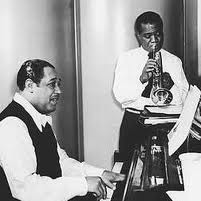
Louis%3ADuke.jpegI doubt that the year to come will be much less busy, but I hope and expect that it will be even more satisfyingly eventful. Next week we start making our circuitous way to Winter Park for a second residency, in the course of which, among other exciting things, I'll be directing excerpts from my first play, a one-man show about Louis Armstrong called Satchmo at the Waldorf, about which much more in due course. I'll also be buckling down to write a sizable chunk of my next book, Black Beauty: A Life of Duke Ellington, and zooming all around the country in search of memorable theater. Sooner or later we'll unpack the rest of the boxes in our new apartment and start rehanging the Teachout Museum in earnest.

What Mrs. T and I won't do is take our good fortune for granted, starting with the astonishing fact of our being together. It is, I suspect, exceedingly rare for two people in the middle of life to make a marriage as close as this one has become. When you marry late, every day is a surprise and a blessing. I nearly died five years ago this month, at exactly the same moment that I met and fell in love with Hilary, which makes what has happened to us (and what didn't happen to me) all the more poignant.

I take a dark view of many, perhaps most things, but I try very hard to live life with a smile. Somewhere or other Joseph Epstein wrote that H.L. Mencken's lifelong pessimism never stopped him from getting a good dinner, which seems to me exactly the right attitude toward the world and its myriad woes. I know that they exist, but I also know that I am a lucky man, and so long as my luck holds, I hope never to do it the injustice of ingratitude.

On that note, I wish for all of you the happiest and most hopeful of new years. May you laugh often, cry only when you want to, and never be bored!

Posted December 31, 12:00 AM

TT: Deep down in their private lives

In today's Wall Street Journal drama column I report from Chicago on the Steppenwolf Theatre Company's revival of Who's Afraid of Virginia Woolf? It is a very great production. Here's an excerpt.

* * *

When not writing plays like "August: Osage County" and "Killer Joe," Tracy Letts acts. In David Cromer's 2005 Off-Broadway staging of Austin Pendleton's "Orson's Shadow," he played an effete, stuttering drama critic; in the Steppenwolf Theatre Company's 2009 Chicago revival of David Mamet's "American Buffalo," he played a sleazy penny-ante thief. This time around he's playing George, the hard-drinking, switchblade-tongued small-town professor who is at the molten center of Steppenwolf's new production of Edward Albee's "Who's Afraid of Virginia Woolf?" It's a part that couldn't be more different from the others in which I've seen Mr. Letts, and what he does with it makes me wonder whether there's a better character actor to be found on the American stage today.

Vwoolf.jpegWhat is most striking about Mr. Letts' performance, though, is that it doesn't stand out from the rest of this remarkable show. Instead, Mr. Letts is part of an ensemble cast whose four members, directed with uncommon subtlety by longtime Albee collaborator Pam MacKinnon, function as an exquisitely well-coordinated ensemble in which nobody ever makes a false move. In the wrong hands, "Virginia Woolf" can come off as a hysterically overwrought insult marathon. In the hands of Mr. Letts, Amy Morton, Carrie Coon and Madison Dirks, it feels as though you're sitting quietly in a corner of the room, watching four people get tight, shed their inhibitions and admit to themselves and one another that their hopes and dreams have come to naught....

A note for East Coast theater buffs: Steppenwolf's "Who's Afraid of Virginia Woolf" will transfer to Washington, D.C., on Feb. 25, where it will be performed as part of Arena Stage's Edward Albee Festival. Whether in Chicago or Washington, it's a show you mustn't miss.

* * *

Read the whole thing here.

In 1962 Columbia Masterworks recorded a performance of Who's Afraid of Virginia Woolf by Arthur Hill, Uta Hagen, George Grizzard, and Melinda Dillon, the four members of the original Broadway cast. Here's an excerpt from that album, which has been out of print for decades:

Posted December 31, 12:00 AM

TT: Just because

Glynis Johns and Len Cariou sing "Send in the Clowns," from Stephen Sondheim's A Little Night Music:

Posted December 31, 12:00 AM

TT: Almanac

Man is a victim of dope
In the incurable form of hope.

Ogden Nash, "Good-by, Old Year, You Oaf or Why Don't They Pay the Bonus?"

Posted December 31, 12:00 AM

December 30, 2010

TT: So you want to see a show?

Here's my list of recommended Broadway, off-Broadway, and out-of-town shows, updated weekly. In all cases, I gave these shows favorable reviews (if sometimes qualifiedly so) in The Wall Street Journal when they opened. For more information, click on the title.

Warning: Broadway shows marked with an asterisk were sold out, or nearly so, last week.

BROADWAY:
La Cage aux Folles (musical, PG-13, adult subject matter, reviewed here)
Driving Miss Daisy * (drama, G, possible for smart children, closes Apr. 9, reviewed here)
Lombardi (drama, G/PG-13, a modest amount of adult subject matter, reviewed here)
The Merchant of Venice * (Shakespeare, PG-13, adult subject matter, on hiatus Jan. 9-31, then open through Feb. 20, reviewed here)
Million Dollar Quartet (jukebox musical, G, reviewed here)

OFF BROADWAY:
Angels in America (drama, PG-13/R, adult subject matter, extended through Mar. 27, reviewed here)
Avenue Q (musical, R, adult subject matter and one show-stopping scene of puppet-on-puppet sex, reviewed here)
The Fantasticks (musical, G, suitable for children capable of enjoying a love story, reviewed here)
Play Dead (theatrical spook show, PG-13, utterly unsuitable for easily frightened children or adults, reviewed here)

CLOSING SOON OFF BROADWAY:
Alfred Hitchcock's The 39 Steps (comedy, G, suitable for bright children, closes Jan. 16, original Broadway production reviewed here)

CLOSING NEXT WEEK ON BROADWAY:
A Free Man of Color (epic comedy, PG-13/R, adult subject matter, closes Jan. 9, reviewed here)

CLOSING TONIGHT IN WASHINGTON, D.C.:
Oklahoma! (musical, G, suitable for children, reviewed here)

CLOSING SUNDAY IN MADISON, N.J.:
I Capture the Castle (comedy, G/PG-13, suitable for unusually precocious children, reviewed here)

CLOSING SUNDAY ON BROADWAY:
Bloody Bloody Andrew Jackson (musical, PG-13/R, reviewed here)
Fela! (musical, PG-13, adult subject matter, reviewed here)
The Pee-wee Herman Show (comic revue, G/PG-13, heavily larded with double entendres, reviewed here)

Posted December 30, 12:00 AM

TT: Almanac

"The optimist proclaims that we live in the best of all possible worlds; and the pessimist fears this is true."

James Branch Cabell, The Silver Stallion

Posted December 30, 12:00 AM

December 29, 2010

TT: Snapshot

Alec Guinness plays the title character in Father Brown, a 1954 film directed by Robert Hamer and based on the mystery stories of G.K. Chesterton:

A rare sound newsreel film of G.K. Chesterton speaking at Worcester College in 1931:

(These are the latest in a weekly series of arts-related videos that appear in this space each Wednesday.)

Posted December 29, 12:00 AM

TT: Almanac

"No one doubts that an ordinary man can get on with this world: but we demand not strength enough to get on with it, but strength enough to get it on. Can he hate it enough to change it, and yet love it enough to think it worth changing? Can he look up at its colossal good without once feeling acquiescence? Can he look up at its colossal evil without once feeling despair? Can he, in short, be at once not only a pessimist and an optimist, but a fanatical pessimist and a fanatical optimist?"

G.K. Chesterton, Orthodoxy

Posted December 29, 12:00 AM

December 28, 2010

TT: Almanac

"This is a pleasant surprise, Archie. I would not have believed it. That of course is the advantage of being a pessimist; a pessimist gets nothing but pleasant surprises, an optimist nothing but unpleasant."

Rex Stout, Fer-de-Lance

Posted December 28, 12:00 AM

December 27, 2010

TT: Watching the weather

Mrs. T and I are flying back to New York tomorrow afternoon--or so we hope. We've been watching the news of the Great Christmas Blizzard of 2010 from a very safe distance, and I can't begin to tell you how relieved we are not to have been on the move yesterday.

A week in Smalltown, U.S.A., has slowed my mental clock down to a comfortable crawl. I don't have any more deadlines to hit until 2011, and I'm profoundly grateful for that as well. Instead of hammering away at the MacBook, I've been spending time with my mother, brother, sister-in-law, and spouse, opening presents and eating casseroles and doing dishes. Mom, Mrs. T, and I watch a movie every night (the week's fare has included Mildred Pierce, The Bishop's Wife, and The Great Escape) and sleep late every morning.

I could get used to this, except that, of course, I can't. My real life beckons: I have a show to see on Saturday and a review to file the next morning. Snow or no snow, the merry-go-round awaits me, and I guess I won't be sorry to get up on the horse again--but I suspect it won't be long before I start to miss the deep white peace of our happy, uneventful week in Smalltown.

Posted December 27, 10:38 AM

TT: Night thoughts on Jack Benny

I've been reading a book—not a new one, alas—about Jack Benny. The experience has proved to be unexpectedly sobering.

Benny died in 1974, the year that I graduated from high school, and is now, so far as I can tell, pretty much unknown to everyone younger than I am. Yet there was a time when he was one of the most famous people in America, and his fame was not short-lived: he appeared weekly on radio from 1932 to 1955 and regularly on TV from 1950 to 1965. Nor was he in any way culturally insignificant. Benny and his writers may not have invented situation comedy, but it's generally agreed that they perfected it. (Gary Giddins has written perceptively about Benny's contributions to modern comedy.) So why is he forgotten today?

Jack.jpegThe answer is, of course, that Benny did his best and most individual work on network radio, a medium that hit the skids around 1950 and for all intents and purposes ceased to exist in 1962, when the last surviving weekly dramatic series, Suspense and Yours Truly, Johnny Dollar, were cancelled by CBS. Virtually all of Benny's radio shows were recorded, most of them in decent sound, and a high percentage of them can be heard on line by anyone who cares to search for them. Alas, few are inclined to bother, and so it seems highly unlikely that any classic radio series, even one as good as The Jack Benny Program, will find a new audience in the twenty-first century.

That a giant of comedy like Jack Benny should have faded from our collective consciousness is not all that surprising, though it makes me sad, as do all such manifestations of the vanity of human wishes. What really jolted me was to read the other day that the Jimmy Stewart Museum was in dire financial straits. Stewart, needless to say, appeared in a considerable number of the most popular and critically acclaimed movies made in Hollywood in the twentieth century. But now that so many young people are unwilling to watch movies made before they were born, I find myself wondering whether any actor of the studio era, even the universally admired star of such celebrated films as Anatomy of a Murder, It's a Wonderful Life, The Philadelphia Story, Rear Window, The Shop Around the Corner, and Vertigo, can count on being widely remembered over the very long haul.

As for Benny, I suspect that he will be remembered longest for his role in Ernst Lubitsch's To Be or Not to Be, the only first-rate film in which he starred. You don't have to know anything about Benny to appreciate the uncanny skill with which he impersonates a ham actor who longs desperately to play Hamlet, and that is why his performance in To Be or Not to Be can still be appreciated today.

Not so Benny the radio star, whose hopelessly inept violin playing and pretended stinginess and vanity long ago disappeared into the cultural memory hole. Up to a point, I'm sorry to see them go. For anyone at all familiar with Benny's painstakingly worked-up comic persona, his show remains a fully valid theatrical experience, and were there world enough and time, I'd happily fritter away half-hour upon half-hour listening to one episode after another on my iPod.

Now that I've settled into middle age, though, I'm increasingly inclined to feel that life is too short to waste on situation comedies, even those as splendidly wrought as the radio version of The Jack Benny Program. (The TV version, though effective, wasn't nearly as good.) I need richer, more emotionally complex comic fare, be it Noël Coward, Howard Hawks, or Shakespeare—or the brilliantly concise animated cartoons of the Forties and early Fifties, which can still make me laugh out loud. Not so the shows that occupy the airwaves today. I loathe the snarky, reflexively referential Irony Lite of today's single-camera TV comedies and animated sitcoms.

At the same time, I now find even the best sitcoms of the Sixties and Seventies to be insufficiently pointed to satisfy my mature taste. As much as I love to laugh, I find that these series are no longer capable of supplying me with the aesthetic and spiritual nourishment that I need to get through the day. I want comedy that bites—hard—and the closer it gets to the knuckle, the louder I laugh. I wonder whether I'll still feel that way when I grow old.

* * *

Jack Benny and Isaac Stern play an excerpt from Bach's Two-Violin Concerto with Eugene Ormandy and the New York Philharmonic at Carnegie Hall in 1961:

Posted December 27, 12:00 AM

TT: Just because

Gerry Mulligan and Ben Webster play "Who's Got Rhythm" in 1963:

Posted December 27, 12:00 AM

TT: Almanac

"The basis of optimism is sheer terror."

Oscar Wilde, The Picture of Dorian Gray

Posted December 27, 12:00 AM

December 24, 2010

TT: To you and yours...

...much joy and much love—today, tomorrow, and always.

Posted December 24, 12:00 AM

TT: Safety first, surprises second

glass-menagerie.jpgToday's Wall Street Journal drama column is my annual best-of-the-year wrapup: "It's been a rocky year for American theater—and not just for the accident-prone members of the cast of Spider-Man: Turn Off the Dark. In the musical's latest mishap, a stunt double was injured during a preview performance on Monday. No doubt his colleagues are starting to wonder whether they ought to look for a safer line of work. Money is tight, playgoers are staying home, donors are saying no and artistic directors are playing it safe, opting for small-cast shows and familiar comedies instead of hard-hitting drama. Yet there was still more than enough to see as I criss-crossed the land in search of great shows."

Among other things, I single out Gordon Edelstein's breathtakingly fresh and poignant production of Tennessee Williams' The Glass Menagerie (pictured here) as the best revival of the year and Chicago's TimeLine Theatre as the company of the year:

Chicago's TimeLine Theatre, which specializes in "stories inspired by history," outdid itself with better-than-the-original productions of Aaron Sorkin's "The Farnsworth Invention" and Peter Morgan's "Frost/Nixon" performed in its own 87-seat theater, showing that a small troupe with creativity and nerve to burn can make as much magic as a big-ticket Broadway extravaganza....

To find out what what else I liked in 2010, go here.

Posted December 24, 12:00 AM

TT: 'Tis the season (IV)

Louis Armstrong recites "The Night Before Christmas":

Posted December 24, 12:00 AM

TT: The beautiful sound of sorrow

In today's "Sightings" column for The Wall Street Journal, I write about Archeophone Records' There Breathes a Hope: The Legacy of John Work II and His Fisk Jubilee Quartet, 1909-1916. Here's an excerpt.

* * *

Century-old records are the closest thing we have to a time machine. To listen to the voice of Theodore Roosevelt or the piano playing of Claude Debussy is to feel the years falling away like autumn leaves from a maple tree. Rarely, though, have I been so engrossed by an album remastered from antique 78s as I was by "There Breathes a Hope: The Legacy of John Work II and His Fisk Jubilee Quartet, 1909-1916," an anthology released by Archeophone Records. This two-CD set, which also includes a profusely illustrated 100-page booklet, contains 43 of the first recordings of black spirituals. It is the most important historical reissue of 2010--and one that tells a story about turn-of-the-century black culture that may make some listeners squirm with retrospective discomfort.

hope-lg.jpgNashville's Fisk University, which opened its doors in 1866, is one of America's oldest historically black colleges. It is also known to scholars of American music as the home of the Fisk Jubilee Singers, an ensemble founded in 1871 that introduced concertgoers around the world to such deathless songs of sorrow and hope as "There Is a Balm in Gilead" and "Roll Jordan Roll," in the process raising hundreds of thousands of dollars for the inadequately funded school. The original Fisk Jubilee Singers disbanded before the invention of the phonograph, but in 1899 John Work II, a teacher at Fisk, reorganized the group, and a male quartet drawn from the chorus started making recordings for the Victor Talking Machine Company in 1909.

No matter how much you think you know about spirituals, I think you'll be surprised to hear these performances, because few of them sound anything like what you're likely to be expecting. Their musical tone is formal, sometimes even a bit staid, as if you were hearing four gentlemen in high-button shoes warbling close-harmony hymns in the parlor. Not always--the quartet tosses off the syncopations in the up-tempo tunes with a light, dancing touch--but it's downright startling to hear them sing "CHAH-ree-AHT" in the very first recording of "Swing Low, Sweet Chariot." No less surprising is that they recorded "Old Black Joe," one of Stephen Foster's nostalgic plantation songs, at their third session....

* * *

Read the whole thing here.

Posted December 24, 12:00 AM

TT: Almanac

"Happy, happy Christmas, that can win us back to the delusions of our childish days; that can recall to the old man the pleasures of his youth; that can transport the sailor and the traveller, thousands of miles away, back to his own fire-side and his quiet home!"

Charles Dickens, The Pickwick Papers

Posted December 24, 12:00 AM

December 23, 2010

TT: So you want to see a show?

Here's my list of recommended Broadway, off-Broadway, and out-of-town shows, updated weekly. In all cases, I gave these shows favorable reviews (if sometimes qualifiedly so) in The Wall Street Journal when they opened. For more information, click on the title.

Warning: Broadway shows marked with an asterisk were sold out, or nearly so, last week.

BROADWAY:
La Cage aux Folles (musical, PG-13, adult subject matter, reviewed here)
Driving Miss Daisy * (drama, G, possible for smart children, closes Apr. 9, reviewed here)
Lombardi (drama, G/PG-13, a modest amount of adult subject matter, reviewed here)
The Merchant of Venice * (Shakespeare, PG-13, adult subject matter, on hiatus Jan. 9-31, then extended through Feb. 20, reviewed here)
Million Dollar Quartet (jukebox musical, G, reviewed here)

OFF BROADWAY:
Alfred Hitchcock's The 39 Steps (comedy, G, suitable for bright children, closes Jan. 16, original Broadway production reviewed here)
Angels in America (drama, PG-13/R, adult subject matter, extended through Mar. 27, reviewed here)
Avenue Q (musical, R, adult subject matter and one show-stopping scene of puppet-on-puppet sex, reviewed here)
The Fantasticks (musical, G, suitable for children capable of enjoying a love story, reviewed here)
Play Dead (theatrical spook show, PG-13, utterly unsuitable for easily frightened children or adults, reviewed here)

CLOSING SOON ON BROADWAY:
A Free Man of Color (epic comedy, PG-13/R, adult subject matter, closes Jan. 9, reviewed here)

CLOSING NEXT WEEK IN MADISON, N.J.:
I Capture the Castle (comedy, G/PG-13, suitable for unusually precocious children, closes Jan. 2, reviewed here)

CLOSING NEXT WEEK IN WASHINGTON, D.C.:
Oklahoma! (musical, G, suitable for children, closes Dec. 30, reviewed here)

CLOSING NEXT WEEK ON BROADWAY:
Bloody Bloody Andrew Jackson (musical, PG-13/R, closes Jan. 2, reviewed here)
Fela! (musical, PG-13, adult subject matter, closes Jan. 2, reviewed here)
The Pee-wee Herman Show (comic revue, G/PG-13, heavily larded with double entendres, closes Jan. 2, reviewed here)

Posted December 23, 12:00 AM

TT: 'Tis the season (III)

Mister Magoo's Christmas Carol, directed by Abe Levitow with songs by Jule Styne and Bob Merrill, originally shown on NBC in 1962:

Posted December 23, 12:00 AM

TT: Almanac

"I believe in the sweet spot, soft-core pornography, opening your presents Christmas morning rather than Christmas eve, and I believe in long, slow, deep, soft, wet kisses that last three days."

Ron Shelton, screenplay for Bull Durham

Posted December 23, 12:00 AM

December 22, 2010

TT: Snapshot

The Choir of King's College, Cambridge, sings Peter Warlock's "Balulalow":

(This is the latest in a weekly series of arts-related videos that appear in this space each Wednesday.)

Posted December 22, 12:00 AM

TT: Almanac

"I hear that in many places something has happened to Christmas; that it is changing from a time of merriment and carefree gaiety to a holiday which is filled with tedium; that many people dread the day and the obligation to give Christmas presents is a nightmare to weary, bored souls; that the children of enlightened parents no longer believe in Santa Claus; that all in all, the effort to be happy and have pleasure makes many honest hearts grow dark with despair instead of beaming with good will and cheerfulness."

Julia Peterkin, A Plantation Christmas

Posted December 22, 12:00 AM

December 21, 2010

TT: Entry from an unkept diary

Methuselah.jpeg• Middle age isn't all bad, but it's still full of diminishments, one of which is that my ability to write for long stretches of time isn't what it used to be. The end product, I trust, is still of passably high quality, but time was when I would routinely write two unrelated pieces in the course of a single day, then go out at night and see a show. Alas, I find it increasingly difficult to change hats: if I write a Wall Street Journal drama column from scratch in the morning, it's all but impossible for me to knock out a chunk of, say, my Duke Ellington biography in the afternoon. I don't know whether it's a matter of flagging energy or lessened will, but one way or another, I seem to have lost some of my endurance.

Thus I rejoice to report what happened when I accompanied Mrs. T to the University of Connecticut Health Center last week for a day's worth of visits to various and sundry doctors. Her appointments were non-consecutive, meaning that I had to spend some six-odd hours sitting in waiting rooms. Not wanting to fritter away a whole day reading or idly surfing the Web, I decided to write a "Sightings" column for next week's Wall Street Journal. It came with unexpected ease and I sent it off to the paper. Then inspiration struck, and I started writing a second "Sightings" column, which I finished just as Mrs. T emerged from the day's last appointment. I sent it in and we went home.

The best part of this story is that my editors at the Journal approved both pieces with nothing more than trivial queries, so they'll be going into the paper just as I wrote them--back to back in the waiting room.

Forgive my vanity, but there's life in the old boy yet!

Posted December 21, 12:00 AM

TT: 'Tis the season (II)

Bing Crosby sings Irving Berlin's "White Christmas" in Holiday Inn:


Posted December 21, 12:00 AM

TT: Almanac

"Hope is the best possession. None are completely wretched but those who are without hope; and few are reduced so low as that."

William Hazlitt, Characteristics

Posted December 21, 12:00 AM

December 20, 2010

TT: Winging our way

CG20101208-Whos-Afraid-of-Virginia-Woolf.jpgBy the time most of you get around to reading this posting, Mrs. T and I will be on our way to Chicago, where we're spending the next two days hanging out with Our Girl (whom we love dearly) and seeing Steppenwolf Theatre Company's much-discussed revival of Who's Afraid of Virginia Woolf? (which stars Tracy Letts, the author of Killer Joe and August: Osage County, who is also a highly distinguished actor in his own right). On Wednesday we head down to Smalltown, U.S.A., where Christmas and my family are to be found.

I'll do my best to keep you posted on what we're up to this week, but if I don't, there'll still be the usual videos, almanac entries and theater-related postings to keep you occupied.

In the meantime, enjoy the holidays--we will!

Posted December 20, 12:00 AM

TT: 'Tis the season (I)

Mel Tormé and Judy Garland sing Tormé's "The Christmas Song" on The Judy Garland Christmas Show, originally aired on CBS in 1963:


Posted December 20, 12:00 AM

TT: Almanac

"Christmas is a holiday that persecutes the lonely, the frayed and the rejected."

Jimmy Cannon, Nobody Asked Me, But...

Posted December 20, 12:00 AM

December 17, 2010

TT: Stuffing the stockings

National Review Online recently asked me to make some Christmas-gift suggestions. To see my picks, go here and scroll down.

Posted December 17, 4:13 PM

TT: Taking another shot at Candide

In today's Wall Street Journal drama column, I report on Mary Zimmerman's new production of Candide--not very enthusiastically, I fear. Here's an excerpt.

* * *

Of all the great musicals, "Candide" poses the biggest problems to anyone who tries to stage it. It's universally agreed that Leonard Bernstein's brilliant operetta-style score is altogether worthy of Voltaire's ferocious satire of 18th-century optimism, but the original 1956 Broadway production closed after 73 performances, mainly because of the heavy-handedness of Lillian Hellman's book, and since then the show has been revised and rewritten repeatedly in an attempt to make it work. Now Mary Zimmerman, whose "Metamorphoses" hit big in 2002, has taken up the challenge, concocting a new version of "Candide" co-produced by Chicago's Goodman Theatre and the Shakespeare Theatre Company of Washington, D.C., where I saw it last week. I wish I could say that Ms. Zimmerman has finally cracked the "Candide" code, but her version, despite many memorable moments, fails once again to solve the problem of creating a convincing context for Bernstein's miraculously effervescent music.

Candd.jpegMs. Zimmerman, like the vast majority of her predecessors, takes as a starting point Harold Prince's successful 1974 Broadway revival of "Candide," for which Hugh Wheeler wrote an all-new book that was undeniably effective but dismayingly vulgar. Eight years later Mr. Prince put together a longer "opera-house version" of the show for the New York City Opera, and in 1989 Bernstein himself recorded an even longer "final revised version" of the score with which subsequent directors have continued to tinker. This time around, Ms. Zimmerman has scrapped Wheeler's dialogue, replacing much of it with speeches drawn directly from Voltaire's novella, and has crammed in more of Bernstein's revised score than any previous non-operatic stage version.

The result is a musical that runs for three hours and feels slow, especially in the second act, which sags badly in the middle. It doesn't help that Ms. Zimmerman, like Wheeler before her, relies on a string of third-person narrators to advance the episodic plot, a device that slows the action to something in between a crawl and a waddle. The hectic staging--the actors are forever pushing around props and set pieces--fails to paper over the sluggish pacing...

* * *

Read the whole thing here.

Posted December 17, 12:00 AM

TT: Almanac

"Only two classes of books are of universal appeal: the very best and the very worst."

Ford Madox Ford, Joseph Conrad : A Personal Remembrance

Posted December 17, 12:00 AM

December 16, 2010

DANCE

Les Ballets Trockadero de Monte Carlo (Joyce, 175 Eighth Ave., closes Jan. 2). The Trocks are an all-male ballet company whose "women" dance in drag. Sometimes they do the classics more or less straight, sometimes they dance brilliantly witty parodies, and sometimes they do out-of-left-field works like Merce Cunningham's Patterns in Space, which is on the first of the two programs that they're dancing during their current New York season. No matter what they're doing, the results are at once uproariously funny and mysteriously illuminating. To spend an evening with the Trocks is to think twice--or more--about what ballet is and how it works. Very strongly recommended, even to those who (like me) are usually allergic to drag acts (TT).

Posted December 16, 9:26 AM

TT: So you want to see a show?

Here's my list of recommended Broadway, off-Broadway, and out-of-town shows, updated weekly. In all cases, I gave these shows favorable reviews (if sometimes qualifiedly so) in The Wall Street Journal when they opened. For more information, click on the title.

Warning: Broadway shows marked with an asterisk were sold out, or nearly so, last week.

BROADWAY:
La Cage aux Folles (musical, PG-13, adult subject matter, reviewed here)
Driving Miss Daisy * (drama, G, possible for smart children, extended through Apr. 9, reviewed here)
A Free Man of Color (epic comedy, PG-13/R, adult subject matter, closes Jan. 9, reviewed here)
Lombardi (drama, G/PG-13, a modest amount of adult subject matter, reviewed here)
The Merchant of Venice * (Shakespeare, PG-13, adult subject matter, closes Jan. 9, reviewed here)
Million Dollar Quartet (jukebox musical, G, reviewed here)

OFF BROADWAY:
Alfred Hitchcock's The 39 Steps (comedy, G, suitable for bright children, closes Jan. 16, original Broadway production reviewed here)
Angels in America (drama, PG-13/R, adult subject matter, extended through Mar. 27, reviewed here)
Avenue Q (musical, R, adult subject matter and one show-stopping scene of puppet-on-puppet sex, reviewed here)
The Fantasticks (musical, G, suitable for children capable of enjoying a love story, reviewed here)
Play Dead (theatrical spook show, PG-13, utterly unsuitable for easily frightened children or adults, reviewed here)

CLOSING SOON IN MADISON, N.J.:
I Capture the Castle (comedy, G/PG-13, suitable for unusually precocious children, closes Jan. 2, reviewed here)

CLOSING SOON IN WASHINGTON, D.C.:
Oklahoma! (musical, G, suitable for children, closes Dec. 30, reviewed here)

CLOSING SOON ON BROADWAY:
Bloody Bloody Andrew Jackson (musical, PG-13/R, closes Jan. 2, reviewed here)
Fela! (musical, PG-13, adult subject matter, closes Jan. 2, reviewed here)
The Pee-wee Herman Show (comic revue, G/PG-13, heavily larded with double entendres, closes Jan. 2, reviewed here)

Posted December 16, 12:00 AM

TT: Almanac

"To him boredom was a tragedy, for he had no more realization than if he had been an animal that any state he was in would ever come to an end."

Rebecca West, The Thinking Reed

Posted December 16, 12:00 AM

December 15, 2010

TT: Snapshot

An extremely rare kinescope of the Hallmark Hall of Fame TV adaptation of The Fantasticks, directed by George Schaefer and starring Bert Lahr, Ricardo Montalban, and Stanley Holloway, originally telecast by NBC on Oct. 18, 1964 and never shown again. This print also includes the original commercials:

(This is the latest in a weekly series of arts-related videos that appear in this space each Wednesday.)

Posted December 15, 12:00 AM

TT: Almanac

"The rightness of a thing isn't determined by the amount of courage it takes."

Mary Renault, The Charioteer

Posted December 15, 12:00 AM

December 14, 2010

TT: Almanac

"The novelist of manners must be more interested in other people than in himself, and that, unfortunately, is not often found in the places where ostensibly 'serious' fiction is now written."

Jonathan Yardley, "Bard of the Upper Crust" (Washington Post, Dec. 3, 2010)

Posted December 14, 12:00 AM

December 13, 2010

TT: In memory of an old friend

Nancy LaMott, who died fifteen years ago today, sings "Time After Time":

Posted December 13, 12:00 AM

TT: All freshened up

It took long enough, but I've finally updated the "Top Five" and "Out of the Past" modules of the right-hand column. If you're looking for gift ideas—or feel like spending a little money on yourself—take note.

Posted December 13, 12:00 AM

TT: Almanac

"Between too early and too late, there is never more than a moment."

Franz Werfel, Jacobowsky and the Colonel

Posted December 13, 12:00 AM

December 12, 2010

CD

The Busch Quartet, Beethoven: The Late String Quartets (EMI Classics, three CDs). If you read my recent Wall Street Journal column about Adolf Busch and the Nazis and want to hear how this courageous artist made music, the place to start is EMI's collection of the Busch Quartet's legendary 78-era recordings of Beethoven's last six string quartets, which is available on CD or as a digital download. The playing may strike contemporary listeners as less than ideally polished, but the interpretations are uniquely penetrating, and Busch's violin playing combines forthrightness and Innigkeit in a way that no one has rivaled, before or since. Warning: don't expect state-of-the-art sound (TT).

Posted December 12, 3:46 PM

CD

Robert Shaw Chamber Singers, Songs of Angels: Christmas Hymns and Carols (Telarc). Had it up to here with super-slick holiday musical fare? Then allow me to direct your attention to this 1994 CD, in which America's most celebrated choral conductor remade the much-loved a cappella arrangements of traditional carols that he first recorded on 78 in 1946. The singing is lovely, the arrangements tasteful. Guaranteed to cleanse your ears of Christmastide commercialism (TT).

Posted December 12, 3:27 PM

NOVEL

Rumer Godden, In This House of Brede. (Simon & Schuster, $25). In this quietly absorbing 1969 novel, the author of the book on which Jean Renoir's The River was based tells the story of a well-heeled British civil servant of a certain age who renounces the world, gives away her earthly possessions, and enters an abbey to become a cloistered nun. Whatever your religious views, if any, my guess is that you'll be impressed, not least because Godden portrays the social life (so to speak) of a tightly-knit religious community with absolute candor (TT).

Posted December 12, 3:22 PM

BOOK

Siddhartha Mukherjee, The Emperor of All Maladies: A Biography of Cancer (Scribner, $30). An extraordinarily compelling history of a disease that once was unmentionable and is now a national obsession. Mukherjee's theme is the way in which the preternaturally stubborn resolve of generation after generation of cancer researchers has led them to make great scientific discoveries--then prevented them from seeing the flaws in their theories that are discovered by their successors. Sobering and splendidly well written (TT).

Posted December 12, 2:52 PM

PLAY

Play Dead (Players, 115 MacDougal). An off-Broadway spook show concocted by Teller (Penn Jillette's silent partner) in collaboration with Todd Robbins, who tells the more-or-less true stories of a serial killer, two phony mediums, a geek (look it up) and a murder victim whom Robbins knew in real life. During and in between these narratives, things...happen. The nature of these grisly occurrences can best be summarized by saying that the white suit worn by Robbins grows steadily redder throughout the evening. Great fun for anyone who likes magic and stage blood, and ideal for kids who are not--repeat, not--highly impressionable (TT).

Posted December 12, 2:25 PM

MP3

Coleman Hawkins, To Be or Not to Bop (Wnts). The first great jazz saxophonist was also one of a handful of swing-era giants who successfully embraced bebop, both on and off record. This new mp3-only downloadable collection contains twenty-two of the bop-and-bop-flavored 78 sides that Hawkins recorded in the mid-to-late-Forties with such then-youngsters as Dizzy Gillespie, J.J. Johnson, Hank Jones, Howard McGhee, Fats Navarro, Oscar Pettiford, and Max Roach, including the premiere recordings of "I Mean You," "Salt Peanuts" and "Woody'n You." It's the first time that Hawkins' key bop recordings have been released in a single-source anthology. Listen and marvel at his ability to ride the wave of a radically innovative new jazz style (TT).

Posted December 12, 2:19 PM

GALLERY

Sargent and Impressionism (Adelson Galleries, 19 E. 82, closes Saturday). Two dozen-plus paintings and watercolors in which John Singer Sargent, who befriended Monet and looked closely at his work, dabbled in the then-revolutionary language of French impressionism, almost always to striking (if not quite idiomatic) effect. Guaranteed to open the eyes of those who think of Sargent purely as as a high-society portraitist (TT).

Posted December 12, 2:07 PM

December 10, 2010

TT: The girl in the kitchen sink

I went to Madison, New Jersey, last Saturday to see the Shakespeare Theatre of New Jersey perform I Capture the Castle. It was a knockout. Here's an excerpt from my review in today's Wall Street Journal.

* * *

9104364-large.jpgDoctors have a saying: "The dose makes the poison." If you're a playwright, charm works the same way. It's an indispensable part of the dramatic pharmacopoeia, but put in a pinch too much and a show can cloy. That doesn't happen in Dodie Smith's "I Capture the Castle," which is being performed for the first time on the East Coast by the Shakespeare Theatre of New Jersey. Not only does Smith's stage version of her fizzy 1948 novel about a clever young woman teetering on the brink of adulthood get the dosage right, but it has been impeccably directed by Cameron Watson and is being performed on a handsome set by an ideal cast. The word "irresistible" is rarely true, but I don't see how anyone not descended from Scrooge McDuck could fail to fall for "I Capture the Castle."

Smith, who died in 1990, was a British novelist and playwright who is best known for having written the book on which Walt Disney's "One Hundred and One Dalmatians" was based. While none of her plays went over big on Broadway, the original version of "I Capture the Castle" has become something of a cult favorite, winning fans as varied as J.K. Rowling and Donald E. Westlake. The 1954 stage adaptation, however, is all but unknown, and until now had only received a single American production four years ago in Los Angeles.

Mr. Watson, who directed the show there, has restaged it in New Jersey, bringing with him one cast member, Rebecca Mozo, who plays Cassandra Mortmain, the budding novelist who is the play's narrator. Cassandra, who sometimes likes to write while sitting in the kitchen sink, is a fey girl-woman who knows much of poverty--her impecunious family lives in a tumbledown castle--but nothing about men. "I know all about the facts of life," she says firmly. "And I don't think much of them." Then her life is turned inside out when two rich young Americans declare themselves to be the owners of the castle in which the Mortmains live....

Each member of the cast catches the exact tone of his or her character, above all Ms. Mozo, who brings off with sweet grace the tricky task of showing us Cassandra's discovery of the hurt of romantic love....

* * *

Read the whole thing here.

The theatrical trailer from the 2003 BBC film version of I Capture the Castle:

Posted December 10, 12:00 AM

TT: The man who said no to Hitler

For the past couple of months, I've been working my way through Adolf Busch: The Life of an Honest Musician, Tully Potter's massive two-volume biography of the greatest German violinist of the twentieth century, who is best known in this country for having co-founded the Marlboro Music School and Festival with Rudolf Serkin, his son-in-law and recital partner. Potter's book is far too long for the ordinary reader, but so wonderfully well written and researched that anyone with more than a casual interest in Busch and his times will find it an unexpectedly easy read.

Part of what makes Adolf Busch: The Life of an Honest Musician so interesting, though, is that it also contains a bitingly frank account of how Germany's classical musicians behaved under the Nazi regime. Busch, it turns out, was the only well-known non-Jewish German classical musician who conducted himself impeccably: he canceled all of his concert dates in Germany a few weeks after Hitler came to power in 1933, declaring himself to be disgusted by "the actions of my Christian compatriots against German Jews."

I knew that most German musicians had collaborated with the Hitler regime in one way or another, but I hadn't realized that Busch stood alone in his iron integrity. This fact inspired me to write a "Sightings" column for today's Wall Street Journal in which I talk about what Busch did, and why it still matters. Here's an excerpt.

* * *

Virtually all of the other big names in Austro-German music, including Wilhelm Furtwängler, Walter Gieseking, Herbert von Karajan, Carl Orff and Richard Strauss, stayed behind, some because they were active supporters of Hitler and others because they thought that the Nazis would dry up and blow away. Busch knew better. In a prophetic letter, he wrote, "Some of them believe that if they only 'play along,' the atrocities and injustice that are part and parcel of the movement will be tempered, can be turned around...they do not notice that they can only have a retarding effect, that the atrocities will still take place, only perhaps a bit later."

154124_10150117940282193_652497192_7367205_7118722_n.jpgBusch's principled stand was motivated in part by the fact that many of his closest friends and colleagues were Jewish, including Serkin and Karl Doktor, the violist of the Busch Quartet. But the Nazis, who were keenly aware of the force of public opinion, were prepared to look the other way at such things in order to prevent prominent non-Jewish Germans from leaving the country in protest. As late as 1937, it was discreetly made known to Busch that if he returned, the Nazi government would let Serkin come back as well. "If you hang Hitler in the middle, with Goering on the left and Goebbels on the right, I'll return to Germany," he replied.

As anti-Semitic laws spread across the continent, Busch responded by cancelling there as well, and at the end of 1939 he, Serkin and the members of the Busch Quartet moved to the U.S. What happened next was a tragedy. Though Serkin was quickly able to establish himself as a top-tier soloist, America in the '40s had an oversupply of famous violinists and a limited appetite for chamber music. Busch was able to eke out a living, but his days of fame were over....

* * *

Read the whole thing here.

Posted December 10, 12:00 AM

TT: Almanac

"Art is a revolt against fate."

André Malraux, Voices of Silence

Posted December 10, 12:00 AM

December 9, 2010

TT: So you want to see a show?

Here's my list of recommended Broadway, off-Broadway, and out-of-town shows, updated weekly. In all cases, I gave these shows favorable reviews (if sometimes qualifiedly so) in The Wall Street Journal when they opened. For more information, click on the title.

Warning: Broadway shows marked with an asterisk were sold out, or nearly so, last week.

BROADWAY:
La Cage aux Folles (musical, PG-13, adult subject matter, reviewed here)
Driving Miss Daisy * (drama, G, possible for smart children, closes Jan. 29, reviewed here)
A Free Man of Color (epic comedy, PG-13/R, adult subject matter, closes Jan. 9, reviewed here)
Lombardi (drama, G/PG-13, a modest amount of adult subject matter, reviewed here)
The Merchant of Venice * (Shakespeare, PG-13, adult subject matter, closes Jan. 9, reviewed here)
Million Dollar Quartet (jukebox musical, G, reviewed here)

OFF BROADWAY:
Alfred Hitchcock's The 39 Steps (comedy, G, suitable for bright children, closes Jan. 16, original Broadway production reviewed here)
Angels in America (drama, PG-13/R, adult subject matter, closes Feb. 20, reviewed here)
Avenue Q (musical, R, adult subject matter and one show-stopping scene of puppet-on-puppet sex, reviewed here)
The Fantasticks (musical, G, suitable for children capable of enjoying a love story, reviewed here)
Play Dead (theatrical spook show, PG-13, utterly unsuitable for easily frightened children or adults, reviewed here)

CLOSING SOON ON BROADWAY:
Bloody Bloody Andrew Jackson (musical, PG-13/R, closes Jan. 2, reviewed here)
Fela! (musical, PG-13, adult subject matter, closes Jan. 2, reviewed here)
The Pee-wee Herman Show (comic revue, G/PG-13, heavily larded with double entendres, closes Jan. 2, reviewed here)

CLOSING SOON IN WASHINGTON, D.C.:
Oklahoma! (musical, G, suitable for children, closes Dec. 30, reviewed here)

CLOSING SUNDAY ON BROADWAY:
The Pitmen Painters (serious comedy, G, too demanding for children, reviewed here)

Posted December 09, 12:00 AM

TT: Almanac

"The sons of torture victims make good terrorists."

André Malraux, Man's Fate

Posted December 09, 12:00 AM

December 8, 2010

TT: Snapshot

A rare kinescope of Sammy Davis, Jr., and the Will Mastin Trio performing on The Buick-Berle Show in 1954. In this excerpt from the group's nightclub act, Davis impersonates Nat King Cole, Tony Bennett, Vaughn Monroe, Billy Eckstine, Jimmy Cagney, Jimmy Stewart, Cary Grant, Frankie Laine, and Jerry Lewis:

(This is the latest in a weekly series of arts-related videos that appear in this space each Wednesday.)

Posted December 08, 12:00 AM

TT: Almanac

"Perhaps the rare and simple pleasure of being seen for what one is compensates for the misery of being it."

Margaret Drabble, A Summer Bird-Cage

Posted December 08, 12:00 AM

December 7, 2010

TT: Off we go

Mrs. T and I are off to Washington, D.C., to see Mary Zimmerman's new production of Leonard Bernstein's Candide, one of the all-time great problem shows (brilliant score, impossible book). Zimmerman's revival, which originated in Chicago earlier this season, is an attempt to solve the show's underlying conceptual problems without compromising the integrity of Bernstein's music. Does it succeed? I've heard varying reports from Chicago, so I want to see for myself.

Mrs. T and I will be spending the night in Washington and returning to New York on Wednesday for further adventures in our new apartment, which is gradually starting to look less like a warehouse and more like a residence. More as it happens!

Posted December 07, 7:19 AM

TT: Almanac

"Sometimes it seems the only accomplishment my education ever bestowed on me, the ability to think in quotations."

Margaret Drabble, A Summer Bird-Cage

Posted December 07, 12:00 AM

December 6, 2010

TT: The horror! The horror!

After a long and unbroken string of too-bad-to-be-true incidents, Mrs. T and I arrived last Friday at the alarming conclusion that we were both in a Philadelphia. For those unfamiliar with the one-act plays of David Ives, a Philadelphia is a metaphysical black hole "inside of what we know as reality." When you fall into a Philadelphia, everything—but everything—goes wrong.

No, I don't want to talk about it. I'm too tired. The two of us only just started to crawl out of our Philadelphia on Saturday afternoon, just in time to drive to New Jersey (which is, of course, dangerously close to Philadelphia) to dine with an aunt and uncle and see the Shakespeare Theatre of New Jersey's production of I Capture the Castle. So in lieu of sharing the gory details, I'll post an excerpt from "The Philadelphia" that explains everything. Metaphysically speaking, that is.

* * *

AL: Because in a Philadelphia, no matter what you ask for, you can't get it. You ask for something, they're not gonna have it. You want to do something, it ain't gonna get done. You want to go somewhere, you can't get there from here.

MARK: Good God. So this is very serious.

267px-PatsCheesesteak.jpgAL: Just remember, Marcus. This is a condition named for the town that invented the cheese steak. Something that nobody in his right mind would willingly ask for.

MARK: And I thought I was just having a very bad day....

AL: Sure. Millions of people have spent entire lifetimes inside a Philadelphia and never even knew it. Look at the city of Philadelphia itself. Hopelessly trapped forever inside a Philadelphia. And do they know it?

MARK: Well what can I do? Should I just kill myself now and get it over with?

AL: You try to kill yourself in a Philadelphia, you're only gonna get hurt, babe.

MARK: So what do I do?

AL: Best thing to do is wait it out. Someday the great cosmic train will whisk you outta the City of Brotherly Love and off to someplace happier.

Posted December 06, 12:00 AM

TT: Just because

American Ballet Theatre dances Antony Tudor's Pillar of Fire in 1973. The score is Arnold Schoenberg's Verklärte Nacht:

Posted December 06, 12:00 AM

TT: Almanac

"Facing it—always facing it—that's the way to get through."

Joseph Conrad, "Typhoon" (courtesy of Books, Inq.)

Posted December 06, 12:00 AM

December 3, 2010

TT: Believe it or not

I'm taking a day off from my Wall Street Journal drama column. See you next Friday!

Posted December 03, 12:00 AM

TT: Just because

Rudolf Serkin, Eugene Ormandy, and the Vienna Philharmonic play the first movement of Mozart's C Major Piano Concerto, K. 467:

Posted December 03, 12:00 AM

TT: Almanac

"Life—how curious is that habit that makes us think it is not here, but elsewhere."

V.S. Pritchett, Midnight Oil

Posted December 03, 12:00 AM

December 2, 2010

TT: So you want to see a show?

Here's my list of recommended Broadway, off-Broadway, and out-of-town shows, updated weekly. In all cases, I gave these shows favorable reviews (if sometimes qualifiedly so) in The Wall Street Journal when they opened. For more information, click on the title.

Warning: Broadway shows marked with an asterisk were sold out, or nearly so, last week.

BROADWAY:
Bloody Bloody Andrew Jackson (musical, PG-13/R, closes Jan. 2, reviewed here)
La Cage aux Folles (musical, PG-13, adult subject matter, reviewed here)
Driving Miss Daisy * (drama, G, possible for smart children, closes Jan. 29, reviewed here)
Fela! (musical, PG-13, adult subject matter, closes Jan. 2, reviewed here)
A Free Man of Color (epic comedy, PG-13/R, adult subject matter, closes Jan. 9, reviewed here)
Lombardi (drama, G/PG-13, a modest amount of adult subject matter, reviewed here)
The Merchant of Venice * (Shakespeare, PG-13, adult subject matter, closes Jan. 9, reviewed here)
Million Dollar Quartet (jukebox musical, G, reviewed here)
The Pee-wee Herman Show (comic revue, G/PG-13, heavily larded with double entendres, closes Jan. 2, reviewed here)

OFF BROADWAY:
Alfred Hitchcock's The 39 Steps (comedy, G, suitable for bright children, closes Jan. 16, original Broadway production reviewed here)
Angels in America (drama, PG-13/R, adult subject matter, closes Feb. 20, reviewed here)
Avenue Q (musical, R, adult subject matter and one show-stopping scene of puppet-on-puppet sex, reviewed here)
The Fantasticks (musical, G, suitable for children capable of enjoying a love story, reviewed here)
Play Dead (theatrical spook show, PG-13, utterly unsuitable for easily frightened children or adults, reviewed here)

IN WASHINGTON, D.C.:
Oklahoma! (musical, G, suitable for children, closes Dec. 30, reviewed here)

CLOSING NEXT WEEK ON BROADWAY:
The Pitmen Painters (serious comedy, G, too demanding for children, closes Dec. 12, reviewed here)

Posted December 02, 12:00 AM

TT: Almanac

"To be young is painful but exhilarating: to be certain and to pass into uncertainty and on to new certainties; to be conscious of the changes from one hour to the next; to be intolerant of others and blindly interested in oneself. It is so hard to remember youth, simply because one loses dramatic interest in oneself. One is harsh; one is all sentiment."

V.S. Pritchett, Midnight Oil (courtesy of Anecdotal Evidence)

Posted December 02, 12:00 AM

December 1, 2010

TT: Snapshot

Patti LuPone sings the opening scene of Marc Blitzstein's The Cradle Will Rock in a revival by the Acting Company that was telecast on PBS in 1986. The production was directed by John Houseman and Christopher J. Markle:

(This is the latest in a weekly series of arts-related videos that appear in this space each Wednesday.)

Posted December 01, 12:00 AM

TT: Free for the asking

Powell256.jpgIf you visit this blog more than occasionally, you've been encouraged numerous times to read A Dance to the Music of Time, Anthony Powell's twelve-volume roman fleuve about twentieth-century England, which was originally published between 1951 and 1975. In 2004 I wrote an essay about A Dance to the Music of Time for the New York Times Book Review in which I praised it in the strongest possible terms.

Should you need a stronger push, Levi Stahl, an accomplished litblogger who works for the University of Chicago Press, advises me that effective today, all twelve volumes of Dance will become available as e-books and will be marketed on all existing e-book platforms. What's more, A Question of Upbringing, the first volume in the cycle, can be downloaded for free. No catch: it's yours. The eleven other volumes will cost you eight bucks apiece.

This is, in my opinion, an absolutely brilliant piece of marketing, and I cannot commend it to you too enthusiastically. For more information, go here and here, then get cracking. You won't be sorry.

Posted December 01, 12:00 AM

TT: Prose in motion

POPS%20ON%20THE%20B%20TRAIN.jpgEvery writer dreams of seeing one of his books being read in public. It's never happened to me, alas, but a friend of mine snapped this photograph on the B train in New York City the other day and e-mailed it to me. The book on the left is, needless to say, the paperback edition of Pops: A Life of Louis Armstrong.

Whoever and wherever you are, dear reader, I hope you were enjoying yourself as much as I enjoyed seeing you on the screen of my MacBook!

Posted December 01, 12:00 AM

TT: Almanac

"The whole idea of interviews is in itself absurd—one cannot answer deep questions about what one's life was like—one writes novels about it."

Anthony Powell, (interview, London Times, May 15, 1986)

Posted December 01, 12:00 AM

e="application/atom+xml" title="Atom" href="http://www.artsjournal.com/aboutlastnight/atom.xml" /> About Last Night: December 2010 Archives

« November 2010 | Main | January 2011 »

December 2010 Archives

December 1, 2010

TT: Almanac

"The whole idea of interviews is in itself absurd—one cannot answer deep questions about what one's life was like—one writes novels about it."

Anthony Powell, (interview, London Times, May 15, 1986)

TT: Prose in motion

POPS%20ON%20THE%20B%20TRAIN.jpgEvery writer dreams of seeing one of his books being read in public. It's never happened to me, alas, but a friend of mine snapped this photograph on the B train in New York City the other day and e-mailed it to me. The book on the left is, needless to say, the paperback edition of Pops: A Life of Louis Armstrong.

Whoever and wherever you are, dear reader, I hope you were enjoying yourself as much as I enjoyed seeing you on the screen of my MacBook!

TT: Free for the asking

Powell256.jpgIf you visit this blog more than occasionally, you've been encouraged numerous times to read A Dance to the Music of Time, Anthony Powell's twelve-volume roman fleuve about twentieth-century England, which was originally published between 1951 and 1975. In 2004 I wrote an essay about A Dance to the Music of Time for the New York Times Book Review in which I praised it in the strongest possible terms.

Should you need a stronger push, Levi Stahl, an accomplished litblogger who works for the University of Chicago Press, advises me that effective today, all twelve volumes of Dance will become available as e-books and will be marketed on all existing e-book platforms. What's more, A Question of Upbringing, the first volume in the cycle, can be downloaded for free. No catch: it's yours. The eleven other volumes will cost you eight bucks apiece.

This is, in my opinion, an absolutely brilliant piece of marketing, and I cannot commend it to you too enthusiastically. For more information, go here and here, then get cracking. You won't be sorry.

TT: Snapshot

Patti LuPone sings the opening scene of Marc Blitzstein's The Cradle Will Rock in a revival by the Acting Company that was telecast on PBS in 1986. The production was directed by John Houseman and Christopher J. Markle:

(This is the latest in a weekly series of arts-related videos that appear in this space each Wednesday.)

December 2, 2010

TT: Almanac

"To be young is painful but exhilarating: to be certain and to pass into uncertainty and on to new certainties; to be conscious of the changes from one hour to the next; to be intolerant of others and blindly interested in oneself. It is so hard to remember youth, simply because one loses dramatic interest in oneself. One is harsh; one is all sentiment."

V.S. Pritchett, Midnight Oil (courtesy of Anecdotal Evidence)

TT: So you want to see a show?

Here's my list of recommended Broadway, off-Broadway, and out-of-town shows, updated weekly. In all cases, I gave these shows favorable reviews (if sometimes qualifiedly so) in The Wall Street Journal when they opened. For more information, click on the title.

Warning: Broadway shows marked with an asterisk were sold out, or nearly so, last week.

BROADWAY:
Bloody Bloody Andrew Jackson (musical, PG-13/R, closes Jan. 2, reviewed here)
La Cage aux Folles (musical, PG-13, adult subject matter, reviewed here)
Driving Miss Daisy * (drama, G, possible for smart children, closes Jan. 29, reviewed here)
Fela! (musical, PG-13, adult subject matter, closes Jan. 2, reviewed here)
A Free Man of Color (epic comedy, PG-13/R, adult subject matter, closes Jan. 9, reviewed here)
Lombardi (drama, G/PG-13, a modest amount of adult subject matter, reviewed here)
The Merchant of Venice * (Shakespeare, PG-13, adult subject matter, closes Jan. 9, reviewed here)
Million Dollar Quartet (jukebox musical, G, reviewed here)
The Pee-wee Herman Show (comic revue, G/PG-13, heavily larded with double entendres, closes Jan. 2, reviewed here)

OFF BROADWAY:
Alfred Hitchcock's The 39 Steps (comedy, G, suitable for bright children, closes Jan. 16, original Broadway production reviewed here)
Angels in America (drama, PG-13/R, adult subject matter, closes Feb. 20, reviewed here)
Avenue Q (musical, R, adult subject matter and one show-stopping scene of puppet-on-puppet sex, reviewed here)
The Fantasticks (musical, G, suitable for children capable of enjoying a love story, reviewed here)
Play Dead (theatrical spook show, PG-13, utterly unsuitable for easily frightened children or adults, reviewed here)

IN WASHINGTON, D.C.:
Oklahoma! (musical, G, suitable for children, closes Dec. 30, reviewed here)

CLOSING NEXT WEEK ON BROADWAY:
The Pitmen Painters (serious comedy, G, too demanding for children, closes Dec. 12, reviewed here)

December 3, 2010

TT: Almanac

"Life—how curious is that habit that makes us think it is not here, but elsewhere."

V.S. Pritchett, Midnight Oil

TT: Just because

Rudolf Serkin, Eugene Ormandy, and the Vienna Philharmonic play the first movement of Mozart's C Major Piano Concerto, K. 467:

TT: Believe it or not

I'm taking a day off from my Wall Street Journal drama column. See you next Friday!

December 6, 2010

TT: Almanac

"Facing it—always facing it—that's the way to get through."

Joseph Conrad, "Typhoon" (courtesy of Books, Inq.)

TT: Just because

American Ballet Theatre dances Antony Tudor's Pillar of Fire in 1973. The score is Arnold Schoenberg's Verklärte Nacht:

TT: The horror! The horror!

After a long and unbroken string of too-bad-to-be-true incidents, Mrs. T and I arrived last Friday at the alarming conclusion that we were both in a Philadelphia. For those unfamiliar with the one-act plays of David Ives, a Philadelphia is a metaphysical black hole "inside of what we know as reality." When you fall into a Philadelphia, everything—but everything—goes wrong.

No, I don't want to talk about it. I'm too tired. The two of us only just started to crawl out of our Philadelphia on Saturday afternoon, just in time to drive to New Jersey (which is, of course, dangerously close to Philadelphia) to dine with an aunt and uncle and see the Shakespeare Theatre of New Jersey's production of I Capture the Castle. So in lieu of sharing the gory details, I'll post an excerpt from "The Philadelphia" that explains everything. Metaphysically speaking, that is.

* * *

AL: Because in a Philadelphia, no matter what you ask for, you can't get it. You ask for something, they're not gonna have it. You want to do something, it ain't gonna get done. You want to go somewhere, you can't get there from here.

MARK: Good God. So this is very serious.

267px-PatsCheesesteak.jpgAL: Just remember, Marcus. This is a condition named for the town that invented the cheese steak. Something that nobody in his right mind would willingly ask for.

MARK: And I thought I was just having a very bad day....

AL: Sure. Millions of people have spent entire lifetimes inside a Philadelphia and never even knew it. Look at the city of Philadelphia itself. Hopelessly trapped forever inside a Philadelphia. And do they know it?

MARK: Well what can I do? Should I just kill myself now and get it over with?

AL: You try to kill yourself in a Philadelphia, you're only gonna get hurt, babe.

MARK: So what do I do?

AL: Best thing to do is wait it out. Someday the great cosmic train will whisk you outta the City of Brotherly Love and off to someplace happier.

December 7, 2010

TT: Almanac

"Sometimes it seems the only accomplishment my education ever bestowed on me, the ability to think in quotations."

Margaret Drabble, A Summer Bird-Cage

TT: Off we go

Mrs. T and I are off to Washington, D.C., to see Mary Zimmerman's new production of Leonard Bernstein's Candide, one of the all-time great problem shows (brilliant score, impossible book). Zimmerman's revival, which originated in Chicago earlier this season, is an attempt to solve the show's underlying conceptual problems without compromising the integrity of Bernstein's music. Does it succeed? I've heard varying reports from Chicago, so I want to see for myself.

Mrs. T and I will be spending the night in Washington and returning to New York on Wednesday for further adventures in our new apartment, which is gradually starting to look less like a warehouse and more like a residence. More as it happens!

December 8, 2010

TT: Almanac

"Perhaps the rare and simple pleasure of being seen for what one is compensates for the misery of being it."

Margaret Drabble, A Summer Bird-Cage

TT: Snapshot

A rare kinescope of Sammy Davis, Jr., and the Will Mastin Trio performing on The Buick-Berle Show in 1954. In this excerpt from the group's nightclub act, Davis impersonates Nat King Cole, Tony Bennett, Vaughn Monroe, Billy Eckstine, Jimmy Cagney, Jimmy Stewart, Cary Grant, Frankie Laine, and Jerry Lewis:

(This is the latest in a weekly series of arts-related videos that appear in this space each Wednesday.)

December 9, 2010

TT: Almanac

"The sons of torture victims make good terrorists."

André Malraux, Man's Fate

TT: So you want to see a show?

Here's my list of recommended Broadway, off-Broadway, and out-of-town shows, updated weekly. In all cases, I gave these shows favorable reviews (if sometimes qualifiedly so) in The Wall Street Journal when they opened. For more information, click on the title.

Warning: Broadway shows marked with an asterisk were sold out, or nearly so, last week.

BROADWAY:
La Cage aux Folles (musical, PG-13, adult subject matter, reviewed here)
Driving Miss Daisy * (drama, G, possible for smart children, closes Jan. 29, reviewed here)
A Free Man of Color (epic comedy, PG-13/R, adult subject matter, closes Jan. 9, reviewed here)
Lombardi (drama, G/PG-13, a modest amount of adult subject matter, reviewed here)
The Merchant of Venice * (Shakespeare, PG-13, adult subject matter, closes Jan. 9, reviewed here)
Million Dollar Quartet (jukebox musical, G, reviewed here)

OFF BROADWAY:
Alfred Hitchcock's The 39 Steps (comedy, G, suitable for bright children, closes Jan. 16, original Broadway production reviewed here)
Angels in America (drama, PG-13/R, adult subject matter, closes Feb. 20, reviewed here)
Avenue Q (musical, R, adult subject matter and one show-stopping scene of puppet-on-puppet sex, reviewed here)
The Fantasticks (musical, G, suitable for children capable of enjoying a love story, reviewed here)
Play Dead (theatrical spook show, PG-13, utterly unsuitable for easily frightened children or adults, reviewed here)

CLOSING SOON ON BROADWAY:
Bloody Bloody Andrew Jackson (musical, PG-13/R, closes Jan. 2, reviewed here)
Fela! (musical, PG-13, adult subject matter, closes Jan. 2, reviewed here)
The Pee-wee Herman Show (comic revue, G/PG-13, heavily larded with double entendres, closes Jan. 2, reviewed here)

CLOSING SOON IN WASHINGTON, D.C.:
Oklahoma! (musical, G, suitable for children, closes Dec. 30, reviewed here)

CLOSING SUNDAY ON BROADWAY:
The Pitmen Painters (serious comedy, G, too demanding for children, reviewed here)

December 10, 2010

TT: Almanac

"Art is a revolt against fate."

André Malraux, Voices of Silence

TT: The man who said no to Hitler

For the past couple of months, I've been working my way through Adolf Busch: The Life of an Honest Musician, Tully Potter's massive two-volume biography of the greatest German violinist of the twentieth century, who is best known in this country for having co-founded the Marlboro Music School and Festival with Rudolf Serkin, his son-in-law and recital partner. Potter's book is far too long for the ordinary reader, but so wonderfully well written and researched that anyone with more than a casual interest in Busch and his times will find it an unexpectedly easy read.

Part of what makes Adolf Busch: The Life of an Honest Musician so interesting, though, is that it also contains a bitingly frank account of how Germany's classical musicians behaved under the Nazi regime. Busch, it turns out, was the only well-known non-Jewish German classical musician who conducted himself impeccably: he canceled all of his concert dates in Germany a few weeks after Hitler came to power in 1933, declaring himself to be disgusted by "the actions of my Christian compatriots against German Jews."

I knew that most German musicians had collaborated with the Hitler regime in one way or another, but I hadn't realized that Busch stood alone in his iron integrity. This fact inspired me to write a "Sightings" column for today's Wall Street Journal in which I talk about what Busch did, and why it still matters. Here's an excerpt.

* * *

Virtually all of the other big names in Austro-German music, including Wilhelm Furtwängler, Walter Gieseking, Herbert von Karajan, Carl Orff and Richard Strauss, stayed behind, some because they were active supporters of Hitler and others because they thought that the Nazis would dry up and blow away. Busch knew better. In a prophetic letter, he wrote, "Some of them believe that if they only 'play along,' the atrocities and injustice that are part and parcel of the movement will be tempered, can be turned around...they do not notice that they can only have a retarding effect, that the atrocities will still take place, only perhaps a bit later."

154124_10150117940282193_652497192_7367205_7118722_n.jpgBusch's principled stand was motivated in part by the fact that many of his closest friends and colleagues were Jewish, including Serkin and Karl Doktor, the violist of the Busch Quartet. But the Nazis, who were keenly aware of the force of public opinion, were prepared to look the other way at such things in order to prevent prominent non-Jewish Germans from leaving the country in protest. As late as 1937, it was discreetly made known to Busch that if he returned, the Nazi government would let Serkin come back as well. "If you hang Hitler in the middle, with Goering on the left and Goebbels on the right, I'll return to Germany," he replied.

As anti-Semitic laws spread across the continent, Busch responded by cancelling there as well, and at the end of 1939 he, Serkin and the members of the Busch Quartet moved to the U.S. What happened next was a tragedy. Though Serkin was quickly able to establish himself as a top-tier soloist, America in the '40s had an oversupply of famous violinists and a limited appetite for chamber music. Busch was able to eke out a living, but his days of fame were over....

* * *

Read the whole thing here.

TT: The girl in the kitchen sink

I went to Madison, New Jersey, last Saturday to see the Shakespeare Theatre of New Jersey perform I Capture the Castle. It was a knockout. Here's an excerpt from my review in today's Wall Street Journal.

* * *

9104364-large.jpgDoctors have a saying: "The dose makes the poison." If you're a playwright, charm works the same way. It's an indispensable part of the dramatic pharmacopoeia, but put in a pinch too much and a show can cloy. That doesn't happen in Dodie Smith's "I Capture the Castle," which is being performed for the first time on the East Coast by the Shakespeare Theatre of New Jersey. Not only does Smith's stage version of her fizzy 1948 novel about a clever young woman teetering on the brink of adulthood get the dosage right, but it has been impeccably directed by Cameron Watson and is being performed on a handsome set by an ideal cast. The word "irresistible" is rarely true, but I don't see how anyone not descended from Scrooge McDuck could fail to fall for "I Capture the Castle."

Smith, who died in 1990, was a British novelist and playwright who is best known for having written the book on which Walt Disney's "One Hundred and One Dalmatians" was based. While none of her plays went over big on Broadway, the original version of "I Capture the Castle" has become something of a cult favorite, winning fans as varied as J.K. Rowling and Donald E. Westlake. The 1954 stage adaptation, however, is all but unknown, and until now had only received a single American production four years ago in Los Angeles.

Mr. Watson, who directed the show there, has restaged it in New Jersey, bringing with him one cast member, Rebecca Mozo, who plays Cassandra Mortmain, the budding novelist who is the play's narrator. Cassandra, who sometimes likes to write while sitting in the kitchen sink, is a fey girl-woman who knows much of poverty--her impecunious family lives in a tumbledown castle--but nothing about men. "I know all about the facts of life," she says firmly. "And I don't think much of them." Then her life is turned inside out when two rich young Americans declare themselves to be the owners of the castle in which the Mortmains live....

Each member of the cast catches the exact tone of his or her character, above all Ms. Mozo, who brings off with sweet grace the tricky task of showing us Cassandra's discovery of the hurt of romantic love....

* * *

Read the whole thing here.

The theatrical trailer from the 2003 BBC film version of I Capture the Castle:

December 12, 2010

GALLERY

Sargent and Impressionism (Adelson Galleries, 19 E. 82, closes Saturday). Two dozen-plus paintings and watercolors in which John Singer Sargent, who befriended Monet and looked closely at his work, dabbled in the then-revolutionary language of French impressionism, almost always to striking (if not quite idiomatic) effect. Guaranteed to open the eyes of those who think of Sargent purely as as a high-society portraitist (TT).

MP3

Coleman Hawkins, To Be or Not to Bop (Wnts). The first great jazz saxophonist was also one of a handful of swing-era giants who successfully embraced bebop, both on and off record. This new mp3-only downloadable collection contains twenty-two of the bop-and-bop-flavored 78 sides that Hawkins recorded in the mid-to-late-Forties with such then-youngsters as Dizzy Gillespie, J.J. Johnson, Hank Jones, Howard McGhee, Fats Navarro, Oscar Pettiford, and Max Roach, including the premiere recordings of "I Mean You," "Salt Peanuts" and "Woody'n You." It's the first time that Hawkins' key bop recordings have been released in a single-source anthology. Listen and marvel at his ability to ride the wave of a radically innovative new jazz style (TT).

PLAY

Play Dead (Players, 115 MacDougal). An off-Broadway spook show concocted by Teller (Penn Jillette's silent partner) in collaboration with Todd Robbins, who tells the more-or-less true stories of a serial killer, two phony mediums, a geek (look it up) and a murder victim whom Robbins knew in real life. During and in between these narratives, things...happen. The nature of these grisly occurrences can best be summarized by saying that the white suit worn by Robbins grows steadily redder throughout the evening. Great fun for anyone who likes magic and stage blood, and ideal for kids who are not--repeat, not--highly impressionable (TT).

BOOK

Siddhartha Mukherjee, The Emperor of All Maladies: A Biography of Cancer (Scribner, $30). An extraordinarily compelling history of a disease that once was unmentionable and is now a national obsession. Mukherjee's theme is the way in which the preternaturally stubborn resolve of generation after generation of cancer researchers has led them to make great scientific discoveries--then prevented them from seeing the flaws in their theories that are discovered by their successors. Sobering and splendidly well written (TT).

NOVEL

Rumer Godden, In This House of Brede. (Simon & Schuster, $25). In this quietly absorbing 1969 novel, the author of the book on which Jean Renoir's The River was based tells the story of a well-heeled British civil servant of a certain age who renounces the world, gives away her earthly possessions, and enters an abbey to become a cloistered nun. Whatever your religious views, if any, my guess is that you'll be impressed, not least because Godden portrays the social life (so to speak) of a tightly-knit religious community with absolute candor (TT).

CD

Robert Shaw Chamber Singers, Songs of Angels: Christmas Hymns and Carols (Telarc). Had it up to here with super-slick holiday musical fare? Then allow me to direct your attention to this 1994 CD, in which America's most celebrated choral conductor remade the much-loved a cappella arrangements of traditional carols that he first recorded on 78 in 1946. The singing is lovely, the arrangements tasteful. Guaranteed to cleanse your ears of Christmastide commercialism (TT).

CD

The Busch Quartet, Beethoven: The Late String Quartets (EMI Classics, three CDs). If you read my recent Wall Street Journal column about Adolf Busch and the Nazis and want to hear how this courageous artist made music, the place to start is EMI's collection of the Busch Quartet's legendary 78-era recordings of Beethoven's last six string quartets, which is available on CD or as a digital download. The playing may strike contemporary listeners as less than ideally polished, but the interpretations are uniquely penetrating, and Busch's violin playing combines forthrightness and Innigkeit in a way that no one has rivaled, before or since. Warning: don't expect state-of-the-art sound (TT).

December 13, 2010

TT: Almanac

"Between too early and too late, there is never more than a moment."

Franz Werfel, Jacobowsky and the Colonel

TT: All freshened up

It took long enough, but I've finally updated the "Top Five" and "Out of the Past" modules of the right-hand column. If you're looking for gift ideas—or feel like spending a little money on yourself—take note.

TT: In memory of an old friend

Nancy LaMott, who died fifteen years ago today, sings "Time After Time":

December 14, 2010

TT: Almanac

"The novelist of manners must be more interested in other people than in himself, and that, unfortunately, is not often found in the places where ostensibly 'serious' fiction is now written."

Jonathan Yardley, "Bard of the Upper Crust" (Washington Post, Dec. 3, 2010)

December 15, 2010

TT: Almanac

"The rightness of a thing isn't determined by the amount of courage it takes."

Mary Renault, The Charioteer

TT: Snapshot

An extremely rare kinescope of the Hallmark Hall of Fame TV adaptation of The Fantasticks, directed by George Schaefer and starring Bert Lahr, Ricardo Montalban, and Stanley Holloway, originally telecast by NBC on Oct. 18, 1964 and never shown again. This print also includes the original commercials:

(This is the latest in a weekly series of arts-related videos that appear in this space each Wednesday.)

December 16, 2010

TT: Almanac

"To him boredom was a tragedy, for he had no more realization than if he had been an animal that any state he was in would ever come to an end."

Rebecca West, The Thinking Reed

TT: So you want to see a show?

Here's my list of recommended Broadway, off-Broadway, and out-of-town shows, updated weekly. In all cases, I gave these shows favorable reviews (if sometimes qualifiedly so) in The Wall Street Journal when they opened. For more information, click on the title.

Warning: Broadway shows marked with an asterisk were sold out, or nearly so, last week.

BROADWAY:
La Cage aux Folles (musical, PG-13, adult subject matter, reviewed here)
Driving Miss Daisy * (drama, G, possible for smart children, extended through Apr. 9, reviewed here)
A Free Man of Color (epic comedy, PG-13/R, adult subject matter, closes Jan. 9, reviewed here)
Lombardi (drama, G/PG-13, a modest amount of adult subject matter, reviewed here)
The Merchant of Venice * (Shakespeare, PG-13, adult subject matter, closes Jan. 9, reviewed here)
Million Dollar Quartet (jukebox musical, G, reviewed here)

OFF BROADWAY:
Alfred Hitchcock's The 39 Steps (comedy, G, suitable for bright children, closes Jan. 16, original Broadway production reviewed here)
Angels in America (drama, PG-13/R, adult subject matter, extended through Mar. 27, reviewed here)
Avenue Q (musical, R, adult subject matter and one show-stopping scene of puppet-on-puppet sex, reviewed here)
The Fantasticks (musical, G, suitable for children capable of enjoying a love story, reviewed here)
Play Dead (theatrical spook show, PG-13, utterly unsuitable for easily frightened children or adults, reviewed here)

CLOSING SOON IN MADISON, N.J.:
I Capture the Castle (comedy, G/PG-13, suitable for unusually precocious children, closes Jan. 2, reviewed here)

CLOSING SOON IN WASHINGTON, D.C.:
Oklahoma! (musical, G, suitable for children, closes Dec. 30, reviewed here)

CLOSING SOON ON BROADWAY:
Bloody Bloody Andrew Jackson (musical, PG-13/R, closes Jan. 2, reviewed here)
Fela! (musical, PG-13, adult subject matter, closes Jan. 2, reviewed here)
The Pee-wee Herman Show (comic revue, G/PG-13, heavily larded with double entendres, closes Jan. 2, reviewed here)

DANCE

Les Ballets Trockadero de Monte Carlo (Joyce, 175 Eighth Ave., closes Jan. 2). The Trocks are an all-male ballet company whose "women" dance in drag. Sometimes they do the classics more or less straight, sometimes they dance brilliantly witty parodies, and sometimes they do out-of-left-field works like Merce Cunningham's Patterns in Space, which is on the first of the two programs that they're dancing during their current New York season. No matter what they're doing, the results are at once uproariously funny and mysteriously illuminating. To spend an evening with the Trocks is to think twice--or more--about what ballet is and how it works. Very strongly recommended, even to those who (like me) are usually allergic to drag acts (TT).

December 17, 2010

TT: Almanac

"Only two classes of books are of universal appeal: the very best and the very worst."

Ford Madox Ford, Joseph Conrad : A Personal Remembrance

TT: Taking another shot at Candide

In today's Wall Street Journal drama column, I report on Mary Zimmerman's new production of Candide--not very enthusiastically, I fear. Here's an excerpt.

* * *

Of all the great musicals, "Candide" poses the biggest problems to anyone who tries to stage it. It's universally agreed that Leonard Bernstein's brilliant operetta-style score is altogether worthy of Voltaire's ferocious satire of 18th-century optimism, but the original 1956 Broadway production closed after 73 performances, mainly because of the heavy-handedness of Lillian Hellman's book, and since then the show has been revised and rewritten repeatedly in an attempt to make it work. Now Mary Zimmerman, whose "Metamorphoses" hit big in 2002, has taken up the challenge, concocting a new version of "Candide" co-produced by Chicago's Goodman Theatre and the Shakespeare Theatre Company of Washington, D.C., where I saw it last week. I wish I could say that Ms. Zimmerman has finally cracked the "Candide" code, but her version, despite many memorable moments, fails once again to solve the problem of creating a convincing context for Bernstein's miraculously effervescent music.

Candd.jpegMs. Zimmerman, like the vast majority of her predecessors, takes as a starting point Harold Prince's successful 1974 Broadway revival of "Candide," for which Hugh Wheeler wrote an all-new book that was undeniably effective but dismayingly vulgar. Eight years later Mr. Prince put together a longer "opera-house version" of the show for the New York City Opera, and in 1989 Bernstein himself recorded an even longer "final revised version" of the score with which subsequent directors have continued to tinker. This time around, Ms. Zimmerman has scrapped Wheeler's dialogue, replacing much of it with speeches drawn directly from Voltaire's novella, and has crammed in more of Bernstein's revised score than any previous non-operatic stage version.

The result is a musical that runs for three hours and feels slow, especially in the second act, which sags badly in the middle. It doesn't help that Ms. Zimmerman, like Wheeler before her, relies on a string of third-person narrators to advance the episodic plot, a device that slows the action to something in between a crawl and a waddle. The hectic staging--the actors are forever pushing around props and set pieces--fails to paper over the sluggish pacing...

* * *

Read the whole thing here.

TT: Stuffing the stockings

National Review Online recently asked me to make some Christmas-gift suggestions. To see my picks, go here and scroll down.

December 20, 2010

TT: Almanac

"Christmas is a holiday that persecutes the lonely, the frayed and the rejected."

Jimmy Cannon, Nobody Asked Me, But...

TT: 'Tis the season (I)

Mel Tormé and Judy Garland sing Tormé's "The Christmas Song" on The Judy Garland Christmas Show, originally aired on CBS in 1963:


TT: Winging our way

CG20101208-Whos-Afraid-of-Virginia-Woolf.jpgBy the time most of you get around to reading this posting, Mrs. T and I will be on our way to Chicago, where we're spending the next two days hanging out with Our Girl (whom we love dearly) and seeing Steppenwolf Theatre Company's much-discussed revival of Who's Afraid of Virginia Woolf? (which stars Tracy Letts, the author of Killer Joe and August: Osage County, who is also a highly distinguished actor in his own right). On Wednesday we head down to Smalltown, U.S.A., where Christmas and my family are to be found.

I'll do my best to keep you posted on what we're up to this week, but if I don't, there'll still be the usual videos, almanac entries and theater-related postings to keep you occupied.

In the meantime, enjoy the holidays--we will!

December 21, 2010

TT: Almanac

"Hope is the best possession. None are completely wretched but those who are without hope; and few are reduced so low as that."

William Hazlitt, Characteristics

TT: 'Tis the season (II)

Bing Crosby sings Irving Berlin's "White Christmas" in Holiday Inn:


TT: Entry from an unkept diary

Methuselah.jpeg• Middle age isn't all bad, but it's still full of diminishments, one of which is that my ability to write for long stretches of time isn't what it used to be. The end product, I trust, is still of passably high quality, but time was when I would routinely write two unrelated pieces in the course of a single day, then go out at night and see a show. Alas, I find it increasingly difficult to change hats: if I write a Wall Street Journal drama column from scratch in the morning, it's all but impossible for me to knock out a chunk of, say, my Duke Ellington biography in the afternoon. I don't know whether it's a matter of flagging energy or lessened will, but one way or another, I seem to have lost some of my endurance.

Thus I rejoice to report what happened when I accompanied Mrs. T to the University of Connecticut Health Center last week for a day's worth of visits to various and sundry doctors. Her appointments were non-consecutive, meaning that I had to spend some six-odd hours sitting in waiting rooms. Not wanting to fritter away a whole day reading or idly surfing the Web, I decided to write a "Sightings" column for next week's Wall Street Journal. It came with unexpected ease and I sent it off to the paper. Then inspiration struck, and I started writing a second "Sightings" column, which I finished just as Mrs. T emerged from the day's last appointment. I sent it in and we went home.

The best part of this story is that my editors at the Journal approved both pieces with nothing more than trivial queries, so they'll be going into the paper just as I wrote them--back to back in the waiting room.

Forgive my vanity, but there's life in the old boy yet!

December 22, 2010

TT: Almanac

"I hear that in many places something has happened to Christmas; that it is changing from a time of merriment and carefree gaiety to a holiday which is filled with tedium; that many people dread the day and the obligation to give Christmas presents is a nightmare to weary, bored souls; that the children of enlightened parents no longer believe in Santa Claus; that all in all, the effort to be happy and have pleasure makes many honest hearts grow dark with despair instead of beaming with good will and cheerfulness."

Julia Peterkin, A Plantation Christmas

TT: Snapshot

The Choir of King's College, Cambridge, sings Peter Warlock's "Balulalow":

(This is the latest in a weekly series of arts-related videos that appear in this space each Wednesday.)

December 23, 2010

TT: Almanac

"I believe in the sweet spot, soft-core pornography, opening your presents Christmas morning rather than Christmas eve, and I believe in long, slow, deep, soft, wet kisses that last three days."

Ron Shelton, screenplay for Bull Durham

TT: 'Tis the season (III)

Mister Magoo's Christmas Carol, directed by Abe Levitow with songs by Jule Styne and Bob Merrill, originally shown on NBC in 1962:

TT: So you want to see a show?

Here's my list of recommended Broadway, off-Broadway, and out-of-town shows, updated weekly. In all cases, I gave these shows favorable reviews (if sometimes qualifiedly so) in The Wall Street Journal when they opened. For more information, click on the title.

Warning: Broadway shows marked with an asterisk were sold out, or nearly so, last week.

BROADWAY:
La Cage aux Folles (musical, PG-13, adult subject matter, reviewed here)
Driving Miss Daisy * (drama, G, possible for smart children, closes Apr. 9, reviewed here)
Lombardi (drama, G/PG-13, a modest amount of adult subject matter, reviewed here)
The Merchant of Venice * (Shakespeare, PG-13, adult subject matter, on hiatus Jan. 9-31, then extended through Feb. 20, reviewed here)
Million Dollar Quartet (jukebox musical, G, reviewed here)

OFF BROADWAY:
Alfred Hitchcock's The 39 Steps (comedy, G, suitable for bright children, closes Jan. 16, original Broadway production reviewed here)
Angels in America (drama, PG-13/R, adult subject matter, extended through Mar. 27, reviewed here)
Avenue Q (musical, R, adult subject matter and one show-stopping scene of puppet-on-puppet sex, reviewed here)
The Fantasticks (musical, G, suitable for children capable of enjoying a love story, reviewed here)
Play Dead (theatrical spook show, PG-13, utterly unsuitable for easily frightened children or adults, reviewed here)

CLOSING SOON ON BROADWAY:
A Free Man of Color (epic comedy, PG-13/R, adult subject matter, closes Jan. 9, reviewed here)

CLOSING NEXT WEEK IN MADISON, N.J.:
I Capture the Castle (comedy, G/PG-13, suitable for unusually precocious children, closes Jan. 2, reviewed here)

CLOSING NEXT WEEK IN WASHINGTON, D.C.:
Oklahoma! (musical, G, suitable for children, closes Dec. 30, reviewed here)

CLOSING NEXT WEEK ON BROADWAY:
Bloody Bloody Andrew Jackson (musical, PG-13/R, closes Jan. 2, reviewed here)
Fela! (musical, PG-13, adult subject matter, closes Jan. 2, reviewed here)
The Pee-wee Herman Show (comic revue, G/PG-13, heavily larded with double entendres, closes Jan. 2, reviewed here)

December 24, 2010

TT: Almanac

"Happy, happy Christmas, that can win us back to the delusions of our childish days; that can recall to the old man the pleasures of his youth; that can transport the sailor and the traveller, thousands of miles away, back to his own fire-side and his quiet home!"

Charles Dickens, The Pickwick Papers

TT: 'Tis the season (IV)

Louis Armstrong recites "The Night Before Christmas":

TT: The beautiful sound of sorrow

In today's "Sightings" column for The Wall Street Journal, I write about Archeophone Records' There Breathes a Hope: The Legacy of John Work II and His Fisk Jubilee Quartet, 1909-1916. Here's an excerpt.

* * *

Century-old records are the closest thing we have to a time machine. To listen to the voice of Theodore Roosevelt or the piano playing of Claude Debussy is to feel the years falling away like autumn leaves from a maple tree. Rarely, though, have I been so engrossed by an album remastered from antique 78s as I was by "There Breathes a Hope: The Legacy of John Work II and His Fisk Jubilee Quartet, 1909-1916," an anthology released by Archeophone Records. This two-CD set, which also includes a profusely illustrated 100-page booklet, contains 43 of the first recordings of black spirituals. It is the most important historical reissue of 2010--and one that tells a story about turn-of-the-century black culture that may make some listeners squirm with retrospective discomfort.

hope-lg.jpgNashville's Fisk University, which opened its doors in 1866, is one of America's oldest historically black colleges. It is also known to scholars of American music as the home of the Fisk Jubilee Singers, an ensemble founded in 1871 that introduced concertgoers around the world to such deathless songs of sorrow and hope as "There Is a Balm in Gilead" and "Roll Jordan Roll," in the process raising hundreds of thousands of dollars for the inadequately funded school. The original Fisk Jubilee Singers disbanded before the invention of the phonograph, but in 1899 John Work II, a teacher at Fisk, reorganized the group, and a male quartet drawn from the chorus started making recordings for the Victor Talking Machine Company in 1909.

No matter how much you think you know about spirituals, I think you'll be surprised to hear these performances, because few of them sound anything like what you're likely to be expecting. Their musical tone is formal, sometimes even a bit staid, as if you were hearing four gentlemen in high-button shoes warbling close-harmony hymns in the parlor. Not always--the quartet tosses off the syncopations in the up-tempo tunes with a light, dancing touch--but it's downright startling to hear them sing "CHAH-ree-AHT" in the very first recording of "Swing Low, Sweet Chariot." No less surprising is that they recorded "Old Black Joe," one of Stephen Foster's nostalgic plantation songs, at their third session....

* * *

Read the whole thing here.

TT: Safety first, surprises second

glass-menagerie.jpgToday's Wall Street Journal drama column is my annual best-of-the-year wrapup: "It's been a rocky year for American theater—and not just for the accident-prone members of the cast of Spider-Man: Turn Off the Dark. In the musical's latest mishap, a stunt double was injured during a preview performance on Monday. No doubt his colleagues are starting to wonder whether they ought to look for a safer line of work. Money is tight, playgoers are staying home, donors are saying no and artistic directors are playing it safe, opting for small-cast shows and familiar comedies instead of hard-hitting drama. Yet there was still more than enough to see as I criss-crossed the land in search of great shows."

Among other things, I single out Gordon Edelstein's breathtakingly fresh and poignant production of Tennessee Williams' The Glass Menagerie (pictured here) as the best revival of the year and Chicago's TimeLine Theatre as the company of the year:

Chicago's TimeLine Theatre, which specializes in "stories inspired by history," outdid itself with better-than-the-original productions of Aaron Sorkin's "The Farnsworth Invention" and Peter Morgan's "Frost/Nixon" performed in its own 87-seat theater, showing that a small troupe with creativity and nerve to burn can make as much magic as a big-ticket Broadway extravaganza....

To find out what what else I liked in 2010, go here.

TT: To you and yours...

...much joy and much love—today, tomorrow, and always.

December 27, 2010

TT: Almanac

"The basis of optimism is sheer terror."

Oscar Wilde, The Picture of Dorian Gray

TT: Just because

Gerry Mulligan and Ben Webster play "Who's Got Rhythm" in 1963:

TT: Night thoughts on Jack Benny

I've been reading a book—not a new one, alas—about Jack Benny. The experience has proved to be unexpectedly sobering.

Benny died in 1974, the year that I graduated from high school, and is now, so far as I can tell, pretty much unknown to everyone younger than I am. Yet there was a time when he was one of the most famous people in America, and his fame was not short-lived: he appeared weekly on radio from 1932 to 1955 and regularly on TV from 1950 to 1965. Nor was he in any way culturally insignificant. Benny and his writers may not have invented situation comedy, but it's generally agreed that they perfected it. (Gary Giddins has written perceptively about Benny's contributions to modern comedy.) So why is he forgotten today?

Jack.jpegThe answer is, of course, that Benny did his best and most individual work on network radio, a medium that hit the skids around 1950 and for all intents and purposes ceased to exist in 1962, when the last surviving weekly dramatic series, Suspense and Yours Truly, Johnny Dollar, were cancelled by CBS. Virtually all of Benny's radio shows were recorded, most of them in decent sound, and a high percentage of them can be heard on line by anyone who cares to search for them. Alas, few are inclined to bother, and so it seems highly unlikely that any classic radio series, even one as good as The Jack Benny Program, will find a new audience in the twenty-first century.

That a giant of comedy like Jack Benny should have faded from our collective consciousness is not all that surprising, though it makes me sad, as do all such manifestations of the vanity of human wishes. What really jolted me was to read the other day that the Jimmy Stewart Museum was in dire financial straits. Stewart, needless to say, appeared in a considerable number of the most popular and critically acclaimed movies made in Hollywood in the twentieth century. But now that so many young people are unwilling to watch movies made before they were born, I find myself wondering whether any actor of the studio era, even the universally admired star of such celebrated films as Anatomy of a Murder, It's a Wonderful Life, The Philadelphia Story, Rear Window, The Shop Around the Corner, and Vertigo, can count on being widely remembered over the very long haul.

As for Benny, I suspect that he will be remembered longest for his role in Ernst Lubitsch's To Be or Not to Be, the only first-rate film in which he starred. You don't have to know anything about Benny to appreciate the uncanny skill with which he impersonates a ham actor who longs desperately to play Hamlet, and that is why his performance in To Be or Not to Be can still be appreciated today.

Not so Benny the radio star, whose hopelessly inept violin playing and pretended stinginess and vanity long ago disappeared into the cultural memory hole. Up to a point, I'm sorry to see them go. For anyone at all familiar with Benny's painstakingly worked-up comic persona, his show remains a fully valid theatrical experience, and were there world enough and time, I'd happily fritter away half-hour upon half-hour listening to one episode after another on my iPod.

Now that I've settled into middle age, though, I'm increasingly inclined to feel that life is too short to waste on situation comedies, even those as splendidly wrought as the radio version of The Jack Benny Program. (The TV version, though effective, wasn't nearly as good.) I need richer, more emotionally complex comic fare, be it Noël Coward, Howard Hawks, or Shakespeare—or the brilliantly concise animated cartoons of the Forties and early Fifties, which can still make me laugh out loud. Not so the shows that occupy the airwaves today. I loathe the snarky, reflexively referential Irony Lite of today's single-camera TV comedies and animated sitcoms.

At the same time, I now find even the best sitcoms of the Sixties and Seventies to be insufficiently pointed to satisfy my mature taste. As much as I love to laugh, I find that these series are no longer capable of supplying me with the aesthetic and spiritual nourishment that I need to get through the day. I want comedy that bites—hard—and the closer it gets to the knuckle, the louder I laugh. I wonder whether I'll still feel that way when I grow old.

* * *

Jack Benny and Isaac Stern play an excerpt from Bach's Two-Violin Concerto with Eugene Ormandy and the New York Philharmonic at Carnegie Hall in 1961:

TT: Watching the weather

Mrs. T and I are flying back to New York tomorrow afternoon--or so we hope. We've been watching the news of the Great Christmas Blizzard of 2010 from a very safe distance, and I can't begin to tell you how relieved we are not to have been on the move yesterday.

A week in Smalltown, U.S.A., has slowed my mental clock down to a comfortable crawl. I don't have any more deadlines to hit until 2011, and I'm profoundly grateful for that as well. Instead of hammering away at the MacBook, I've been spending time with my mother, brother, sister-in-law, and spouse, opening presents and eating casseroles and doing dishes. Mom, Mrs. T, and I watch a movie every night (the week's fare has included Mildred Pierce, The Bishop's Wife, and The Great Escape) and sleep late every morning.

I could get used to this, except that, of course, I can't. My real life beckons: I have a show to see on Saturday and a review to file the next morning. Snow or no snow, the merry-go-round awaits me, and I guess I won't be sorry to get up on the horse again--but I suspect it won't be long before I start to miss the deep white peace of our happy, uneventful week in Smalltown.

December 28, 2010

TT: Almanac

"This is a pleasant surprise, Archie. I would not have believed it. That of course is the advantage of being a pessimist; a pessimist gets nothing but pleasant surprises, an optimist nothing but unpleasant."

Rex Stout, Fer-de-Lance

December 29, 2010

TT: Almanac

"No one doubts that an ordinary man can get on with this world: but we demand not strength enough to get on with it, but strength enough to get it on. Can he hate it enough to change it, and yet love it enough to think it worth changing? Can he look up at its colossal good without once feeling acquiescence? Can he look up at its colossal evil without once feeling despair? Can he, in short, be at once not only a pessimist and an optimist, but a fanatical pessimist and a fanatical optimist?"

G.K. Chesterton, Orthodoxy

TT: Snapshot

Alec Guinness plays the title character in Father Brown, a 1954 film directed by Robert Hamer and based on the mystery stories of G.K. Chesterton:

A rare sound newsreel film of G.K. Chesterton speaking at Worcester College in 1931:

(These are the latest in a weekly series of arts-related videos that appear in this space each Wednesday.)

December 30, 2010

TT: Almanac

"The optimist proclaims that we live in the best of all possible worlds; and the pessimist fears this is true."

James Branch Cabell, The Silver Stallion

TT: So you want to see a show?

Here's my list of recommended Broadway, off-Broadway, and out-of-town shows, updated weekly. In all cases, I gave these shows favorable reviews (if sometimes qualifiedly so) in The Wall Street Journal when they opened. For more information, click on the title.

Warning: Broadway shows marked with an asterisk were sold out, or nearly so, last week.

BROADWAY:
La Cage aux Folles (musical, PG-13, adult subject matter, reviewed here)
Driving Miss Daisy * (drama, G, possible for smart children, closes Apr. 9, reviewed here)
Lombardi (drama, G/PG-13, a modest amount of adult subject matter, reviewed here)
The Merchant of Venice * (Shakespeare, PG-13, adult subject matter, on hiatus Jan. 9-31, then open through Feb. 20, reviewed here)
Million Dollar Quartet (jukebox musical, G, reviewed here)

OFF BROADWAY:
Angels in America (drama, PG-13/R, adult subject matter, extended through Mar. 27, reviewed here)
Avenue Q (musical, R, adult subject matter and one show-stopping scene of puppet-on-puppet sex, reviewed here)
The Fantasticks (musical, G, suitable for children capable of enjoying a love story, reviewed here)
Play Dead (theatrical spook show, PG-13, utterly unsuitable for easily frightened children or adults, reviewed here)

CLOSING SOON OFF BROADWAY:
Alfred Hitchcock's The 39 Steps (comedy, G, suitable for bright children, closes Jan. 16, original Broadway production reviewed here)

CLOSING NEXT WEEK ON BROADWAY:
A Free Man of Color (epic comedy, PG-13/R, adult subject matter, closes Jan. 9, reviewed here)

CLOSING TONIGHT IN WASHINGTON, D.C.:
Oklahoma! (musical, G, suitable for children, reviewed here)

CLOSING SUNDAY IN MADISON, N.J.:
I Capture the Castle (comedy, G/PG-13, suitable for unusually precocious children, reviewed here)

CLOSING SUNDAY ON BROADWAY:
Bloody Bloody Andrew Jackson (musical, PG-13/R, reviewed here)
Fela! (musical, PG-13, adult subject matter, reviewed here)
The Pee-wee Herman Show (comic revue, G/PG-13, heavily larded with double entendres, reviewed here)

December 31, 2010

TT: Almanac

Man is a victim of dope
In the incurable form of hope.

Ogden Nash, "Good-by, Old Year, You Oaf or Why Don't They Pay the Bonus?"

TT: Just because

Glynis Johns and Len Cariou sing "Send in the Clowns," from Stephen Sondheim's A Little Night Music:

TT: Deep down in their private lives

In today's Wall Street Journal drama column I report from Chicago on the Steppenwolf Theatre Company's revival of Who's Afraid of Virginia Woolf? It is a very great production. Here's an excerpt.

* * *

When not writing plays like "August: Osage County" and "Killer Joe," Tracy Letts acts. In David Cromer's 2005 Off-Broadway staging of Austin Pendleton's "Orson's Shadow," he played an effete, stuttering drama critic; in the Steppenwolf Theatre Company's 2009 Chicago revival of David Mamet's "American Buffalo," he played a sleazy penny-ante thief. This time around he's playing George, the hard-drinking, switchblade-tongued small-town professor who is at the molten center of Steppenwolf's new production of Edward Albee's "Who's Afraid of Virginia Woolf?" It's a part that couldn't be more different from the others in which I've seen Mr. Letts, and what he does with it makes me wonder whether there's a better character actor to be found on the American stage today.

Vwoolf.jpegWhat is most striking about Mr. Letts' performance, though, is that it doesn't stand out from the rest of this remarkable show. Instead, Mr. Letts is part of an ensemble cast whose four members, directed with uncommon subtlety by longtime Albee collaborator Pam MacKinnon, function as an exquisitely well-coordinated ensemble in which nobody ever makes a false move. In the wrong hands, "Virginia Woolf" can come off as a hysterically overwrought insult marathon. In the hands of Mr. Letts, Amy Morton, Carrie Coon and Madison Dirks, it feels as though you're sitting quietly in a corner of the room, watching four people get tight, shed their inhibitions and admit to themselves and one another that their hopes and dreams have come to naught....

A note for East Coast theater buffs: Steppenwolf's "Who's Afraid of Virginia Woolf" will transfer to Washington, D.C., on Feb. 25, where it will be performed as part of Arena Stage's Edward Albee Festival. Whether in Chicago or Washington, it's a show you mustn't miss.

* * *

Read the whole thing here.

In 1962 Columbia Masterworks recorded a performance of Who's Afraid of Virginia Woolf by Arthur Hill, Uta Hagen, George Grizzard, and Melinda Dillon, the four members of the original Broadway cast. Here's an excerpt from that album, which has been out of print for decades:

TT: The old year passeth

This has been quite a year for Mrs. T and me, in some ways difficult, in others gratifying. We've seen a hundred shows, moved to a new neighborhood in Manhattan, taken a full-fledged vacation, driven up Highway 1 from San Diego to San Francisco, spent two wonderful months in residence at Rollins College in Winter Park, Florida, and generally kept moving--far too much for our mutual good, I fear, but we did what we had to do and it didn't kill us, so that's that.

Louis%3ADuke.jpegI doubt that the year to come will be much less busy, but I hope and expect that it will be even more satisfyingly eventful. Next week we start making our circuitous way to Winter Park for a second residency, in the course of which, among other exciting things, I'll be directing excerpts from my first play, a one-man show about Louis Armstrong called Satchmo at the Waldorf, about which much more in due course. I'll also be buckling down to write a sizable chunk of my next book, Black Beauty: A Life of Duke Ellington, and zooming all around the country in search of memorable theater. Sooner or later we'll unpack the rest of the boxes in our new apartment and start rehanging the Teachout Museum in earnest.

What Mrs. T and I won't do is take our good fortune for granted, starting with the astonishing fact of our being together. It is, I suspect, exceedingly rare for two people in the middle of life to make a marriage as close as this one has become. When you marry late, every day is a surprise and a blessing. I nearly died five years ago this month, at exactly the same moment that I met and fell in love with Hilary, which makes what has happened to us (and what didn't happen to me) all the more poignant.

I take a dark view of many, perhaps most things, but I try very hard to live life with a smile. Somewhere or other Joseph Epstein wrote that H.L. Mencken's lifelong pessimism never stopped him from getting a good dinner, which seems to me exactly the right attitude toward the world and its myriad woes. I know that they exist, but I also know that I am a lucky man, and so long as my luck holds, I hope never to do it the injustice of ingratitude.

On that note, I wish for all of you the happiest and most hopeful of new years. May you laugh often, cry only when you want to, and never be bored!

PLAY

Who's Afraid of Virginia Woolf? (Steppenwolf Theatre Company, Chicago, closes Feb. 13 and reopens in Washington, D.C. Feb. 25). Tracy Letts, the author of August: Osage County, stars in a stunningly direct and unadorned production of Edward Albee's best play, backed up by a perfect ensemble cast and directed with precision and simplicity by Pam MacKinnon. I saw it a week too late to cram it into my best-of-the-year list, but you can be it'll be there come 2011 (TT).

BOOK

David R. Dow, The Autobiography of an Execution (Twelve, $24.99). An astonishingly well-written memoir by Texas' best-known death-row lawyer in which he describes the nuts and bolts of how his clients make their (usually inevitable) way to the grave. No matter how you feel about capital punishment--and especially if you support it, whether staunchly or uneasily--this book will bring you face to face with the arbitrary, often capricious way in which the death penalty really works. It's the most sobering book that I read in 2010 (TT).

CD

The Complete 1932-1940 Brunswick, Columbia and Master Recordings of Duke Ellington and His Famous Orchestra (Mosaic, eleven CDs). A boxful of prime stuff from the master, remastered with unprecedented sharpness and clarity and accompanied by Grammy-worthy liner notes by Ellington authority Steven Lasker. All surviving alternate takes are included, but they're bunched at the end of each disc, thus making for infinitely more pleasurable listening. No, it's not cheap, but you've still got to have it, and the edition is strictly limited to 5,000 copies. Don't dally--they're not kidding (TT).

GALLERY

Helen Frankenthaler, Frankenthaler: East and Beyond (Knoedler & Company, 19 E. 70, January 8-March 11). Twelve paintings and twenty woodcuts reflecting Frankenthaler's longstanding interest in Asian art. If you're into color-field abstraction, be there (TT).

CD

Willem Mengelberg and the Concertgebouw Orchestra, Mahler Symphony No. 4 in G Major. A 1939 radio broadcast by a conductor who knew Mahler well, took detailed notes on the composer-conductor's interpretation of the Fourth Symphony, and wrote them into his own score of the work. The result is a performance full of extravagantly romantic gestures whose authenticity, if problematic, is almost always convincing to the ear. Not that it matters, but the sound is quite tolerable (TT).

BOOK

Norman Lebrecht, Mahler Remembered. Snippets and excerpts from contemporary memoirs, interviews, and newspaper and magazine stories, deftly arranged into a mosaic-like portrait of Gustav Mahler that is more readable than any existing biography of the composer. The place to start if you've just discovered Mahler's music and want to know what the man was like (TT).

TT: A message of hope for 2011

About December 2010

This page contains all entries posted to About Last Night in December 2010. They are listed from oldest to newest.

November 2010 is the previous archive.

January 2011 is the next archive.

Many more can be found on the main index page or by looking through the archives.

Powered by
Movable Type 3.33