AJ Logo an ARTSJOURNAL weblog | ArtsJournal Home | AJ Blog Central

« October 2010 | Main | December 2010 »

November 30, 2010

THE ORIGINAL MOVIE MOGUL

"For the past half century and more, it has been generally taken for granted that the director of a film is to be considered its 'author,' the individual who is primarily responsible for the film's total effect, even when the weight of factual evidence pertaining to a specific film clearly indicates otherwise. Yet it remains unusual for the average American filmgoer to be able to name the directors of more than a handful of his favorite movies, and prior to the Fifties, when the 'auteur theory' became fashionable, it was far less common. For years, the only Hollywood directors widely known by name were those who, like Charlie Chaplin and Orson Welles, also starred in the films they directed--and a mostly forgotten man named Cecil B. DeMille..."

Posted November 30, 11:24 PM

TT: Just because

Nat King Cole sings "Stompin' at the Savoy," accompanied by Roy Eldridge, Coleman Hawkins, Stan Getz, and the Oscar Peterson Trio with Jo Jones on drums:


Posted November 30, 3:35 PM

TT: Memories on the walls

%2842%29%20WILSON%20BREAKING%20LIGHTOne of the frustrating things about changing apartments on the fly is that Mrs. T and I haven't had time to hang any of the two-dozen-odd pieces in the Teachout Museum. If you're serious about it, hanging pictures is an excruciatingly serious business, especially when you have a lot of them, and we're still in the maybe-this-one-should-go-there stage of what promises to be a protracted process. Hence it's pleasant to be reminded of what we're missing, and on Saturday The Wall Street Journal ran a very good interview with one of our favorite artists, Jane Wilson, whose "Breaking Light" (pictured above) is one of our proudest possessions.

We met Wilson in a midtown elevator last year—she's eighty-six years old and still a beauty—but can't claim to know her, so it's nice to find out that she likes to listen to the music of Francis Poulenc while painting, and that she sees her work as being filled with sky and space:

Ms. Wilson starts each new work with a horizontal line near the bottom of the canvas. Not necessarily a bold line, but something she can use to orient herself. "I know I want a lot of sky," she said. "My subject is really atmosphere and the quality of air as we live it. That's what I think about: the vitality in surrounding spaces."

Read the whole piece, then pick up a copy of Elisabeth Sussman's Jane Wilson: Horizons. You won't be sorry.

Posted November 30, 8:43 AM

TT: Almanac

"'Yes, sir,' said Jeeves in a low, cold voice, as if he had been bitten in the leg by a personal friend."

P.G. Wodehouse, Carry On, Jeeves

Posted November 30, 12:00 AM

November 29, 2010

TT: Getting better

Alice.jpegI have much to tell—about our move to Hudson Heights, our trip to Smalltown, U.S.A., and various other adventures along the way—and no time or energy with which to tell it, at least for the moment. Instead I'm busy judging a literary award, which means that I'm winnowing down some thirty-odd books to a short list of half a dozen or so worthy titles. This is fun and no fun at the same time (too many good books, not enough prizes). I also have to finish writing an essay on Cab Calloway and continue the seemingly endless process of unpacking a couple of dozen boxes that all bear labels indicating that they require more or less immediate attention.

The good part—there is a good part—is that Mrs. T and I have gotten our new living room into something remotely approaching civilized order. Yes, the bookshelves required a couple of hours' worth of aggressive sorting, but I supplied it this afternoon, and the room as a whole is now neat enough that it's already possible to sit and relax without feeling the irresistible compulsion to Do Stuff.

Naka.jpegTo be sure, Mrs. T and I have started making preliminary decisions about which works of art should hang where, which should keep us busy for weeks to come. On the other hand, my Nakamichi SoundSpace 5 stereo, which looks not unlike a piece of minimalist sculpture, is already set up in the northwest corner of the room and is emitting beautiful sounds. Tranquility, in other words, is peering through the window from time to time, though it has yet to make itself at home.

I'll keep you posted as I continue to pull myself together. For now, suffice it to say that Mrs. T and I are very happy to be here and are feeling exceedingly hopeful!

Posted November 29, 12:00 AM

TT: Almanac

"I've found that one must try and teach people that there's no top limit to disaster—that, so long as breath remains in your body, you've got to accept the miseries of life. They will often seem infinite, insupportable. They are part of the human condition."

Ian Fleming, You Only Live Twice

Posted November 29, 12:00 AM

November 26, 2010

MP3

Samuel Beckett, Waiting for Godot (Hallmark). You never know until you look. The much-coveted Columbia Masterworks double-LP set of the original 1956 Broadway production of the most influential play of the twentieth century--complete and unabridged--was sneaked into print earlier this year as an mp3-only download. Now you can hear Bert Lahr, E.G. Marshall, Kurt Kasznar, and Alvin Epstein (the last of whom is, glory be, still with us!) performing Samuel Beckett's masterpiece with supreme, sublime theatricality. No program notes, alas, so to read about how the Herbert Berghof-directed production took shape, read the relevant chapter in Notes on a Cowardly Lion, John Lahr's wonderful 1969 biography of his father--but do that later. Right now, go straight to your computer, download this album at once, and listen to what the Cowardly Lion made of Estragon. The price? $3.56. Believe me, you're never going to get a better deal on anything as long as you live (TT).

Posted November 26, 10:50 AM

TT: An O.K. Oklahoma!

In today's Wall Street Journal drama column I review two shows, one in Washington, D.C. (Arena Stage's Oklahoma!) and one off Broadway (the world premiere of Neil LaBute's The Break of Noon). Here's an excerpt.

* * *

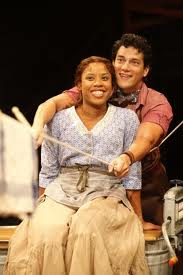
Corny, charming, and as handsomely made as a hand-sewn quilt, "Oklahoma!" is one of the permanent landmarks of American musical theater. Though scholars continue to quarrel over whether the first of the Richard Rodgers-Oscar Hammerstein II collaborations was also the first "integrated" musical--a show, that is, in which music, lyrics, book and choreography all work together to advance an emotionally serious plot--contemporary audiences don't care whether it deserves priority over, say, "Pal Joey" or "Porgy and Bess." Either way, they like it fine, and show no signs of longing for some fancy director to treat it to a high-concept staging. Nor has Molly Smith, the artistic director of Arena Stage, done anything of the kind. Ms. Smith's "Oklahoma!" is a perfectly, almost baldly straightforward production that deviates from the norm in only two ways: It is performed in the round by a multicultural cast whose members include a Latino Curly (Nicholas Rodriguez) and a black Laurey (Eleasha Gamble). Otherwise, this is much the same "Oklahoma!" that your grandfolks loved.

Okie.jpegIs that good enough for 2010 and the inaugural production of the newly built Mead Center for American Theater? Arena Stage's enthusiastic audiences clearly think so, and up to a point I'm inclined to agree with them. Ms. Smith's unselfconsciously lively staging, after all, is full of the high-stepping energy without which no production of "Oklahoma!" can hope to make its mark. What I miss, however, is any sense that we're being told something about the show that we didn't already know....

Neil LaBute is back again, and I wish I could say that he's returned to form after a long, dull stretch. No such luck. "The Break of Noon," like all of his plays since "Fat Pig," starts strong, loses steam and drifts all over the road before coasting to a dead stop.

Part of the problem is that Mr. LaBute is seeking this time around to breathe life into a musty plot twist that dates back to Edwardian times: How might the modern world respond to a person who claims that God has spoken to him? In this umpteenth iteration, we get a regular-guy businessman named, predictably enough, John Smith (David Duchovny). The only survivor of a mass murder, John believes that God told him midway through the shootings that "you shall be saved." The experience transforms him, though not so much as to prevent him from capitalizing on the transformation by selling his story to the media, and for the rest of the evening we watch him interact with a string of skeptics, including his ex-wife (Amanda Peet), a cynical talk-show host (Tracee Chimo) and the detective in charge of his case (John Earl Jelks), all of whom are variously disinclined to take his implausible tale at face value.

As usual with Mr. LaBute, the first scene, a monologue in which John tells what happened on the fatal day, is pointed and powerful, but nothing that happens thereafter is half so fresh...

* * *

Read the whole thing here.

Posted November 26, 12:00 AM

TT: The Cowardly Lion's bravest night

GODOT%20LP%20JACKET.jpgI rejoice to report that the 1956 recording of the first Broadway production of Waiting for Godot, starring Bert Lahr, is finally back in print. Since no one else in the world seems to be aware of this wonderful fact, I decided to announce it to the world in my "Sightings" column for today's Wall Street Journal. Here's an excerpt:

Every critic who covered the show heaped praise on Lahr, and the most perceptive ones saw that his performance was profoundly true to the spirit of the play. Though Lahr was no kind of intellectual, he had instinctively understood what Beckett was up to. "I know it's supposed to be tragic, but there are lots of gags," he told his agent after reading the script. So there are, for "Godot" is a Laurel-and-Hardyesque farce about the meaninglessness of life. Even those critics who, like Brooks Atkinson of the New York Times, found it hard to stomach the play's dark vision were staggered by the crazed beauty of Lahr's acting: "His long experience as a bawling mountebank has equipped Mr. Lahr to represent eloquently the tragic comedy of one of the lost souls of the earth."

Alas, "Godot" closed after just 10 weeks, and Lahr never appeared in it again. But Goddard Lieberson, who produced original-cast albums for Columbia Records, had the brilliant idea to record a complete performance of the play. The existence of the resulting album, which has been out of print for the past quarter-century, is no secret, but its long-standing unavailability has caused it to be overlooked by most people who write about "Godot." Even John Lahr, the comedian's younger son, fails to mention it in "Notes on a Cowardly Lion," the uniquely perceptive biography of his father that he wrote in 1969.

It is, therefore, stop-press news for anybody who loves great theater that the 1956 recording of "Godot" is available once again, not as a CD but as an mp3-only sound file that you can download from Amazon for $3.56 or from iTunes for $5.99. (You can find it on either site by searching for "Bert Lahr.") Culturally speaking, I'd call that the deal of the decade....

The 1956 production of "Godot" was Lahr's show all the way, and to hear it now is to boggle at his seemingly infinite comic resourcefulness. He whines, he whimpers, he chortles, he grunts, giving each line precisely the right flavor. Yet never for a moment does his clowning conceal the play's underlying pathos, and whenever he opens his mouth, it's always Beckett, not Bert Lahr, that you hear....

Read the whole thing here.

Posted November 26, 12:00 AM

TT: Almanac

"The fact is that the average man's love of liberty is nine-tenths imaginary, exactly like his love of sense, justice and truth. He is not actually happy when free; he is uncomfortable, a bit alarmed, and intolerably lonely."

H.L. Mencken, Baltimore Evening Sun, Feb. 12, 1923

Posted November 26, 12:00 AM

November 25, 2010

TT: So you want to see a show?

Here's my list of recommended Broadway, off-Broadway, and out-of-town shows, updated weekly. In all cases, I gave these shows favorable reviews (if sometimes qualifiedly so) in The Wall Street Journal when they opened. For more information, click on the title.

Warning: Broadway shows marked with an asterisk were sold out, or nearly so, last week.

BROADWAY:
Bloody Bloody Andrew Jackson (musical, PG-13/R, reviewed here)
La Cage aux Folles (musical, PG-13, adult subject matter, reviewed here)
Driving Miss Daisy * (drama, G, possible for smart children, closes Jan. 29, reviewed here)
Fela! (musical, PG-13, adult subject matter, closes Jan. 2, reviewed here)
A Free Man of Color (epic comedy, PG-13/R, adult subject matter, closes Jan. 9, reviewed here)
Lombardi (drama, G/PG-13, a modest amount of adult subject matter, reviewed here)
The Merchant of Venice * (Shakespeare, PG-13, adult subject matter, closes Jan. 9, reviewed here)
Million Dollar Quartet (jukebox musical, G, reviewed here)
The Pee-wee Herman Show (comic revue, G/PG-13, heavily larded with double entendres, closes Jan. 2, reviewed here)
The Pitmen Painters (serious comedy, G, too demanding for children, closes Dec. 12, reviewed here)

OFF BROADWAY:
Alfred Hitchcock's The 39 Steps (comedy, G, suitable for bright children, closes Jan. 16, original Broadway production reviewed here)
Angels in America (drama, PG-13/R, adult subject matter, closes Feb. 20, reviewed here)
Avenue Q (musical, R, adult subject matter and one show-stopping scene of puppet-on-puppet sex, reviewed here)
The Fantasticks (musical, G, suitable for children capable of enjoying a love story, reviewed here)
Play Dead (theatrical spook show, PG-13, utterly unsuitable for easily frightened children or adults, reviewed here)

CLOSING SUNDAY IN PHOENIX, ARIZ.:
Ma Rainey's Black Bottom (drama, PG-13/R, adult subject matter and violence, reviewed here)

CLOSING SUNDAY ON BROADWAY:
A Life in the Theatre (serious comedy, PG-13, reviewed here)

Posted November 25, 12:00 AM

TT: Almanac

"I believe in Michael Angelo, Velasquez, and Rembrandt; in the might of design, the mystery of color, the redemption of all things by Beauty everlasting, and the message of Art that has made these hands blessed."

George Bernard Shaw, The Doctor's Dilemma

Posted November 25, 12:00 AM

November 24, 2010

TT: Snapshot

Dame Margot Fonteyn dances Frederick Ashton's Salut d'amour, set to the music of Edward Elgar:

(This is the latest in a weekly series of arts-related videos that appear in this space each Wednesday.)

Posted November 24, 12:00 AM

TT: Almanac

"My dear, it would be a terrible poverty of life if music were political. I cannot imagine it because what does this mean--'political music'? That is why I ignore questions about political music because music is music. Painting is painting."

Henryk Górecki, interview with Bruce Duffie (April 1994)

Posted November 24, 12:00 AM

November 23, 2010

TT: Almanac

"The basic fact about human existence is not that it is a tragedy, but that it is a bore. It is not so much a war as an endless standing in line."

H.L. Mencken, Baltimore Evening Sun (Aug. 9, 1926)

Posted November 23, 12:00 AM

November 22, 2010

TT: Funny like a straitjacket

Brendan Fraser has just made his Broadway debut in the American premiere of Elling, an occasion that attracted the attention of the editors of the Greater New York section of The Wall Street Journal, who asked me to review the opening for today's paper. Here's an excerpt.

* * *

My preliminary expectations about Simon Bent's "Elling" can be summed up as follows: Why would any American producer in his right mind choose to put money into a British stage play adapted from a Norwegian film based on a series of allegedly comic novels about two mentally ill men, one prim and fussy and the other loud and sloppy? What good could come of so patently misguided an investment? None whatsoever, I regret to say: "Elling" is relentlessly sentimental and comprehensively unfunny, so much so that I had to struggle to stay awake all the way to the bitter end.

I may well be underestimating the potency of Norwegian humor, for which I humbly apologize in advance. That said, the premise of "Elling," in which the title character (Denis O'Hare) and his roommate Kjell Bjarne (Brendan Fraser) are transferred from an insane asylum to a halfway house in order to adjust to life in the outside world, strikes me as...well, not very funny. Not knowing the novels by Ingvar Ambjornsen on which "Elling" is based, I can't say anything about their theatrical potential, but it strikes me that Mr. Bent has turned them into a rigidly commercial comedy that plays like a cross between "The Odd Couple" and "One Flew Over the Cuckoo's Nest," with a bit of "Waiting for Godot" thrown in to confuse the issue....

Mr. Fraser is, or can be, an accomplished film actor--he was quite good as Ian McKellen's innocent foil in "Gods and Monsters"--but his one-dimensional performance is both unvaried and unmemorable....

* * *

The print version of the Journal's Greater New York section only appears in copies of the paper published in the New York area, but the complete contents of the section are available on line, and you can read my review of Elling by going here.

Posted November 22, 12:00 AM

TT: Almanac

If thou dislik'st the Piece thou light'st on first;
Thinke that of All, that I have writ, the worst:
But if thou read'st my Book unto the end,
And still do'st this, and that verse, reprehend:
O Perverse man! If All disgustfull be,
The Extreame Scabbe take thee, and thine, for me.

Robert Herrick, "To the Soure Reader" (courtesy of Hannah Farber)

Posted November 22, 12:00 AM

November 19, 2010

TT: They, too, sing America

In today's Wall Street Journal I review two important shows about different aspects of the black experience in America, the world premiere of John Guare's A Free Man of Color and the Arizona Theatre Company's revival of August Wilson's Ma Rainey's Black Bottom. Here's an excerpt.

* * *

To call a play "sprawling" is not necessarily a bad thing. Some canvases are naturally larger than others, and critics who (like me) have a built-in bias in favor of careful craftsmanship must always be on guard lest it cause them to underrate a work of genius whose corners aren't tucked in. If neatness is what you expect from John Guare's "A Free Man of Color," you'll be doomed to disappointment. Mr. Guare's ambitious new play, which tells the fantastic tale of Jacques Cornet (Jeffrey Wright), a 19th-century millionaire playboy from New Orleans who happens to be black, has a cast of 33 and runs for two and a half crowded hours. Yes, it sprawls, but for all its hectic messiness, "A Free Man of Color" is one of the three or four most stirring new plays I've seen since I started writing this column seven years ago.

Free%20Man.jpegSet in 1801, just before the Louisiana Purchase brought New Orleans under the thumb of Washington, "A Free Man of Color" starts out as a bawdy Restoration-style comedy of bad manners in which the Big Easy is portrayed as a prelapsarian Eden to whose richer citizens the concept of racial prejudice is as alien as the shadow of sexual guilt. Even though he's black, Jacques Cornet is well-heeled enough to have slaves of his own, and the fact that he is so wealthy and attractive (Mr. Guare describes him as "a dazzling piece of work") insulates him from the common plight of his fellow blacks. The first act, in which his sexual misadventures are catalogued in frenzied detail, plays like a 10-door farce salted with so many laughs that you won't have time to catch your breath.

In the second act, history catches up with Monsieur Cornet. No sooner does Thomas Jefferson (John McMartin) approve the purchase of the Louisiana Territory than his status as a "free man of color" is revoked, and New Orleans' gaudiest peacock is shorn of his feathers and sold into slavery, a terrible denouement described by Mr. Guare in language that approaches the condition of poetry...

The Arizona Theatre Company, whose shows are seen in Phoenix and Tucson, is currently doing "Ma Rainey" as well as I can imagine it being done. The staging is by Lou Bellamy, the artistic director of St. Paul's Penumbra Theatre Company, whose magnificent Off-Broadway revival of Wilson's "Two Trains Running" was one of the highlights of the 2006-07 season. Like that well-remembered production, it is earthily direct, wholly to the point and impeccably cast, with Jevetta Steele hitting the center of the bull's-eye as the bisexual blues shouter whose sidemen are at murderous odds with one another. Vicki Smith's three-level recording-studio set is a model of smell-the-coffee realism....

* * *

Read the whole thing here.

Posted November 19, 12:00 AM

TT: Almanac

"The blues help you get out of bed in the morning. You get up knowing you ain't alone. There's something else in the world. Something's been added by that song. This be an empty world without the blues. I take that emptiness and try to fill it up with something."

August Wilson, Ma Rainey's Black Bottom

Posted November 19, 12:00 AM

November 18, 2010

TT: Music for a couch day

Kenny Burrell, Bob Magnusson, and Sherman Ferguson play "All Blues":

Posted November 18, 2:11 PM

TT: So you want to see a show?

Here's my list of recommended Broadway, off-Broadway, and out-of-town shows, updated weekly. In all cases, I gave these shows favorable reviews (if sometimes qualifiedly so) in The Wall Street Journal when they opened. For more information, click on the title.

Warning: Broadway shows marked with an asterisk were sold out, or nearly so, last week.

BROADWAY:
Bloody Bloody Andrew Jackson (musical, PG-13/R, reviewed here)
La Cage aux Folles (musical, PG-13, adult subject matter, reviewed here)
Driving Miss Daisy * (drama, G, possible for smart children, closes Jan. 29, reviewed here)
Fela! (musical, PG-13, adult subject matter, closes Jan. 2, reviewed here)
Lombardi (drama, G/PG-13, a modest amount of adult subject matter, reviewed here)
The Merchant of Venice * (Shakespeare, PG-13, adult subject matter, closes Jan. 9, reviewed here)
Million Dollar Quartet (jukebox musical, G, reviewed here)
The Pee-wee Herman Show (comic revue, G/PG-13, heavily larded with double entendres, closes Jan. 2, reviewed here)
The Pitmen Painters (serious comedy, G, too demanding for children, closes Dec. 12, reviewed here)

OFF BROADWAY:
Alfred Hitchcock's The 39 Steps (comedy, G, suitable for bright children, closes Jan. 16, original Broadway production reviewed here)
Angels in America (drama, PG-13/R, adult subject matter, closes Feb. 20, reviewed here)
Avenue Q (musical, R, adult subject matter and one show-stopping scene of puppet-on-puppet sex, reviewed here)
The Fantasticks (musical, G, suitable for children capable of enjoying a love story, reviewed here)
Play Dead (theatrical spook show, PG-13, utterly unsuitable for easily frightened children or adults, reviewed here)

CLOSING NEXT WEEK ON BROADWAY:
A Life in the Theatre (serious comedy, PG-13, closes Nov. 28, reviewed here)

Posted November 18, 12:00 AM

TT: Almanac

"Truth would quickly cease to be stranger than fiction, once we got as used to it."

H.L. Mencken, A Little Book in C Major

Posted November 18, 12:00 AM

November 17, 2010

TT: Snapshot (in honor of moving day)

An excerpt from Laurel and Hardy's "The Music Box":

(This is the latest in a weekly series of arts-related videos that appear in this space each Wednesday.)

UPDATE: Courtesy of Mr. Anecdotal Evidence, Samuel Beckett on Laurel and Hardy.

Posted November 17, 12:00 AM

TT: Almanac

"A man who can laugh, if only at himself, is never really miserable."

H.L. Mencken, Minority Report: H.L. Mencken's Notebooks

Posted November 17, 12:00 AM

November 16, 2010

TT: A little traveling music, please

Jimmy Rushing sings "Goin' to Chicago Blues" on a 1958 episode of The Subject Is Jazz, accompanied by an all-star band led by Buck Clayton:

Posted November 16, 12:00 AM

TT: Almanac

"Indeed, I simply can't imagine competence as anything save admirable, for it is very rare in this world, and especially in this great Republic, and those who have it in some measure, in any art or craft from adultery to zoology, are the only human beings I can think of who will be worth the oil it will take to fry them in Hell."

H. L. Mencken, Heathen Days (courtesy of Margaret Hivnor)

Posted November 16, 12:00 AM

November 15, 2010

TT: The Merchant of Broadway

The big news in New York theater this week is the opening of the Broadway transfer of the Public Theater's production of The Merchant of Venice. Accordingly, The Wall Street Journal asked me to write a special review for today's Greater New York section. Here's an excerpt.

* * *

SHylock.jpegWhen I reviewed the Public Theater's Central Park production of "The Merchant of Venice" in June, I said that it might end up on Broadway, and that it deserved to. This has now happened, and the main reason for the transfer is, needless to say, Al Pacino. Even so, what was true six months ago is still true today: Mr. Pacino is a galvanic Shylock, but this "Merchant" would be more than good enough to play on Broadway no matter who was in the title role. The best news is that Daniel Sullivan and Mark Wendland, the director and set designer, have managed to take a site-specific outdoor production and move it to the proscenium stage of the Broadhurst Theatre without any loss of theatrical potency. If anything, the show is more tightly focused in its smaller indoor home.

Shakespeare on Broadway has tended in recent seasons to be spotty, usually because of the stunt casting that makes such productions as Jude Law's "Hamlet" financially feasible. Fortunately, Mr. Pacino's performance, in which he plays Shylock as an old-fashioned "stage Jew" driven to the edge of madness by his lust for revenge, is no stunt. He is a veteran stage actor who knows how to nail every line to the auditorium's back wall, and even if you think he's flirting with caricature--which he is--you'll find the results enthralling...

Would that the cheap seats were a whole lot cheaper, but don't begrudge Mr. Pacino his big-name salary. He's earning every cent of whatever he's being paid--and then some. You'll never see a more exciting "Merchant of Venice," or a more thought-provoking one.

* * *

The print version of the Journal's Greater New York section only appears in copies of the paper published in the New York area, but the complete contents of the section are available on line, and you can read my review of The Merchant of Venice by going here.

Posted November 15, 12:00 AM

TT: Not quite as bad as a fire

caravan.jpegAfter a lengthy stretch of largely contented residence on the Upper West Side of Manhattan, Mrs. T and I are exchanging Central Park West for Fort Tryon Park and moving uptown to Washington Heights later this week. Our goal was to find a larger apartment in a quiet, comfortable neighborhood that can be reached easily by subway, and we think we've succeeded. Needless to say, the proof of the pudding is in the living, and I'll keep you abreast of how our new life in Washington Heights shapes up.

For the moment, though, our immediate concern is transferring several thousand books and compact discs and some two dozen works of art from Apartment No. 1 to Apartment No. 2, a task that I expect will keep both of us preoccupied for the next few days (at least!). To this end, I won't be doing any blogging this week outside of the usual daily postings.

I hope to be back again next Monday. In the meantime, please send lovely thoughts our way as we tear up our old lives and march anxiously toward the future....

Posted November 15, 12:00 AM

TT: Almanac

"The more one suffers, the more, I believe, has one a sense for the comic. It is only by the deepest suffering that one acquires true authority in the use of the comic, an authority which by one word transforms as by magic the reasonable creature one calls man into a caricature."

Søren Kierkegaard, Stages on Life's Way

Posted November 15, 12:00 AM

November 14, 2010

NO, YOU CAN'T

"What do you think of when you hear the word 'genius'? Most of us, I suspect, picture a fellow in a white coat who squints into a microscope, twiddles a knob, and says, "Eureka! I've found the cure for cancer!" More often than not, though, scientific and creative discoveries are the result not of bolts of mental lightning but of long stretches of painfully hard slogging..."

Posted November 14, 9:52 PM

November 12, 2010

TT: Not for the faint of heart!!

In today's Wall Street Journal drama column, I review two New York shows that are more than a bit off the beaten path of convention, Teller's Play Dead and Paul Reubens' The Pee-wee Herman Show. Here's an excerpt.

* * *

Without spoiling any of its secrets, I can say that "Play Dead" is a slicked-up version of a good old-fashioned Saturday-night spook show in which Todd Robbins, Mr. Teller's co-author and onstage alter ego, tells the more or less true stories of a serial killer, two phony mediums, a geek (look it up) and a murder victim whom Mr. Robbins knew in real life. During and in between these narratives, things...happen. The nature of these grisly occurrences can best be summarized by saying that the white suit worn by Mr. Robbins grows steadily redder throughout the evening.

Teller.jpegSeeing as how the creators of "Play Dead" are both veteran stage magicians, it stands to reason that you'll see--or think you saw--some spectacular and seemingly inexplicable illusions, including the eating of a lightbulb and the murder of an audience member. But what really drives the show is the contempt in which its makers rightly hold those charlatans who use "magic" to defraud the public. The middle section of "Play Dead," for instance, is a Houdini-like reenactment of a fake séance that is at one and the same time funny, furious and wholly enthralling....

Unlikely as it may sound, it's been 20 years since "Pee-wee's Playhouse" went off the air, which means that the Broadway transfer of "The Pee-wee Herman Show" is above all a nostalgia act aimed at thirtysomethings who spent their Saturday mornings watching Paul Reubens' cheerfully ironic take on children's TV. Many such folk were present when I saw a press preview of the show last week, and they made their presence known, lustily cheering all their favorite bits. If you, too, were a fan, all you need to know is that Mr. Reubens, who is now 58, is still playing the part of a weirdly spritely man-child and that he has given us what is in essence a 90-minute-long stage version of his TV show, complete with talking furniture and peculiar playmates. Except for the superlative puppetry of Basil Twist, the main difference between Pee-wee then and now is that the script of "The Pee-wee Herman Show" is thickly larded with double entendres, jokes about gay marriage and other nudge-nudge-wink-wink nods to its now-grown fans....

* * *

Read the whole thing here.

Posted November 12, 12:00 AM

TT: No, you can't

Hulce.jpegAre geniuses made, not born? I just read a new book called Sudden Genius? in which the British biographer Andrew Robinson offers an admirably balanced take on this controversial topic--far more balanced than the one to be found in Malcolm Gladwell's Outliers, which comes dangerously close to arguing that genius doen't exist at all. In my "Sightings" column for today's Wall Street Journal, I compare and contrast these two points of view:

Andrew Robinson examines key moments in the lives of such giants as Marie Curie, Charles Darwin, Albert Einstein and Leonardo da Vinci. The conclusion that he draws from their experience is that creative genius is "the work of human grit, not the product of superhuman grace." Along the way, Mr. Robinson also takes time out to consider one of the most fashionable modern-day theories of genius--and finds it wanting.

The theory is known in England as "the 10-year rule" and in the U.S., where it has been popularized by Malcolm Gladwell, the author of "Outliers," as "the 10,000-hour rule." The premise is the same: To become successful at anything, you must spend 10 years working at it for 20 hours each week. Do so, however, and success is all but inevitable. You don't have to be a genius--in fact, there's no such thing.

K. Anders Ericsson, the psychologist who is widely credited with having formulated the 10,000-hour rule, says in "The Making of an Expert," a 2007 article summarizing his research, that "experts are always made, not born." He discounts the role played by innate talent, citing Wolfgang Amadeus Mozart as an example....

The problem with the 10,000-hour rule is that many of its most ardent proponents are political ideologues who see the existence of genius as an affront to their vision of human equality, and will do anything to explain it away. They have a lot of explaining to do...

Read the whole thing here.

Posted November 12, 12:00 AM

TT: Almanac

"The presence of irony does not necessarily mean that the earnestness is excluded. Only assistant professors assume that."

Søren Kierkegaard, Concluding Unscientific Postscript to Philosophical Fragments

Posted November 12, 12:00 AM

November 11, 2010

BOOK

Alyn Shipton, Hi-De-Ho: The Life of Cab Calloway (Oxford, $29.95). This is, surprisingly, the first full-length biography of the creator of Minnie the Moocher and Smokey Joe, and it's a solid piece of work, a bit short on color but thoroughly reliable and informative. Contrary to the received view of snobbish jazz critics, Calloway was a first-rate jazz-flavored pop singer whose vocals were comparable in quality to the brilliant ensemble playing of the big band that he led throughout the Thirties and Forties, and Shipton gives him his due. Must reading for swing buffs, especially in tandem with The Chu and Dizzy Years, Hep Records' indispensable two-CD compilation of Calloway's key 78s (TT).

Posted November 11, 7:59 AM

CD

Murray Perahia, Perahia Brahms (Sony Classical). An anthology of Brahms' finest works for solo piano--the Handel Variations, the B Minor and G Minor Rhapsodies, and the ten intermezzi and other short pieces of Opp. 118 and 119--all played in an understated, unexaggerated style that emphasizes their autumnal virtues. Not only is this the strongest single-disc collection of Brahms' piano music since Van Cliburn's My Favorite Brahms, originally released in 1975, but Perahia's chastely classical playing contrasts very nicely with Cliburn's expansive romanticism (TT).

Posted November 11, 7:58 AM

TT: Straight from the source

As I mentioned in this space last week, Danse Russe, my latest operatic collaboration with Paul Moravec, received its first workshop performance on Saturday afternoon in Philadelphia. Paul and I were both pleased by the results--but why take our word for it? In the following video, shot during the workshop, Paul talks about Danse Russe and Center City Opera Theater performs piano-accompanied excerpts from the latest draft of the score. Take a look and see for yourself:

If you haven't seen it yet, here's an earlier interview taped at my apartment two weeks ago in which I talk about the making of Danse Russe:

Posted November 11, 12:10 AM

TT: So you want to see a show?

Here's my list of recommended Broadway, off-Broadway, and out-of-town shows, updated weekly. In all cases, I gave these shows favorable reviews (if sometimes qualifiedly so) in The Wall Street Journal when they opened. For more information, click on the title.

Warning: Broadway shows marked with an asterisk were sold out, or nearly so, last week.

BROADWAY:
Bloody Bloody Andrew Jackson (musical, PG-13/R, reviewed here)
La Cage aux Folles (musical, PG-13, adult subject matter, reviewed here)
Driving Miss Daisy * (drama, G, possible for smart children, closes Jan. 29, reviewed here)
Fela! (musical, PG-13, adult subject matter, closes Jan. 2, reviewed here)
Lombardi (drama, G/PG-13, a modest amount of adult subject matter, reviewed here)
The Merchant of Venice * (Shakespeare, PG-13, adult subject matter, closes Jan. 9, reviewed here)
Million Dollar Quartet (jukebox musical, G, reviewed here)
The Pitmen Painters (serious comedy, G, too demanding for children, closes Dec. 12, reviewed here)

OFF BROADWAY:
Alfred Hitchcock's The 39 Steps (comedy, G, suitable for bright children, original Broadway production reviewed here)
Angels in America (drama, PG-13/R, adult subject matter, closes Feb. 20, reviewed here)
Avenue Q (musical, R, adult subject matter and one show-stopping scene of puppet-on-puppet sex, reviewed here)
The Fantasticks (musical, G, suitable for children capable of enjoying a love story, reviewed here)

CLOSING SOON ON BROADWAY:
A Life in the Theatre (serious comedy, PG-13, closes Nov. 28, reviewed here)

CLOSING SUNDAY IN CHICAGO:
Night and Day (serious comedy, PG-13, reviewed here)

Posted November 11, 12:00 AM

TT: In memoriam

Arturo Benedetti Michelangeli plays the funeral march from Chopin's Second Piano Sonata:

Posted November 11, 12:00 AM

TT: Almanac

"Only the dead have seen the end of war."

George Santayana, Soliloquies in England and Later Soliloquies

Posted November 11, 12:00 AM

November 10, 2010

TT: Snapshot

Skip James sings "Devil Got My Woman" at the Newport Folk Festival in 1966:

(This is the latest in a weekly series of arts-related videos that appear in this space each Wednesday.)

Posted November 10, 12:00 AM

TT: Almanac

"All actual life is encounter."

Martin Buber, I and Thou

Posted November 10, 12:00 AM

November 9, 2010

TT: Almanac

"Hypocrisy, of course, delights in the most sublime speculations; for, never intending to go beyond speculation, it costs nothing to have it magnificent."

Edmund Burke, Reflections on the Revolution in France

Posted November 09, 12:00 AM

November 8, 2010

TT: Just because

Van Cliburn plays Liszt's Twelfth Hungarian Rhapsody in Moscow in 1962:

Posted November 08, 12:17 AM

TT: Taking the test

Charles Murray's recent Washington Post essay about the emergence of a "new elite" in American life got talked about, and rightly so. But it was this part of the piece that caught my eye:

Far from spending their college years in a meritocratic melting pot, the New Elite spend school with people who are mostly just like them—which might not be so bad, except that so many of them have been ensconced in affluent suburbs from birth and have never been outside the bubble of privilege. Few of them grew up in the small cities, towns or rural areas where more than a third of all Americans still live....

With geographical clustering goes cultural clustering. Get into a conversation about television with members of the New Elite, and they can probably talk about a few trendy shows—"Mad Men" now, "The Sopranos" a few years ago. But they haven't any idea who replaced Bob Barker on "The Price Is Right." They know who Oprah is, but they've never watched one of her shows from beginning to end.

Talk to them about sports, and you may get an animated discussion of yoga, pilates, skiing or mountain biking, but they are unlikely to know who Jimmie Johnson is (the really famous Jimmie Johnson, not the former Dallas Cowboys coach), and the acronym MMA means nothing to them.

They can talk about books endlessly, but they've never read a "Left Behind" novel (65 million copies sold) or a Harlequin romance (part of a genre with a core readership of 29 million Americans).

They take interesting vacations and can tell you all about a great backpacking spot in the Sierra Nevada or an exquisite B&B overlooking Boothbay Harbor, but they wouldn't be caught dead in an RV or on a cruise ship (unless it was a small one going to the Galapagos). They have never heard of Branson, Mo.

There are so many quintessentially American things that few members of the New Elite have experienced. They probably haven't ever attended a meeting of a Kiwanis Club or Rotary Club, or lived for at least a year in a small town (college doesn't count) or in an urban neighborhood in which most of their neighbors did not have college degrees (gentrifying neighborhoods don't count). They are unlikely to have spent at least a year with a family income less than twice the poverty line (graduate school doesn't count) or to have a close friend who is an evangelical Christian. They are unlikely to have even visited a factory floor, let alone worked on one.

Taken individually, members of the New Elite are isolated from mainstream America as a result of lifestyle choices that are nobody's business but their own. But add them all up, and they mean that the New Elite lives in a world that doesn't intersect with mainstream America in many important ways....

Up to a point, I think Murray is onto something—but only up to a point. Take, for instance, the case of yours truly. Yes, I'm an aesthete with an art collection who lives on the Upper West Side of Manhattan, earns his living as a drama critic, used to play jazz, has written two opera libretti, and loves to stay in B&Bs. But that's not all I am, or all I've done:

SIKESTON%20POSTCARD.jpg• I spent the first eighteen years of my life in a small town, and I've never lived in a suburb, affluent or otherwise.

• I got my bachelor's degree from a Southern Baptist college.

• I watched the first three seasons of The Sopranos, but have yet to see a single episode of Mad Men.

• I had to look up Jimmie Johnson and the MMA, but I do know that Drew Carey replaced Bob Barker on The Price Is Right, and I've seen plenty of episodes of The Oprah Show from beginning to end.

• I've never read a "Left Behind" book, but I saw (and wrote about) Left Behind: The Movie.

• Not only did I spend countless nights in my father's various RVs, but I went to Branson for my first honeymoon, and I used to play in a country band.

• I won a Rotary Club speaking contest in high school.

• Most of the members of my family, both immediate and extended, are evangelical Christians.

So who am I, Charles Murray? Where do I fit into your system of cultural pigeonholes? How do you explain me—and might my very existence suggest that America is a more complicated place than you care to admit?

Posted November 08, 12:00 AM

TT: Almanac

"People crushed by law, have no hopes but from power. If laws are their enemies, they will be enemies to laws; and those who have much to hope and nothing to lose, will always be dangerous."

Edmund Burke, letter to Charles James Fox (October 8, 1777)

Posted November 08, 12:00 AM

November 5, 2010

TT: Reason to be nervous

Today my entire Wall Street Journal drama column is devoted to the premiere of Women on the Verge of a Nervous Breakdown, which stars Sherie Rene Scott, Patti LuPone, Laura Benanti, and Brian Stokes Mitchell and which opened cold on Broadway last night without an out-of-town tryout. Too bad--it's no good. Here's an excerpt.

* * *

Recipe for a commodity musical: (1) Take an ultra-familiar piece of source material, preferably a hit movie. (2) Adapt it for the stage in the most literal and obvious way imaginable, adding only extra jokes. (3) Stir in a dozen or so innocuous songs that won't divert the audience's attention from how closely the stage version resembles its source. If you're lucky, you get "The Addams Family"; if not, "9 to 5." Either way, you get the kind of been-there-seen-that musical that has been blighting Broadway for the past decade and more.

WOTVVV.jpegSo what does this formula have to do with "Women on the Verge of a Nervous Breakdown," Lincoln Center Theater's big-budget musical version of Pedro Almodovár's 1988 screen comedy about three women whom love has driven to the brink of madness? The answer is that Jeffrey Lane and David Yazbek, last seen on the Great White Way as the creators of "Dirty Rotten Scoundrels," have now sought to commoditize not an off-the-rack Hollywood comedy but one of the most individual and significant Spanish-language films of the postwar era. It's as if they'd tried to turn "Shoot the Piano Player" or "Wings of Desire" into a Big Mac musical--and the results, not at all surprisingly, are a flavorless mess....

For all its seeming lunacy, "Women on the Verge" is in fact a wholly serious comedy about a macho culture that encourages men to be faithless to the women who love them. The fact that Mr. Almodovár is gay made it easier for him to portray that culture with a sharp-eyed detachment that did nothing to diminish his sympathy for his female characters. That's part of what makes "Women on the Verge" more than a dizzy sex comedy: You always know whose side it's on.

To turn so fully realized a work of cinematic art into an equally successful musical demands that it be subjected to a complete and thoroughgoing imaginative transformation. Otherwise, the new version will seem superfluous--which is what's wrong with the stage version of "Women on the Verge." Instead of breaking new creative ground, Mr. Lane's book tracks Mr. Almodovár's setting and plot slavishly, salting his script with unfunny one- and two-liners that serve only to dilute the crisp, elliptical dialogue of the screenplay. As for Mr. Yazbek's songs, they're as forgettable as Muzak in a noisy restaurant...

* * *

Read the whole thing here.

Posted November 05, 12:00 AM

TT: Almanac

"A sense of security, of well-being, of summer warmth pervades my memory. That robust reality makes a ghost of the present. The mirror brims with brightness; a bumblebee has entered the room and bumps against the ceiling. Everything is as it should be, nothing will ever change, nobody will ever die."

Vladimir Nabokov, Speak, Memory

Posted November 05, 12:00 AM

November 4, 2010

TT: A happy correction

I was wrong when I said the other day that Saturday's workshop performance of Danse Russe, the new opera that Paul Moravec and I are writing for Philadelphia's Center City Opera Theater, is an invitation-only affair. In fact, it's open to the public, so if you happen to be in Philadelphia at three p.m. and want to see what we're up to, you are hereby officially invited!

Admission is free, but you'll need a ticket to get in. For more information, go here.

Posted November 04, 3:29 PM

TT: So you want to see a show?

Here's my list of recommended Broadway, off-Broadway, and out-of-town shows, updated weekly. In all cases, I gave these shows favorable reviews (if sometimes qualifiedly so) in The Wall Street Journal when they opened. For more information, click on the title.

Warning: Broadway shows marked with an asterisk were sold out, or nearly so, last week.

BROADWAY:
Bloody Bloody Andrew Jackson (musical, PG-13/R, reviewed here)
La Cage aux Folles (musical, PG-13, adult subject matter, reviewed here)
Driving Miss Daisy * (drama, G, possible for smart children, closes Jan. 29, reviewed here)
Fela! (musical, PG-13, adult subject matter, closes Jan. 2, reviewed here)
A Life in the Theatre (serious comedy, PG-13, closes Jan. 2, reviewed here)
Lombardi (drama, G/PG-13, a modest amount of adult subject matter, reviewed here)
Million Dollar Quartet (jukebox musical, G, reviewed here)
The Pitmen Painters (serious comedy, G, too demanding for children, closes Dec. 12, reviewed here)

OFF BROADWAY:
Alfred Hitchcock's The 39 Steps (comedy, G, suitable for bright children, original Broadway production reviewed here)
Angels in America (drama, PG-13/R, adult subject matter, closes Feb. 20, reviewed here)
Avenue Q (musical, R, adult subject matter and one show-stopping scene of puppet-on-puppet sex, reviewed here)
The Fantasticks (musical, G, suitable for children capable of enjoying a love story, reviewed here)

CLOSING SOON IN CHICAGO:
Night and Day (serious comedy, PG-13, extended through Nov. 14, reviewed here)

Posted November 04, 12:00 AM

TT: Almanac

"I don't think in any language. I think in images. I don't believe that people think in languages. They don't move their lips when they think. It is only a certain type of illiterate person who moves his lips as he reads or ruminates. No, I think in images, and now and then a Russian phrase or an English phrase will form with the foam of the brainwave, but that's about all."

Vladimir Nabokov, Strong Opinions

Posted November 04, 12:00 AM

November 3, 2010

TT: Snapshot

A rare video of the Thad Jones/Mel Lewis Jazz Orchestra playing Jerome Richardson's "The Groove Merchant" in 1969:

(This is the latest in a weekly series of arts-related videos that appear in this space each Wednesday.)

Posted November 03, 12:00 AM

TT: Almanac

"I believe that through discipline, though not through discipline alone, we can achieve serenity, and a certain small but precious measure of the freedom from the accidents of incarnation, and charity, and that detachment which preserves the world which it renounces."

J. Robert Oppenheimer, letter to Frank Oppenheimer (March 12, 1932)

Posted November 03, 12:00 AM

November 2, 2010

TT: Let's make an(other) opera!

Igor-Stravinsky-002.jpgIf you follow this blog regularly, you know that Paul Moravec and I are working on our second opera, Danse Russe, which has been commissioned by Philadelphia's Center City Opera Theater and will be premiered in April. It's a backstage comedy--we call it a vaudeville--about the making of Igor Stravinsky's The Rite of Spring. The four characters, accordingly, are Stravinsky, Sergei Diaghilev, Vaslav Nijinsky, and Pierre Monteux (who conducted the first performance of The Rite of Spring in Paris in 1913).

I haven't had anything to say about Danse Russe in this space since the initial announcement of the commission because I've been too busy writing the opera to write about it, but I'm delighted (and relieved) to report that the libretto is now finished and Paul has drafted all but one scene of the piano score. That's more than enough for Center City Opera to mount a workshop performance in Philadelphia next week.

On Friday, November 5, Paul and I will take part in a discussion of Danse Russe at Philadelphia's Knapp Gallery. The workshop performance will take place the next afternoon. Both events are open to the public. To find out more and purchase tickets, go here.

Last week I was interviewed about Danse Russe at my New York apartment by Center City's Mary Knapp. Excerpts from that interview have just been posted on YouTube, and you can view them here. Mary edited her questions out of the video, but they were good ones. If I do say so myself, I think my answers will tell you quite a bit about what Paul and I think we're up to:

Posted November 02, 12:00 AM

TT: Almanac

"People can foresee the future only when it coincides with their own wishes, and the most grossly obvious facts can be ignored when they are unwelcome."

George Orwell, "London Letter," Partisan Review, Winter 1945

Posted November 02, 12:00 AM

November 1, 2010

DE-ROMANTICIZING THE BLUES

"By now, the sounds and rhythms of the blues are so ubiquitous that they seem almost to be embedded in the musical DNA of the human race--in part because their origins have long been shrouded in what can only be described as romantic myth. Even when scholars with musical training write about the emergence of the blues, the results can be starry-eyed and frankly sentimental..."

Posted November 01, 5:20 AM

TT: How's that noose fit, Mr. Bones?

In the Greater New York section of this morning's Wall Street Journal, I review the Broadway transfer of The Scottsboro Boys, the new John Kander-Fred Ebb musical whose off-Broadway incarnation was one of last season's most highly praised shows. I loathed most of it. Here's an excerpt.

* * *

Scottsboro.jpegI suspect that most of the younger people who come to see "The Scottsboro Boys" won't know much about the Depression-era case that inspired the show, infamous though it once was. Very briefly, then, nine black boys from Georgia and Tennessee (one was 12, the others in their teens) who were riding the rails in search of work in 1931 were pulled off their train in Alabama, arrested by a local posse and accused of raping a pair of white girls who had been riding the same train. A few days later, having barely escaped lynching, they were convicted and sentenced to death. Their case became a nationwide cause célèbre, and the Supreme Court ruled that they had been denied due process and would have to be retried. But even though one of the women subsequently recanted her original testimony, five of the now-grown boys remained behind bars for years to come, the last one being paroled in 1950.

In "The Scottsboro Boys," Messrs. Kander and Ebb and David Thompson, the show's librettist, have compressed this complicated sequence of events into a lengthy one-act musical that makes use of all the theatrical conventions of the old-fashioned blackface minstrel shows that were popular well into the 20th century. (Mr. Kander, who is 83, actually directed blackface shows at a Wisconsin boys' camp in the Thirties.) Except for Mr. Cullum, who plays the master of ceremonies, the performers are all black, and most of the songs, which are written with a grasp of period style that will surprise no one familiar with such earlier Kander-Ebb shows as "Cabaret" and "Chicago," are staged as grotesque parodies of the eye-rolling shuffle-and-grin style familiar to anyone who has seen films of Stepin Fetchit and Mantan Moreland...

"The Scottsboro Boys" would have been courageous had it been mounted on Broadway, or anywhere else in America, in the Sixties. In that long-gone decade, the prospect of watching a stageful of black men perform a "comic" minstrel show about so hideous an event would have stung like a flogging. But the intervening half-century has seen not only the election of a black president but the mounting of musicals like "Ragtime" and "Assassins" in which broadly similar theatrical techniques are used to identical ends, thereby robbing the caricatures in "The Scottsboro Boys" of their shock effect. I suppose there are places in America where such a show might still jolt its viewers, but to see "The Scottsboro Boys" on Broadway is to witness a nightly act of collective self-congratulation in which the right-thinking members of the audience preen themselves complacently at the thought of their own enlightenment....

* * *

The print version of the Journal's Greater New York section only appears in copies of the paper published in the New York area, but the complete contents of the section are available on line, and you can read my review of The Scottsboro Boys by going here.

Posted November 01, 12:00 AM

TT: A reminder about tonight

In case you didn't happen to see the blog on Friday, Candace Bushnell and I will be chatting about the novels of Elaine Dundy tonight at seven p.m. at the Barnes & Noble on East Eighty-Sixth Street in Manhattan. For more information about our joint appearance, which is open to the public, go here.

Posted November 01, 12:00 AM

TT: Almanac

"Writing a book is a horrible, exhausting struggle, like a long bout of some painful illness. One would never undertake such a thing if one were not driven on by some demon whom one can neither resist nor understand."

George Orwell, Why I Write

Posted November 01, 12:00 AM

e="application/atom+xml" title="Atom" href="http://www.artsjournal.com/aboutlastnight/atom.xml" /> About Last Night: November 2010 Archives

« October 2010 | Main | December 2010 »

November 2010 Archives

November 1, 2010

TT: Almanac

"Writing a book is a horrible, exhausting struggle, like a long bout of some painful illness. One would never undertake such a thing if one were not driven on by some demon whom one can neither resist nor understand."

George Orwell, Why I Write

TT: A reminder about tonight

In case you didn't happen to see the blog on Friday, Candace Bushnell and I will be chatting about the novels of Elaine Dundy tonight at seven p.m. at the Barnes & Noble on East Eighty-Sixth Street in Manhattan. For more information about our joint appearance, which is open to the public, go here.

TT: How's that noose fit, Mr. Bones?

In the Greater New York section of this morning's Wall Street Journal, I review the Broadway transfer of The Scottsboro Boys, the new John Kander-Fred Ebb musical whose off-Broadway incarnation was one of last season's most highly praised shows. I loathed most of it. Here's an excerpt.

* * *

Scottsboro.jpegI suspect that most of the younger people who come to see "The Scottsboro Boys" won't know much about the Depression-era case that inspired the show, infamous though it once was. Very briefly, then, nine black boys from Georgia and Tennessee (one was 12, the others in their teens) who were riding the rails in search of work in 1931 were pulled off their train in Alabama, arrested by a local posse and accused of raping a pair of white girls who had been riding the same train. A few days later, having barely escaped lynching, they were convicted and sentenced to death. Their case became a nationwide cause célèbre, and the Supreme Court ruled that they had been denied due process and would have to be retried. But even though one of the women subsequently recanted her original testimony, five of the now-grown boys remained behind bars for years to come, the last one being paroled in 1950.

In "The Scottsboro Boys," Messrs. Kander and Ebb and David Thompson, the show's librettist, have compressed this complicated sequence of events into a lengthy one-act musical that makes use of all the theatrical conventions of the old-fashioned blackface minstrel shows that were popular well into the 20th century. (Mr. Kander, who is 83, actually directed blackface shows at a Wisconsin boys' camp in the Thirties.) Except for Mr. Cullum, who plays the master of ceremonies, the performers are all black, and most of the songs, which are written with a grasp of period style that will surprise no one familiar with such earlier Kander-Ebb shows as "Cabaret" and "Chicago," are staged as grotesque parodies of the eye-rolling shuffle-and-grin style familiar to anyone who has seen films of Stepin Fetchit and Mantan Moreland...

"The Scottsboro Boys" would have been courageous had it been mounted on Broadway, or anywhere else in America, in the Sixties. In that long-gone decade, the prospect of watching a stageful of black men perform a "comic" minstrel show about so hideous an event would have stung like a flogging. But the intervening half-century has seen not only the election of a black president but the mounting of musicals like "Ragtime" and "Assassins" in which broadly similar theatrical techniques are used to identical ends, thereby robbing the caricatures in "The Scottsboro Boys" of their shock effect. I suppose there are places in America where such a show might still jolt its viewers, but to see "The Scottsboro Boys" on Broadway is to witness a nightly act of collective self-congratulation in which the right-thinking members of the audience preen themselves complacently at the thought of their own enlightenment....

* * *

The print version of the Journal's Greater New York section only appears in copies of the paper published in the New York area, but the complete contents of the section are available on line, and you can read my review of The Scottsboro Boys by going here.

DE-ROMANTICIZING THE BLUES

"By now, the sounds and rhythms of the blues are so ubiquitous that they seem almost to be embedded in the musical DNA of the human race--in part because their origins have long been shrouded in what can only be described as romantic myth. Even when scholars with musical training write about the emergence of the blues, the results can be starry-eyed and frankly sentimental..."

November 2, 2010

TT: Almanac

"People can foresee the future only when it coincides with their own wishes, and the most grossly obvious facts can be ignored when they are unwelcome."

George Orwell, "London Letter," Partisan Review, Winter 1945

TT: Let's make an(other) opera!

Igor-Stravinsky-002.jpgIf you follow this blog regularly, you know that Paul Moravec and I are working on our second opera, Danse Russe, which has been commissioned by Philadelphia's Center City Opera Theater and will be premiered in April. It's a backstage comedy--we call it a vaudeville--about the making of Igor Stravinsky's The Rite of Spring. The four characters, accordingly, are Stravinsky, Sergei Diaghilev, Vaslav Nijinsky, and Pierre Monteux (who conducted the first performance of The Rite of Spring in Paris in 1913).

I haven't had anything to say about Danse Russe in this space since the initial announcement of the commission because I've been too busy writing the opera to write about it, but I'm delighted (and relieved) to report that the libretto is now finished and Paul has drafted all but one scene of the piano score. That's more than enough for Center City Opera to mount a workshop performance in Philadelphia next week.

On Friday, November 5, Paul and I will take part in a discussion of Danse Russe at Philadelphia's Knapp Gallery. The workshop performance will take place the next afternoon. Both events are open to the public. To find out more and purchase tickets, go here.

Last week I was interviewed about Danse Russe at my New York apartment by Center City's Mary Knapp. Excerpts from that interview have just been posted on YouTube, and you can view them here. Mary edited her questions out of the video, but they were good ones. If I do say so myself, I think my answers will tell you quite a bit about what Paul and I think we're up to:

November 3, 2010

TT: Almanac

"I believe that through discipline, though not through discipline alone, we can achieve serenity, and a certain small but precious measure of the freedom from the accidents of incarnation, and charity, and that detachment which preserves the world which it renounces."

J. Robert Oppenheimer, letter to Frank Oppenheimer (March 12, 1932)

TT: Snapshot

A rare video of the Thad Jones/Mel Lewis Jazz Orchestra playing Jerome Richardson's "The Groove Merchant" in 1969:

(This is the latest in a weekly series of arts-related videos that appear in this space each Wednesday.)

November 4, 2010

TT: Almanac

"I don't think in any language. I think in images. I don't believe that people think in languages. They don't move their lips when they think. It is only a certain type of illiterate person who moves his lips as he reads or ruminates. No, I think in images, and now and then a Russian phrase or an English phrase will form with the foam of the brainwave, but that's about all."

Vladimir Nabokov, Strong Opinions

TT: So you want to see a show?

Here's my list of recommended Broadway, off-Broadway, and out-of-town shows, updated weekly. In all cases, I gave these shows favorable reviews (if sometimes qualifiedly so) in The Wall Street Journal when they opened. For more information, click on the title.

Warning: Broadway shows marked with an asterisk were sold out, or nearly so, last week.

BROADWAY:
Bloody Bloody Andrew Jackson (musical, PG-13/R, reviewed here)
La Cage aux Folles (musical, PG-13, adult subject matter, reviewed here)
Driving Miss Daisy * (drama, G, possible for smart children, closes Jan. 29, reviewed here)
Fela! (musical, PG-13, adult subject matter, closes Jan. 2, reviewed here)
A Life in the Theatre (serious comedy, PG-13, closes Jan. 2, reviewed here)
Lombardi (drama, G/PG-13, a modest amount of adult subject matter, reviewed here)
Million Dollar Quartet (jukebox musical, G, reviewed here)
The Pitmen Painters (serious comedy, G, too demanding for children, closes Dec. 12, reviewed here)

OFF BROADWAY:
Alfred Hitchcock's The 39 Steps (comedy, G, suitable for bright children, original Broadway production reviewed here)
Angels in America (drama, PG-13/R, adult subject matter, closes Feb. 20, reviewed here)
Avenue Q (musical, R, adult subject matter and one show-stopping scene of puppet-on-puppet sex, reviewed here)
The Fantasticks (musical, G, suitable for children capable of enjoying a love story, reviewed here)

CLOSING SOON IN CHICAGO:
Night and Day (serious comedy, PG-13, extended through Nov. 14, reviewed here)

TT: A happy correction

I was wrong when I said the other day that Saturday's workshop performance of Danse Russe, the new opera that Paul Moravec and I are writing for Philadelphia's Center City Opera Theater, is an invitation-only affair. In fact, it's open to the public, so if you happen to be in Philadelphia at three p.m. and want to see what we're up to, you are hereby officially invited!

Admission is free, but you'll need a ticket to get in. For more information, go here.

November 5, 2010

TT: Almanac

"A sense of security, of well-being, of summer warmth pervades my memory. That robust reality makes a ghost of the present. The mirror brims with brightness; a bumblebee has entered the room and bumps against the ceiling. Everything is as it should be, nothing will ever change, nobody will ever die."

Vladimir Nabokov, Speak, Memory

TT: Reason to be nervous

Today my entire Wall Street Journal drama column is devoted to the premiere of Women on the Verge of a Nervous Breakdown, which stars Sherie Rene Scott, Patti LuPone, Laura Benanti, and Brian Stokes Mitchell and which opened cold on Broadway last night without an out-of-town tryout. Too bad--it's no good. Here's an excerpt.

* * *

Recipe for a commodity musical: (1) Take an ultra-familiar piece of source material, preferably a hit movie. (2) Adapt it for the stage in the most literal and obvious way imaginable, adding only extra jokes. (3) Stir in a dozen or so innocuous songs that won't divert the audience's attention from how closely the stage version resembles its source. If you're lucky, you get "The Addams Family"; if not, "9 to 5." Either way, you get the kind of been-there-seen-that musical that has been blighting Broadway for the past decade and more.

WOTVVV.jpegSo what does this formula have to do with "Women on the Verge of a Nervous Breakdown," Lincoln Center Theater's big-budget musical version of Pedro Almodovár's 1988 screen comedy about three women whom love has driven to the brink of madness? The answer is that Jeffrey Lane and David Yazbek, last seen on the Great White Way as the creators of "Dirty Rotten Scoundrels," have now sought to commoditize not an off-the-rack Hollywood comedy but one of the most individual and significant Spanish-language films of the postwar era. It's as if they'd tried to turn "Shoot the Piano Player" or "Wings of Desire" into a Big Mac musical--and the results, not at all surprisingly, are a flavorless mess....

For all its seeming lunacy, "Women on the Verge" is in fact a wholly serious comedy about a macho culture that encourages men to be faithless to the women who love them. The fact that Mr. Almodovár is gay made it easier for him to portray that culture with a sharp-eyed detachment that did nothing to diminish his sympathy for his female characters. That's part of what makes "Women on the Verge" more than a dizzy sex comedy: You always know whose side it's on.

To turn so fully realized a work of cinematic art into an equally successful musical demands that it be subjected to a complete and thoroughgoing imaginative transformation. Otherwise, the new version will seem superfluous--which is what's wrong with the stage version of "Women on the Verge." Instead of breaking new creative ground, Mr. Lane's book tracks Mr. Almodovár's setting and plot slavishly, salting his script with unfunny one- and two-liners that serve only to dilute the crisp, elliptical dialogue of the screenplay. As for Mr. Yazbek's songs, they're as forgettable as Muzak in a noisy restaurant...

* * *

Read the whole thing here.

November 8, 2010

TT: Almanac

"People crushed by law, have no hopes but from power. If laws are their enemies, they will be enemies to laws; and those who have much to hope and nothing to lose, will always be dangerous."

Edmund Burke, letter to Charles James Fox (October 8, 1777)

TT: Taking the test

Charles Murray's recent Washington Post essay about the emergence of a "new elite" in American life got talked about, and rightly so. But it was this part of the piece that caught my eye:

Far from spending their college years in a meritocratic melting pot, the New Elite spend school with people who are mostly just like them—which might not be so bad, except that so many of them have been ensconced in affluent suburbs from birth and have never been outside the bubble of privilege. Few of them grew up in the small cities, towns or rural areas where more than a third of all Americans still live....

With geographical clustering goes cultural clustering. Get into a conversation about television with members of the New Elite, and they can probably talk about a few trendy shows—"Mad Men" now, "The Sopranos" a few years ago. But they haven't any idea who replaced Bob Barker on "The Price Is Right." They know who Oprah is, but they've never watched one of her shows from beginning to end.

Talk to them about sports, and you may get an animated discussion of yoga, pilates, skiing or mountain biking, but they are unlikely to know who Jimmie Johnson is (the really famous Jimmie Johnson, not the former Dallas Cowboys coach), and the acronym MMA means nothing to them.

They can talk about books endlessly, but they've never read a "Left Behind" novel (65 million copies sold) or a Harlequin romance (part of a genre with a core readership of 29 million Americans).

They take interesting vacations and can tell you all about a great backpacking spot in the Sierra Nevada or an exquisite B&B overlooking Boothbay Harbor, but they wouldn't be caught dead in an RV or on a cruise ship (unless it was a small one going to the Galapagos). They have never heard of Branson, Mo.

There are so many quintessentially American things that few members of the New Elite have experienced. They probably haven't ever attended a meeting of a Kiwanis Club or Rotary Club, or lived for at least a year in a small town (college doesn't count) or in an urban neighborhood in which most of their neighbors did not have college degrees (gentrifying neighborhoods don't count). They are unlikely to have spent at least a year with a family income less than twice the poverty line (graduate school doesn't count) or to have a close friend who is an evangelical Christian. They are unlikely to have even visited a factory floor, let alone worked on one.

Taken individually, members of the New Elite are isolated from mainstream America as a result of lifestyle choices that are nobody's business but their own. But add them all up, and they mean that the New Elite lives in a world that doesn't intersect with mainstream America in many important ways....

Up to a point, I think Murray is onto something—but only up to a point. Take, for instance, the case of yours truly. Yes, I'm an aesthete with an art collection who lives on the Upper West Side of Manhattan, earns his living as a drama critic, used to play jazz, has written two opera libretti, and loves to stay in B&Bs. But that's not all I am, or all I've done:

SIKESTON%20POSTCARD.jpg• I spent the first eighteen years of my life in a small town, and I've never lived in a suburb, affluent or otherwise.

• I got my bachelor's degree from a Southern Baptist college.

• I watched the first three seasons of The Sopranos, but have yet to see a single episode of Mad Men.

• I had to look up Jimmie Johnson and the MMA, but I do know that Drew Carey replaced Bob Barker on The Price Is Right, and I've seen plenty of episodes of The Oprah Show from beginning to end.

• I've never read a "Left Behind" book, but I saw (and wrote about) Left Behind: The Movie.

• Not only did I spend countless nights in my father's various RVs, but I went to Branson for my first honeymoon, and I used to play in a country band.

• I won a Rotary Club speaking contest in high school.

• Most of the members of my family, both immediate and extended, are evangelical Christians.

So who am I, Charles Murray? Where do I fit into your system of cultural pigeonholes? How do you explain me—and might my very existence suggest that America is a more complicated place than you care to admit?

TT: Just because

Van Cliburn plays Liszt's Twelfth Hungarian Rhapsody in Moscow in 1962:

November 9, 2010

TT: Almanac

"Hypocrisy, of course, delights in the most sublime speculations; for, never intending to go beyond speculation, it costs nothing to have it magnificent."

Edmund Burke, Reflections on the Revolution in France

November 10, 2010

TT: Almanac

"All actual life is encounter."

Martin Buber, I and Thou

TT: Snapshot

Skip James sings "Devil Got My Woman" at the Newport Folk Festival in 1966:

(This is the latest in a weekly series of arts-related videos that appear in this space each Wednesday.)

November 11, 2010

TT: Almanac

"Only the dead have seen the end of war."

George Santayana, Soliloquies in England and Later Soliloquies

TT: In memoriam

Arturo Benedetti Michelangeli plays the funeral march from Chopin's Second Piano Sonata:

TT: So you want to see a show?

Here's my list of recommended Broadway, off-Broadway, and out-of-town shows, updated weekly. In all cases, I gave these shows favorable reviews (if sometimes qualifiedly so) in The Wall Street Journal when they opened. For more information, click on the title.

Warning: Broadway shows marked with an asterisk were sold out, or nearly so, last week.

BROADWAY:
Bloody Bloody Andrew Jackson (musical, PG-13/R, reviewed here)
La Cage aux Folles (musical, PG-13, adult subject matter, reviewed here)
Driving Miss Daisy * (drama, G, possible for smart children, closes Jan. 29, reviewed here)
Fela! (musical, PG-13, adult subject matter, closes Jan. 2, reviewed here)
Lombardi (drama, G/PG-13, a modest amount of adult subject matter, reviewed here)
The Merchant of Venice * (Shakespeare, PG-13, adult subject matter, closes Jan. 9, reviewed here)
Million Dollar Quartet (jukebox musical, G, reviewed here)
The Pitmen Painters (serious comedy, G, too demanding for children, closes Dec. 12, reviewed here)

OFF BROADWAY:
Alfred Hitchcock's The 39 Steps (comedy, G, suitable for bright children, original Broadway production reviewed here)
Angels in America (drama, PG-13/R, adult subject matter, closes Feb. 20, reviewed here)
Avenue Q (musical, R, adult subject matter and one show-stopping scene of puppet-on-puppet sex, reviewed here)
The Fantasticks (musical, G, suitable for children capable of enjoying a love story, reviewed here)

CLOSING SOON ON BROADWAY:
A Life in the Theatre (serious comedy, PG-13, closes Nov. 28, reviewed here)

CLOSING SUNDAY IN CHICAGO:
Night and Day (serious comedy, PG-13, reviewed here)

TT: Straight from the source

As I mentioned in this space last week, Danse Russe, my latest operatic collaboration with Paul Moravec, received its first workshop performance on Saturday afternoon in Philadelphia. Paul and I were both pleased by the results--but why take our word for it? In the following video, shot during the workshop, Paul talks about Danse Russe and Center City Opera Theater performs piano-accompanied excerpts from the latest draft of the score. Take a look and see for yourself:

If you haven't seen it yet, here's an earlier interview taped at my apartment two weeks ago in which I talk about the making of Danse Russe:

CD

Murray Perahia, Perahia Brahms (Sony Classical). An anthology of Brahms' finest works for solo piano--the Handel Variations, the B Minor and G Minor Rhapsodies, and the ten intermezzi and other short pieces of Opp. 118 and 119--all played in an understated, unexaggerated style that emphasizes their autumnal virtues. Not only is this the strongest single-disc collection of Brahms' piano music since Van Cliburn's My Favorite Brahms, originally released in 1975, but Perahia's chastely classical playing contrasts very nicely with Cliburn's expansive romanticism (TT).

BOOK

Alyn Shipton, Hi-De-Ho: The Life of Cab Calloway (Oxford, $29.95). This is, surprisingly, the first full-length biography of the creator of Minnie the Moocher and Smokey Joe, and it's a solid piece of work, a bit short on color but thoroughly reliable and informative. Contrary to the received view of snobbish jazz critics, Calloway was a first-rate jazz-flavored pop singer whose vocals were comparable in quality to the brilliant ensemble playing of the big band that he led throughout the Thirties and Forties, and Shipton gives him his due. Must reading for swing buffs, especially in tandem with The Chu and Dizzy Years, Hep Records' indispensable two-CD compilation of Calloway's key 78s (TT).

November 12, 2010

TT: Almanac

"The presence of irony does not necessarily mean that the earnestness is excluded. Only assistant professors assume that."

Søren Kierkegaard, Concluding Unscientific Postscript to Philosophical Fragments

TT: No, you can't

Hulce.jpegAre geniuses made, not born? I just read a new book called Sudden Genius? in which the British biographer Andrew Robinson offers an admirably balanced take on this controversial topic--far more balanced than the one to be found in Malcolm Gladwell's Outliers, which comes dangerously close to arguing that genius doen't exist at all. In my "Sightings" column for today's Wall Street Journal, I compare and contrast these two points of view:

Andrew Robinson examines key moments in the lives of such giants as Marie Curie, Charles Darwin, Albert Einstein and Leonardo da Vinci. The conclusion that he draws from their experience is that creative genius is "the work of human grit, not the product of superhuman grace." Along the way, Mr. Robinson also takes time out to consider one of the most fashionable modern-day theories of genius--and finds it wanting.

The theory is known in England as "the 10-year rule" and in the U.S., where it has been popularized by Malcolm Gladwell, the author of "Outliers," as "the 10,000-hour rule." The premise is the same: To become successful at anything, you must spend 10 years working at it for 20 hours each week. Do so, however, and success is all but inevitable. You don't have to be a genius--in fact, there's no such thing.

K. Anders Ericsson, the psychologist who is widely credited with having formulated the 10,000-hour rule, says in "The Making of an Expert," a 2007 article summarizing his research, that "experts are always made, not born." He discounts the role played by innate talent, citing Wolfgang Amadeus Mozart as an example....

The problem with the 10,000-hour rule is that many of its most ardent proponents are political ideologues who see the existence of genius as an affront to their vision of human equality, and will do anything to explain it away. They have a lot of explaining to do...

Read the whole thing here.

TT: Not for the faint of heart!!

In today's Wall Street Journal drama column, I review two New York shows that are more than a bit off the beaten path of convention, Teller's Play Dead and Paul Reubens' The Pee-wee Herman Show. Here's an excerpt.

* * *

Without spoiling any of its secrets, I can say that "Play Dead" is a slicked-up version of a good old-fashioned Saturday-night spook show in which Todd Robbins, Mr. Teller's co-author and onstage alter ego, tells the more or less true stories of a serial killer, two phony mediums, a geek (look it up) and a murder victim whom Mr. Robbins knew in real life. During and in between these narratives, things...happen. The nature of these grisly occurrences can best be summarized by saying that the white suit worn by Mr. Robbins grows steadily redder throughout the evening.

Teller.jpegSeeing as how the creators of "Play Dead" are both veteran stage magicians, it stands to reason that you'll see--or think you saw--some spectacular and seemingly inexplicable illusions, including the eating of a lightbulb and the murder of an audience member. But what really drives the show is the contempt in which its makers rightly hold those charlatans who use "magic" to defraud the public. The middle section of "Play Dead," for instance, is a Houdini-like reenactment of a fake séance that is at one and the same time funny, furious and wholly enthralling....

Unlikely as it may sound, it's been 20 years since "Pee-wee's Playhouse" went off the air, which means that the Broadway transfer of "The Pee-wee Herman Show" is above all a nostalgia act aimed at thirtysomethings who spent their Saturday mornings watching Paul Reubens' cheerfully ironic take on children's TV. Many such folk were present when I saw a press preview of the show last week, and they made their presence known, lustily cheering all their favorite bits. If you, too, were a fan, all you need to know is that Mr. Reubens, who is now 58, is still playing the part of a weirdly spritely man-child and that he has given us what is in essence a 90-minute-long stage version of his TV show, complete with talking furniture and peculiar playmates. Except for the superlative puppetry of Basil Twist, the main difference between Pee-wee then and now is that the script of "The Pee-wee Herman Show" is thickly larded with double entendres, jokes about gay marriage and other nudge-nudge-wink-wink nods to its now-grown fans....

* * *

Read the whole thing here.

November 14, 2010

NO, YOU CAN'T

"What do you think of when you hear the word 'genius'? Most of us, I suspect, picture a fellow in a white coat who squints into a microscope, twiddles a knob, and says, "Eureka! I've found the cure for cancer!" More often than not, though, scientific and creative discoveries are the result not of bolts of mental lightning but of long stretches of painfully hard slogging..."

November 15, 2010

TT: Almanac

"The more one suffers, the more, I believe, has one a sense for the comic. It is only by the deepest suffering that one acquires true authority in the use of the comic, an authority which by one word transforms as by magic the reasonable creature one calls man into a caricature."

Søren Kierkegaard, Stages on Life's Way

TT: Not quite as bad as a fire

caravan.jpegAfter a lengthy stretch of largely contented residence on the Upper West Side of Manhattan, Mrs. T and I are exchanging Central Park West for Fort Tryon Park and moving uptown to Washington Heights later this week. Our goal was to find a larger apartment in a quiet, comfortable neighborhood that can be reached easily by subway, and we think we've succeeded. Needless to say, the proof of the pudding is in the living, and I'll keep you abreast of how our new life in Washington Heights shapes up.

For the moment, though, our immediate concern is transferring several thousand books and compact discs and some two dozen works of art from Apartment No. 1 to Apartment No. 2, a task that I expect will keep both of us preoccupied for the next few days (at least!). To this end, I won't be doing any blogging this week outside of the usual daily postings.

I hope to be back again next Monday. In the meantime, please send lovely thoughts our way as we tear up our old lives and march anxiously toward the future....

TT: The Merchant of Broadway

The big news in New York theater this week is the opening of the Broadway transfer of the Public Theater's production of The Merchant of Venice. Accordingly, The Wall Street Journal asked me to write a special review for today's Greater New York section. Here's an excerpt.

* * *

SHylock.jpegWhen I reviewed the Public Theater's Central Park production of "The Merchant of Venice" in June, I said that it might end up on Broadway, and that it deserved to. This has now happened, and the main reason for the transfer is, needless to say, Al Pacino. Even so, what was true six months ago is still true today: Mr. Pacino is a galvanic Shylock, but this "Merchant" would be more than good enough to play on Broadway no matter who was in the title role. The best news is that Daniel Sullivan and Mark Wendland, the director and set designer, have managed to take a site-specific outdoor production and move it to the proscenium stage of the Broadhurst Theatre without any loss of theatrical potency. If anything, the show is more tightly focused in its smaller indoor home.

Shakespeare on Broadway has tended in recent seasons to be spotty, usually because of the stunt casting that makes such productions as Jude Law's "Hamlet" financially feasible. Fortunately, Mr. Pacino's performance, in which he plays Shylock as an old-fashioned "stage Jew" driven to the edge of madness by his lust for revenge, is no stunt. He is a veteran stage actor who knows how to nail every line to the auditorium's back wall, and even if you think he's flirting with caricature--which he is--you'll find the results enthralling...

Would that the cheap seats were a whole lot cheaper, but don't begrudge Mr. Pacino his big-name salary. He's earning every cent of whatever he's being paid--and then some. You'll never see a more exciting "Merchant of Venice," or a more thought-provoking one.

* * *

The print version of the Journal's Greater New York section only appears in copies of the paper published in the New York area, but the complete contents of the section are available on line, and you can read my review of The Merchant of Venice by going here.

November 16, 2010

TT: Almanac

"Indeed, I simply can't imagine competence as anything save admirable, for it is very rare in this world, and especially in this great Republic, and those who have it in some measure, in any art or craft from adultery to zoology, are the only human beings I can think of who will be worth the oil it will take to fry them in Hell."

H. L. Mencken, Heathen Days (courtesy of Margaret Hivnor)

TT: A little traveling music, please

Jimmy Rushing sings "Goin' to Chicago Blues" on a 1958 episode of The Subject Is Jazz, accompanied by an all-star band led by Buck Clayton:

November 17, 2010

TT: Almanac

"A man who can laugh, if only at himself, is never really miserable."

H.L. Mencken, Minority Report: H.L. Mencken's Notebooks

TT: Snapshot (in honor of moving day)

An excerpt from Laurel and Hardy's "The Music Box":

(This is the latest in a weekly series of arts-related videos that appear in this space each Wednesday.)

UPDATE: Courtesy of Mr. Anecdotal Evidence, Samuel Beckett on Laurel and Hardy.

November 18, 2010

TT: Almanac

"Truth would quickly cease to be stranger than fiction, once we got as used to it."

H.L. Mencken, A Little Book in C Major

TT: So you want to see a show?

Here's my list of recommended Broadway, off-Broadway, and out-of-town shows, updated weekly. In all cases, I gave these shows favorable reviews (if sometimes qualifiedly so) in The Wall Street Journal when they opened. For more information, click on the title.

Warning: Broadway shows marked with an asterisk were sold out, or nearly so, last week.

BROADWAY:
Bloody Bloody Andrew Jackson (musical, PG-13/R, reviewed here)
La Cage aux Folles (musical, PG-13, adult subject matter, reviewed here)
Driving Miss Daisy * (drama, G, possible for smart children, closes Jan. 29, reviewed here)
Fela! (musical, PG-13, adult subject matter, closes Jan. 2, reviewed here)
Lombardi (drama, G/PG-13, a modest amount of adult subject matter, reviewed here)
The Merchant of Venice * (Shakespeare, PG-13, adult subject matter, closes Jan. 9, reviewed here)
Million Dollar Quartet (jukebox musical, G, reviewed here)
The Pee-wee Herman Show (comic revue, G/PG-13, heavily larded with double entendres, closes Jan. 2, reviewed here)
The Pitmen Painters (serious comedy, G, too demanding for children, closes Dec. 12, reviewed here)

OFF BROADWAY:
Alfred Hitchcock's The 39 Steps (comedy, G, suitable for bright children, closes Jan. 16, original Broadway production reviewed here)
Angels in America (drama, PG-13/R, adult subject matter, closes Feb. 20, reviewed here)
Avenue Q (musical, R, adult subject matter and one show-stopping scene of puppet-on-puppet sex, reviewed here)
The Fantasticks (musical, G, suitable for children capable of enjoying a love story, reviewed here)
Play Dead (theatrical spook show, PG-13, utterly unsuitable for easily frightened children or adults, reviewed here)

CLOSING NEXT WEEK ON BROADWAY:
A Life in the Theatre (serious comedy, PG-13, closes Nov. 28, reviewed here)

TT: Music for a couch day

Kenny Burrell, Bob Magnusson, and Sherman Ferguson play "All Blues":

November 19, 2010

TT: Almanac

"The blues help you get out of bed in the morning. You get up knowing you ain't alone. There's something else in the world. Something's been added by that song. This be an empty world without the blues. I take that emptiness and try to fill it up with something."

August Wilson, Ma Rainey's Black Bottom

TT: They, too, sing America

In today's Wall Street Journal I review two important shows about different aspects of the black experience in America, the world premiere of John Guare's A Free Man of Color and the Arizona Theatre Company's revival of August Wilson's Ma Rainey's Black Bottom. Here's an excerpt.

* * *

To call a play "sprawling" is not necessarily a bad thing. Some canvases are naturally larger than others, and critics who (like me) have a built-in bias in favor of careful craftsmanship must always be on guard lest it cause them to underrate a work of genius whose corners aren't tucked in. If neatness is what you expect from John Guare's "A Free Man of Color," you'll be doomed to disappointment. Mr. Guare's ambitious new play, which tells the fantastic tale of Jacques Cornet (Jeffrey Wright), a 19th-century millionaire playboy from New Orleans who happens to be black, has a cast of 33 and runs for two and a half crowded hours. Yes, it sprawls, but for all its hectic messiness, "A Free Man of Color" is one of the three or four most stirring new plays I've seen since I started writing this column seven years ago.

Free%20Man.jpegSet in 1801, just before the Louisiana Purchase brought New Orleans under the thumb of Washington, "A Free Man of Color" starts out as a bawdy Restoration-style comedy of bad manners in which the Big Easy is portrayed as a prelapsarian Eden to whose richer citizens the concept of racial prejudice is as alien as the shadow of sexual guilt. Even though he's black, Jacques Cornet is well-heeled enough to have slaves of his own, and the fact that he is so wealthy and attractive (Mr. Guare describes him as "a dazzling piece of work") insulates him from the common plight of his fellow blacks. The first act, in which his sexual misadventures are catalogued in frenzied detail, plays like a 10-door farce salted with so many laughs that you won't have time to catch your breath.

In the second act, history catches up with Monsieur Cornet. No sooner does Thomas Jefferson (John McMartin) approve the purchase of the Louisiana Territory than his status as a "free man of color" is revoked, and New Orleans' gaudiest peacock is shorn of his feathers and sold into slavery, a terrible denouement described by Mr. Guare in language that approaches the condition of poetry...

The Arizona Theatre Company, whose shows are seen in Phoenix and Tucson, is currently doing "Ma Rainey" as well as I can imagine it being done. The staging is by Lou Bellamy, the artistic director of St. Paul's Penumbra Theatre Company, whose magnificent Off-Broadway revival of Wilson's "Two Trains Running" was one of the highlights of the 2006-07 season. Like that well-remembered production, it is earthily direct, wholly to the point and impeccably cast, with Jevetta Steele hitting the center of the bull's-eye as the bisexual blues shouter whose sidemen are at murderous odds with one another. Vicki Smith's three-level recording-studio set is a model of smell-the-coffee realism....

* * *

Read the whole thing here.

November 22, 2010

TT: Almanac

If thou dislik'st the Piece thou light'st on first;
Thinke that of All, that I have writ, the worst:
But if thou read'st my Book unto the end,
And still do'st this, and that verse, reprehend:
O Perverse man! If All disgustfull be,
The Extreame Scabbe take thee, and thine, for me.

Robert Herrick, "To the Soure Reader" (courtesy of Hannah Farber)

TT: Funny like a straitjacket

Brendan Fraser has just made his Broadway debut in the American premiere of Elling, an occasion that attracted the attention of the editors of the Greater New York section of The Wall Street Journal, who asked me to review the opening for today's paper. Here's an excerpt.

* * *

My preliminary expectations about Simon Bent's "Elling" can be summed up as follows: Why would any American producer in his right mind choose to put money into a British stage play adapted from a Norwegian film based on a series of allegedly comic novels about two mentally ill men, one prim and fussy and the other loud and sloppy? What good could come of so patently misguided an investment? None whatsoever, I regret to say: "Elling" is relentlessly sentimental and comprehensively unfunny, so much so that I had to struggle to stay awake all the way to the bitter end.

I may well be underestimating the potency of Norwegian humor, for which I humbly apologize in advance. That said, the premise of "Elling," in which the title character (Denis O'Hare) and his roommate Kjell Bjarne (Brendan Fraser) are transferred from an insane asylum to a halfway house in order to adjust to life in the outside world, strikes me as...well, not very funny. Not knowing the novels by Ingvar Ambjornsen on which "Elling" is based, I can't say anything about their theatrical potential, but it strikes me that Mr. Bent has turned them into a rigidly commercial comedy that plays like a cross between "The Odd Couple" and "One Flew Over the Cuckoo's Nest," with a bit of "Waiting for Godot" thrown in to confuse the issue....

Mr. Fraser is, or can be, an accomplished film actor--he was quite good as Ian McKellen's innocent foil in "Gods and Monsters"--but his one-dimensional performance is both unvaried and unmemorable....

* * *

The print version of the Journal's Greater New York section only appears in copies of the paper published in the New York area, but the complete contents of the section are available on line, and you can read my review of Elling by going here.

November 23, 2010

TT: Almanac

"The basic fact about human existence is not that it is a tragedy, but that it is a bore. It is not so much a war as an endless standing in line."

H.L. Mencken, Baltimore Evening Sun (Aug. 9, 1926)

November 24, 2010

TT: Almanac

"My dear, it would be a terrible poverty of life if music were political. I cannot imagine it because what does this mean--'political music'? That is why I ignore questions about political music because music is music. Painting is painting."

Henryk Górecki, interview with Bruce Duffie (April 1994)

TT: Snapshot

Dame Margot Fonteyn dances Frederick Ashton's Salut d'amour, set to the music of Edward Elgar:

(This is the latest in a weekly series of arts-related videos that appear in this space each Wednesday.)

November 25, 2010

TT: Almanac

"I believe in Michael Angelo, Velasquez, and Rembrandt; in the might of design, the mystery of color, the redemption of all things by Beauty everlasting, and the message of Art that has made these hands blessed."

George Bernard Shaw, The Doctor's Dilemma

TT: So you want to see a show?

Here's my list of recommended Broadway, off-Broadway, and out-of-town shows, updated weekly. In all cases, I gave these shows favorable reviews (if sometimes qualifiedly so) in The Wall Street Journal when they opened. For more information, click on the title.

Warning: Broadway shows marked with an asterisk were sold out, or nearly so, last week.

BROADWAY:
Bloody Bloody Andrew Jackson (musical, PG-13/R, reviewed here)
La Cage aux Folles (musical, PG-13, adult subject matter, reviewed here)
Driving Miss Daisy * (drama, G, possible for smart children, closes Jan. 29, reviewed here)
Fela! (musical, PG-13, adult subject matter, closes Jan. 2, reviewed here)
A Free Man of Color (epic comedy, PG-13/R, adult subject matter, closes Jan. 9, reviewed here)
Lombardi (drama, G/PG-13, a modest amount of adult subject matter, reviewed here)
The Merchant of Venice * (Shakespeare, PG-13, adult subject matter, closes Jan. 9, reviewed here)
Million Dollar Quartet (jukebox musical, G, reviewed here)
The Pee-wee Herman Show (comic revue, G/PG-13, heavily larded with double entendres, closes Jan. 2, reviewed here)
The Pitmen Painters (serious comedy, G, too demanding for children, closes Dec. 12, reviewed here)

OFF BROADWAY:
Alfred Hitchcock's The 39 Steps (comedy, G, suitable for bright children, closes Jan. 16, original Broadway production reviewed here)
Angels in America (drama, PG-13/R, adult subject matter, closes Feb. 20, reviewed here)
Avenue Q (musical, R, adult subject matter and one show-stopping scene of puppet-on-puppet sex, reviewed here)
The Fantasticks (musical, G, suitable for children capable of enjoying a love story, reviewed here)
Play Dead (theatrical spook show, PG-13, utterly unsuitable for easily frightened children or adults, reviewed here)

CLOSING SUNDAY IN PHOENIX, ARIZ.:
Ma Rainey's Black Bottom (drama, PG-13/R, adult subject matter and violence, reviewed here)

CLOSING SUNDAY ON BROADWAY:
A Life in the Theatre (serious comedy, PG-13, reviewed here)

November 26, 2010

TT: Almanac

"The fact is that the average man's love of liberty is nine-tenths imaginary, exactly like his love of sense, justice and truth. He is not actually happy when free; he is uncomfortable, a bit alarmed, and intolerably lonely."

H.L. Mencken, Baltimore Evening Sun, Feb. 12, 1923

TT: The Cowardly Lion's bravest night

GODOT%20LP%20JACKET.jpgI rejoice to report that the 1956 recording of the first Broadway production of Waiting for Godot, starring Bert Lahr, is finally back in print. Since no one else in the world seems to be aware of this wonderful fact, I decided to announce it to the world in my "Sightings" column for today's Wall Street Journal. Here's an excerpt:

Every critic who covered the show heaped praise on Lahr, and the most perceptive ones saw that his performance was profoundly true to the spirit of the play. Though Lahr was no kind of intellectual, he had instinctively understood what Beckett was up to. "I know it's supposed to be tragic, but there are lots of gags," he told his agent after reading the script. So there are, for "Godot" is a Laurel-and-Hardyesque farce about the meaninglessness of life. Even those critics who, like Brooks Atkinson of the New York Times, found it hard to stomach the play's dark vision were staggered by the crazed beauty of Lahr's acting: "His long experience as a bawling mountebank has equipped Mr. Lahr to represent eloquently the tragic comedy of one of the lost souls of the earth."

Alas, "Godot" closed after just 10 weeks, and Lahr never appeared in it again. But Goddard Lieberson, who produced original-cast albums for Columbia Records, had the brilliant idea to record a complete performance of the play. The existence of the resulting album, which has been out of print for the past quarter-century, is no secret, but its long-standing unavailability has caused it to be overlooked by most people who write about "Godot." Even John Lahr, the comedian's younger son, fails to mention it in "Notes on a Cowardly Lion," the uniquely perceptive biography of his father that he wrote in 1969.

It is, therefore, stop-press news for anybody who loves great theater that the 1956 recording of "Godot" is available once again, not as a CD but as an mp3-only sound file that you can download from Amazon for $3.56 or from iTunes for $5.99. (You can find it on either site by searching for "Bert Lahr.") Culturally speaking, I'd call that the deal of the decade....

The 1956 production of "Godot" was Lahr's show all the way, and to hear it now is to boggle at his seemingly infinite comic resourcefulness. He whines, he whimpers, he chortles, he grunts, giving each line precisely the right flavor. Yet never for a moment does his clowning conceal the play's underlying pathos, and whenever he opens his mouth, it's always Beckett, not Bert Lahr, that you hear....

Read the whole thing here.

TT: An O.K. Oklahoma!

In today's Wall Street Journal drama column I review two shows, one in Washington, D.C. (Arena Stage's Oklahoma!) and one off Broadway (the world premiere of Neil LaBute's The Break of Noon). Here's an excerpt.

* * *

Corny, charming, and as handsomely made as a hand-sewn quilt, "Oklahoma!" is one of the permanent landmarks of American musical theater. Though scholars continue to quarrel over whether the first of the Richard Rodgers-Oscar Hammerstein II collaborations was also the first "integrated" musical--a show, that is, in which music, lyrics, book and choreography all work together to advance an emotionally serious plot--contemporary audiences don't care whether it deserves priority over, say, "Pal Joey" or "Porgy and Bess." Either way, they like it fine, and show no signs of longing for some fancy director to treat it to a high-concept staging. Nor has Molly Smith, the artistic director of Arena Stage, done anything of the kind. Ms. Smith's "Oklahoma!" is a perfectly, almost baldly straightforward production that deviates from the norm in only two ways: It is performed in the round by a multicultural cast whose members include a Latino Curly (Nicholas Rodriguez) and a black Laurey (Eleasha Gamble). Otherwise, this is much the same "Oklahoma!" that your grandfolks loved.

Okie.jpegIs that good enough for 2010 and the inaugural production of the newly built Mead Center for American Theater? Arena Stage's enthusiastic audiences clearly think so, and up to a point I'm inclined to agree with them. Ms. Smith's unselfconsciously lively staging, after all, is full of the high-stepping energy without which no production of "Oklahoma!" can hope to make its mark. What I miss, however, is any sense that we're being told something about the show that we didn't already know....

Neil LaBute is back again, and I wish I could say that he's returned to form after a long, dull stretch. No such luck. "The Break of Noon," like all of his plays since "Fat Pig," starts strong, loses steam and drifts all over the road before coasting to a dead stop.

Part of the problem is that Mr. LaBute is seeking this time around to breathe life into a musty plot twist that dates back to Edwardian times: How might the modern world respond to a person who claims that God has spoken to him? In this umpteenth iteration, we get a regular-guy businessman named, predictably enough, John Smith (David Duchovny). The only survivor of a mass murder, John believes that God told him midway through the shootings that "you shall be saved." The experience transforms him, though not so much as to prevent him from capitalizing on the transformation by selling his story to the media, and for the rest of the evening we watch him interact with a string of skeptics, including his ex-wife (Amanda Peet), a cynical talk-show host (Tracee Chimo) and the detective in charge of his case (John Earl Jelks), all of whom are variously disinclined to take his implausible tale at face value.

As usual with Mr. LaBute, the first scene, a monologue in which John tells what happened on the fatal day, is pointed and powerful, but nothing that happens thereafter is half so fresh...

* * *

Read the whole thing here.

MP3

Samuel Beckett, Waiting for Godot (Hallmark). You never know until you look. The much-coveted Columbia Masterworks double-LP set of the original 1956 Broadway production of the most influential play of the twentieth century--complete and unabridged--was sneaked into print earlier this year as an mp3-only download. Now you can hear Bert Lahr, E.G. Marshall, Kurt Kasznar, and Alvin Epstein (the last of whom is, glory be, still with us!) performing Samuel Beckett's masterpiece with supreme, sublime theatricality. No program notes, alas, so to read about how the Herbert Berghof-directed production took shape, read the relevant chapter in Notes on a Cowardly Lion, John Lahr's wonderful 1969 biography of his father--but do that later. Right now, go straight to your computer, download this album at once, and listen to what the Cowardly Lion made of Estragon. The price? $3.56. Believe me, you're never going to get a better deal on anything as long as you live (TT).

November 29, 2010

TT: Almanac

"I've found that one must try and teach people that there's no top limit to disaster—that, so long as breath remains in your body, you've got to accept the miseries of life. They will often seem infinite, insupportable. They are part of the human condition."

Ian Fleming, You Only Live Twice

TT: Getting better

Alice.jpegI have much to tell—about our move to Hudson Heights, our trip to Smalltown, U.S.A., and various other adventures along the way—and no time or energy with which to tell it, at least for the moment. Instead I'm busy judging a literary award, which means that I'm winnowing down some thirty-odd books to a short list of half a dozen or so worthy titles. This is fun and no fun at the same time (too many good books, not enough prizes). I also have to finish writing an essay on Cab Calloway and continue the seemingly endless process of unpacking a couple of dozen boxes that all bear labels indicating that they require more or less immediate attention.

The good part—there is a good part—is that Mrs. T and I have gotten our new living room into something remotely approaching civilized order. Yes, the bookshelves required a couple of hours' worth of aggressive sorting, but I supplied it this afternoon, and the room as a whole is now neat enough that it's already possible to sit and relax without feeling the irresistible compulsion to Do Stuff.

Naka.jpegTo be sure, Mrs. T and I have started making preliminary decisions about which works of art should hang where, which should keep us busy for weeks to come. On the other hand, my Nakamichi SoundSpace 5 stereo, which looks not unlike a piece of minimalist sculpture, is already set up in the northwest corner of the room and is emitting beautiful sounds. Tranquility, in other words, is peering through the window from time to time, though it has yet to make itself at home.

I'll keep you posted as I continue to pull myself together. For now, suffice it to say that Mrs. T and I are very happy to be here and are feeling exceedingly hopeful!

November 30, 2010

TT: Almanac

"'Yes, sir,' said Jeeves in a low, cold voice, as if he had been bitten in the leg by a personal friend."

P.G. Wodehouse, Carry On, Jeeves

TT: Memories on the walls

%2842%29%20WILSON%20BREAKING%20LIGHTOne of the frustrating things about changing apartments on the fly is that Mrs. T and I haven't had time to hang any of the two-dozen-odd pieces in the Teachout Museum. If you're serious about it, hanging pictures is an excruciatingly serious business, especially when you have a lot of them, and we're still in the maybe-this-one-should-go-there stage of what promises to be a protracted process. Hence it's pleasant to be reminded of what we're missing, and on Saturday The Wall Street Journal ran a very good interview with one of our favorite artists, Jane Wilson, whose "Breaking Light" (pictured above) is one of our proudest possessions.

We met Wilson in a midtown elevator last year—she's eighty-six years old and still a beauty—but can't claim to know her, so it's nice to find out that she likes to listen to the music of Francis Poulenc while painting, and that she sees her work as being filled with sky and space:

Ms. Wilson starts each new work with a horizontal line near the bottom of the canvas. Not necessarily a bold line, but something she can use to orient herself. "I know I want a lot of sky," she said. "My subject is really atmosphere and the quality of air as we live it. That's what I think about: the vitality in surrounding spaces."

Read the whole piece, then pick up a copy of Elisabeth Sussman's Jane Wilson: Horizons. You won't be sorry.

TT: Just because

Nat King Cole sings "Stompin' at the Savoy," accompanied by Roy Eldridge, Coleman Hawkins, Stan Getz, and the Oscar Peterson Trio with Jo Jones on drums:


THE ORIGINAL MOVIE MOGUL

"For the past half century and more, it has been generally taken for granted that the director of a film is to be considered its 'author,' the individual who is primarily responsible for the film's total effect, even when the weight of factual evidence pertaining to a specific film clearly indicates otherwise. Yet it remains unusual for the average American filmgoer to be able to name the directors of more than a handful of his favorite movies, and prior to the Fifties, when the 'auteur theory' became fashionable, it was far less common. For years, the only Hollywood directors widely known by name were those who, like Charlie Chaplin and Orson Welles, also starred in the films they directed--and a mostly forgotten man named Cecil B. DeMille..."

About November 2010

This page contains all entries posted to About Last Night in November 2010. They are listed from oldest to newest.

October 2010 is the previous archive.

December 2010 is the next archive.

Many more can be found on the main index page or by looking through the archives.

Powered by
Movable Type 3.33