
AJ Logo an ARTSJOURNAL weblog | ArtsJournal Home | AJ Blog Central

« July 2010 | Main | September 2010 »

August 31, 2010

MOSS HART'S AMERICAN DREAM

"American artists have grown conspicuously uncomfortable in recent years about portraying the American Dream as anything other than a snare and a delusion, and they are still less likely to look to their own lives for proof that it is both real and desirable. Hence it is both surprising and revealing that the best-loved of all theatrical memoirs--and indeed, one of the best American memoirs of the twentieth century--should be a book by a man who not only lived the dream but also believed devoutly in its essential truth..."

Posted August 31, 8:00 PM

TT: Theme song

Dave Dudley sings "Six Days on the Road":

Posted August 31, 12:00 AM

TT: Almanac

"He had a logical mind uncomplicated by the intellectual's deference to dialectic for its own sake."

William Haggard, The Arena

Posted August 31, 12:00 AM

August 30, 2010

TT: Take to the highway

Paul-Cezanne-XX-A-Bend-in-the-Road-1900-1906.jpgMrs. T and I are giving ourselves an eight-day-long vacation, starting this morning. Yes, we're going away, and no, I'm not going to say where. I'm only just starting to get the hang of taking time off after a lifetime of overwork, and one of the things I figured out after our most recent coop-flying experiment is that vacations should not be conducted in public. So we're going to keep ourselves to ourselves this time around. If you should happen to see us tooling town the road, feel free to say hello--but be so kind as not to tell anyone else, O.K.?

In case you're wondering, I filed Friday's Wall Street Journal drama column last week and pre-posted the usual almanac entries and theater-related stuff. Beyond that, though, I intend to have nothing to say about anything, whether here or on Twitter. I need a rest--badly.

Our Girl and CAAF will be taking up the slack this week. I'll return next Tuesday. Have fun while I'm away.

Posted August 30, 12:00 AM

TT: Just because

James Taylor sings "Country Road":

Posted August 30, 12:00 AM

TT: Almanac

"To a surrounded enemy you must leave a way of escape."

Sun Tzu, The Art of War

Posted August 30, 12:00 AM

August 27, 2010

TT: Regina the First

In the first of two reports from Wisconsin's American Players Theatre, I review revivals of Lillian Hellman's Another Part of the Forest and George Bernard Shaw's Major Barbara in today's Wall Street Journal. Here's an excerpt.

* * *

Of Lillian Hellman's eight original plays, only one, "The Little Foxes," is still performed regularly. The others, if not quite forgotten, are much less well known, and it's been decades since any of them was last seen on Broadway. So what have we been missing? To find out, I went to Wisconsin to check out American Players Theatre's production of "Another Part of the Forest," the 1946 play in which Hellman turned back the clock 20 years on the main characters of "The Little Foxes" to show what made them such despicable beasts. Though "Another Part of the Forest" was filmed in 1948 and continues to be revived on occasion--the Peccadillo Theater Company performed it Off-Off-Broadway earlier this summer--I can't recall the last time it received a major staging anywhere in America. I went mostly out of curiosity, but stayed to cheer: "Another Part of the Forest" throws a dramatic punch comparable in weight to "The Little Foxes," and APT is performing it with terrific authority.
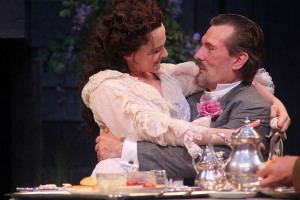
4c211615a80d2.preview-300.jpgIn "The Little Foxes," which takes place circa 1900, Regina (played here by Tiffany Scott), the stone-hearted scoundrel whose greed knows no bounds, is without question the star of the show. This time around, though, she yields pride of place to Ben (Marcus Truschinski), her brainy but no less cold brother, and Marcus (Jonathan Smoots), the patriarch of the Hubbard family, a fathomlessly cynical Alabama shopkeeper who turned himself into a millionaire by betraying the Confederate cause, in the process driving his wife (Sarah Day) half-mad with shame and guilt. Not surprisingly, his children are prepared to do anything to feather their own nests, both to one another and to anyone else sufficiently imprudent to try to stop them.

The only real problem with "Another Part of the Forest" is that the younger characters are already pretty much set in their ways when the curtain goes up: Regina and Ben are monsters and Oscar (Eric Parks), their younger brother, is a brainless boob. Since we already know them from "The Little Foxes," "Another Part of the Forest" plays like "The Further Adventures of the Horrible Hubbards" instead of shedding light on the evolution of their mature personalities. That said, the plot is so watertight and the dialogue so full of bristling malice that it's hard to begrudge Hellman her desire to play a second game with so many of the same pieces...

I'm no less pleased--if hardly surprised--to report the success of David Frank's wonderfully transparent production of Shaw's "Major Barbara," in which an arms manufacturer (Mr. Smoots) persuades his peace-loving daughter (Colleen Madden) to give up her position with the Salvation Army and embrace the gospel of high explosives. (Yes, Shaw was being ironic, but anyone who knows anything about him will realize that "Major Barbara" hints, however unconsciously, at his own tendency to worship at the altar of power.)

Mr. Frank, APT's artistic director, is working with a cast so full of company veterans that it verges on being a permanent ensemble--Sarah Day, who plays Lady Undershaft with irresistible relish, has been with APT for a quarter-century--and the enviable stylistic unanimity of this production is doubtless due in part to that fact. Everyone is on the same high-comedy wavelength and all of the acting is easy and unforced....

* * *

Read the whole thing here.

Posted August 27, 12:00 AM

TT: Sursum corda

Buddy Rich plays "Love for Sale" in 1970:

Posted August 27, 12:00 AM

TT: Almanac

"When you got older, did you actually need your parents less or did you just learn how to replace them?"

Glen David Gold, Carter Beats the Devil

Posted August 27, 12:00 AM

August 26, 2010

TT: So you want to see a show?

Here's my list of recommended Broadway, off-Broadway, and out-of-town shows, updated weekly. In all cases, I gave these shows favorable reviews (if sometimes qualifiedly so) in The Wall Street Journal when they opened. For more information, click on the title.

Warning: Broadway shows marked with an asterisk were sold out, or nearly so, last week.

BROADWAY:
La Cage aux Folles (musical, PG-13, adult subject matter, reviewed here)
Fela! * (musical, PG-13, adult subject matter, closes Jan. 2, reviewed here)
Million Dollar Quartet (jukebox musical, G, reviewed here)

OFF BROADWAY:
Alfred Hitchcock's The 39 Steps (comedy, G, suitable for bright children, original Broadway production reviewed here)
Avenue Q (musical, R, adult subject matter and one show-stopping scene of puppet-on-puppet sex, reviewed here)
The Fantasticks (musical, G, suitable for children capable of enjoying a love story, reviewed here)

IN ASHLAND, ORE.:
Hamlet (Shakespeare, PG-13, closes Oct. 30, reviewed here)
Ruined (drama, PG-13/R, violence and adult subject matter, closes Oct. 31, reviewed here)
She Loves Me (musical, G, suitable for children capable of enjoying a love story, closes Oct. 30, reviewed here)

IN SAN DIEGO:
King Lear/The Madness of George III (drama, PG-13, playing in rotating repertory through Sept. 24, reviewed here)

CLOSING SOON OFF BROADWAY:
Our Town (drama, G, suitable for mature children, closes Sept. 12, reviewed here)

CLOSING NEXT WEEK IN GARRISON, N.Y.:
The Taming of the Shrew/Troilus and Cressida (Shakespeare, PG-13, playing in rotating repertory through Sept. 5, reviewed here)

CLOSING NEXT WEEK IN LENOX, MASS.:
Richard III (Shakespeare, PG-13, closes Sept. 5, reviewed here)
The Taster (drama, PG-13, adult subject matter, closes Sept. 4, reviewed here)
The Winter's Tale (Shakespeare, PG-13, closes Sept. 5, reviewed here)

CLOSING NEXT WEEK IN WESTPORT, CONN.:
I Do! I Do! (musical, G, extended through Sept. 4, reviewed here)

CLOSING SUNDAY IN PITTSFIELD, MASS.:
Absurd Person Singular (farce, PG-13, reviewed here)

CLOSING SUNDAY IN SANTA CRUZ, CALIF.:
The Lion in Winter (serious comedy, PG-13, reviewed here)
Love's Labour's Lost (Shakespeare, PG-13, reviewed here)

Posted August 26, 12:00 AM

TT: Almanac

"I get very impatient with people who say 'I go to the theatre to be taken out of myself.' I think, 'There's probably nothing in yourself.' I'm only interested in making sure people are reintroduced to themselves. Great theatre draws your attention to things in real life, to the negligible, the boring and nondescript. A playwright like Chekhov makes that considerable and reintroduces us to the things that we have overlooked."

Jonathan Miller (interviewed in The Independent, Aug. 3, 2010)

Posted August 26, 12:00 AM

August 25, 2010

TT: Snapshot

An excerpt from the 1942 film of The Man Who Came to Dinner, directed by William Keighley and adapted (mostly faithfully) by Philip G. Epstein and Julius J. Epstein from the play by George S. Kaufman and Moss Hart. Monty Woolley, who plays Sheridan Whiteside, created the role on Broadway in 1939:

(This is the latest in a weekly series of arts-related videos that appear in this space each Wednesday.)

Posted August 25, 12:00 AM

TT: Almanac

"To be able to write a play, for performance in a theatre, a man must be sensitive, imaginative, naïve, gullible, passionate; he must be something of an imbecile, something of a poet, something of a liar, something of a damn fool. He must be a chaser of wild geese, as well as of wild ducks. He must be prepared to make a public spectacle of himself. He must be independent and brave, and sure of himself and of the importance of his work; because if he isn't, he will never survive the scorching blasts of derision that will probably greet his first efforts."

Robert E. Sherwood, preface to The Queen's Husband

Posted August 25, 12:00 AM

August 24, 2010

CRITIC IN THE COURTROOM

"I've always wanted to write a book about the fine arts called 'What Were They Thinking?' If I do, one of the chapters will be about how the Cleveland Plain Dealer demoted Don Rosenberg, its classical-music critic, and how Mr. Rosenberg responded by hauling his bosses into court..."

Posted August 24, 10:26 PM

TT: Just because

Stephen Hough plays Paderewski's B Flat Nocturne, Op. 14, No. 6:

Posted August 24, 1:25 AM

TT: Almanac

"A lost cause may still deserve support, and that support is never wasted."

Kingsley Amis, The King's English (courtesy of Levi Stahl)

Posted August 24, 12:00 AM

August 23, 2010

TT: Entry from an unkept diary

• Somebody compared me to a Holocaust denier the other day for having spoken ill of Elie Wiesel. While I wouldn't dream of dignifying such a remark by responding to it, I was struck by its sheer nastiness. It goes without saying that the world has always contained plenty of people who assume that you're a contemptible idiot if you disagree with them about anything. To be sure, I doubt that such creatures are significantly more numerous today than they were a century ago, or even a quarter-century, but I incline to think that they now talk quite a bit louder than they used to--especially when they're sitting alone at their computers.

I hear the gentleman in the second balcony yelling "You're one to talk!" He's got a point: I've written some awfully sharp things in my capacity as a professional critic, and will doubtless continue to do so. But I don't think I've ever cast personal aspersions on the artists whom I've criticized. That seems to me to be supremely inappropriate, even when the aspersions are true--and I do know a fair number of unpleasant things about some of the artists whom I cover in The Wall Street Journal and elsewhere. The world of art has always had its share of...well, bad actors.

Speaking as a biographer, I believe deeply that it is my responsibility to tell the truth about artists who are no longer living, even when it makes them look bad. Speaking as a critic and commentator, I think the private lives of living artists are their business and no one else's. And lest we forget, the argumentum ad hominem is not in fact an argument at all, though it can be effective when deployed with skill and mercilessness.

Which brings us back, however circuitously, to my own case. I'd like to think that anybody who read a piece (or a posting or tweet) in which I was compared to a Holocaust denier would simply roll his eyes and move on. But I'm old enough to know better. More and more of the American people are choosing to live in closed circles of collective concurrence, and I have no doubt that in certain of those circles, those who read such an attack on me would nod their heads sagely and say something on the order of "Yep, it figures. Probably beats his wife, too."

George Washington once drew up a list of rules of civility. Here is the first one:

1st Every Action done in Company, ought to be with Some Sign of Respect, to those that are Present.

I'm with the father of our country. To be gratuitously nasty in public discourse is like relieving yourself in a swimming pool. Even if nobody knows you did it, you still made the pool a dirtier place for everybody--yourself included.

* * *

To put things in perspective, here is Death Mills, a film about the Nazi death camps that Billy Wilder--yes, that Billy Wilder--assembled for the U.S. War Department in 1945. It was shown to Germans immediately after the war in order to force them to come to grips with the terrible reality of the Holocaust, about which many German citizens claimed to know nothing:

Posted August 23, 12:00 AM

TT: Almanac

"When the situation was manageable it was neglected, and now that it is thoroughly out of hand, we apply too late the remedies which then might have effected a cure. There is nothing new in the story. It is as old as the Sibylline books. It falls into that long dismal catalogue of the fruitlessness of experience and the confirmed unteachability of mankind. Want of foresight, unwillingness to act when action would be simple and effective, lack of clear thinking, confusion of counsel until the emergency comes, until self-preservation strikes its jarring gong--these are the features which constitute the endless repetition of history."

Winston Churchill, speech in the House of Commons, 1935

Posted August 23, 12:00 AM

August 20, 2010

TT: Good times, bad times

I took another swing through New England last weekend to catch a pair of shows about marriage that couldn't be more different, Westport Country Playhouse's I Do! I Do! and Barrington Stage Company's Absurd Person Singular. Here's an excerpt from my review in today's Wall Street Journal.

* * *

Is marriage a bed of roses--or of nails? Your answer to that question may depend on whether you choose to see Westport Country Playhouse's sunny revival of "I Do! I Do!" or Barrington Stage Company's sardonic production of "Absurd Person Singular." Both shows are formally innovative comedies of marriage that were hugely successful when first produced on Broadway. Beyond that, though, they have next to nothing in common save for being very, very good.

"I Do! I Do!" is a two-character musical by Tom Jones and Harvey Schmidt, the "Fantasticks" guys, based on "The Fourposter," Jan de Hartog's ever-popular 1951 play about a half-century in the life of a successful marriage. The show is close to plotless, with each song offering a snapshot of an archetypical marital situation: the honeymoon, the first child, the first quarrel....

Kate Baldwin, whose performance in last season's revival of "Finian's Rainbow" established her as one of Broadway's musical-comedy queens, is an absolute knockout as the wife of "I Do! I Do!" If Mary Martin was any better than this...well, let's just say that I don't see how she could have been. Not only is Ms. Baldwin a charismatic actor, but her concert-quality singing is as good as you're ever going to hear in a musical....

AbsurdPersonBSC10KSPRA_307.sized.jpgAlan Ayckbourn, England's most popular playwright, rang the bell in America in 1974 with "Absurd Person Singular," which ran for 591 performances on Broadway. Not until last year's triumphant revival of "The Norman Conquests" did he make anything like the same kind of splash--the Manhattan Theatre Club's 2005 production was a flop--but Mr. Ayckbourn's dark farces of marital discord are now being performed with steadily growing frequency both Off Broadway and elsewhere in the U.S. Judging by the rapturous reception of "The Norman Conquests," I'd say that Broadway is about ready to catch up with the rest of the country.

Meanwhile, Barrington Stage is mounting a strongly acted revival of "Absurd Person Singular," whose three acts, set on three successive Christmases, show us three couples whose lives are in varied states of disarray. Finnerty Steeves, one of this country's top regional-theater actors, is nothing short of extraordinary as the desperately unhappy Eva, who tries without success to kill herself seven times in a row in the second act. That these repeated attempts should be as hysterically funny as they are grimly serious says everything about the complexity of Mr. Ayckbourn's style of comedy....

* * *

Read the whole thing here.

Mary Martin and Robert Preston perform "Nobody's Perfect" (from I Do! I Do!) on the 1966 Tony Awards telecast:

Posted August 20, 12:00 AM

TT: Critic in the courtroom

If you haven't heard about how Don Rosenberg, who used to be the classical music critic of the Cleveland Plain Dealer, sued his own paper for defamation and age discrimination, go here to catch up. Then turn to my "Sightings" column for Saturday's Wall Street Journal, in which I take a closer look at the suit and why it matters to critics all over America.

Was Rosenberg wise to sue? Did he ever have a chance to prevail in court--and should he have done so? Read all about it in tomorrow's Journal.

UPDATE: Read the whole thing here.

Posted August 20, 12:00 AM

TT: Almanac

"I can't understand how anyone is able to paint without optimism. Despite the general pessimistic attitude in the world today, I am nothing but an optimist."

Hans Hofmann (quoted in Katharine Kuh, The Artist's Voice: Talks With Seventeen Modern Artists)

Posted August 20, 12:00 AM

August 19, 2010

PLAY

The Glass Menagerie (Mark Taper Forum, 135 N. Grand, Los Angeles, closes Oct. 17). Gordon Edelstein's off-Broadway production of Tennessee Williams' masterpiece should have transferred to Broadway. Instead it's now playing in Los Angeles for a month-long run, and I recommend it to West Coast readers with the utmost enthusiasm. It's a recreative landmark, perfectly cast and imaginatively staged, that will make you feel as though you're seeing The Glass Menagerie for the first time. Every line, every pause, every gesture is as fresh as a shaft of sunlight (TT).

Posted August 19, 10:09 PM

BOOK

Rosanne Cash, Composed (Viking, $26.95). This is a remarkable piece of work, a making-of-an-artist memoir by a musician who is equally adept at writing prose. Composed is--all at once--funny and poetic and down to earth, and Cash also has a great many exceedingly shrewd things to say about the music business and its discontents. Don't go looking for gossip, but if you want to learn about the inner and outer lives of one of our very best singer-songwriters, you won't be even slightly disappointed (TT).

Posted August 19, 11:49 AM

DVD

Presenting Sacha Guitry (Criterion Collection, four discs). Four films by the great French actor-playwright-director, none of which, so far as I know, has ever been available on home video in this country. In The Story of a Cheat, The Pearls of the Crown, Désiré, and Quadrille, Guitry transferred his stage-farce style to the screen with astonishing and near-unprecedented success. I can't think of another playwright who took to film with such idiomatic gusto. If there's any justice at all, this long-overdue box set will introduce Guitry to a new generation of film buffs who have no idea how much pure pleasure they've been missing (TT).

Posted August 19, 11:05 AM

BOOK

Richard Stark, Deadly Edge/Plunder Squad/Slayground (University of Chicago, $14 each). Three more titles in the University of Chicago Press' ongoing uniform paperback edition of the complete novels of Richard Stark (a/k/a Donald E. Westlake). Parker, Stark's diamond-hard anti-heroic heister-protagonist, has admitted a woman into his life but remains as tough and unrelenting as ever. The plots are more complex, the language richer, the canvas wider. Get them all (TT).

Posted August 19, 11:05 AM

TT: This ain't no party

Spring%20Green.jpegHere I go again, this time to Wisconsin by way of Chicago. I'm spending a week in Spring Green, where I'll be seeing four of the plays currently being performed by American Players Theatre at its two-stage complex. One by Shaw, one by Somerset Maugham, one by Lillian Hellman, and one by Athol Fugard: I'd say that's a pretty nice package, wouldn't you?

As usual, I'll be staying just down the road from Taliesin, Frank Lloyd Wright's country home, and spending most of my days slaving over a hot word processor. This is no vacation, alas and thank you very much. Mrs. T has had enough travel for one summer and prefers not to this time around, but Our Girl plans to drive up from Chicago and see Major Barbara with me on Saturday afternoon, after which we'll dine at one of my favorite restaurants. In addition, I intend to nibble on Pleasant Ridge Reserve Cheese while I'm in town.

More as it happens.

Posted August 19, 4:04 AM

TT: So you want to see a show?

Here's my list of recommended Broadway, off-Broadway, and out-of-town shows, updated weekly. In all cases, I gave these shows favorable reviews (if sometimes qualifiedly so) in The Wall Street Journal when they opened. For more information, click on the title.

Warning: Broadway shows marked with an asterisk were sold out, or nearly so, last week.

BROADWAY:
La Cage aux Folles (musical, PG-13, adult subject matter, reviewed here)
Fela! * (musical, PG-13, adult subject matter, closes Jan. 2, reviewed here)
Million Dollar Quartet (jukebox musical, G, reviewed here)

OFF BROADWAY:
Alfred Hitchcock's The 39 Steps (comedy, G, suitable for bright children, original Broadway production reviewed here)
Avenue Q (musical, R, adult subject matter and one show-stopping scene of puppet-on-puppet sex, reviewed here)
The Fantasticks (musical, G, suitable for children capable of enjoying a love story, reviewed here)
Our Town (drama, G, suitable for mature children, closes Sept. 12, reviewed here)

IN ASHLAND, ORE.:
Hamlet (Shakespeare, PG-13, closes Oct. 30, reviewed here)
Ruined (drama, PG-13/R, violence and adult subject matter, closes Oct. 31, reviewed here)
She Loves Me (musical, G, suitable for children capable of enjoying a love story, closes Oct. 30, reviewed here)

IN SAN DIEGO:
King Lear/The Madness of George III (drama, PG-13, playing in rotating repertory through Sept. 24, reviewed here)

CLOSING SOON IN GARRISON, N.Y.:
The Taming of the Shrew/Troilus and Cressida (Shakespeare, PG-13, playing in rotating repertory through Sept. 5, reviewed here)

CLOSING SOON IN LENOX, MASS.:
Richard III (Shakespeare, PG-13, closes Sept. 5, reviewed here)
The Taster (drama, PG-13, adult subject matter, closes Sept. 4, reviewed here)
The Winter's Tale (Shakespeare, PG-13, closes Sept. 5, reviewed here)

CLOSING NEXT WEEK IN SANTA CRUZ, CALIF.:
The Lion in Winter (serious comedy, PG-13, closes Aug. 29, reviewed here)
Love's Labour's Lost (Shakespeare, PG-13, closes Aug. 29, reviewed here)

CLOSING SUNDAY ON BROADWAY:
South Pacific * (musical, G/PG-13, some sexual content, brilliantly staged but unsuitable for viewers acutely allergic to preachiness, reviewed here)

Posted August 19, 12:00 AM

TT: Almanac

"He has found his style, when he cannot do otherwise, i.e., cannot do something else."

Paul Klee, diary entry #825 (Munich, 1908)

Posted August 19, 12:00 AM

August 18, 2010

TT: Snapshot

Jack Larson, who played Jimmy Olsen on Superman and wrote the libretto for Virgil Thomson's Lord Byron, is interviewed in the Sturges House, designed and built by Frank Lloyd Wright in 1939 and bought by Larson and the late James Bridges in 1967:

(This is the latest in a weekly series of arts-related videos that appear in this space each Wednesday.)

Posted August 18, 12:00 AM

TT: The stuff to give the troops

Orson Welles said it, and he was right: "We need encouragement a lot more than we admit, even to ourselves." So it was pleasant indeed to receive this e-mail from a good and gifted friend:

You will survive as much more than a footnote in the Marsden Hartley catalogue.

Brazil and I say so.

True or not, it sure is nice to hear--not to mention inspiring.

Posted August 18, 12:00 AM

TT: Almanac

"The more horrible this world (as today, for instance), the more abstract our art, whereas a happy world brings forth an art of the here and now."

Paul Klee, diary entry #951 (1915)

Posted August 18, 12:00 AM

August 17, 2010

TT: Imperdível!

Pops%20newly%20arrived%21.jpgPops: A Vida de Louis Armstrong has just been published in Brazil by Larousse. One of my Brazilian friends saw Pops in a bookstore over the weekend, took a photo of the display with her cellphone, and sent it to me via e-mail. It's a bit fuzzy, but I think you'll get the idea.

Here is the Portuguese catalogue copy, which is surprisingly intelligible, even to a monoglot like me:

Esta é a biografia definitiva de um gênio nascido na sarjeta que se tornou uma celebridade conhecida nos quatro cantos do mundo.

O biógrafo Teachout pesquisou e avaliou a vida e o trabalho de Armstrong como ninguém jamais o fez. Da infância pobre, do precoce interesse pela música, de sua vida em Nova Orleans até a mudança para Chicago, e muito além, o autor mergulha fundo na história desse ícone da música.

Tudo na medida exata. Palavras e sentimentos. Segredos e crueza. Síntese e exagero. A medida exata para alguém chamado Louis Armstrong.

Imperdível!

This is the first time that any of my books has been translated into another language and published by a major foreign house, and seeing as how I have a special love for Brazil and its music, I'm touched that I should have made my international debut south of the border.

Posted August 17, 12:00 AM

TT: Almanac

"The beautiful, which is perhaps inseparable from art, is not after all tied to the subject, but to the pictorial representation. In this way and in no other does art overcome the ugly without avoiding it."

Paul Klee, diary entry #733 (December 1905)

Posted August 17, 12:00 AM

August 16, 2010

TT: It's in the book

In 2006 Mrs. T and I successfully bid on a copy of "Apples on Table," a 1923 lithograph by Marsden Hartley. Though he's never been popular, Hartley was, with John Marin, one of this country's first important modernist painters, and I've loved his work ever since I became familiar with it.

%2821%29%20HARTLEY%20APPLES%20ON%20A%20TABLE.jpgNeedless to say, it had never occurred to me that I might actually be in a position to own a Hartley, but I discovered, very much to my surprise, that his lithographs were and are not only rare but obscure. He made only eighteen, most of them in smallish editions of twenty-five. They are scarcely ever exhibited--the only show devoted to Hartley's prints, so far as I know, took place at the University of Kansas in 1972--and even those connoisseurs with a special interest in Hartley typically know little or nothing about them.

Because they're so obscure, Hartley's lithographs don't cost anything like what you'd expect to pay for a pencil-signed print by a major American modernist. If memory serves, we paid $3,800 for "Apples on Table" in 2006, at a time when Hartley's oil paintings were selling for as high as two million dollars. That's not chump change for an impecunious critic, but we managed to scrape it together, and "Apples on Table" has hung over the dinner table in our Manhattan apartment ever since. It's the first thing I see each time I unlock the front door after a long absence, and the sight of it never fails to warm my heart.

A couple of weeks ago, I received a form letter--an old-fashioned piece of snail mail, thank you very much--from Gail R. Levin, a Maine-based scholar who is working on a catalogue raisonné of Hartley's lithographs. Levin's goal is to track down every surviving copy of all eighteen prints, and to this end the auction house from which Mrs. T and I bought "Apples on Table" gave her our address.

The text of the letter is self-explanatory:

We plan to publish a handsomely illustrated, thoroughly researched and updated edition of Hartley's stunning lithographic production....Would you please assist me in my research by filling out the attached data sheet for this and any other Hartley lithograph you might currently own?

I confess to having been thrilled by Levin's letter. To be sure, several of the pieces that Mrs. T and I own can be found in existing catalogues raisonnés, but this will be the first time that our ownership of a work of art has been acknowledged by an art historian. That may not seem like a big deal to you, but I can't help but be excited by it.

As I wrote six years ago apropos of my purchase of a Max Beerbohm caricature that is listed in Rupert Hart-Davis' 1972 catalogue of Beerbohm's drawings:

So there it was in black and white: my Max is officially known in the world of Beerbohmiana as "Hart-Davis 631." It was publicly exhibited at the Leicester Galleries, Max's London dealer, in 1913, and mentioned in a review of the show by Eddie Marsh, one of those semi-eminent Edwardian litterateurs who is constantly popping up in books, diaries, memoirs, and letters of the period. Presumably some even less eminent Edwardian bought it from the Leicester Galleries, for "Mr. Percy Grainger" has never been reproduced, nor was Hart-Davis able to establish its ownership as of 1972, the year he published his catalogue; it was invisible to Beerbohm scholars between 1913 and last week, when it came into my possession.

I felt a little shiver of excitement as I looked at the entry for Hart-Davis 631. My Max may not be famous, but it nonetheless has an official existence, of which I am now a part. If a younger scholar should someday take it upon himself to update the catalogue, he will add "OWNER Terry Teachout" to the entry for Hart-Davis 631. I find that a pleasant prospect. Even if The Skeptic and the Teachout Reader should crumble irrevocably into dust, I will live forever as a footnote to the lives of two men far greater than myself: not only did I rediscover the manuscript of A Second Mencken Chrestomathy among H.L. Mencken's private papers and edit it for publication, but I was the first recorded owner of Hart-Davis 631.

Such frissons are, I believe, a legitimate part of the myriad delights of collecting art, even on a modest scale. Most of us, after all, never come to the attention of historians: we are members of the anonymous legions of those who, as Thomas Gray put it in his "Elegy in a Country Churchyard," are born to blush unseen. Yet I suspect that anyone who writes a book feels at one time or another the longing that Mencken summed up in a private memorandum that he wrote on the first day of 1927: "I have done a great deal less than I wanted to do and a great deal less than I might have done if my equipment had been better, but this, at least, I have accomplished, and it is one of the principal desires of man: I have delivered myself from anonymity."

Needless to say, I cannot speak the same words with anything remotely approaching H.L. Mencken's self-confidence. To be sure, I like to think that Pops and The Skeptic might possibly survive me, but I'm not counting on it. Biographers write not for posterity but for their own generation, and rarely if ever are their efforts remembered in the long run save as footnotes to the subsequent efforts of their successors.

706_128062355681.jpgFor this reason, I don't think there's much chance that anyone will remember me a hundred years from today, unless they happen to be perusing Gail Levin's files and stumble across her research into the provenance of "Apples on Table," in which case they will know that a copy of this exquisite hommage to Cézanne was once owned by an otherwise unknown couple named "Terry and Hilary Teachout." By then Mrs. T and I will be long gone, and our handsome print will presumably be giving pleasure to a person or persons as yet unborn.

As for the two of us, we will, if nothing else, exemplify the last stanza of Philip Larkin's great poem about the tombstone of a long-forgotten English couple:

The stone fidelity
They hardly meant has come to be
Their final blazon, and to prove
Our almost-instinct almost true:
What will survive of us is love.

So, too, shall it be for Mrs. T and me. Even if no stone should mark our final resting place, our marriage is now inscribed in the scholar's book of life.

Posted August 16, 12:00 AM

TT: Almanac

YVES MICHAUD: When is a painting finished?

JOAN MITCHELL: When it stops questioning me.

Quoted in Kristine Stiles (ed.), Theories and Documents of Contemporary Art: A Sourcebook of Artists' Writings

Posted August 16, 12:00 AM

August 13, 2010

TT: Eat love die

Shakespeare & Company, the summer theater festival in Lenox, Massachusetts, has become one of my most eagerly awaited annual out-of-town reviewing stops. To see why, take a look at my drama column in today's Wall Street Journal, in which I report on three of the company's ten summer shows, a new play by Joan Ackermann called The Taster and a pair of Shakespeare productions, Richard III and The Winter's Tale. Here's an excerpt.

* * *

"The Taster" is one of those plays in which the members of the cast double as characters from the past and present. Tom O'Keefe and Maureen O'Flynn play Gregorio, a 16th-century Basque king, and his unhappy Queen Mariana (he longs to sire a son but has fallen out of love with his wife). They also play Henry and Claudia, a modern-day New York couple whose marriage is on the rocks (he's a depressed ex-banker who is living off his wife's modest income as an opera singer while attempting to translate a forgotten play about the plight of King Gregorio and Queen Mariana). Rocco Sisto is the title character, one of Gregorio's food tasters--he specializes in the detection of slow-acting poisons--whom Mariana seduces in the hope of passing off their bastard child as the king's heir.

If all this sounds impossibly tangled, don't despair. Not only has Ms. Ackermann woven her two plots together so adroitly as to recall Jorge Luis Borges at his most virtuosic, but Tina Packer, the director, has staged "The Taster" with such scrupulous attentiveness to period detail that you always know where you are and what time (so to speak) it is. The dialogue blends quiet, uncloying lyricism ("The back of her neck smells like my childhood") with comic flashes that crackle like summer lightning...

richardiiisco10kspra_263-sized_.jpgJohn Douglas Thompson, who took New York by storm last year in the Irish Repertory Theatre's revival of "The Emperor Jones," is very much the star of "Richard III," in which he gives yet another timber-shivering performance as the hunchbacked beast who'll kill anyone, up to and including his brother and his wife, in order to set England's crown upon his head. Mr. Thompson's pellucid diction is a known quantity among American connoisseurs of classical acting--he makes every syllable shine--but even those who have seen his Othello will be impressed anew by the individuality with which he makes manifest the monstrous urges of Shakespeare's nastiest piece of work. What I liked best about his interpretation was its grisly humor...

As for "The Winter's Tale," which appears to be well on the way to becoming the most frequently performed of Shakespeare's less popular plays, Kevin G. Coleman's wonderfully balanced staging makes each tricky change of mood feel as natural as the turning of a page. Jonathan Epstein, who plays the self-laceratingly jealous King Leontes, starts off in a low, intimate key, then unleashes his dark fury so persuasively that you almost want to look away from the stage....

* * *

Read the whole thing here.

Posted August 13, 12:00 AM

TT: Almanac

"The truth is cruel, but it can be loved, and it makes free those who have loved it."

George Santayana, "Ideal Immortality"

Posted August 13, 12:00 AM

August 12, 2010

TT: Just because

Vladimir Horowitz plays Chopin's B Minor Mazurka, Op. 33/4, in Vienna in 1987. This is a piece for which Horowitz had a special fondness--one that I share:

Posted August 12, 3:52 PM

TT: So you want to see a show?

Here's my list of recommended Broadway, off-Broadway, and out-of-town shows, updated weekly. In all cases, I gave these shows favorable reviews (if sometimes qualifiedly so) in The Wall Street Journal when they opened. For more information, click on the title.

Warning: Broadway shows marked with an asterisk were sold out, or nearly so, last week.

BROADWAY:
La Cage aux Folles (musical, PG-13, adult subject matter, reviewed here)
Fela! * (musical, PG-13, adult subject matter, reviewed here)
Million Dollar Quartet (jukebox musical, G, reviewed here)

OFF BROADWAY:
Alfred Hitchcock's The 39 Steps (comedy, G, suitable for bright children, original Broadway production reviewed here)
Avenue Q (musical, R, adult subject matter and one show-stopping scene of puppet-on-puppet sex, reviewed here)
The Fantasticks (musical, G, suitable for children capable of enjoying a love story, reviewed here)
Our Town (drama, G, suitable for mature children, closes Sept. 12, reviewed here)

IN ASHLAND, ORE.:
Hamlet (Shakespeare, PG-13, closes Oct. 30, reviewed here)
Ruined (drama, PG-13/R, violence and adult subject matter, closes Oct. 31, reviewed here)
She Loves Me (musical, G, suitable for children capable of enjoying a love story, closes Oct. 30, reviewed here)

IN GARRISON, N.Y.:
The Taming of the Shrew/Troilus and Cressida (Shakespeare, PG-13, playing in rotating repertory through Sept. 5, reviewed here)

IN SAN DIEGO:
King Lear/The Madness of George III (drama, PG-13, playing in rotating repertory through Sept. 24, reviewed here)

CLOSING SOON IN SANTA CRUZ, CALIF.:
The Lion in Wnter (serious comedy, PG-13, closes Aug. 29, reviewed here)
Love's Labour's Lost (Shakespeare, PG-13, closes Aug. 29, reviewed here)

CLOSING NEXT WEEK ON BROADWAY:
South Pacific * (musical, G/PG-13, some sexual content, brilliantly staged but unsuitable for viewers acutely allergic to preachiness, closes Aug. 22, reviewed here)

CLOSING SUNDAY IN GLENCOE, ILL.:
A Streetcar Named Desire (drama, PG-13, adult subject matter, reviewed here)

CLOSING SUNDAY IN PETERBOROUGH, N.H.:
Tartuffe (verse comedy, PG-13, adult subject matter, reviewed here)

Posted August 12, 12:00 AM

TT: Almanac

"The truth. It is a beautiful and terrible thing, and should therefore be treated with great caution."

J.K. Rowling, Harry Potter and the Philosopher's Stone

Posted August 12, 12:00 AM

August 11, 2010

TT: Come on and hear (cont'd)

Bryant Park, 12:30 today. Be there or be square:

bnikfgbmkkgrhqmh-c8etsbyu7fblitohqjw_12.jpg

Posted August 11, 12:00 AM

TT: Snapshot

Erle Stanley Gardner, the creator of Perry Mason, appears as the mystery guest on a 1957 episode of What's My Line?:

(This is the latest in a weekly series of arts-related videos that appear in this space each Wednesday.)

Posted August 11, 12:00 AM

TT: Almanac

"Such is the irresistible nature of truth, that all it asks, and all it wants, is the liberty of appearing. The sun needs no inscription to distinguish him from darkness."

Thomas Paine, The Rights of Man

Posted August 11, 12:00 AM

August 10, 2010

TT: The return of Pops

armstrong9b.jpgAs I mentioned the other day, Pops: A Life of Louis Armstrong, like Dolly Levi, is still going strong. Not only will the corrected paperback edition be published by Mariner Books on October 7--which happens to be the third anniversary of my marriage to Mrs. T--but I continue to make Pops-related public appearances around the country. The latest of these is an outdoor reading and signing at New York's Bryant Park that takes place on Wednesday, for which I'll be joined by Jon-Erik Kellso, a tradition-minded trumpeter who knows his Pops backwards and forwards.

The festivities start at 12:30. For more information, go here and scroll down.


* * *

Jon-Erik Kellso and the Ear Regulars play "Please" at New York's Ear Inn in 2009:

Posted August 10, 12:00 AM

TT: Almanac

"It is a fool's prerogative to utter truths that no one else will speak."

Neil Gaiman, Dream Country

Posted August 10, 12:00 AM

August 9, 2010

SHAME ON ELIE WIESEL

"Do you have a right not to be written about? Elie Wiesel thinks he does--and he's prepared to sic his lawyers on anyone who thinks otherwise..."

Posted August 09, 11:35 PM

TT: Once again, just because

Courtesy of Philip Terzian, the Count Basie Septet plays "One O'Clock Jump" in 1950. The band also includes Buddy DeFranco on clarinet, Clark Terry on trumpet, Wardell Gray on tenor sax, Jimmy Lewis on bass, Gus Johnson on drums, and--of course--Freddie Green on guitar:


Posted August 09, 8:54 AM

TT: Entry from an unkept diary

• In recent weeks I've been dipping into Somerset Maugham, a writer whom I admire very much--with qualifications. One of the problems I have with Maugham relates to his most characteristic theme, which is obsessive "love" (by which he means sexual attraction). In Maugham's novels and stories, it is common for seemingly unworthy people to be "loved" by men or women of a different social class. Nor do these presumed unworthies improve with closer inspection: the better you get to know them, as in the case of Mildred in Of Human Bondage or Albert, the chauffeur-lover of "The Human Element," the less attractive they become. Maugham's Mildreds and Alberts are usually portrayed as disagreeable, opportunistic, and--to put it gently--not very interesting. We are clearly expected to conclude that the sexual magnetism emitted by these unappetizing creatures is as irresistible as it is inexplicable, but it is never made manifest other than by authorial assertion.

Maugham was, of course, writing of his own experience, for the great love of his life, Gerald Haxton, was a singularly bad piece of work, drunken, disloyal, and unscrupulous in every conceivable way. Alas, Maugham was hopelessly obsessed with Haxton, and thus brought himself much grief.

OfHumanBondage.jpgMy problem with Maugham's writing arises from the fact that this kind of obsession is not an experience I recognize, which makes it impossible for me to sympathize other than theoretically with those of his characters who are so enthralled. Try as I might, I can't put myself in the place of a person like Philip Carey, the hero of Of Human Bondage, who seems to adore Mildred, the pale, shrewish tea-shop waitress, precisely because she is so common. Throughout my life, the women to whom I have been attracted more than casually have been both bright and talented. Only once have I ever been strongly attracted to a woman who, though by no means stupid, wasn't exactly brainy. To be sure, I have also been attracted at first sight to a fair number of women of whom I knew nothing, but no sooner did I make their acquaintance than I discovered that they were--sure enough--bright and talented.

Is Maugham's experience more common than mine? I doubt it. Yet there must be something about it that resonates with large numbers of people, since he was one of the most popular authors of the twentieth century. Or did his readers simply fail to register the idioysncrasy of his manner of portraying love?

UPDATE: A friend writes:

How good to feel, when we have been rejected, that our beloved was a stupid scoundrel. Maugham avenges our amour propre.

Posted August 09, 12:00 AM

TT: Almanac

"No man with any sense assumes that a woman's words mean to her exactly what they mean to him."

Rex Stout, The Mother Hunt

Posted August 09, 12:00 AM

August 6, 2010

TT: The hypocrite's new clothes

I don't get to review the plays of Molière very often, but in today's Wall Street Journal I report enthusiastically on a recent trip to New Hampshire to see the Peterborough Players' production of Gus Kaikkonen's new verse translation of Tartuffe. Here's an excerpt.

* * *

GANTRY.jpeg"Tartuffe"'s satirical thrusts are both perennially fresh and perennially relevant, especially in America, a country that has long been beset by Bible-thumping hucksters. Indeed, the title character (played in Peterborough by Ian Merrill Peakes) is the French forerunner of Elmer Gantry, a versatile con man whose latest racket is religion. He worms his way into the household of the gullible Orgon (David Haugen) and sets himself up as an arbiter of moral rectitude while simultaneously seeking to bed his patron's wife and wed his daughter, who already has a fiancée.

When Mr. Kaikkonen last staged "Tartuffe" Off Broadway for the Pearl Theatre Company, he used the now-familiar rhyming translation of Richard Wilbur. In this country Mr. Wilbur's version is more or less standard, though Christopher Hampton's lumpy-sounding blank-verse rendering has lately found favor in England. So why do it over again? Because "Tartuffe" is a comedy, and Mr. Wilbur's translation, a miracle of elegant versification, is more witty than funny. Mr. Kaikkonen, by contrast, has given us a blunter, racier "Tartuffe," and though he lacks Mr. Wilbur's technical virtuosity, his up-to-date diction and sharp timing pay off in laughter....

Mr. Kaikkonen's staging, with its slapsticky sight gags and zany facemaking, builds effectively on the enhanced comic potential of his translation, and the members of his cast, most of whom are Peterborough Players veterans, dig in with palpable pleasure. Mr. Peakes is a marvelously slick and sleazy Tartuffe who is handsome rather than oily-looking, a smart touch. The contributions of his colleagues fit together as smoothly as the pieces of a hand-cut jigsaw puzzle, with Carmen Decker scooping up the best-in-show prize. Ms. Decker plays Madame Pernelle, Orgon's mother, as a horrible old crone who has been steeped in the sour brine of pious malice...

* * *

Read the whole thing here.

Posted August 06, 12:00 AM

TT: Shame on Elie Wiesel

If you follow theater news at all closely, you'll know that Elie Wiesel (who should need no introduction to readers of this blog) recently threatened to sue Deb Margolin and Theatre J, the author and producers of a play called Imagining Madoff, in which Wiesel was to be portrayed on stage--fictionally, but under his real name. As a result of the threatened litigation, the original production of Imagining Madoff was canceled. That cancellation, and the reasons for it, is the subject of my "Sightings" column in Saturday's Wall Street Journal, in which I ask why so prominent a human-rights advocate decided to use the power of threatened litigation to curtail the free-speech rights of a playwright and a theater company.

If you're curious about what happened to Margolin and why it matters, pick up a copy of tomorrow's Journal and see what I have to say.

UPDATE: Read the whole thing here.

Posted August 06, 12:00 AM

TT: Almanac

"The more I think about it, the more convinced I am that the stories we are told govern what we believe possible."

Brooke Berman, No Place Like Home: A Memoir in 39 Apartments

Posted August 06, 12:00 AM

August 5, 2010

TT: So you want to see a show?

Here's my list of recommended Broadway, off-Broadway, and out-of-town shows, updated weekly. In all cases, I gave these shows favorable reviews (if sometimes qualifiedly so) in The Wall Street Journal when they opened. For more information, click on the title.

Warning: Broadway shows marked with an asterisk were sold out, or nearly so, last week.

BROADWAY:
La Cage aux Folles (musical, PG-13, adult subject matter, reviewed here)
Fela! * (musical, PG-13, adult subject matter, reviewed here)
Million Dollar Quartet (jukebox musical, G, reviewed here)

OFF BROADWAY:
Alfred Hitchcock's The 39 Steps (comedy, G, suitable for bright children, original Broadway production reviewed here)
Avenue Q (musical, R, adult subject matter and one show-stopping scene of puppet-on-puppet sex, reviewed here)
The Fantasticks (musical, G, suitable for children capable of enjoying a love story, reviewed here)
Our Town (drama, G, suitable for mature children, closes Sept. 12, reviewed here)

IN ASHLAND, ORE.:
Hamlet (Shakespeare, PG-13, closes Oct. 30, reviewed here)
Ruined (drama, PG-13/R, violence and adult subject matter, closes Oct. 31, reviewed here)
She Loves Me (musical, G, suitable for children capable of enjoying a love story, closes Oct. 30, reviewed here)

IN GARRISON, N.Y.:
The Taming of the Shrew/Troilus and Cressida (Shakespeare, PG-13, playing in rotating repertory through Sept. 5, reviewed here)

IN SAN DIEGO:
King Lear/The Madness of George III (drama, PG-13, playing in rotating repertory through Sept. 24, reviewed here)

IN SANTA CRUZ, CALIF.:
The Lion in Wnter (serious comedy, PG-13, closes Aug. 29, reviewed here)
Love's Labour's Lost (Shakespeare, PG-13, closes Aug. 29, reviewed here)

CLOSING SOON ON BROADWAY:
South Pacific * (musical, G/PG-13, some sexual content, brilliantly staged but unsuitable for viewers acutely allergic to preachiness, closes Aug. 22, reviewed here)

CLOSING NEXT WEEK IN GLENCOE, ILL.:
A Streetcar Named Desire (drama, PG-13, adult subject matter, extended through Aug. 15, reviewed here)

Posted August 05, 12:00 AM

TT: Almanac

"I believe that the trade of critic, in literature, music, and the drama, is the most degraded of all trades, and that it has no real value. However, let it go. It is the will of God that we must have critics, and missionaries, and Congressmen, and humorists, and we must bear the burden."

Mark Twain, Autobiography of Mark Twain

Posted August 05, 12:00 AM

August 4, 2010

TT: Snapshot

Edward R. Murrow interviews Maria Callas on Person to Person in 1958:

(This is the latest in a weekly series of arts-related videos that appear in this space each Wednesday.)

Posted August 04, 12:00 AM

TT: Almanac

"Doing beautiful things is its own reward. If you do something that you're proud of, that someone else understands, that is a thing of beauty that wasn't there before--you can't beat that."

Teller (quoted in the Daily Telegraph, July 9, 2010)

Posted August 04, 12:00 AM

August 3, 2010

TT: Night thoughts

The phrase "senior moment" makes me want to retch. It is at once euphemistic and cute, a dreadful combination, and the fact that I am now old enough to experience with fair regularity the transitory lapses of memory to which it refers doesn't make it any more palatable.

Peer.jpegA few weeks ago Mrs. T and I were driving from Connecticut to Maine when I suddenly found myself incapable of remembering the name of Ralph Peer. Not only does Peer figure prominently in Pops, but an old friend of mine once planned to write his biography, a book whose subtitle I had no trouble recalling, even though the book itself never got finished. I even managed to reel off an impromptu outline of Peer's career and achievements. The only thing I couldn't come up with was his name. After some twenty-odd minutes of frustration, I boiled over, steered into a rest stop, booted up my laptop, and pulled up the chapter from Pops in which I wrote about Peer. No sooner did his name flash on the screen than I felt as if a boil in my brain had been lanced.

I don't lose any sleep worrying about such transient episodes--I've been having them for the better part of a decade, after all--but I do feel a bit rueful about them on occasion. I used to have a near-perfect memory, and now I don't. Nor can I deny that I occasionally find myself haunted by the thought that I might someday be deprived by illness of the whole of my memory, which would mean that I would cease to be myself. I've never been close to anyone who suffered from Alzheimer's disease, but one of my mother's oldest friends was stricken with it a number of years ago, and I looked on in horror as he gradually withdrew into a genial but impenetrable cloud of unknowingness.

"Old age is a shipwreck," Charles de Gaulle wrote, and at fifty-four I am close enough to my own old age to wonder what it will be like. I'd like to think that Charles Dickens foretold it when he assured the readers of Barnaby Rudge that "Father Time is not always a hard parent, and, though he tarries for none of his children, often lays his hand lightly on those who have used him well." But I know well--too well--that it isn't always like that.

CozzensTimeCover.jpgJames Gould Cozzens, a thoroughly hardheaded novelist who took care never to turn his face from reality, wrote in By Love Possessed a thumbnail sketch of an increasingly absentminded octogenarian lawyer that is all the more chilling for its complete lack of melodrama:

Incidentally, Arthur Winner must reflect, Noah really ought to stop driving a car; but who would venture to say so? Who would call his attention to his malady without a cure--the yellow leaves, or none, or few; the twilight of the day; in the ashes, the doubtful glow of the expiring fire? This was the time of year on which Noah was congratulated; these were the mental powers whose persistence was often and admiringly mentioned. Remarkable? Yes; so remarkable that admiration posed the query of astonishment: Can such things be?

To that question, a question must be returned. The answer depended on what you meant. In his own field, on those probate and fiduciary matters to which Noah had given a lifetime, half a century, Noah could sound as acute and sagacious as ever. There, nothing unknown or new could now confront him; the right answers, formulated over and over so often that he had them by heart, came of themselves. If unimpaired mental powers was construed to mean competence to do today that job of ten years ago on the Decedents Estates Law that Willard Lowe had praised, Arthur Winner would be inclined to agree that Noah, unequaled in technical knowledge, unexcelled in practical estate and trust management, with so much of the special sort of legal experience needed in this special sort of work, probably still kept that competence. If, by unimpaired mental powers, you meant an unaffected judgment, a continuing sound sense of proportion, a reliable balance, a firmness of command in coming to decisions and a promptitude in acting on them--what was to be said about that?

What, indeed?

Posted August 03, 12:00 AM

TT: Almanac

"I've noticed that most plays dealing with the tragic suffering of the human condition are written by people who haven't experienced that much of it themselves. People who have genuinely suffered, more often than not, want to laugh."

Brooke Berman, No Place Like Home: A Memoir in 39 Apartments

Posted August 03, 12:00 AM

August 2, 2010

TT: Mitch(ell) Miller, R.I.P.

Long before he metamorphosed into the smiling maestro of Sing Along With Mitch and the producer of such preposterous pop novelties as Frank Sinatra's "Mama Will Bark" and Rosemary Clooney's "Come on-a My House," Mitch Miller, who died over the weekend at the august age of ninety-nine, was a classical oboist who cut a fair number of solo records for which he will always be remembered by connoisseurs of great wind playing. Here's one of the very best ones:


Posted August 02, 2:58 PM

TT: Don't believe everything you read

KellsoSPond.jpgAmazingly enough, I'm not even close to finished with Pops: A Life of Louis Armstrong. Among other things, I'll be talking about the book at New York's Bryant Park at 12:30 on Wednesday, August 11, accompanied by the fabulous jazz trumpeter Jon-Erik Kellso, who'll play before I speak and supply some relevant musical examples during the speech itself.

Alas, the New Yorker, which used to check its facts, got the date of my appearance wrong in its Goings On About Town section. If you show up on August 4, I won't be there--I'll be up in New Hampshire, seeing the Peterborough Players' production of Tartuffe. So kindly ignore the New Yorker and come hear Jon-Erik and me and me do our thing next Wednesday!

Posted August 02, 8:46 AM

TT: Home team strikes out

In the Greater New York section of this morning's Wall Street Journal, I re-review the Broadway revival of A Little Night Music, in which Elaine Stritch and Bernadette Peters have replaced Angela Lansbury and Catherine Zeta-Jones. Sad to say, the production is as disappointing now as it was when it opened last year. Here's an excerpt.

* * *

Curtain%20call.jpegBroadway feeds off Hollywood like a thirsty vampire. It was the presence of Catherine Zeta-Jones and Angela Lansbury in the first Broadway revival of "A Little Night Music," not the production's dubious artistic merits, that kept it running for six months. Now that they've moved on, the producers have decided to take a very big chance and replace them not with a second pair of certified screen stars but with Elaine Stritch and Bernadette Peters, two deservedly beloved Broadway performers whose names are not generally known to the public at large (though Ms. Peters teetered on the edge of full-scale celebrity in the '70s and '80s and Ms. Stritch's guest appearances on "30 Rock" have made her a somewhat more familiar face). Will they be able to keep the show open for another six months? I doubt it--and not just because they lack the name recognition necessary to galvanize the tourist trade. Much as I esteem both women, neither one of them is well cast....

Ms. Stritch's cackling spunky-grandma demeanor is infinitely removed from the haughty disillusion of the worldly-wise Madame Armfeldt...

Ms. Peters, who was last seen on Broadway six years ago in Sam Mendes' revival of "Gypsy," is even more closely identified with the musicals of Stephen Sondheim than Ms. Stritch, having previously created starring roles in "Sunday in the Park with George" and "Into the Woods." I don't blame her in the least for wanting to try her hand at playing Desirée Armfeldt, the aging actress who longs to put the hurly-burly of the chaise-longue behind her and settle down with a more-or-less suitable man. It's one of the richest and most emotionally complex female roles in a Sondheim musical, and Ms. Peters, who looks half her age, brings it to persuasive life in the heart-wrenching scene in which she sings "Send in the Clowns" to Alexander Hanson. Elsewhere, though, her mile-wide performance is too coarse for comfort...

* * *

Read the whole thing here.

Posted August 02, 12:00 AM

TT: Almanac

"Who is to say what is normal in a king? Deferred to, agreed with, acquiesced in. Who could flourish on such a daily diet of compliance? To be curbed, stood up to, in a word thwarted, exercises the character, elasticates the spirit, makes it pliant. It is the want of such exercise that makes rulers rigid."

Alan Bennett, The Madness of George III

Posted August 02, 12:00 AM

e="application/atom+xml" title="Atom" href="http://www.artsjournal.com/aboutlastnight/atom.xml" /> About Last Night: August 2010 Archives

« July 2010 | Main | September 2010 »

August 2010 Archives

August 2, 2010

TT: Almanac

"Who is to say what is normal in a king? Deferred to, agreed with, acquiesced in. Who could flourish on such a daily diet of compliance? To be curbed, stood up to, in a word thwarted, exercises the character, elasticates the spirit, makes it pliant. It is the want of such exercise that makes rulers rigid."

Alan Bennett, The Madness of George III

TT: Home team strikes out

In the Greater New York section of this morning's Wall Street Journal, I re-review the Broadway revival of A Little Night Music, in which Elaine Stritch and Bernadette Peters have replaced Angela Lansbury and Catherine Zeta-Jones. Sad to say, the production is as disappointing now as it was when it opened last year. Here's an excerpt.

* * *

Curtain%20call.jpegBroadway feeds off Hollywood like a thirsty vampire. It was the presence of Catherine Zeta-Jones and Angela Lansbury in the first Broadway revival of "A Little Night Music," not the production's dubious artistic merits, that kept it running for six months. Now that they've moved on, the producers have decided to take a very big chance and replace them not with a second pair of certified screen stars but with Elaine Stritch and Bernadette Peters, two deservedly beloved Broadway performers whose names are not generally known to the public at large (though Ms. Peters teetered on the edge of full-scale celebrity in the '70s and '80s and Ms. Stritch's guest appearances on "30 Rock" have made her a somewhat more familiar face). Will they be able to keep the show open for another six months? I doubt it--and not just because they lack the name recognition necessary to galvanize the tourist trade. Much as I esteem both women, neither one of them is well cast....

Ms. Stritch's cackling spunky-grandma demeanor is infinitely removed from the haughty disillusion of the worldly-wise Madame Armfeldt...

Ms. Peters, who was last seen on Broadway six years ago in Sam Mendes' revival of "Gypsy," is even more closely identified with the musicals of Stephen Sondheim than Ms. Stritch, having previously created starring roles in "Sunday in the Park with George" and "Into the Woods." I don't blame her in the least for wanting to try her hand at playing Desirée Armfeldt, the aging actress who longs to put the hurly-burly of the chaise-longue behind her and settle down with a more-or-less suitable man. It's one of the richest and most emotionally complex female roles in a Sondheim musical, and Ms. Peters, who looks half her age, brings it to persuasive life in the heart-wrenching scene in which she sings "Send in the Clowns" to Alexander Hanson. Elsewhere, though, her mile-wide performance is too coarse for comfort...

* * *

Read the whole thing here.

TT: Don't believe everything you read

KellsoSPond.jpgAmazingly enough, I'm not even close to finished with Pops: A Life of Louis Armstrong. Among other things, I'll be talking about the book at New York's Bryant Park at 12:30 on Wednesday, August 11, accompanied by the fabulous jazz trumpeter Jon-Erik Kellso, who'll play before I speak and supply some relevant musical examples during the speech itself.

Alas, the New Yorker, which used to check its facts, got the date of my appearance wrong in its Goings On About Town section. If you show up on August 4, I won't be there--I'll be up in New Hampshire, seeing the Peterborough Players' production of Tartuffe. So kindly ignore the New Yorker and come hear Jon-Erik and me and me do our thing next Wednesday!

TT: Mitch(ell) Miller, R.I.P.

Long before he metamorphosed into the smiling maestro of Sing Along With Mitch and the producer of such preposterous pop novelties as Frank Sinatra's "Mama Will Bark" and Rosemary Clooney's "Come on-a My House," Mitch Miller, who died over the weekend at the august age of ninety-nine, was a classical oboist who cut a fair number of solo records for which he will always be remembered by connoisseurs of great wind playing. Here's one of the very best ones:


August 3, 2010

TT: Almanac

"I've noticed that most plays dealing with the tragic suffering of the human condition are written by people who haven't experienced that much of it themselves. People who have genuinely suffered, more often than not, want to laugh."

Brooke Berman, No Place Like Home: A Memoir in 39 Apartments

TT: Night thoughts

The phrase "senior moment" makes me want to retch. It is at once euphemistic and cute, a dreadful combination, and the fact that I am now old enough to experience with fair regularity the transitory lapses of memory to which it refers doesn't make it any more palatable.

Peer.jpegA few weeks ago Mrs. T and I were driving from Connecticut to Maine when I suddenly found myself incapable of remembering the name of Ralph Peer. Not only does Peer figure prominently in Pops, but an old friend of mine once planned to write his biography, a book whose subtitle I had no trouble recalling, even though the book itself never got finished. I even managed to reel off an impromptu outline of Peer's career and achievements. The only thing I couldn't come up with was his name. After some twenty-odd minutes of frustration, I boiled over, steered into a rest stop, booted up my laptop, and pulled up the chapter from Pops in which I wrote about Peer. No sooner did his name flash on the screen than I felt as if a boil in my brain had been lanced.

I don't lose any sleep worrying about such transient episodes--I've been having them for the better part of a decade, after all--but I do feel a bit rueful about them on occasion. I used to have a near-perfect memory, and now I don't. Nor can I deny that I occasionally find myself haunted by the thought that I might someday be deprived by illness of the whole of my memory, which would mean that I would cease to be myself. I've never been close to anyone who suffered from Alzheimer's disease, but one of my mother's oldest friends was stricken with it a number of years ago, and I looked on in horror as he gradually withdrew into a genial but impenetrable cloud of unknowingness.

"Old age is a shipwreck," Charles de Gaulle wrote, and at fifty-four I am close enough to my own old age to wonder what it will be like. I'd like to think that Charles Dickens foretold it when he assured the readers of Barnaby Rudge that "Father Time is not always a hard parent, and, though he tarries for none of his children, often lays his hand lightly on those who have used him well." But I know well--too well--that it isn't always like that.

CozzensTimeCover.jpgJames Gould Cozzens, a thoroughly hardheaded novelist who took care never to turn his face from reality, wrote in By Love Possessed a thumbnail sketch of an increasingly absentminded octogenarian lawyer that is all the more chilling for its complete lack of melodrama:

Incidentally, Arthur Winner must reflect, Noah really ought to stop driving a car; but who would venture to say so? Who would call his attention to his malady without a cure--the yellow leaves, or none, or few; the twilight of the day; in the ashes, the doubtful glow of the expiring fire? This was the time of year on which Noah was congratulated; these were the mental powers whose persistence was often and admiringly mentioned. Remarkable? Yes; so remarkable that admiration posed the query of astonishment: Can such things be?

To that question, a question must be returned. The answer depended on what you meant. In his own field, on those probate and fiduciary matters to which Noah had given a lifetime, half a century, Noah could sound as acute and sagacious as ever. There, nothing unknown or new could now confront him; the right answers, formulated over and over so often that he had them by heart, came of themselves. If unimpaired mental powers was construed to mean competence to do today that job of ten years ago on the Decedents Estates Law that Willard Lowe had praised, Arthur Winner would be inclined to agree that Noah, unequaled in technical knowledge, unexcelled in practical estate and trust management, with so much of the special sort of legal experience needed in this special sort of work, probably still kept that competence. If, by unimpaired mental powers, you meant an unaffected judgment, a continuing sound sense of proportion, a reliable balance, a firmness of command in coming to decisions and a promptitude in acting on them--what was to be said about that?

What, indeed?

August 4, 2010

TT: Almanac

"Doing beautiful things is its own reward. If you do something that you're proud of, that someone else understands, that is a thing of beauty that wasn't there before--you can't beat that."

Teller (quoted in the Daily Telegraph, July 9, 2010)

TT: Snapshot

Edward R. Murrow interviews Maria Callas on Person to Person in 1958:

(This is the latest in a weekly series of arts-related videos that appear in this space each Wednesday.)

August 5, 2010

TT: Almanac

"I believe that the trade of critic, in literature, music, and the drama, is the most degraded of all trades, and that it has no real value. However, let it go. It is the will of God that we must have critics, and missionaries, and Congressmen, and humorists, and we must bear the burden."

Mark Twain, Autobiography of Mark Twain

TT: So you want to see a show?

Here's my list of recommended Broadway, off-Broadway, and out-of-town shows, updated weekly. In all cases, I gave these shows favorable reviews (if sometimes qualifiedly so) in The Wall Street Journal when they opened. For more information, click on the title.

Warning: Broadway shows marked with an asterisk were sold out, or nearly so, last week.

BROADWAY:
La Cage aux Folles (musical, PG-13, adult subject matter, reviewed here)
Fela! * (musical, PG-13, adult subject matter, reviewed here)
Million Dollar Quartet (jukebox musical, G, reviewed here)

OFF BROADWAY:
Alfred Hitchcock's The 39 Steps (comedy, G, suitable for bright children, original Broadway production reviewed here)
Avenue Q (musical, R, adult subject matter and one show-stopping scene of puppet-on-puppet sex, reviewed here)
The Fantasticks (musical, G, suitable for children capable of enjoying a love story, reviewed here)
Our Town (drama, G, suitable for mature children, closes Sept. 12, reviewed here)

IN ASHLAND, ORE.:
Hamlet (Shakespeare, PG-13, closes Oct. 30, reviewed here)
Ruined (drama, PG-13/R, violence and adult subject matter, closes Oct. 31, reviewed here)
She Loves Me (musical, G, suitable for children capable of enjoying a love story, closes Oct. 30, reviewed here)

IN GARRISON, N.Y.:
The Taming of the Shrew/Troilus and Cressida (Shakespeare, PG-13, playing in rotating repertory through Sept. 5, reviewed here)

IN SAN DIEGO:
King Lear/The Madness of George III (drama, PG-13, playing in rotating repertory through Sept. 24, reviewed here)

IN SANTA CRUZ, CALIF.:
The Lion in Wnter (serious comedy, PG-13, closes Aug. 29, reviewed here)
Love's Labour's Lost (Shakespeare, PG-13, closes Aug. 29, reviewed here)

CLOSING SOON ON BROADWAY:
South Pacific * (musical, G/PG-13, some sexual content, brilliantly staged but unsuitable for viewers acutely allergic to preachiness, closes Aug. 22, reviewed here)

CLOSING NEXT WEEK IN GLENCOE, ILL.:
A Streetcar Named Desire (drama, PG-13, adult subject matter, extended through Aug. 15, reviewed here)

August 6, 2010

TT: Almanac

"The more I think about it, the more convinced I am that the stories we are told govern what we believe possible."

Brooke Berman, No Place Like Home: A Memoir in 39 Apartments

TT: Shame on Elie Wiesel

If you follow theater news at all closely, you'll know that Elie Wiesel (who should need no introduction to readers of this blog) recently threatened to sue Deb Margolin and Theatre J, the author and producers of a play called Imagining Madoff, in which Wiesel was to be portrayed on stage--fictionally, but under his real name. As a result of the threatened litigation, the original production of Imagining Madoff was canceled. That cancellation, and the reasons for it, is the subject of my "Sightings" column in Saturday's Wall Street Journal, in which I ask why so prominent a human-rights advocate decided to use the power of threatened litigation to curtail the free-speech rights of a playwright and a theater company.

If you're curious about what happened to Margolin and why it matters, pick up a copy of tomorrow's Journal and see what I have to say.

UPDATE: Read the whole thing here.

TT: The hypocrite's new clothes

I don't get to review the plays of Molière very often, but in today's Wall Street Journal I report enthusiastically on a recent trip to New Hampshire to see the Peterborough Players' production of Gus Kaikkonen's new verse translation of Tartuffe. Here's an excerpt.

* * *

GANTRY.jpeg"Tartuffe"'s satirical thrusts are both perennially fresh and perennially relevant, especially in America, a country that has long been beset by Bible-thumping hucksters. Indeed, the title character (played in Peterborough by Ian Merrill Peakes) is the French forerunner of Elmer Gantry, a versatile con man whose latest racket is religion. He worms his way into the household of the gullible Orgon (David Haugen) and sets himself up as an arbiter of moral rectitude while simultaneously seeking to bed his patron's wife and wed his daughter, who already has a fiancée.

When Mr. Kaikkonen last staged "Tartuffe" Off Broadway for the Pearl Theatre Company, he used the now-familiar rhyming translation of Richard Wilbur. In this country Mr. Wilbur's version is more or less standard, though Christopher Hampton's lumpy-sounding blank-verse rendering has lately found favor in England. So why do it over again? Because "Tartuffe" is a comedy, and Mr. Wilbur's translation, a miracle of elegant versification, is more witty than funny. Mr. Kaikkonen, by contrast, has given us a blunter, racier "Tartuffe," and though he lacks Mr. Wilbur's technical virtuosity, his up-to-date diction and sharp timing pay off in laughter....

Mr. Kaikkonen's staging, with its slapsticky sight gags and zany facemaking, builds effectively on the enhanced comic potential of his translation, and the members of his cast, most of whom are Peterborough Players veterans, dig in with palpable pleasure. Mr. Peakes is a marvelously slick and sleazy Tartuffe who is handsome rather than oily-looking, a smart touch. The contributions of his colleagues fit together as smoothly as the pieces of a hand-cut jigsaw puzzle, with Carmen Decker scooping up the best-in-show prize. Ms. Decker plays Madame Pernelle, Orgon's mother, as a horrible old crone who has been steeped in the sour brine of pious malice...

* * *

Read the whole thing here.

August 9, 2010

TT: Almanac

"No man with any sense assumes that a woman's words mean to her exactly what they mean to him."

Rex Stout, The Mother Hunt

TT: Entry from an unkept diary

• In recent weeks I've been dipping into Somerset Maugham, a writer whom I admire very much--with qualifications. One of the problems I have with Maugham relates to his most characteristic theme, which is obsessive "love" (by which he means sexual attraction). In Maugham's novels and stories, it is common for seemingly unworthy people to be "loved" by men or women of a different social class. Nor do these presumed unworthies improve with closer inspection: the better you get to know them, as in the case of Mildred in Of Human Bondage or Albert, the chauffeur-lover of "The Human Element," the less attractive they become. Maugham's Mildreds and Alberts are usually portrayed as disagreeable, opportunistic, and--to put it gently--not very interesting. We are clearly expected to conclude that the sexual magnetism emitted by these unappetizing creatures is as irresistible as it is inexplicable, but it is never made manifest other than by authorial assertion.

Maugham was, of course, writing of his own experience, for the great love of his life, Gerald Haxton, was a singularly bad piece of work, drunken, disloyal, and unscrupulous in every conceivable way. Alas, Maugham was hopelessly obsessed with Haxton, and thus brought himself much grief.

OfHumanBondage.jpgMy problem with Maugham's writing arises from the fact that this kind of obsession is not an experience I recognize, which makes it impossible for me to sympathize other than theoretically with those of his characters who are so enthralled. Try as I might, I can't put myself in the place of a person like Philip Carey, the hero of Of Human Bondage, who seems to adore Mildred, the pale, shrewish tea-shop waitress, precisely because she is so common. Throughout my life, the women to whom I have been attracted more than casually have been both bright and talented. Only once have I ever been strongly attracted to a woman who, though by no means stupid, wasn't exactly brainy. To be sure, I have also been attracted at first sight to a fair number of women of whom I knew nothing, but no sooner did I make their acquaintance than I discovered that they were--sure enough--bright and talented.

Is Maugham's experience more common than mine? I doubt it. Yet there must be something about it that resonates with large numbers of people, since he was one of the most popular authors of the twentieth century. Or did his readers simply fail to register the idioysncrasy of his manner of portraying love?

UPDATE: A friend writes:

How good to feel, when we have been rejected, that our beloved was a stupid scoundrel. Maugham avenges our amour propre.

TT: Once again, just because

Courtesy of Philip Terzian, the Count Basie Septet plays "One O'Clock Jump" in 1950. The band also includes Buddy DeFranco on clarinet, Clark Terry on trumpet, Wardell Gray on tenor sax, Jimmy Lewis on bass, Gus Johnson on drums, and--of course--Freddie Green on guitar:


SHAME ON ELIE WIESEL

"Do you have a right not to be written about? Elie Wiesel thinks he does--and he's prepared to sic his lawyers on anyone who thinks otherwise..."

August 10, 2010

TT: Almanac

"It is a fool's prerogative to utter truths that no one else will speak."

Neil Gaiman, Dream Country

TT: The return of Pops

armstrong9b.jpgAs I mentioned the other day, Pops: A Life of Louis Armstrong, like Dolly Levi, is still going strong. Not only will the corrected paperback edition be published by Mariner Books on October 7--which happens to be the third anniversary of my marriage to Mrs. T--but I continue to make Pops-related public appearances around the country. The latest of these is an outdoor reading and signing at New York's Bryant Park that takes place on Wednesday, for which I'll be joined by Jon-Erik Kellso, a tradition-minded trumpeter who knows his Pops backwards and forwards.

The festivities start at 12:30. For more information, go here and scroll down.


* * *

Jon-Erik Kellso and the Ear Regulars play "Please" at New York's Ear Inn in 2009:

August 11, 2010

TT: Almanac

"Such is the irresistible nature of truth, that all it asks, and all it wants, is the liberty of appearing. The sun needs no inscription to distinguish him from darkness."

Thomas Paine, The Rights of Man

TT: Snapshot

Erle Stanley Gardner, the creator of Perry Mason, appears as the mystery guest on a 1957 episode of What's My Line?:

(This is the latest in a weekly series of arts-related videos that appear in this space each Wednesday.)

TT: Come on and hear (cont'd)

Bryant Park, 12:30 today. Be there or be square:

bnikfgbmkkgrhqmh-c8etsbyu7fblitohqjw_12.jpg

August 12, 2010

TT: Almanac

"The truth. It is a beautiful and terrible thing, and should therefore be treated with great caution."

J.K. Rowling, Harry Potter and the Philosopher's Stone

TT: So you want to see a show?

Here's my list of recommended Broadway, off-Broadway, and out-of-town shows, updated weekly. In all cases, I gave these shows favorable reviews (if sometimes qualifiedly so) in The Wall Street Journal when they opened. For more information, click on the title.

Warning: Broadway shows marked with an asterisk were sold out, or nearly so, last week.

BROADWAY:
La Cage aux Folles (musical, PG-13, adult subject matter, reviewed here)
Fela! * (musical, PG-13, adult subject matter, reviewed here)
Million Dollar Quartet (jukebox musical, G, reviewed here)

OFF BROADWAY:
Alfred Hitchcock's The 39 Steps (comedy, G, suitable for bright children, original Broadway production reviewed here)
Avenue Q (musical, R, adult subject matter and one show-stopping scene of puppet-on-puppet sex, reviewed here)
The Fantasticks (musical, G, suitable for children capable of enjoying a love story, reviewed here)
Our Town (drama, G, suitable for mature children, closes Sept. 12, reviewed here)

IN ASHLAND, ORE.:
Hamlet (Shakespeare, PG-13, closes Oct. 30, reviewed here)
Ruined (drama, PG-13/R, violence and adult subject matter, closes Oct. 31, reviewed here)
She Loves Me (musical, G, suitable for children capable of enjoying a love story, closes Oct. 30, reviewed here)

IN GARRISON, N.Y.:
The Taming of the Shrew/Troilus and Cressida (Shakespeare, PG-13, playing in rotating repertory through Sept. 5, reviewed here)

IN SAN DIEGO:
King Lear/The Madness of George III (drama, PG-13, playing in rotating repertory through Sept. 24, reviewed here)

CLOSING SOON IN SANTA CRUZ, CALIF.:
The Lion in Wnter (serious comedy, PG-13, closes Aug. 29, reviewed here)
Love's Labour's Lost (Shakespeare, PG-13, closes Aug. 29, reviewed here)

CLOSING NEXT WEEK ON BROADWAY:
South Pacific * (musical, G/PG-13, some sexual content, brilliantly staged but unsuitable for viewers acutely allergic to preachiness, closes Aug. 22, reviewed here)

CLOSING SUNDAY IN GLENCOE, ILL.:
A Streetcar Named Desire (drama, PG-13, adult subject matter, reviewed here)

CLOSING SUNDAY IN PETERBOROUGH, N.H.:
Tartuffe (verse comedy, PG-13, adult subject matter, reviewed here)

TT: Just because

Vladimir Horowitz plays Chopin's B Minor Mazurka, Op. 33/4, in Vienna in 1987. This is a piece for which Horowitz had a special fondness--one that I share:

August 13, 2010

TT: Almanac

"The truth is cruel, but it can be loved, and it makes free those who have loved it."

George Santayana, "Ideal Immortality"

TT: Eat love die

Shakespeare & Company, the summer theater festival in Lenox, Massachusetts, has become one of my most eagerly awaited annual out-of-town reviewing stops. To see why, take a look at my drama column in today's Wall Street Journal, in which I report on three of the company's ten summer shows, a new play by Joan Ackermann called The Taster and a pair of Shakespeare productions, Richard III and The Winter's Tale. Here's an excerpt.

* * *

"The Taster" is one of those plays in which the members of the cast double as characters from the past and present. Tom O'Keefe and Maureen O'Flynn play Gregorio, a 16th-century Basque king, and his unhappy Queen Mariana (he longs to sire a son but has fallen out of love with his wife). They also play Henry and Claudia, a modern-day New York couple whose marriage is on the rocks (he's a depressed ex-banker who is living off his wife's modest income as an opera singer while attempting to translate a forgotten play about the plight of King Gregorio and Queen Mariana). Rocco Sisto is the title character, one of Gregorio's food tasters--he specializes in the detection of slow-acting poisons--whom Mariana seduces in the hope of passing off their bastard child as the king's heir.

If all this sounds impossibly tangled, don't despair. Not only has Ms. Ackermann woven her two plots together so adroitly as to recall Jorge Luis Borges at his most virtuosic, but Tina Packer, the director, has staged "The Taster" with such scrupulous attentiveness to period detail that you always know where you are and what time (so to speak) it is. The dialogue blends quiet, uncloying lyricism ("The back of her neck smells like my childhood") with comic flashes that crackle like summer lightning...

richardiiisco10kspra_263-sized_.jpgJohn Douglas Thompson, who took New York by storm last year in the Irish Repertory Theatre's revival of "The Emperor Jones," is very much the star of "Richard III," in which he gives yet another timber-shivering performance as the hunchbacked beast who'll kill anyone, up to and including his brother and his wife, in order to set England's crown upon his head. Mr. Thompson's pellucid diction is a known quantity among American connoisseurs of classical acting--he makes every syllable shine--but even those who have seen his Othello will be impressed anew by the individuality with which he makes manifest the monstrous urges of Shakespeare's nastiest piece of work. What I liked best about his interpretation was its grisly humor...

As for "The Winter's Tale," which appears to be well on the way to becoming the most frequently performed of Shakespeare's less popular plays, Kevin G. Coleman's wonderfully balanced staging makes each tricky change of mood feel as natural as the turning of a page. Jonathan Epstein, who plays the self-laceratingly jealous King Leontes, starts off in a low, intimate key, then unleashes his dark fury so persuasively that you almost want to look away from the stage....

* * *

Read the whole thing here.

August 16, 2010

TT: Almanac

YVES MICHAUD: When is a painting finished?

JOAN MITCHELL: When it stops questioning me.

Quoted in Kristine Stiles (ed.), Theories and Documents of Contemporary Art: A Sourcebook of Artists' Writings

TT: It's in the book

In 2006 Mrs. T and I successfully bid on a copy of "Apples on Table," a 1923 lithograph by Marsden Hartley. Though he's never been popular, Hartley was, with John Marin, one of this country's first important modernist painters, and I've loved his work ever since I became familiar with it.

%2821%29%20HARTLEY%20APPLES%20ON%20A%20TABLE.jpgNeedless to say, it had never occurred to me that I might actually be in a position to own a Hartley, but I discovered, very much to my surprise, that his lithographs were and are not only rare but obscure. He made only eighteen, most of them in smallish editions of twenty-five. They are scarcely ever exhibited--the only show devoted to Hartley's prints, so far as I know, took place at the University of Kansas in 1972--and even those connoisseurs with a special interest in Hartley typically know little or nothing about them.

Because they're so obscure, Hartley's lithographs don't cost anything like what you'd expect to pay for a pencil-signed print by a major American modernist. If memory serves, we paid $3,800 for "Apples on Table" in 2006, at a time when Hartley's oil paintings were selling for as high as two million dollars. That's not chump change for an impecunious critic, but we managed to scrape it together, and "Apples on Table" has hung over the dinner table in our Manhattan apartment ever since. It's the first thing I see each time I unlock the front door after a long absence, and the sight of it never fails to warm my heart.

A couple of weeks ago, I received a form letter--an old-fashioned piece of snail mail, thank you very much--from Gail R. Levin, a Maine-based scholar who is working on a catalogue raisonné of Hartley's lithographs. Levin's goal is to track down every surviving copy of all eighteen prints, and to this end the auction house from which Mrs. T and I bought "Apples on Table" gave her our address.

The text of the letter is self-explanatory:

We plan to publish a handsomely illustrated, thoroughly researched and updated edition of Hartley's stunning lithographic production....Would you please assist me in my research by filling out the attached data sheet for this and any other Hartley lithograph you might currently own?

I confess to having been thrilled by Levin's letter. To be sure, several of the pieces that Mrs. T and I own can be found in existing catalogues raisonnés, but this will be the first time that our ownership of a work of art has been acknowledged by an art historian. That may not seem like a big deal to you, but I can't help but be excited by it.

As I wrote six years ago apropos of my purchase of a Max Beerbohm caricature that is listed in Rupert Hart-Davis' 1972 catalogue of Beerbohm's drawings:

So there it was in black and white: my Max is officially known in the world of Beerbohmiana as "Hart-Davis 631." It was publicly exhibited at the Leicester Galleries, Max's London dealer, in 1913, and mentioned in a review of the show by Eddie Marsh, one of those semi-eminent Edwardian litterateurs who is constantly popping up in books, diaries, memoirs, and letters of the period. Presumably some even less eminent Edwardian bought it from the Leicester Galleries, for "Mr. Percy Grainger" has never been reproduced, nor was Hart-Davis able to establish its ownership as of 1972, the year he published his catalogue; it was invisible to Beerbohm scholars between 1913 and last week, when it came into my possession.

I felt a little shiver of excitement as I looked at the entry for Hart-Davis 631. My Max may not be famous, but it nonetheless has an official existence, of which I am now a part. If a younger scholar should someday take it upon himself to update the catalogue, he will add "OWNER Terry Teachout" to the entry for Hart-Davis 631. I find that a pleasant prospect. Even if The Skeptic and the Teachout Reader should crumble irrevocably into dust, I will live forever as a footnote to the lives of two men far greater than myself: not only did I rediscover the manuscript of A Second Mencken Chrestomathy among H.L. Mencken's private papers and edit it for publication, but I was the first recorded owner of Hart-Davis 631.

Such frissons are, I believe, a legitimate part of the myriad delights of collecting art, even on a modest scale. Most of us, after all, never come to the attention of historians: we are members of the anonymous legions of those who, as Thomas Gray put it in his "Elegy in a Country Churchyard," are born to blush unseen. Yet I suspect that anyone who writes a book feels at one time or another the longing that Mencken summed up in a private memorandum that he wrote on the first day of 1927: "I have done a great deal less than I wanted to do and a great deal less than I might have done if my equipment had been better, but this, at least, I have accomplished, and it is one of the principal desires of man: I have delivered myself from anonymity."

Needless to say, I cannot speak the same words with anything remotely approaching H.L. Mencken's self-confidence. To be sure, I like to think that Pops and The Skeptic might possibly survive me, but I'm not counting on it. Biographers write not for posterity but for their own generation, and rarely if ever are their efforts remembered in the long run save as footnotes to the subsequent efforts of their successors.

706_128062355681.jpgFor this reason, I don't think there's much chance that anyone will remember me a hundred years from today, unless they happen to be perusing Gail Levin's files and stumble across her research into the provenance of "Apples on Table," in which case they will know that a copy of this exquisite hommage to Cézanne was once owned by an otherwise unknown couple named "Terry and Hilary Teachout." By then Mrs. T and I will be long gone, and our handsome print will presumably be giving pleasure to a person or persons as yet unborn.

As for the two of us, we will, if nothing else, exemplify the last stanza of Philip Larkin's great poem about the tombstone of a long-forgotten English couple:

The stone fidelity
They hardly meant has come to be
Their final blazon, and to prove
Our almost-instinct almost true:
What will survive of us is love.

So, too, shall it be for Mrs. T and me. Even if no stone should mark our final resting place, our marriage is now inscribed in the scholar's book of life.

August 17, 2010

TT: Almanac

"The beautiful, which is perhaps inseparable from art, is not after all tied to the subject, but to the pictorial representation. In this way and in no other does art overcome the ugly without avoiding it."

Paul Klee, diary entry #733 (December 1905)

TT: Imperdível!

Pops%20newly%20arrived%21.jpgPops: A Vida de Louis Armstrong has just been published in Brazil by Larousse. One of my Brazilian friends saw Pops in a bookstore over the weekend, took a photo of the display with her cellphone, and sent it to me via e-mail. It's a bit fuzzy, but I think you'll get the idea.

Here is the Portuguese catalogue copy, which is surprisingly intelligible, even to a monoglot like me:

Esta é a biografia definitiva de um gênio nascido na sarjeta que se tornou uma celebridade conhecida nos quatro cantos do mundo.

O biógrafo Teachout pesquisou e avaliou a vida e o trabalho de Armstrong como ninguém jamais o fez. Da infância pobre, do precoce interesse pela música, de sua vida em Nova Orleans até a mudança para Chicago, e muito além, o autor mergulha fundo na história desse ícone da música.

Tudo na medida exata. Palavras e sentimentos. Segredos e crueza. Síntese e exagero. A medida exata para alguém chamado Louis Armstrong.

Imperdível!

This is the first time that any of my books has been translated into another language and published by a major foreign house, and seeing as how I have a special love for Brazil and its music, I'm touched that I should have made my international debut south of the border.

August 18, 2010

TT: Almanac

"The more horrible this world (as today, for instance), the more abstract our art, whereas a happy world brings forth an art of the here and now."

Paul Klee, diary entry #951 (1915)

TT: The stuff to give the troops

Orson Welles said it, and he was right: "We need encouragement a lot more than we admit, even to ourselves." So it was pleasant indeed to receive this e-mail from a good and gifted friend:

You will survive as much more than a footnote in the Marsden Hartley catalogue.

Brazil and I say so.

True or not, it sure is nice to hear--not to mention inspiring.

TT: Snapshot

Jack Larson, who played Jimmy Olsen on Superman and wrote the libretto for Virgil Thomson's Lord Byron, is interviewed in the Sturges House, designed and built by Frank Lloyd Wright in 1939 and bought by Larson and the late James Bridges in 1967:

(This is the latest in a weekly series of arts-related videos that appear in this space each Wednesday.)

August 19, 2010

TT: Almanac

"He has found his style, when he cannot do otherwise, i.e., cannot do something else."

Paul Klee, diary entry #825 (Munich, 1908)

TT: So you want to see a show?

Here's my list of recommended Broadway, off-Broadway, and out-of-town shows, updated weekly. In all cases, I gave these shows favorable reviews (if sometimes qualifiedly so) in The Wall Street Journal when they opened. For more information, click on the title.

Warning: Broadway shows marked with an asterisk were sold out, or nearly so, last week.

BROADWAY:
La Cage aux Folles (musical, PG-13, adult subject matter, reviewed here)
Fela! * (musical, PG-13, adult subject matter, closes Jan. 2, reviewed here)
Million Dollar Quartet (jukebox musical, G, reviewed here)

OFF BROADWAY:
Alfred Hitchcock's The 39 Steps (comedy, G, suitable for bright children, original Broadway production reviewed here)
Avenue Q (musical, R, adult subject matter and one show-stopping scene of puppet-on-puppet sex, reviewed here)
The Fantasticks (musical, G, suitable for children capable of enjoying a love story, reviewed here)
Our Town (drama, G, suitable for mature children, closes Sept. 12, reviewed here)

IN ASHLAND, ORE.:
Hamlet (Shakespeare, PG-13, closes Oct. 30, reviewed here)
Ruined (drama, PG-13/R, violence and adult subject matter, closes Oct. 31, reviewed here)
She Loves Me (musical, G, suitable for children capable of enjoying a love story, closes Oct. 30, reviewed here)

IN SAN DIEGO:
King Lear/The Madness of George III (drama, PG-13, playing in rotating repertory through Sept. 24, reviewed here)

CLOSING SOON IN GARRISON, N.Y.:
The Taming of the Shrew/Troilus and Cressida (Shakespeare, PG-13, playing in rotating repertory through Sept. 5, reviewed here)

CLOSING SOON IN LENOX, MASS.:
Richard III (Shakespeare, PG-13, closes Sept. 5, reviewed here)
The Taster (drama, PG-13, adult subject matter, closes Sept. 4, reviewed here)
The Winter's Tale (Shakespeare, PG-13, closes Sept. 5, reviewed here)

CLOSING NEXT WEEK IN SANTA CRUZ, CALIF.:
The Lion in Winter (serious comedy, PG-13, closes Aug. 29, reviewed here)
Love's Labour's Lost (Shakespeare, PG-13, closes Aug. 29, reviewed here)

CLOSING SUNDAY ON BROADWAY:
South Pacific * (musical, G/PG-13, some sexual content, brilliantly staged but unsuitable for viewers acutely allergic to preachiness, reviewed here)

TT: This ain't no party

Spring%20Green.jpegHere I go again, this time to Wisconsin by way of Chicago. I'm spending a week in Spring Green, where I'll be seeing four of the plays currently being performed by American Players Theatre at its two-stage complex. One by Shaw, one by Somerset Maugham, one by Lillian Hellman, and one by Athol Fugard: I'd say that's a pretty nice package, wouldn't you?

As usual, I'll be staying just down the road from Taliesin, Frank Lloyd Wright's country home, and spending most of my days slaving over a hot word processor. This is no vacation, alas and thank you very much. Mrs. T has had enough travel for one summer and prefers not to this time around, but Our Girl plans to drive up from Chicago and see Major Barbara with me on Saturday afternoon, after which we'll dine at one of my favorite restaurants. In addition, I intend to nibble on Pleasant Ridge Reserve Cheese while I'm in town.

More as it happens.

BOOK

Richard Stark, Deadly Edge/Plunder Squad/Slayground (University of Chicago, $14 each). Three more titles in the University of Chicago Press' ongoing uniform paperback edition of the complete novels of Richard Stark (a/k/a Donald E. Westlake). Parker, Stark's diamond-hard anti-heroic heister-protagonist, has admitted a woman into his life but remains as tough and unrelenting as ever. The plots are more complex, the language richer, the canvas wider. Get them all (TT).

DVD

Presenting Sacha Guitry (Criterion Collection, four discs). Four films by the great French actor-playwright-director, none of which, so far as I know, has ever been available on home video in this country. In The Story of a Cheat, The Pearls of the Crown, Désiré, and Quadrille, Guitry transferred his stage-farce style to the screen with astonishing and near-unprecedented success. I can't think of another playwright who took to film with such idiomatic gusto. If there's any justice at all, this long-overdue box set will introduce Guitry to a new generation of film buffs who have no idea how much pure pleasure they've been missing (TT).

BOOK

Rosanne Cash, Composed (Viking, $26.95). This is a remarkable piece of work, a making-of-an-artist memoir by a musician who is equally adept at writing prose. Composed is--all at once--funny and poetic and down to earth, and Cash also has a great many exceedingly shrewd things to say about the music business and its discontents. Don't go looking for gossip, but if you want to learn about the inner and outer lives of one of our very best singer-songwriters, you won't be even slightly disappointed (TT).

PLAY

The Glass Menagerie (Mark Taper Forum, 135 N. Grand, Los Angeles, closes Oct. 17). Gordon Edelstein's off-Broadway production of Tennessee Williams' masterpiece should have transferred to Broadway. Instead it's now playing in Los Angeles for a month-long run, and I recommend it to West Coast readers with the utmost enthusiasm. It's a recreative landmark, perfectly cast and imaginatively staged, that will make you feel as though you're seeing The Glass Menagerie for the first time. Every line, every pause, every gesture is as fresh as a shaft of sunlight (TT).

August 20, 2010

TT: Almanac

"I can't understand how anyone is able to paint without optimism. Despite the general pessimistic attitude in the world today, I am nothing but an optimist."

Hans Hofmann (quoted in Katharine Kuh, The Artist's Voice: Talks With Seventeen Modern Artists)

TT: Critic in the courtroom

If you haven't heard about how Don Rosenberg, who used to be the classical music critic of the Cleveland Plain Dealer, sued his own paper for defamation and age discrimination, go here to catch up. Then turn to my "Sightings" column for Saturday's Wall Street Journal, in which I take a closer look at the suit and why it matters to critics all over America.

Was Rosenberg wise to sue? Did he ever have a chance to prevail in court--and should he have done so? Read all about it in tomorrow's Journal.

UPDATE: Read the whole thing here.

TT: Good times, bad times

I took another swing through New England last weekend to catch a pair of shows about marriage that couldn't be more different, Westport Country Playhouse's I Do! I Do! and Barrington Stage Company's Absurd Person Singular. Here's an excerpt from my review in today's Wall Street Journal.

* * *

Is marriage a bed of roses--or of nails? Your answer to that question may depend on whether you choose to see Westport Country Playhouse's sunny revival of "I Do! I Do!" or Barrington Stage Company's sardonic production of "Absurd Person Singular." Both shows are formally innovative comedies of marriage that were hugely successful when first produced on Broadway. Beyond that, though, they have next to nothing in common save for being very, very good.

"I Do! I Do!" is a two-character musical by Tom Jones and Harvey Schmidt, the "Fantasticks" guys, based on "The Fourposter," Jan de Hartog's ever-popular 1951 play about a half-century in the life of a successful marriage. The show is close to plotless, with each song offering a snapshot of an archetypical marital situation: the honeymoon, the first child, the first quarrel....

Kate Baldwin, whose performance in last season's revival of "Finian's Rainbow" established her as one of Broadway's musical-comedy queens, is an absolute knockout as the wife of "I Do! I Do!" If Mary Martin was any better than this...well, let's just say that I don't see how she could have been. Not only is Ms. Baldwin a charismatic actor, but her concert-quality singing is as good as you're ever going to hear in a musical....

AbsurdPersonBSC10KSPRA_307.sized.jpgAlan Ayckbourn, England's most popular playwright, rang the bell in America in 1974 with "Absurd Person Singular," which ran for 591 performances on Broadway. Not until last year's triumphant revival of "The Norman Conquests" did he make anything like the same kind of splash--the Manhattan Theatre Club's 2005 production was a flop--but Mr. Ayckbourn's dark farces of marital discord are now being performed with steadily growing frequency both Off Broadway and elsewhere in the U.S. Judging by the rapturous reception of "The Norman Conquests," I'd say that Broadway is about ready to catch up with the rest of the country.

Meanwhile, Barrington Stage is mounting a strongly acted revival of "Absurd Person Singular," whose three acts, set on three successive Christmases, show us three couples whose lives are in varied states of disarray. Finnerty Steeves, one of this country's top regional-theater actors, is nothing short of extraordinary as the desperately unhappy Eva, who tries without success to kill herself seven times in a row in the second act. That these repeated attempts should be as hysterically funny as they are grimly serious says everything about the complexity of Mr. Ayckbourn's style of comedy....

* * *

Read the whole thing here.

Mary Martin and Robert Preston perform "Nobody's Perfect" (from I Do! I Do!) on the 1966 Tony Awards telecast:

August 23, 2010

TT: Almanac

"When the situation was manageable it was neglected, and now that it is thoroughly out of hand, we apply too late the remedies which then might have effected a cure. There is nothing new in the story. It is as old as the Sibylline books. It falls into that long dismal catalogue of the fruitlessness of experience and the confirmed unteachability of mankind. Want of foresight, unwillingness to act when action would be simple and effective, lack of clear thinking, confusion of counsel until the emergency comes, until self-preservation strikes its jarring gong--these are the features which constitute the endless repetition of history."

Winston Churchill, speech in the House of Commons, 1935

TT: Entry from an unkept diary

• Somebody compared me to a Holocaust denier the other day for having spoken ill of Elie Wiesel. While I wouldn't dream of dignifying such a remark by responding to it, I was struck by its sheer nastiness. It goes without saying that the world has always contained plenty of people who assume that you're a contemptible idiot if you disagree with them about anything. To be sure, I doubt that such creatures are significantly more numerous today than they were a century ago, or even a quarter-century, but I incline to think that they now talk quite a bit louder than they used to--especially when they're sitting alone at their computers.

I hear the gentleman in the second balcony yelling "You're one to talk!" He's got a point: I've written some awfully sharp things in my capacity as a professional critic, and will doubtless continue to do so. But I don't think I've ever cast personal aspersions on the artists whom I've criticized. That seems to me to be supremely inappropriate, even when the aspersions are true--and I do know a fair number of unpleasant things about some of the artists whom I cover in The Wall Street Journal and elsewhere. The world of art has always had its share of...well, bad actors.

Speaking as a biographer, I believe deeply that it is my responsibility to tell the truth about artists who are no longer living, even when it makes them look bad. Speaking as a critic and commentator, I think the private lives of living artists are their business and no one else's. And lest we forget, the argumentum ad hominem is not in fact an argument at all, though it can be effective when deployed with skill and mercilessness.

Which brings us back, however circuitously, to my own case. I'd like to think that anybody who read a piece (or a posting or tweet) in which I was compared to a Holocaust denier would simply roll his eyes and move on. But I'm old enough to know better. More and more of the American people are choosing to live in closed circles of collective concurrence, and I have no doubt that in certain of those circles, those who read such an attack on me would nod their heads sagely and say something on the order of "Yep, it figures. Probably beats his wife, too."

George Washington once drew up a list of rules of civility. Here is the first one:

1st Every Action done in Company, ought to be with Some Sign of Respect, to those that are Present.

I'm with the father of our country. To be gratuitously nasty in public discourse is like relieving yourself in a swimming pool. Even if nobody knows you did it, you still made the pool a dirtier place for everybody--yourself included.

* * *

To put things in perspective, here is Death Mills, a film about the Nazi death camps that Billy Wilder--yes, that Billy Wilder--assembled for the U.S. War Department in 1945. It was shown to Germans immediately after the war in order to force them to come to grips with the terrible reality of the Holocaust, about which many German citizens claimed to know nothing:

August 24, 2010

TT: Almanac

"A lost cause may still deserve support, and that support is never wasted."

Kingsley Amis, The King's English (courtesy of Levi Stahl)

TT: Just because

Stephen Hough plays Paderewski's B Flat Nocturne, Op. 14, No. 6:

CRITIC IN THE COURTROOM

"I've always wanted to write a book about the fine arts called 'What Were They Thinking?' If I do, one of the chapters will be about how the Cleveland Plain Dealer demoted Don Rosenberg, its classical-music critic, and how Mr. Rosenberg responded by hauling his bosses into court..."

August 25, 2010

TT: Almanac

"To be able to write a play, for performance in a theatre, a man must be sensitive, imaginative, naïve, gullible, passionate; he must be something of an imbecile, something of a poet, something of a liar, something of a damn fool. He must be a chaser of wild geese, as well as of wild ducks. He must be prepared to make a public spectacle of himself. He must be independent and brave, and sure of himself and of the importance of his work; because if he isn't, he will never survive the scorching blasts of derision that will probably greet his first efforts."

Robert E. Sherwood, preface to The Queen's Husband

TT: Snapshot

An excerpt from the 1942 film of The Man Who Came to Dinner, directed by William Keighley and adapted (mostly faithfully) by Philip G. Epstein and Julius J. Epstein from the play by George S. Kaufman and Moss Hart. Monty Woolley, who plays Sheridan Whiteside, created the role on Broadway in 1939:

(This is the latest in a weekly series of arts-related videos that appear in this space each Wednesday.)

August 26, 2010

TT: Almanac

"I get very impatient with people who say 'I go to the theatre to be taken out of myself.' I think, 'There's probably nothing in yourself.' I'm only interested in making sure people are reintroduced to themselves. Great theatre draws your attention to things in real life, to the negligible, the boring and nondescript. A playwright like Chekhov makes that considerable and reintroduces us to the things that we have overlooked."

Jonathan Miller (interviewed in The Independent, Aug. 3, 2010)

TT: So you want to see a show?

Here's my list of recommended Broadway, off-Broadway, and out-of-town shows, updated weekly. In all cases, I gave these shows favorable reviews (if sometimes qualifiedly so) in The Wall Street Journal when they opened. For more information, click on the title.

Warning: Broadway shows marked with an asterisk were sold out, or nearly so, last week.

BROADWAY:
La Cage aux Folles (musical, PG-13, adult subject matter, reviewed here)
Fela! * (musical, PG-13, adult subject matter, closes Jan. 2, reviewed here)
Million Dollar Quartet (jukebox musical, G, reviewed here)

OFF BROADWAY:
Alfred Hitchcock's The 39 Steps (comedy, G, suitable for bright children, original Broadway production reviewed here)
Avenue Q (musical, R, adult subject matter and one show-stopping scene of puppet-on-puppet sex, reviewed here)
The Fantasticks (musical, G, suitable for children capable of enjoying a love story, reviewed here)

IN ASHLAND, ORE.:
Hamlet (Shakespeare, PG-13, closes Oct. 30, reviewed here)
Ruined (drama, PG-13/R, violence and adult subject matter, closes Oct. 31, reviewed here)
She Loves Me (musical, G, suitable for children capable of enjoying a love story, closes Oct. 30, reviewed here)

IN SAN DIEGO:
King Lear/The Madness of George III (drama, PG-13, playing in rotating repertory through Sept. 24, reviewed here)

CLOSING SOON OFF BROADWAY:
Our Town (drama, G, suitable for mature children, closes Sept. 12, reviewed here)

CLOSING NEXT WEEK IN GARRISON, N.Y.:
The Taming of the Shrew/Troilus and Cressida (Shakespeare, PG-13, playing in rotating repertory through Sept. 5, reviewed here)

CLOSING NEXT WEEK IN LENOX, MASS.:
Richard III (Shakespeare, PG-13, closes Sept. 5, reviewed here)
The Taster (drama, PG-13, adult subject matter, closes Sept. 4, reviewed here)
The Winter's Tale (Shakespeare, PG-13, closes Sept. 5, reviewed here)

CLOSING NEXT WEEK IN WESTPORT, CONN.:
I Do! I Do! (musical, G, extended through Sept. 4, reviewed here)

CLOSING SUNDAY IN PITTSFIELD, MASS.:
Absurd Person Singular (farce, PG-13, reviewed here)

CLOSING SUNDAY IN SANTA CRUZ, CALIF.:
The Lion in Winter (serious comedy, PG-13, reviewed here)
Love's Labour's Lost (Shakespeare, PG-13, reviewed here)

August 27, 2010

TT: Almanac

"When you got older, did you actually need your parents less or did you just learn how to replace them?"

Glen David Gold, Carter Beats the Devil

TT: Sursum corda

Buddy Rich plays "Love for Sale" in 1970:

TT: Regina the First

In the first of two reports from Wisconsin's American Players Theatre, I review revivals of Lillian Hellman's Another Part of the Forest and George Bernard Shaw's Major Barbara in today's Wall Street Journal. Here's an excerpt.

* * *

Of Lillian Hellman's eight original plays, only one, "The Little Foxes," is still performed regularly. The others, if not quite forgotten, are much less well known, and it's been decades since any of them was last seen on Broadway. So what have we been missing? To find out, I went to Wisconsin to check out American Players Theatre's production of "Another Part of the Forest," the 1946 play in which Hellman turned back the clock 20 years on the main characters of "The Little Foxes" to show what made them such despicable beasts. Though "Another Part of the Forest" was filmed in 1948 and continues to be revived on occasion--the Peccadillo Theater Company performed it Off-Off-Broadway earlier this summer--I can't recall the last time it received a major staging anywhere in America. I went mostly out of curiosity, but stayed to cheer: "Another Part of the Forest" throws a dramatic punch comparable in weight to "The Little Foxes," and APT is performing it with terrific authority.

4c211615a80d2.preview-300.jpgIn "The Little Foxes," which takes place circa 1900, Regina (played here by Tiffany Scott), the stone-hearted scoundrel whose greed knows no bounds, is without question the star of the show. This time around, though, she yields pride of place to Ben (Marcus Truschinski), her brainy but no less cold brother, and Marcus (Jonathan Smoots), the patriarch of the Hubbard family, a fathomlessly cynical Alabama shopkeeper who turned himself into a millionaire by betraying the Confederate cause, in the process driving his wife (Sarah Day) half-mad with shame and guilt. Not surprisingly, his children are prepared to do anything to feather their own nests, both to one another and to anyone else sufficiently imprudent to try to stop them.

The only real problem with "Another Part of the Forest" is that the younger characters are already pretty much set in their ways when the curtain goes up: Regina and Ben are monsters and Oscar (Eric Parks), their younger brother, is a brainless boob. Since we already know them from "The Little Foxes," "Another Part of the Forest" plays like "The Further Adventures of the Horrible Hubbards" instead of shedding light on the evolution of their mature personalities. That said, the plot is so watertight and the dialogue so full of bristling malice that it's hard to begrudge Hellman her desire to play a second game with so many of the same pieces...

I'm no less pleased--if hardly surprised--to report the success of David Frank's wonderfully transparent production of Shaw's "Major Barbara," in which an arms manufacturer (Mr. Smoots) persuades his peace-loving daughter (Colleen Madden) to give up her position with the Salvation Army and embrace the gospel of high explosives. (Yes, Shaw was being ironic, but anyone who knows anything about him will realize that "Major Barbara" hints, however unconsciously, at his own tendency to worship at the altar of power.)

Mr. Frank, APT's artistic director, is working with a cast so full of company veterans that it verges on being a permanent ensemble--Sarah Day, who plays Lady Undershaft with irresistible relish, has been with APT for a quarter-century--and the enviable stylistic unanimity of this production is doubtless due in part to that fact. Everyone is on the same high-comedy wavelength and all of the acting is easy and unforced....

* * *

Read the whole thing here.

August 30, 2010

TT: Almanac

"To a surrounded enemy you must leave a way of escape."

Sun Tzu, The Art of War

TT: Just because

James Taylor sings "Country Road":

TT: Take to the highway

Paul-Cezanne-XX-A-Bend-in-the-Road-1900-1906.jpgMrs. T and I are giving ourselves an eight-day-long vacation, starting this morning. Yes, we're going away, and no, I'm not going to say where. I'm only just starting to get the hang of taking time off after a lifetime of overwork, and one of the things I figured out after our most recent coop-flying experiment is that vacations should not be conducted in public. So we're going to keep ourselves to ourselves this time around. If you should happen to see us tooling town the road, feel free to say hello--but be so kind as not to tell anyone else, O.K.?

In case you're wondering, I filed Friday's Wall Street Journal drama column last week and pre-posted the usual almanac entries and theater-related stuff. Beyond that, though, I intend to have nothing to say about anything, whether here or on Twitter. I need a rest--badly.

Our Girl and CAAF will be taking up the slack this week. I'll return next Tuesday. Have fun while I'm away.

August 31, 2010

TT: Almanac

"He had a logical mind uncomplicated by the intellectual's deference to dialectic for its own sake."

William Haggard, The Arena

TT: Theme song

Dave Dudley sings "Six Days on the Road":

MOSS HART'S AMERICAN DREAM

"American artists have grown conspicuously uncomfortable in recent years about portraying the American Dream as anything other than a snare and a delusion, and they are still less likely to look to their own lives for proof that it is both real and desirable. Hence it is both surprising and revealing that the best-loved of all theatrical memoirs--and indeed, one of the best American memoirs of the twentieth century--should be a book by a man who not only lived the dream but also believed devoutly in its essential truth..."

About August 2010

This page contains all entries posted to About Last Night in August 2010. They are listed from oldest to newest.

July 2010 is the previous archive.

September 2010 is the next archive.

Many more can be found on the main index page or by looking through the archives.

Powered by
Movable Type 3.33