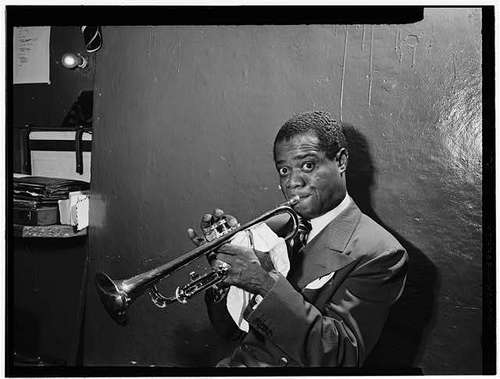
« February 2010 | Main | April 2010 »
March 31, 2010
TT: Herb Ellis, R.I.P.
So far as I know, everybody in and around jazz liked Herb Ellis, both as a guitarist and as a man. His no-nonsense style was a big part of what made the Oscar Peterson Trio so solid and satisfying in its piano-guitar-bass version, and his longtime partnership with Peterson and Ray Brown continues to be admired to this day, not least by those who, like me, have had the exhilarating pleasure of playing in a hard-swinging rhythm section.
Alas, there isn't much film of the Peterson Trio on YouTube, but this 1958 version of "A Gal in Calico" has been making the rounds ever since the announcement of Ellis' death on Sunday (he suffered from Alzheimer's disease). It's a fine way to remember a superior artist:
Posted March 31, 9:16 AM
TT: Snapshot
"Another Day Another Doormat," a 1959 animated cartoon written by Tom Morrison and directed by Al Kouzel:
(This is the latest in a weekly series of arts-related videos that appear in this space each Wednesday.)
Posted March 31, 12:00 AM
TT: Entry from an unkept diary
• Unlike most middle-aged bloggers, I've been hearing from the public for the whole of my adult life--I started writing newspaper criticism while I was still an undergraduate--and so it's nothing new when strangers write to tell me that I'm a despicable beast. The emergence of cyberspace, however, has made it vastly easier for people to express their opinions of public and semi-public figures, either directly via e-mail or by posting a comment or review somewhere on the Web, which means that there's a whole lot more to read today than there was in, say, 1980.
I don't go out of my way to read everything that gets written about me, but I do see a fair amount of it in the ordinary course of my working day, and it never fails to strike me that a considerable number of the people who write about the pieces that they read, whether by me or anyone else, haven't actually read them. Or, to be exact, they read until they encounter a statement with which they disagree, at which precise moment they stop reading, boil over, and start clicking away at their keyboards with what they imagine to be annihilating fury.
It goes without saying that the opinions of such folk aren't worth knowing. But I wonder: are most people like that? In other words, might it be normal for the average human being to be incapable of considering, however briefly, the possible validity, however partial, of opinions in any way contrary to his own? I hesitate to suggest such a dispiriting notion, but the older I grow, the more likely it seems.
H.L. Mencken said it: "Public opinion, in its raw state, gushes out in the immemorial form of the mob's fear. It is piped into central factories, and there it is flavoured and coloured and put into cans." That was in Notes on Democracy, published in 1926. Plus ça change...
Posted March 31, 12:00 AM
TT: Almanac
"Reading means borrowing."
G.C. Lichtenberg, Reflections
Posted March 31, 12:00 AM
March 30, 2010
TT: Apologies in advance
It may not seem like it, but I read all of my incoming mail, and do my best to answer it as well. I just spent a couple of hours chewing through a pile of accumulated messages. Alas, there are times when I simply get too much mail to keep up, especially when I write Wall Street Journal columns that touch a nerve. I know that some of you have sent me e-mails that slipped between the cracks, and I hope you'll forgive me if you fail to get a response, timely or otherwise. Please try again--I really do love hearing from you!
As for snail mail, here are four things I should have said long ago:
• Remember that it's much easier for me to answer e-mail than snail mail!
• I regret that I can no longer honor new requests to sign copies of Pops: A Life of Louis Armstrong and return them to you by mail. Of course I'll happily sign your copy in person, but the oppressive volume of snail mail that I now receive at my New York address, coupled with the rigors of my traveling schedule, has made it impossible for me to do anything more than that.
• I throw away unsolicited review copies of books and compact discs. This is a small apartment, and I can't cope with packages that come over the transom. Again, forgive me for being so blunt, but I'm the one that has to clean up the mess every day (I don't have a secretary). I'm sure your self-produced album is wonderful, but there's no chance that I'm going to listen to it, much less write about it, so please don't bother.
• If you're a publicist who writes to me here or at my Wall Street Journal mailbox instead of at my private e-mail address, you're wasting your time. Mass-mailed press releases sent to my blogbox are deleted unread, and the Journal only forwards reader mail, not press releases, to my private address. Experienced publicists either know how to get in touch with me directly or can find out--all it takes is a little digging--and should do so.
Posted March 30, 4:34 PM
TT: It's that man again
Here's how busy I've been: I completely forgot that C-SPAN would be airing my January appearance at Politics and Prose in Washington, D.C., during which I read from and answered questions about Pops: A Life of Louis Armstrong. I couldn't figure out why the Amazon sales rank for Pops had been spiking unpredictably in recent days. Then my mother told me that a neighbor called her on Saturday morning and said, "Turn on your TV--Terry's on it!"
If you're curious, you can watch the telecast by going here. To be perfectly frank, I didn't think that it was one of my better performances, but the folks at Politics and Prose claimed to feel otherwise, so I invite you to decide for yourself.
Posted March 30, 12:00 AM
TT: Almanac
"Books are fatal: they are the curse of the human race. Nine-tenths of existing books are nonsense, and the clever books are the refutation of that nonsense. The greatest misfortune that ever befell man was the invention of printing."
Benjamin Disraeli, Lothair
Posted March 30, 12:00 AM
March 29, 2010
TT: Ten books which influenced my view of the world
This meme, started by Tyler Cowen and picked up by, among others, Jenny Davidson and Ross Douthat, has piqued my interest. Here goes:
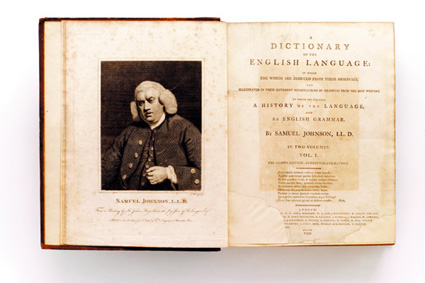
• W. Jackson Bate, Samuel Johnson. It was this modern exemplar of the biographer's art, not Boswell's Life, that introduced me to the man who became and remained my hero. Not only did Dr. Johnson's clear-eyed, cant-free view of human nature help me to see the world as it is, but I found his lifelong struggle against his own inborn defects of temperament to be powerfully inspiring. I still do, and probably always will.
• Joseph Conrad, Under Western Eyes. I came to Conrad relatively late, which is doubtless a good thing, since he is not for the young, whose inexperience prevents them from grappling with his cinder-black disillusion. Together with The Secret Agent, its companion piece, Under Western Eyes clarified my inchoate beliefs about the relationship between politics and idealism. I wrote about both books fourteen years ago in a New York Times op-ed piece published after it became known that the Unabomber was a Conrad fan (though not a very intelligent one). One line says it all: "He was a dangerous man--a convinced man."
• James Gould Cozzens, Guard of Honor. All but forgotten today, Guard of Honor is the greatest novel of World War II to be written by an American. Reading it made me a stoic, or at least as much of one as I think it suitable for a gentleman to be.
• Edwin Denby, Dance Writings. Missing from this list, somewhat to my surprise, is any book having to do with music. Needless to say, I read hundreds of books about music in my youth, but none of them, so far as I know, shaped the way that I see the world--they merely pointed me toward the composers and performers whose work did the shaping. Edwin Denby did that for me with dance, but he also taught me how a newspaper critic can write about a complex art form in a serious yet accessible way. Even though my style is nothing like his, he remains my journalistic beau ideal.
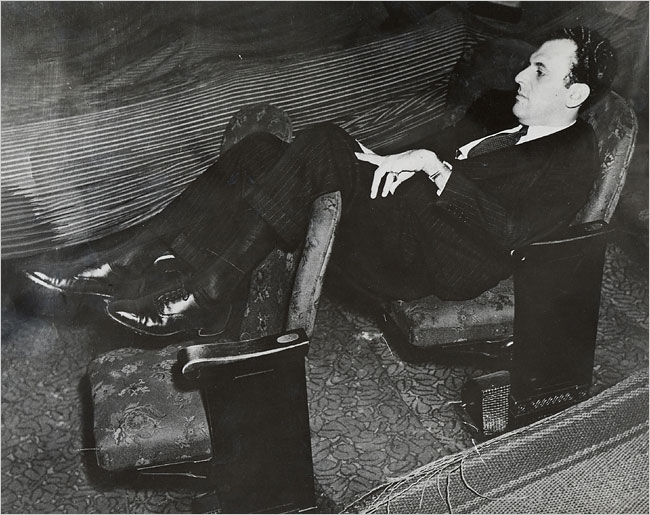
• Moss Hart, Act One: An Autobiography. If you want to become hopelessly stagestruck, read Act One in high school. It never occurred to me as a theater-crazy teenager that I would someday become a New York drama critic, much less write an opera libretto, but I suspect that my adolescent reading of Hart's half-realistic, half-starry-eyed memoir of the road that led him to Broadway planted the seeds that bore fruit half a lifetime later.
• Randall Jarrell, Pictures from an Institution: A Comedy. This coruscatingly brilliant comic novel "showed" me the world of the intellect in much the same way that Act One showed me the world of the theater, but with a big difference: Jarrell's sharp-witted snapshots of academic life did more than anything else to prevent me from going to graduate school. It's possible that he did me a disservice--I discovered years later that I loved teaching--but I think it at least as likely that he saved me from a life of chronic frustration.
• George Orwell, The Collected Essays, Journalism, and Letters. I found an already-battered paperback edition of this four-volume set in the Book Bug, a used-book store in Cape Girardeau, Missouri, some forty years ago. It remains on my shelf to this day. Orwell was the first nonfiction writer whose commonsense style spoke to me, and whose work gave me a sense of the kind of writing that I wanted to do. I also was influenced by his willingness to engage with the world in essentially moralistic terms, even though his perspective was entirely secular.
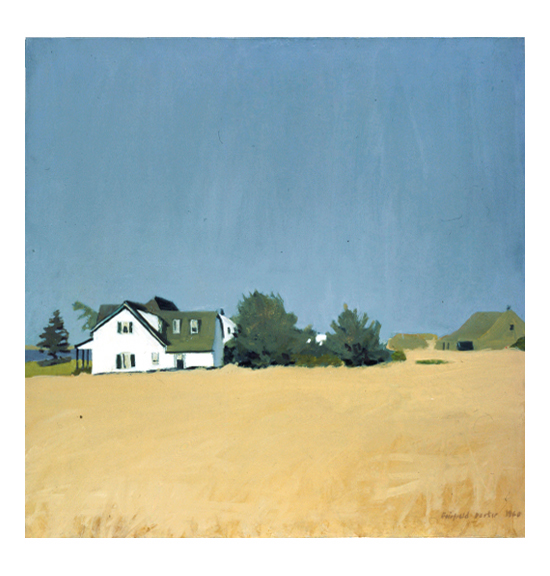
• Fairfield Porter, Art in Its Own Terms: Selected Criticism, 1935-1975. Porter was a great painter (though he is not yet widely recognized as such) who was also a great critic. On the same day that I first looked at one of his paintings, "Wheat," I bought a copy of this book in the shop of Kansas City's Nelson-Atkins Museum of Art. It taught me how to see--and how to think about what I saw. It also made me a better critic.
• Robert Penn Warren, All the King's Men. The most insightful of all American political novels, though not so much about the political process (if you want to understand that, read Allen Drury's Advise and Consent) as about the deep-seated passions that drive high-minded men to seek power over one another. In a well-regulated society, you wouldn't be allowed to register to vote until you'd read it.
• Evelyn Waugh, Black Mischief. I've read a great deal about politics in my lifetime, but no book, not even All the King's Men, did more to shape my political philosophy, such as it is, than this ferociously funny parable of the thinness of the crust of ice on which civilization rests.
So how about it, Our Girl and CAAF? Care to play?
Posted March 29, 12:00 AM
TT: Nota bene
You'll find plenty of new stuff in the right-hand column today, so give a gander.
Posted March 29, 12:00 AM
TT: Almanac
"Read the best books first, or you may not have a chance to read them at all."
Henry David Thoreau, A Week on the Concord and Merrimack Rivers
Posted March 29, 12:00 AM
March 28, 2010
BOOK
H.L. Mencken, Notes on Democracy. Underrated by critics ever since its original publication in 1926, Mencken's pithy "treatise" on democracy (he wrote similar books on religion and morals) was reprinted last fall by Dissident Books in a paperback edition. It is greatly deserving of a new audience. For all the inescapable limitations of Mencken's damn-the-boobs point of view, Notes on Democracy, in addition to being among the most personal of his books, is also the most artfully written and least well known of his many essays on democracy and its discontents. If you're feeling disillusioned with the wisdom of the masses--no matter what your reasons--you'll find it grimly amusing and hugely diverting (TT).Posted March 28, 7:01 PM
FILM
I Know Where I'm Going! This 1947 Michael Powell-Emeric Pressburger film, surprisingly little known in this country despite its release on DVD by the Criterion Collection, is a fantasy-tinged romcom about a priggish young woman (Wendy Hiller) who decides to marry a rich older man but is swayed from her course by a Scottish laird (Roger Livesey) who, unlike her, is in tune with the quiet joys of village life. The film's surface charm conceals a tough-minded critique of contemporary materialism, yet Powell, Pressburger and their delectable cast never allow it to become obtrusively heavy-handed. I've no idea why this wonderful film isn't as popular as the Ealing comedies (TT).Posted March 28, 12:51 PM
PLAY
The Glass Menagerie (Roundabout/Laura Pels, 111 W. 46th St., extended through June 13). Gordon Edelstein's production of Tennessee Williams' masterpiece is a recreative landmark, perfectly cast and imaginatively staged, that will make you feel as though you're seeing The Glass Menagerie for the first time. Every line, every pause, every gesture is as fresh as a shaft of sunlight. It joins David Cromer's Our Town on the short list of New York's must-see shows (TT).Posted March 28, 12:37 PM
CD
Dollison and Marsh, Vertical Voices: The Music of Maria Schneider (ArtistShare). Julia Dollison has joined forces with her husband, the singer-arranger Kerry Marsh, to create an album of Maria Schneider's compositions for big band in which all of the original horn parts are sung, not played. (Schneider's own rhythm section provides instrumental support.) More than just a technical tour de force, this CD is a miracle of kaleidoscopically varied vocal color that provides an arresting new perspective on Schneider's musical genius. If you've heard Observatory, Dollison's 2005 debut CD, you won't need to be told twice to get Vertical Voices. If not, get them both (TT).Posted March 28, 12:31 PM
BOOK
Charles Addams, The Addams Family: An Evilution (Pomergranate, $39.95). All of the 200-plus surviving cartoons--many of them previously unpublished--featuring the members of the decidedly creepy family that "graced" the pages of The New Yorker for a half-century. If you only know the Addams family through its various incarnations on TV and in film, you're missing most of the point of the output of one of the most gifted and original cartoonists of the twentieth century (TT).Posted March 28, 12:09 PM
OPERA
L'Etoile (New York City Opera, Lincoln Center, Apr. 1 and 3). Constant Lambert called Emmanuel Chabrier "the first important composer since Mozart to show that seriousness is not the same as solemnity, that profundity is not dependent upon length, that wit is not always the same as buffoonery, and that frivolity and beauty are not necessarily enemies." Curious? Then check out Mark Lamos' 2002 staging of Chabrier's near-surreal, divinely silly operetta, newly revived by the New York City Opera. It's the aesthetic equivalent of a chilled split of Dom Perignon (TT).Posted March 28, 12:00 PM
March 26, 2010
TT: A masterpiece made manifest
I'm one for three in today's Wall Street Journal drama column, but the one, Roundabout's new off-Broadway revival of The Glass Menagerie, is a knockout and a wow. Also present and accounted for--though not very enthusiastically--are Twyla Tharp's Come Fly Away and Suzan-Lori Parks' The Book of Grace. Here's an excerpt.
* * *
Gordon Edelstein, whose past productions at New Haven's Long Wharf Theatre include the best "Uncle Vanya" I've ever seen, has brought his version of Tennessee Williams' masterpiece from Connecticut to the Laura Pels Theatre, the Roundabout Theatre Company's Off-Broadway house. It should have gone to Broadway instead, and perhaps it will someday. In the meantime, though, you must see this show at once. No matter how well you know "The Glass Menagerie," you'll feel as though you're watching it for the first time. Every line, every pause, every gesture is as fresh as a shaft of sunlight.
Mr. Edelstein has added a surprise of his own to the oft-told tale of the Wingfield family, who come north to St. Louis in search of a new life and find themselves trapped in the quicksand of shabby gentility and fading hope. Since "The Glass Menagerie" is an autobiographical memory play narrated by Tom Wingfield, Williams' alter ego, Mr. Edelstein sets the action in a single playing space designed with penny-plain restraint by Michael Yeargan that doubles as the tenement apartment of the Wingfields and--here's the surprise--a grubby New Orleans hotel room to which Tom has fled in order to write the very play that we are seeing. Needless to say, that's not what Williams had in mind, and on paper it may sound like an over-ingenious directorial conceit, but in performance it heightens to a breathtaking degree the immediacy of Tom's recollections.
In addition to rethinking the play in so innovative a way, Mr. Edelstein has assembled a masterly cast whose members perform without the faintest hint of sentimentality....
Twyla Tharp racked up a major disaster three seasons ago with "The Times They Are A-Changin,'" one of the lamest jukebox musicals ever to stagger onto Broadway. Not surprisingly, she's playing it very, very safe this time around: "Come Fly Away" is a love-in-a-nightclub fantasy set to the ever-popular music of Frank Sinatra, whose recordings have previously accompanied three of Ms. Tharp's ballets. The songs are familiar, the dancers are pretty, the set is fancy and the band is hot. All that's missing from this recipe for success are a star and a few memorable onstage events....
If you feel the need for a stiff dose of fatuity, head straight down to the Public Theater to see Suzan-Lori Parks' "The Book of Grace." The setting is Texas, which is--naturally--a desert full of bigots. The villain of the piece is an ultra-conservative border-patrol officer (John Doman) whose long-estranged biracial son (Amari Cheatom) has come home for a visit, in the course of which he beds his Pollyannish stepmother (Elizabeth Marvel, who is, as always, astonishingly good). We are, I think, invited to suppose that the father molested the son once upon a time, or maybe vice versa....
* * *
Read the whole thing here.
Posted March 26, 12:00 AM
TT: Almanac
"It is impossible to persuade a man who does not disagree, but smiles."
Muriel Spark, The Prime of Miss Jean Brodie
Posted March 26, 12:00 AM
March 25, 2010
TT: So you want to see a show?
Here's my list of recommended Broadway, off-Broadway, and out-of-town shows, updated weekly. In all cases, I gave these shows favorable reviews (if sometimes qualifiedly so) in The Wall Street Journal when they opened. For more information, click on the title.
Warning: Broadway shows marked with an asterisk were sold out, or nearly so, last week.
BROADWAY:
• A Behanding in Spokane (black comedy, PG-13, violence and adult subject matter, closes June 6, reviewed here)
• Fela! * (musical, PG-13, adult subject matter, reviewed here)
• God of Carnage (serious comedy, PG-13, adult subject matter, reviewed here)
• The Miracle Worker (drama, G, too intense for small children, reviewed here)
• South Pacific (musical, G/PG-13, some sexual content, brilliantly staged but unsuitable for viewers acutely allergic to preachiness, closes Aug. 22, reviewed here)
OFF BROADWAY:
• Avenue Q (musical, R, adult subject matter and one show-stopping scene of puppet-on-puppet sex, reviewed here)
• The Fantasticks (musical, G, suitable for children capable of enjoying a love story, reviewed here)
• The Orphans' Home Cycle, Parts 1, 2, and 3 (drama, G/PG-13, too complicated for children, now being performed in rotating repertory, closes May 8, reviewed here, here, and here)
• Our Town (drama, G, suitable for mature children, reviewed here)
• The Temperamentals (drama, PG-13, adult subject matter, reviewed here)
CLOSING SOON ON BROADWAY:
• A View from the Bridge * (drama, PG-13, violence and some sexual content, closes Apr. 4, reviewed here)
CLOSING SUNDAY OFF BROADWAY:
• The Boys in the Band (drama, R, adult subject matter, reviewed here)
• Venus in Fur (serious comedy, R, sexual content, reviewed here)
CLOSING SUNDAY IN PRINCETON, N.J.:
• American Buffalo (drama, PG-13/R, violence and very strong language, transferred from Chicago's Steppenwolf Theatre Company, reviewed here)
Posted March 25, 12:00 AM
TT: Almanac
"Writing is not a profession but a vocation of unhappiness. I don't think an artist can ever be happy."
Georges Simenon, interview (Paris Review, Summer 1955)
Posted March 25, 12:00 AM
March 24, 2010
TT: Sorry about that
A reader writes:
"Dad, can I read this book about Louis Armstrong?"(Dad thinks for a second, thinks it will inspire eleven-year-old to practice his trumpet more, thinks it's not a bad choice for a first grownup book, tries to remember what his first truly grownup book was, suspects it was Airport.)
"Sure."
(A half-hour later) "Dad, what's a pimp?"
I guess we need to slap a warning sticker on the paperback!
Posted March 24, 12:02 PM
TT: Snapshot
Noël Coward sings "Uncle Harry" on Together With Music in 1955, introduced by Mary Martin:
(This is the latest in a weekly series of arts-related videos that appear in this space each Wednesday.)
Posted March 24, 12:00 AM
TT: Almanac
"Beware the fictionist writing his own life. Even candor becomes a strategy."
Wilfrid Sheed, "V. S. Pritchett: Midnight Oil"
Posted March 24, 12:00 AM
March 23, 2010
TT: Almanac
"The best comedy is always heartless, an alternative to rational emotion."
Wilfrid Sheed, "The Wit of George S. Kaufman and Dorothy Parker"
Posted March 23, 12:00 AM
March 22, 2010
BRINGING ART BACK TO PBS
"PBS should air fine-arts programs that encompass the full range of the performing arts. That means not just The Nutcracker but ballet and modern-dance masterpieces of all kinds. It means not just ultrafamiliar operas but solo recitals and chamber music. It means not just Broadway musicals but performances of classic and contemporary plays. And these performances should take place not just in New York, Los Angeles and San Francisco but in cities throughout America..."Posted March 22, 4:30 PM
TT: Eighty and counting
I've written so much about Stephen Sondheim over the years that I can't do better on his eightieth birthday than to quote myself. Here's part of an essay I wrote about him for Commentary in 2003:
Unlike most of the American songwriters who preceded him, he had extensive classical training--he studied with the avant-garde composer Milton Babbitt--and was strongly influenced by the harmonic usages of the French impressionists. As a result, his songs are typically based on undulating chordal figurations over which he superimposes melodies painstakingly built up out of short, angular motivic fragments. Listeners familiar with the music of Debussy and Ravel (or with modern jazz) will hear nothing abstruse or elusive in this approach, but anyone whose knowledge of music is limited to the ballads of such Broadway composers as Berlin or Richard Rodgers, with their long, seemingly self-generated melodic lines, will likely find Sondheim's songs to be insufficiently tuneful.No less individual are his lyrics--and the sentiments they express. Though Sondheim's virtuosity is not without precedent (few of his elaborate rhymes would sound out of place in a lyric by Ira Gershwin or Cole Porter), Sondheim's ambivalence toward love is all but unique in American songwriting. Ambivalence, he has said, is his "favorite thing to write about, because it's the way I feel, and I think the way most people feel." Perhaps, but it is also arguably the main reason why his work has never become popular. Even Lorenz Hart, that most disillusioned of American lyricists, left no doubt of his fervent, even desperate longing for the state about which he wrote with such self-lacerating wit. Not so Sondheim, whose best songs are more often than not written from the point of view of an inhibited, alienated man unable to open himself up to the prospect of romantic love....
Sondheim's perspective on love, which is as distinctively "modern" as is his musical language, constitutes a near-complete break with the romantic optimism of the American musical-comedy tradition....
So distinctive an approach will never be everyone's cup of tea, and to this day theatrical producers continue to grapple with the problem of how to present Sondheim's musicals in a way that is commercially viable. At one time I felt that he had made a potentially fatal mistake by choosing to write musicals instead of operas (though Sweeney Todd, his masterpiece, comes as close to being an opera as doesn't matter). I still think it likely that the appeal of his work will always be narrowly limited.
Yet Sondheim is without doubt the most gifted songwriter to work on Broadway in the second half of the twentieth century, and I admire him as much as any creative artist who has been active in my lifetime. His best songs, among which I number "Another Hundred People," "Anyone Can Whistle," "Every Day a Little Death," "Finishing the Hat," "Good Thing Going," "I Remember," "Loving You," "The Miller's Son," "Not a Day Goes By," "Take Me to the World," and the life-enhancing "Comedy Tonight," are a permanent part of the soundtrack of my life. May he live long and prosper greatly!
Posted March 22, 12:48 PM
TT: Almanac
"All professions are conspiracies against the laity."
George Bernard Shaw, The Doctor's Dilemma
Posted March 22, 12:00 AM
March 19, 2010
TT: Formerly famous faces
Strikeout: I pan three plays, Looped, Zero Hour, and When the Rain Stops Falling, in today's Wall Street Journal drama column. Here's an excerpt.
* * *
Broadway being what it is these days, I can't help but wonder exactly what the producers of "Looped" see as their target market. Tallulah Bankhead, the whiskey-voiced, omnivorously promiscuous subject of Matthew Lombardo's new play, used to be something of a theatrical icon, though she was always better known for her one-liners (some of which she actually said) than her stage performances. But Bankhead's failure to make any first-rate films means that she is now known to few people under the age of 40--better make that 60--and it's hard to see why anyone who doesn't know who she was would pay to see an unfunny dramedy that seeks to exploit her faded fame.
"Looped" is loosely based on a real-life occurrence in the pitiful second half of Bankhead's career. In 1965 she supposedly spent eight hours attempting to overdub a single line of dialogue in her last feature film, a bottom-of-the-bottom-of-the-barrel camp horror "classic" called "Die! Die! My Darling!" Out of that ignominous episode, Mr. Lombardo has woven a three-person play in which Bankhead (Valerie Harper) bumps up against a Hollywood film editor (Brian Hutchison) and sound engineer (Michael Mulheren) who attempt with minimal success to get her to speak her line coherently. In between takes she gets plastered, foams at the mouth with prefab wisecracks, tells the story of her life and induces the film editor to confess his Deep Dark Secret. Yes, he's gay, and believe me, I'm not telling you anything that you won't figure out several weeks before Mr. Lombardo spills the beans....
Unlike Tallulah Bankhead, Zero Mostel is reasonably well remembered, if not in the way he would have preferred. His much-larger-than-life performance in Mel Brooks' "The Producers," a movie that he claimed to loathe, has kept his memory green, and a fair amount of his essence also comes through on the original-cast album of "Fiddler on the Roof" and in the uneven film version of "A Funny Thing Happened on the Way to the Forum." But while "Zero Hour," written and performed by Jim Brochu and staged by none other than Piper Laurie, is a highly effective evocation of the public Mostel--Mr. Brochu looks and acts just like an Al Hirschfeld caricature--it doesn't add up to a full-fledged play....
I'm not quite sure that I'd pay to see David Cromer direct the Manhattan phone book, but I'd give it serious thought. Alas, "When the Rain Stops Falling," Andrew Bovell's droningly drab multigenerational saga of a comprehensively unhappy Anglo-Australian family, is more than a little bit phone-booky, Mr. Cromer's best efforts notwithstanding. This is the kind of show whose program includes a family tree--the action bounces back and forth between 1959 and 2039--and you don't get extra credit for guessing that somebody got molested somewhere up the line....
* * *
Read the whole thing here.
Posted March 19, 12:00 AM
TT: Bringing art back to PBS
Paula Kerger, the president and CEO of PBS, gave a litle-noticed speech to Town Hall Los Angeles in January in which she acknowledged what everybody already knows, which is that fine-arts programming on public TV is--to put it mildly--in decline. She also announced plans to beef it up, none of which struck me as particularly impressive, so I decided to get into the act by making a few pointed suggestions of my own. That's the subject of my "Sightings" column for Saturday's Wall Street Journal, in which, among other things, I tell what I'd do if I were (A) put in charge of arts programming at PBS and (B) given a pile of money to spend as I saw fit.
If you want to know more, pick up a copy of tomorrow's paper and see what I have to say.
UPDATE: Read the whole thing here.
Posted March 19, 12:00 AM
TT: Almanac
"There is nothing so terrible as the pursuit of art by those who have no talent."
W. Somerset Maugham, Of Human Bondage
Posted March 19, 12:00 AM
March 18, 2010
TT: On the air
I'll be appearing today on Soundcheck, WNYC's daily music series, to talk with John Schaefer about "The Unsure Artist," my recent Wall Street Journal column about the uncertainties and anxieties of gifted artists. The show starts at two p.m. ET.
Listen live in the New York area by tuning to 93.9 FM, or go here to listen on your computer via streaming audio. As usual, the program will also be archived and can be downloaded as a podcast.
Posted March 18, 10:13 AM
TT: So you want to see a show?
Here's my list of recommended Broadway, off-Broadway, and out-of-town shows, updated weekly. In all cases, I gave these shows favorable reviews (if sometimes qualifiedly so) in The Wall Street Journal when they opened. For more information, click on the title.
Warning: Broadway shows marked with an asterisk were sold out, or nearly so, last week.
BROADWAY:
• A Behanding in Spokane * (black comedy, PG-13, violence and adult subject matter, closes June 6, reviewed here)
• Fela! (musical, PG-13, adult subject matter, reviewed here)
• God of Carnage (serious comedy, PG-13, adult subject matter, reviewed here)
• The Miracle Worker (drama, G, too intense for small children, reviewed here)
• South Pacific (musical, G/PG-13, some sexual content, brilliantly staged but unsuitable for viewers acutely allergic to preachiness, reviewed here)
• A View from the Bridge * (drama, PG-13, violence and some sexual content, closes Apr. 4, reviewed here)
OFF BROADWAY:
• Avenue Q (musical, R, adult subject matter and one show-stopping scene of puppet-on-puppet sex, reviewed here)
• The Boys in the Band (drama, R, adult subject matter, closes Mar. 28, reviewed here)
• The Fantasticks (musical, G, suitable for children capable of enjoying a love story, reviewed here)
• The Orphans' Home Cycle, Parts 1, 2, and 3 (drama, G/PG-13, too complicated for children, now being performed in rotating repertory, closes May 8, reviewed here, here, and here)
• Our Town (drama, G, suitable for mature children, reviewed here)
• The Temperamentals (drama, PG-13, adult subject matter, reviewed here)
CLOSING NEXT WEEK OFF BROADWAY:
• Venus in Fur (serious comedy, R, sexual content, closes Mar. 28, reviewed here)
CLOSING NEXT WEEK IN PRINCETON, N.J.:
• American Buffalo (drama, PG-13/R, violence and very strong language, transferred from Chicago's Steppenwolf Theatre Company, closes Mar. 28, reviewed here)
CLOSING SUNDAY IN LENOX, MASS.:
• Les Liaisons Dangereuses (drama, R, violence and sexual content, reviewed here)
Posted March 18, 12:00 AM
TT: Almanac
"It is not very comfortable to have the gift of being amused at one's own absurdity."
W. Somerset Maugham, Of Human Bondage
Posted March 18, 12:00 AM
March 17, 2010
TT: Snapshot
Andrés Segovia teaches a master class on the guitar transcription of Bach's Chaconne:
(This is the latest in a weekly series of arts-related videos that appear in this space each Wednesday.)
Posted March 17, 12:00 AM
TT: Department of dead metaphors
In preparation for the Broadway debut of The Addams Family, I've been revisiting the wonderful New Yorker cartoons of Charles Addams, which are infinitely more artful and sophisticated than any of their offspring.
I ran across this cartoon on the Web the other day, and the reason why it caught my eye is that the visual "joke" Addams was making arises from a now-dead technology, that of the phonograph. As I looked at it, a disquieting thought occurred to me: what percentage of people under the age of thirty are likely to get the point of the cartoon?
Speaking as a middle-aged music lover, I find myself reluctant to poll my younger friends. Some things are better left unknown....
Posted March 17, 12:00 AM
TT: Almanac
"Like most people who cultivate an interest in the arts, Hayward was extremely anxious to be right. He was dogmatic with those who did not venture to assert themselves, but with the self-assertive he was very modest."
W. Somerset Maugham, Of Human Bondage
Posted March 17, 12:00 AM
March 16, 2010
TT: The second time around
Here's the front cover of the forthcoming paperback edition of Pops: A Life of Louis Armstrong, which will be published in October. Sharp-eyed readers will note one major correction--the cover photo, which was reversed, has been made right--as well a dozen or so near-microscopic fixes to the text.
Mrs. T is delighted that my name will be on the cover this time around. That never bothered me, but I'm pleased to see a quote from Michiko Kakutani's rave review of Pops on the cover of the paperback. I was, not surprisingly, quite proud of that review, and still am.
If you haven't gotten around to buying Pops yet...well, what's keeping you?
Posted March 16, 12:00 AM
TT: Almanac
"I have been attached, deeply attached, to a few people; but I have been interested in men in general not for their own sakes but for the sake of my work."
W. Somerset Maugham, The Summing Up
Posted March 16, 12:00 AM
March 15, 2010
TT: Entry from an unkept diary
• A friend on the West Coast sent me an e-mail the other day that ended, "Give me a call. We never talk." When I read this, it struck me that the only people I call simply to talk nowadays are Mrs. T (when we're in different places), my mother, my brother, and Our Girl in Chicago. I communicate with the rest of the world via e-mail or some other form of direct messaging, and I can't remember the last time that I sent a purely personal letter for any reason other than condolence or to say thanks for a gift or service of some kind.
For me, then, the revolution has happened. I've outlived snail mail, dial phones, answering machines, fax machines, and land lines, and have survived into the post-telephonic age. Yet I haven't fully embraced the new regime, either: I don't own an iPhone, a Kindle, or a BlackBerry, nor do I send more than one or two text messages a week. At least for the moment, I find that my battered MacBook satisfies all of my communicative needs, and I don't feel even slightly tempted to embrace any of the aforementioned items. I do just fine with e-mail.
Might this mean that I've come to the end of my absorptive capacity for technology--in other words, that I am now officially an old fogy? I doubt it. I am, after all, one of the prophets of the e-book, and I'm sure that I'll get around to buying one sooner or later. But as much as I appreciate new technologies, I'm not an early adopter. I prefer to let other people work out the bugs, and I've never been one to buy shiny toys for aging boys. The last gadgets of any significance to enter my life were my first (and only) iPod, which I bought five years ago, and Miranda, the trusty GPS that Mrs. T and I use when traveling. I bought my stereo and TV in 2002 and my cellphone in 2007.
I'm sure the day will come when I finally decide to purchase...well, probably not an iPad, but the platform after the platform after that. But until then, I expect that I'll scrape along quite nicely as a transitional figure, a semi-old-fashioned fellow who has neither a land line nor an iPhone. In the meantime, though, don't call me--I'll call you. Or not.
Posted March 15, 12:00 AM
TT: Almanac
"He was so young, he did not realise how much less is the sense of obligation in those who receive favours than in those who grant them."
W. Somerset Maugham, Of Human Bondage
Posted March 15, 12:00 AM
March 12, 2010
TT: Dude, where's my God?
My luck ran out. In today's Wall Street Journal drama column I review three new plays, Next Fall, The Temperamentals, and Equivocation, only one of which I liked, and that one with reservations (though I do think it's worth seeing). Here's an excerpt.
* * *
In art, good intentions count for something--but not much. The intentions of Geoffrey Nauffts' "Next Fall," a new play about a man (Patrick Breen) whose much younger lover (Patrick Heusinger) is dying, are palpably high-minded, and I suspect that many playgoers will think that this makes it worth seeing. Alas, "Next Fall" is cliché-infested and cloyingly sentimental, and the fact that it has transferred to Broadway after a successful Off-Broadway run means only that you can fool some of the people most of the time.
To say what happens in "Next Fall" is to suggest its relentless predictability. Luke (Mr. Heusinger), a simple-minded but pretty young actor-waiter, falls for Adam (Mr. Breen), a bright but frustrated writer-candle salesman of a certain age. They move in together and would undoubtedly be destined for untroubled happiness were it not that Luke is a born-again Christian whose belief in God prevents him from coming to terms with his homosexuality and admitting it to Arlene (Connie Ray) and Butch (Cotter Smith), his extremely southern parents. Solution: He prays after having sex...
Don't be fooled by the religious trappings of "Next Fall." We're in the world of movie-of-the-week dramaturgy, a never-never-land of tinsel epiphanies and black-and-white creatures like Butch, who is not a human being but a symbol of intolerance...
If you want to see a worthwhile new gay play, I recommend Jon Marans' "The Temperamentals," which suffers from some of the same faults as "Next Fall" but has the distinct advantage of being intelligent and, up to a point, unpredictable. The good part is the first act, in which we meet a group of deeply closeted gay men living in Los Angeles in the '50s, a time when homosexuals who dared to be themselves in public invited social ostracism--or worse. The five main characters of "The Temperamentals" are the founders of the Mattachine Society, one of America's first pro-gay organizations, and in the first act Mr. Marans introduces us to these cautious, ever-watchful men, portraying them so shrewdly and sympathetically that you want to know much, much more about the way they lived then.
I know that critics are supposed to review the show they saw, not the one they'd rather have seen, but I wish that Mr. Marans had dumped the second act of "The Temperamentals" and turned the first act into a full-length black comedy of manners about life in the Eisenhower-era closet. No sooner does "The Temperamentals" become an episode of "Great Gays in History" than it grows painfully preachy...
For sheer pretentiousness, it'd be hard to beat Bill Cain's "Equivocation," which has arrived in New York after making the regional rounds. This historical fantasia, in which we are invited to imagine what might have happened had King James I (David Furr) ordered William Shakespeare (John Pankow) to write a play about the Gunpowder Plot of 1605, is by turns self-consciously clever and elephantine in its contemporary political parallels...
* * *
Read the whole thing here.
Posted March 12, 12:00 AM
TT: Almanac
"It is occasionally indicated to us that we are apparently setting out to give the public what we think they need--and not what they want--but few know what they want and very few what they need. In any case it is better to overestimate the mentality of the public than to underestimate it. He who prides himself on giving what he thinks the public wants is often creating a fictitious demand for lower standards which he himself will then satisfy."
Sir John Reith, BBC internal memorandum (November 1924)
Posted March 12, 12:00 AM
March 11, 2010
TT: Curiosities (third in an occasional series)
Alexander Woollcott, the critic-broadcaster-anthologist who figured in the first posting in this series, was on my mind this week. I've been rereading Cakes and Ale, Somerset Maugham's best novel, in preparation for a review I'm writing of a new Maugham biography that will be published in May. It happens that my personal copy of Cakes and Ale is part of Woollcott's Second Reader, an anthology that Woollcott edited in 1937. I tweeted about this fact the other day, and in the process of looking for an interesting image of Woollcott to run with the version of my tweet that I posted on Facebook, I ran across this wonderful advertisement:

Being a critic and train buff, you can imagine how delighted I was by this ad. Imagine--if you can--a time when critics were solicited to provide paid endorsements for high-profile products!
Posted March 11, 12:00 AM
TT: So you want to see a show?
Here's my list of recommended Broadway, off-Broadway, and out-of-town shows, updated weekly. In all cases, I gave these shows favorable reviews (if sometimes qualifiedly so) in The Wall Street Journal when they opened. For more information, click on the title.
Warning: Broadway shows marked with an asterisk were sold out, or nearly so, last week.
BROADWAY:
• A Behanding in Spokane (black comedy, PG-13, violence and adult subject matter, closes June 6, reviewed here)
• Fela! * (musical, PG-13, adult subject matter, reviewed here)
• God of Carnage (serious comedy, PG-13, adult subject matter, reviewed here)
• The Miracle Worker (drama, G, too intense for small children, reviewed here)
• South Pacific (musical, G/PG-13, some sexual content, brilliantly staged but unsuitable for viewers acutely allergic to preachiness, reviewed here)
• A View from the Bridge * (drama, PG-13, violence and some sexual content, closes Apr. 4, reviewed here)
OFF BROADWAY:
• Avenue Q (musical, R, adult subject matter and one show-stopping scene of puppet-on-puppet sex, reviewed here)
• The Boys in the Band (drama, R, adult subject matter, closes Mar. 28, reviewed here)
• The Fantasticks (musical, G, suitable for children capable of enjoying a love story, reviewed here)
• The Orphans' Home Cycle, Parts 1, 2, and 3 (drama, G/PG-13, too complicated for children, now being performed in rotating repertory, closes May 8, reviewed here, here, and here)
• Our Town (drama, G, suitable for mature children, reviewed here)
CLOSING SOON OFF BROADWAY:
• Venus in Fur (serious comedy, R, sexual content, closes Mar. 28, reviewed here)
CLOSING SOON IN PRINCETON, N.J.:
• American Buffalo (drama, PG-13/R, violence and very strong language, transferred from Chicago's Steppenwolf Theatre Company, closes Mar. 28, reviewed here)
CLOSING NEXT WEEK IN LENOX, MASS.:
• Les Liaisons Dangereuses (drama, R, violence and sexual content, closes Mar. 21, reviewed here)
CLOSING SATURDAY IN ORLANDO, FLA.:
• Hamlet (Shakespeare, PG-13, reviewed here)
Posted March 11, 12:00 AM
TT: Almanac
"The public does not like bad literature. The public likes a certain kind of literature and likes that kind of literature even when it is bad better than another kind of literature even when it is good. Nor is this unreasonable; for the line between different types of literature is as real as the line between tears and laughter; and to tell people who can only get bad comedy that you have some first-class tragedy is as irrational as to offer a man who is shivering over weak warm coffee a really superior sort of ice."
G.K. Chesterton, Charles Dickens
Posted March 11, 12:00 AM
March 10, 2010
OGIC: Lower
Last week I revisited Jacques Tourneur's classic noir Out of the Past for the first time in 15 years, and I've had Mitchum on my mind ever since. I mean since 1995, of course. It's an easy state to attain and a hard one to shake. (Just ask Mitchum's first fan club: the Droolettes, dignity be damned.)
This time around, however, I found just as much of my attention fixed on Kirk Douglas's nice turn as the elegant hood Whit Sterling. In his Mitchum biography Baby, I Don't Care (yes, it is the best book title ever), Lee Server recounts a story from the set via Jane Greer. This, I find, accounts for quite a bit of the deliciousness of both performances.
The two got along well enough off the set, but the rivalry would flare as soon as the camera began to turn. Since Tourneur was not about to accept any obvious histrionics in his diminuendo world, Douglas was left to try and out-underact Mitchum, an exercise in futility, he discovered. He tried adding distracting bits of business during Mitchum's lines and came up with a coin trick, running it quickly between the tops of his fingers. Bob started staring at the fingers until Kirk started staring at the fingers and dropped the coin on the rug. He put the coin away. In another scene, Douglas brought a gold watch fob out of his coat pocket and twirled it around like a propeller. This time everybody stared.
"It was a hoot to watch them going at it," said Jane Greer. "They were two such different types. Kirk was something of a method actor. And Bob was Bob. You weren't going to catch him acting. But they both tried to get the advantage. At one point they were actually trying to upstage each other by who could sit the lowest. The one sitting the lowest had the best camera angle, I guess--I don't know what they were thinking. Bob sat on the couch, so Kirk sat on the table, then one sat on the footstool, and by the end I think they were both on the floor."
Ebert's review of the movie is well worth reading.
Posted March 10, 10:00 AM
TT: Snapshot
Sid Caesar defines jazz:
(This is the latest in a weekly series of arts-related videos that appear in this space each Wednesday.)
Posted March 10, 12:00 AM
TT: Almanac
"Insensibly he formed the most delightful habit in the world, the habit of reading: he did not know that thus he was providing himself with a refuge from all the distress of life; he did not know either that he was creating for himself an unreal world which would make the real world of every day a source of bitter disappointment."
W. Somerset Maugham, Of Human Bondage
Posted March 10, 12:00 AM
March 9, 2010
CAAF: Portraits in first sentences -- Nabokov
A collection of first sentences from Nabokov's short stories. Selection cribbed from Anthony Lane's terrific New Yorker essay about the collected stories, with a couple additions:
"The Wood-Sprite" (Nabokov's first published story, written while he was a student at Cambridge): "I was pensively penning the outline of the inkstand's circular, quivering shadow.""Wingstroke": "When the curved tip of one ski crosses the other, you tumble forward."
"Gods": "Here is what I see in your eyes right now: rainy night, narrow street, streetlamps gliding away into the distance."
"Details of a Sunset": "The last streetcar was disappearing in the mirrorlike murk of the street and, along the wire above it, a spark of Bengal light, crackling and quivering, sped into the distance like a blue star."
"La Veneziana": "In front of the red-hued castle, amid luxuriant elms, there was a vividly green grass court."
"A Letter That Never Reached Russia": "My charming, dear distant one, I presume you cannot have forgotten anything in the more than eight years of our separation, if you manage to remember even the gray-haired, azure liveried watchman who did not bother us in the least when we would meet, skipping school, on a frosty Petersburg morning, in the Suvurov museum, so dusty, so small, so similar to a glorified snuffbox.
"The Potato Elf": "Actually his name was Frederick Dobson."
"The Circle": "In the second place, because he was possessed by a sudden mad hankering after Russia."
"Tyrants Destroyed": "The growth of his power and fame was matched, in my imagination, by the degree of the punishment I would have liked to inflict on him."
"Ultima Thule": "Do you remember the day you and I were lunching (partaking of nourishment) a couple of years before your death?"
"That In Aleppo Once": "Dear V.--Among other things, this is to tell you that at last I am here, in the country whither so many sunsets have led."
"Signs and Symbols": "For the fourth time in as many years they were confronted with the problem of what birthday present to bring a young man who was incurably deranged in his mind."
Through this "scattering of nutshells" (Lane's phrase) you get a portrait of Nabokov as a writer. I was reminded of it by Maud's similar collage of first sentences from nine Muriel Spark novels. Interesting to compare the two. For example, Nabokov's color field: azure shading into quivering blue, vivid greens and a spot of red. The only colors in the Spark selection: "almost white" and the "clear crystal" you come to after the "murk & smog" -- a fittingly chilly palette for a writer who writes as cleanly and sparely as Spark does.
Lane notes another quality of the Nabokov first sentences is their lack of preamble or introduction. The reader is almost always set down at some mid point of the narrative. Writes Lane: "Again and again, with polite indifference, the stories drop us in media res, and leave us to work out what on earth the res might be."
Lane's Nabokov essay can be read online (sub. required) or in his essay collection, Nobody's Perfect.
Posted March 09, 3:06 PM
TT: Almanac
"Once in a while I drop into a church again to kneel at the altar for a word of prayer, though this is often a single supplicatory gasp as much accusation as anything else, such as 'Give us a break, will Ya!'"
Peter De Vries, The Vale of Laughter
Posted March 09, 12:00 AM
March 8, 2010
CAAF: Sickly little mole people
One of the sharpest parts of last night's Oscars was a nice bit by Tina Fey and Robert Downey Jr. about writers versus actors. The transcript, courtesy of Salon:
Fey: Great movies begin with great writing.Downey:What does an actor look for in a script? Specificity. Emotional honesty. Catharsis.
Fey: And what does a writer look for in an actor? Memorizing. Not paraphrasing. Fear of ad-libbing.
Downey: Actors want scripts with social relevance, warm weather locations, phone call scenes that can be shot separately from that insane actress that I hate, and long dense columns of uninterrupted monologue, turning the page, and for instance seeing the phrase, "Tony Stark, continued."
Fey: And we writers dream of a future where actors are mostly computer-generated and their performances can be adjusted by us, on a laptop, alone.
Downey: It's a collaboration, a collaboration between handsome, gifted people and sickly little mole people.
The two were presenting the award for best original screenplay, which went to Mark Boal for The Hurt Locker. Watch the exchange here.
Posted March 08, 1:51 PM
TT: Idling
I finished my stint of jury duty on Friday afternoon, took the next bus to Connecticut, and went into hiding with Mrs. T, whom I hadn't seen for three whole weeks, our longest separation since we were married two and a half years ago. Except for reading a couple of books that I'm planning to review, I did no work of any kind--a near-unprecedented occurrence.
Today I'm returning to New York, where I'll be speaking about Pops: A Life of Louis Armstrong at the Jazz Museum in Harlem tonight at seven p.m. (If you're interested, go here for details.) Between now and Friday I'll be seeing three plays and writing a piece or two, or maybe three.
Not surprisingly, I'm a bit careworn from the events of last week--it isn't easy to sit on a jury while simultaneously holding down what amounts to a full-time job--so I'm planning to keep my blogging to a minimum for the next few days. OGIC and CAAF will take up the slack.
Till soonish.
Posted March 08, 12:00 AM
TT: Almanac
"As long as something is unfinished, there's always that little feeling of insecurity. And a feeling of insecurity is absolutely necessary unless you're so rich that it doesn't matter."
Duke Ellington (quoted in Don George, Sweet Man)
Posted March 08, 12:00 AM
March 7, 2010
THE UNSURE ARTIST
"'A bad word from a colleague can darken a whole day,' Orson Welles once told Peter Bogdanovich. 'We need encouragement a lot more than we admit, even to ourselves.' Remember those words the next time you see someone basking in the sunshine of a standing ovation. What looks to you like a polite formality might just be the only thing capable of giving him the courage to pick up his pen tomorrow morning and face the music all over again..."Posted March 07, 10:45 PM
March 5, 2010
TT: What the right hand is doing
Today's Wall Street Journal column, written in the interstices of my service on a Manhattan jury, gives thumbs up to two new Broadway shows, Martin McDonagh's A Behanding in Spokane and the first Broadway revival of William Gibson's The Miracle Worker. Here's an excerpt.
* * *
When blood is shed in a Martin McDonagh play, the audience always laughs--and usually gasps. Mr. McDonagh is partial to comic violence, and in "A Behanding in Spokane" he lets it rip. I mustn't be too specific, this being a play full of grisly surprises, but there's one thing about which I can be absolutely precise: "A Behanding in Spokane" is the funniest new play to open in New York since I started writing this column.
"Behanding" is the first of Mr. McDonagh's plays to be written specifically for Broadway and the first set on this side of the Atlantic, though I confess to finding his America hard to tell from his Ireland, both being full of more or less demented blabbermouths. In "Behanding" we meet four, the looniest of whom is Mr. Carmichael (Christopher Walken), a homicidal maniac who has spent the past 47 years searching for his left hand, from which he was involuntarily separated by "six hillbilly bastards" who lived to regret their little prank. Now he's gone to ground in a hotel managed by another fast-talking lunatic (Sam Rockwell) and is about to dispose of a couple of small-time crooks (Zoe Kazan and Anthony Mackie) who made the mistake of trying to sell him a phony hand.
You're welcome to interpret "A Behanding in Spokane" as a fable about two lost souls who have more in common than they realize--Mervyn, the hotel clerk, is fully as interesting a character as the mysterious Mr. Carmichael--or you can relax and revel in the virtuosity with which Mr. McDonagh stuffs wildly funny words into the mouths of his cast. Either way, you'll spend an hour and a half laughing nonstop....
William Gibson's "The Miracle Worker," first seen on Broadway in 1959, is the inspirational story of a secular saint, Helen Keller, who overcame the direst of handicaps (an illness left her blind and deaf when she was 19 months old) to become a legend in her own time. It is also a tour de force for a child actress, which is a polite way of saying that "The Miracle Worker" is a theatrical stunt, a play whose star (Abigail Breslin) speaks only one word, "wa-wa," spending the rest of the evening grunting, moaning, kicking her co-star and throwing food every which way. But if "The Miracle Worker" is a stunt, it is a wholly honorable one, and no one can fail to be moved when Annie Sullivan (Alison Pill), Keller's teacher, parts the dark curtain of her handicap and leads her by the hand into the bright world of language.
Prior to this production, "The Miracle Worker" had never been revived on Broadway, presumably because it was made into a hugely successful, deservedly well-remembered movie in 1962. Now it has been mounted as a vehicle for the 13-year-old Ms. Breslin, who was delightful in "Little Miss Sunshine" and is downright remarkable in "The Miracle Worker." Her empty stare, anguished howls and frantic physicality add up to a jarringly intense performance, and the inner glow that lights her face when she first realizes that everything in the world has a name is the stuff first-class acting is made of....
* * *
Read the whole thing here.
Here's a clip from a 1928 newsreel featuring the real-life Helen Keller and Anne Sullivan:
Posted March 05, 12:00 AM
TT: The unsure artist
I recently finished reading an excellent new book by Jon Hancock about Benny Goodman's 1938 Carnegie Hall debut. The concert, which was released as a long-playing record album in 1950 and is still in print to this day, was a landmark event, the first time that an entire evening of jazz was presented at America's best-known and most prestigious concert hall. It was also an exceedingly risky proposition for Goodman, who in 1938 was the equivalent of a swing-era rock star. Such folk didn't go anywhere near Carnegie Hall in the Thirties, and as I read Hancock's book, I asked myself: why did a successful performer like Benny Goodman feel the need to give a concert there? It occurred to me that Goodman, who had extensive classical training and spent much of the rest of his life playing Brahms and Mozart in addition to the jazz that made him famous, might have questioned his own musical worth and felt that a Carnegie Hall appearance would give him cultural legitimacy.
Needless to say, Goodman was by no means the first artist to suffer from deep-seated doubts about his work. Any number of other major artists, including John Keats and Benjamin Britten, have found their private fears to be at times all but incapacitating. My "Sightings" column for Saturday's Wall Street Journal speculates on what causes great artists to question their own accomplishments--and whether such self-doubt is always a bad thing. If you're curious, pick up a copy of tomorrow's Journal and see what I have to say.
UPDATE: Read the whole thing here.
Posted March 05, 12:00 AM
TT: Almanac
"Having led a vicious but not unpleasant life for a vast number of years I am conscious that there are difficulties which even the best brought-up young men cannot always avoid and being as you know a hardened cynic I have a great tolerance for the follies of the human race."
W. Somerset Maugham, letter to Robin Maugham (his nephew), June 5, 1934
Posted March 05, 12:00 AM
March 4, 2010
TT: So you want to see a show?
Here's my list of recommended Broadway, off-Broadway, and out-of-town shows, updated weekly. In all cases, I gave these shows favorable reviews (if sometimes qualifiedly so) in The Wall Street Journal when they opened. For more information, click on the title.
Warning: Broadway shows marked with an asterisk were sold out, or nearly so, last week.
BROADWAY:
• Fela! * (musical, PG-13, adult subject matter, reviewed here)
• God of Carnage (serious comedy, PG-13, adult subject matter, reviewed here)
• South Pacific (musical, G/PG-13, some sexual content, brilliantly staged but unsuitable for viewers acutely allergic to preachiness, reviewed here)
• A View from the Bridge * (drama, PG-13, violence and some sexual content, closes Apr. 4, reviewed here)
OFF BROADWAY:
• Avenue Q (musical, R, adult subject matter and one show-stopping scene of puppet-on-puppet sex, reviewed here)
• The Boys in the Band (drama, R, adult subject matter, closes Mar. 28, reviewed here)
• The Fantasticks (musical, G, suitable for children capable of enjoying a love story, reviewed here)
• The Orphans' Home Cycle, Parts 1, 2, and 3 (drama, G/PG-13, too complicated for children, now being performed in rotating repertory, closes May 8, reviewed here, here, and here)
• Our Town (drama, G, suitable for mature children, reviewed here)
• Venus in Fur (serious comedy, R, sexual content, closes Mar. 28, reviewed here)
CLOSING SOON IN LENOX, MASS.:
• Les Liaisons Dangereuses (drama, R, violence and sexual content, closes Mar. 21, reviewed here)
CLOSING NEXT WEEK IN ORLANDO, FLA.:
• Hamlet (Shakespeare, PG-13, closes Mar. 13, reviewed here)
CLOSING SUNDAY IN MANALAPAN, FLA.:
• Sins of the Mother (drama, PG-13, violence and adult subject matter, reviewed here)
Posted March 04, 12:00 AM
TT: Almanac
"It's very hard to be a gentleman and a writer."
W. Somerset Maugham, Cakes and Ale
Posted March 04, 12:00 AM
March 3, 2010
OGIC: True to words
The writer Barry Hannah died yesterday. I've read only one of his books, the 2001 novel Yonder Stands Your Orphan, but it definitely got my attention. The plot is a hectic, amped-up brand of southern gothic. The words always felt to me more important and satisfying than the story they told, though. They're strung into wonderful, unexpected sentences that glint from the page, and those into paragraphs of similar quality. My love of the book rested on its words and sentences. You know how Olympic winners assessingly lift their new medals in surprise at the heft of them? I feel a little like that encountering a word like "slabby" in the following passage.
In Vicksburg, on the asphalt, the deflected minions of want walked, those who lived to care for and feed their cars, and she watched them outside Big Mart. And the sad philosophic fishermen who lived to drag slabby beauties from the water, that dream of long seconds, so they told her. About the same happy contest as sexual intercourse, as she recalled it, though these episodes sank deeper into a blurred well every day. She loved the men and their lostness on the water. Their rituals with lines and rods and reels and lures. The worship they put into it. How they beleaguered themselves with gear and lore, like solemn children or fools. She had spent too much time being unfoolish, as if that were the calling of her generation. As you would ask somebody the point of their lives and they would answer: horses
Maud Newton, who's crushed by Hannah's loss, has posted several worthwhile links, including one to a strikingly frank Paris Review interview with the author. "The talent of word facility," he says, "is unteachable and uncoachable....I believe you should have the words handy. Not that they all have to be perfect--there's a lot of cross-outs--but language-to-hand is the sine qua non."
Posted March 03, 10:05 AM
TT: Snapshot
William Primrose plays Paganini's Caprice No. 24 on viola, with David Stimer at the piano:
(This is the latest in a weekly series of arts-related videos that appear in this space each Wednesday.)
Posted March 03, 12:00 AM
TT: Almanac
"I am often tired of myself, and I have a notion that by travel I can add to my personality and so change myself a little. I do not bring back from a journey quite the same self that I took."
W. Somerset Maugham, The Gentleman in the Parlour
Posted March 03, 12:00 AM
March 2, 2010
CAAF: One more writing tip
The Guardian's round-up of authors' rules for writing fiction has been making the rounds for a couple weeks now. If you haven't checked it out yet, it's well worth it. Contributors include Geoff Dyer, Margaret Atwood, Sarah Waters, Neil Gaiman among others.
Zadie Smith shares ten rules too but leaves out a piece of advice I've seen her mention before and found useful. It's from a 2008 talk on novel-writing she gave at Columbia, later published in The Believer:
My writing desk is covered in open novels. I read lines to swim in a certain sensibility, to strike a particular note, to encourage rigor when I'm too sentimental, to bring verbal ease when I'm syntactically uptight. I think of reading like a balanced diet; if my sentences are too baggy, too baroque, I cut back on fatty Foster Wallace, say, and pick up Kafka, as roughage. If I'm disappearing up my own aesthete's arse, I stop worrying so much about what Nabokov would say and pick up Dostoyevsky, the patron saint of substance over style, a reminder to us all that good writing is more than elegant sentences.
I've started using this open-books-on-the-desk method too. Partly as inspiration and encouragement when I'm dragging, but also as a practical aid; a way to remind myself about the basics of construction and how writers accomplish simple things like getting a character to walk across a room ("he walked across the room") or go outside ("she went outside"), which it's easy to over-think ("he lumbered across the oak-floored palladium" "she hastened down the hallway, through the doorway, and out to the great outdoors").
This reminds me of a time we were reading Evan Connell's Mrs. Bridge in a writing class. There was a place in the book where the narrative skipped forward a year or so. O'Connell handled the jump this way: "Time passed." No "the leaves fell, snow came and melted, and spring tripped in like a million ballerinas in a million long pink tutus." Just "Time passed." It blew our minds. That's the sort of help the open books can offer. When I've gotten myself in a snarl it's good to peek in one and be reminded that it can be that easy. Time passed. He walked across the room. She went outside. Stately, plump Buck Mulligan came from the stairhead, bearing a bowl of lather on which a mirror and a razor lay crossed.
Posted March 02, 12:05 AM
TT: Almanac
"I would sooner be bored by Proust than amused by anybody else."
W. Somerset Maugham, The Gentleman in the Parlour
Posted March 02, 12:00 AM
March 1, 2010
TT: Burn 'em!
Longtime readers of this blog may recall that my last tour of jury duty took place in 2004. Six years having passed, the time has come to do it again, and today is the dread day. I'll keep you and my editors posted, but I'm not sure how often you'll be hearing from me between now and the day I get sprung, whenever that is.
OGIC and CAAF have been advised.
If you're curious, I'm tweeting from the waiting room for members of the jury pool.
UPDATE: I've just been empaneled for a slip-and-fall civil suit. This could be a long week. (Or two.)
Posted March 01, 10:30 AM
TT: Smaller world
I spent much of last week working on the prologue to Black Beauty: A Life of Duke Ellington, and I tweeted at regular intervals about my progress. As a result, I suddenly found myself in direct communication with a singer-songwriter whom I've long admired from afar. One day she noticed my progress reports about Black Beauty, and all at once we were exchanging messages about my book and her latest album, to which I'd been listening on the road in Florida. "I like it when people say they play it in a car," she wrote. "A car is like a giant headphone." (I love that image.)
What I find most striking about this occurrence is the way in which it underlines the democratizing power of life in the digital age. Not only do I tweet, but I also receive "public" e-mail here and at my Wall Street Journal mailbox. Though I'm not able to keep up with it as consistently as I'd like, I always read my mail and do my best to answer every message that isn't merely abusive. On top of that, Google Search makes it possible for me to know who writes about me on the Web and what they've written. As a result, I now have a fair number of in-person and Web-based friends whom I first "met" in cyberspace, and I expect I'll make more in the future.
The problem with all this democracy, of course, is that it helps to keep me busier than I'd like to be. I'm very selective about following people on Twitter or friending them on Facebook--I have to be in order to get any work done--but that still leaves me with a big pile of tweets and status updates to peruse each morning, and when I'm too busy to chew through them all before starting work, I feel as though I've lost touch with the world.
Now that Mrs. T and I are making plans to take a two-week-long vacation at the end of May, I'm grappling with the Big Question: can I really bring myself to go for two weeks without checking my e-mail, given the fact that I'll almost certainly have a couple of thousand e-mails waiting for me upon my return if I don't? Add to that the countless tweets that I certainly won't try to read, and you end up with quite an anxiety-making prospect.
The answer, needless to say, is that it'll be more important, and more valuable, for me to be out of touch for two weeks than to try to stay in touch during that time. Two unimaginably distant centuries ago, Wordworth lamented the very thing that weighs heavily on me as I plan my vacation:
The world is too much with us; late and soon,
Getting and spending, we lay waste our powers;
Little we see in Nature that is ours;
We have given our hearts away, a sordid boon!
Mind you, I don't think the Internet is anything like a sordid boon. For the most part, in fact, I see it as almost entirely benign in its effects. In 2005 I wrote an essay about blogging that ended with the following lines:
No doubt there will always be shouting in the blogosphere, but it need not all be past each other. When the history of blogging is written a half-century from now, its chroniclers may yet record that the highest achievement of the Internet, a seemingly impersonal piece of postmodern technology, turned out to be its unprecedented ability to bring creatures of flesh and blood closer together.
I still feel that way, very much so. But I also need the same amount of silence in my life that I needed five years ago, the restorative, fertilizing silence that makes it possible for me to generate fresh ideas and refine old ones. Instead I'm getting less of it, and I know better than anyone that I'm my own problem, not to mention the only person who can fix it. Whether or not I can bring myself to pull the plug all the way out of the socket for two whole weeks is something else again, but I'm going to do my damnedest, and I suspect that Mrs. T will be right in there pitching as well.
* * *
I finished writing the first draft of the prologue to Black Beauty on Saturday after four days of very intensive work. It's 8,900 words long, and I think I like it.
Posted March 01, 12:00 AM
TT: Almanac
"Q. Can you keep from writing music? Do you write in spite of yourself?
"A. I don't know how strong the chains, cells, and bars are. I've never tried to escape."
Duke Ellington, Music Is My Mistress
Posted March 01, 12:00 AM