AJ Logo an ARTSJOURNAL weblog | ArtsJournal Home | AJ Blog Central

« September 2009 | Main | November 2009 »

October 30, 2009

TT: Good Friday

Pops: A Life of Louis Armstrong is #33 on Amazon's Best Books of 2009 list--and it isn't even published yet.

Go here to find out more.

Posted October 30, 1:37 PM

CAAF: Commitment anxiety

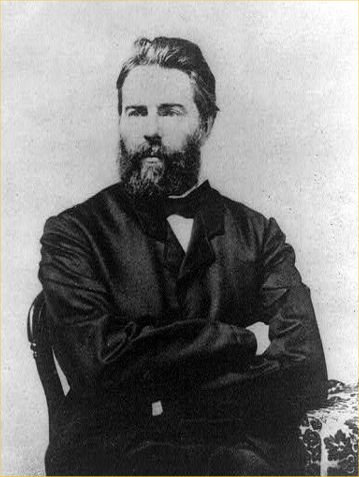
Goodness gracious, the dithering I've done since I wrote here that I'd only be reading Herman Melville in November. Melville's an author (like Nabokov and Dickens) I'm always sort of in the midst of reading -- which is why I initially thought he'd be a good choice. My affection for him felt big enough, burgeoning enough, that it could last out a month of one-on-one fidelity. Also, the writing itself is so varied, with so many moods and voices, that it wouldn't be such a narrow diet. But no sooner had I stated publicly, "It's Herman, nothing but Herman," then I began to feel hollow the way you do when you're telling a lie and panicked that I'd chosen wrong. I padded into the library, got one of his Library of America books off the shelf and opened it to a random page. It fell open to this passage from White-Jacket:

"The Sultan, Indiaman, from New York, and bound to Callao and Canton, sixty days out, all well. What frigate's that?"

"The United States ship Neversink, homeward bound."

"Hurrah! Hurrah! Hurrah!" yelled our enthusiastic countryman, transported with patriotism.

By this time the Sultan had swept past, but the Lieutenant of the Watch could not withhold a parting admonition.

"D'ye hear? You'd better take in some of your flying-kites there. Look out for Cape Horn!"


Christ, I thought, I'll never make it. By Wednesday night I had decided on Nabokov instead, with a focus on the Russian novels (i.e., Invitation to a Beheading, The Gift, Laughter in the Dark, etc.). This would make a neat segue to reading Pushkin and Gogol in December (a Russian Soul odyssey), as well as allow for a day trip to The Original of Laura. Then yesterday it was Eudora Welty -- a writer I've never read but always meant to. And so on ... (The terrible thing: As tiresome as this recital is, it actually represents a radical condensation of interior vacillation.)

I'm now calmed down and it's back to Melville (Herman, nothing but Herman). The proposed syllabus: Typee (first time); Redburn (partly read, loved, yet inexplicably abandoned halfway); Moby-Dick (a reread); and, time allowing, The Confidence-Man (first time), which makes an arc from the start of his writing to the near-end.

Two things that brought me back to Melville. First, this famous note from Hawthorne's journals about a visit the two had in England*:

... on the intervening day, we took a pretty long walk together, and sat down in a hollow among the sand hills ... and smoked a cigar. Melville, as he always does, began to reason of Providence and futurity, and of everything that lies beyond human ken, and informed me that he had "pretty much made up his mind to be annihilated;" but still he does not seem to rest in that anticipation; and, I think, will never rest until he gets hold of a definite belief. It is strange how he persists--and had persisted ever since I knew him, and probably long before-in wandering to and fro over these deserts, as dismal and monotonous as the sand hills amid which we were sitting. He can neither believe, nor be comfortable in his unbelief; and he is too honest and courageous not to try to do one or the other. If he were a religious man, he would be one of the most truly religious and reverential; he has a very high and noble nature, and better worth of immortality than most of us.

(Excerpt taken from Elizabeth Hardwick's marvelous Penguin Life study.)

The second, if you can bear it, has to do with the opening of his story "The Paradise of Bachelors and the Tartarus of Maids," which, as I've recalled it and let it play in my head, has gradually overridden the panic engendered by the White-Jacket passage. Here is how it starts:

It lies not far from Temple-Bar.

Going to it, by the usual way, is like stealing from a heated plain into some cool, deep glen, shady among harboring hills.

Sick with the din and soiled with the mud of Fleet Street -- where the Benedick tradesmen are hurrying by, with ledger-lines ruled along their brows, thinking upon rise of bread and fall of babies -- you adroitly turn a mystic corner -- not a street -- glide down a dim, monastic way flanked by dark, sedate, and solemn piles, and still wending on, give the whole care-worn world the slip, and, disentangled, stand beneath the quiet cloisters of the Paradise of Bachelors.

Sweet are the oases in Sahara; charming the isle-groves of August prairies; delectable pure faith amidst a thousand perfidies: but sweeter, still more charming, most delectable, the dreamy Paradise of Bachelors, found in the stony heart of stunning London.

In mild meditation pace the cloisters; take your pleasure, sip your leisure, in the garden waterward; go linger in the ancient library, go worship in the sculptured chapel: but little have you seen, just nothing do you know, not the sweet kernel have you tasted, till you dine among the banded Bachelors ...

Read the rest here.

* Hawthorne's journal also notes that Melville " ... arrived in Southport with the least little bit of a bundle, which, he told me, contained a night shirt and a tooth-brush. He is a person of very gentlemanly instincts in every respect, save that he is a little heterodox in the matter of clean linen."

Posted October 30, 1:35 PM

TT: It's funny, but is it art?

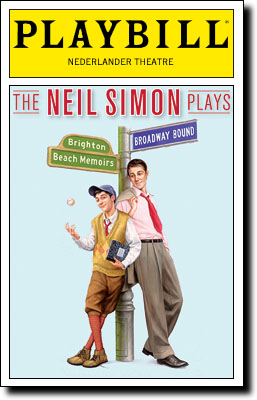
This was a good week on Broadway. David Cromer's production of Neil Simon's Brighton Beach Memoirs and the new revival of Finian's Rainbow, both of which I review in this morning's Wall Street Journal, are exceptionally fine and persuasive mountings of deeply flawed shows. Here's an excerpt.

* * *

neilsimoncover.jpgThe trouble with "Brighton Beach Memoirs," in which Eugene Jerome (Noah Robbins), the author's fictional mouthpiece, tells us how it felt to be a teenager in Brooklyn on the eve of World War II, is that it's a slice of life with too much frosting on top. As always with Mr. Simon, the characters all talk like stand-up comics, frothing at the mouth with one-liners ("Her windows are so filthy, I thought she had black curtains hanging inside") instead of letting laughter arise naturally from the situations in which they find themselves. Mr. Simon abruptly turns off the wisecrack tap in the second act, thereby signaling that he's Getting Serious. For 20 minutes or so the squabbling members of the Jerome family lob grenades of pent-up rage and frustration at one another. Then they kiss, make up and send everybody home happy, save for those suckers who were briefly fooled into thinking that Mr. Simon's bait-and-switch act is something other than a sentimental portrayal of the splendors and miseries of Jewish family life circa 1937.

What Mr. Cromer has done to "Brighton Beach Memoirs" is stage it for truth, not laughs, as if it were a play by Alan Ayckbourn--or Chekhov. Except for Mr. Robbins, whose squirmingly self-conscious speeches to the audience give him little choice but to be charming, nobody overeggs the pudding, nor is anyone too pretty or too cute. Dennis Boutsikaris and Laurie Metcalf, who play Eugene's parents, carry themselves not like sitcom characters but human beings...

I'm not going to try to tell you that all this effort has turned "Brighton Beach Memoirs" into a theatrical masterpiece. It's still a commercial comedy into which a freshening dollop of vinegar has been stirred. But by steering clear of coarse trickery, David Cromer has made the Jerome family seem immeasurably more real without diminishing the play's still-considerable entertainment value....

I don't think I've ever seen a more musically satisfying Broadway show than "Finian's Rainbow." Not only is the Yip Harburg-Burton Lane score a string of flawlessly cut gems, but everyone involved with the production takes the songs seriously, performing them with love and sensitivity....

Unfortunately, there comes a time in "Finian's Rainbow" when the actors stop singing and start talking, at which point it becomes excruciatingly clear that the book, by Harburg and Fred Saidy, is a heavy-handed mishmash of Irish whimsy-whamsy and smug sanctimony....

Go for the music. It's worth it.

* * *

Read the whole thing here.

Posted October 30, 12:00 AM

TT: Forty years of Civilisation

Kenneth Clark's Civilisation: A Personal View, a thirteen-part TV series about Western art and culture, first aired on the BBC in 1969 and on PBS a year later. The series was hugely popular in both countries. Today, however, it's mostly forgotten save by specialists in TV history. A couple of weeks ago the National Gallery in Washington, D.C., hosted a panel discussion of Civilisation and its significance, but to date PBS has shown no interest in commemorating its fortieth anniversary.

In this week's "Sightings" column for The Wall Street Journal I reflect on why Civilisation is no longer well remembered--and explain why many present-day intellectuals hold it in contempt. Pick up a copy of Saturday's Journal and see what I have to say.

UPDATE: Read the whole thing here.

* * *

The opening sequence of "The Skin of Our Teeth," the first episode of Civilisation:

Posted October 30, 12:00 AM

TT: Almanac

"If it wasn't for graft, you'd get a very low type of people in politics! Men without ambition! Jellyfish!"

Preston Sturges, screenplay for The Great McGinty

Posted October 30, 12:00 AM

October 29, 2009

TT: So you want to see a show?

Here's my list of recommended Broadway, off-Broadway, and out-of-town shows, updated weekly. In all cases, I gave these shows favorable reviews (if sometimes qualifiedly so) in The Wall Street Journal when they opened. For more information, click on the title.

Warning: Broadway shows marked with an asterisk were sold out, or nearly so, last week.

BROADWAY:
Alfred Hitchcock's The 39 Steps (comedy, G, suitable for bright children, closes Jan. 10, reviewed here)
God of Carnage * (serious comedy, PG-13, adult subject matter, closes Jan. 3, reviewed here)
Oleanna (drama, PG-13/R, adult subject matter, violence, reviewed here)
South Pacific * (musical, G/PG-13, some sexual content, brilliantly staged but unsuitable for viewers acutely allergic to preachiness, reviewed here)
A Steady Rain * (drama, R, totally unsuitable for children, closes Dec. 6, reviewed here)
Superior Donuts (dark comedy, PG-13, violence, reviewed here)

OFF BROADWAY:
Avenue Q (musical, R, adult subject matter and one show-stopping scene of puppet-on-puppet sex, reviewed here)
The Emperor Jones (drama, PG-13, contains racially sensitive language, extended through Dec. 6, reviewed here)
The Fantasticks (musical, G, suitable for children capable of enjoying a love story, reviewed here)
Our Town (drama, G, suitable for mature children, reviewed here)

CLOSING FRIDAY IN STRATFORD, ONTARIO:
The Importance of Being Earnest (comedy, G, reviewed here)

CLOSING SUNDAY IN ASHLAND, OREGON:
The Music Man (musical, G, very child-friendly, reviewed here)

Posted October 29, 12:00 AM

TT: Almanac

"Encounters with the real, in particular what we really feel, are something we generally try to avoid. Art mediates the encounter, allowing us to get nearer to our longing and our loss, to risk more, to dare more."

Jeanette Winterson, "In Praise of the Crack-Up" (Wall Street Journal, Oct. 17, 2009)

Posted October 29, 12:00 AM

October 28, 2009

CAAF: The new rules of engagement

This weekend I realized how much my reading habits have come to resemble my Internet-surfing. I skip from book to book, dipping in, skimming and grazing, as if each book were an article I was reading online. If the book isn't amazing, I rarely get past the first quarter -- let alone finish it. Of course, at least once in a while, I'm abandoning the book out of shrewish old age. I have less patience for terrible books than I used to. But most of the time, I have to admit, it's not the books that are bad, it's me: I've become a terrible reader.

The first, most obvious reason: Online reading has trained my eyes to be more peripatetic on the page. The favored online writing style is zippy and fast - you get the takeway even as your attention is skittering away, onto the next link. The other night as I was reading, I noticed my eyes were shifting up and down the page, instead of left to right, a sign that I read more on a monitor most days than on a page, but also a symptom that I was out of condition for any sort of complicated sentence: "Where's your kicker, Henry James? Your bullets? Your boldfaced exclamations?" And my brain was roving around just as much as my gaze was: mentally rummaging in the kitchen cupboards (chips?), wondering if I had any new email (probably not), and brooding on my petty jealousies and everyday activities (endless).

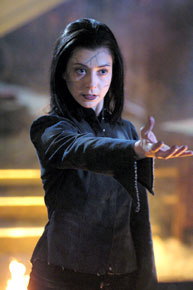
The above has been well recorded in many places. With the next, I wonder if it's strictly personal, or if others of you have noticed this about yourselves too. It's the observation that the Internet for all its virtues -- and let me interject here and say that I love the Internet, some of my best friends are the Internet, etc. -- has given me an overly inflated sense of my own ability to learn and appreciate new things. I've always liked to read several books at once (do you want to read a book about volcanoes tonight, or a novel? Who knows? Better have them both with you!), EvilWillow.jpgbut this weekend I counted and I had some twenty books in different stages of being read around the house, ones I felt I couldn't bear to return to the library or put back on their proper shelves because "I'm reading it." I've fallen into the habit of bringing a stack of three to four into bed with me at night -- picking them up from around the house as I turn off lights like a grocery shopper ambling through the produce section picking whatever pretty fruit strikes the fancy. On the one hand, thus has it always been -- people who like books will have books in their bed, will have far more books on their reading list than they will ever finish, etc. On the other, I think when you casually read a couple hundred little news items, interesting posts and articles online in day, it get frightfully easy to carry a glib sense of engagement away with you from the computer -- to want to click along to the next book whenever you're bored. And on some deeper level, I wonder if the Internet with its ready and immediate access to anything I want to know, has given me a false sense that I'm capable of knowing it, i.e., that I can suck in all that knowledge like Evil Willow draining books at the magic shop. Even as my reading habits have gotten sloppier, have I come to think I'm someone who's capable of reading three or four books before bed? That I'll wake up and suddenly be the man who knew everything? Put another way: If the Internet is infinite, has it made me forget that I'm finite?
herman.jpgAgain, none of these are new habits of mind, but they feel exaggerated by my Internet use. So it's with sorrow but determination that I announce I'm signing off of it forever. Ha ha, just kidding! But what I am doing is orchestrating a new reading regime, a sort of course correction, to make myself a better reader offline. I've used this system in the past when I felt like my Gemini brain had gotten disorderly, and it's worked well. It's to read one author and one author only for a month. No leaping around within the oeuvre, either. It's one book at a time. Front to back. After a lot of thought and vacillation, I've decided November is Herman Melville month. Nothing but Herman until December.* So good-bye, Orlando, Lolly Willowes, Daniel Deronda, and Oryx and Crake; goodbye, Werner Herzog in Brazil and fascinating academic book about Russian Byronism; goodbye, Rebecca Solnit and Randall Jarrell; good-bye, promising if potentially infuriating book** about Charlotte and Emily Bronte's Belgian school essays; good-bye I Lost It At The Movies; and even you, Nabby, good-bye. You're all wonderful, but I will see you later.

* Allowable exceptions: My bookclub book for this month, Barbara Ehrenreich's Bright-Sided; the rest of Sarah Hrdy's Mother Nature (I'm almost through!); and any research books for the novel. But with the latter the same one at a time rule applies.

** Complete non sequitur but: I've noticed this trend among Bronte scholars to be snide about Charlotte, as if in order to properly appreciate Emily (or even Anne or Branwell) it were somehow necessary to knock Charlotte down several pegs. Juliet Barker, author of an otherwise excellent biography, I'm looking at you. And Elizabeth Hardwick, you too (except I love you so I'm not looking that hard). This makes me furious. Some day, I tell you ... well, I'll storm into a Bronte Society Meeting and create quite a scene.

UPDATE: Oh, the Internet. No sooner did I prepare this post then I saw The Elegant Variation has started a discussion on this same topic, using this essay by David Ulin as a jumping-off point.

Posted October 28, 12:01 AM

TT: Snapshot

Duke Ellington plays Billy Strayhorn's "Isfahan" in 1965, with Johnny Hodges on alto saxophone:

(This is the latest in a weekly series of arts-related videos that appear in this space each Wednesday.)

Posted October 28, 12:00 AM

TT: Almanac

"I can't think of anything more exciting than going to bed with a half-finished paragraph."

Eric Hoffer, in conversation with Eric Sevareid (The Passionate State of Mind: Eric Hoffer, CBS, Sept. 19, 1967)

Posted October 28, 12:00 AM

October 27, 2009

TT: It's here

The first finished copy of Pops: A Life of Louis Armstrong arrived in today's mail.

I'm going to have a hard time getting anything done today.

* * *

To celebrate the great day, here's Satchmo and the All Stars in 1959:


Posted October 27, 12:05 PM

CAAF: Bright pretty young things

Ever since I saw Bright Star, I've been wanting to go back and see it again. It's a gorgeous and tough-minded film; I've seen it praised in a couple places for its "restraint" and while that feels like an appropriate description, it might, used in the context of a movie about John Keat's love affair with Fanny Brawne, leave a reader with the impression that Bright Star is a soft or quiet film, which it most definitely isn't. I think the restraint being praised is actually rigor; as if Campion had a bolt of silk and shot it through every yard or so with whalebone. Yes, it's beautiful, but it also stands up straight.

For a more extensive critique, I direct you to Dana Steven's review. For now I just want to ooh and aah over Janet Patterson's costumes for the film, especially the ones worn by Fanny Brawne (played by Abbie Cornish). At the beginning of the movie we learn that Brawne makes her own clothes, and throughout the film her sewing is shown as her creative outlet, an expression of being on the level of a poem or a painting. Knowing this before the film, I thought this aspect of the Fanny character might feel overly intrusive and "herstory"-ish -- one of those instances where a historic figure is given modern habits and attitudes just so the audience can commend her (and along the way, itself) for being so enlightened (e.g., The Duchess) -- but within the universe of Bright Star, Fanny's dressmaking seems like a true and inspired thing. Her dresses aren't just garments then, they're expressions of self, crucial bits of character development -- and Patterson does an amazing job with them, making them a little ludicrous and over-the-top for the occasions on which they're worn, but also completely beguiling and graphically sophisticated. Fanny may not always be dressed appropriately, but she has a marvelous eye for beauty.

I've been searching for stills from the film but can't find many that do justice to the costumes. A couple, though:
costume5.jpg
A party dress worn early in the film. As Brawne tells Keats when she sees him at the party, "This is the first frock in all of Hampstead to have a triple-pleated mushroom collar." Just out of frame: Her lilac gloves.

costume1.jpg
This costume, a striped jacket worn to a picnic on the day they first kiss, was one of my favorites. The strawberry color is so sharp and joyful.
costume3.jpg
Patterson also served as the film's production designer, and, as shown in this still, there's a lovely interplay between the costumes and their settings.

There's more about the film's scene-setting and costuming in the little clip below. After watching it, I desperately want to run off and go to work as some sort of Campion-Patterson apprentice/lackey/fabric finder.

* I'm already anticipating how much I'm going to be rooting for Patterson to win an Oscar for them.

Posted October 27, 12:05 AM

TT: Suspended animation

catnap.jpgToo much stuff to do, too many shows to see, not enough time to blog. I'm going to take the rest of the week off (except for the daily almanac entries, the weekly video, and the usual theater-related postings) and leave you in the hands of CAAF and Our Girl.

I am, however, working on an update of the right-hand column. Over the weekend I pruned a couple of dozen blogs that are no longer active out of "Sites to See," and I also added several new blogs that are worthy of your attention (some of which are by previously quiescent bloggers who have kickstarted themselves). All of the latter are marked with an asterisk. I plan to continue sprucing up the blogroll, and I'll also be posting new Top Five, "Out of the Past," and "TT Elsewhere" picks, so keep your right eye peeled.

I wish I could take a nap now, but deadlines beckon, so instead I'll imagine what it might feel like to do so. In the meantime, see you later.

Posted October 27, 12:00 AM

TT: Almanac

"I have found from experience that nothing annoys an angry critic more than to take no notice of his attack on you."

Spike Hughes, Second Movement

Posted October 27, 12:00 AM

October 26, 2009

OGIC: The ghosts have it

The terrific star of Chicago Shakespeare's new Richard III, Wallace Acton, took a little getting used to in the role for me. He plays it with a pinched, mannered quality that goes against the tide of recent performances I've seen in which our hunchbacked schemer boasts a measure of treacherous sex appeal, gimping around with a certain swagger. Not this Richard (though his movement is remarkable, especially a tortured, twisting jump onto a table). Acton and director Barbara Gaines play Richard's repellency straight and pure--it's mitigated only by his silver tongue, and the effect is to magnify the power and charms of that language and rhetoric.

Their commitment to an unappealing Richard has dramatic payoffs too. When Anne is seduced and Elizabeth coerced by him--the "true love's kiss" he commands her to bear to her daughter in Act 4, Scene 4 is forced on Elizabeth, at length--visceral shudders at the violation ripple through the audience. When Richard appears publicly as king, a couple of bludgeon-wielding heavies silently daring the townspeople not to acclaim him, some of the playgoers comply with halting applause.

In the playbill, Gaines says it struck her, rereading the play, "how every major character has a feeling, an intuition, that they then repress." When the repressed returns, she and the scenic and special effects designers spare little in rolling out the red carpet for it. They have surprises in store that I won't ruin here, but that make the final battle as riveting as possible, with an unexpected layer of complexity. I don't know enough about the history of the play's production to say whether the ghosts of Richard's victims have ever made such an affecting and harrowing return, or whether they've played such a decisive role in how the last act unfolds. But they're unforgettable in this production, a terror and a true moral center.

Richard III runs through November 22. The cast is great and the staging is sharp, juxtaposing period costumes with the occasional appearance of selected modern objects: a steel gurney, a plastic bag, all the most menacing props. There are small details to savor for their emotional resonance, for instance the widowed Queen Margaret's entrance in a gown that's a rotting version of the same one Queen Elizabeth is wearing.

If you're in Chicago or can get here, don't miss it.

Posted October 26, 12:51 AM

TT: See (and hear) it now

You can now see four video clips from The Letter by going here. Do so.

Posted October 26, 12:01 AM

TT: Unique selling point

bw-515d.jpgWhat makes Pops: A Life of Louis Armstrong different from all previous Armstrong biographies? When talking about Pops with interviewers, I usually stress that I'm the first biographer to have had access to the 650 reel-to-reel tapes that Armstrong made during the last quarter-century of his life, many of which contain astonishingly candid recordings of his private after-hours conversations. I also try to work in the fact that I'm the first trained musician ever to have written a fully sourced biography of Armstrong.

In addition to these two things, though, there's another important point that I sometimes forget to make. I've written about it in this space, but I think it's worth repeating, both here and in the future.

To put it as simply as possible, I've sought to write a narrative biography of Louis Armstrong that is comparable in seriousness, scope, and literary quality to a "definitive" high-culture biography of a great novelist--or a great classical composer. Very few popular-music biographies have aspired to that kind of standard, but it seems obvious to me that Satchmo was a figure of comparable artistic and cultural significance, and deserves to be written about in the same way.

If anybody asks you why they should go out and buy a copy of Pops, that's what you should tell them.

Posted October 26, 12:00 AM

TT: Consumables

• What I'm reading: Robin Kelley's new biography of Thelonious Monk

filaments_light.jpg• What I'm listening to: Duke Ellington joue Billy Strayhorn, a two-CD anthology released in France in 2005

• What I'm seeing: Yvonne Jacquette: The Complete Woodcuts 1987-2009, up through November 28 at Mary Ryan Gallery

• This week's shows: David Cromer's production of Neil Simon's Brighton Beach Memoirs, the new Broadway revival of Finian's Rainbow, Lynn Redgrave's Nightingale, Theresa Rebeck's The Understudy, and Goodspeed Musicals' revival of A Funny Thing Happened on the Way to the Forum

Posted October 26, 12:00 AM

TT: Almanac

"Seldom if ever again in life will you be afforded the chance to scrutinize such an array of losers in an environment that actually encourages their most pretentious inclinations!"

Daniel Clowes, "Art School Confidential"

Posted October 26, 12:00 AM

October 24, 2009

THE MYSTERY OF MUSIC

"It won't surprise me if neuroscientists eventually succeed in unlocking the mystery of music. I don't fear that prospect, but I do have a sneaking suspicion that part of the charm of music lies in the fact that we don't know what it means, any more than we can explain the equally mysterious charm of a plotless ballet by George Balanchine or an abstract painting by Piet Mondrian..."

Posted October 24, 11:55 AM

DVD

Les Ballets Trockadero, Vol. 1 and Vol. 2 (Harmonia Mundi). Even if you don't go in for drag acts, it's hard to resist the fabulously ingenious dance comedy of Les Ballets Trockadero de Monte Carlo, an all-male troupe that performs classical ballet--complete with tutus. The smartest works in their repertory are Peter Anastos' "Yes, Virginia, Another Piano Ballet" and "Go for Barocco," in which the quirks and foibles of Jerome Robbins and George Balanchine are satirized with ruthlessly knowing precision. Both dances are available on a pair of newly reissued DVDs that also contain an assortment of "straight" classical works danced with paralyzingly funny near-sincerity. "Yes, Virginia" is on the first disc, "Go for Barocco" on the second (TT).

Posted October 24, 11:00 AM

October 23, 2009

OGIC: That bottled spider

I've just returned from seeing Barbara Gaines's haunted, haunting Richard III at Chicago Shakespeare, and will have more to say about it Monday. For now I'll just say: Go, go, go. There are four performances this weekend, and it's not to be missed. I'll elaborate on this advice next week. (The show runs through November 22.)

Posted October 23, 12:48 AM

TT: Thin ice in the tropics

I saw three shows last weekend, one fabulous and two lousy: The Emperor Jones, Memphis, and After Miss Julie. All are reviewed in today's Wall Street Journal. Here's an excerpt.

* * *

Eugene O'Neill is the most problematic of major American playwrights, not because he wasn't important--nobody doubts that--but because his plays, like Theodore Dreiser's novels, are out of step with modern taste in all sorts of awkward ways. Take "The Emperor Jones," the 1920 one-act play in which a black Pullman porter takes over an impoverished West Indies island with the help of a Cockney crook. It's one of O'Neill's most significant works, yet few companies dare to perform it nowadays, for the title role is written in yassuh-boss period dialect and the word "nigger" is flung around with alarming abandon. Not surprisingly, "The Emperor Jones" hasn't been seen on Broadway since 1927, and Off-Broadway productions are scarcely less rare. In order to get away with reviving it in 1993, the avant-garde Wooster Group cast Brutus Jones as a white woman in blackface, which wowed the cognoscenti but did less well by the play. Now the Irish Repertory Theatre, an Off-Broadway troupe that never fails to deliver the goods, is putting on an uncensored production that is smart, forceful, fiercely involving and wholly successful.

Emperor-Jones-webimage.jpgCiarán O'Reilly has paid O'Neill the compliment of staging "The Emperor Jones" with unapologetic directness, presenting Jones (John Douglas Thompson) as a charismatic dictator who in a just world might well have made better use of his gifts....

I'm not so sure that O'Neill's play still works as a poetic statement about the thin ice on which Western civilization rests, but it definitely works as a tour de force for a first-rate black actor, and Mr. Thompson is all that and then some. I first saw him on stage in Shakespeare & Company's 2008 production of "Othello," in which he spoke Shakespeare's verse with bewitching elegance. In "The Emperor Jones" he shows us another kind of giant, utterly venal yet irresistibly sympathetic....

I've seen dumber musicals than "Memphis," but not many and not by much. This noisy piece of claptrap, which has been rattling around the regional circuit for the past six years, turns the real-life story of Dewey Phillips, a Memphis disc jockey who fell in love with rhythm and blues in the '50s, into a ludicrous fantasy about a white DJ named Huey (Chad Kimball) who puts a black singer named Felicia (Montego Glover) on the radio, thereby driving the local racists crazy. Big surprise: All the black characters are noble hipsters and all the white characters (except for Huey) are redneck squares....

August Strindberg's "Miss Julie," written in 1888 and last seen on Broadway for three nights in 1962, is now being performed there again--after a fashion. In "After Miss Julie," Patrick Marber's 1995 rewrite, Strindberg's once-scandalous, still-disturbing play about an arrogant young countess (Sienna Miller) who sleeps with her father's footman (Jonny Lee Miller) is transplanted from 19th-century Sweden to England in 1945. The action unfolds on the fateful night that the Brits voted Winston Churchill out of office and opted for the promise of socialism, which tells you just about everything you need to know about "After Miss Julie," whose real subject is contemporary class warfare in England....

As for Ms. Miller, a model turned second-tier movie star, all she does is stalk around the stage striking vampy poses and looking really, really skinny....

* * *

Read the whole thing here.

To listen to an aircheck of a 1952 broadcast by Dewey Phillips, go here.

Posted October 23, 12:00 AM

TT: Almanac

"Nothing really wrong with him--only anno domini, but that's the most fatal complaint of all, in the end."

James Hilton, Goodbye, Mr. Chips

Posted October 23, 12:00 AM

October 22, 2009

TT: So you want to see a show?

Here's my list of recommended Broadway, off-Broadway, and out-of-town shows, updated weekly. In all cases, I gave these shows favorable reviews (if sometimes qualifiedly so) in The Wall Street Journal when they opened. For more information, click on the title.

Warning: Broadway shows marked with an asterisk were sold out, or nearly so, last week.

BROADWAY:
Alfred Hitchcock's The 39 Steps (comedy, G, suitable for bright children, closes Jan. 10, reviewed here)
God of Carnage * (serious comedy, PG-13, adult subject matter, closes Jan. 3, reviewed here)
Oleanna (drama, PG-13/R, adult subject matter, violence, reviewed here)
South Pacific * (musical, G/PG-13, some sexual content, brilliantly staged but unsuitable for viewers acutely allergic to preachiness, reviewed here)
A Steady Rain * (drama, R, totally unsuitable for children, closes Dec. 6, reviewed here)
Superior Donuts (dark comedy, PG-13, violence, reviewed here)

OFF BROADWAY:
Avenue Q (musical, R, adult subject matter and one show-stopping scene of puppet-on-puppet sex, reviewed here)
The Fantasticks (musical, G, suitable for children capable of enjoying a love story, reviewed here)
Our Town (drama, G, suitable for mature children, reviewed here)

CLOSING NEXT WEEK IN ASHLAND, OREGON:
The Music Man (musical, G, very child-friendly, closes Nov. 1, reviewed here)

CLOSING NEXT WEEK IN STRATFORD, ONTARIO:
The Importance of Being Earnest (comedy, G, closes Oct. 30, reviewed here)

Posted October 22, 12:00 AM

TT: Almanac

"If men were equal to-morrow and all wore the same coats, they would wear different coats the next day."

Anthony Trollope, The Way We Live Now

Posted October 22, 12:00 AM

October 21, 2009

TT: Snapshot

Mike Wallace interviews Aldous Huxley on The Mike Wallace Interview in 1958:

(This is the latest in a weekly series of arts-related videos that appear in this space each Wednesday.)

Posted October 21, 12:00 AM

TT: Almanac

"All that is required to feel that here and now is happiness is a simple, frugal heart."

Nikos Kazantzakis, Zorba the Greek

Posted October 21, 12:00 AM

October 20, 2009

TT: Very special delivery

sfletter211109.jpgI've been so preoccupied with the fast-approaching publication of Pops that I haven't had much time to think about The Letter. Today I'm thinking about it in a great big way. A few days ago I was told that Opera News had just published a hats-off review of the premiere performance. That review, by Simon Williams, is now available online:

Interest in the new opera at Santa Fe this year ran especially high. The Letter (seen Aug. 7), composed by Paul Moravec to a libretto by Terry Teachout based on W. Somerset Maugham's 1927 play, was intended to be an instantly accessible work with wide popular appeal. It may be just that. For a start, the opera is an improvement on the play, which is verbose, faultily structured and moralistic; instead, Teachout's terse libretto recaptures the stringent economy of the much finer story, also by Maugham, upon which the play is based....

Moravec's score is richly orchestrated and, like much of modern opera, functions like music for the movies; it amplifies emotions, emphasizes confrontation and crisis and drives the action forward. But it also creates a dramatic world in which singing seems to be the only appropriate medium. The thematic and structural unity of the music is not readily apparent at first hearing, but as a dramatic language it is often thrilling. Reminiscences of love are heard through the lush harmonies of nineteenth-century opera. Legal negotiations are harsh and staccato, with voices and orchestra disconnected. A brilliant satire of the gossipy, racist culture of British colonialism is built on jazz rhythms of the 1920s, and Leslie's suicide, accompanied by brutal chords, is a mighty impressive finale. Teachout's libretto allows the music space to explore the layers of the drama and leaves time for atmospheric interludes bordering on the eerie between the nine scenes of the action.

It would have been difficult to muster a stronger cast for the premiere. Patricia Racette had to represent a more conflicted and contradictory character than the central figure in either Maugham's story or play, and there was a danger that the coexistence of passion and coldheartedness could strain credibility. But Racette's consistently powerful singing and flamboyant command of melodrama--at times she seemed a dead ringer for Joan Crawford--carried the day. James Maddalena, as the lawyer, Howard Joyce, who is drawn into corruption by loyalty to his friends, gave a psychologically subtle portrayal of moral ambivalence and, in a soliloquy recalling Captain Vere's final solo in Billy Budd, raised the dilemma that Joyce finds himself in to the level of tragedy. The robust baritone of Anthony Michaels-Moore might have been too strong for the broken figure of Robert Crosbie, the betrayed husband, but he represented moral weakness, emotional dependence and alcoholic indulgence with such devastating detail that Crosbie seemed symbolic of the corruption at the heart of the entire colonial enterprise....

Will The Letter find its way into the repertoire? The warm response of the Santa Fe audience suggests the work may have legs...

We sure hope so.

* * *

Read the whole thing here.

Posted October 20, 11:26 AM

TT: Almanac

"Autobiography is only to be trusted when it reveals something disgraceful."

George Orwell, "Notes on Dali"

Posted October 20, 12:00 AM

October 19, 2009

TT: Promises, promises

I'm more than a little bit distracted this week, so in lieu of writing anything fresh today, I thought I'd post a piece of mine that you might not have seen when it came out in 2006. It's a review of American Movie Critics: An Anthology from the Silents until Now, an anthology edited by Phillip Lopate that was published by the Library of America. I hope you like it.

* * *

Film was the master medium of the twentieth century. Within a few years of its invention, it had supplanted live theater and the novel as the main way in which most people experienced the art of storytelling, and it retains its cultural dominance to this day (though only if you count TV as a species of filmmaking, which you should). It follows, then, that film criticism should by definition be worth reading. Right? Er, well, sometimes. Most of it is in fact flaming hogwash, though Phillip Lopate has held the nonsense to a minimum in his new collection of American film criticism. It isn't perfect--no anthology is--but American Movie Critics will likely become the standard collection of its kind, for the most part rightly so.

The Hippocratic Oath of anthologists starts off as follows: First, don't be dull. Lopate has steered clear of mere dutifulness, one or two puzzling duds notwithstanding, and he's struck a nice balance between such obligatory-but-deserving inclusions as Manny Farber's "Underground Film" and Robert Warshow's "The Gangster as Tragic Hero" and the out-of-left-field nuggets that lend savor to any anthology worth reading. Who knew that Cecilia Ager, who reviewed movies for Variety and PM in the Thirties and Forties, was so wickedly clever? Or that Vincent Canby's never-before-collected New York Times reviews would hold up so well? As for his decision to include the entries on Cary Grant and Howard Hawks from David Thomson's indispensable New Biographical Dictionary of Film, my only regret is that he didn't throw in Humphrey Bogart while he was at it.

Of course I would have done it all differently, and certain of Lopate's oversights are real disappointments. I was surprised, for instance, to find nothing by Anthony Lane or Joe Morgenstern, and positively staggered by the absence of Charles Thomas Samuels, whose Mastering the Film remains one of the most penetrating books on film to be produced by an American critic. Nor am I quite satisfied with his selections from the Thirties and Forties, which too often run to the obvious. (Had Lopate spent a couple of hours trolling through the eight DVD-ROMs that make up The Complete New Yorker, for instance, he would have discovered that Harold Ross was publishing smart film criticism long before Pauline Kael.) In addition, American Movie Critics contains no index, nor are the essays it reprints accompanied by their original dates of publication, though many--but not all--can be found in the back-of-the-book permissions section. These vexing omissions greatly diminish the usefulness of American Movie Critics to the general reader.

chinatown.jpgBe that as it may, this is Phillip Lopate's book, not mine or anybody else's, and it's mostly a fine one. Even where I take issue with his priorities, I have no trouble appreciating them, which is all you can ask of an anthologist (except for an index). John Simon, for instance, surely deserves to have been represented by more than two pieces, but had I been the editor of American Movie Critics, I would have made sure to include, as Lopate does, his reviews of The Last Picture Show and Chinatown:

The final question is whether a mystery film, however concerned with moral climate and psychological overtones, can transcend its genre....These people are much more vulnerable than their genre antecedents, which is what ultimately makes for Chinatown's originality and distinction. Still, the hold of the genre is so strong that, even with sensational plot twists kept at a minimum, there simply isn't room enough for full character development--for the richer humanity required by art.

This acute observation might well serve as an epigraph for American Movie Critics. Likewise this one: "I should like to inquire why we as the nation that produces the movies should never have developed any sound school of movie criticism." Otis Ferguson, the first working film critic to achieve high distinction, wrote those words sixty-five years ago, and Lopate cites them in his excellent introduction, asserting in reply that "we have developed a sound school of American movie criticism--thanks to Ferguson himself, James Agee, Robert Warshow, Manny Farber, Parker Tyler, Andrew Sarris, Pauline Kael, and those who have followed in their wake."

Readable as American Movie Critics is, I'm not so sure I agree. It strikes me as hugely revealing that the early years of American film criticism failed to produce a George Orwell, by which I mean an essayist of the first rank who left behind a significant body of work in which film is considered not in isolation but as part of the larger world of art and culture. Ferguson and Warshow might well have filled the bill had they lived long enough, but both men died too soon to fully prove themselves, and no one like them has come along in subsequent years (except for John Simon, who is far more specifically aesthetic in his wide-ranging interests than the sort of critic I have in mind). At their best, Agee, Farber, and Kael wrote wonderfully about film, but do any of their reviews, or those of the other critics included in American Movie Critics, really stand up to direct comparison with an essay like Orwell's "Raffles and Miss Blandish" or "Inside the Whale"?

I can't help but wonder whether the problem might be that film is incapable of inspiring such writing. Not the medium itself: A movie like Jean Renoir's The Rules of the Game or Kenneth Lonergan's You Can Count on Me is as worthy of close critical scrutiny as any great novel or play. But how often do film critics get to write about such works of cinematic art? Commercial movies cost too much to be produced by anyone other than businessmen, and the independently made low-budget films of the past decade, fine though the best of them are, have yet to transform the American film industry in the way I (and many other critics) once hoped. I spent the past seven years turning out monthly film reviews, in the course of which I saw and wrote about such superb independent and quasi-independent films as Election, Ghost World, The Last Days of Disco, Lost in Translation, Me and You and Everyone We Know, Next Stop Wonderland, Panic, The Station Agent, and Sunshine State. Yet by the end of my run I was more than ready to quit, and since I did so I've seen exactly three new movies, only two of which I liked.

Maybe it's just me, but I suspect that the ease with which I set aside my professional passion for film is more than just a quirk. I find it no less revealing, for instance, that Lopate cites with seeming approval David Denby's reference to "that tone of fond exasperation which we recognize as the sound of a movie critic." Can you imagine any truly serious critic making so chummy, even condescending a remark about opera or painting? It speaks volumes about the inescapable limitations of genre-bound commercial films as works of art and objects of criticism. For once, it seems, Shakespeare was wrong: when it comes to the movies, the fault is not in ourselves, but in our stars.

Posted October 19, 12:00 AM

TT: Almanac

"Just as despair can come to one only from other human beings, hope, too, can be given to one only by other human beings."

Elie Wiesel, Nobel lecture, Dec. 11, 1986

Posted October 19, 12:00 AM

October 16, 2009

TRUTH WITHOUT BULLETS

"The more I read in the literature of the Good War, the more certain I am that it is in memoirs like Donald R. Burgett's Currahee! and E.B. Sledge's With the Old Breed and the dispatches of such journalists as A.J. Liebling and Ernie Pyle that the very best American wartime writing is to be found--with a single exception. Of the countless novels of World War II written by American vets, the only one to which I return regularly is James Gould Cozzens's Guard of Honor..."

Posted October 16, 3:34 PM

WHAT GRANDMA READ

"The parlors of small-town America are full of novels that made their way onto the bestseller lists once upon a time. Some were dismissed as commercial trash by the critics of their day, but others were taken seriously and written about earnestly. Many were Books of the Month, and a few won Pulitzer Prizes. Now they gather dust in the unused front rooms of homes whose owners have moved the TV to a friendlier part of the house..."

Posted October 16, 3:33 PM

THE OTHER O'CONNOR

"The O'Connor everyone remembers is Flannery, who wrote herself into the history of American literature by looking at the poor white Protestants of her native Georgia through the X-ray glasses of Roman Catholic dogma. But there was another Catholic novelist named O'Connor at work in the Fifties and Sixties, and for a time he was both better known and vastly more popular..."

Posted October 16, 3:33 PM

TT: They can't sing (don't ask them)

Broadway and off-Broadway are roaring to life as the 2009-10 season gets underway. In this week's Wall Street Journal drama column I review three newly opened shows, Bye Bye Birdie, Oleanna, and Let Me Down Easy. Here's an excerpt.

* * *

If you're looking for light entertainment, you can't get much lighter than "Bye Bye Birdie," a flyweight farce about the coming of rock and roll to small-town America....

Vast amounts of money and energy have been poured into this production, for the most part to winning effect. Robert Longbottom's brisk staging and clever choreography flow together seamlessly. The quick-change space-age sets, designed by Andrew Jackness, look as though they'd been swiped from the warehouse of a late-'60s TV variety show. Jonathan Tunick's new orchestrations evoke Nelson Riddle and Count Basie with smoothly swinging exactitude. The costumes are colorful, the chorus fabulous, the pit band hip.

So what's the catch? Just this: Only one of the stars can sing....

Not to put too fine a point on it, the Roundabout's revival of "Bye Bye Birdie" is the worst-sung musical I've ever seen on Broadway. If that prospect doesn't faze you, or if you're tone-deaf, then go with my blessing...

Pullman%20and%20Stiles%20in%20Oleanna.jpgThe Los Angeles revival of David Mamet's "Oleanna" that I praised in this space in July has now transferred to Broadway. The big difference is that it's being acted on a proscenium stage in New York, which diminishes the fist-in-the-face impact that Doug Hughes' production had when I saw it on the thrust stage of the Mark Taper Forum. I think this may explain why the play seems to get off to a slower start: Bill Pullman has to work harder to fill the space of the John Golden Theatre, and in the first scene it feels as though the play is catching up with his twitchy, hyperactive performance as a college professor charged with sexual harassment. Once Mr. Pullman and the script get into sync, though, "Oleanna" flies to the finish line, and Julia Stiles is terrific throughout...

Anna Deavere Smith's new one-woman show bills itself as being about health care, but the truth is that "Let Me Down Easy" is mostly about the grimmer subject of death and dying. Not only are the results depressing in the extreme, but Ms. Smith's latest exercise in theatrical journalism, in which she delivers monologues based on interviews with a dozen real-life characters, is stronger on the journalism than the theater. Her flat-textured "impersonations" of such familiar figures as Lance Armstrong and Lauren Hutton run to caricature...

* * *

Read the whole thing here.

Posted October 16, 12:00 AM

TT: It don't mean a thing

Scientists are forever proving what everybody knows, especially when it comes to music. It's been demonstrated, for instance, that music has the power to influence our perception of human emotions--but how does that process work? Might it possibly be related to the endlessly intriguing question of what, if anything, music means? That's the subject of my latest "Sightings" column in Saturday's Wall Street Journal.

Could it be that the emotional power of music has something to do with the fact that we don't know what it means? To find out, pick up a copy of tomorrow's Journal and see what I have to say.

UPDATE: Read the whole thing here.

Posted October 16, 12:00 AM

TT: Almanac

"The week in the hospital was a long and exquisitely serialized course of suspense. Nothing in the X ray, nothing in the blood tests, nothing in the other examinations. There remained a report on a throat culture that had had to be sent to the state laboratory. That turned up some streptococcus infection.

"'So that's it,' Dr. Cameron said, greeting me at the elevator. 'Her temperature's been normal now for two days, so it's probably let up. She's just walked in the hall without any pains. She feels a lot better. Give it another day and you can take her home. But anyhow, we've eliminated everything serious.'

"That was the happiest moment of my life. Or the next several days were the happiest days of my life. The fairy would not become a gnome. We could break bread in peace again, my child and I. The greatest experience open to man is the recovery of the commonplace. Coffee in the morning and whiskeys in the evening again without fear. Books to read without that shadow falling across the page. Carol curled up with one in her chair and I in mine. And the bliss of finishing off an evening with a game of rummy and a mug of cocoa together. And how good again to sail into Tony's midtown bar, with its sparkling glasses, hitherto scarcely noticed, ready to tilt us into evening, the clean knives standing upended in their crocks of cheese at the immaculate stroke of five. My keyed-up senses got everything: the echo of wood smoke in Cheddar, of the seahorse in the human spine (the fairy would not be a gnome!), of the dogwood flower in the blades of an electric fan, or vice versa...But you can multiply for yourself the list of pleasures to be extorted from Simple Things when the world has once again been restored to you."

Peter De Vries, The Blood of the Lamb

Posted October 16, 12:00 AM

October 15, 2009

TT: So you want to see a show?

Here's my list of recommended Broadway, off-Broadway, and out-of-town shows, updated weekly. In all cases, I gave these shows favorable reviews (if sometimes qualifiedly so) in The Wall Street Journal when they opened. For more information, click on the title.

Warning: Broadway shows marked with an asterisk were sold out, or nearly so, last week.

BROADWAY:
Alfred Hitchcock's The 39 Steps (comedy, G, suitable for bright children, closes Jan. 10, reviewed here)
God of Carnage * (serious comedy, PG-13, adult subject matter, closes Jan. 3, reviewed here)
South Pacific * (musical, G/PG-13, some sexual content, brilliantly staged but unsuitable for viewers acutely allergic to preachiness, reviewed here)
A Steady Rain * (drama, R, totally unsuitable for children, closes Dec. 6, reviewed here)
Superior Donuts (dark comedy, PG-13, violence, reviewed here)

OFF BROADWAY:
The Fantasticks (musical, G, suitable for children capable of enjoying a love story, reviewed here)
Our Town (drama, G, suitable for mature children, reviewed here)

CLOSING SOON IN ASHLAND, OREGON:
The Music Man (musical, G, very child-friendly, closes Nov. 1, reviewed here)

CLOSING SOON IN STRATFORD, ONTARIO:
The Importance of Being Earnest (comedy, G, closes Oct. 30, reviewed here)

CLOSING SUNDAY IN CHICAGO:
The History Boys (drama, PG-13/R, adult subject matter, too intellectually complex for most adolescents, reviewed here)

CLOSING SUNDAY IN SPRING GREEN, WIS:
Long Day's Journey into Night (drama, PG-13, adult subject matter, too long and demanding for some adolescents, reviewed here)

Posted October 15, 12:00 AM

TT: Almanac

"The only person who can afford to be a purist is a professional artist; most purists are neither professionals nor artists."

Spike Hughes, Second Movement

Posted October 15, 12:00 AM

October 14, 2009

TT: A question of taste

a0005177-1.jpgMuch has been written in recent days, most of it silly and some of it ignorant, about the modern art that Barack and Michelle Obama have borrowed to display in the White House. Among the more conspicuously vulgar of the pieces published so far was an essay by Blake Gopnik, the Washington Post's art critic, in which, among other things, he commented on the loan by the National Gallery of Art of two important still lifes by the great Italian modernist Giorgio Morandi:

Then there are Morandi's mild-mannered paintings of bottles and jars. Those shouldn't raise an eyebrow...unless a viewer cares that they were painted by a once-proud fascist who'd sucked up to Benito Mussolini. It's not far-fetched to see something fiercely reactionary in Morandi's work. Even the fiercest Blue Dogs might wince.

Anyone seriously interested in learning about Morandi's involvement with Italian fascism can read all about it in this excellent book. Anyone who believes that it matters in the present context--or who is capable of using the phrases "mild-mannered" and "fiercely reactionary" to describe Morandi's visionary, intensely concentrated art--is a philistine.

That said, I'll give Gopnik this much: at least he acknowledges that the Obamas' choice of art almost certainly reflects non-aesthetic priorities to some unknown and unknowable extent. While it would please me to know that the Obamas genuinely like modern art, long experience has taught me that no public act by a politician, least of all one that bears on artistic matters, can ever be taken at face value. Rarely do successful pols permit their personal tastes (assuming that they have any) to interfere with opportunities to show solidarity with their supporters.

Meg Greenfield put it best in Washington:

A walking, talking person-shaped but otherwise not very human amalgam of "positions," that familiar, tirelessly striving figure interviewed on the evening news who resoundingly tells you what he is thinking--and you keep wondering whether you should believe a word of it. These are people who don't seem to live in the world so much as to inhabit some point on graph paper, whose coordinates are (sideways) the political spectrum and (up and down) the latest overnight poll figures.

a0005178-1.jpgOn the other hand, I fail to see how the hanging of two still lifes by Giorgio Morandi is likely to appeal to any identifiable group of voters. Morandi, after all, is by no means a popular master, even among the most passionate admirers of European modernism. It's no accident that neither of the paintings borrowed by the Obamas was on view at the National Gallery of Art, nor have I seen either one hanging there at any time in the past. I'd like to think that the choice of these two canvases reflects nothing more than the discerning eye of the person or persons who picked them.

Alas, it appears that President Obama appears to have had little or no input in this matter. According to the New York Times:

In the weeks before the inauguration, Michael Smith, the Obamas' decorator, paid a visit to Harry Cooper, curator of modern and contemporary art at the National Gallery in Washington. Mr. Smith was not there to see the latest exhibition, but rather to talk about what art he could borrow....

Mr. Smith, working with Michelle Obama and the White House curator, William Allman, made choices for the first family's living quarters and office areas after perusing the Web sites of three Washington museums: the Smithsonian American Art Museum, the National Gallery of Art and the Hirshhorn Museum and Sculpture Garden.

thebuilders.jpgAll of which, needless to say, adds up to precisely nothing. The fact that two Morandi still lifes now hang in the White House tells us nothing more about Barack Obama than the fact that Jacob Lawrence's "The Builders" was added to the White House art collection in 2007 told us about George W. Bush. It is a symbolic gesture pure and simple, one for which a modest amount of gratitude--but no more--is due.

As Tyler Green sensibly observed:

I'm glad the White House is hanging modern and contemporary art. But consider the White House art hang within the context of the New Zealand-Samoa ambassadorial nomination: It's nice and it means something, but it's a gesture rather than a commitment.

That's about right.

* * *

The fullest list of art borrowed to date by the Obamas appeared in The Wall Street Journal. You can read it by going here.

To read about the paintings by Morandi currently hanging in the White House, go here and here.

Posted October 14, 12:00 AM

TT: Snapshot

Robert Benchley in "The Treasurer's Report," filmed in 1928:

(This is the latest in a weekly series of arts-related videos that appear in this space each Wednesday.)

Posted October 14, 12:00 AM

TT: Almanac

"There seems to be no lengths to which humorless people will not go to analyze humor. It seems to worry them."

Robert Benchley, "What Does It Mean?"

Posted October 14, 12:00 AM

October 13, 2009

TT: "M" is for the many things she gave me

POPS%20JACKET.jpgApropos of the fast-approaching publication of Pops: A Life of Louis Armstrong, the new issue of Publishers Weekly contains a profile of me:

Cultural critic Terry Teachout first heard jazz legend Louis Armstrong around 1964 when, as a boy in rural Sikeston, Mo., he was summoned by his mother to watch Armstrong sing "Hello, Dolly" on The Ed Sullivan Show. Most kids would have balked. Not Teachout.

"I was thrilled," Teachout says, relaxing in a padded chair in his compact, art-lined Upper West Side Manhattan apartment. "He, from that moment on, became an important part of my life."

Teachout went on to become a jazz musician himself, playing bass in different combos before shifting careers to writing. Best-known as the drama critic for the Wall Street Journal, Teachout is also the author of The Skeptic: A Life of H.L. Mencken (HarperCollins, 2002), among other works. And come December 2, he'll add Pops: A Life of Louis Armstrong (Houghton Mifflin Harcourt).

Teachout recalls, while on tour promoting The Skeptic, returning to his hotel and flopping, exhausted, onto the bed. "I'm lying there looking at the ceiling," he says, "and it was really just like a bolt of lightning hit me on the forehead--Armstrong!"

The bolt wasn't quite out of the blue. Michael Cogswell, director of the Louis Armstrong House and Archives in Queens, had planted the seed earlier when he told Teachout about a remarkable and newly available treasure trove. Armstrong, it turned out, had been an avid home tape-recording buff. And the archives had recently converted his collection of some 650 fragile tapes into listenable CDs.

"I am the first biographer ever to have had access to them," Teachout says...

Read the whole thing here.

* * *

In other news, my Amazon author page now contains a list of tour dates for Pops through the end of 2009. To see it, go here.

Posted October 13, 12:00 AM

TT: Almanac

"The surest way to make a monkey of a man is to quote him. That remark in itself wouldn't make any sense if quoted as it stands."

Robert Benchley, "Quick Quotations"

Posted October 13, 12:00 AM

October 12, 2009

CAAF: Don't quote me

For Terry's friend who protests the growing trend of quote misattribution, the most egregious example I've seen recently. Poor Dorothy! (Spotted by Gwenda.)

Posted October 12, 12:59 PM

TT: When beauty isn't true

CAAF recently posted about a law-clerk friend who enjoys reading Chief Justice Roberts' opinions because they're so stylishly written. The same friend also cited a dissent by a circuit judge that starts out as follows:

It is said that the wife of English lexicographer Samuel Johnson returned home unexpectedly in the middle of the day, to find Dr. Johnson in the kitchen with the chambermaid. She exclaimed, "My dear Dr. Johnson, I am surprised." To which he reputedly replied, "No my dear, you are amazed. We are surprised."

To which a friend of mine replied:

He references Samuel Johnson. He has it wrong. It was Noah Webster, the great American lexicographer, who was with the chambermaid when the wife came in, and it was most likely apocryphal. Irritation springs from two things. 1. You ain't were gonna ever find old Samuel Johnson groping anyone, rumors of his relationship with Mrs. Thrale notwithstanding. He was famously a man of discipline, inhibition, awkwardness, and High Church guilt. 2. More and more I find people putting famous phrases in the mouths of the wrong people, e.g., "As Henry Luce said, 'Accuracy to a newspaper is what virtue is to a woman...'" I would like everyone to stop this. Thank you.

Holmes.jpgMy own response to CAAF's post was to think of Oliver Wendell Holmes Jr., the only American jurist whose opinions are by way of being great literature, a fact that had much to do with their impact on non-lawyers throughout the twentieth century. Edmund Wilson, for one, observed in Patriotic Gore that Justice Holmes' opinions were "so elegantly and clearly presented, so free from the cumbersome formulas and the obsolete jargon of jurists, that, though only an expert can judge them, they may profitably be read by the layman."

There, alas, is the rub. I've found that experts are less inclined to admire Justice Holmes than laymen, not because he wrote too prettily but because the beauty of his style sometimes lent undeserved force to deeply problematic views. Richard Posner, who edited a superb anthology of Holmes' writings, put his finger on that tendency in his introduction to The Essential Holmes.

That Judge Posner admires Holmes' style is not in doubt:

His majority and dissenting opinions alike are remarkable not only for the poet's gift of metaphor that is their principal stylistic distinction, but also for their brevity, freshness, and freedom from legal jargon; a directness bordering on the colloquial; a lightness of touch foreign to the legal temperament; and an insistence on being concrete rather than legalistic--on identifying values and policies rather than intoning formulas. The content is sometimes formalistic, the form invariably realistic, practical.

But he goes on to observe that "some of Holmes' best opinions...owe their distinction to their rhetorical skill rather than to the qualities of their reasoning; often they are not well reasoned at all. In part at least, Holmes was a great judge because he was a great literary artist." And Judge Posner, for all his understandable admiration of Justice Holmes, is no less quick to point to Buck v. Bell, the 1927 ruling in which the Supreme Court declared that it was constitutional for the state of Virginia to sterilize Carrie Buck, a retarded eighteen-year-old woman who had given birth to a retarded illegitimate child and whose own mother was also said to be retarded.

Justice Holmes wrote for the majority:

We have seen more than once that the public welfare may call upon the best citizens for their lives. It would be strange if it could not call upon those who already sap the strength of the State for these lesser sacrifices, often not felt to be such by those concerned, in order to prevent our being swamped with incompetence. It is better for all the world, if instead of waiting to execute degenerate offspring for crime, or to let them starve for their imbecility, society can prevent those who are manifestly unfit from continuing their kind. The principle that sustains compulsory vaccination is broad enough to cover cutting the Fallopian tubes. Jacobson v. Massachusetts, 197 U.S. 11. Three generations of imbeciles are enough.

That is, as Judge Posner rightly observes, an aesthetically exquisite piece of rhetoric, but one whose implications are abhorrent, especially when read in light of the fact that some modern scholars now believe that Buck, who lived until 1983, may not in fact have been retarded at all.

150px-Carrie_Buck.jpgI always remember the fate of Carrie Buck whenever I hear a judge praised for the literary artfulness of his opinions. I yield to no one in my admiration for what Walter Lippmann called "the grand style" of Justice Holmes' writings. His was a great personality, one fully worthy of having been enshrined in the pages of Patriotic Gore, and it shines through every opinion that he wrote. But I squirm at the thought that the pith and vigor of his style may have increased the willingness of his fellow justices to order the eugenic sterilization of a teenage girl on wholly specious grounds.

Clement Greenberg said it: "There are, of course, more important things than art: life itself, what actually happens to you....Art solves nothing, either for the artist himself or for those who receive his art." Perhaps the world would be a better place if more judges wrote well--but somehow I doubt it.

Posted October 12, 12:00 AM

TT: Look to the right

Now that I'm back in the saddle again, I've freshened the Top Five and "Out of the Past" modules in the right-hand column with new recommendations. Take a look.

Posted October 12, 12:00 AM

TT: Almanac

"We laugh at honour and are shocked to find traitors in our midst."

C.S. Lewis, The Abolition of Man

Posted October 12, 12:00 AM

October 11, 2009

HOLLYWOOD JUSTICE

"The unseemly rapidity with which Roman Polanski's friends lined up to support him is a demonstration of the extent to which Hollywood is isolated from the rest of the world. It's a company town, a place where the powerful can go for months at a time without hearing anyone disagree with them about anything..."

Posted October 11, 10:48 PM

CD

Jascha Heifetz Plays Korngold, Rózsa, and Waxman (RCA Victor Gold Seal). I keep telling people that Miklós Rózsa, who is best known for having scored such Hollywood films as Double Indemnity and Ben-Hur, was also a first-rate classical composer, but somehow the message never seems to seep through. Instead of preaching yet another a sermon, allow me instead to direct you to Jascha Heifetz's 1956 premiere recording of Rózsa's Violin Concerto. I once described Rózsa's music as "user-friendly Bartók," and that's not a bad way to sum up this masterly piece, whose musical language recalls the pungently folk-like modal coloration of Bartók but has an astringent romanticism all its own. Not surprisingly, Heifetz played it to the hilt, and this performance, handsomely accompanied by Walter Hendl and the Dallas Symphony, would be worth hearing even if the piece weren't so good. It's coupled, logically enough, with Erich Wolfgang Korngold's Heifetz-commissioned violin concerto and Franz Waxman's "Carmen" Fantasy. Absolutely not for music-movie buffs only! (TT).

Posted October 11, 8:14 AM

DVD

Breach. Is Chris Cooper our best character actor? That thought has occurred to me on more than one occasion, most recently after seeing him in Billy Ray's 2007 docudrama about Robert Hanssen, the FBI agent who spent two decades peddling government secrets to the KGB. Except for the soppy score, Breach is a tremendously involving film whose makers get everything right--but in the end it is Cooper's performance that turns a piece of well-crafted entertainment into something not unlike high art. Cooper's Hanssen is a study in self-loathing arrogance, a fanatical zealot with something unknowably wrong at the core. Somehow I doubt that the real-life Robert Hanssen was half so interesting as the one we meet in Breach. So much the worse for real life (TT).

Posted October 11, 8:02 AM

October 10, 2009

CD

Nellie McKay, Normal as Blueberry Pie: A Tribute to Doris Day (Verve). Nellie McKay, of all people, has recorded an album of pop standards--and it's a beaut. Her delicate alto-flute voice and tiptoe enunciation turn out to be ideally suited to the repertoire of Doris Day, who was a popular big-band singer before she moved to Hollywood and became a perky icon of Eisenhower-era American innocence. The fare ranges from light-footed swingers like "Dig It" to lyrical cameos like "I Remember You," and the instrumental arrangements, most of them by McKay herself, are engagingly quirky. Glints of irony twinkle here and there, but there's nothing sour or backhanded about Normal as Blueberry Pie (TT).

Posted October 10, 4:11 PM

FOLIO

Jane Wilson: Horizons (Merrell, $60). The first full-length study of Wilson's life and work, Horizons contains a penetrating biographical essay by Elizabeth Sussman, a wide-ranging interview by Justin Spring, and handsome reproductions of some ninety-odd paintings and works on paper. In recent years Wilson has specialized in all-but-abstract skyscapes whose canvas-filling bands of color and looming storm clouds are precisely poised between loose representation and abstract expressionism. Horizons puts these later paintings in perspective, illustrating the debt that Wilson owes not only to Mark Rothko but to Fairfield Porter. A long-overdue tribute to a superior artist greatly deserving of wider recognition (TT).

Posted October 10, 4:11 PM

DVD

On the Road with Charles Kuralt, Set 1 (three discs, out Oct. 27). Cynics should steer clear of this collection of "On the Road" pieces in which Kuralt, who spent thirteen years driving around America in a motor home, reported for The CBS Evening News with Walter Cronkite on whatever caught his eye along the way: a circus bandleader, a cymbal factory, a professional blower of soap bubbles. "I have attempted to keep 'relevance' and 'significance' entirely out of all the stories I send back," Kuralt wrote in A Life on the Road, his 1990 autobiography. He succeeded, much to the delight of a generation of TV viewers who loved the uncondescending sweetness with which he portrayed the quiet delights of life off the beaten path. I saw many of these pieces when they first aired in the Seventies, and I find it hard to watch them now without growing misty-eyed (TT).

Posted October 10, 4:11 PM

October 9, 2009

BOOK

David Kynaston, Austerity Britain: 1945-51 (Bloomsbury, $15.95 paper). What was England like in the chilly, near-penniless days after World War II? Most of us only know "austerity Britain" from its wry, distanced portrayals in the Ealing comedies, but David Kynaston has now given us a complex and persuasive portrait of life under postwar British socialism, a masterly piece of social history that succeeds in giving the American reader a clear understanding of how the English people responded to the daunting challenge of getting by on not nearly enough. Wholly engrossing, no matter what your political point of view may be (TT).

Posted October 09, 8:30 AM

TT: Little black Hamlet

In today's Wall Street Journal I review two new Broadway shows that are already drawing large audiences, Jude Law's Hamlet and the Manhattan Theatre Club's revival of The Royal Family. I had sharply mixed feelings about both shows. Here's an excerpt.

* * *

Few Broadway producers would dream of putting cash into a homegrown Shakespeare staging: They'd rather buy British, and they won't even do that without a Hollywood-issued flop-insurance policy.

6a00c2251ea318549d01101854a993860f-500pi.jpgSo what are the backers of Mr. Law's "Hamlet" getting for their money? A perfectly respectable, perfectly predictable modern-dress version whose been-there-seen-this minimalist décor, created by Christopher Oram, is the theatrical equivalent of a little black dress: Everybody has one and they all look alike. The whole cast, in fact, is dressed in black (except for Ophelia, who is black). Black leather jackets, black pea jackets, black shirts and ties...you get the idea. The set is an abstract castle whose sole ornament is a pair of proscenium-high doors that slide open and shut at frequent intervals, much like the elevators in a high-rise office building, and the mist-filled stage is illuminated by narrow shafts of chilly bluish-white light.

It would be inordinately difficult to make anything surprising happen in this enervatingly familiar space. Michael Grandage, who directed the Donmar Warehouse premiere of "Frost/Nixon" that came to Broadway two years ago, barely even tries....

Mr. Law, a well-trained actor with extensive stage experience, gives a performance that struck me as a polished first draft...

George S. Kaufman was the Neil Simon of his day, a commercial craftsman whose comedies used to be immensely popular but are now mostly forgotten, "The Man Who Came to Dinner" and "You Can't Take It With You" excepted. The Manhattan Theatre Club's revival of "The Royal Family," written in 1927 by Kaufman and Edna Ferber, the authoress of such blockbuster novels as "Show Boat" and "Giant," is only the third Kaufman revival to open on Broadway in the past quarter-century. Why are his plays seen so rarely? Partly because they call for big casts--it takes 16 actors to perform "The Royal Family"--but mostly because contemporary audiences suckled on TV expect stage comedies to move faster than they did in the '20s and '30s. The Manhattan Theatre Club's production of "The Royal Family" runs for two hours and 45 minutes, and by the time the third act (yes, there's a third act) got going, I felt like the lady sitting a couple of rows behind me who cried "My God, this is a long play!" louder than she realized....

* * *

Read the whole thing here.

Posted October 09, 12:00 AM

TT: Almanac

"The affirmative of affirmatives is love."

Ralph Waldo Emerson, "Success"

Posted October 09, 12:00 AM

October 8, 2009

CAAF: The elements of legal style

Yesterday, a friend of mine who's a law clerk happened to mention how much she enjoys reading Justice Roberts' legal decisions. This enjoyment, she said, is irrespective of any agreement or disagreement with him on points of law -- but rather has to do with his writing style, which she described as crisp, readable and frequently entertaining.

One favorite is his dissent in Pennsylvania v. Nathan Dunlap, which opens in a Sam Spade style:

North Philly, May 4, 2001. Officer Sean Devlin, Narcotics Strike Force, was working the morning shift. Undercover surveillance. The neighborhood? Tough as a three-dollar steak. Devlin knew. Five years on the beat, nine months with the Strike Force. He'd made fifteen, twenty drug busts in the neighborhood.

Devlin spotted him: a lone man on the corner. Another approached. Quick exchange of words. Cash handed over; small objects handed back. Each man then quickly on his own way. Devlin knew the guy wasn't buying bus tokens. He radioed a description and Officer Stein picked up the buyer. Sure enough: three bags of crack in the guy's pocket. Head downtown and book him. Just another day at the office.

On the same topic of Legal Dissents that Make Enjoyable Reading, my friend also cited this one, given by Judge Bybee in the 9th Circuit case US v. Nevils:

It is said that the wife of English lexicographer Samuel Johnson returned home unexpectedly in the middle of the day, to find Dr. Johnson in the kitchen with the chambermaid. She exclaimed, "My dear Dr. Johnson, I am surprised." To which he reputedly replied, "No my dear, you are amazed. We are surprised."

Earl Nevils was surprised when two LA police officers with guns drawn ordered him not to move. But Nevils was not amazed in the least by the circumstances in which he found himself: he had a loaded, chambered semiautomatic Tec 9 on his lap and a loaded, chambered .40 caliber pistol by his leg. Nor was he astonished by the marijuana, ecstasy, cash and a cellphone on a table a foot away. Although the unoccupied apartment was not his, Nevils wasn't the least bewildered at finding himself in Apartment #6--officers had found drugs and guns in the apartment just three weeks earlier and had arrested Nevils there for parole violation. According to one of the officers, Nevils first impulse was to "grab towards his lap" where the Tec 9 lay and "then he stopped and put his hands up." He later exclaimed to an officer, "I don't believe this s---. Those m------------ left me sleeping and didn't wake me." The jury found him guilty of being a felon in possession.

The majority overturns his conviction because it finds the evidence insufficient to show that Nevils knowingly possessed the guns. It surmises that it is equally plausible that someone--anyone, actually, since the defense couldn't finger any person in particular--set Nevils up by placing the guns on him while he was in a drunken stupor. Thus, the majority concludes, no reasonable juror--certainly not the twelve who did--could have found that Nevils knowingly possessed the guns. Like Mrs. Johnson, I am both amazed and disappointed. I respectfully dissent.

Posted October 08, 1:09 PM

TT: So you want to see a show?

Here's my list of recommended Broadway, off-Broadway, and out-of-town shows, updated weekly. In all cases, I gave these shows favorable reviews (if sometimes qualifiedly so) in The Wall Street Journal when they opened. For more information, click on the title.

Warning: Broadway shows marked with an asterisk were sold out, or nearly so, last week.

BROADWAY:
Alfred Hitchcock's The 39 Steps (comedy, G, suitable for bright children, closes Jan. 10, reviewed here)
God of Carnage * (serious comedy, PG-13, adult subject matter, closes Jan. 3, reviewed here)
South Pacific * (musical, G/PG-13, some sexual content, brilliantly staged but unsuitable for viewers acutely allergic to preachiness, reviewed here)
A Steady Rain * (drama, R, totally unsuitable for children, closes Dec. 6, reviewed here)
Superior Donuts * (dark comedy, PG-13, violence, reviewed here)

OFF BROADWAY:
The Fantasticks (musical, G, suitable for children capable of enjoying a love story, reviewed here)
Our Town (drama, G, suitable for mature children, reviewed here)

IN ASHLAND, OREGON:
The Music Man (musical, G, very child-friendly, closes Nov. 1, reviewed here)

IN STRATFORD, ONTARIO:
The Importance of Being Earnest (comedy, G, closes Oct. 30, reviewed here)

CLOSING SOON IN CHICAGO:
The History Boys (drama, PG-13/R, adult subject matter, too intellectually complex for most adolescents, closes Oct. 18, reviewed here)

CLOSING SOON IN SPRING GREEN, WIS:
Long Day's Journey into Night (drama, PG-13, adult subject matter, too long and demanding for some adolescents, closes Oct. 18, reviewed here)

CLOSING FRIDAY IN SPRING GREEN, WIS.:
Henry V (Shakespeare, G, reviewed here)

CLOSING SATURDAY IN STRATFORD, ONTARIO:
Three Sisters (drama, PG-13, reviewed here)

CLOSING SUNDAY IN ARLINGTON, VA.:
Dirty Blonde (serious comedy, PG-13, adult subject matter, reviewed here)

CLOSING SUNDAY IN ST. LOUIS, MO.:
Amadeus (drama, PG-13, reviewed here)

Posted October 08, 12:00 AM

TT: Almanac

"Of all forms of caution, caution in love is perhaps the most fatal to true happiness."

Bertrand Russell, The Conquest of Happiness

Posted October 08, 12:00 AM

October 7, 2009

TT: Snapshot

Leonard Bernstein and the London Symphony Orchestra perform Bernstein's Candide Overture:

(This is the latest in a weekly series of arts-related videos that appear in this space each Wednesday.)

Posted October 07, 12:00 AM

TT: Almanac

"A happy marriage has in it all the pleasures of friendship, all the enjoyments of sense and reason; and indeed all the sweets of life."

Joseph Addison, The Spectator, Dec. 29, 1711

Posted October 07, 12:00 AM

October 6, 2009

OGIC: Preceding Polanski

I'm sick while my cobloggers are both traveling, but here's a little something to tide you over. In Lolita, D. G. Myers finds, Humbert Humbert offered many of the same lines of defense that Roman Polanski and his supporters are spewing today.

Polanski is a "renown [sic] and international artist," say Woody Allen, Pedro Almodovar, Martin Scorsese, and other film people in a petition demanding his immediate release. "The gentle and dreamy regions through which I crept were the patrimonies of poets," Humbert protests--"not crime's prowling ground."

Read the rest.

Posted October 06, 12:50 PM

TT: Almanac

"Pleasure is the only thing to live for. Nothing ages like happiness."

Oscar Wilde, An Ideal Husband

Posted October 06, 12:00 AM

October 5, 2009

TT: Far from here

n652497192_465684_5041.jpgMrs. T and I got married two years ago this Wednesday. We've decided to celebrate the occasion by flying the coop and spending a few days at Ecce Bed and Breakfast, the country retreat where we spent the first part of our honeymoon. The snapshot on the right was taken by a friend on the morning after the ceremony in a restaurant on the Upper West Side of Manhattan, a few hours before Hilary and I departed for Ecce. We were both sick at the time--she came down with pneumonia a couple of weeks later--but that didn't matter in the slightest. Neither of us had ever been happier, and we're even happier today than we were then.

ECCE%20SNAP.jpgThe photo on the left is the view from the hammock in the backyard of Ecce, which overlooks the Upper Delaware River. Some pictures lie, but this one tells the plain truth: Ecce is really that pretty, and that serene. I can't think of a nicer place to be, or a better person with whom to be than my beloved Mrs. T. In a life that has been full to the brim of good fortune, she is by far the best thing that has ever happened to me.

Except for the usual almanac entries, Wednesday video, and theater-related postings, I plan to be absent from this space all week.

See you Monday.

Posted October 05, 12:00 AM

TT: Almanac

"Wheresoever she was, there was Eden."

Mark Twain, "The Diaries of Adam and Eve"

Posted October 05, 12:00 AM

October 2, 2009

TT: It won't play in Peoria

n652497192_6408.jpgMuch has been written about Roman Polanski since his arrest in Zurich last week, but one aspect of the story that has struck me forcibly in the last couple of days is the widening fissure between Hollywood celebrities, most of whom have lined up more or less solidly behind Polanski, and the public at large, which appears unwilling to cut him any slack at all. Moreover, a growing number of decidedly unusual subjects, including Kevin "Silent Bob" Smith and Eugene Robinson of the Washington Post, are choosing to break cultural ranks and condemn Polanski.

What triggered this split, and what is its significance? I'll be talking about these questions--and supplying a bit of historical perspective--in my "Sightings" column for Saturday's Wall Street Journal. Pick up a copy of tomorrow's paper and see what I have to say.

UPDATE: Read the whole thing here.

Posted October 02, 12:00 AM

TT: Serious entertainment, Chicago-style

I'm back on Broadway after a long absence, but you wouldn't know it by this week's Wall Street Journal drama column, in which I rave (albeit with some judicious reservations) about two new plays, A Steady Rain and Superior Donuts, that both originated in Chicago. Here's an excerpt.

* * *

tn-500_donuts31.jpgChicago has come to Broadway--with a great big bang. Two new plays by Chicago-based writers, Keith Huff's "A Steady Rain" and Tracy Letts' "Superior Donuts," opened across the street from one another this week. Not only are both shows set to become box-office hits, but both are characteristic of Chicagoland theater at its gritty, no-nonsense best. The difference is that while "Superior Donuts" is a straight Chicago-to-New-York transfer of the Steppenwolf Theatre Company production, "A Steady Rain" is a made-for-Broadway remounting that features two movie stars, Daniel Craig ("Casino Royale") and Hugh Jackman ("X-Men"), whose real-life accents are unmistakably un-American.

Why does this matter? Because Messrs. Craig and Jackman are playing a pair of beat cops from the south side of Chicago, the first slightly bent and the second crooked as a twice-bought pol, who talk the spiky talk of the streets where they grew up ("I known the guy since kinnygarten"). In a two-man play, especially one written by a sharp-eared Chicago author whose father-in-law and brother-in-law were policemen, American audiences have a right to expect the actors to sound like the characters they're playing. Mr. Craig, a British actor with classical training and a wide variety of stage experience, manages this tricky task with cool aplomb, tunnelling so far inside his part that it's easy to forget who's playing it. Mr. Jackman does his damnedest to keep up, but Australian vowels occasionally peep through the nasal snarl of his ersatz Chicago accent, and though he gives a strong, satisfying performance, you're always aware that it is a performance.

Not that this diminishes the gut-level impact of "A Steady Rain," an irresistibly forceful exercise in noir-style tandem storytelling in which the hushed audience watches Mr. Jackman's character hurtle headlong toward the abyss of self-destruction...

If "A Steady Rain" is the theatrical equivalent of a Scott Turow novel, then "Superior Donuts" is "You Can't Take It With You" rewritten by David Mamet, a dark comedy about a workplace "family" of charmingly wacky characters who suddenly find themselves caught in the deadly undertow of reality. The setting is a rundown six-stool donut shop in uptown Chicago whose proprietor, Arthur Przybyszewski (played to perfection by Michael McKean), is a burnt-out hippie whose hard shell of cynicism is cracked open by a young black man (Jon Michael Hill) who fast-talks his way into a job behind the counter. Much of what happens thereafter is obvious, but not all--the audience at the preview I saw gasped twice, both times loudly, at a surprising plot twist--and Mr. Letts, who is best known on Broadway as the author of "August: Osage County," takes scrupulous care to balance laughter and sorrow in exactly the right proportions....

* * *

Read the whole thing here.

Posted October 02, 12:00 AM

TT: Almanac

"Indefinitiveness is an element of true music--I mean of true musical expression. Give to it any undue decision--imbue it with any very determinate tone--and you deprive it, at once, of its ethereal, its ideal, its intrinsic and essential character. You dispel its luxury of dream. You dissolve the atmosphere of the mystic upon which it floats."

Edgar Allan Poe, Marginalia

Posted October 02, 12:00 AM

October 1, 2009

CAAF: A few things I'm into right now


• "Samba Triste," performed by a young Baden Powell.

• Karen Russell's "Vampires In The Lemon Grove": Originally appeared in Zoetrope and is included in Best American Short Stories 2008, edited by Salman Rushdie. Worth searching out.

• Two nonfiction books: Rebecca Solnit's history of walking, Wanderlust, and Sarah Hrdy's Mother Nature: Maternal Instincts and How They Shape the Human Species, the latter recommended by Steph. Neither are about topics I'd have thought I'd find interesting -- and yet they're both fascinating. Both definitely of the fox, not hedgehog school.

Summer Will Show, of course.

• Werner Herzog: My new thing is to watch a Herzog double feature on the weekends, Werner Herzog Sundays!, a ritual I plan to keep up for at least a few more weeks. The first weekend was My Best Fiend: Klaus Kinski and Grizzly Man, which worked well back to back as character studies. Next were the Les Blank-directed documentaries about Herzog: Burden of Dreams and Werner Herzog Eats His Shoe. I'll be away this weekend, but the one after will be Fitzcarraldo and I don't know what. Maybe filling out an application for Herzog's Rogue Film School.

Posted October 01, 9:14 PM

THE GREATER OF TWO LOESSERS

"Frank Loesser's standing as a giant of American popular song would be secure even if he had written nothing but Guys and Dolls, one of a handful of postwar musicals to have received three Broadway revivals, the second of which ran almost as long as the original production. It is the quintessential Broadway show, a vade mecum of theatrical craft--and the long road that led Loesser to its opening night is in some ways as interesting as the show itself..."

Posted October 01, 10:21 AM

TT: So you want to see a show?

Here's my list of recommended Broadway, off-Broadway, and out-of-town shows, updated weekly. In all cases, I gave these shows favorable reviews (if sometimes qualifiedly so) in The Wall Street Journal when they opened. For more information, click on the title.

Warning: Broadway shows marked with an asterisk were sold out, or nearly so, last week.

BROADWAY:
Alfred Hitchcock's The 39 Steps (comedy, G, suitable for bright children, closes Jan. 10, reviewed here)
God of Carnage * (serious comedy, PG-13, adult subject matter, closes Jan. 3, reviewed here)
South Pacific (musical, G/PG-13, some sexual content, brilliantly staged but unsuitable for viewers acutely allergic to preachiness, reviewed here)

OFF BROADWAY:
The Fantasticks (musical, G, suitable for children capable of enjoying a love story, reviewed here)
Our Town (drama, G, suitable for mature children, reviewed here)

IN ASHLAND, OREGON:
The Music Man (musical, G, very child-friendly, closes Nov. 1, reviewed here)

IN STRATFORD, ONTARIO:
The Importance of Being Earnest (comedy, G, closes Oct. 30, reviewed here)

CLOSING SOON IN CHICAGO:
The History Boys (drama, PG-13/R, adult subject matter, too intellectually complex for most adolescents, closes Oct. 18, reviewed here)

CLOSING SOON IN SPRING GREEN, WIS:
Long Day's Journey into Night (drama, PG-13, adult subject matter, too long and demanding for some adolescents, closes Oct. 18, reviewed here)

CLOSING NEXT WEEK IN PROVIDENCE, R.I..:
Cabaret (musical, PG-13, closes Oct. 11, reviewed here)

CLOSING FRIDAY IN SPRING GREEN, WIS.:
Henry V (Shakespeare, G, reviewed here)

CLOSING SATURDAY IN STRATFORD, ONTARIO:
Three Sisters (drama, PG-13, reviewed here)

CLOSING SUNDAY IN ARLINGTON, VA.:
Dirty Blonde (serious comedy, PG-13, adult subject matter, reviewed here)

CLOSING SUNDAY IN ST. LOUIS, MO.:
Amadeus (drama, PG-13, reviewed here)

Posted October 01, 12:00 AM

TT: Almanac

"When I hear music, I fear no danger. I am invulnerable. I see no foe. I am related to the earliest times, and to the latest."

Henry David Thoreau, journal entry, Jan. 13, 1857

Posted October 01, 12:00 AM

e="application/atom+xml" title="Atom" href="http://www.artsjournal.com/aboutlastnight/atom.xml" /> About Last Night: October 2009 Archives

« September 2009 | Main | November 2009 »

October 2009 Archives

October 1, 2009

TT: Almanac

"When I hear music, I fear no danger. I am invulnerable. I see no foe. I am related to the earliest times, and to the latest."

Henry David Thoreau, journal entry, Jan. 13, 1857

TT: So you want to see a show?

Here's my list of recommended Broadway, off-Broadway, and out-of-town shows, updated weekly. In all cases, I gave these shows favorable reviews (if sometimes qualifiedly so) in The Wall Street Journal when they opened. For more information, click on the title.

Warning: Broadway shows marked with an asterisk were sold out, or nearly so, last week.

BROADWAY:
Alfred Hitchcock's The 39 Steps (comedy, G, suitable for bright children, closes Jan. 10, reviewed here)
God of Carnage * (serious comedy, PG-13, adult subject matter, closes Jan. 3, reviewed here)
South Pacific (musical, G/PG-13, some sexual content, brilliantly staged but unsuitable for viewers acutely allergic to preachiness, reviewed here)

OFF BROADWAY:
The Fantasticks (musical, G, suitable for children capable of enjoying a love story, reviewed here)
Our Town (drama, G, suitable for mature children, reviewed here)

IN ASHLAND, OREGON:
The Music Man (musical, G, very child-friendly, closes Nov. 1, reviewed here)

IN STRATFORD, ONTARIO:
The Importance of Being Earnest (comedy, G, closes Oct. 30, reviewed here)

CLOSING SOON IN CHICAGO:
The History Boys (drama, PG-13/R, adult subject matter, too intellectually complex for most adolescents, closes Oct. 18, reviewed here)

CLOSING SOON IN SPRING GREEN, WIS:
Long Day's Journey into Night (drama, PG-13, adult subject matter, too long and demanding for some adolescents, closes Oct. 18, reviewed here)

CLOSING NEXT WEEK IN PROVIDENCE, R.I..:
Cabaret (musical, PG-13, closes Oct. 11, reviewed here)

CLOSING FRIDAY IN SPRING GREEN, WIS.:
Henry V (Shakespeare, G, reviewed here)

CLOSING SATURDAY IN STRATFORD, ONTARIO:
Three Sisters (drama, PG-13, reviewed here)

CLOSING SUNDAY IN ARLINGTON, VA.:
Dirty Blonde (serious comedy, PG-13, adult subject matter, reviewed here)

CLOSING SUNDAY IN ST. LOUIS, MO.:
Amadeus (drama, PG-13, reviewed here)

THE GREATER OF TWO LOESSERS

"Frank Loesser's standing as a giant of American popular song would be secure even if he had written nothing but Guys and Dolls, one of a handful of postwar musicals to have received three Broadway revivals, the second of which ran almost as long as the original production. It is the quintessential Broadway show, a vade mecum of theatrical craft--and the long road that led Loesser to its opening night is in some ways as interesting as the show itself..."

CAAF: A few things I'm into right now


• "Samba Triste," performed by a young Baden Powell.

• Karen Russell's "Vampires In The Lemon Grove": Originally appeared in Zoetrope and is included in Best American Short Stories 2008, edited by Salman Rushdie. Worth searching out.

• Two nonfiction books: Rebecca Solnit's history of walking, Wanderlust, and Sarah Hrdy's Mother Nature: Maternal Instincts and How They Shape the Human Species, the latter recommended by Steph. Neither are about topics I'd have thought I'd find interesting -- and yet they're both fascinating. Both definitely of the fox, not hedgehog school.

Summer Will Show, of course.

• Werner Herzog: My new thing is to watch a Herzog double feature on the weekends, Werner Herzog Sundays!, a ritual I plan to keep up for at least a few more weeks. The first weekend was My Best Fiend: Klaus Kinski and Grizzly Man, which worked well back to back as character studies. Next were the Les Blank-directed documentaries about Herzog: Burden of Dreams and Werner Herzog Eats His Shoe. I'll be away this weekend, but the one after will be Fitzcarraldo and I don't know what. Maybe filling out an application for Herzog's Rogue Film School.

October 2, 2009

TT: Almanac

"Indefinitiveness is an element of true music--I mean of true musical expression. Give to it any undue decision--imbue it with any very determinate tone--and you deprive it, at once, of its ethereal, its ideal, its intrinsic and essential character. You dispel its luxury of dream. You dissolve the atmosphere of the mystic upon which it floats."

Edgar Allan Poe, Marginalia

TT: Serious entertainment, Chicago-style

I'm back on Broadway after a long absence, but you wouldn't know it by this week's Wall Street Journal drama column, in which I rave (albeit with some judicious reservations) about two new plays, A Steady Rain and Superior Donuts, that both originated in Chicago. Here's an excerpt.

* * *

tn-500_donuts31.jpgChicago has come to Broadway--with a great big bang. Two new plays by Chicago-based writers, Keith Huff's "A Steady Rain" and Tracy Letts' "Superior Donuts," opened across the street from one another this week. Not only are both shows set to become box-office hits, but both are characteristic of Chicagoland theater at its gritty, no-nonsense best. The difference is that while "Superior Donuts" is a straight Chicago-to-New-York transfer of the Steppenwolf Theatre Company production, "A Steady Rain" is a made-for-Broadway remounting that features two movie stars, Daniel Craig ("Casino Royale") and Hugh Jackman ("X-Men"), whose real-life accents are unmistakably un-American.

Why does this matter? Because Messrs. Craig and Jackman are playing a pair of beat cops from the south side of Chicago, the first slightly bent and the second crooked as a twice-bought pol, who talk the spiky talk of the streets where they grew up ("I known the guy since kinnygarten"). In a two-man play, especially one written by a sharp-eared Chicago author whose father-in-law and brother-in-law were policemen, American audiences have a right to expect the actors to sound like the characters they're playing. Mr. Craig, a British actor with classical training and a wide variety of stage experience, manages this tricky task with cool aplomb, tunnelling so far inside his part that it's easy to forget who's playing it. Mr. Jackman does his damnedest to keep up, but Australian vowels occasionally peep through the nasal snarl of his ersatz Chicago accent, and though he gives a strong, satisfying performance, you're always aware that it is a performance.

Not that this diminishes the gut-level impact of "A Steady Rain," an irresistibly forceful exercise in noir-style tandem storytelling in which the hushed audience watches Mr. Jackman's character hurtle headlong toward the abyss of self-destruction...

If "A Steady Rain" is the theatrical equivalent of a Scott Turow novel, then "Superior Donuts" is "You Can't Take It With You" rewritten by David Mamet, a dark comedy about a workplace "family" of charmingly wacky characters who suddenly find themselves caught in the deadly undertow of reality. The setting is a rundown six-stool donut shop in uptown Chicago whose proprietor, Arthur Przybyszewski (played to perfection by Michael McKean), is a burnt-out hippie whose hard shell of cynicism is cracked open by a young black man (Jon Michael Hill) who fast-talks his way into a job behind the counter. Much of what happens thereafter is obvious, but not all--the audience at the preview I saw gasped twice, both times loudly, at a surprising plot twist--and Mr. Letts, who is best known on Broadway as the author of "August: Osage County," takes scrupulous care to balance laughter and sorrow in exactly the right proportions....

* * *

Read the whole thing here.

TT: It won't play in Peoria

n652497192_6408.jpgMuch has been written about Roman Polanski since his arrest in Zurich last week, but one aspect of the story that has struck me forcibly in the last couple of days is the widening fissure between Hollywood celebrities, most of whom have lined up more or less solidly behind Polanski, and the public at large, which appears unwilling to cut him any slack at all. Moreover, a growing number of decidedly unusual subjects, including Kevin "Silent Bob" Smith and Eugene Robinson of the Washington Post, are choosing to break cultural ranks and condemn Polanski.

What triggered this split, and what is its significance? I'll be talking about these questions--and supplying a bit of historical perspective--in my "Sightings" column for Saturday's Wall Street Journal. Pick up a copy of tomorrow's paper and see what I have to say.

UPDATE: Read the whole thing here.

October 5, 2009

TT: Almanac

"Wheresoever she was, there was Eden."

Mark Twain, "The Diaries of Adam and Eve"

TT: Far from here

n652497192_465684_5041.jpgMrs. T and I got married two years ago this Wednesday. We've decided to celebrate the occasion by flying the coop and spending a few days at Ecce Bed and Breakfast, the country retreat where we spent the first part of our honeymoon. The snapshot on the right was taken by a friend on the morning after the ceremony in a restaurant on the Upper West Side of Manhattan, a few hours before Hilary and I departed for Ecce. We were both sick at the time--she came down with pneumonia a couple of weeks later--but that didn't matter in the slightest. Neither of us had ever been happier, and we're even happier today than we were then.

ECCE%20SNAP.jpgThe photo on the left is the view from the hammock in the backyard of Ecce, which overlooks the Upper Delaware River. Some pictures lie, but this one tells the plain truth: Ecce is really that pretty, and that serene. I can't think of a nicer place to be, or a better person with whom to be than my beloved Mrs. T. In a life that has been full to the brim of good fortune, she is by far the best thing that has ever happened to me.

Except for the usual almanac entries, Wednesday video, and theater-related postings, I plan to be absent from this space all week.

See you Monday.

October 6, 2009

TT: Almanac

"Pleasure is the only thing to live for. Nothing ages like happiness."

Oscar Wilde, An Ideal Husband

OGIC: Preceding Polanski

I'm sick while my cobloggers are both traveling, but here's a little something to tide you over. In Lolita, D. G. Myers finds, Humbert Humbert offered many of the same lines of defense that Roman Polanski and his supporters are spewing today.

Polanski is a "renown [sic] and international artist," say Woody Allen, Pedro Almodovar, Martin Scorsese, and other film people in a petition demanding his immediate release. "The gentle and dreamy regions through which I crept were the patrimonies of poets," Humbert protests--"not crime's prowling ground."

Read the rest.

October 7, 2009

TT: Almanac

"A happy marriage has in it all the pleasures of friendship, all the enjoyments of sense and reason; and indeed all the sweets of life."

Joseph Addison, The Spectator, Dec. 29, 1711

TT: Snapshot

Leonard Bernstein and the London Symphony Orchestra perform Bernstein's Candide Overture:

(This is the latest in a weekly series of arts-related videos that appear in this space each Wednesday.)

October 8, 2009

TT: Almanac

"Of all forms of caution, caution in love is perhaps the most fatal to true happiness."

Bertrand Russell, The Conquest of Happiness

TT: So you want to see a show?

Here's my list of recommended Broadway, off-Broadway, and out-of-town shows, updated weekly. In all cases, I gave these shows favorable reviews (if sometimes qualifiedly so) in The Wall Street Journal when they opened. For more information, click on the title.

Warning: Broadway shows marked with an asterisk were sold out, or nearly so, last week.

BROADWAY:
Alfred Hitchcock's The 39 Steps (comedy, G, suitable for bright children, closes Jan. 10, reviewed here)
God of Carnage * (serious comedy, PG-13, adult subject matter, closes Jan. 3, reviewed here)
South Pacific * (musical, G/PG-13, some sexual content, brilliantly staged but unsuitable for viewers acutely allergic to preachiness, reviewed here)
A Steady Rain * (drama, R, totally unsuitable for children, closes Dec. 6, reviewed here)
Superior Donuts * (dark comedy, PG-13, violence, reviewed here)

OFF BROADWAY:
The Fantasticks (musical, G, suitable for children capable of enjoying a love story, reviewed here)
Our Town (drama, G, suitable for mature children, reviewed here)

IN ASHLAND, OREGON:
The Music Man (musical, G, very child-friendly, closes Nov. 1, reviewed here)

IN STRATFORD, ONTARIO:
The Importance of Being Earnest (comedy, G, closes Oct. 30, reviewed here)

CLOSING SOON IN CHICAGO:
The History Boys (drama, PG-13/R, adult subject matter, too intellectually complex for most adolescents, closes Oct. 18, reviewed here)

CLOSING SOON IN SPRING GREEN, WIS:
Long Day's Journey into Night (drama, PG-13, adult subject matter, too long and demanding for some adolescents, closes Oct. 18, reviewed here)

CLOSING FRIDAY IN SPRING GREEN, WIS.:
Henry V (Shakespeare, G, reviewed here)

CLOSING SATURDAY IN STRATFORD, ONTARIO:
Three Sisters (drama, PG-13, reviewed here)

CLOSING SUNDAY IN ARLINGTON, VA.:
Dirty Blonde (serious comedy, PG-13, adult subject matter, reviewed here)

CLOSING SUNDAY IN ST. LOUIS, MO.:
Amadeus (drama, PG-13, reviewed here)

CAAF: The elements of legal style

Yesterday, a friend of mine who's a law clerk happened to mention how much she enjoys reading Justice Roberts' legal decisions. This enjoyment, she said, is irrespective of any agreement or disagreement with him on points of law -- but rather has to do with his writing style, which she described as crisp, readable and frequently entertaining.

One favorite is his dissent in Pennsylvania v. Nathan Dunlap, which opens in a Sam Spade style:

North Philly, May 4, 2001. Officer Sean Devlin, Narcotics Strike Force, was working the morning shift. Undercover surveillance. The neighborhood? Tough as a three-dollar steak. Devlin knew. Five years on the beat, nine months with the Strike Force. He'd made fifteen, twenty drug busts in the neighborhood.

Devlin spotted him: a lone man on the corner. Another approached. Quick exchange of words. Cash handed over; small objects handed back. Each man then quickly on his own way. Devlin knew the guy wasn't buying bus tokens. He radioed a description and Officer Stein picked up the buyer. Sure enough: three bags of crack in the guy's pocket. Head downtown and book him. Just another day at the office.

On the same topic of Legal Dissents that Make Enjoyable Reading, my friend also cited this one, given by Judge Bybee in the 9th Circuit case US v. Nevils:

It is said that the wife of English lexicographer Samuel Johnson returned home unexpectedly in the middle of the day, to find Dr. Johnson in the kitchen with the chambermaid. She exclaimed, "My dear Dr. Johnson, I am surprised." To which he reputedly replied, "No my dear, you are amazed. We are surprised."

Earl Nevils was surprised when two LA police officers with guns drawn ordered him not to move. But Nevils was not amazed in the least by the circumstances in which he found himself: he had a loaded, chambered semiautomatic Tec 9 on his lap and a loaded, chambered .40 caliber pistol by his leg. Nor was he astonished by the marijuana, ecstasy, cash and a cellphone on a table a foot away. Although the unoccupied apartment was not his, Nevils wasn't the least bewildered at finding himself in Apartment #6--officers had found drugs and guns in the apartment just three weeks earlier and had arrested Nevils there for parole violation. According to one of the officers, Nevils first impulse was to "grab towards his lap" where the Tec 9 lay and "then he stopped and put his hands up." He later exclaimed to an officer, "I don't believe this s---. Those m------------ left me sleeping and didn't wake me." The jury found him guilty of being a felon in possession.

The majority overturns his conviction because it finds the evidence insufficient to show that Nevils knowingly possessed the guns. It surmises that it is equally plausible that someone--anyone, actually, since the defense couldn't finger any person in particular--set Nevils up by placing the guns on him while he was in a drunken stupor. Thus, the majority concludes, no reasonable juror--certainly not the twelve who did--could have found that Nevils knowingly possessed the guns. Like Mrs. Johnson, I am both amazed and disappointed. I respectfully dissent.

October 9, 2009

TT: Almanac

"The affirmative of affirmatives is love."

Ralph Waldo Emerson, "Success"

TT: Little black Hamlet

In today's Wall Street Journal I review two new Broadway shows that are already drawing large audiences, Jude Law's Hamlet and the Manhattan Theatre Club's revival of The Royal Family. I had sharply mixed feelings about both shows. Here's an excerpt.

* * *

Few Broadway producers would dream of putting cash into a homegrown Shakespeare staging: They'd rather buy British, and they won't even do that without a Hollywood-issued flop-insurance policy.

6a00c2251ea318549d01101854a993860f-500pi.jpgSo what are the backers of Mr. Law's "Hamlet" getting for their money? A perfectly respectable, perfectly predictable modern-dress version whose been-there-seen-this minimalist décor, created by Christopher Oram, is the theatrical equivalent of a little black dress: Everybody has one and they all look alike. The whole cast, in fact, is dressed in black (except for Ophelia, who is black). Black leather jackets, black pea jackets, black shirts and ties...you get the idea. The set is an abstract castle whose sole ornament is a pair of proscenium-high doors that slide open and shut at frequent intervals, much like the elevators in a high-rise office building, and the mist-filled stage is illuminated by narrow shafts of chilly bluish-white light.

It would be inordinately difficult to make anything surprising happen in this enervatingly familiar space. Michael Grandage, who directed the Donmar Warehouse premiere of "Frost/Nixon" that came to Broadway two years ago, barely even tries....

Mr. Law, a well-trained actor with extensive stage experience, gives a performance that struck me as a polished first draft...

George S. Kaufman was the Neil Simon of his day, a commercial craftsman whose comedies used to be immensely popular but are now mostly forgotten, "The Man Who Came to Dinner" and "You Can't Take It With You" excepted. The Manhattan Theatre Club's revival of "The Royal Family," written in 1927 by Kaufman and Edna Ferber, the authoress of such blockbuster novels as "Show Boat" and "Giant," is only the third Kaufman revival to open on Broadway in the past quarter-century. Why are his plays seen so rarely? Partly because they call for big casts--it takes 16 actors to perform "The Royal Family"--but mostly because contemporary audiences suckled on TV expect stage comedies to move faster than they did in the '20s and '30s. The Manhattan Theatre Club's production of "The Royal Family" runs for two hours and 45 minutes, and by the time the third act (yes, there's a third act) got going, I felt like the lady sitting a couple of rows behind me who cried "My God, this is a long play!" louder than she realized....

* * *

Read the whole thing here.

BOOK

David Kynaston, Austerity Britain: 1945-51 (Bloomsbury, $15.95 paper). What was England like in the chilly, near-penniless days after World War II? Most of us only know "austerity Britain" from its wry, distanced portrayals in the Ealing comedies, but David Kynaston has now given us a complex and persuasive portrait of life under postwar British socialism, a masterly piece of social history that succeeds in giving the American reader a clear understanding of how the English people responded to the daunting challenge of getting by on not nearly enough. Wholly engrossing, no matter what your political point of view may be (TT).

October 10, 2009

DVD

On the Road with Charles Kuralt, Set 1 (three discs, out Oct. 27). Cynics should steer clear of this collection of "On the Road" pieces in which Kuralt, who spent thirteen years driving around America in a motor home, reported for The CBS Evening News with Walter Cronkite on whatever caught his eye along the way: a circus bandleader, a cymbal factory, a professional blower of soap bubbles. "I have attempted to keep 'relevance' and 'significance' entirely out of all the stories I send back," Kuralt wrote in A Life on the Road, his 1990 autobiography. He succeeded, much to the delight of a generation of TV viewers who loved the uncondescending sweetness with which he portrayed the quiet delights of life off the beaten path. I saw many of these pieces when they first aired in the Seventies, and I find it hard to watch them now without growing misty-eyed (TT).

FOLIO

Jane Wilson: Horizons (Merrell, $60). The first full-length study of Wilson's life and work, Horizons contains a penetrating biographical essay by Elizabeth Sussman, a wide-ranging interview by Justin Spring, and handsome reproductions of some ninety-odd paintings and works on paper. In recent years Wilson has specialized in all-but-abstract skyscapes whose canvas-filling bands of color and looming storm clouds are precisely poised between loose representation and abstract expressionism. Horizons puts these later paintings in perspective, illustrating the debt that Wilson owes not only to Mark Rothko but to Fairfield Porter. A long-overdue tribute to a superior artist greatly deserving of wider recognition (TT).

CD

Nellie McKay, Normal as Blueberry Pie: A Tribute to Doris Day (Verve). Nellie McKay, of all people, has recorded an album of pop standards--and it's a beaut. Her delicate alto-flute voice and tiptoe enunciation turn out to be ideally suited to the repertoire of Doris Day, who was a popular big-band singer before she moved to Hollywood and became a perky icon of Eisenhower-era American innocence. The fare ranges from light-footed swingers like "Dig It" to lyrical cameos like "I Remember You," and the instrumental arrangements, most of them by McKay herself, are engagingly quirky. Glints of irony twinkle here and there, but there's nothing sour or backhanded about Normal as Blueberry Pie (TT).

October 11, 2009

DVD

Breach. Is Chris Cooper our best character actor? That thought has occurred to me on more than one occasion, most recently after seeing him in Billy Ray's 2007 docudrama about Robert Hanssen, the FBI agent who spent two decades peddling government secrets to the KGB. Except for the soppy score, Breach is a tremendously involving film whose makers get everything right--but in the end it is Cooper's performance that turns a piece of well-crafted entertainment into something not unlike high art. Cooper's Hanssen is a study in self-loathing arrogance, a fanatical zealot with something unknowably wrong at the core. Somehow I doubt that the real-life Robert Hanssen was half so interesting as the one we meet in Breach. So much the worse for real life (TT).

CD

Jascha Heifetz Plays Korngold, Rózsa, and Waxman (RCA Victor Gold Seal). I keep telling people that Miklós Rózsa, who is best known for having scored such Hollywood films as Double Indemnity and Ben-Hur, was also a first-rate classical composer, but somehow the message never seems to seep through. Instead of preaching yet another a sermon, allow me instead to direct you to Jascha Heifetz's 1956 premiere recording of Rózsa's Violin Concerto. I once described Rózsa's music as "user-friendly Bartók," and that's not a bad way to sum up this masterly piece, whose musical language recalls the pungently folk-like modal coloration of Bartók but has an astringent romanticism all its own. Not surprisingly, Heifetz played it to the hilt, and this performance, handsomely accompanied by Walter Hendl and the Dallas Symphony, would be worth hearing even if the piece weren't so good. It's coupled, logically enough, with Erich Wolfgang Korngold's Heifetz-commissioned violin concerto and Franz Waxman's "Carmen" Fantasy. Absolutely not for music-movie buffs only! (TT).

HOLLYWOOD JUSTICE

"The unseemly rapidity with which Roman Polanski's friends lined up to support him is a demonstration of the extent to which Hollywood is isolated from the rest of the world. It's a company town, a place where the powerful can go for months at a time without hearing anyone disagree with them about anything..."

October 12, 2009

TT: Almanac

"We laugh at honour and are shocked to find traitors in our midst."

C.S. Lewis, The Abolition of Man

TT: Look to the right

Now that I'm back in the saddle again, I've freshened the Top Five and "Out of the Past" modules in the right-hand column with new recommendations. Take a look.

TT: When beauty isn't true

CAAF recently posted about a law-clerk friend who enjoys reading Chief Justice Roberts' opinions because they're so stylishly written. The same friend also cited a dissent by a circuit judge that starts out as follows:

It is said that the wife of English lexicographer Samuel Johnson returned home unexpectedly in the middle of the day, to find Dr. Johnson in the kitchen with the chambermaid. She exclaimed, "My dear Dr. Johnson, I am surprised." To which he reputedly replied, "No my dear, you are amazed. We are surprised."

To which a friend of mine replied:

He references Samuel Johnson. He has it wrong. It was Noah Webster, the great American lexicographer, who was with the chambermaid when the wife came in, and it was most likely apocryphal. Irritation springs from two things. 1. You ain't were gonna ever find old Samuel Johnson groping anyone, rumors of his relationship with Mrs. Thrale notwithstanding. He was famously a man of discipline, inhibition, awkwardness, and High Church guilt. 2. More and more I find people putting famous phrases in the mouths of the wrong people, e.g., "As Henry Luce said, 'Accuracy to a newspaper is what virtue is to a woman...'" I would like everyone to stop this. Thank you.

Holmes.jpgMy own response to CAAF's post was to think of Oliver Wendell Holmes Jr., the only American jurist whose opinions are by way of being great literature, a fact that had much to do with their impact on non-lawyers throughout the twentieth century. Edmund Wilson, for one, observed in Patriotic Gore that Justice Holmes' opinions were "so elegantly and clearly presented, so free from the cumbersome formulas and the obsolete jargon of jurists, that, though only an expert can judge them, they may profitably be read by the layman."

There, alas, is the rub. I've found that experts are less inclined to admire Justice Holmes than laymen, not because he wrote too prettily but because the beauty of his style sometimes lent undeserved force to deeply problematic views. Richard Posner, who edited a superb anthology of Holmes' writings, put his finger on that tendency in his introduction to The Essential Holmes.

That Judge Posner admires Holmes' style is not in doubt:

His majority and dissenting opinions alike are remarkable not only for the poet's gift of metaphor that is their principal stylistic distinction, but also for their brevity, freshness, and freedom from legal jargon; a directness bordering on the colloquial; a lightness of touch foreign to the legal temperament; and an insistence on being concrete rather than legalistic--on identifying values and policies rather than intoning formulas. The content is sometimes formalistic, the form invariably realistic, practical.

But he goes on to observe that "some of Holmes' best opinions...owe their distinction to their rhetorical skill rather than to the qualities of their reasoning; often they are not well reasoned at all. In part at least, Holmes was a great judge because he was a great literary artist." And Judge Posner, for all his understandable admiration of Justice Holmes, is no less quick to point to Buck v. Bell, the 1927 ruling in which the Supreme Court declared that it was constitutional for the state of Virginia to sterilize Carrie Buck, a retarded eighteen-year-old woman who had given birth to a retarded illegitimate child and whose own mother was also said to be retarded.

Justice Holmes wrote for the majority:

We have seen more than once that the public welfare may call upon the best citizens for their lives. It would be strange if it could not call upon those who already sap the strength of the State for these lesser sacrifices, often not felt to be such by those concerned, in order to prevent our being swamped with incompetence. It is better for all the world, if instead of waiting to execute degenerate offspring for crime, or to let them starve for their imbecility, society can prevent those who are manifestly unfit from continuing their kind. The principle that sustains compulsory vaccination is broad enough to cover cutting the Fallopian tubes. Jacobson v. Massachusetts, 197 U.S. 11. Three generations of imbeciles are enough.

That is, as Judge Posner rightly observes, an aesthetically exquisite piece of rhetoric, but one whose implications are abhorrent, especially when read in light of the fact that some modern scholars now believe that Buck, who lived until 1983, may not in fact have been retarded at all.

150px-Carrie_Buck.jpgI always remember the fate of Carrie Buck whenever I hear a judge praised for the literary artfulness of his opinions. I yield to no one in my admiration for what Walter Lippmann called "the grand style" of Justice Holmes' writings. His was a great personality, one fully worthy of having been enshrined in the pages of Patriotic Gore, and it shines through every opinion that he wrote. But I squirm at the thought that the pith and vigor of his style may have increased the willingness of his fellow justices to order the eugenic sterilization of a teenage girl on wholly specious grounds.

Clement Greenberg said it: "There are, of course, more important things than art: life itself, what actually happens to you....Art solves nothing, either for the artist himself or for those who receive his art." Perhaps the world would be a better place if more judges wrote well--but somehow I doubt it.

CAAF: Don't quote me

For Terry's friend who protests the growing trend of quote misattribution, the most egregious example I've seen recently. Poor Dorothy! (Spotted by Gwenda.)

October 13, 2009

TT: Almanac

"The surest way to make a monkey of a man is to quote him. That remark in itself wouldn't make any sense if quoted as it stands."

Robert Benchley, "Quick Quotations"

TT: "M" is for the many things she gave me

POPS%20JACKET.jpgApropos of the fast-approaching publication of Pops: A Life of Louis Armstrong, the new issue of Publishers Weekly contains a profile of me:

Cultural critic Terry Teachout first heard jazz legend Louis Armstrong around 1964 when, as a boy in rural Sikeston, Mo., he was summoned by his mother to watch Armstrong sing "Hello, Dolly" on The Ed Sullivan Show. Most kids would have balked. Not Teachout.

"I was thrilled," Teachout says, relaxing in a padded chair in his compact, art-lined Upper West Side Manhattan apartment. "He, from that moment on, became an important part of my life."

Teachout went on to become a jazz musician himself, playing bass in different combos before shifting careers to writing. Best-known as the drama critic for the Wall Street Journal, Teachout is also the author of The Skeptic: A Life of H.L. Mencken (HarperCollins, 2002), among other works. And come December 2, he'll add Pops: A Life of Louis Armstrong (Houghton Mifflin Harcourt).

Teachout recalls, while on tour promoting The Skeptic, returning to his hotel and flopping, exhausted, onto the bed. "I'm lying there looking at the ceiling," he says, "and it was really just like a bolt of lightning hit me on the forehead--Armstrong!"

The bolt wasn't quite out of the blue. Michael Cogswell, director of the Louis Armstrong House and Archives in Queens, had planted the seed earlier when he told Teachout about a remarkable and newly available treasure trove. Armstrong, it turned out, had been an avid home tape-recording buff. And the archives had recently converted his collection of some 650 fragile tapes into listenable CDs.

"I am the first biographer ever to have had access to them," Teachout says...

Read the whole thing here.

* * *

In other news, my Amazon author page now contains a list of tour dates for Pops through the end of 2009. To see it, go here.

October 14, 2009

TT: Almanac

"There seems to be no lengths to which humorless people will not go to analyze humor. It seems to worry them."

Robert Benchley, "What Does It Mean?"

TT: Snapshot

Robert Benchley in "The Treasurer's Report," filmed in 1928:

(This is the latest in a weekly series of arts-related videos that appear in this space each Wednesday.)

TT: A question of taste

a0005177-1.jpgMuch has been written in recent days, most of it silly and some of it ignorant, about the modern art that Barack and Michelle Obama have borrowed to display in the White House. Among the more conspicuously vulgar of the pieces published so far was an essay by Blake Gopnik, the Washington Post's art critic, in which, among other things, he commented on the loan by the National Gallery of Art of two important still lifes by the great Italian modernist Giorgio Morandi:

Then there are Morandi's mild-mannered paintings of bottles and jars. Those shouldn't raise an eyebrow...unless a viewer cares that they were painted by a once-proud fascist who'd sucked up to Benito Mussolini. It's not far-fetched to see something fiercely reactionary in Morandi's work. Even the fiercest Blue Dogs might wince.

Anyone seriously interested in learning about Morandi's involvement with Italian fascism can read all about it in this excellent book. Anyone who believes that it matters in the present context--or who is capable of using the phrases "mild-mannered" and "fiercely reactionary" to describe Morandi's visionary, intensely concentrated art--is a philistine.

That said, I'll give Gopnik this much: at least he acknowledges that the Obamas' choice of art almost certainly reflects non-aesthetic priorities to some unknown and unknowable extent. While it would please me to know that the Obamas genuinely like modern art, long experience has taught me that no public act by a politician, least of all one that bears on artistic matters, can ever be taken at face value. Rarely do successful pols permit their personal tastes (assuming that they have any) to interfere with opportunities to show solidarity with their supporters.

Meg Greenfield put it best in Washington:

A walking, talking person-shaped but otherwise not very human amalgam of "positions," that familiar, tirelessly striving figure interviewed on the evening news who resoundingly tells you what he is thinking--and you keep wondering whether you should believe a word of it. These are people who don't seem to live in the world so much as to inhabit some point on graph paper, whose coordinates are (sideways) the political spectrum and (up and down) the latest overnight poll figures.

a0005178-1.jpgOn the other hand, I fail to see how the hanging of two still lifes by Giorgio Morandi is likely to appeal to any identifiable group of voters. Morandi, after all, is by no means a popular master, even among the most passionate admirers of European modernism. It's no accident that neither of the paintings borrowed by the Obamas was on view at the National Gallery of Art, nor have I seen either one hanging there at any time in the past. I'd like to think that the choice of these two canvases reflects nothing more than the discerning eye of the person or persons who picked them.

Alas, it appears that President Obama appears to have had little or no input in this matter. According to the New York Times:

In the weeks before the inauguration, Michael Smith, the Obamas' decorator, paid a visit to Harry Cooper, curator of modern and contemporary art at the National Gallery in Washington. Mr. Smith was not there to see the latest exhibition, but rather to talk about what art he could borrow....

Mr. Smith, working with Michelle Obama and the White House curator, William Allman, made choices for the first family's living quarters and office areas after perusing the Web sites of three Washington museums: the Smithsonian American Art Museum, the National Gallery of Art and the Hirshhorn Museum and Sculpture Garden.

thebuilders.jpgAll of which, needless to say, adds up to precisely nothing. The fact that two Morandi still lifes now hang in the White House tells us nothing more about Barack Obama than the fact that Jacob Lawrence's "The Builders" was added to the White House art collection in 2007 told us about George W. Bush. It is a symbolic gesture pure and simple, one for which a modest amount of gratitude--but no more--is due.

As Tyler Green sensibly observed:

I'm glad the White House is hanging modern and contemporary art. But consider the White House art hang within the context of the New Zealand-Samoa ambassadorial nomination: It's nice and it means something, but it's a gesture rather than a commitment.

That's about right.

* * *

The fullest list of art borrowed to date by the Obamas appeared in The Wall Street Journal. You can read it by going here.

To read about the paintings by Morandi currently hanging in the White House, go here and here.

October 15, 2009

TT: Almanac

"The only person who can afford to be a purist is a professional artist; most purists are neither professionals nor artists."

Spike Hughes, Second Movement

TT: So you want to see a show?

Here's my list of recommended Broadway, off-Broadway, and out-of-town shows, updated weekly. In all cases, I gave these shows favorable reviews (if sometimes qualifiedly so) in The Wall Street Journal when they opened. For more information, click on the title.

Warning: Broadway shows marked with an asterisk were sold out, or nearly so, last week.

BROADWAY:
Alfred Hitchcock's The 39 Steps (comedy, G, suitable for bright children, closes Jan. 10, reviewed here)
God of Carnage * (serious comedy, PG-13, adult subject matter, closes Jan. 3, reviewed here)
South Pacific * (musical, G/PG-13, some sexual content, brilliantly staged but unsuitable for viewers acutely allergic to preachiness, reviewed here)
A Steady Rain * (drama, R, totally unsuitable for children, closes Dec. 6, reviewed here)
Superior Donuts (dark comedy, PG-13, violence, reviewed here)

OFF BROADWAY:
The Fantasticks (musical, G, suitable for children capable of enjoying a love story, reviewed here)
Our Town (drama, G, suitable for mature children, reviewed here)

CLOSING SOON IN ASHLAND, OREGON:
The Music Man (musical, G, very child-friendly, closes Nov. 1, reviewed here)

CLOSING SOON IN STRATFORD, ONTARIO:
The Importance of Being Earnest (comedy, G, closes Oct. 30, reviewed here)

CLOSING SUNDAY IN CHICAGO:
The History Boys (drama, PG-13/R, adult subject matter, too intellectually complex for most adolescents, reviewed here)

CLOSING SUNDAY IN SPRING GREEN, WIS:
Long Day's Journey into Night (drama, PG-13, adult subject matter, too long and demanding for some adolescents, reviewed here)

October 16, 2009

TT: Almanac

"The week in the hospital was a long and exquisitely serialized course of suspense. Nothing in the X ray, nothing in the blood tests, nothing in the other examinations. There remained a report on a throat culture that had had to be sent to the state laboratory. That turned up some streptococcus infection.

"'So that's it,' Dr. Cameron said, greeting me at the elevator. 'Her temperature's been normal now for two days, so it's probably let up. She's just walked in the hall without any pains. She feels a lot better. Give it another day and you can take her home. But anyhow, we've eliminated everything serious.'

"That was the happiest moment of my life. Or the next several days were the happiest days of my life. The fairy would not become a gnome. We could break bread in peace again, my child and I. The greatest experience open to man is the recovery of the commonplace. Coffee in the morning and whiskeys in the evening again without fear. Books to read without that shadow falling across the page. Carol curled up with one in her chair and I in mine. And the bliss of finishing off an evening with a game of rummy and a mug of cocoa together. And how good again to sail into Tony's midtown bar, with its sparkling glasses, hitherto scarcely noticed, ready to tilt us into evening, the clean knives standing upended in their crocks of cheese at the immaculate stroke of five. My keyed-up senses got everything: the echo of wood smoke in Cheddar, of the seahorse in the human spine (the fairy would not be a gnome!), of the dogwood flower in the blades of an electric fan, or vice versa...But you can multiply for yourself the list of pleasures to be extorted from Simple Things when the world has once again been restored to you."

Peter De Vries, The Blood of the Lamb

TT: It don't mean a thing

Scientists are forever proving what everybody knows, especially when it comes to music. It's been demonstrated, for instance, that music has the power to influence our perception of human emotions--but how does that process work? Might it possibly be related to the endlessly intriguing question of what, if anything, music means? That's the subject of my latest "Sightings" column in Saturday's Wall Street Journal.

Could it be that the emotional power of music has something to do with the fact that we don't know what it means? To find out, pick up a copy of tomorrow's Journal and see what I have to say.

UPDATE: Read the whole thing here.

TT: They can't sing (don't ask them)

Broadway and off-Broadway are roaring to life as the 2009-10 season gets underway. In this week's Wall Street Journal drama column I review three newly opened shows, Bye Bye Birdie, Oleanna, and Let Me Down Easy. Here's an excerpt.

* * *

If you're looking for light entertainment, you can't get much lighter than "Bye Bye Birdie," a flyweight farce about the coming of rock and roll to small-town America....

Vast amounts of money and energy have been poured into this production, for the most part to winning effect. Robert Longbottom's brisk staging and clever choreography flow together seamlessly. The quick-change space-age sets, designed by Andrew Jackness, look as though they'd been swiped from the warehouse of a late-'60s TV variety show. Jonathan Tunick's new orchestrations evoke Nelson Riddle and Count Basie with smoothly swinging exactitude. The costumes are colorful, the chorus fabulous, the pit band hip.

So what's the catch? Just this: Only one of the stars can sing....

Not to put too fine a point on it, the Roundabout's revival of "Bye Bye Birdie" is the worst-sung musical I've ever seen on Broadway. If that prospect doesn't faze you, or if you're tone-deaf, then go with my blessing...

Pullman%20and%20Stiles%20in%20Oleanna.jpgThe Los Angeles revival of David Mamet's "Oleanna" that I praised in this space in July has now transferred to Broadway. The big difference is that it's being acted on a proscenium stage in New York, which diminishes the fist-in-the-face impact that Doug Hughes' production had when I saw it on the thrust stage of the Mark Taper Forum. I think this may explain why the play seems to get off to a slower start: Bill Pullman has to work harder to fill the space of the John Golden Theatre, and in the first scene it feels as though the play is catching up with his twitchy, hyperactive performance as a college professor charged with sexual harassment. Once Mr. Pullman and the script get into sync, though, "Oleanna" flies to the finish line, and Julia Stiles is terrific throughout...

Anna Deavere Smith's new one-woman show bills itself as being about health care, but the truth is that "Let Me Down Easy" is mostly about the grimmer subject of death and dying. Not only are the results depressing in the extreme, but Ms. Smith's latest exercise in theatrical journalism, in which she delivers monologues based on interviews with a dozen real-life characters, is stronger on the journalism than the theater. Her flat-textured "impersonations" of such familiar figures as Lance Armstrong and Lauren Hutton run to caricature...

* * *

Read the whole thing here.

THE OTHER O'CONNOR

"The O'Connor everyone remembers is Flannery, who wrote herself into the history of American literature by looking at the poor white Protestants of her native Georgia through the X-ray glasses of Roman Catholic dogma. But there was another Catholic novelist named O'Connor at work in the Fifties and Sixties, and for a time he was both better known and vastly more popular..."

WHAT GRANDMA READ

"The parlors of small-town America are full of novels that made their way onto the bestseller lists once upon a time. Some were dismissed as commercial trash by the critics of their day, but others were taken seriously and written about earnestly. Many were Books of the Month, and a few won Pulitzer Prizes. Now they gather dust in the unused front rooms of homes whose owners have moved the TV to a friendlier part of the house..."

TRUTH WITHOUT BULLETS

"The more I read in the literature of the Good War, the more certain I am that it is in memoirs like Donald R. Burgett's Currahee! and E.B. Sledge's With the Old Breed and the dispatches of such journalists as A.J. Liebling and Ernie Pyle that the very best American wartime writing is to be found--with a single exception. Of the countless novels of World War II written by American vets, the only one to which I return regularly is James Gould Cozzens's Guard of Honor..."

October 19, 2009

TT: Almanac

"Just as despair can come to one only from other human beings, hope, too, can be given to one only by other human beings."

Elie Wiesel, Nobel lecture, Dec. 11, 1986

TT: Promises, promises

I'm more than a little bit distracted this week, so in lieu of writing anything fresh today, I thought I'd post a piece of mine that you might not have seen when it came out in 2006. It's a review of American Movie Critics: An Anthology from the Silents until Now, an anthology edited by Phillip Lopate that was published by the Library of America. I hope you like it.

* * *

Film was the master medium of the twentieth century. Within a few years of its invention, it had supplanted live theater and the novel as the main way in which most people experienced the art of storytelling, and it retains its cultural dominance to this day (though only if you count TV as a species of filmmaking, which you should). It follows, then, that film criticism should by definition be worth reading. Right? Er, well, sometimes. Most of it is in fact flaming hogwash, though Phillip Lopate has held the nonsense to a minimum in his new collection of American film criticism. It isn't perfect--no anthology is--but American Movie Critics will likely become the standard collection of its kind, for the most part rightly so.

The Hippocratic Oath of anthologists starts off as follows: First, don't be dull. Lopate has steered clear of mere dutifulness, one or two puzzling duds notwithstanding, and he's struck a nice balance between such obligatory-but-deserving inclusions as Manny Farber's "Underground Film" and Robert Warshow's "The Gangster as Tragic Hero" and the out-of-left-field nuggets that lend savor to any anthology worth reading. Who knew that Cecilia Ager, who reviewed movies for Variety and PM in the Thirties and Forties, was so wickedly clever? Or that Vincent Canby's never-before-collected New York Times reviews would hold up so well? As for his decision to include the entries on Cary Grant and Howard Hawks from David Thomson's indispensable New Biographical Dictionary of Film, my only regret is that he didn't throw in Humphrey Bogart while he was at it.

Of course I would have done it all differently, and certain of Lopate's oversights are real disappointments. I was surprised, for instance, to find nothing by Anthony Lane or Joe Morgenstern, and positively staggered by the absence of Charles Thomas Samuels, whose Mastering the Film remains one of the most penetrating books on film to be produced by an American critic. Nor am I quite satisfied with his selections from the Thirties and Forties, which too often run to the obvious. (Had Lopate spent a couple of hours trolling through the eight DVD-ROMs that make up The Complete New Yorker, for instance, he would have discovered that Harold Ross was publishing smart film criticism long before Pauline Kael.) In addition, American Movie Critics contains no index, nor are the essays it reprints accompanied by their original dates of publication, though many--but not all--can be found in the back-of-the-book permissions section. These vexing omissions greatly diminish the usefulness of American Movie Critics to the general reader.

chinatown.jpgBe that as it may, this is Phillip Lopate's book, not mine or anybody else's, and it's mostly a fine one. Even where I take issue with his priorities, I have no trouble appreciating them, which is all you can ask of an anthologist (except for an index). John Simon, for instance, surely deserves to have been represented by more than two pieces, but had I been the editor of American Movie Critics, I would have made sure to include, as Lopate does, his reviews of The Last Picture Show and Chinatown:

The final question is whether a mystery film, however concerned with moral climate and psychological overtones, can transcend its genre....These people are much more vulnerable than their genre antecedents, which is what ultimately makes for Chinatown's originality and distinction. Still, the hold of the genre is so strong that, even with sensational plot twists kept at a minimum, there simply isn't room enough for full character development--for the richer humanity required by art.

This acute observation might well serve as an epigraph for American Movie Critics. Likewise this one: "I should like to inquire why we as the nation that produces the movies should never have developed any sound school of movie criticism." Otis Ferguson, the first working film critic to achieve high distinction, wrote those words sixty-five years ago, and Lopate cites them in his excellent introduction, asserting in reply that "we have developed a sound school of American movie criticism--thanks to Ferguson himself, James Agee, Robert Warshow, Manny Farber, Parker Tyler, Andrew Sarris, Pauline Kael, and those who have followed in their wake."

Readable as American Movie Critics is, I'm not so sure I agree. It strikes me as hugely revealing that the early years of American film criticism failed to produce a George Orwell, by which I mean an essayist of the first rank who left behind a significant body of work in which film is considered not in isolation but as part of the larger world of art and culture. Ferguson and Warshow might well have filled the bill had they lived long enough, but both men died too soon to fully prove themselves, and no one like them has come along in subsequent years (except for John Simon, who is far more specifically aesthetic in his wide-ranging interests than the sort of critic I have in mind). At their best, Agee, Farber, and Kael wrote wonderfully about film, but do any of their reviews, or those of the other critics included in American Movie Critics, really stand up to direct comparison with an essay like Orwell's "Raffles and Miss Blandish" or "Inside the Whale"?

I can't help but wonder whether the problem might be that film is incapable of inspiring such writing. Not the medium itself: A movie like Jean Renoir's The Rules of the Game or Kenneth Lonergan's You Can Count on Me is as worthy of close critical scrutiny as any great novel or play. But how often do film critics get to write about such works of cinematic art? Commercial movies cost too much to be produced by anyone other than businessmen, and the independently made low-budget films of the past decade, fine though the best of them are, have yet to transform the American film industry in the way I (and many other critics) once hoped. I spent the past seven years turning out monthly film reviews, in the course of which I saw and wrote about such superb independent and quasi-independent films as Election, Ghost World, The Last Days of Disco, Lost in Translation, Me and You and Everyone We Know, Next Stop Wonderland, Panic, The Station Agent, and Sunshine State. Yet by the end of my run I was more than ready to quit, and since I did so I've seen exactly three new movies, only two of which I liked.

Maybe it's just me, but I suspect that the ease with which I set aside my professional passion for film is more than just a quirk. I find it no less revealing, for instance, that Lopate cites with seeming approval David Denby's reference to "that tone of fond exasperation which we recognize as the sound of a movie critic." Can you imagine any truly serious critic making so chummy, even condescending a remark about opera or painting? It speaks volumes about the inescapable limitations of genre-bound commercial films as works of art and objects of criticism. For once, it seems, Shakespeare was wrong: when it comes to the movies, the fault is not in ourselves, but in our stars.

October 20, 2009

TT: Almanac

"Autobiography is only to be trusted when it reveals something disgraceful."

George Orwell, "Notes on Dali"

TT: Very special delivery

sfletter211109.jpgI've been so preoccupied with the fast-approaching publication of Pops that I haven't had much time to think about The Letter. Today I'm thinking about it in a great big way. A few days ago I was told that Opera News had just published a hats-off review of the premiere performance. That review, by Simon Williams, is now available online:

Interest in the new opera at Santa Fe this year ran especially high. The Letter (seen Aug. 7), composed by Paul Moravec to a libretto by Terry Teachout based on W. Somerset Maugham's 1927 play, was intended to be an instantly accessible work with wide popular appeal. It may be just that. For a start, the opera is an improvement on the play, which is verbose, faultily structured and moralistic; instead, Teachout's terse libretto recaptures the stringent economy of the much finer story, also by Maugham, upon which the play is based....

Moravec's score is richly orchestrated and, like much of modern opera, functions like music for the movies; it amplifies emotions, emphasizes confrontation and crisis and drives the action forward. But it also creates a dramatic world in which singing seems to be the only appropriate medium. The thematic and structural unity of the music is not readily apparent at first hearing, but as a dramatic language it is often thrilling. Reminiscences of love are heard through the lush harmonies of nineteenth-century opera. Legal negotiations are harsh and staccato, with voices and orchestra disconnected. A brilliant satire of the gossipy, racist culture of British colonialism is built on jazz rhythms of the 1920s, and Leslie's suicide, accompanied by brutal chords, is a mighty impressive finale. Teachout's libretto allows the music space to explore the layers of the drama and leaves time for atmospheric interludes bordering on the eerie between the nine scenes of the action.

It would have been difficult to muster a stronger cast for the premiere. Patricia Racette had to represent a more conflicted and contradictory character than the central figure in either Maugham's story or play, and there was a danger that the coexistence of passion and coldheartedness could strain credibility. But Racette's consistently powerful singing and flamboyant command of melodrama--at times she seemed a dead ringer for Joan Crawford--carried the day. James Maddalena, as the lawyer, Howard Joyce, who is drawn into corruption by loyalty to his friends, gave a psychologically subtle portrayal of moral ambivalence and, in a soliloquy recalling Captain Vere's final solo in Billy Budd, raised the dilemma that Joyce finds himself in to the level of tragedy. The robust baritone of Anthony Michaels-Moore might have been too strong for the broken figure of Robert Crosbie, the betrayed husband, but he represented moral weakness, emotional dependence and alcoholic indulgence with such devastating detail that Crosbie seemed symbolic of the corruption at the heart of the entire colonial enterprise....

Will The Letter find its way into the repertoire? The warm response of the Santa Fe audience suggests the work may have legs...

We sure hope so.

* * *

Read the whole thing here.

October 21, 2009

TT: Almanac

"All that is required to feel that here and now is happiness is a simple, frugal heart."

Nikos Kazantzakis, Zorba the Greek

TT: Snapshot

Mike Wallace interviews Aldous Huxley on The Mike Wallace Interview in 1958:

(This is the latest in a weekly series of arts-related videos that appear in this space each Wednesday.)

October 22, 2009

TT: Almanac

"If men were equal to-morrow and all wore the same coats, they would wear different coats the next day."

Anthony Trollope, The Way We Live Now

TT: So you want to see a show?

Here's my list of recommended Broadway, off-Broadway, and out-of-town shows, updated weekly. In all cases, I gave these shows favorable reviews (if sometimes qualifiedly so) in The Wall Street Journal when they opened. For more information, click on the title.

Warning: Broadway shows marked with an asterisk were sold out, or nearly so, last week.

BROADWAY:
Alfred Hitchcock's The 39 Steps (comedy, G, suitable for bright children, closes Jan. 10, reviewed here)
God of Carnage * (serious comedy, PG-13, adult subject matter, closes Jan. 3, reviewed here)
Oleanna (drama, PG-13/R, adult subject matter, violence, reviewed here)
South Pacific * (musical, G/PG-13, some sexual content, brilliantly staged but unsuitable for viewers acutely allergic to preachiness, reviewed here)
A Steady Rain * (drama, R, totally unsuitable for children, closes Dec. 6, reviewed here)
Superior Donuts (dark comedy, PG-13, violence, reviewed here)

OFF BROADWAY:
Avenue Q (musical, R, adult subject matter and one show-stopping scene of puppet-on-puppet sex, reviewed here)
The Fantasticks (musical, G, suitable for children capable of enjoying a love story, reviewed here)
Our Town (drama, G, suitable for mature children, reviewed here)

CLOSING NEXT WEEK IN ASHLAND, OREGON:
The Music Man (musical, G, very child-friendly, closes Nov. 1, reviewed here)

CLOSING NEXT WEEK IN STRATFORD, ONTARIO:
The Importance of Being Earnest (comedy, G, closes Oct. 30, reviewed here)

October 23, 2009

TT: Almanac

"Nothing really wrong with him--only anno domini, but that's the most fatal complaint of all, in the end."

James Hilton, Goodbye, Mr. Chips

TT: Thin ice in the tropics

I saw three shows last weekend, one fabulous and two lousy: The Emperor Jones, Memphis, and After Miss Julie. All are reviewed in today's Wall Street Journal. Here's an excerpt.

* * *

Eugene O'Neill is the most problematic of major American playwrights, not because he wasn't important--nobody doubts that--but because his plays, like Theodore Dreiser's novels, are out of step with modern taste in all sorts of awkward ways. Take "The Emperor Jones," the 1920 one-act play in which a black Pullman porter takes over an impoverished West Indies island with the help of a Cockney crook. It's one of O'Neill's most significant works, yet few companies dare to perform it nowadays, for the title role is written in yassuh-boss period dialect and the word "nigger" is flung around with alarming abandon. Not surprisingly, "The Emperor Jones" hasn't been seen on Broadway since 1927, and Off-Broadway productions are scarcely less rare. In order to get away with reviving it in 1993, the avant-garde Wooster Group cast Brutus Jones as a white woman in blackface, which wowed the cognoscenti but did less well by the play. Now the Irish Repertory Theatre, an Off-Broadway troupe that never fails to deliver the goods, is putting on an uncensored production that is smart, forceful, fiercely involving and wholly successful.

Emperor-Jones-webimage.jpgCiarán O'Reilly has paid O'Neill the compliment of staging "The Emperor Jones" with unapologetic directness, presenting Jones (John Douglas Thompson) as a charismatic dictator who in a just world might well have made better use of his gifts....

I'm not so sure that O'Neill's play still works as a poetic statement about the thin ice on which Western civilization rests, but it definitely works as a tour de force for a first-rate black actor, and Mr. Thompson is all that and then some. I first saw him on stage in Shakespeare & Company's 2008 production of "Othello," in which he spoke Shakespeare's verse with bewitching elegance. In "The Emperor Jones" he shows us another kind of giant, utterly venal yet irresistibly sympathetic....

I've seen dumber musicals than "Memphis," but not many and not by much. This noisy piece of claptrap, which has been rattling around the regional circuit for the past six years, turns the real-life story of Dewey Phillips, a Memphis disc jockey who fell in love with rhythm and blues in the '50s, into a ludicrous fantasy about a white DJ named Huey (Chad Kimball) who puts a black singer named Felicia (Montego Glover) on the radio, thereby driving the local racists crazy. Big surprise: All the black characters are noble hipsters and all the white characters (except for Huey) are redneck squares....

August Strindberg's "Miss Julie," written in 1888 and last seen on Broadway for three nights in 1962, is now being performed there again--after a fashion. In "After Miss Julie," Patrick Marber's 1995 rewrite, Strindberg's once-scandalous, still-disturbing play about an arrogant young countess (Sienna Miller) who sleeps with her father's footman (Jonny Lee Miller) is transplanted from 19th-century Sweden to England in 1945. The action unfolds on the fateful night that the Brits voted Winston Churchill out of office and opted for the promise of socialism, which tells you just about everything you need to know about "After Miss Julie," whose real subject is contemporary class warfare in England....

As for Ms. Miller, a model turned second-tier movie star, all she does is stalk around the stage striking vampy poses and looking really, really skinny....

* * *

Read the whole thing here.

To listen to an aircheck of a 1952 broadcast by Dewey Phillips, go here.

OGIC: That bottled spider

I've just returned from seeing Barbara Gaines's haunted, haunting Richard III at Chicago Shakespeare, and will have more to say about it Monday. For now I'll just say: Go, go, go. There are four performances this weekend, and it's not to be missed. I'll elaborate on this advice next week. (The show runs through November 22.)

October 24, 2009

DVD

Les Ballets Trockadero, Vol. 1 and Vol. 2 (Harmonia Mundi). Even if you don't go in for drag acts, it's hard to resist the fabulously ingenious dance comedy of Les Ballets Trockadero de Monte Carlo, an all-male troupe that performs classical ballet--complete with tutus. The smartest works in their repertory are Peter Anastos' "Yes, Virginia, Another Piano Ballet" and "Go for Barocco," in which the quirks and foibles of Jerome Robbins and George Balanchine are satirized with ruthlessly knowing precision. Both dances are available on a pair of newly reissued DVDs that also contain an assortment of "straight" classical works danced with paralyzingly funny near-sincerity. "Yes, Virginia" is on the first disc, "Go for Barocco" on the second (TT).

THE MYSTERY OF MUSIC

"It won't surprise me if neuroscientists eventually succeed in unlocking the mystery of music. I don't fear that prospect, but I do have a sneaking suspicion that part of the charm of music lies in the fact that we don't know what it means, any more than we can explain the equally mysterious charm of a plotless ballet by George Balanchine or an abstract painting by Piet Mondrian..."

October 26, 2009

TT: Almanac

"Seldom if ever again in life will you be afforded the chance to scrutinize such an array of losers in an environment that actually encourages their most pretentious inclinations!"

Daniel Clowes, "Art School Confidential"

TT: Consumables

• What I'm reading: Robin Kelley's new biography of Thelonious Monk

filaments_light.jpg• What I'm listening to: Duke Ellington joue Billy Strayhorn, a two-CD anthology released in France in 2005

• What I'm seeing: Yvonne Jacquette: The Complete Woodcuts 1987-2009, up through November 28 at Mary Ryan Gallery

• This week's shows: David Cromer's production of Neil Simon's Brighton Beach Memoirs, the new Broadway revival of Finian's Rainbow, Lynn Redgrave's Nightingale, Theresa Rebeck's The Understudy, and Goodspeed Musicals' revival of A Funny Thing Happened on the Way to the Forum

TT: Unique selling point

bw-515d.jpgWhat makes Pops: A Life of Louis Armstrong different from all previous Armstrong biographies? When talking about Pops with interviewers, I usually stress that I'm the first biographer to have had access to the 650 reel-to-reel tapes that Armstrong made during the last quarter-century of his life, many of which contain astonishingly candid recordings of his private after-hours conversations. I also try to work in the fact that I'm the first trained musician ever to have written a fully sourced biography of Armstrong.

In addition to these two things, though, there's another important point that I sometimes forget to make. I've written about it in this space, but I think it's worth repeating, both here and in the future.

To put it as simply as possible, I've sought to write a narrative biography of Louis Armstrong that is comparable in seriousness, scope, and literary quality to a "definitive" high-culture biography of a great novelist--or a great classical composer. Very few popular-music biographies have aspired to that kind of standard, but it seems obvious to me that Satchmo was a figure of comparable artistic and cultural significance, and deserves to be written about in the same way.

If anybody asks you why they should go out and buy a copy of Pops, that's what you should tell them.

TT: See (and hear) it now

You can now see four video clips from The Letter by going here. Do so.

OGIC: The ghosts have it

The terrific star of Chicago Shakespeare's new Richard III, Wallace Acton, took a little getting used to in the role for me. He plays it with a pinched, mannered quality that goes against the tide of recent performances I've seen in which our hunchbacked schemer boasts a measure of treacherous sex appeal, gimping around with a certain swagger. Not this Richard (though his movement is remarkable, especially a tortured, twisting jump onto a table). Acton and director Barbara Gaines play Richard's repellency straight and pure--it's mitigated only by his silver tongue, and the effect is to magnify the power and charms of that language and rhetoric.

Their commitment to an unappealing Richard has dramatic payoffs too. When Anne is seduced and Elizabeth coerced by him--the "true love's kiss" he commands her to bear to her daughter in Act 4, Scene 4 is forced on Elizabeth, at length--visceral shudders at the violation ripple through the audience. When Richard appears publicly as king, a couple of bludgeon-wielding heavies silently daring the townspeople not to acclaim him, some of the playgoers comply with halting applause.

In the playbill, Gaines says it struck her, rereading the play, "how every major character has a feeling, an intuition, that they then repress." When the repressed returns, she and the scenic and special effects designers spare little in rolling out the red carpet for it. They have surprises in store that I won't ruin here, but that make the final battle as riveting as possible, with an unexpected layer of complexity. I don't know enough about the history of the play's production to say whether the ghosts of Richard's victims have ever made such an affecting and harrowing return, or whether they've played such a decisive role in how the last act unfolds. But they're unforgettable in this production, a terror and a true moral center.

Richard III runs through November 22. The cast is great and the staging is sharp, juxtaposing period costumes with the occasional appearance of selected modern objects: a steel gurney, a plastic bag, all the most menacing props. There are small details to savor for their emotional resonance, for instance the widowed Queen Margaret's entrance in a gown that's a rotting version of the same one Queen Elizabeth is wearing.

If you're in Chicago or can get here, don't miss it.

October 27, 2009

TT: Almanac

"I have found from experience that nothing annoys an angry critic more than to take no notice of his attack on you."

Spike Hughes, Second Movement

TT: Suspended animation

catnap.jpgToo much stuff to do, too many shows to see, not enough time to blog. I'm going to take the rest of the week off (except for the daily almanac entries, the weekly video, and the usual theater-related postings) and leave you in the hands of CAAF and Our Girl.

I am, however, working on an update of the right-hand column. Over the weekend I pruned a couple of dozen blogs that are no longer active out of "Sites to See," and I also added several new blogs that are worthy of your attention (some of which are by previously quiescent bloggers who have kickstarted themselves). All of the latter are marked with an asterisk. I plan to continue sprucing up the blogroll, and I'll also be posting new Top Five, "Out of the Past," and "TT Elsewhere" picks, so keep your right eye peeled.

I wish I could take a nap now, but deadlines beckon, so instead I'll imagine what it might feel like to do so. In the meantime, see you later.

CAAF: Bright pretty young things

Ever since I saw Bright Star, I've been wanting to go back and see it again. It's a gorgeous and tough-minded film; I've seen it praised in a couple places for its "restraint" and while that feels like an appropriate description, it might, used in the context of a movie about John Keat's love affair with Fanny Brawne, leave a reader with the impression that Bright Star is a soft or quiet film, which it most definitely isn't. I think the restraint being praised is actually rigor; as if Campion had a bolt of silk and shot it through every yard or so with whalebone. Yes, it's beautiful, but it also stands up straight.

For a more extensive critique, I direct you to Dana Steven's review. For now I just want to ooh and aah over Janet Patterson's costumes for the film, especially the ones worn by Fanny Brawne (played by Abbie Cornish). At the beginning of the movie we learn that Brawne makes her own clothes, and throughout the film her sewing is shown as her creative outlet, an expression of being on the level of a poem or a painting. Knowing this before the film, I thought this aspect of the Fanny character might feel overly intrusive and "herstory"-ish -- one of those instances where a historic figure is given modern habits and attitudes just so the audience can commend her (and along the way, itself) for being so enlightened (e.g., The Duchess) -- but within the universe of Bright Star, Fanny's dressmaking seems like a true and inspired thing. Her dresses aren't just garments then, they're expressions of self, crucial bits of character development -- and Patterson does an amazing job with them, making them a little ludicrous and over-the-top for the occasions on which they're worn, but also completely beguiling and graphically sophisticated. Fanny may not always be dressed appropriately, but she has a marvelous eye for beauty.

I've been searching for stills from the film but can't find many that do justice to the costumes. A couple, though:
costume5.jpg
A party dress worn early in the film. As Brawne tells Keats when she sees him at the party, "This is the first frock in all of Hampstead to have a triple-pleated mushroom collar." Just out of frame: Her lilac gloves.

costume1.jpg
This costume, a striped jacket worn to a picnic on the day they first kiss, was one of my favorites. The strawberry color is so sharp and joyful.
costume3.jpg
Patterson also served as the film's production designer, and, as shown in this still, there's a lovely interplay between the costumes and their settings.

There's more about the film's scene-setting and costuming in the little clip below. After watching it, I desperately want to run off and go to work as some sort of Campion-Patterson apprentice/lackey/fabric finder.

* I'm already anticipating how much I'm going to be rooting for Patterson to win an Oscar for them.

TT: It's here

The first finished copy of Pops: A Life of Louis Armstrong arrived in today's mail.

I'm going to have a hard time getting anything done today.

* * *

To celebrate the great day, here's Satchmo and the All Stars in 1959:


October 28, 2009

TT: Almanac

"I can't think of anything more exciting than going to bed with a half-finished paragraph."

Eric Hoffer, in conversation with Eric Sevareid (The Passionate State of Mind: Eric Hoffer, CBS, Sept. 19, 1967)

TT: Snapshot

Duke Ellington plays Billy Strayhorn's "Isfahan" in 1965, with Johnny Hodges on alto saxophone:

(This is the latest in a weekly series of arts-related videos that appear in this space each Wednesday.)

CAAF: The new rules of engagement

This weekend I realized how much my reading habits have come to resemble my Internet-surfing. I skip from book to book, dipping in, skimming and grazing, as if each book were an article I was reading online. If the book isn't amazing, I rarely get past the first quarter -- let alone finish it. Of course, at least once in a while, I'm abandoning the book out of shrewish old age. I have less patience for terrible books than I used to. But most of the time, I have to admit, it's not the books that are bad, it's me: I've become a terrible reader.

The first, most obvious reason: Online reading has trained my eyes to be more peripatetic on the page. The favored online writing style is zippy and fast - you get the takeway even as your attention is skittering away, onto the next link. The other night as I was reading, I noticed my eyes were shifting up and down the page, instead of left to right, a sign that I read more on a monitor most days than on a page, but also a symptom that I was out of condition for any sort of complicated sentence: "Where's your kicker, Henry James? Your bullets? Your boldfaced exclamations?" And my brain was roving around just as much as my gaze was: mentally rummaging in the kitchen cupboards (chips?), wondering if I had any new email (probably not), and brooding on my petty jealousies and everyday activities (endless).

The above has been well recorded in many places. With the next, I wonder if it's strictly personal, or if others of you have noticed this about yourselves too. It's the observation that the Internet for all its virtues -- and let me interject here and say that I love the Internet, some of my best friends are the Internet, etc. -- has given me an overly inflated sense of my own ability to learn and appreciate new things. I've always liked to read several books at once (do you want to read a book about volcanoes tonight, or a novel? Who knows? Better have them both with you!), EvilWillow.jpgbut this weekend I counted and I had some twenty books in different stages of being read around the house, ones I felt I couldn't bear to return to the library or put back on their proper shelves because "I'm reading it." I've fallen into the habit of bringing a stack of three to four into bed with me at night -- picking them up from around the house as I turn off lights like a grocery shopper ambling through the produce section picking whatever pretty fruit strikes the fancy. On the one hand, thus has it always been -- people who like books will have books in their bed, will have far more books on their reading list than they will ever finish, etc. On the other, I think when you casually read a couple hundred little news items, interesting posts and articles online in day, it get frightfully easy to carry a glib sense of engagement away with you from the computer -- to want to click along to the next book whenever you're bored. And on some deeper level, I wonder if the Internet with its ready and immediate access to anything I want to know, has given me a false sense that I'm capable of knowing it, i.e., that I can suck in all that knowledge like Evil Willow draining books at the magic shop. Even as my reading habits have gotten sloppier, have I come to think I'm someone who's capable of reading three or four books before bed? That I'll wake up and suddenly be the man who knew everything? Put another way: If the Internet is infinite, has it made me forget that I'm finite?

herman.jpgAgain, none of these are new habits of mind, but they feel exaggerated by my Internet use. So it's with sorrow but determination that I announce I'm signing off of it forever. Ha ha, just kidding! But what I am doing is orchestrating a new reading regime, a sort of course correction, to make myself a better reader offline. I've used this system in the past when I felt like my Gemini brain had gotten disorderly, and it's worked well. It's to read one author and one author only for a month. No leaping around within the oeuvre, either. It's one book at a time. Front to back. After a lot of thought and vacillation, I've decided November is Herman Melville month. Nothing but Herman until December.* So good-bye, Orlando, Lolly Willowes, Daniel Deronda, and Oryx and Crake; goodbye, Werner Herzog in Brazil and fascinating academic book about Russian Byronism; goodbye, Rebecca Solnit and Randall Jarrell; good-bye, promising if potentially infuriating book** about Charlotte and Emily Bronte's Belgian school essays; good-bye I Lost It At The Movies; and even you, Nabby, good-bye. You're all wonderful, but I will see you later.

* Allowable exceptions: My bookclub book for this month, Barbara Ehrenreich's Bright-Sided; the rest of Sarah Hrdy's Mother Nature (I'm almost through!); and any research books for the novel. But with the latter the same one at a time rule applies.

** Complete non sequitur but: I've noticed this trend among Bronte scholars to be snide about Charlotte, as if in order to properly appreciate Emily (or even Anne or Branwell) it were somehow necessary to knock Charlotte down several pegs. Juliet Barker, author of an otherwise excellent biography, I'm looking at you. And Elizabeth Hardwick, you too (except I love you so I'm not looking that hard). This makes me furious. Some day, I tell you ... well, I'll storm into a Bronte Society Meeting and create quite a scene.

UPDATE: Oh, the Internet. No sooner did I prepare this post then I saw The Elegant Variation has started a discussion on this same topic, using this essay by David Ulin as a jumping-off point.

October 29, 2009

TT: Almanac

"Encounters with the real, in particular what we really feel, are something we generally try to avoid. Art mediates the encounter, allowing us to get nearer to our longing and our loss, to risk more, to dare more."

Jeanette Winterson, "In Praise of the Crack-Up" (Wall Street Journal, Oct. 17, 2009)

TT: So you want to see a show?

Here's my list of recommended Broadway, off-Broadway, and out-of-town shows, updated weekly. In all cases, I gave these shows favorable reviews (if sometimes qualifiedly so) in The Wall Street Journal when they opened. For more information, click on the title.

Warning: Broadway shows marked with an asterisk were sold out, or nearly so, last week.

BROADWAY:
Alfred Hitchcock's The 39 Steps (comedy, G, suitable for bright children, closes Jan. 10, reviewed here)
God of Carnage * (serious comedy, PG-13, adult subject matter, closes Jan. 3, reviewed here)
Oleanna (drama, PG-13/R, adult subject matter, violence, reviewed here)
South Pacific * (musical, G/PG-13, some sexual content, brilliantly staged but unsuitable for viewers acutely allergic to preachiness, reviewed here)
A Steady Rain * (drama, R, totally unsuitable for children, closes Dec. 6, reviewed here)
Superior Donuts (dark comedy, PG-13, violence, reviewed here)

OFF BROADWAY:
Avenue Q (musical, R, adult subject matter and one show-stopping scene of puppet-on-puppet sex, reviewed here)
The Emperor Jones (drama, PG-13, contains racially sensitive language, extended through Dec. 6, reviewed here)
The Fantasticks (musical, G, suitable for children capable of enjoying a love story, reviewed here)
Our Town (drama, G, suitable for mature children, reviewed here)

CLOSING FRIDAY IN STRATFORD, ONTARIO:
The Importance of Being Earnest (comedy, G, reviewed here)

CLOSING SUNDAY IN ASHLAND, OREGON:
The Music Man (musical, G, very child-friendly, reviewed here)

October 30, 2009

TT: Almanac

"If it wasn't for graft, you'd get a very low type of people in politics! Men without ambition! Jellyfish!"

Preston Sturges, screenplay for The Great McGinty

TT: Forty years of Civilisation

Kenneth Clark's Civilisation: A Personal View, a thirteen-part TV series about Western art and culture, first aired on the BBC in 1969 and on PBS a year later. The series was hugely popular in both countries. Today, however, it's mostly forgotten save by specialists in TV history. A couple of weeks ago the National Gallery in Washington, D.C., hosted a panel discussion of Civilisation and its significance, but to date PBS has shown no interest in commemorating its fortieth anniversary.

In this week's "Sightings" column for The Wall Street Journal I reflect on why Civilisation is no longer well remembered--and explain why many present-day intellectuals hold it in contempt. Pick up a copy of Saturday's Journal and see what I have to say.

UPDATE: Read the whole thing here.

* * *

The opening sequence of "The Skin of Our Teeth," the first episode of Civilisation:

TT: It's funny, but is it art?

This was a good week on Broadway. David Cromer's production of Neil Simon's Brighton Beach Memoirs and the new revival of Finian's Rainbow, both of which I review in this morning's Wall Street Journal, are exceptionally fine and persuasive mountings of deeply flawed shows. Here's an excerpt.

* * *

neilsimoncover.jpgThe trouble with "Brighton Beach Memoirs," in which Eugene Jerome (Noah Robbins), the author's fictional mouthpiece, tells us how it felt to be a teenager in Brooklyn on the eve of World War II, is that it's a slice of life with too much frosting on top. As always with Mr. Simon, the characters all talk like stand-up comics, frothing at the mouth with one-liners ("Her windows are so filthy, I thought she had black curtains hanging inside") instead of letting laughter arise naturally from the situations in which they find themselves. Mr. Simon abruptly turns off the wisecrack tap in the second act, thereby signaling that he's Getting Serious. For 20 minutes or so the squabbling members of the Jerome family lob grenades of pent-up rage and frustration at one another. Then they kiss, make up and send everybody home happy, save for those suckers who were briefly fooled into thinking that Mr. Simon's bait-and-switch act is something other than a sentimental portrayal of the splendors and miseries of Jewish family life circa 1937.

What Mr. Cromer has done to "Brighton Beach Memoirs" is stage it for truth, not laughs, as if it were a play by Alan Ayckbourn--or Chekhov. Except for Mr. Robbins, whose squirmingly self-conscious speeches to the audience give him little choice but to be charming, nobody overeggs the pudding, nor is anyone too pretty or too cute. Dennis Boutsikaris and Laurie Metcalf, who play Eugene's parents, carry themselves not like sitcom characters but human beings...

I'm not going to try to tell you that all this effort has turned "Brighton Beach Memoirs" into a theatrical masterpiece. It's still a commercial comedy into which a freshening dollop of vinegar has been stirred. But by steering clear of coarse trickery, David Cromer has made the Jerome family seem immeasurably more real without diminishing the play's still-considerable entertainment value....

I don't think I've ever seen a more musically satisfying Broadway show than "Finian's Rainbow." Not only is the Yip Harburg-Burton Lane score a string of flawlessly cut gems, but everyone involved with the production takes the songs seriously, performing them with love and sensitivity....

Unfortunately, there comes a time in "Finian's Rainbow" when the actors stop singing and start talking, at which point it becomes excruciatingly clear that the book, by Harburg and Fred Saidy, is a heavy-handed mishmash of Irish whimsy-whamsy and smug sanctimony....

Go for the music. It's worth it.

* * *

Read the whole thing here.

CAAF: Commitment anxiety

Goodness gracious, the dithering I've done since I wrote here that I'd only be reading Herman Melville in November. Melville's an author (like Nabokov and Dickens) I'm always sort of in the midst of reading -- which is why I initially thought he'd be a good choice. My affection for him felt big enough, burgeoning enough, that it could last out a month of one-on-one fidelity. Also, the writing itself is so varied, with so many moods and voices, that it wouldn't be such a narrow diet. But no sooner had I stated publicly, "It's Herman, nothing but Herman," then I began to feel hollow the way you do when you're telling a lie and panicked that I'd chosen wrong. I padded into the library, got one of his Library of America books off the shelf and opened it to a random page. It fell open to this passage from White-Jacket:

"The Sultan, Indiaman, from New York, and bound to Callao and Canton, sixty days out, all well. What frigate's that?"

"The United States ship Neversink, homeward bound."

"Hurrah! Hurrah! Hurrah!" yelled our enthusiastic countryman, transported with patriotism.

By this time the Sultan had swept past, but the Lieutenant of the Watch could not withhold a parting admonition.

"D'ye hear? You'd better take in some of your flying-kites there. Look out for Cape Horn!"


Christ, I thought, I'll never make it. By Wednesday night I had decided on Nabokov instead, with a focus on the Russian novels (i.e., Invitation to a Beheading, The Gift, Laughter in the Dark, etc.). This would make a neat segue to reading Pushkin and Gogol in December (a Russian Soul odyssey), as well as allow for a day trip to The Original of Laura. Then yesterday it was Eudora Welty -- a writer I've never read but always meant to. And so on ... (The terrible thing: As tiresome as this recital is, it actually represents a radical condensation of interior vacillation.)

I'm now calmed down and it's back to Melville (Herman, nothing but Herman). The proposed syllabus: Typee (first time); Redburn (partly read, loved, yet inexplicably abandoned halfway); Moby-Dick (a reread); and, time allowing, The Confidence-Man (first time), which makes an arc from the start of his writing to the near-end.

Two things that brought me back to Melville. First, this famous note from Hawthorne's journals about a visit the two had in England*:

... on the intervening day, we took a pretty long walk together, and sat down in a hollow among the sand hills ... and smoked a cigar. Melville, as he always does, began to reason of Providence and futurity, and of everything that lies beyond human ken, and informed me that he had "pretty much made up his mind to be annihilated;" but still he does not seem to rest in that anticipation; and, I think, will never rest until he gets hold of a definite belief. It is strange how he persists--and had persisted ever since I knew him, and probably long before-in wandering to and fro over these deserts, as dismal and monotonous as the sand hills amid which we were sitting. He can neither believe, nor be comfortable in his unbelief; and he is too honest and courageous not to try to do one or the other. If he were a religious man, he would be one of the most truly religious and reverential; he has a very high and noble nature, and better worth of immortality than most of us.

(Excerpt taken from Elizabeth Hardwick's marvelous Penguin Life study.)

The second, if you can bear it, has to do with the opening of his story "The Paradise of Bachelors and the Tartarus of Maids," which, as I've recalled it and let it play in my head, has gradually overridden the panic engendered by the White-Jacket passage. Here is how it starts:

It lies not far from Temple-Bar.

Going to it, by the usual way, is like stealing from a heated plain into some cool, deep glen, shady among harboring hills.

Sick with the din and soiled with the mud of Fleet Street -- where the Benedick tradesmen are hurrying by, with ledger-lines ruled along their brows, thinking upon rise of bread and fall of babies -- you adroitly turn a mystic corner -- not a street -- glide down a dim, monastic way flanked by dark, sedate, and solemn piles, and still wending on, give the whole care-worn world the slip, and, disentangled, stand beneath the quiet cloisters of the Paradise of Bachelors.

Sweet are the oases in Sahara; charming the isle-groves of August prairies; delectable pure faith amidst a thousand perfidies: but sweeter, still more charming, most delectable, the dreamy Paradise of Bachelors, found in the stony heart of stunning London.

In mild meditation pace the cloisters; take your pleasure, sip your leisure, in the garden waterward; go linger in the ancient library, go worship in the sculptured chapel: but little have you seen, just nothing do you know, not the sweet kernel have you tasted, till you dine among the banded Bachelors ...

Read the rest here.

* Hawthorne's journal also notes that Melville " ... arrived in Southport with the least little bit of a bundle, which, he told me, contained a night shirt and a tooth-brush. He is a person of very gentlemanly instincts in every respect, save that he is a little heterodox in the matter of clean linen."

TT: Good Friday

Pops: A Life of Louis Armstrong is #33 on Amazon's Best Books of 2009 list--and it isn't even published yet.

Go here to find out more.

About October 2009

This page contains all entries posted to About Last Night in October 2009. They are listed from oldest to newest.

September 2009 is the previous archive.

November 2009 is the next archive.

Many more can be found on the main index page or by looking through the archives.

Powered by
Movable Type 3.33