AJ Logo an ARTSJOURNAL weblog | ArtsJournal Home | AJ Blog Central

« June 2009 | Main | August 2009 »

July 31, 2009

TT: Absent with leave

I'm taking a week off from my Wall Street Journal drama column in order to recuperate from the premiere of The Letter. This is the first time I've skipped a column since I nearly died in 2005. I think I've earned a little holiday, don't you?

See you next week.

Posted July 31, 12:00 AM

TT: Almanac

"A comedy is just a tragedy interrupted, I once said. Do you finish with the kiss or when she opens her eyes to tell him she loves him and sees blonde hairs on his collar?"

Alan Ayckbourn, "A Crash Course in Playwriting"

Posted July 31, 12:00 AM

July 30, 2009

TT: Blowin' in the wind

218435145_08afee444b.jpgAs the house lights went down just before nine o'clock last night in preparation for the second performance of The Letter, lightning crackled in the distance and dark clouds scudded across the moon that shone down on Santa Fe. Paul Moravec pointed up and said, "Look--it's just like the first scene of the movie!" And sure enough, it was.

Gorgeously theatrical-looking bolts of lightning split the sky throughout the first four scenes of the opera, but nary an unintended sound was heard in the open-air theater until the moment in the sixth scene when Mika Shigematsu handed the fatal letter to Rodell Rosel. "This is the correct document, sir," Rodell sang to Jim Maddalena. Then an ominous peal of thunder rolled over the mesa. I could almost hear the packed house shuddering. Nature is the best designer, I thought, hugging myself with delight.
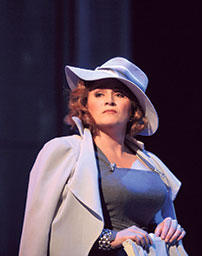
the-letter-l.jpgNature got a bit out of hand in the last scene. A gusty wind blew through the theater, knocking several plates and wine glasses off the dinner table at center stage just before Pat Racette started singing her big aria. I was briefly afraid that it would upstage her, but I should have known better. Instead of being intimidated by the wind, Pat used it, striding across the stage with utter self-confidence, and received a well-deserved round of applause for having risen so fearlessly to the occasion.

Alas, the wind kept on blowing, and when I saw the ground cloth billowing beneath the singers' feet, I felt sure that Patrick Summers, the conductor, would have to stop the show. But everyone kept their heads, and the opera continued all the way to the final blackout without further incident. Paul and I had been asked to take a curtain call, and we burst through the stage door just in time to see the members of the cast laughing as they waited in the wings to take their bows. "You are the greatest trouper who ever lived!" I told Pat.

If you read what I wrote in this space after the opening-night performance of The Letter, you'll recall that I was unable to hear the applause from the wings on Saturday, nor could I see the audience when Paul and I went on stage for our curtain call. Not so last night! I had no trouble hearing the reassuring sounds of clapping and cheers and seeing the happy people in the first few rows of seats, not to mention the musicians in the pit, all of whom were grinning broadly. By then we were feeling pretty loose, and when Paul and I stepped back from the lip of the stage to join the cast for a group call, I said the only thing possible under the circumstances: "Well, we blew 'em away!" Everyone in the company was hooting as we trotted into the wings. No sooner did I catch sight of Duane Schuler and Paul Horpedahl, the lighting designer and head of production, than I fixed them both with a steely gaze and said, "O.K., guys--keep the lightning, kill the wind!"

So what was it like to watch the rest of the second performance of The Letter? On the whole, I had a lot more fun. Until the wind started blowing, I wasn't nervous at all, and it felt this time as though I were seeing a show that I'd written. The audience laughed in all the right places and fell silent on cue, an indication that the opera was working the way it was intended to work. The only difference was that on Wednesday, we got applause during the show, after each of the three main arias and (much to Paul's and my surprise) immediately following the central flashback. Mrs. T told me that the ovation at the end was, if anything, even more fervent than on Saturday.

I'll be in town until Tuesday, long enough to see the third performance on Monday night, but the pressure is off. It seems clear--gratifyingly, gloriously clear--that Paul and I have succeeded in writing a modern opera that goes over with audiences in a big way, which is what we set out to do. From here on, I'm going to sit back and enjoy myself. Whatever lies in store for The Letter is out of my hands. For now, it's time to bask in the applause and revel in the moment.

Posted July 30, 2:41 AM

TT: So you want to see a show?

Here's my list of recommended Broadway, off-Broadway, and out-of-town shows, updated weekly. In all cases, I gave these shows favorable reviews (if sometimes qualifiedly so) in The Wall Street Journal when they opened. For more information, click on the title.

Warning: Broadway shows marked with an asterisk were sold out, or nearly so, last week.

BROADWAY:
Alfred Hitchcock's The 39 Steps (comedy, G, suitable for bright children, reviewed here)
Avenue Q * (musical, R, adult subject matter and one show-stopping scene of puppet-on-puppet sex, closes Sept. 13, reviewed here)
The Little Mermaid * (musical, G, entirely suitable for children, closes Aug. 30, reviewed here)
South Pacific * (musical, G/PG-13, some sexual content, brilliantly staged but unsuitable for viewers acutely allergic to preachiness, reviewed here)

OFF BROADWAY:
The Fantasticks (musical, G, suitable for children capable of enjoying a love story, reviewed here)
Our Town (drama, G, suitable for mature children, reviewed here)
Ruined (drama, PG-13/R, sexual content and suggestions of extreme violence, closes Sept. 6, reviewed here)

IN ASHLAND, OREGON:
The Music Man (musical, G, very child-friendly, closes Nov. 1, reviewed here)

IN CHICAGO:
The History Boys (drama, PG-13/R, adult subject matter, too intellectually complex for most adolescents, closes Sept. 27, reviewed here)

IN GARRISON, N.Y.:
Pericles and Much Ado About Nothing (Shakespeare, PG-13, playing in repertory through Sept. 6, reviewed here)

CLOSING SOON ON BROADWAY:
Mary Stuart (drama, G, far too long and complicated for children, closes Aug. 16, reviewed here)

CLOSING SUNDAY IN CHICAGO:
A Minister's Wife (musical, PG-13, reviewed here)

Posted July 30, 12:00 AM

TT: Almanac

"I am not suggesting that witnessing a spate of appallingly bad plays is a creditable method of learning how to write a good one, but it has its points. Though I had no idea whatever of writing plays at that time--the thought never crossed my mind--I am certain that some of those expository first acts, some of the ineptitudes of those second-act climaxes, and some of the stunning lack of invention in those third acts must somehow have seeped into my inner consciousness. The big 'hit' of any season always seems absurdly simple; so effortlessly does it unfold, that it almost seems as though it could not have been written any other way. Watch a failure on the same subject, and you will see by what a slim margin the mistakes have been by-passed, the cul-de-sacs averted in the hit."

Moss Hart, Act One

Posted July 30, 12:00 AM

July 29, 2009

TT: Tune me in

If you live within range of KSFR, Santa Fe's public radio station, I'll be talking about jazz--and, more than likely, about The Letter--on "Good Morning Jazz," John Greenspan's Wednesday-morning jazz program, which airs from nine a.m. to noon MT (that's eleven a.m. to two p.m. ET). Tune your radio to 101.1 FM, or go here to listen on the Web via streaming audio.

I'm about to head into the studio, so tune in now!

Posted July 29, 10:51 AM

TT: Snapshot

Billie Holiday sings "Fine and Mellow" on The Sound of Jazz, originally telecast on CBS in 1957. The soloists (in order) are Ben Webster on tenor saxophone, Lester Young on tenor saxophone, Vic Dickenson on trombone, Gerry Mulligan on baritone saxophone, Coleman Hawkins on tenor saxophone, and Roy Eldridge on trumpet:

(This is the latest in a weekly series of arts-related videos that appear in this space each Wednesday.)

Posted July 29, 12:00 AM

TT: Almanac


"A man who tells me my play is very bad, is less my enemy than he who lets it die in silence. A man, whose business it is to be talked of, is much helped by being attacked."


Samuel Johnson (quoted in James Boswell, Journal of a Tour to the Hebrides

Posted July 29, 12:00 AM

July 28, 2009

TT: Unrest cure

I'm still knocked out from the protracted siege of work that led to the premiere of The Letter in Santa Fe last Saturday. I've been doing my best to get some rest, but the aftermath of an opening night can be almost exhausting as the prelude to it. I've been inundated with calls and e-mail from friends and colleagues, and I also have a couple of looming deadlines that are keeping me from basking in the echoes of last week's applause. Mrs. T and I are going to a concert of Paul Moravec's chamber music tonight, and we'll be seeing the second performance of The Letter on Wednesday. My guess is that both occasions will be enormously gratifying--not least because I won't have anything to do but sit and listen.

Needless to say, not everybody liked The Letter as much as the first-nighters who cheered us to the echo. My old colleagues at the Washington Post, for instance, published a scorched-earth pan on Monday, the thrust of which was that Paul and I should take up another line of work. I can't say I enjoyed reading it, but I believe I can stand the heat. I ought to be able to: after all, I've been dishing it out for most of my professional life! Gian Carlo Menotti, a hugely successful opera composer who got more than his share of bad reviews, claimed to be dismissive of critics. "They often spoil my breakfast but never my lunch," he said. For my part, I'm old enough by now to be reasonably sure of myself, and I plan to have a good lunch today.

Meanwhile, life goes on: I have to finish writing a Commentary essay on Alan Ayckbourn, a task that would be more pleasant if I weren't so tired but from which I wouldn't dream of shirking. So excuse me while I get back to work. Writing opera libretti is great fun, but it doesn't pay the bills.

UPDATE: I just finished the Ayckbourn essay and sent it off. Twenty-eight hundred words, thank you very much! Shall I take a nap now? Or perhaps I should get going on another libretto....

Posted July 28, 12:00 AM

TT: Almanac

"A newspaper that wishes to make its fortune should never waste its columns and weary its readers by praising anything."

Anthony Trollope, The Way We Live Now

Posted July 28, 12:00 AM

July 27, 2009

TT: I deserve a break today

I'm all in. See you tomorrow. Or Tuesday.

Posted July 27, 12:47 AM

TT: Almanac

"The applause of a single human being is of great consequence."

Samuel Johnson (quoted in James Boswell, Life of Johnson)

Posted July 27, 12:00 AM

July 26, 2009

TT: How it felt

santa-fe-opera.jpgA minute or two before the house lights went down and the world premiere of The Letter got underway, Paul Moravec tapped me on the shoulder. "Turn around and look," he said. I was sitting in an aisle seat toward the front of the left side of the theater. I turned around and saw that all two thousand of the seats in the Santa Fe Opera's Crosby Theatre were full. Paul grinned. "Did you ever think you'd see anything like that?" he said. Mrs. T snapped a picture of the two uf us. Then we sat back down to watch the show.

The first public performance of The Letter went even more smoothly than the last dress rehearsal. I know this because I watched it like a hawk. I was holding my wife's hand from beginning to end, but she told me later that I never took my eyes off the stage. "It felt like you weren't there at all," she said. My ears registered the sound of laughter in unexpected and gratifying places, a sure sign that the audience was on top of the plot. Yet I couldn't spare a glance for anyone around me, not even Hilary. All I wanted to see was the performance itself. I didn't feel nervous--it was as though I were watching a show that someone else had written. Once or twice Paul reached back from the aisle seat in front of me and tapped me on the leg as if to say It works! Otherwise I was completely caught up in the action on stage.

Ninety-five minutes after Pat Racette fired the six pistol shots that set The Letter in motion, the orchestra blasted out a climactic E-minor chord and the stage went black. A fraction of a second later, the audience burst into loud applause. I looked at my wife for the first time and kissed her. My brother and sister-in-law, who were seated to her left, said something I couldn't quite hear. Then I saw Paul getting to his feet. The two of us had been told before the show to head for the stage door as soon as the performance was over, so I gave Hilary's hand a squeeze, stood up, and started backstage. Just before I got to the door, I ran into Brad Woolbright, the Santa Fe Opera's artistic administrator, a man who under ordinary circumstances is almost alarmingly cool and self-contained. His face was lit up like a Christmas tree. "They like it! It's a hit!" he said, then hugged me.

By the time I reached the wings, the entire production team was assembled and the curtain calls were underway. The sound of the audience out front was strangely muted. "Hey, Sullivan!" I said to Paul, clasping his arm.

"Hey, Gilbert!" he said to me, looking as though he'd won two lotteries in a single day.

I saw Jonathan Kent, the director, standing behind Paul. "What do we do now, Jonathan?" I shouted. He laughed. The stage manager told us that Jonathan, Hildegard Bechtler, Tom Ford, and Duane Schuler should line up and get ready to take a group curtain call, after which Paul and I would go on stage. I heard a surge of applause, glanced at the backstage TV monitor, and saw that Pat Racette was taking her bow. Patrick Summers, the conductor, followed her. Next came the production team. Paul and I stood in the wings, waiting for a signal from the assistant stage manager, who held her hand in the air to keep us from moving prematurely. After an agonizingly long pause, she dropped her hand. "O.K., composer, this is it," I said to Paul, and we made our entrance.

Once I got on stage, I looked to my left and saw the cast lined up, their faces glowing. I hugged Mika Shigematsu and Paul hugged Pat, whose hands I clasped tightly. I was about to start embracing the other cast members when I realized that the audience was still applauding. My God, I've got to take a bow right now! I thought, and stepped to center stage, standing to Paul's left. I looked out at the audience and saw nothing but a bottomless pit of blackness. The stage lights were so bright that I couldn't see beyond the edge of the orchestra pit. I knew that the audience was clapping, but I felt as though I were hearing them from under water. I sensed that Paul was bowing, so I did the same thing, bending almost double at the waist. Was that bow deep enough? I asked myself. Did it look all right?

Paul and I bowed a second time. People in costumes surged up behind me and I heard a voice in the distance shout "Group call!" I put my right arm around Paul and my left arm around Patrick Summers. The entire cast and production team stepped forward and took two bows together, looking like a mismatched chorus line. Then the stage lights started to dim and we made our exit.

The next few minutes are an impenetrable blur in my memory. All I know for sure is that Charles MacKay, the general director of the Santa Fe Opera, hugged me two or three times, and that Paul and I kept looking at one another as though we'd awakened from a dream. Suddenly the wings filled up with people, and I pulled myself together and started greeting friends, family members, company members, and excited strangers. Somebody shouted "Hilary's here!" and I saw my wife, looking the same way she did on the day we got married. I took her in my arms, then glanced past her and saw my brother and sister-in-law. "That was cool!" Kathy said. Dave, my normally poker-faced brother, was smiling broadly beneath his neatly trimmed mustache.

"Did they like it?" I asked my wife.

"Are you kidding?" she asked. "They were shouting! They were shrieking! I called your mother and held up the cellphone so that she could hear the cheers."

"I couldn't really tell back here," I said. "I knew they were clapping, but I couldn't hear how loud it was. Was my bow all right?"

"It was perfect," she said.

"Did I look all right next to Tom Ford?"

"I didn't even notice him," she said.

At length the backstage crowd started to thin out. Paul came up to me. "I guess we'd better head for the cast party," he said. His face was flushed. "You da man!" he added.

"You da man!" I replied.

We passed through the stage door, and I saw with amazement that it was raining outside. Fifteen or twenty minutes later, Mrs. T and I arrived at the party. Joyce Idema, the head of the press department, greeted us at the door. "Are you happy?" she asked.

"I think so," I said. "I'm kind of stunned."

"The energy here is amazing," Joyce said. "Can you hear it out on the terrace? Everybody here is happy."

The terrace was jammed, and no sooner did Hilary and I make our entrance than dozens of people came up to tell us how wonderfully things had gone. Someone pressed a glass of champagne into my hand and said that we'd gotten a standing ovation. "That never happens at Santa Fe premieres," he added. "This is the first time a new opera has ever gotten that kind of response."

"I didn't know that," I said. "I couldn't see anything from the stage." All at once I felt unsteady on my feet.

Hilary and I spent the next hour or so exchanging hugs and congratulations with everyone in sight. Two phrases were repeated again and again: This show has legs. This show is going to travel. I thanked everyone as graciously as I could, but I was in a daze. I still felt as though I'd spent the whole evening watching a show written by somebody else.

"My back hurts," I said to Hilary. "Why does my back hurt?"

"Because of all the stress," she said.

"But I wasn't nervous," I said. "Why should my back be hurting now?"

She laughed. "You can take a couple of Aleve when we get home," she replied. "Do you want something from the buffet? Something sweet? Are you ready to go?"

"I think so," I said. "I feel like I'm about to fall down." We started making our slow way through the crowd, and a little while later we were on the way back to our rented condo. I drove very, very slowly, like a drunk who was afraid of running off the road, even though the only thing I'd had to drink was a few mouthfuls of champagne.

"See how carefully I'm driving?" I said to Mrs. T as I pulled into our parking space.

"I saw," she said gently. "I think it's about time you went to bed."

Posted July 26, 1:25 PM

TT: Almanac (special weekend edition)

"Is success in any other profession as dazzling, as deeply satisfying, as it is in the theatre? I cannot pretend to know, but I doubt it. There are other professions where the rewards are as great or greater than those the theatre offers, there are professions where the fruits of success are as immediate, and still others where the pursuit of a more admirable goal undoubtedly brings a nobler sense of fulfillment. But I wonder if success in any of them tastes as sweet. Again, I am inclined to doubt it. There is an intensity, an extravagance, an abundant and unequivocal gratification to the vanity and the ego that can be satisfied more richly and more fully by success in the theatre than in any other calling. Like everything else about the theatre, its success is emphatic and immoderate. Perhaps what makes it so marvelously satisfying is that it is a success that is anything but lonely--everyone seems to share in it, friends and strangers alike--and a first success in the theatre is the most intoxicating and beguiling time imaginable. No success afterward surpasses it."

Moss Hart, Act One

Posted July 26, 1:20 PM

July 25, 2009

TT: The latest from Santa Fe

• Deborah Baker of the Associated Press recently interviewed Paul Moravec and me about The Letter:

Gunshots. A dead lover. A cigarette-puffing leading lady whose neck could end up in a noose. Welcome to "opera noir."

The Santa Fe Opera's latest original offering, "The Letter," is classic opera mayhem in a compact, stylish package....

To read the story, go here.

• Mary Charlotte, the host of Santa Fe Radio Café, which airs every Friday on KSFR-FM, Santa Fe's public radio station, interviewed Paul and me about The Letter just before Thursday's final dress rehearsal. To listen to her program in streaming audio or download it as a podcast, go here.

• To read the Santa Fe New Mexican's interview with Patricia Racette, star of The Letter, go here.

• To read the Santa Fe New Mexican's interview with Tom Ford, costume designer of The Letter, go here.

• An old friend writes:

The all-time best wish for a First Night was Noël Coward's telegram to Gertrude Lawrence--"May you have a warm hand at your opening"--but it doesn't quite work in this case. So let me just wish you all success and sane and smart reviews.

Sounds good to me.

* * *

In a few minutes I'll dress and depart for the theater where The Letter is about to be performed for the first time. My heartfelt thanks to all who've sent messages of encouragement in the past few hours. We are full of hope!

And now, here goes nothing....

Posted July 25, 8:45 AM

TT: Almanac (special weekend edition)

"I used to think that actors were just people who liked to put make-up on their faces every night. That producers, directors, and all the rest were part of the whole absurd foolishness and vanity. I was wrong. If there's a debt owed, it's my debt to you--to all of you--for showing me a new world--a new frontier--the real democracy of the theater. Thank you for that."

Moss Hart, Light Up the Sky

Posted July 25, 8:07 AM

July 24, 2009

TT: We know every part by heart

So here it is at last, the distinguished thing: The Letter opens tomorrow night. The final dress rehearsal was as smooth as silk. The invited audience applauded wildly. Paul Moravec and I went home happy. Now it's out of our hands.

If I have time, I'll post and tweet throughout the weekend. If not...not. Meanwhile, here's how all of us in Santa Fe are feeling today:

* * *

UPDATE: Two details from last night that I forgot to share:

• My wife doesn't impress easily, but I finally brought off the feat by speaking the following eight words: "Hilary, I'd like you to meet Tom Ford."

• Mrs. T gave me the perfect present after the rehearsal--a vintage Givenchy tie that was previously owned by Virgil Thomson, the great composer-critic. (She knew him at the very end of his life.) This time I was impressed.

Posted July 24, 12:00 AM

TT: That was no lady

Life goes on, and even though I'm in Santa Fe, I filed a drama column on schedule for today's Wall Street Journal. (I'm taking next week off.) In it I report on my visit to the Stratford Shakespeare Festival. Here's an excerpt.

* * *

If you're looking for one-stop theatrical shopping, go north to the Stratford Shakespeare Festival, which in summertime more or less takes over the smallish Ontario town for which it is named. This year the festival is presenting 14 plays on four stages, and the fare is richly varied. Much is being made of the fact that under Des McAnuff, the new artistic director, the festival has cut back on Shakespeare (three plays this season, five last season) and beefed up the budget for its roster of crowd-pleasing musical comedies. Be that as it may, classical theater remains Stratford's mainstay, and Brian Bedford's brilliantly zany staging of "The Importance of Being Earnest" is good enough to justify a trip to Canada all by itself.

brian-bedford-as-lady-bracknell2.jpgMr. Bedford's production of Oscar Wilde's ever-enchanting comedy of turn-of-the-century English manners is built around a gimmick that turns out not to be the least bit gimmicky: In addition to directing, he also plays Lady Bracknell, the money-hungry monster of propriety who is determined to stop Algernon and Gwendolen (Mike Shara and Sara Topham), her nephew and daughter, from marrying beneath themselves. I don't care for camped-up drag acts, but Mr. Bedford, who makes himself up to look like Queen Victoria and carries himself like a snooty gargoyle, is giving us something completely different, an impersonation so sharp-witted and closely observed that it demands to be accepted on its own daring terms....

Martha Henry's production of Anton Chekhov's "Three Sisters," by contrast, is a satisfyingly traditional, bracingly direct ensemble piece whose only novelty is the fact that it is being performed on the three-quarter-round stage of the Tom Patterson Theatre. At first I wondered whether the cast might be a bit underpowered, but then I got on Ms. Henry's unassuming wavelength, and before I knew it I was caught up in Chekhov's sad comedy of wasted lives. To see a classic like "Three Sisters" in so plain a setting is to appreciate anew the clear-eyed intimacy of theater in the round, and Ms. Henry uses that intimacy to maximum advantage....

* * *

Read the whole thing here.

Posted July 24, 12:00 AM

TT: Does Broadway need women?

An enormous amount of ink is being spilled over "Opening the Curtain on Playwright Gender: An Integrated Economic Analysis of Discrimination in American Theater," a paper by a Princeton undergraduate which purports to show, among other things, that female artistic directors of theater companies are more likely to discriminate against women playwrights than their male counterparts.

The paper, by Emily Glassberg Sands, concludes--as was already widely believed--that women playwrights get the short end of the stick in America. But is that really what the numbers crunched in "Opening the Curtain on Playwright Gender" demonstrate? I took a close and unhurried look at Sands' facts, figures, and analysis, and my "Sightings" column in Saturday's Wall Street Journal tells what I found there. Pick up a copy of Saturday's paper and see what I have to say.

UPDATE: Read the whole thing here.

Posted July 24, 12:00 AM

TT: Almanac

"I walked toward Once in a Lifetime for the last time--that final walk every playwright takes toward his play, knowing that it is no longer his, that it belongs to the actors and the audience now, that a part of himself is to be judged by strangers and that he can only watch it as a stranger himself. The main consideration of his day, the keystone that has dictated his every waking moment, the cause that has enlisted his being for all these months, is at an end. He moves toward his destination with mixed emotions--it is the completion he has sought, but there is the ache of finality in it. He is at last a spectator--a spectator with the largest stake in the gamble of the evening, but a spectator nonetheless."

Moss Hart, Act One

Posted July 24, 12:00 AM

July 23, 2009

TT: Present at the creation

I just heard via Facebook from Barbara Brown, my old high-school English and drama teacher. She directed the first play I ever saw, a production of Blithe Spirit that was performed in the gymnasium of the Smalltown Junior High School forty-one years ago. That production caused me to become stage-struck, with consequences of which readers of this blog need not be reminded. A couple of years later I joined the Smalltown High School Drama Club, and Barbara directed me in stagings of Harvey and The Innocents. I never was much of an actor, alas, but I learned things from her that I've never forgotten.

d4fa2c5b7163cf19_landing.jpegBarbara left Smalltown around the same time that I did, and I hadn't heard anything from or about her between then and this morning. As I read her message, I was reminded of the wonderful passage from Act One in which Moss Hart describes the backstage telegrams he received on the opening night of Once in a Lifetime, his first collaboration with George S. Kaufman and the play that made him famous:

Opening-night telegrams may seem a foolish and perfunctory convention, but they are not. Those words are the only ones likely to penetrate the minds and warm the hearts of the people who receive them at this particular moment. Opened backstage in that chill interval of waiting for the house lights to darken and the curtain to rise, they perform the admirable function of saying that hope still runs high. Far-fetched little jokes seem uncommonly humorous in opening-night telegrams, and ten words with an unexpected name signed to them can be strangely touching....

The years leaped out of each envelope with quicksilver flashes of memory, the old jumbled with the new. Time seemed to stop as I looked at each name and the years each name recalled, and something like calm began to settle over me.

Needless to say, Western Union is now a thing of the distant past, but Facebook and Twitter are taking up the slack, and it meant as much to me to hear from Barbara as it did to Moss Hart to hear from all the people in his past who sent telegrams to the Music Box Theatre on that fateful night in 1930. So thank you, dear teacher, for thinking to get in touch with me today. You were the first in a long line of people who made The Letter possible. I never forgot you, and I never will.

Posted July 23, 10:50 AM

TT: Did Maugham know best?

biography_03.jpgA few days ago I heard Jonathan Richards, a Santa Fe-based actor and writer, give a public reading of "The Letter," the short story by W. Somerset Maugham that inspired Paul Moravec and me to write The Letter. Our opera is based on Maugham's own 1927 stage version of "The Letter," but it was the story that was our starting point--I hadn't yet read the play when I first got the idea to turn "The Letter" into an opera--and more than two years had gone by since I last looked at it. Hence I found it fascinating to hear Jonathan read "The Letter" out loud, not least because I'd forgotten that it was the source of the original version of one of the best lines in the libretto.

C9F38295-3048-C0CE-556FFC6684A94FB1.jpgIn the second scene of the opera, Howard Joyce, the very proper lawyer who takes on the case of Leslie Crosbie, a woman who shot and killed a neighbor whom she claims tried to rape her, reflects on his client's plight. "One never knows what respectable women are capable of," he muses. My libretto contains most of the best-known lines of dialogue from Maugham's stage version of The Letter, but that particular line isn't in the play, and when Jim Maddalena, who plays the role of Joyce, told me that it was his favorite line in the opera, I wondered whether I'd actually come up with it myself.

The answer, it turns out, is that I based it on a line from the original short story, one that had slipped my mind until I heard Jonathan read it out loud at Collected Works last week:

"The fact is, I suppose," he reflected, "that you can never know what hidden possibilities of savagery there are in the most respectable of women."

somerset.jpgSo far as I can remember, this is the only line from "The Letter" that can be found in the opera but not in the play. Even so, it's a good example of how I changed virtually all of Maugham's language in order to make it pithier and more lyrical. Try to imagine Jim singing that handsomely worded but rather complicated sentence and you'll start to get an idea of the process by which a librettist turns the script of a play into the libretto of an opera.

* * *

Mrs. T and I had a busman's holiday yesterday: we went to see the Santa Fe Opera's production of Don Giovanni. I've been so busy with The Letter of late that it's been more than a year since I saw an opera not written by Paul Moravec and me, and it was a great treat to relax and let Mozart and da Ponte do the heavy lifting.

Tonight it's back to work. The final dress rehearsal of The Letter starts at nine o'clock. Definitely no tweeting--I expect to be completely preoccupied--but I'll let you know how it went on Friday.

Posted July 23, 9:57 AM

TT: So you want to see a show?

Here's my list of recommended Broadway, off-Broadway, and out-of-town shows, updated weekly. In all cases, I gave these shows favorable reviews (if sometimes qualifiedly so) in The Wall Street Journal when they opened. For more information, click on the title.

Warning: Broadway shows marked with an asterisk were sold out, or nearly so, last week.

BROADWAY:
Alfred Hitchcock's The 39 Steps (comedy, G, suitable for bright children, reviewed here)
Avenue Q * (musical, R, adult subject matter and one show-stopping scene of puppet-on-puppet sex, closes Sept. 13, reviewed here)
The Little Mermaid * (musical, G, entirely suitable for children, closes Aug. 30, reviewed here)
South Pacific * (musical, G/PG-13, some sexual content, brilliantly staged but unsuitable for viewers acutely allergic to preachiness, reviewed here)

OFF BROADWAY:
The Fantasticks (musical, G, suitable for children capable of enjoying a love story, reviewed here)
Our Town (drama, G, suitable for mature children, reviewed here)
Ruined (drama, PG-13/R, sexual content and suggestions of extreme violence, closes Sept. 6, reviewed here)

IN ASHLAND, OREGON:
The Music Man (musical, G, very child-friendly, closes Nov. 1, reviewed here)

IN CHICAGO:
The History Boys (drama, PG-13/R, adult subject matter, too intellectually complex for most adolescents, extended through Sept. 27, reviewed here)
A Minister's Wife (musical, PG-13, closes Aug. 2, reviewed here)

IN GARRISON, N.Y.:
Pericles and Much Ado About Nothing (Shakespeare, PG-13, playing in repertory through Sept. 6, reviewed here)

CLOSING SOON ON BROADWAY:
Mary Stuart (drama, G, far too long and complicated for children, closes Aug. 16, reviewed here)

CLOSING NEXT WEEK IN CHICAGO:
A Minister's Wife (musical, PG-13, closes Aug. 2, reviewed here)

CLOSING SUNDAY ON BROADWAY:
The Norman Conquests (three related comedies, PG-13, comprehensively unsuitable for children, playing in repertory through Sunday, reviewed here)

Posted July 23, 12:00 AM

TT: Almanac

"People ask you for criticism, but they only want praise."

W. Somerset Maugham, Of Human Bondage

Posted July 23, 12:00 AM

July 22, 2009

TT: In a mist

5331_134314692192_652497192_2956709_5822581_n.jpgThe first orchestral dress rehearsal of The Letter began in a rainstorm. Even after the rain stopped, there was fog throughout the area. That's not an inappropriate effect for an opera noir, though I would have preferred lightning. Fortunately, the Santa Fe Opera's Crosby Theatre, while it's an open-air house, is shielded more or less effectively from the weather, so the rehearsal started on time--immediately after sunset--and proceeded without incident.

I don't want to court the wrath of the theater gods, but I can't deny what everyone seems to be saying this morning, which is that last night's rehearsal went extraordinarily, even phenomenally well. All of Monday's minor glitches cleared themselves up as if by magic, and everyone in the cast rose to the occasion and performed as though their lives depended on it. On Monday we got to see what the show looked like for the first time, and now we know how it will sound with all the design elements in place and fully functioning. Not to put too fine a point on it, but The Letter looks like a movie, sounds like an opera, and plays like a play. It is, in short, everything that Paul Moravec and I had hoped for it to be, and we're thrilled beyond words.

No rehearsal tonight! Mrs. T has arrived, and the two of us are going to take the evening off and see Don Giovanni after Paul and I talk to an Associated Press reporter and give a presentation on The Letter in downtown Santa Fe. The final dress begins at nine o'clock sharp tomorrow night. I can't wait....

Posted July 22, 11:15 AM

TT: Snapshot

The theatrical trailer for the 1940 film version of The Letter, directed by William Wyler and starring Bette Davis:

(This is the latest in a weekly series of arts-related videos that appear in this space each Wednesday.)

Posted July 22, 12:00 AM

TT: Almanac

"You can do anything in this world if you are prepared to take the consequences."

W. Somerset Maugham, The Circle

Posted July 22, 12:00 AM

July 21, 2009

TT: The news in brief

0719092327.jpgMonday's dress rehearsal for The Letter went very, very well. This was the first time that we saw Tom Ford's costumes on stage, as well as the first time that all of Duane Schuler's lighting cues were run in sequence. The combination was...well, pretty overwhelming. The Letter really does look like a film noir, only in color and with a transfiguring touch of early-Forties glamour. Between them, Tom, Duane, and Hildegard Bechtler, our set designer, have pulled out all the stops: gleaming white suits, louvered windows, ceiling fans, muslin curtains that billow in the moonlight, dark shadows that criss-cross the stage.

I doubt I'll be tweeting today--I have a frenetic schedule throughout the day, followed by the first orchestral rehearsal in the evening--but I'll try to let you know how things went when I get home late tonight. For the moment, though, all systems appear to be go, and then some.

Posted July 21, 2:41 AM

TT: Almanac

"No one really knows anything much about a play until it meets its first audience; not its director, its actors, its producers, and least of all its author. The scenes he has counted on most strongly, his favorite bits of fine writing--the delicately balanced emotional or comedic thrusts, the witty, ironic summing up, the wry third-act curtain with its caustic stinging last line that adroitly illuminates the theme--these are the things that are most likely to go down the drain first, sometimes with an audible thud."

Moss Hart, Act One

Posted July 21, 12:00 AM

July 20, 2009

TT: All there is

the-letter-cover2-230x300.jpgThe Letter opens on Saturday, and I find it harder and harder to think or write about anything else. Among other distractions, I have two pieces due this week, a "Sightings" column for Saturday's Wall Street Journal and an essay about Alan Ayckbourn for the September issue of Commentary. Needless to say, I'll get them written--I don't miss deadlines--but in a perfect world, I wouldn't have anything to do but eat, sleep, and rehearse.

The Santa Fe Opera makes such single-minded concentration easy, for its headquarters is a campus-like complex of buildings located atop a seven-thousand-foot-high mesa north of town. Between rehearsing, eating in the cantina, and lounging by the company-only swimming pool, it's perfectly possible to spend virtually all of your time in Santa Fe at the ranch (as we opera types call it). So far I've also managed to hang out with one old friend and one new one, buy a copy of the new Elmore Leonard novel at Garcia Street Books, and eat a green chile cheeseburger at Bert's Burger Bowl, but otherwise I haven't done much of anything since arriving in Santa Fe that wasn't more or less directly related to The Letter. I haven't even taken time off to visit the Georgia O'Keeffe Museum, which is quite an oversight on the part of an art-loving boulevardier.

Why am I so wrapped up in The Letter? My work on the opera, after all, is all but done. I've rewritten one line of the text and signed off on two cuts since arriving in Santa Fe last Sunday, but that's been about it. The cast and production team don't really need me, and I've mostly been trying not to get under their feet. Yet I went so far last night as to spend two hours watching a lighting rehearsal of The Letter, when I could have stayed home and read Road Dogs instead. ("I can't believe you're here," said Duane Schuler, the lighting designer. "This is like watching grass grow.")

0717091337.jpgWhat is it, then, that keeps drawing me back to the ranch, and to the men and women who are bringing The Letter to life? Part of it is that they're all very nice people--I'm a bit surprised by how straightforwardly companionable my colleagues are--but the biggest reason, I suspect, is that I find it both exciting and reassuring to be in the presence of the work of art to which Paul Moravec and I have devoted so much of the past three years of our lives. Right now I want nothing more than to hear and see The Letter as often as possible, not on my iBook or in my imagination but on the stage of the Santa Fe Opera. Only then does it become real.

If The Letter were a painting, I could hang it on my wall and look at it as often as I liked, but an opera, like a play or a ballet, is nothing more than a set of instructions, an idea that must be brought to life through the act of performance. If music, as I have remarked on more than one occasion, is an art form whose meaning is radically ambiguous, then theater is an art form whose content is radically evanescent. The Santa Fe Opera will perform The Letter six times, and it's entirely possible that it will never be seen again after that. Even if it should be taken up by other companies, it won't be done in the same way that it's being done here and now. Is it any wonder, then, that I want to hurl myself into this unrepeatable, irreplaceable experience--that I want, as actors say, to be as "present" as I can possibly be?

Henry James said it: we shall never be again as we were. That's true of every moment of our lives. Of course they should all be infinitely precious, and of course they're not--we toss them aside heedlessly, charging on to the next experience. For me, though, these particular moments are different. Yesterday I found myself thinking of these oft-quoted lines from the last scene of Our Town:

EMILY Do any human beings ever realize life while they live it?--every, every minute?

STAGE MANAGER No.

Pause.

The saints and poets, maybe--they do some.

I'm neither of those things, but I do know what's happening to me this week, and I think I'm realizing as much of it as it's possible for an ordinary human to grasp. I only wish it could go on and on and on.

UPDATE: The lighting rehearsal turned out to be anything but dull. To read about it, go here.

Posted July 20, 12:00 AM

TT: Almanac

"I remember years ago climbing up to the fly gallery of the Globe (now the Gielgud) Theatre in Shaftesbury Avenue. It was the final night of Ten Times Table. The set was due to be struck and a new set brought in and fitted up. This new set was also for a play of mine, Joking Apart. For about three days (and some nights) I watched as dozens of stagehands, painters, electricians, stage managers and prop makers swarmed across the stage, first dismantlng one set and then assembling the other. The director in me watched with fascination while somewhere inside, the writer was silently screaming: My God, what have I started?"

Alan Ayckbourn, The Crafty Art of Playmaking

Posted July 20, 12:00 AM

July 19, 2009

SUBMITTED FOR YOUR APPROVAL

"While a fair number of playwrights and directors have written criticism on the side, very few drama critics have changed directions in midcareer and written for the stage, and fewer still have had any luck at it. I'm trying to beat those odds..."

Posted July 19, 12:21 AM

July 17, 2009

TT: Where all opera composers belong

Paul Moravec on the set of The Letter:

0717091140.jpg

(For more details, follow my "livetweeting" of today's stage rehearsal by going to my Twitter page.)

Posted July 17, 1:55 PM

TT: Really up to date in River City

In today's Wall Street Journal drama column I report on my recent visit to the Oregon Shakespeare Festival, and most of my review is devoted to Bill Rauch's revival of The Music Man. Here's an excerpt.

* * *

Robert Preston was the best thing--and the worst--that ever happened to "The Music Man." His 1957 Broadway performance as Harold Hill, the smooth-talking con man who breezes into a hick town to defraud its residents and ends up losing his heart to the local librarian, was so exuberantly charismatic that it made him a star overnight. Five years later, Preston appeared in the film version of "The Music Man," one of a handful of Hollywood musicals to clearly suggest the theatrical impact of the stage show on which it was based. Since then, every director who takes on "The Music Man" has labored in the long shadow of the 1962 film version. Not even Susan Stroman, who staged the 2000 Broadway revival, managed to break free from its now-stifling example, while Craig Bierko, who played Harold Hill for Stroman, did little more than mimic Preston's indelible performance.

musicman_2_jg_6073_gallery.jpgAll this points to the reason why the Oregon Shakespeare Festival's production of "The Music Man" is making so positive an impression on its audiences. Bill Rauch, the company's artistic director, has done what I thought impossible: He's turned his back on tradition and given us a high-concept "Music Man" in which every detail has been rethought and refurbished. Yet Mr. Rauch's innovations never obstruct our front-row view of Meredith Willson's sweet salute to turn-of-the-century American life. It's as though a faded painting had been scrupulously restored and hung in a brand-new gallery. Yes, it's still the same old show, but you'll see things in it that you didn't know were there.

The surprises start when a lone musician strolls onto Rachel Hauck's penny-plain clapboard unit set, pulls a harmonica out of his pocket and plays a medley of tunes from the show instead of the usual slam-bang knock-'em-dead overture. The stage fills with actors dressed in black, white and gray. This is River City, a town full of upright folk who lead ultra-proper lives (We're so by-God stubborn we can stand touchin' noses/For a week at a time and never see eye to eye). Then a too-friendly gent in a gaudy red waistcoat dances into town and tells everyone he meets that what they need is a brass band. One by one, the locals succumb to the in-your-face charm of the unscrupulous "Professor" Hill (Michael Elich) and sign on the dotted line--and as they do so, they start to sport flashy-looking socks, handkerchiefs and other accessories. By intermission, the stage is as colorful as a double rainbow....

* * *

Read the whole thing here.

Posted July 17, 12:00 AM

TT: Almanac

"Whatever is in any way beautiful has its source of beauty in itself, and is complete in itself; praise forms no part of it. So it is none the worse nor the better for being praised."

Marcus Aurelius, Meditations

Posted July 17, 12:00 AM

July 16, 2009

TT: Submitted for your approval

STILL%20OF%20SERLING.jpgI wrote a piece for Sunday's Los Angeles Times on what it feels like for a drama critic to put himself on the line by writing a stage work:

I didn't agree to write an opera libretto in order to become a better critic, much less to impress the artists whose work I review. But I've found in recent months that a good many theater professionals appear to be pleasantly surprised that I'm putting my money where my mouth is. Together with Paul Moravec and the other wonderfully gifted men and women with whom I am collaborating on the premiere of The Letter, I'm submitting myself for approval--not just from my fellow critics but from the people who read my reviews each week....

My piece has just been posted on the paper's Web site, and you can read it by going here.

Posted July 16, 2:45 PM

TT: Pit stop

0715091257.jpgI saw the sets for The Letter for the first time at Wednesday's stage rehearsal, and I also heard the Santa Fe Opera pit orchestra play the first four scenes. Both experiences were knock-me-down exciting. Fortunately, I was able to connect with Twitter via wi-fi from my seat in the theater, so I "livetweeted" the entire rehearsal in considerable detail.

To find out how it all went, go to my Twitter page and start scrolling. (The tweets are in reverse chronological order.)

Posted July 16, 12:00 AM

TT: So you want to see a show?

Here's my list of recommended Broadway, off-Broadway, and out-of-town shows, updated weekly. In all cases, I gave these shows favorable reviews (if sometimes qualifiedly so) in The Wall Street Journal when they opened. For more information, click on the title.

Warning: Broadway shows marked with an asterisk were sold out, or nearly so, last week.

BROADWAY:
Alfred Hitchcock's The 39 Steps (comedy, G, suitable for bright children, reviewed here)
Avenue Q * (musical, R, adult subject matter and one show-stopping scene of puppet-on-puppet sex, closes Sept. 13, reviewed here)
The Little Mermaid * (musical, G, entirely suitable for children, closes Aug. 30, reviewed here)
Mary Stuart (drama, G, far too long and complicated for children, closes Aug. 16, reviewed here)
South Pacific * (musical, G/PG-13, some sexual content, brilliantly staged but unsuitable for viewers acutely allergic to preachiness, reviewed here)

OFF BROADWAY:
The Fantasticks (musical, G, suitable for children capable of enjoying a love story, reviewed here)
Our Town (drama, G, suitable for mature children, reviewed here)
Ruined (drama, PG-13/R, sexual content and suggestions of extreme violence, closes Sept. 6, reviewed here)

IN CHICAGO:
The History Boys (drama, PG-13/R, adult subject matter, too intellectually complex for most adolescents, extended through Sept. 27, reviewed here)
A Minister's Wife (musical, PG-13, closes Aug. 2, reviewed here)

IN GARRISON, N.Y.:
Pericles and Much Ado About Nothing (Shakespeare, PG-13, playing in repertory through Sept. 6, reviewed here)

CLOSING SOON ON BROADWAY:
The Norman Conquests (three related comedies, PG-13, comprehensively unsuitable for children, playing in repertory through July 26, reviewed here)

CLOSING SUNDAY ON BROADWAY:
God of Carnage * (serious comedy, PG-13, adult subject matter, reopens Sept. 8 and runs through Nov. 15, reviewed here)

CLOSING SUNDAY OFF BROADWAY:
The Rivalry (historical drama, G, too complicated for children, reviewed here)

CLOSING SUNDAY IN LA JOLLA:
Restoration (serious comedy, PG-13, reviewed here)

Posted July 16, 12:00 AM

TT: Almanac

"You know who the critics are? The men who have failed in literature and art."

Benjamin Disraeli, Lothair

Posted July 16, 12:00 AM

July 15, 2009

TT: Modern opera in a nutshell

Direct from the stage of the Santa Fe Opera:

0715091128.jpg

Posted July 15, 1:39 PM

TT: Minute by minute

0714091533.jpgYesterday's rehearsal of The Letter took place out of doors. We couldn't have asked for a better day to go outside and play: the heat wave that rolled over Santa Fe last week finally loosened its grip on the city, and the "ranch" where the Santa Fe Opera makes its home was cooled by a delicious summer breeze.

Much to my delight, I discovered as the rehearsal got underway that I was able to pick up a wi-fi signal in the rehearsal shed, so I decided to use my iBook to "livetweet" the proceedings on my Twitter page. By the time we were done, I'd posted more than four dozen updates and received direct messages from numerous readers here and in England (including a couple of Santa Fe Opera staffers who were stuck in their offices). So far as I know, this is the first time that anyone has ever tweeted a running account of a rehearsal for a new opera.

In lieu of a detailed posting about Tuesday's activities, allow me to point you to my Twitter page, where you can read all about how things went.

Posted July 15, 12:00 AM

TT: Up in the air (II)

I usually try to work in two shows a day when visiting summer festivals, but my eighteen-hour-long trip to the Oregon Shakespeare Festival left me so frazzled that I decided to take an afternoon off. Alas, the change of time zones made it impossible for me to sleep in, so instead of enjoying the unfamiliar sensation of having nothing to do, I hopped in my rental car and headed off in search of adventure.

%282%29%20THE%20BASE%20%286%2C350%20FEET%29.jpgMy destination was Mount Ashland, a 7,533-foot-high ski slope eighteen miles from town. The chair lift only operates during the skiing season, but it's possible to drive to the ski base throughout the year, and I had a feeling that there'd be something worth seeing once I got there. I was right. A sign posted at the base advised visitors that they could drive to the summit of the mountain. I did so--or tried to, anyway. Part of the way up the road, I reached an improvised parking lot, after which the trail became too narrow for anything but Jeeps or off-road vehicles. A second sign informed me that it was a mile and a half to the summit. I saw a family walking up the trail. I locked the car and started following them, and before I knew it, I'd passed them. No water, no walking shoes, no suntan lotion: just me, doing something unplanned, unconsidered, and slightly crazy.

The last time I hiked up any part of a mountain was in the summer of 2007, a year and a half after I fell victim to a case of congestive heart failure that nearly did away with me. That impromptu expedition to the top of Clingmans Dome was one of the happiest days of my life, and the memory of how it felt to look out on the Great Smoky Mountains from 6,643 feet above sea level was still so strong and vivid that I didn't think twice about heading up the trail that leads to the summit of Mount Ashland. Had I paused to reflect on what I was about to do, I might well have changed my mind, since the Mount Ashland trail is three times longer and nine hundred feet higher than the Clingmans Dome trail. On the other hand, I knew that I'd soon be spending three weeks working in a New Mexico opera house built atop a seven-thousand-foot-high mesa, so I figured that I might as well get an early start on adjusting to the altitude.

%285%29%20APPROACHING%20THE%20SUMMIT.jpgI had plenty of time to reconsider my folly, for it took me more than an hour to reach the summit. I've never done anything more physically stressful in my life, and once or twice I gave thought to turning around. But not seriously or for very long: once I had the bit between my teeth, I was determined to go all the way to the top. Nor was there a time when I felt any worse than tired: no dizzy spells, no twinges in the chest, no oh-God-what-was-I-thinking moments. I stopped to rest at prudent intervals, then resumed my upward trudge, blissfully certain that my body, exasperated though it was by my lack of forethought, hadn't the slightest intention of betraying me.

%2811%29%20THE%20SUMMIT%20%287%2C533%20FEET%29.jpgIn due course I reached the summit of Mount Ashland, a pile of rocks whose highest point is marked with a round medallion left by the National Geodetic Survey. Below it is a giant white radome, the business end of a ski lift, and the entryways to the ski trails of Mount Ashland. No one was there when I reached the top, nor did anyone join me for a good fifteen minutes. I was all by myself, more so than I ever am in the course of my normal life. No first-night crowds, no chatty passers-by strolling along the sidewalk below my office window, no spouse sleeping in a hotel bed while I peck away on my laptop: no one but me, alone with my thoughts and a cloud of flies that materialized out of nowhere and moved in on me, drawn by the smell of my sweat.

%2813%29%20LOOKING%20BACK%20DOWN%20AT%20THE%20BASE.jpgI looked down the mountain at the ski base that I'd left behind an hour before. Then I pulled my cellphone out of my pocket and made two calls, the first to my wife and the second to my mother. To both I briefly explained where I was and what I'd done. "How are you breathing?" were the first anxious words out of Mrs. T's mouth.

"Just fine, dear," I said. "I couldn't possibly feel better--or more pleased with myself."

"Oh, I know how you feel," she said, the fear vanished from her voice. "Like Wile E. Coyote, super-genius. Right?"

"You know me too well," I replied.

%288%29%20TOP%20OF%20THE%20WORLD%2C%20MA%21.jpgAs soon as I hung up on my mother, I remembered that my cellphone takes pictures. I started snapping them in profusion, certain that no one would believe what I'd done unless I brought back evidence. Then the flies finally got the best of me and I clambered down to the ski lift, where I ran into the family that I'd passed on the way up the mountain. The father obligingly took my picture and the mother insisted that I take a long, cool drink out of one of their water bottles. I told them that I'd been in the hospital a few years earlier but was healthy again, and they made over me as if I were a child prodigy. Then we said our farewells and I started back down the trail, grinning like a fool.

%2815%29%20END%20OF%20THE%20TRAIL.jpgHalf an hour later I unlocked my car and noticed that I'd forgotten to close the window on the front passenger side. Nothing was missing. I laughed out loud, turned the car around, and started driving down Mount Ashland. As I looked in the rear-view mirror, I saw that my face was cherry-red with sunburn, and laughed even louder.

The next morning I gazed idly out a window of the plane that was carrying me from Oregon to Los Angeles, and realized with a start that I was staring down at the summit of Mount Ashland. This time I didn't laugh. I sat in silence and rejoiced anew in the good fortune that has followed me ever since I lay in a hospital bed four and a half years ago, wondering whether my time had run out. Instead of dying, I fell in love and got married, wrote an opera libretto and a biography of Louis Armstrong, traveled to every corner of America, and climbed two mountains. No matter what the rest of my days may hold in store, I'll never have any right to complain about what I've had so far.

(Second of two parts)

Posted July 15, 12:00 AM

TT: Snapshot

"Whom Dunnit," Ernie Kovacs' parody of TV game shows. Kovacs plays the guest:

(This is the latest in a weekly series of arts-related videos that appear in this space each Wednesday.)

Posted July 15, 12:00 AM

TT: Almanac

All enmity, all envy, they disclaim,
Disinterested thieves of our good name:
Cool, sober murderers of their neighbors' fame.

Samuel Taylor Coleridge, "Modern Critics"

Posted July 15, 12:00 AM

July 14, 2009

TT: At the starting gate

PAUL%20AND%20THE%20POSTER.jpgPaul Moravec and I spent most of Monday in rehearsals for the world premiere of The Letter, and by the time I ate dinner, did a bit of grocery shopping, and got back to my condo, I was far too tired to set down anything like a coherent account of the day's activities. I did manage to tweet about the rehearsals at reasonably frequent intervals throughout the day, though, and you can see what I said by going here.

Very briefly, all is going staggeringly well at the Santa Fe Opera. We've hit a few minor bumps in the road, but no potholes, and everyone in a position to know seems to think that we're on track toward a smooth opening on July 25. Yesterday we ran through the whole opera in the rehearsal hall, and on Wednesday and Thursday we'll see it on stage for the first time--complete with orchestra. It's tempting to say that I can't wait, but the truth is that I want to savor every minute of the process. Sure, it's exhausting, but I've never had so much fun in my life.

More tomorrow...maybe. Until then, follow me on Twitter and stay up to the minute with The Letter.

* * *

To hear my personal lullaby from last night, go here. I adore Fauré!

Posted July 14, 12:00 AM

TT: Do you know the man in the chair?

Raymond-Chandler-sitting--001.jpg

If so--or if not--go here.

How is it possible that I overlooked this story when it was published a month ago? I guess I had other things on my mind....

Posted July 14, 12:00 AM

TT: Almanac

"Poor devils! Where do they come from? At what age are they sent to the slaughter-house? What is done with their bones? Where do such animals pasture in the daytime? Do they have females, and young? How many of them handled the brush before being reduced to the broom?"

Hector Berlioz (on music critics), Les grotesques de la musique

Posted July 14, 12:00 AM

July 13, 2009

TT: Head first

I arrived in Santa Fe early yesterday evening, dropped my bags at the rented condo where I'll be spending the next three weeks, called Mrs. T and my mother to let them know that I was in one piece, then went off to dinner with Paul Moravec, composer of The Letter, which opens in twelve days.

My trip began with a short working holiday: I flew to Los Angeles and spent two nights in the improbably beautiful Topanga Canyon. I saw a pair of plays at the Will Geer Theatricum Botanicum and stayed at the Tuscali Mountain Inn, an idyllic hillside retreat located a mere quarter-mile from the theater. The hosts are friendly, the food tasty, the furnishings elegant (a Picasso etching was hung next to my desk), the beds comfortable. The last of these was more important than usual: I was greatly in need of sleep, and got plenty of it.

6a00d83451c83e69e200e55373c7d28833-320wi.jpgAs for Paul, he made it to Santa Fe a week ago and has been reporting to me by phone twice daily about the rehearsals (go here to see what he's been saying). I grew more excited each time I spoke to him. Now the wait is over. I'm here. It's happening. Later this morning I'll drive to the Santa Fe Opera to attend my first rehearsal. Paul has already told me what to expect: "It's overwhelming, hearing it being performed for real. You'll feel the same way when you get here. You'll want to cry." I'm sure he's right--I've always been an easy weeper--but once the shock wave has rolled over me, I have no doubt that the press of work will pull me to my feet again. I doubt I'm going to have much time to feel overwhelmed by the unfamiliar sensation of seeing and hearing my words and Paul's music sung by performers on a stage.

A year and a half ago, Paul and I attended the third New York screening of the film version of Sweeney Todd, a work that influenced us deeply in writing The Letter. As I wrote in this space at the time:

Halfway throught he film, in the brief pause between "Epiphany" and "A Little Priest," I leaned over to Paul and whispered, "This is the mark we have to hit." He nodded.

On the street afterward, I said, "Inspiring, huh?"

Paul grinned. "The work waits...and I'm full of joy," he replied. Then he disappeared into the night.

That goes octuple today.

* * *

Footnote to a long but satisfying day: I eased myself towards my first night's sleep in Santa Fe by listening to this. Thanks, Pat.

Posted July 13, 12:00 AM

TT: Almanac


"You may abuse a tragedy, though you cannot write one. You may scold a carpenter who has made you a bad table, though you cannot make a table. It is not your trade to make tables."

Samuel Johnson (quoted in James Boswell, Life of Johnson

Posted July 13, 12:00 AM

July 10, 2009

TT: T minus 15

255-santa_fe_opera_merriam.jpgThe Letter opens in fifteen days. This morning I fly to the West Coast (again!) to see two shows at the Will Geer Theatricum Botanicum. On Sunday I'll travel from Los Angeles to Santa Fe via Albuquerque, and from then until July 25 I'll devote virtually the whole of my time and energy to my first opera. Not all: I'll have to write three pieces while I'm in Santa Fe. Such is the life of a working journalist. But most of my Wall Street Journal copy is already filed and edited in advance for the next three weeks, and I'm going to do my damnedest to finish writing the rest of it before I hit town.

No, it doesn't seem real--not quite, not yet. I've been exchanging several phone calls each day with Paul Moravec, who's already out in Santa Fe helping to rehearse The Letter, but I still can't believe it's really, truly happening, no doubt because I haven't seen it yet. That comes when I report to the Santa Fe Opera House on Monday. I hope I'll have the presence of mind to blog and tweet about what I see there, but don't be surprised if I dry up for a day or two out of sheer excitement. Nothing like this has ever happened to me before, and I can't wait for it to start.

Posted July 10, 12:00 AM

TT: Pericles' excellent adventures

In today's Wall Street Journal drama column I report on my recent visit to the Hudson Valley Shakespeare Festival, where I saw Pericles and Much Ado About Nothing. Here's an excerpt.

* * *

Hardly anybody does "Pericles," which was staged just once in the 19th century and remains to this day the least well known of Shakespeare's plays. If you want to embarrass a critic, ask him to summarize the plot and watch him start stammering. (It's happened to me!) Now that the recession has caused American theater companies to pull in their horns and play it safe, revivals have become scarcer still. All the more reason, then, to laud the Hudson Valley Shakespeare Festival for taking a chance on "Pericles," and to praise Terrence O'Brien, the festival's artistic director, for giving it a staging so lucid, genial and persuasive that you'll go home wondering why it isn't as popular as "Twelfth Night."

21theatwe.span.jpgThe trouble with "Pericles" is that it lacks the inexorable momentum of Shakespeare's best-loved plays, which hurtle toward their denouements like bullets toward the bull's-eye. Not so this sprawling tale of a Phoenician prince who wanders from adventure to adventure, driven by the lash of increasingly implausible coincidence and the skullduggery of the 60-odd characters who share the stage with him. Yes, there's a plot, but it's so loosely knit that Shakespeare launches each act with a prologue whose sole purpose is to keep the audience in the picture. By the time Pericles is finally reunited with his long-lost wife and daughter, you'll probably have forgotten how they disappeared in the first place.

How can a modern-day director bring "Pericles" into focus? By simultaneously playing its absurdities with tongue in cheek and taking its serious moments seriously. That, at any rate, is Mr. O'Brien's approach, and it works perfectly. He gives us, among other delightful things, pirates with avast-me-hearties accents and funky dances complete with lip-synching--yet everyone in his 19-member cast is capable of turning on a dime and speaking Shakespeare's verse sweetly and sonorously whenever the situation calls for eloquence....

John Christian Plummer's staging of "Much Ado About Nothing" is no less typical of the Hudson Valley approach. Instead of coming up with an over-elaborate directorial concept that obscures the plain meaning of the text, Mr. Plummer is content to cloak his well-chosen cast in a riotous medley of mismatched costumes, some of which look as though they came from the cantina scene in "Star Wars" and the rest from "Only Angels Have Wings." The rest he leaves to the actors, and in particular to Nance Williamson and Jason O'Connell, who play Beatrice and Benedick, the reluctant lovers, as well as I've seen them played....

* * *

Read the whole thing here.

Posted July 10, 12:00 AM

TT: The perfect film score

chinatown8.jpgJune 20 marked the thirty-fifth anniversary of the original theatrical release of Chinatown, for me the best American film of the Seventies. I also think that Jerry Goldsmith's score, which lost out at the Oscars to The Godfather, Part II, is one of the half-dozen best film scores of the twentieth century. Many people know that it was written under severe time pressure, but few know the full story of how Goldsmith was brought in at the last minute to compose a new score for Chinatown. In this week's "Sightings" column I tell that story, and pay tribute to one of the best pieces of postwar American music--regardless of genre.

To find out more, pick up a copy of Saturday's Wall Street Journal and see what I have to say.

UPDATE: Read the whole thing here.

Posted July 10, 12:00 AM

TT: Almanac

"Insects sting, not in malice, but because they want to live. It is the same with critics: they desire our blood, not our pain."

Friedrich Nietzsche, Human All-too-Human

Posted July 10, 12:00 AM

July 9, 2009

CAAF: My angel is a centerfold

Several interesting features to this story about Playboy's acquiring rights to run an excerpt from Nabokov's The Original of Laura. That the New Yorker passed on the rights (!). The degree to which Playboy pitched some serious woo to gain them, including the dispatch of fresh orchids to the Wylie Agency offices. And that Playboy was asked to make an offer without having seen the manuscript -- and did. The magazine's literary editor Amy Grace Loyd is quoted as saying, "I knew because of Nabokov's genius, even if the manuscript was even more messy than it actually is, I would probably still be content."

For those of you who haven't been following this saga: The Original of Laura is the manuscript Nabokov left unfinished at his death, in 1977. He requested that it be destroyed. It wasn't. And now after some public hand-wringing and a lapse of a little more than three decades, the work will be published by Knopf on Nov. 17 -- with suitably somber cover art by Chip Kidd. The 5,000-word excerpt runs in Playboy's December issue (out Nov. 10), accompanied by what one imagines will be less somber cover art.

So how good can we expect The Original of Laura to be? Wikipedia's thorough entry on the novel shows only a small circle of people have read it (or had excerpts read to them), and bits and pieces of the manuscript have appeared in a couple magazines. But the most promising mention I've yet come across is contained in a letter written by Dmitri Nabokov to the National Review in 1987. The letter, a point-by-point rebuttal of claims made by critic-biographer Andrew Field in his V.N.: The Life and Art of Vladimir Nabokov, ends with a denial of Field's characterization of the end of Nabokov's life as marked by "heavy drinking" and "decline". Dmitri writes:

[T]he decline Field invents presumably encompasses such petits riens as Ada, Transparent Things, Look at the Harlequins, and The Original of Laura, which was interrupted by Nabokov's death and promised to be one of his most brilliant and original works (for the time being, my word will have to be taken for that)."

Intriguing, right?

Posted July 09, 1:49 PM

TT: And now for something completely different

Yes, I'm mostly thinking about the premiere of The Letter on July 25, but I haven't lost sight of the publication of Pops: A Life of Louis Armstrong on December 2. The good news is that Houghton Mifflin Harcourt is planning to send me on a multi-city book tour, and several dates have already been confirmed.

Here are the places where I'll definitely be speaking:

• The Boston Athenaeum on December 3.

• The Lincoln Center Barnes & Noble on December 7.

• The Los Angeles Public Library on December 8.

• Baltimore's Enoch Pratt Free Library on December 9.

• The Philadelphia Free Library on December 10.

In addition, there's a good chance that I'll be speaking in Washington, D.C., on January 6--no details yet, though.

Needless to say, watch this space for further information and additional tour dates in other cities.

As for The Letter, the Santa Fe Opera has now posted an online schedule of events related to the upcoming premiere, including various public appearances that Paul Moravec and I will be making. If you're coming to Santa Fe to see the show, go here to find out what else you can do.

Posted July 09, 11:37 AM

TT: As it happens

A reminder: if you want regular updates on rehearsals for the world premiere of The Letter, all you have to do is start following me on Twitter.

To see my last five tweets, look at the "Terry's Twitters" module in the right-hand column.

Posted July 09, 12:00 AM

TT: So you want to see a show?

Here's my list of recommended Broadway, off-Broadway, and out-of-town shows, updated weekly. In all cases, I gave these shows favorable reviews (if sometimes qualifiedly so) in The Wall Street Journal when they opened. For more information, click on the title.

Warning: Broadway shows marked with an asterisk were sold out, or nearly so, last week.

BROADWAY:
Alfred Hitchcock's The 39 Steps (comedy, G, suitable for bright children, reviewed here)
Avenue Q * (musical, R, adult subject matter and one show-stopping scene of puppet-on-puppet sex, closes Sept. 13, reviewed here)
The Little Mermaid * (musical, G, entirely suitable for children, closes Aug. 30, reviewed here)
Mary Stuart (drama, G, far too long and complicated for children, closes Aug. 16, reviewed here)
South Pacific * (musical, G/PG-13, some sexual content, brilliantly staged but unsuitable for viewers acutely allergic to preachiness, reviewed here)

OFF BROADWAY:
The Fantasticks (musical, G, suitable for children capable of enjoying a love story, reviewed here)
Our Town (drama, G, suitable for mature children, reviewed here)
Ruined (drama, PG-13/R, sexual content and suggestions of extreme violence, closes Sept. 6, reviewed here)

IN CHICAGO:
The History Boys (drama, PG-13/R, adult subject matter, too intellectually complex for most adolescents, extended through Sept. 27, reviewed here)
A Minister's Wife (musical, PG-13, closes Aug. 2, reviewed here)

CLOSING SOON ON BROADWAY:
The Norman Conquests (three related comedies, PG-13, comprehensively unsuitable for children, playing in repertory and extended through July 26, reviewed here)

CLOSING NEXT WEEK ON BROADWAY:
God of Carnage * (serious comedy, PG-13, adult subject matter, closes July 19, then reopens Sept. 8 and runs through Nov. 15, reviewed here)

CLOSING NEXT WEEK OFF BROADWAY:
The Rivalry (historical drama, G, too complicated for children, closes July 19, reviewed here)

CLOSING NEXT WEEK IN LA JOLLA:
Restoration (serious comedy, PG-13, closes July 19, reviewed here)

CLOSING SUNDAY ON BROADWAY:
Waiting for Godot * (drama, PG-13, accessible to intelligent and open-minded adolescents, closes July 12, reviewed here)

CLOSING SUNDAY IN LOS ANGELES:
Oleanna (drama, R, adult subject matter, reviewed here)

Posted July 09, 12:00 AM

TT: Almanac

"Strange as these words may sound I often play with the idea that when all the social theories collapse and wars and revolutions leave humanity in utter gloom, the poet--whom Plato banned from his Republic--may rise up to save us all."

Isaac Bashevis Singer, Nobel lecture, Dec. 8, 1978

Posted July 09, 12:00 AM

July 8, 2009

OPERA

The Letter (Santa Fe Opera, Santa Fe, N.M., in repertory July 25-Aug. 18). Adultery, murder, lies, blackmail, confession, trial, hallucination, acquittal, confrontation, disaster, blood, blackout--all in ninety minutes with no intermission. An opera noir, in other words, based on the 1927 Somerset Maugham play and staged by Jonathan Kent (Faith Healer). Patricia Racette is the star, Hildegard Bechtler the set designer, Tom Ford the costume designer. Music by Paul Moravec, words by yours truly. A rattling good show, if we do say so ourselves (TT).

Posted July 08, 9:48 AM

BOOK

Lauren Braun Costello and Russell Reich, Notes on Cooking: A Short Guide to an Essential Craft (RCR Creative Press, $21.95). I can barely boil water, but I know an immensely informative guide when I read one, and this one fills the bill. Fans of Reich's Notes on Directing, among whom I number myself, will recall the drill: Notes on Cooking is a 143-page list of 217 dos and don'ts for cooks, aspiring and otherwise. Some are starkly practical ("Fish should not smell") and others subtly suggestive ("Embrace the mundane"). The advice--I'm told--is sound, the writing crisp, the design pleasing to the eye. Stuff a stocking or two with this one, and buy another for yourself (TT).

Posted July 08, 9:29 AM

PORTRAIT OF A PAINTER

"To chat with Wolf Kahn in his studio is the purest of pleasures and the easiest of jobs. All you have to do is prompt him with an occasional question, then sit back and enjoy the answers, taking care not to be distracted by the paintings everywhere you look. (That's the hard part.) I visited him there last February, and this is some of what he said..."

Posted July 08, 9:17 AM

OGIC: Bonus Terry

By day, among other tasks, I edit a magazine about the University of Chicago's undergraduate college and its alumni, one of whom is the painter Wolf Kahn. In our last issue, Terry, who is (like me) a fan and (unlike me) an owner of Kahn's work, interviewed the artist for the magazine. When the interview happened last winter, I dreamed at my desk in Chicago of being a fly on the wall in Kahn's Manhattan studio while the two of them met, talked, and looked at Kahn's recent paintings of the Chrysler Building. Terry's story (and Dan Dry's photographs) are the next best thing. Read all about it here.

Posted July 08, 12:05 AM

TT: Snapshot

"The Juggler of Our Lady," a 1958 animated version of the medieval legend, adapted and designed by R.O. Blechman, directed by Al Kouzel, and narrated by Boris Karloff:

(This is the latest in a weekly series of arts-related videos that appear in this space each Wednesday.)

Posted July 08, 12:00 AM

TT: Almanac

"An artist must pass judgment only on what he understands; his range is limited as that of any other specialist--that's what I keep repeating and insisting upon. Anyone who says that the artist's field is all answers and no questions has never done any writing or had any dealings with imagery. An artist observes, selects, guesses and synthesizes."

Anton Chekhov, letter to A.S. Suvorin (Oct. 27, 1888)

Posted July 08, 12:00 AM

July 7, 2009

TT: Didn't he ramble!

Here's how NBC Nightly News covered the death of Louis Armstrong on July 6, 1971. The anchorman is John Chancellor. The music accompanying the montage of still photos is an edited version of the 1950 Armstrong All Stars studio recording of "New Orleans Function":

Posted July 07, 7:06 PM

TT: Tweeting an opera

Paul Moravec is phoning me from the Santa Fe Opera House to report on rehearsals for The Letter. Instead of putting up minute-by-minute posts at "About Last Night," I plan to tweet about the rehearsals from now through opening night (though I'll also continue to post full-length blog entries about The Letter as time permits).

To read my tweets, go to the right-hand column and look at the "Terry's Twitters" module, or go directly to my Twitter page and start following me.

Posted July 07, 1:42 PM

TT: Almanac

"Happiness does not await us all. One needn't be a prophet to say that there will be more grief and pain than serenity and money. That is why we must hang on to one another."

Anton Chekhov, letter to K.S. Barantsevich (Mar. 3, 1888)

Posted July 07, 12:00 AM

July 6, 2009

TT: Who'd have thought it?

MOVIE%20POSTER%20%28BELGIAN%29.jpgI've reached an alarmingly high level of preoccupation with The Letter. Yes, I'm capable on occasion of thinking about other things, but whenever my mind wanders from whatever I'm doing at any given moment, I find myself wondering what's going on in Santa Fe. Paul Moravec, my collaborator, is now at the opera house, attending orchestral rehearsals. On Friday I fly to Los Angeles to review a pair of weekend performances at the Will Geer Theatricum Botanicum, after which I head for New Mexico on Sunday to join the company for the last two weeks of rehearsals. Ready or not, we open on July 25.

I finally had my first dream about The Letter a couple of nights ago. Alas, it was one of those surreal pseudo-narratives that make little or no sense to the dreamer's waking self. No one in the real-life cast of the opera figured in my dream, which took place on a stage that bore no resemblance to that of the Santa Fe Opera. Instead of the seventy-piece orchestra that will accompany The Letter, a chamber orchestra was in the pit, and it was playing Bach's "Sheep May Safely Graze." Go figure.

So now what? Well, I have three pieces to write for The Wall Street Journal before I leave on Friday. I also have to pack enough clothes and books for a three-week stay in Santa Fe, and no doubt I'll blog a bit between now and the time of my departure. Among other things, I still have to report on my ascent to the summit of Mount Ashland. For the moment, though, I can't seem to think about much of anything but The Letter, so try to be patient with me! I've been pregnant for three years, and it's just about time to stop eating ice cream and pickles and head for the hospital.

UPDATE: The Santa Fe season opened on Friday with Verdi's La Traviata, starring Natalie Dessay. Here's an Associated Press review of the first performance.

The season continued on Saturday with the premiere of a new production of Donizetti's Elixir of Love. Here's a review from the Santa Fe New Mexican.

Posted July 06, 12:00 AM

TT: Almanac

"The advancement of the masses is a mere by-product of the uniquely human fact that discontent is at the root of the creative process: that the most gifted members of the human species are at their creative best when they cannot have their way, and must compensate for what they miss by realizing and cultivating their capacities and talents."

Eric Hoffer, The Ordeal of Change

Posted July 06, 12:00 AM

July 5, 2009

DANCE

Pilobolus Dance Theatre (Joyce Theater, 175 Eighth Ave., July 13-Aug. 8). The annual summer season of everybody's favorite...what? Pilobolus remains a pigeonhole-resistant fusion of modern dance, gymnastics, performance art, wit, and charm. Three New York premieres this time around, plus the usual assortment of repertory staples, including "Day Two," "Pseudopodia," and "Walklyndon." Prepare to be delighted (TT).

Posted July 05, 10:28 PM

CD

Gary Burton, Pat Metheny, Steve Swallow, and Antonio Sanchez, Quartet Live (Concord Jazz). A 2007 reunion date by three of the most influential jazz-rock instrumentalists of the post-Coltrane era, with Sanchez providing ideal support on drums. The tunes include Metheny's "Midwestern Night's Dream" and Swallow's "Falling Grace" and the playing is exquisite. Excellent liner notes by all four musicians. Need I say more? (TT)

Posted July 05, 10:09 PM

July 4, 2009

TT: Out of the past

On Friday NPR aired a story by John McDonough about the last great reunion of veterans of the American Civil War, which took place in Gettysburg in 1938. The ceremonies were broadcast live on network radio, and McDonough's story contained excerpts from surviving airchecks of those broadcasts. You can listen to the story here.

It occurred to me after listening to the NPR story that someone might have posted newsreel footage of the 1938 reunion on YouTube. Sure enough, a fair amount of the footage is available for viewing. Here are two clips. The first is a silent montage of newsreel excerpts:

The second is a seventeen-second-long sound clip that shows Union and Confederate veterans shaking hands over the stone wall at Bloody Angle:

Lest we forget!

UPDATE: More newsreel footage and radio broadcasts from the 1938 reunion at Gettysburg can be found on this DVD.

To see still photographs from the 1938 reunion, go here.

Posted July 04, 5:31 PM

TT: Close enough for jazz

This isn't really Louis Armstrong's birthday, but he thought he was born on July 4, 1900, so I invite you to spend a few minutes of this beautiful and blessed day watching one of America's greatest artists talk and play:

Posted July 04, 1:12 PM

July 3, 2009

TT: He said, she did

In today's Wall Street Journal drama column I review two West Coast plays, the Los Angeles revival of David Mamet's Oleanna and the La Jolla premiere of Claudia Shear's Restoration. Both are first rate. Here's an excerpt.

* * *

David Mamet shocked a great many people when he declared that he was no longer a "brain-dead liberal." What made him change his stripes? "I began to question what I actually thought and found that I do not think that people are basically good at heart," he wrote in a much-quoted essay published last year in the Village Voice. That belated conclusion won't come as a surprise to anyone who sees "Oleanna," Mamet's 1992 two-character play about a sexual-harassment case, in the incisive Broadway-bound revival now playing at Los Angeles' Mark Taper Forum. Whatever else "Oleanna" is or isn't, it's definitely not the work of a playwright who takes a rosy view of human nature.

6a00d8341c630a53ef011570f63dbc970b-500wi.jpgBill Pullman plays John, the self-important but well-meaning professor who tries to help Carol (Julia Stiles), a student who is floundering in one of his classes and comes to his office in despair. We see their meeting, at which nothing egregiously offensive happens. Then, in the second act, we learn that Carol has filed an official complaint of harassment by John in which she exaggerates and misrepresents everything that took place in the first act. At first it appears that the complaint arises from a genuine misunderstanding, but Carol turns out to be part of a "group" of female students "who suffer what I suffer." She's been collecting evidence against John on their behalf, and in third act she hints that their real purpose is to control what he teaches in his classes....

What is most impressive about this revival, which Doug Hughes ("Doubt") has directed with an enthralling combination of force and subtlety, is that the actors give both characters their due: Mr. Pullman is so tightly wound that he all but quivers, while Ms. Stiles appears to have strolled directly into the theater from the nearest classroom....

I last saw Claudia Shear on Broadway 10 years ago in "Dirty Blonde," her delightful three-person play about a woman obsessed with the spirit of Mae West. Alas, I haven't heard much of her since then, so I made a point of going to the La Jolla Playhouse to catch the premiere of "Restoration," her fictionalized retelling of the story of the 2003 cleaning of Michelangelo's David. Ms. Shear plays Giulia, a middle-aged scholar-restorer with a redwood-sized chip on her shoulder who becomes obsessed with the statue in part because she believes herself to be physically unattractive: "Beautiful eyes--the catch-all compliment for the plain woman." No doubt this too-neat summary sounds as though Ms. Shear is using a great work of art as the pretext for a three-hankie weeper. Not so: "Restoration" is a beautifully wrought portrait of an unhappy woman who uses her sharp tongue to hold the world at bay...

* * *

Read the whole thing here.

Posted July 03, 12:00 AM

TT: Almanac

"If a nation values anything more than freedom, it will lose its freedom; and the irony of it is that if it is comfort or money that it values more, it will lose that too."

W. Somerset Maugham, Strictly Personal

Posted July 03, 12:00 AM

July 2, 2009

TT: So you want to see a show?

Here's my list of recommended Broadway, off-Broadway, and out-of-town shows, updated weekly. In all cases, I gave these shows favorable reviews (if sometimes qualifiedly so) in The Wall Street Journal when they opened. For more information, click on the title.

Warning: Broadway shows marked with an asterisk were sold out, or nearly so, last week.

BROADWAY:
Alfred Hitchcock's The 39 Steps (comedy, G, suitable for bright children, reviewed here)
Avenue Q * (musical, R, adult subject matter and one show-stopping scene of puppet-on-puppet sex, closes Sept. 13, reviewed here)
The Little Mermaid * (musical, G, entirely suitable for children, closes Aug. 30, reviewed here)
Mary Stuart (drama, G, far too long and complicated for children, closes Aug. 16, reviewed here)
The Norman Conquests (three related comedies, PG-13, comprehensively unsuitable for children, playing in repertory and extended through July 26, reviewed here)
South Pacific * (musical, G/PG-13, some sexual content, brilliantly staged but unsuitable for viewers acutely allergic to preachiness, reviewed here)

OFF BROADWAY:
The Fantasticks (musical, G, suitable for children capable of enjoying a love story, reviewed here)
Our Town (drama, G, suitable for mature children, reviewed here)
Ruined (drama, PG-13/R, sexual content and suggestions of extreme violence, closes Sept. 6, reviewed here)

IN CHICAGO:
The History Boys (drama, PG-13/R, adult subject matter, too intellectually complex for most adolescents, extended through Sept. 27, reviewed here)
A Minister's Wife (musical, PG-13, closes Aug. 2, reviewed here)

CLOSING SOON ON BROADWAY:
God of Carnage * (serious comedy, PG-13, adult subject matter, closes July 19, then reopens Sept. 8 and runs through Nov. 15, reviewed here)

CLOSING SOON OFF BROADWAY:
The Rivalry (historical drama, G, too complicated for children, closes July 19, reviewed here)

CLOSING NEXT WEEK ON BROADWAY:
Waiting for Godot * (drama, PG-13, accessible to intelligent and open-minded adolescents, closes July 12, reviewed here)

CLOSING SUNDAY IN HARTFORD, CONN.:
Dividing the Estate (black comedy, PG-13, reviewed here)

CLOSING SUNDAY OFF BROADWAY:
Coraline (musical, G, possibly too scary for small children and very problematic for twee-hating adults, reviewed here)

Posted July 02, 12:00 AM

TT: Almanac

"For my part I have never avoided the influence of others. I would have considered it cowardice and a lack of sincerity toward myself."

Henri Matisse, interview (L'Art Vivant, Sept. 15, 1925)

Posted July 02, 12:00 AM

July 1, 2009

A CRITIC TAKES A BOW

"When the Santa Fe Opera commissioned The Letter in November of 2006, I'd never written a stage work of any kind (except for an unperformed play that rests at the bottom of a desk drawer, where it belongs). Instead, I had spent my career practicing a form of literary endeavor that most artists hold in contempt..."

Posted July 01, 10:21 AM

TT: Snapshot

Benno Moiseiwitsch plays the first movement of Rachmaninoff's Second Piano Concerto in 1944, accompanied by Constant Lambert and the London Philharmonic:

(This is the latest in a weekly series of arts-related videos that appear in this space each Wednesday.)

Posted July 01, 12:00 AM

TT: Almanac

"What makes a poet is, surely, the love of these things, a desperate search for the tiny ray of sunshine which used to flicker on the floor of a child's bedroom."

François Mauriac, Questions of Precedence

Posted July 01, 12:00 AM

e="application/atom+xml" title="Atom" href="http://www.artsjournal.com/aboutlastnight/atom.xml" /> About Last Night: July 2009 Archives

« June 2009 | Main | August 2009 »

July 2009 Archives

July 1, 2009

TT: Almanac

"What makes a poet is, surely, the love of these things, a desperate search for the tiny ray of sunshine which used to flicker on the floor of a child's bedroom."

François Mauriac, Questions of Precedence

TT: Snapshot

Benno Moiseiwitsch plays the first movement of Rachmaninoff's Second Piano Concerto in 1944, accompanied by Constant Lambert and the London Philharmonic:

(This is the latest in a weekly series of arts-related videos that appear in this space each Wednesday.)

A CRITIC TAKES A BOW

"When the Santa Fe Opera commissioned The Letter in November of 2006, I'd never written a stage work of any kind (except for an unperformed play that rests at the bottom of a desk drawer, where it belongs). Instead, I had spent my career practicing a form of literary endeavor that most artists hold in contempt..."

July 2, 2009

TT: Almanac

"For my part I have never avoided the influence of others. I would have considered it cowardice and a lack of sincerity toward myself."

Henri Matisse, interview (L'Art Vivant, Sept. 15, 1925)

TT: So you want to see a show?

Here's my list of recommended Broadway, off-Broadway, and out-of-town shows, updated weekly. In all cases, I gave these shows favorable reviews (if sometimes qualifiedly so) in The Wall Street Journal when they opened. For more information, click on the title.

Warning: Broadway shows marked with an asterisk were sold out, or nearly so, last week.

BROADWAY:
Alfred Hitchcock's The 39 Steps (comedy, G, suitable for bright children, reviewed here)
Avenue Q * (musical, R, adult subject matter and one show-stopping scene of puppet-on-puppet sex, closes Sept. 13, reviewed here)
The Little Mermaid * (musical, G, entirely suitable for children, closes Aug. 30, reviewed here)
Mary Stuart (drama, G, far too long and complicated for children, closes Aug. 16, reviewed here)
The Norman Conquests (three related comedies, PG-13, comprehensively unsuitable for children, playing in repertory and extended through July 26, reviewed here)
South Pacific * (musical, G/PG-13, some sexual content, brilliantly staged but unsuitable for viewers acutely allergic to preachiness, reviewed here)

OFF BROADWAY:
The Fantasticks (musical, G, suitable for children capable of enjoying a love story, reviewed here)
Our Town (drama, G, suitable for mature children, reviewed here)
Ruined (drama, PG-13/R, sexual content and suggestions of extreme violence, closes Sept. 6, reviewed here)

IN CHICAGO:
The History Boys (drama, PG-13/R, adult subject matter, too intellectually complex for most adolescents, extended through Sept. 27, reviewed here)
A Minister's Wife (musical, PG-13, closes Aug. 2, reviewed here)

CLOSING SOON ON BROADWAY:
God of Carnage * (serious comedy, PG-13, adult subject matter, closes July 19, then reopens Sept. 8 and runs through Nov. 15, reviewed here)

CLOSING SOON OFF BROADWAY:
The Rivalry (historical drama, G, too complicated for children, closes July 19, reviewed here)

CLOSING NEXT WEEK ON BROADWAY:
Waiting for Godot * (drama, PG-13, accessible to intelligent and open-minded adolescents, closes July 12, reviewed here)

CLOSING SUNDAY IN HARTFORD, CONN.:
Dividing the Estate (black comedy, PG-13, reviewed here)

CLOSING SUNDAY OFF BROADWAY:
Coraline (musical, G, possibly too scary for small children and very problematic for twee-hating adults, reviewed here)

July 3, 2009

TT: Almanac

"If a nation values anything more than freedom, it will lose its freedom; and the irony of it is that if it is comfort or money that it values more, it will lose that too."

W. Somerset Maugham, Strictly Personal

TT: He said, she did

In today's Wall Street Journal drama column I review two West Coast plays, the Los Angeles revival of David Mamet's Oleanna and the La Jolla premiere of Claudia Shear's Restoration. Both are first rate. Here's an excerpt.

* * *

David Mamet shocked a great many people when he declared that he was no longer a "brain-dead liberal." What made him change his stripes? "I began to question what I actually thought and found that I do not think that people are basically good at heart," he wrote in a much-quoted essay published last year in the Village Voice. That belated conclusion won't come as a surprise to anyone who sees "Oleanna," Mamet's 1992 two-character play about a sexual-harassment case, in the incisive Broadway-bound revival now playing at Los Angeles' Mark Taper Forum. Whatever else "Oleanna" is or isn't, it's definitely not the work of a playwright who takes a rosy view of human nature.

6a00d8341c630a53ef011570f63dbc970b-500wi.jpgBill Pullman plays John, the self-important but well-meaning professor who tries to help Carol (Julia Stiles), a student who is floundering in one of his classes and comes to his office in despair. We see their meeting, at which nothing egregiously offensive happens. Then, in the second act, we learn that Carol has filed an official complaint of harassment by John in which she exaggerates and misrepresents everything that took place in the first act. At first it appears that the complaint arises from a genuine misunderstanding, but Carol turns out to be part of a "group" of female students "who suffer what I suffer." She's been collecting evidence against John on their behalf, and in third act she hints that their real purpose is to control what he teaches in his classes....

What is most impressive about this revival, which Doug Hughes ("Doubt") has directed with an enthralling combination of force and subtlety, is that the actors give both characters their due: Mr. Pullman is so tightly wound that he all but quivers, while Ms. Stiles appears to have strolled directly into the theater from the nearest classroom....

I last saw Claudia Shear on Broadway 10 years ago in "Dirty Blonde," her delightful three-person play about a woman obsessed with the spirit of Mae West. Alas, I haven't heard much of her since then, so I made a point of going to the La Jolla Playhouse to catch the premiere of "Restoration," her fictionalized retelling of the story of the 2003 cleaning of Michelangelo's David. Ms. Shear plays Giulia, a middle-aged scholar-restorer with a redwood-sized chip on her shoulder who becomes obsessed with the statue in part because she believes herself to be physically unattractive: "Beautiful eyes--the catch-all compliment for the plain woman." No doubt this too-neat summary sounds as though Ms. Shear is using a great work of art as the pretext for a three-hankie weeper. Not so: "Restoration" is a beautifully wrought portrait of an unhappy woman who uses her sharp tongue to hold the world at bay...

* * *

Read the whole thing here.

July 4, 2009

TT: Close enough for jazz

This isn't really Louis Armstrong's birthday, but he thought he was born on July 4, 1900, so I invite you to spend a few minutes of this beautiful and blessed day watching one of America's greatest artists talk and play:

TT: Out of the past

On Friday NPR aired a story by John McDonough about the last great reunion of veterans of the American Civil War, which took place in Gettysburg in 1938. The ceremonies were broadcast live on network radio, and McDonough's story contained excerpts from surviving airchecks of those broadcasts. You can listen to the story here.

It occurred to me after listening to the NPR story that someone might have posted newsreel footage of the 1938 reunion on YouTube. Sure enough, a fair amount of the footage is available for viewing. Here are two clips. The first is a silent montage of newsreel excerpts:

The second is a seventeen-second-long sound clip that shows Union and Confederate veterans shaking hands over the stone wall at Bloody Angle:

Lest we forget!

UPDATE: More newsreel footage and radio broadcasts from the 1938 reunion at Gettysburg can be found on this DVD.

To see still photographs from the 1938 reunion, go here.

July 5, 2009

CD

Gary Burton, Pat Metheny, Steve Swallow, and Antonio Sanchez, Quartet Live (Concord Jazz). A 2007 reunion date by three of the most influential jazz-rock instrumentalists of the post-Coltrane era, with Sanchez providing ideal support on drums. The tunes include Metheny's "Midwestern Night's Dream" and Swallow's "Falling Grace" and the playing is exquisite. Excellent liner notes by all four musicians. Need I say more? (TT)

DANCE

Pilobolus Dance Theatre (Joyce Theater, 175 Eighth Ave., July 13-Aug. 8). The annual summer season of everybody's favorite...what? Pilobolus remains a pigeonhole-resistant fusion of modern dance, gymnastics, performance art, wit, and charm. Three New York premieres this time around, plus the usual assortment of repertory staples, including "Day Two," "Pseudopodia," and "Walklyndon." Prepare to be delighted (TT).

July 6, 2009

TT: Almanac

"The advancement of the masses is a mere by-product of the uniquely human fact that discontent is at the root of the creative process: that the most gifted members of the human species are at their creative best when they cannot have their way, and must compensate for what they miss by realizing and cultivating their capacities and talents."

Eric Hoffer, The Ordeal of Change

TT: Who'd have thought it?

MOVIE%20POSTER%20%28BELGIAN%29.jpgI've reached an alarmingly high level of preoccupation with The Letter. Yes, I'm capable on occasion of thinking about other things, but whenever my mind wanders from whatever I'm doing at any given moment, I find myself wondering what's going on in Santa Fe. Paul Moravec, my collaborator, is now at the opera house, attending orchestral rehearsals. On Friday I fly to Los Angeles to review a pair of weekend performances at the Will Geer Theatricum Botanicum, after which I head for New Mexico on Sunday to join the company for the last two weeks of rehearsals. Ready or not, we open on July 25.

I finally had my first dream about The Letter a couple of nights ago. Alas, it was one of those surreal pseudo-narratives that make little or no sense to the dreamer's waking self. No one in the real-life cast of the opera figured in my dream, which took place on a stage that bore no resemblance to that of the Santa Fe Opera. Instead of the seventy-piece orchestra that will accompany The Letter, a chamber orchestra was in the pit, and it was playing Bach's "Sheep May Safely Graze." Go figure.

So now what? Well, I have three pieces to write for The Wall Street Journal before I leave on Friday. I also have to pack enough clothes and books for a three-week stay in Santa Fe, and no doubt I'll blog a bit between now and the time of my departure. Among other things, I still have to report on my ascent to the summit of Mount Ashland. For the moment, though, I can't seem to think about much of anything but The Letter, so try to be patient with me! I've been pregnant for three years, and it's just about time to stop eating ice cream and pickles and head for the hospital.

UPDATE: The Santa Fe season opened on Friday with Verdi's La Traviata, starring Natalie Dessay. Here's an Associated Press review of the first performance.

The season continued on Saturday with the premiere of a new production of Donizetti's Elixir of Love. Here's a review from the Santa Fe New Mexican.

July 7, 2009

TT: Almanac

"Happiness does not await us all. One needn't be a prophet to say that there will be more grief and pain than serenity and money. That is why we must hang on to one another."

Anton Chekhov, letter to K.S. Barantsevich (Mar. 3, 1888)

TT: Tweeting an opera

Paul Moravec is phoning me from the Santa Fe Opera House to report on rehearsals for The Letter. Instead of putting up minute-by-minute posts at "About Last Night," I plan to tweet about the rehearsals from now through opening night (though I'll also continue to post full-length blog entries about The Letter as time permits).

To read my tweets, go to the right-hand column and look at the "Terry's Twitters" module, or go directly to my Twitter page and start following me.

TT: Didn't he ramble!

Here's how NBC Nightly News covered the death of Louis Armstrong on July 6, 1971. The anchorman is John Chancellor. The music accompanying the montage of still photos is an edited version of the 1950 Armstrong All Stars studio recording of "New Orleans Function":

July 8, 2009

TT: Almanac

"An artist must pass judgment only on what he understands; his range is limited as that of any other specialist--that's what I keep repeating and insisting upon. Anyone who says that the artist's field is all answers and no questions has never done any writing or had any dealings with imagery. An artist observes, selects, guesses and synthesizes."

Anton Chekhov, letter to A.S. Suvorin (Oct. 27, 1888)

TT: Snapshot

"The Juggler of Our Lady," a 1958 animated version of the medieval legend, adapted and designed by R.O. Blechman, directed by Al Kouzel, and narrated by Boris Karloff:

(This is the latest in a weekly series of arts-related videos that appear in this space each Wednesday.)

OGIC: Bonus Terry

By day, among other tasks, I edit a magazine about the University of Chicago's undergraduate college and its alumni, one of whom is the painter Wolf Kahn. In our last issue, Terry, who is (like me) a fan and (unlike me) an owner of Kahn's work, interviewed the artist for the magazine. When the interview happened last winter, I dreamed at my desk in Chicago of being a fly on the wall in Kahn's Manhattan studio while the two of them met, talked, and looked at Kahn's recent paintings of the Chrysler Building. Terry's story (and Dan Dry's photographs) are the next best thing. Read all about it here.

PORTRAIT OF A PAINTER

"To chat with Wolf Kahn in his studio is the purest of pleasures and the easiest of jobs. All you have to do is prompt him with an occasional question, then sit back and enjoy the answers, taking care not to be distracted by the paintings everywhere you look. (That's the hard part.) I visited him there last February, and this is some of what he said..."

BOOK

Lauren Braun Costello and Russell Reich, Notes on Cooking: A Short Guide to an Essential Craft (RCR Creative Press, $21.95). I can barely boil water, but I know an immensely informative guide when I read one, and this one fills the bill. Fans of Reich's Notes on Directing, among whom I number myself, will recall the drill: Notes on Cooking is a 143-page list of 217 dos and don'ts for cooks, aspiring and otherwise. Some are starkly practical ("Fish should not smell") and others subtly suggestive ("Embrace the mundane"). The advice--I'm told--is sound, the writing crisp, the design pleasing to the eye. Stuff a stocking or two with this one, and buy another for yourself (TT).

OPERA

The Letter (Santa Fe Opera, Santa Fe, N.M., in repertory July 25-Aug. 18). Adultery, murder, lies, blackmail, confession, trial, hallucination, acquittal, confrontation, disaster, blood, blackout--all in ninety minutes with no intermission. An opera noir, in other words, based on the 1927 Somerset Maugham play and staged by Jonathan Kent (Faith Healer). Patricia Racette is the star, Hildegard Bechtler the set designer, Tom Ford the costume designer. Music by Paul Moravec, words by yours truly. A rattling good show, if we do say so ourselves (TT).

July 9, 2009

TT: Almanac

"Strange as these words may sound I often play with the idea that when all the social theories collapse and wars and revolutions leave humanity in utter gloom, the poet--whom Plato banned from his Republic--may rise up to save us all."

Isaac Bashevis Singer, Nobel lecture, Dec. 8, 1978

TT: So you want to see a show?

Here's my list of recommended Broadway, off-Broadway, and out-of-town shows, updated weekly. In all cases, I gave these shows favorable reviews (if sometimes qualifiedly so) in The Wall Street Journal when they opened. For more information, click on the title.

Warning: Broadway shows marked with an asterisk were sold out, or nearly so, last week.

BROADWAY:
Alfred Hitchcock's The 39 Steps (comedy, G, suitable for bright children, reviewed here)
Avenue Q * (musical, R, adult subject matter and one show-stopping scene of puppet-on-puppet sex, closes Sept. 13, reviewed here)
The Little Mermaid * (musical, G, entirely suitable for children, closes Aug. 30, reviewed here)
Mary Stuart (drama, G, far too long and complicated for children, closes Aug. 16, reviewed here)
South Pacific * (musical, G/PG-13, some sexual content, brilliantly staged but unsuitable for viewers acutely allergic to preachiness, reviewed here)

OFF BROADWAY:
The Fantasticks (musical, G, suitable for children capable of enjoying a love story, reviewed here)
Our Town (drama, G, suitable for mature children, reviewed here)
Ruined (drama, PG-13/R, sexual content and suggestions of extreme violence, closes Sept. 6, reviewed here)

IN CHICAGO:
The History Boys (drama, PG-13/R, adult subject matter, too intellectually complex for most adolescents, extended through Sept. 27, reviewed here)
A Minister's Wife (musical, PG-13, closes Aug. 2, reviewed here)

CLOSING SOON ON BROADWAY:
The Norman Conquests (three related comedies, PG-13, comprehensively unsuitable for children, playing in repertory and extended through July 26, reviewed here)

CLOSING NEXT WEEK ON BROADWAY:
God of Carnage * (serious comedy, PG-13, adult subject matter, closes July 19, then reopens Sept. 8 and runs through Nov. 15, reviewed here)

CLOSING NEXT WEEK OFF BROADWAY:
The Rivalry (historical drama, G, too complicated for children, closes July 19, reviewed here)

CLOSING NEXT WEEK IN LA JOLLA:
Restoration (serious comedy, PG-13, closes July 19, reviewed here)

CLOSING SUNDAY ON BROADWAY:
Waiting for Godot * (drama, PG-13, accessible to intelligent and open-minded adolescents, closes July 12, reviewed here)

CLOSING SUNDAY IN LOS ANGELES:
Oleanna (drama, R, adult subject matter, reviewed here)

TT: As it happens

A reminder: if you want regular updates on rehearsals for the world premiere of The Letter, all you have to do is start following me on Twitter.

To see my last five tweets, look at the "Terry's Twitters" module in the right-hand column.

TT: And now for something completely different

Yes, I'm mostly thinking about the premiere of The Letter on July 25, but I haven't lost sight of the publication of Pops: A Life of Louis Armstrong on December 2. The good news is that Houghton Mifflin Harcourt is planning to send me on a multi-city book tour, and several dates have already been confirmed.

Here are the places where I'll definitely be speaking:

• The Boston Athenaeum on December 3.

• The Lincoln Center Barnes & Noble on December 7.

• The Los Angeles Public Library on December 8.

• Baltimore's Enoch Pratt Free Library on December 9.

• The Philadelphia Free Library on December 10.

In addition, there's a good chance that I'll be speaking in Washington, D.C., on January 6--no details yet, though.

Needless to say, watch this space for further information and additional tour dates in other cities.

As for The Letter, the Santa Fe Opera has now posted an online schedule of events related to the upcoming premiere, including various public appearances that Paul Moravec and I will be making. If you're coming to Santa Fe to see the show, go here to find out what else you can do.

CAAF: My angel is a centerfold

Several interesting features to this story about Playboy's acquiring rights to run an excerpt from Nabokov's The Original of Laura. That the New Yorker passed on the rights (!). The degree to which Playboy pitched some serious woo to gain them, including the dispatch of fresh orchids to the Wylie Agency offices. And that Playboy was asked to make an offer without having seen the manuscript -- and did. The magazine's literary editor Amy Grace Loyd is quoted as saying, "I knew because of Nabokov's genius, even if the manuscript was even more messy than it actually is, I would probably still be content."

For those of you who haven't been following this saga: The Original of Laura is the manuscript Nabokov left unfinished at his death, in 1977. He requested that it be destroyed. It wasn't. And now after some public hand-wringing and a lapse of a little more than three decades, the work will be published by Knopf on Nov. 17 -- with suitably somber cover art by Chip Kidd. The 5,000-word excerpt runs in Playboy's December issue (out Nov. 10), accompanied by what one imagines will be less somber cover art.

So how good can we expect The Original of Laura to be? Wikipedia's thorough entry on the novel shows only a small circle of people have read it (or had excerpts read to them), and bits and pieces of the manuscript have appeared in a couple magazines. But the most promising mention I've yet come across is contained in a letter written by Dmitri Nabokov to the National Review in 1987. The letter, a point-by-point rebuttal of claims made by critic-biographer Andrew Field in his V.N.: The Life and Art of Vladimir Nabokov, ends with a denial of Field's characterization of the end of Nabokov's life as marked by "heavy drinking" and "decline". Dmitri writes:

[T]he decline Field invents presumably encompasses such petits riens as Ada, Transparent Things, Look at the Harlequins, and The Original of Laura, which was interrupted by Nabokov's death and promised to be one of his most brilliant and original works (for the time being, my word will have to be taken for that)."

Intriguing, right?

July 10, 2009

TT: Almanac

"Insects sting, not in malice, but because they want to live. It is the same with critics: they desire our blood, not our pain."

Friedrich Nietzsche, Human All-too-Human

TT: The perfect film score

chinatown8.jpgJune 20 marked the thirty-fifth anniversary of the original theatrical release of Chinatown, for me the best American film of the Seventies. I also think that Jerry Goldsmith's score, which lost out at the Oscars to The Godfather, Part II, is one of the half-dozen best film scores of the twentieth century. Many people know that it was written under severe time pressure, but few know the full story of how Goldsmith was brought in at the last minute to compose a new score for Chinatown. In this week's "Sightings" column I tell that story, and pay tribute to one of the best pieces of postwar American music--regardless of genre.

To find out more, pick up a copy of Saturday's Wall Street Journal and see what I have to say.

UPDATE: Read the whole thing here.

TT: Pericles' excellent adventures

In today's Wall Street Journal drama column I report on my recent visit to the Hudson Valley Shakespeare Festival, where I saw Pericles and Much Ado About Nothing. Here's an excerpt.

* * *

Hardly anybody does "Pericles," which was staged just once in the 19th century and remains to this day the least well known of Shakespeare's plays. If you want to embarrass a critic, ask him to summarize the plot and watch him start stammering. (It's happened to me!) Now that the recession has caused American theater companies to pull in their horns and play it safe, revivals have become scarcer still. All the more reason, then, to laud the Hudson Valley Shakespeare Festival for taking a chance on "Pericles," and to praise Terrence O'Brien, the festival's artistic director, for giving it a staging so lucid, genial and persuasive that you'll go home wondering why it isn't as popular as "Twelfth Night."

21theatwe.span.jpgThe trouble with "Pericles" is that it lacks the inexorable momentum of Shakespeare's best-loved plays, which hurtle toward their denouements like bullets toward the bull's-eye. Not so this sprawling tale of a Phoenician prince who wanders from adventure to adventure, driven by the lash of increasingly implausible coincidence and the skullduggery of the 60-odd characters who share the stage with him. Yes, there's a plot, but it's so loosely knit that Shakespeare launches each act with a prologue whose sole purpose is to keep the audience in the picture. By the time Pericles is finally reunited with his long-lost wife and daughter, you'll probably have forgotten how they disappeared in the first place.

How can a modern-day director bring "Pericles" into focus? By simultaneously playing its absurdities with tongue in cheek and taking its serious moments seriously. That, at any rate, is Mr. O'Brien's approach, and it works perfectly. He gives us, among other delightful things, pirates with avast-me-hearties accents and funky dances complete with lip-synching--yet everyone in his 19-member cast is capable of turning on a dime and speaking Shakespeare's verse sweetly and sonorously whenever the situation calls for eloquence....

John Christian Plummer's staging of "Much Ado About Nothing" is no less typical of the Hudson Valley approach. Instead of coming up with an over-elaborate directorial concept that obscures the plain meaning of the text, Mr. Plummer is content to cloak his well-chosen cast in a riotous medley of mismatched costumes, some of which look as though they came from the cantina scene in "Star Wars" and the rest from "Only Angels Have Wings." The rest he leaves to the actors, and in particular to Nance Williamson and Jason O'Connell, who play Beatrice and Benedick, the reluctant lovers, as well as I've seen them played....

* * *

Read the whole thing here.

TT: T minus 15

255-santa_fe_opera_merriam.jpgThe Letter opens in fifteen days. This morning I fly to the West Coast (again!) to see two shows at the Will Geer Theatricum Botanicum. On Sunday I'll travel from Los Angeles to Santa Fe via Albuquerque, and from then until July 25 I'll devote virtually the whole of my time and energy to my first opera. Not all: I'll have to write three pieces while I'm in Santa Fe. Such is the life of a working journalist. But most of my Wall Street Journal copy is already filed and edited in advance for the next three weeks, and I'm going to do my damnedest to finish writing the rest of it before I hit town.

No, it doesn't seem real--not quite, not yet. I've been exchanging several phone calls each day with Paul Moravec, who's already out in Santa Fe helping to rehearse The Letter, but I still can't believe it's really, truly happening, no doubt because I haven't seen it yet. That comes when I report to the Santa Fe Opera House on Monday. I hope I'll have the presence of mind to blog and tweet about what I see there, but don't be surprised if I dry up for a day or two out of sheer excitement. Nothing like this has ever happened to me before, and I can't wait for it to start.

July 13, 2009

TT: Almanac


"You may abuse a tragedy, though you cannot write one. You may scold a carpenter who has made you a bad table, though you cannot make a table. It is not your trade to make tables."

Samuel Johnson (quoted in James Boswell, Life of Johnson

TT: Head first

I arrived in Santa Fe early yesterday evening, dropped my bags at the rented condo where I'll be spending the next three weeks, called Mrs. T and my mother to let them know that I was in one piece, then went off to dinner with Paul Moravec, composer of The Letter, which opens in twelve days.

My trip began with a short working holiday: I flew to Los Angeles and spent two nights in the improbably beautiful Topanga Canyon. I saw a pair of plays at the Will Geer Theatricum Botanicum and stayed at the Tuscali Mountain Inn, an idyllic hillside retreat located a mere quarter-mile from the theater. The hosts are friendly, the food tasty, the furnishings elegant (a Picasso etching was hung next to my desk), the beds comfortable. The last of these was more important than usual: I was greatly in need of sleep, and got plenty of it.

6a00d83451c83e69e200e55373c7d28833-320wi.jpgAs for Paul, he made it to Santa Fe a week ago and has been reporting to me by phone twice daily about the rehearsals (go here to see what he's been saying). I grew more excited each time I spoke to him. Now the wait is over. I'm here. It's happening. Later this morning I'll drive to the Santa Fe Opera to attend my first rehearsal. Paul has already told me what to expect: "It's overwhelming, hearing it being performed for real. You'll feel the same way when you get here. You'll want to cry." I'm sure he's right--I've always been an easy weeper--but once the shock wave has rolled over me, I have no doubt that the press of work will pull me to my feet again. I doubt I'm going to have much time to feel overwhelmed by the unfamiliar sensation of seeing and hearing my words and Paul's music sung by performers on a stage.

A year and a half ago, Paul and I attended the third New York screening of the film version of Sweeney Todd, a work that influenced us deeply in writing The Letter. As I wrote in this space at the time:

Halfway throught he film, in the brief pause between "Epiphany" and "A Little Priest," I leaned over to Paul and whispered, "This is the mark we have to hit." He nodded.

On the street afterward, I said, "Inspiring, huh?"

Paul grinned. "The work waits...and I'm full of joy," he replied. Then he disappeared into the night.

That goes octuple today.

* * *

Footnote to a long but satisfying day: I eased myself towards my first night's sleep in Santa Fe by listening to this. Thanks, Pat.

July 14, 2009

TT: Almanac

"Poor devils! Where do they come from? At what age are they sent to the slaughter-house? What is done with their bones? Where do such animals pasture in the daytime? Do they have females, and young? How many of them handled the brush before being reduced to the broom?"

Hector Berlioz (on music critics), Les grotesques de la musique

TT: Do you know the man in the chair?

Raymond-Chandler-sitting--001.jpg

If so--or if not--go here.

How is it possible that I overlooked this story when it was published a month ago? I guess I had other things on my mind....

TT: At the starting gate

PAUL%20AND%20THE%20POSTER.jpgPaul Moravec and I spent most of Monday in rehearsals for the world premiere of The Letter, and by the time I ate dinner, did a bit of grocery shopping, and got back to my condo, I was far too tired to set down anything like a coherent account of the day's activities. I did manage to tweet about the rehearsals at reasonably frequent intervals throughout the day, though, and you can see what I said by going here.

Very briefly, all is going staggeringly well at the Santa Fe Opera. We've hit a few minor bumps in the road, but no potholes, and everyone in a position to know seems to think that we're on track toward a smooth opening on July 25. Yesterday we ran through the whole opera in the rehearsal hall, and on Wednesday and Thursday we'll see it on stage for the first time--complete with orchestra. It's tempting to say that I can't wait, but the truth is that I want to savor every minute of the process. Sure, it's exhausting, but I've never had so much fun in my life.

More tomorrow...maybe. Until then, follow me on Twitter and stay up to the minute with The Letter.

* * *

To hear my personal lullaby from last night, go here. I adore Fauré!

July 15, 2009

TT: Almanac

All enmity, all envy, they disclaim,
Disinterested thieves of our good name:
Cool, sober murderers of their neighbors' fame.

Samuel Taylor Coleridge, "Modern Critics"

TT: Snapshot

"Whom Dunnit," Ernie Kovacs' parody of TV game shows. Kovacs plays the guest:

(This is the latest in a weekly series of arts-related videos that appear in this space each Wednesday.)

TT: Up in the air (II)

I usually try to work in two shows a day when visiting summer festivals, but my eighteen-hour-long trip to the Oregon Shakespeare Festival left me so frazzled that I decided to take an afternoon off. Alas, the change of time zones made it impossible for me to sleep in, so instead of enjoying the unfamiliar sensation of having nothing to do, I hopped in my rental car and headed off in search of adventure.

%282%29%20THE%20BASE%20%286%2C350%20FEET%29.jpgMy destination was Mount Ashland, a 7,533-foot-high ski slope eighteen miles from town. The chair lift only operates during the skiing season, but it's possible to drive to the ski base throughout the year, and I had a feeling that there'd be something worth seeing once I got there. I was right. A sign posted at the base advised visitors that they could drive to the summit of the mountain. I did so--or tried to, anyway. Part of the way up the road, I reached an improvised parking lot, after which the trail became too narrow for anything but Jeeps or off-road vehicles. A second sign informed me that it was a mile and a half to the summit. I saw a family walking up the trail. I locked the car and started following them, and before I knew it, I'd passed them. No water, no walking shoes, no suntan lotion: just me, doing something unplanned, unconsidered, and slightly crazy.

The last time I hiked up any part of a mountain was in the summer of 2007, a year and a half after I fell victim to a case of congestive heart failure that nearly did away with me. That impromptu expedition to the top of Clingmans Dome was one of the happiest days of my life, and the memory of how it felt to look out on the Great Smoky Mountains from 6,643 feet above sea level was still so strong and vivid that I didn't think twice about heading up the trail that leads to the summit of Mount Ashland. Had I paused to reflect on what I was about to do, I might well have changed my mind, since the Mount Ashland trail is three times longer and nine hundred feet higher than the Clingmans Dome trail. On the other hand, I knew that I'd soon be spending three weeks working in a New Mexico opera house built atop a seven-thousand-foot-high mesa, so I figured that I might as well get an early start on adjusting to the altitude.

%285%29%20APPROACHING%20THE%20SUMMIT.jpgI had plenty of time to reconsider my folly, for it took me more than an hour to reach the summit. I've never done anything more physically stressful in my life, and once or twice I gave thought to turning around. But not seriously or for very long: once I had the bit between my teeth, I was determined to go all the way to the top. Nor was there a time when I felt any worse than tired: no dizzy spells, no twinges in the chest, no oh-God-what-was-I-thinking moments. I stopped to rest at prudent intervals, then resumed my upward trudge, blissfully certain that my body, exasperated though it was by my lack of forethought, hadn't the slightest intention of betraying me.

%2811%29%20THE%20SUMMIT%20%287%2C533%20FEET%29.jpgIn due course I reached the summit of Mount Ashland, a pile of rocks whose highest point is marked with a round medallion left by the National Geodetic Survey. Below it is a giant white radome, the business end of a ski lift, and the entryways to the ski trails of Mount Ashland. No one was there when I reached the top, nor did anyone join me for a good fifteen minutes. I was all by myself, more so than I ever am in the course of my normal life. No first-night crowds, no chatty passers-by strolling along the sidewalk below my office window, no spouse sleeping in a hotel bed while I peck away on my laptop: no one but me, alone with my thoughts and a cloud of flies that materialized out of nowhere and moved in on me, drawn by the smell of my sweat.

%2813%29%20LOOKING%20BACK%20DOWN%20AT%20THE%20BASE.jpgI looked down the mountain at the ski base that I'd left behind an hour before. Then I pulled my cellphone out of my pocket and made two calls, the first to my wife and the second to my mother. To both I briefly explained where I was and what I'd done. "How are you breathing?" were the first anxious words out of Mrs. T's mouth.

"Just fine, dear," I said. "I couldn't possibly feel better--or more pleased with myself."

"Oh, I know how you feel," she said, the fear vanished from her voice. "Like Wile E. Coyote, super-genius. Right?"

"You know me too well," I replied.

%288%29%20TOP%20OF%20THE%20WORLD%2C%20MA%21.jpgAs soon as I hung up on my mother, I remembered that my cellphone takes pictures. I started snapping them in profusion, certain that no one would believe what I'd done unless I brought back evidence. Then the flies finally got the best of me and I clambered down to the ski lift, where I ran into the family that I'd passed on the way up the mountain. The father obligingly took my picture and the mother insisted that I take a long, cool drink out of one of their water bottles. I told them that I'd been in the hospital a few years earlier but was healthy again, and they made over me as if I were a child prodigy. Then we said our farewells and I started back down the trail, grinning like a fool.

%2815%29%20END%20OF%20THE%20TRAIL.jpgHalf an hour later I unlocked my car and noticed that I'd forgotten to close the window on the front passenger side. Nothing was missing. I laughed out loud, turned the car around, and started driving down Mount Ashland. As I looked in the rear-view mirror, I saw that my face was cherry-red with sunburn, and laughed even louder.

The next morning I gazed idly out a window of the plane that was carrying me from Oregon to Los Angeles, and realized with a start that I was staring down at the summit of Mount Ashland. This time I didn't laugh. I sat in silence and rejoiced anew in the good fortune that has followed me ever since I lay in a hospital bed four and a half years ago, wondering whether my time had run out. Instead of dying, I fell in love and got married, wrote an opera libretto and a biography of Louis Armstrong, traveled to every corner of America, and climbed two mountains. No matter what the rest of my days may hold in store, I'll never have any right to complain about what I've had so far.

(Second of two parts)

TT: Minute by minute

0714091533.jpgYesterday's rehearsal of The Letter took place out of doors. We couldn't have asked for a better day to go outside and play: the heat wave that rolled over Santa Fe last week finally loosened its grip on the city, and the "ranch" where the Santa Fe Opera makes its home was cooled by a delicious summer breeze.

Much to my delight, I discovered as the rehearsal got underway that I was able to pick up a wi-fi signal in the rehearsal shed, so I decided to use my iBook to "livetweet" the proceedings on my Twitter page. By the time we were done, I'd posted more than four dozen updates and received direct messages from numerous readers here and in England (including a couple of Santa Fe Opera staffers who were stuck in their offices). So far as I know, this is the first time that anyone has ever tweeted a running account of a rehearsal for a new opera.

In lieu of a detailed posting about Tuesday's activities, allow me to point you to my Twitter page, where you can read all about how things went.

TT: Modern opera in a nutshell

Direct from the stage of the Santa Fe Opera:

0715091128.jpg

July 16, 2009

TT: Almanac

"You know who the critics are? The men who have failed in literature and art."

Benjamin Disraeli, Lothair

TT: So you want to see a show?

Here's my list of recommended Broadway, off-Broadway, and out-of-town shows, updated weekly. In all cases, I gave these shows favorable reviews (if sometimes qualifiedly so) in The Wall Street Journal when they opened. For more information, click on the title.

Warning: Broadway shows marked with an asterisk were sold out, or nearly so, last week.

BROADWAY:
Alfred Hitchcock's The 39 Steps (comedy, G, suitable for bright children, reviewed here)
Avenue Q * (musical, R, adult subject matter and one show-stopping scene of puppet-on-puppet sex, closes Sept. 13, reviewed here)
The Little Mermaid * (musical, G, entirely suitable for children, closes Aug. 30, reviewed here)
Mary Stuart (drama, G, far too long and complicated for children, closes Aug. 16, reviewed here)
South Pacific * (musical, G/PG-13, some sexual content, brilliantly staged but unsuitable for viewers acutely allergic to preachiness, reviewed here)

OFF BROADWAY:
The Fantasticks (musical, G, suitable for children capable of enjoying a love story, reviewed here)
Our Town (drama, G, suitable for mature children, reviewed here)
Ruined (drama, PG-13/R, sexual content and suggestions of extreme violence, closes Sept. 6, reviewed here)

IN CHICAGO:
The History Boys (drama, PG-13/R, adult subject matter, too intellectually complex for most adolescents, extended through Sept. 27, reviewed here)
A Minister's Wife (musical, PG-13, closes Aug. 2, reviewed here)

IN GARRISON, N.Y.:
Pericles and Much Ado About Nothing (Shakespeare, PG-13, playing in repertory through Sept. 6, reviewed here)

CLOSING SOON ON BROADWAY:
The Norman Conquests (three related comedies, PG-13, comprehensively unsuitable for children, playing in repertory through July 26, reviewed here)

CLOSING SUNDAY ON BROADWAY:
God of Carnage * (serious comedy, PG-13, adult subject matter, reopens Sept. 8 and runs through Nov. 15, reviewed here)

CLOSING SUNDAY OFF BROADWAY:
The Rivalry (historical drama, G, too complicated for children, reviewed here)

CLOSING SUNDAY IN LA JOLLA:
Restoration (serious comedy, PG-13, reviewed here)

TT: Pit stop

0715091257.jpgI saw the sets for The Letter for the first time at Wednesday's stage rehearsal, and I also heard the Santa Fe Opera pit orchestra play the first four scenes. Both experiences were knock-me-down exciting. Fortunately, I was able to connect with Twitter via wi-fi from my seat in the theater, so I "livetweeted" the entire rehearsal in considerable detail.

To find out how it all went, go to my Twitter page and start scrolling. (The tweets are in reverse chronological order.)

TT: Submitted for your approval

STILL%20OF%20SERLING.jpgI wrote a piece for Sunday's Los Angeles Times on what it feels like for a drama critic to put himself on the line by writing a stage work:

I didn't agree to write an opera libretto in order to become a better critic, much less to impress the artists whose work I review. But I've found in recent months that a good many theater professionals appear to be pleasantly surprised that I'm putting my money where my mouth is. Together with Paul Moravec and the other wonderfully gifted men and women with whom I am collaborating on the premiere of The Letter, I'm submitting myself for approval--not just from my fellow critics but from the people who read my reviews each week....

My piece has just been posted on the paper's Web site, and you can read it by going here.

July 17, 2009

TT: Almanac

"Whatever is in any way beautiful has its source of beauty in itself, and is complete in itself; praise forms no part of it. So it is none the worse nor the better for being praised."

Marcus Aurelius, Meditations

TT: Really up to date in River City

In today's Wall Street Journal drama column I report on my recent visit to the Oregon Shakespeare Festival, and most of my review is devoted to Bill Rauch's revival of The Music Man. Here's an excerpt.

* * *

Robert Preston was the best thing--and the worst--that ever happened to "The Music Man." His 1957 Broadway performance as Harold Hill, the smooth-talking con man who breezes into a hick town to defraud its residents and ends up losing his heart to the local librarian, was so exuberantly charismatic that it made him a star overnight. Five years later, Preston appeared in the film version of "The Music Man," one of a handful of Hollywood musicals to clearly suggest the theatrical impact of the stage show on which it was based. Since then, every director who takes on "The Music Man" has labored in the long shadow of the 1962 film version. Not even Susan Stroman, who staged the 2000 Broadway revival, managed to break free from its now-stifling example, while Craig Bierko, who played Harold Hill for Stroman, did little more than mimic Preston's indelible performance.

musicman_2_jg_6073_gallery.jpgAll this points to the reason why the Oregon Shakespeare Festival's production of "The Music Man" is making so positive an impression on its audiences. Bill Rauch, the company's artistic director, has done what I thought impossible: He's turned his back on tradition and given us a high-concept "Music Man" in which every detail has been rethought and refurbished. Yet Mr. Rauch's innovations never obstruct our front-row view of Meredith Willson's sweet salute to turn-of-the-century American life. It's as though a faded painting had been scrupulously restored and hung in a brand-new gallery. Yes, it's still the same old show, but you'll see things in it that you didn't know were there.

The surprises start when a lone musician strolls onto Rachel Hauck's penny-plain clapboard unit set, pulls a harmonica out of his pocket and plays a medley of tunes from the show instead of the usual slam-bang knock-'em-dead overture. The stage fills with actors dressed in black, white and gray. This is River City, a town full of upright folk who lead ultra-proper lives (We're so by-God stubborn we can stand touchin' noses/For a week at a time and never see eye to eye). Then a too-friendly gent in a gaudy red waistcoat dances into town and tells everyone he meets that what they need is a brass band. One by one, the locals succumb to the in-your-face charm of the unscrupulous "Professor" Hill (Michael Elich) and sign on the dotted line--and as they do so, they start to sport flashy-looking socks, handkerchiefs and other accessories. By intermission, the stage is as colorful as a double rainbow....

* * *

Read the whole thing here.

TT: Where all opera composers belong

Paul Moravec on the set of The Letter:

0717091140.jpg

(For more details, follow my "livetweeting" of today's stage rehearsal by going to my Twitter page.)

July 19, 2009

SUBMITTED FOR YOUR APPROVAL

"While a fair number of playwrights and directors have written criticism on the side, very few drama critics have changed directions in midcareer and written for the stage, and fewer still have had any luck at it. I'm trying to beat those odds..."

July 20, 2009

TT: Almanac

"I remember years ago climbing up to the fly gallery of the Globe (now the Gielgud) Theatre in Shaftesbury Avenue. It was the final night of Ten Times Table. The set was due to be struck and a new set brought in and fitted up. This new set was also for a play of mine, Joking Apart. For about three days (and some nights) I watched as dozens of stagehands, painters, electricians, stage managers and prop makers swarmed across the stage, first dismantlng one set and then assembling the other. The director in me watched with fascination while somewhere inside, the writer was silently screaming: My God, what have I started?"

Alan Ayckbourn, The Crafty Art of Playmaking

TT: All there is

the-letter-cover2-230x300.jpgThe Letter opens on Saturday, and I find it harder and harder to think or write about anything else. Among other distractions, I have two pieces due this week, a "Sightings" column for Saturday's Wall Street Journal and an essay about Alan Ayckbourn for the September issue of Commentary. Needless to say, I'll get them written--I don't miss deadlines--but in a perfect world, I wouldn't have anything to do but eat, sleep, and rehearse.

The Santa Fe Opera makes such single-minded concentration easy, for its headquarters is a campus-like complex of buildings located atop a seven-thousand-foot-high mesa north of town. Between rehearsing, eating in the cantina, and lounging by the company-only swimming pool, it's perfectly possible to spend virtually all of your time in Santa Fe at the ranch (as we opera types call it). So far I've also managed to hang out with one old friend and one new one, buy a copy of the new Elmore Leonard novel at Garcia Street Books, and eat a green chile cheeseburger at Bert's Burger Bowl, but otherwise I haven't done much of anything since arriving in Santa Fe that wasn't more or less directly related to The Letter. I haven't even taken time off to visit the Georgia O'Keeffe Museum, which is quite an oversight on the part of an art-loving boulevardier.

Why am I so wrapped up in The Letter? My work on the opera, after all, is all but done. I've rewritten one line of the text and signed off on two cuts since arriving in Santa Fe last Sunday, but that's been about it. The cast and production team don't really need me, and I've mostly been trying not to get under their feet. Yet I went so far last night as to spend two hours watching a lighting rehearsal of The Letter, when I could have stayed home and read Road Dogs instead. ("I can't believe you're here," said Duane Schuler, the lighting designer. "This is like watching grass grow.")

0717091337.jpgWhat is it, then, that keeps drawing me back to the ranch, and to the men and women who are bringing The Letter to life? Part of it is that they're all very nice people--I'm a bit surprised by how straightforwardly companionable my colleagues are--but the biggest reason, I suspect, is that I find it both exciting and reassuring to be in the presence of the work of art to which Paul Moravec and I have devoted so much of the past three years of our lives. Right now I want nothing more than to hear and see The Letter as often as possible, not on my iBook or in my imagination but on the stage of the Santa Fe Opera. Only then does it become real.

If The Letter were a painting, I could hang it on my wall and look at it as often as I liked, but an opera, like a play or a ballet, is nothing more than a set of instructions, an idea that must be brought to life through the act of performance. If music, as I have remarked on more than one occasion, is an art form whose meaning is radically ambiguous, then theater is an art form whose content is radically evanescent. The Santa Fe Opera will perform The Letter six times, and it's entirely possible that it will never be seen again after that. Even if it should be taken up by other companies, it won't be done in the same way that it's being done here and now. Is it any wonder, then, that I want to hurl myself into this unrepeatable, irreplaceable experience--that I want, as actors say, to be as "present" as I can possibly be?

Henry James said it: we shall never be again as we were. That's true of every moment of our lives. Of course they should all be infinitely precious, and of course they're not--we toss them aside heedlessly, charging on to the next experience. For me, though, these particular moments are different. Yesterday I found myself thinking of these oft-quoted lines from the last scene of Our Town:

EMILY Do any human beings ever realize life while they live it?--every, every minute?

STAGE MANAGER No.

Pause.

The saints and poets, maybe--they do some.

I'm neither of those things, but I do know what's happening to me this week, and I think I'm realizing as much of it as it's possible for an ordinary human to grasp. I only wish it could go on and on and on.

UPDATE: The lighting rehearsal turned out to be anything but dull. To read about it, go here.

July 21, 2009

TT: Almanac

"No one really knows anything much about a play until it meets its first audience; not its director, its actors, its producers, and least of all its author. The scenes he has counted on most strongly, his favorite bits of fine writing--the delicately balanced emotional or comedic thrusts, the witty, ironic summing up, the wry third-act curtain with its caustic stinging last line that adroitly illuminates the theme--these are the things that are most likely to go down the drain first, sometimes with an audible thud."

Moss Hart, Act One

TT: The news in brief

0719092327.jpgMonday's dress rehearsal for The Letter went very, very well. This was the first time that we saw Tom Ford's costumes on stage, as well as the first time that all of Duane Schuler's lighting cues were run in sequence. The combination was...well, pretty overwhelming. The Letter really does look like a film noir, only in color and with a transfiguring touch of early-Forties glamour. Between them, Tom, Duane, and Hildegard Bechtler, our set designer, have pulled out all the stops: gleaming white suits, louvered windows, ceiling fans, muslin curtains that billow in the moonlight, dark shadows that criss-cross the stage.

I doubt I'll be tweeting today--I have a frenetic schedule throughout the day, followed by the first orchestral rehearsal in the evening--but I'll try to let you know how things went when I get home late tonight. For the moment, though, all systems appear to be go, and then some.

July 22, 2009

TT: Almanac

"You can do anything in this world if you are prepared to take the consequences."

W. Somerset Maugham, The Circle

TT: Snapshot

The theatrical trailer for the 1940 film version of The Letter, directed by William Wyler and starring Bette Davis:

(This is the latest in a weekly series of arts-related videos that appear in this space each Wednesday.)

TT: In a mist

5331_134314692192_652497192_2956709_5822581_n.jpgThe first orchestral dress rehearsal of The Letter began in a rainstorm. Even after the rain stopped, there was fog throughout the area. That's not an inappropriate effect for an opera noir, though I would have preferred lightning. Fortunately, the Santa Fe Opera's Crosby Theatre, while it's an open-air house, is shielded more or less effectively from the weather, so the rehearsal started on time--immediately after sunset--and proceeded without incident.

I don't want to court the wrath of the theater gods, but I can't deny what everyone seems to be saying this morning, which is that last night's rehearsal went extraordinarily, even phenomenally well. All of Monday's minor glitches cleared themselves up as if by magic, and everyone in the cast rose to the occasion and performed as though their lives depended on it. On Monday we got to see what the show looked like for the first time, and now we know how it will sound with all the design elements in place and fully functioning. Not to put too fine a point on it, but The Letter looks like a movie, sounds like an opera, and plays like a play. It is, in short, everything that Paul Moravec and I had hoped for it to be, and we're thrilled beyond words.

No rehearsal tonight! Mrs. T has arrived, and the two of us are going to take the evening off and see Don Giovanni after Paul and I talk to an Associated Press reporter and give a presentation on The Letter in downtown Santa Fe. The final dress begins at nine o'clock sharp tomorrow night. I can't wait....

July 23, 2009

TT: Almanac

"People ask you for criticism, but they only want praise."

W. Somerset Maugham, Of Human Bondage

TT: So you want to see a show?

Here's my list of recommended Broadway, off-Broadway, and out-of-town shows, updated weekly. In all cases, I gave these shows favorable reviews (if sometimes qualifiedly so) in The Wall Street Journal when they opened. For more information, click on the title.

Warning: Broadway shows marked with an asterisk were sold out, or nearly so, last week.

BROADWAY:
Alfred Hitchcock's The 39 Steps (comedy, G, suitable for bright children, reviewed here)
Avenue Q * (musical, R, adult subject matter and one show-stopping scene of puppet-on-puppet sex, closes Sept. 13, reviewed here)
The Little Mermaid * (musical, G, entirely suitable for children, closes Aug. 30, reviewed here)
South Pacific * (musical, G/PG-13, some sexual content, brilliantly staged but unsuitable for viewers acutely allergic to preachiness, reviewed here)

OFF BROADWAY:
The Fantasticks (musical, G, suitable for children capable of enjoying a love story, reviewed here)
Our Town (drama, G, suitable for mature children, reviewed here)
Ruined (drama, PG-13/R, sexual content and suggestions of extreme violence, closes Sept. 6, reviewed here)

IN ASHLAND, OREGON:
The Music Man (musical, G, very child-friendly, closes Nov. 1, reviewed here)

IN CHICAGO:
The History Boys (drama, PG-13/R, adult subject matter, too intellectually complex for most adolescents, extended through Sept. 27, reviewed here)
A Minister's Wife (musical, PG-13, closes Aug. 2, reviewed here)

IN GARRISON, N.Y.:
Pericles and Much Ado About Nothing (Shakespeare, PG-13, playing in repertory through Sept. 6, reviewed here)

CLOSING SOON ON BROADWAY:
Mary Stuart (drama, G, far too long and complicated for children, closes Aug. 16, reviewed here)

CLOSING NEXT WEEK IN CHICAGO:
A Minister's Wife (musical, PG-13, closes Aug. 2, reviewed here)

CLOSING SUNDAY ON BROADWAY:
The Norman Conquests (three related comedies, PG-13, comprehensively unsuitable for children, playing in repertory through Sunday, reviewed here)

TT: Did Maugham know best?

biography_03.jpgA few days ago I heard Jonathan Richards, a Santa Fe-based actor and writer, give a public reading of "The Letter," the short story by W. Somerset Maugham that inspired Paul Moravec and me to write The Letter. Our opera is based on Maugham's own 1927 stage version of "The Letter," but it was the story that was our starting point--I hadn't yet read the play when I first got the idea to turn "The Letter" into an opera--and more than two years had gone by since I last looked at it. Hence I found it fascinating to hear Jonathan read "The Letter" out loud, not least because I'd forgotten that it was the source of the original version of one of the best lines in the libretto.

C9F38295-3048-C0CE-556FFC6684A94FB1.jpgIn the second scene of the opera, Howard Joyce, the very proper lawyer who takes on the case of Leslie Crosbie, a woman who shot and killed a neighbor whom she claims tried to rape her, reflects on his client's plight. "One never knows what respectable women are capable of," he muses. My libretto contains most of the best-known lines of dialogue from Maugham's stage version of The Letter, but that particular line isn't in the play, and when Jim Maddalena, who plays the role of Joyce, told me that it was his favorite line in the opera, I wondered whether I'd actually come up with it myself.

The answer, it turns out, is that I based it on a line from the original short story, one that had slipped my mind until I heard Jonathan read it out loud at Collected Works last week:

"The fact is, I suppose," he reflected, "that you can never know what hidden possibilities of savagery there are in the most respectable of women."

somerset.jpgSo far as I can remember, this is the only line from "The Letter" that can be found in the opera but not in the play. Even so, it's a good example of how I changed virtually all of Maugham's language in order to make it pithier and more lyrical. Try to imagine Jim singing that handsomely worded but rather complicated sentence and you'll start to get an idea of the process by which a librettist turns the script of a play into the libretto of an opera.

* * *

Mrs. T and I had a busman's holiday yesterday: we went to see the Santa Fe Opera's production of Don Giovanni. I've been so busy with The Letter of late that it's been more than a year since I saw an opera not written by Paul Moravec and me, and it was a great treat to relax and let Mozart and da Ponte do the heavy lifting.

Tonight it's back to work. The final dress rehearsal of The Letter starts at nine o'clock. Definitely no tweeting--I expect to be completely preoccupied--but I'll let you know how it went on Friday.

TT: Present at the creation

I just heard via Facebook from Barbara Brown, my old high-school English and drama teacher. She directed the first play I ever saw, a production of Blithe Spirit that was performed in the gymnasium of the Smalltown Junior High School forty-one years ago. That production caused me to become stage-struck, with consequences of which readers of this blog need not be reminded. A couple of years later I joined the Smalltown High School Drama Club, and Barbara directed me in stagings of Harvey and The Innocents. I never was much of an actor, alas, but I learned things from her that I've never forgotten.

d4fa2c5b7163cf19_landing.jpegBarbara left Smalltown around the same time that I did, and I hadn't heard anything from or about her between then and this morning. As I read her message, I was reminded of the wonderful passage from Act One in which Moss Hart describes the backstage telegrams he received on the opening night of Once in a Lifetime, his first collaboration with George S. Kaufman and the play that made him famous:

Opening-night telegrams may seem a foolish and perfunctory convention, but they are not. Those words are the only ones likely to penetrate the minds and warm the hearts of the people who receive them at this particular moment. Opened backstage in that chill interval of waiting for the house lights to darken and the curtain to rise, they perform the admirable function of saying that hope still runs high. Far-fetched little jokes seem uncommonly humorous in opening-night telegrams, and ten words with an unexpected name signed to them can be strangely touching....

The years leaped out of each envelope with quicksilver flashes of memory, the old jumbled with the new. Time seemed to stop as I looked at each name and the years each name recalled, and something like calm began to settle over me.

Needless to say, Western Union is now a thing of the distant past, but Facebook and Twitter are taking up the slack, and it meant as much to me to hear from Barbara as it did to Moss Hart to hear from all the people in his past who sent telegrams to the Music Box Theatre on that fateful night in 1930. So thank you, dear teacher, for thinking to get in touch with me today. You were the first in a long line of people who made The Letter possible. I never forgot you, and I never will.

July 24, 2009

TT: Almanac

"I walked toward Once in a Lifetime for the last time--that final walk every playwright takes toward his play, knowing that it is no longer his, that it belongs to the actors and the audience now, that a part of himself is to be judged by strangers and that he can only watch it as a stranger himself. The main consideration of his day, the keystone that has dictated his every waking moment, the cause that has enlisted his being for all these months, is at an end. He moves toward his destination with mixed emotions--it is the completion he has sought, but there is the ache of finality in it. He is at last a spectator--a spectator with the largest stake in the gamble of the evening, but a spectator nonetheless."

Moss Hart, Act One

TT: Does Broadway need women?

An enormous amount of ink is being spilled over "Opening the Curtain on Playwright Gender: An Integrated Economic Analysis of Discrimination in American Theater," a paper by a Princeton undergraduate which purports to show, among other things, that female artistic directors of theater companies are more likely to discriminate against women playwrights than their male counterparts.

The paper, by Emily Glassberg Sands, concludes--as was already widely believed--that women playwrights get the short end of the stick in America. But is that really what the numbers crunched in "Opening the Curtain on Playwright Gender" demonstrate? I took a close and unhurried look at Sands' facts, figures, and analysis, and my "Sightings" column in Saturday's Wall Street Journal tells what I found there. Pick up a copy of Saturday's paper and see what I have to say.

UPDATE: Read the whole thing here.

TT: That was no lady

Life goes on, and even though I'm in Santa Fe, I filed a drama column on schedule for today's Wall Street Journal. (I'm taking next week off.) In it I report on my visit to the Stratford Shakespeare Festival. Here's an excerpt.

* * *

If you're looking for one-stop theatrical shopping, go north to the Stratford Shakespeare Festival, which in summertime more or less takes over the smallish Ontario town for which it is named. This year the festival is presenting 14 plays on four stages, and the fare is richly varied. Much is being made of the fact that under Des McAnuff, the new artistic director, the festival has cut back on Shakespeare (three plays this season, five last season) and beefed up the budget for its roster of crowd-pleasing musical comedies. Be that as it may, classical theater remains Stratford's mainstay, and Brian Bedford's brilliantly zany staging of "The Importance of Being Earnest" is good enough to justify a trip to Canada all by itself.

brian-bedford-as-lady-bracknell2.jpgMr. Bedford's production of Oscar Wilde's ever-enchanting comedy of turn-of-the-century English manners is built around a gimmick that turns out not to be the least bit gimmicky: In addition to directing, he also plays Lady Bracknell, the money-hungry monster of propriety who is determined to stop Algernon and Gwendolen (Mike Shara and Sara Topham), her nephew and daughter, from marrying beneath themselves. I don't care for camped-up drag acts, but Mr. Bedford, who makes himself up to look like Queen Victoria and carries himself like a snooty gargoyle, is giving us something completely different, an impersonation so sharp-witted and closely observed that it demands to be accepted on its own daring terms....

Martha Henry's production of Anton Chekhov's "Three Sisters," by contrast, is a satisfyingly traditional, bracingly direct ensemble piece whose only novelty is the fact that it is being performed on the three-quarter-round stage of the Tom Patterson Theatre. At first I wondered whether the cast might be a bit underpowered, but then I got on Ms. Henry's unassuming wavelength, and before I knew it I was caught up in Chekhov's sad comedy of wasted lives. To see a classic like "Three Sisters" in so plain a setting is to appreciate anew the clear-eyed intimacy of theater in the round, and Ms. Henry uses that intimacy to maximum advantage....

* * *

Read the whole thing here.

TT: We know every part by heart

So here it is at last, the distinguished thing: The Letter opens tomorrow night. The final dress rehearsal was as smooth as silk. The invited audience applauded wildly. Paul Moravec and I went home happy. Now it's out of our hands.

If I have time, I'll post and tweet throughout the weekend. If not...not. Meanwhile, here's how all of us in Santa Fe are feeling today:

* * *

UPDATE: Two details from last night that I forgot to share:

• My wife doesn't impress easily, but I finally brought off the feat by speaking the following eight words: "Hilary, I'd like you to meet Tom Ford."

• Mrs. T gave me the perfect present after the rehearsal--a vintage Givenchy tie that was previously owned by Virgil Thomson, the great composer-critic. (She knew him at the very end of his life.) This time I was impressed.

July 25, 2009

TT: Almanac (special weekend edition)

"I used to think that actors were just people who liked to put make-up on their faces every night. That producers, directors, and all the rest were part of the whole absurd foolishness and vanity. I was wrong. If there's a debt owed, it's my debt to you--to all of you--for showing me a new world--a new frontier--the real democracy of the theater. Thank you for that."

Moss Hart, Light Up the Sky

TT: The latest from Santa Fe

• Deborah Baker of the Associated Press recently interviewed Paul Moravec and me about The Letter:

Gunshots. A dead lover. A cigarette-puffing leading lady whose neck could end up in a noose. Welcome to "opera noir."

The Santa Fe Opera's latest original offering, "The Letter," is classic opera mayhem in a compact, stylish package....

To read the story, go here.

• Mary Charlotte, the host of Santa Fe Radio Café, which airs every Friday on KSFR-FM, Santa Fe's public radio station, interviewed Paul and me about The Letter just before Thursday's final dress rehearsal. To listen to her program in streaming audio or download it as a podcast, go here.

• To read the Santa Fe New Mexican's interview with Patricia Racette, star of The Letter, go here.

• To read the Santa Fe New Mexican's interview with Tom Ford, costume designer of The Letter, go here.

• An old friend writes:

The all-time best wish for a First Night was Noël Coward's telegram to Gertrude Lawrence--"May you have a warm hand at your opening"--but it doesn't quite work in this case. So let me just wish you all success and sane and smart reviews.

Sounds good to me.

* * *

In a few minutes I'll dress and depart for the theater where The Letter is about to be performed for the first time. My heartfelt thanks to all who've sent messages of encouragement in the past few hours. We are full of hope!

And now, here goes nothing....

July 26, 2009

TT: Almanac (special weekend edition)

"Is success in any other profession as dazzling, as deeply satisfying, as it is in the theatre? I cannot pretend to know, but I doubt it. There are other professions where the rewards are as great or greater than those the theatre offers, there are professions where the fruits of success are as immediate, and still others where the pursuit of a more admirable goal undoubtedly brings a nobler sense of fulfillment. But I wonder if success in any of them tastes as sweet. Again, I am inclined to doubt it. There is an intensity, an extravagance, an abundant and unequivocal gratification to the vanity and the ego that can be satisfied more richly and more fully by success in the theatre than in any other calling. Like everything else about the theatre, its success is emphatic and immoderate. Perhaps what makes it so marvelously satisfying is that it is a success that is anything but lonely--everyone seems to share in it, friends and strangers alike--and a first success in the theatre is the most intoxicating and beguiling time imaginable. No success afterward surpasses it."

Moss Hart, Act One

TT: How it felt

santa-fe-opera.jpgA minute or two before the house lights went down and the world premiere of The Letter got underway, Paul Moravec tapped me on the shoulder. "Turn around and look," he said. I was sitting in an aisle seat toward the front of the left side of the theater. I turned around and saw that all two thousand of the seats in the Santa Fe Opera's Crosby Theatre were full. Paul grinned. "Did you ever think you'd see anything like that?" he said. Mrs. T snapped a picture of the two uf us. Then we sat back down to watch the show.

The first public performance of The Letter went even more smoothly than the last dress rehearsal. I know this because I watched it like a hawk. I was holding my wife's hand from beginning to end, but she told me later that I never took my eyes off the stage. "It felt like you weren't there at all," she said. My ears registered the sound of laughter in unexpected and gratifying places, a sure sign that the audience was on top of the plot. Yet I couldn't spare a glance for anyone around me, not even Hilary. All I wanted to see was the performance itself. I didn't feel nervous--it was as though I were watching a show that someone else had written. Once or twice Paul reached back from the aisle seat in front of me and tapped me on the leg as if to say It works! Otherwise I was completely caught up in the action on stage.

Ninety-five minutes after Pat Racette fired the six pistol shots that set The Letter in motion, the orchestra blasted out a climactic E-minor chord and the stage went black. A fraction of a second later, the audience burst into loud applause. I looked at my wife for the first time and kissed her. My brother and sister-in-law, who were seated to her left, said something I couldn't quite hear. Then I saw Paul getting to his feet. The two of us had been told before the show to head for the stage door as soon as the performance was over, so I gave Hilary's hand a squeeze, stood up, and started backstage. Just before I got to the door, I ran into Brad Woolbright, the Santa Fe Opera's artistic administrator, a man who under ordinary circumstances is almost alarmingly cool and self-contained. His face was lit up like a Christmas tree. "They like it! It's a hit!" he said, then hugged me.

By the time I reached the wings, the entire production team was assembled and the curtain calls were underway. The sound of the audience out front was strangely muted. "Hey, Sullivan!" I said to Paul, clasping his arm.

"Hey, Gilbert!" he said to me, looking as though he'd won two lotteries in a single day.

I saw Jonathan Kent, the director, standing behind Paul. "What do we do now, Jonathan?" I shouted. He laughed. The stage manager told us that Jonathan, Hildegard Bechtler, Tom Ford, and Duane Schuler should line up and get ready to take a group curtain call, after which Paul and I would go on stage. I heard a surge of applause, glanced at the backstage TV monitor, and saw that Pat Racette was taking her bow. Patrick Summers, the conductor, followed her. Next came the production team. Paul and I stood in the wings, waiting for a signal from the assistant stage manager, who held her hand in the air to keep us from moving prematurely. After an agonizingly long pause, she dropped her hand. "O.K., composer, this is it," I said to Paul, and we made our entrance.

Once I got on stage, I looked to my left and saw the cast lined up, their faces glowing. I hugged Mika Shigematsu and Paul hugged Pat, whose hands I clasped tightly. I was about to start embracing the other cast members when I realized that the audience was still applauding. My God, I've got to take a bow right now! I thought, and stepped to center stage, standing to Paul's left. I looked out at the audience and saw nothing but a bottomless pit of blackness. The stage lights were so bright that I couldn't see beyond the edge of the orchestra pit. I knew that the audience was clapping, but I felt as though I were hearing them from under water. I sensed that Paul was bowing, so I did the same thing, bending almost double at the waist. Was that bow deep enough? I asked myself. Did it look all right?

Paul and I bowed a second time. People in costumes surged up behind me and I heard a voice in the distance shout "Group call!" I put my right arm around Paul and my left arm around Patrick Summers. The entire cast and production team stepped forward and took two bows together, looking like a mismatched chorus line. Then the stage lights started to dim and we made our exit.

The next few minutes are an impenetrable blur in my memory. All I know for sure is that Charles MacKay, the general director of the Santa Fe Opera, hugged me two or three times, and that Paul and I kept looking at one another as though we'd awakened from a dream. Suddenly the wings filled up with people, and I pulled myself together and started greeting friends, family members, company members, and excited strangers. Somebody shouted "Hilary's here!" and I saw my wife, looking the same way she did on the day we got married. I took her in my arms, then glanced past her and saw my brother and sister-in-law. "That was cool!" Kathy said. Dave, my normally poker-faced brother, was smiling broadly beneath his neatly trimmed mustache.

"Did they like it?" I asked my wife.

"Are you kidding?" she asked. "They were shouting! They were shrieking! I called your mother and held up the cellphone so that she could hear the cheers."

"I couldn't really tell back here," I said. "I knew they were clapping, but I couldn't hear how loud it was. Was my bow all right?"

"It was perfect," she said.

"Did I look all right next to Tom Ford?"

"I didn't even notice him," she said.

At length the backstage crowd started to thin out. Paul came up to me. "I guess we'd better head for the cast party," he said. His face was flushed. "You da man!" he added.

"You da man!" I replied.

We passed through the stage door, and I saw with amazement that it was raining outside. Fifteen or twenty minutes later, Mrs. T and I arrived at the party. Joyce Idema, the head of the press department, greeted us at the door. "Are you happy?" she asked.

"I think so," I said. "I'm kind of stunned."

"The energy here is amazing," Joyce said. "Can you hear it out on the terrace? Everybody here is happy."

The terrace was jammed, and no sooner did Hilary and I make our entrance than dozens of people came up to tell us how wonderfully things had gone. Someone pressed a glass of champagne into my hand and said that we'd gotten a standing ovation. "That never happens at Santa Fe premieres," he added. "This is the first time a new opera has ever gotten that kind of response."

"I didn't know that," I said. "I couldn't see anything from the stage." All at once I felt unsteady on my feet.

Hilary and I spent the next hour or so exchanging hugs and congratulations with everyone in sight. Two phrases were repeated again and again: This show has legs. This show is going to travel. I thanked everyone as graciously as I could, but I was in a daze. I still felt as though I'd spent the whole evening watching a show written by somebody else.

"My back hurts," I said to Hilary. "Why does my back hurt?"

"Because of all the stress," she said.

"But I wasn't nervous," I said. "Why should my back be hurting now?"

She laughed. "You can take a couple of Aleve when we get home," she replied. "Do you want something from the buffet? Something sweet? Are you ready to go?"

"I think so," I said. "I feel like I'm about to fall down." We started making our slow way through the crowd, and a little while later we were on the way back to our rented condo. I drove very, very slowly, like a drunk who was afraid of running off the road, even though the only thing I'd had to drink was a few mouthfuls of champagne.

"See how carefully I'm driving?" I said to Mrs. T as I pulled into our parking space.

"I saw," she said gently. "I think it's about time you went to bed."

July 27, 2009

TT: Almanac

"The applause of a single human being is of great consequence."

Samuel Johnson (quoted in James Boswell, Life of Johnson)

TT: I deserve a break today

I'm all in. See you tomorrow. Or Tuesday.

July 28, 2009

TT: Almanac

"A newspaper that wishes to make its fortune should never waste its columns and weary its readers by praising anything."

Anthony Trollope, The Way We Live Now

TT: Unrest cure

I'm still knocked out from the protracted siege of work that led to the premiere of The Letter in Santa Fe last Saturday. I've been doing my best to get some rest, but the aftermath of an opening night can be almost exhausting as the prelude to it. I've been inundated with calls and e-mail from friends and colleagues, and I also have a couple of looming deadlines that are keeping me from basking in the echoes of last week's applause. Mrs. T and I are going to a concert of Paul Moravec's chamber music tonight, and we'll be seeing the second performance of The Letter on Wednesday. My guess is that both occasions will be enormously gratifying--not least because I won't have anything to do but sit and listen.

Needless to say, not everybody liked The Letter as much as the first-nighters who cheered us to the echo. My old colleagues at the Washington Post, for instance, published a scorched-earth pan on Monday, the thrust of which was that Paul and I should take up another line of work. I can't say I enjoyed reading it, but I believe I can stand the heat. I ought to be able to: after all, I've been dishing it out for most of my professional life! Gian Carlo Menotti, a hugely successful opera composer who got more than his share of bad reviews, claimed to be dismissive of critics. "They often spoil my breakfast but never my lunch," he said. For my part, I'm old enough by now to be reasonably sure of myself, and I plan to have a good lunch today.

Meanwhile, life goes on: I have to finish writing a Commentary essay on Alan Ayckbourn, a task that would be more pleasant if I weren't so tired but from which I wouldn't dream of shirking. So excuse me while I get back to work. Writing opera libretti is great fun, but it doesn't pay the bills.

UPDATE: I just finished the Ayckbourn essay and sent it off. Twenty-eight hundred words, thank you very much! Shall I take a nap now? Or perhaps I should get going on another libretto....

July 29, 2009

TT: Almanac


"A man who tells me my play is very bad, is less my enemy than he who lets it die in silence. A man, whose business it is to be talked of, is much helped by being attacked."


Samuel Johnson (quoted in James Boswell, Journal of a Tour to the Hebrides

TT: Snapshot

Billie Holiday sings "Fine and Mellow" on The Sound of Jazz, originally telecast on CBS in 1957. The soloists (in order) are Ben Webster on tenor saxophone, Lester Young on tenor saxophone, Vic Dickenson on trombone, Gerry Mulligan on baritone saxophone, Coleman Hawkins on tenor saxophone, and Roy Eldridge on trumpet:

(This is the latest in a weekly series of arts-related videos that appear in this space each Wednesday.)

TT: Tune me in

If you live within range of KSFR, Santa Fe's public radio station, I'll be talking about jazz--and, more than likely, about The Letter--on "Good Morning Jazz," John Greenspan's Wednesday-morning jazz program, which airs from nine a.m. to noon MT (that's eleven a.m. to two p.m. ET). Tune your radio to 101.1 FM, or go here to listen on the Web via streaming audio.

I'm about to head into the studio, so tune in now!

July 30, 2009

TT: Almanac

"I am not suggesting that witnessing a spate of appallingly bad plays is a creditable method of learning how to write a good one, but it has its points. Though I had no idea whatever of writing plays at that time--the thought never crossed my mind--I am certain that some of those expository first acts, some of the ineptitudes of those second-act climaxes, and some of the stunning lack of invention in those third acts must somehow have seeped into my inner consciousness. The big 'hit' of any season always seems absurdly simple; so effortlessly does it unfold, that it almost seems as though it could not have been written any other way. Watch a failure on the same subject, and you will see by what a slim margin the mistakes have been by-passed, the cul-de-sacs averted in the hit."

Moss Hart, Act One

TT: So you want to see a show?

Here's my list of recommended Broadway, off-Broadway, and out-of-town shows, updated weekly. In all cases, I gave these shows favorable reviews (if sometimes qualifiedly so) in The Wall Street Journal when they opened. For more information, click on the title.

Warning: Broadway shows marked with an asterisk were sold out, or nearly so, last week.

BROADWAY:
Alfred Hitchcock's The 39 Steps (comedy, G, suitable for bright children, reviewed here)
Avenue Q * (musical, R, adult subject matter and one show-stopping scene of puppet-on-puppet sex, closes Sept. 13, reviewed here)
The Little Mermaid * (musical, G, entirely suitable for children, closes Aug. 30, reviewed here)
South Pacific * (musical, G/PG-13, some sexual content, brilliantly staged but unsuitable for viewers acutely allergic to preachiness, reviewed here)

OFF BROADWAY:
The Fantasticks (musical, G, suitable for children capable of enjoying a love story, reviewed here)
Our Town (drama, G, suitable for mature children, reviewed here)
Ruined (drama, PG-13/R, sexual content and suggestions of extreme violence, closes Sept. 6, reviewed here)

IN ASHLAND, OREGON:
The Music Man (musical, G, very child-friendly, closes Nov. 1, reviewed here)

IN CHICAGO:
The History Boys (drama, PG-13/R, adult subject matter, too intellectually complex for most adolescents, closes Sept. 27, reviewed here)

IN GARRISON, N.Y.:
Pericles and Much Ado About Nothing (Shakespeare, PG-13, playing in repertory through Sept. 6, reviewed here)

CLOSING SOON ON BROADWAY:
Mary Stuart (drama, G, far too long and complicated for children, closes Aug. 16, reviewed here)

CLOSING SUNDAY IN CHICAGO:
A Minister's Wife (musical, PG-13, reviewed here)

TT: Blowin' in the wind

218435145_08afee444b.jpgAs the house lights went down just before nine o'clock last night in preparation for the second performance of The Letter, lightning crackled in the distance and dark clouds scudded across the moon that shone down on Santa Fe. Paul Moravec pointed up and said, "Look--it's just like the first scene of the movie!" And sure enough, it was.

Gorgeously theatrical-looking bolts of lightning split the sky throughout the first four scenes of the opera, but nary an unintended sound was heard in the open-air theater until the moment in the sixth scene when Mika Shigematsu handed the fatal letter to Rodell Rosel. "This is the correct document, sir," Rodell sang to Jim Maddalena. Then an ominous peal of thunder rolled over the mesa. I could almost hear the packed house shuddering. Nature is the best designer, I thought, hugging myself with delight.

the-letter-l.jpgNature got a bit out of hand in the last scene. A gusty wind blew through the theater, knocking several plates and wine glasses off the dinner table at center stage just before Pat Racette started singing her big aria. I was briefly afraid that it would upstage her, but I should have known better. Instead of being intimidated by the wind, Pat used it, striding across the stage with utter self-confidence, and received a well-deserved round of applause for having risen so fearlessly to the occasion.

Alas, the wind kept on blowing, and when I saw the ground cloth billowing beneath the singers' feet, I felt sure that Patrick Summers, the conductor, would have to stop the show. But everyone kept their heads, and the opera continued all the way to the final blackout without further incident. Paul and I had been asked to take a curtain call, and we burst through the stage door just in time to see the members of the cast laughing as they waited in the wings to take their bows. "You are the greatest trouper who ever lived!" I told Pat.

If you read what I wrote in this space after the opening-night performance of The Letter, you'll recall that I was unable to hear the applause from the wings on Saturday, nor could I see the audience when Paul and I went on stage for our curtain call. Not so last night! I had no trouble hearing the reassuring sounds of clapping and cheers and seeing the happy people in the first few rows of seats, not to mention the musicians in the pit, all of whom were grinning broadly. By then we were feeling pretty loose, and when Paul and I stepped back from the lip of the stage to join the cast for a group call, I said the only thing possible under the circumstances: "Well, we blew 'em away!" Everyone in the company was hooting as we trotted into the wings. No sooner did I catch sight of Duane Schuler and Paul Horpedahl, the lighting designer and head of production, than I fixed them both with a steely gaze and said, "O.K., guys--keep the lightning, kill the wind!"

So what was it like to watch the rest of the second performance of The Letter? On the whole, I had a lot more fun. Until the wind started blowing, I wasn't nervous at all, and it felt this time as though I were seeing a show that I'd written. The audience laughed in all the right places and fell silent on cue, an indication that the opera was working the way it was intended to work. The only difference was that on Wednesday, we got applause during the show, after each of the three main arias and (much to Paul's and my surprise) immediately following the central flashback. Mrs. T told me that the ovation at the end was, if anything, even more fervent than on Saturday.

I'll be in town until Tuesday, long enough to see the third performance on Monday night, but the pressure is off. It seems clear--gratifyingly, gloriously clear--that Paul and I have succeeded in writing a modern opera that goes over with audiences in a big way, which is what we set out to do. From here on, I'm going to sit back and enjoy myself. Whatever lies in store for The Letter is out of my hands. For now, it's time to bask in the applause and revel in the moment.

July 31, 2009

TT: Almanac

"A comedy is just a tragedy interrupted, I once said. Do you finish with the kiss or when she opens her eyes to tell him she loves him and sees blonde hairs on his collar?"

Alan Ayckbourn, "A Crash Course in Playwriting"

TT: Absent with leave

I'm taking a week off from my Wall Street Journal drama column in order to recuperate from the premiere of The Letter. This is the first time I've skipped a column since I nearly died in 2005. I think I've earned a little holiday, don't you?

See you next week.

About July 2009

This page contains all entries posted to About Last Night in July 2009. They are listed from oldest to newest.

June 2009 is the previous archive.

August 2009 is the next archive.

Many more can be found on the main index page or by looking through the archives.

Powered by
Movable Type 3.33