« May 2009 | Main | July 2009 »
June 30, 2009
TT: And...they're off!
I'm in downtown Los Angeles, where I'll be seeing Bill Pullman and Julia Stiles in David Mamet's Oleanna tonight. Meanwhile, the cast of The Letter has assembled in Santa Fe, where rehearsals began yesterday morning with a table reading of the libretto. That surprised me, but then I remembered that Jonathan Kent, our director, spends most of his time staging plays, so it stands to reason that he'd start the ball rolling by having the singers read the script out loud.
I know you shouldn't wish time away, but I can't help wishing that I could turn the clock forward to July 13, the day when I report to the Santa Fe Opera House for my first rehearsal. Would that bilocation were possible! For now I'm having to rely on long-distance reports from the members of the cast. I returned home from dinner last night to find an e-mail from James Maddalena, who created the title role of John Adams' Nixon in China and is playing Howard Joyce, a lawyer who bends his code of ethics to save the life of his best friend's wife, in The Letter. "I think this is going to be stupendous!" he said.
Sounds good to me.
Posted June 30, 12:00 AM
TT: Almanac
"Critics, as they are birds of prey, have ever a natural inclination to carrion."
Alexander Pope, letter to William Wycherley, Dec. 26, 1704
Posted June 30, 12:00 AM
June 29, 2009
MUSICAL
A Minister's Wife (Writers' Theatre, 325 Tudor Court, Glencoe, Ill., closes Aug. 2). Josh Schmidt, Austin Pendleton, and Jan Tranen have teamed up to create a musical version of George Bernard Shaw's Candida that's better than the original. The score is exquisite, the book crisp and pointed, the lyrics plain-spoken yet poignant. The ensemble cast, led by Kevin Gudahl, is excellent in every way, and Michael Halberstam's staging is wonderfully sensitive. A perfect show, in short, one that is surely destined to make its way to New York--but why wait? You'll never see it done better than in Chicagoland (TT).Posted June 29, 2:04 AM
HOW DANCES DISAPPEAR
"Merce Cunningham is shutting down his world-famous dance company--after he dies. That may sound like a dog-bites-man story, but in fact it's the most surprising and significant piece of dance-related news to come along in years. Most choreographers who run dance companies do everything they can to ensure that their companies will survive them. Not Mr. Cunningham..."Posted June 29, 1:20 AM
TT: Up in the air (I)
In the summer I hit the drama-festival circuit, and I try to get from one town to the next in as uncomplicated and unhurried a way as I can contrive. Not only has experience taught me to travel light and never fly on show days--to do otherwise is asking for trouble--but I also have to give myself sufficient time to write, file, and edit my Wall Street Journal drama columns from the road.
The upcoming premiere of The Letter, however, means that I'll be cramming in more shows than usual between now and then, since I'm flying to Santa Fe on July 12 to attend the last two weeks of rehearsal and the first three performances of the opera. It isn't easy to get from Santa Fe to anywhere else, so I've decided not to try to see any out-of-town shows while I'm there. Instead, I'm stockpiling long-running festival performances that I can write about in July.
I've already seen the three Stratford Shakespeare Festival shows that I'll be reviewing in my July 24 column, and last week Mrs. T and I went to the Hudson Valley Shakespeare Festival to see Much Ado About Nothing and Pericles, about which I'll be writing on July 10. We go to Hudson Valley every summer--it's our favorite outdoor Shakespeare festival--and we have our travel routine down pat. We always stay at Storm King Lodge in Mountainville, a stone's throw away from Storm King Art Center, and we always dine al fresco each night at the Boscobel Restoration, the 1808 house on whose elegantly manicured lawn the Hudson Valley Festival pitches its tent.
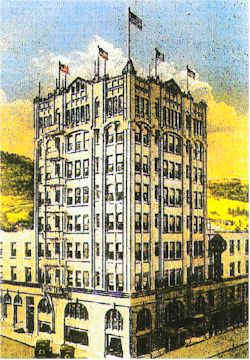
Two nights on the Hudson isn't nearly enough to suit me, but it was all the time I could spare this season. America is a big country, and it's never bigger than when you're going directly from the Hudson Valley Shakespeare Festival to the Oregon Shakespeare Festival with no stops in between. No playgoing stops, that is: on Thursday I ate a hearty breakfast in Mountainville, drove to the train station in Beacon, took a commuter train from there to Grand Central Station, caught a cab from there to LaGuardia Airport, flew to Denver, spent two hours waiting for a thunderstorm to blow over, flew to Oregon, picked up a rental car, drove to the Ashland Springs Hotel, and went straight to bed, having spent a grand total of eighteen hours getting from one coast to the other.
I fell hard for Ashland when I went there for the first time three years ago, and I haven't changed my mind. It's an immaculately kept little town whose business district seems to consist mainly of first-class restaurants, of which Amuse and Chateaulin remain my favorites. You can see all the plays you want in between meals--the Oregon Shakespeare Festival performs in three different theaters--and you can walk just about everywhere without difficulty, though you do need a car to get to Mount Ashland, the 7,533-foot-high peak to whose summit I hiked last Saturday morning.
Really. No fooling.
(To be continued)
Posted June 29, 12:00 AM
TT: Another little taste
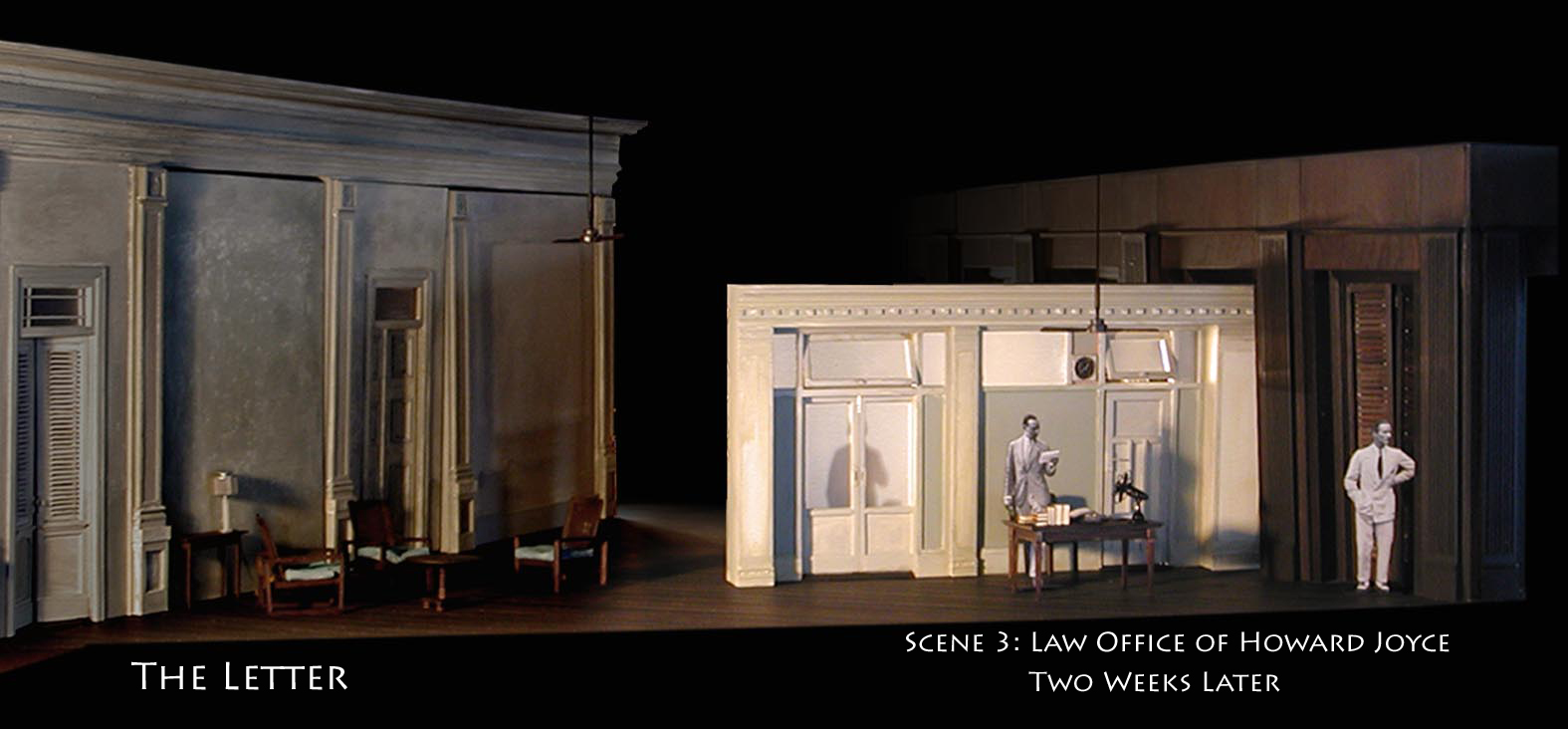
I recently posted a photo of the scale model of Hildegard Bechtler's set for the first and second scenes of The Letter, which take place in the living room of the home of Leslie Crosbie, who shoots her faithless lover dead as the opera begins. Here's the set for the third and sixth scenes, which take place in the Singapore office of Howard Joyce, Leslie's lawyer and her husband's best friend:

Since The Letter plays continuously without a break, the sets are designed to be changed quickly in full view of the audience. The wall unit at downstage left is rolled on from the wings.
* * *
Anne Constable wrote a story for Sunday's Santa Fe New Mexican that tells how the Santa Fe Opera's technical and property crews go about building the sets and props for the company's productions. Needless to say, I was especially interested in the part about The Letter, but the whole piece makes for fascinating reading.
Posted June 29, 12:00 AM
TT: Almanac
"Critics are like brushers of noblemen's clothes."
George Herbert, Jacula Prudentum
Posted June 29, 12:00 AM
June 26, 2009
TT: Heart transplant
Today's Wall Street Journal drama column is devoted in its entirety to a Chicago-area show, Writers' Theatre's premiere production of A Minister's Wife. Here's an excerpt.
* * *
Music was George Bernard Shaw's first love, and he claimed that his plays were operas in disguise. Yet few composers have found inspiration in the chilly glitter of his dialogue, and only one musical version of a Shaw play, "My Fair Lady," has hit the bull's-eye--until now. Austin Pendleton, Josh Schmidt and Jan Tranen have turned "Candida" into a chamber musical called "A Minister's Wife" that is the talk of Chicagoland. No doubt it will find its way to New York in time, though I wouldn't wait for that to happen if I were you. Not only is "A Minister's Wife" the most fully realized piece of musical theater to come along since "The Light in the Piazza," but I can't imagine anyone improving on the quiet delicacy of Writers' Theatre's premiere production....
What the makers of "A Minister's Wife" have added to "Candida" is the warmth that its author left out--yet they have accomplished this transformation without doing violence to the letter of Shaw's play. Mr. Pendleton, the author of "Orson's Shadow," has done a remarkable job of compressing a tightly written three-act play into an even tighter one-act libretto that runs for roughly 90 intermission-free minutes. No less striking are Ms. Tranen's plain-spoken yet poignant lyrics, which heighten the emotions concealed in Shaw's neatly turned prose...
Josh Schmidt first came to the attention of New York audiences two seasons ago with his score for "Adding Machine," a musical so glitteringly crafted that I initially took its self-assurance for glibness. No one will make that mistake about the music that Mr. Schmidt has written for "A Minister's Wife." Atop a crisply chattering minimalist-style instrumental accompaniment that evokes the typewriter used by Morell's secretary to transcribe his sermons, Mr. Schmidt flings long, tender arcs of melody that cling to the ear like phrases from old love letters. The results are at once strongly contemporary and immediately engaging....
* * *
Read the whole thing here.
Posted June 26, 12:00 AM
TT: How dances disappear
Merce Cunningham, who turned ninety this year, has announced that his world-famous dance company will be disbanded after he dies. That's a big story, bigger than you might think if you don't follow dance closely. Most choreographers, after all, do their best to ensure that their companies will outlive them. Why has Cunningham decided otherwise? Because he thinks his dances have a better chance of surviving over the long haul if his associates concentrate on making them available to other companies instead of keeping his own troupe going.
This decision is the subject of my "Sightings" column for Saturday's Wall Street Journal, in which I talk about the inherent fragility of dance--and what choreographers can do to circumvent it. To see what I have to say, pick up a copy of tomorrow's Journal.
UPDATE: Read the whole thing here.
* * *
An excerpt from Cunningham's "Beach Birds for Camera," danced by the Merce Cunningham Dance Company:
Posted June 26, 12:00 AM
TT: Almanac
"What makes old age hard to bear is not the failing of one's faculties, mental and physical, but the burden of one's memories."
W. Somerset Maugham, Points of View
Posted June 26, 12:00 AM
June 25, 2009
TT: Now's the time
The Letter opens one month from today. Next week Commentary runs an essay by me called "A Critic Takes a Bow." This is the first paragraph:
On July 25, I expect to step from the wings of an opera house perched atop a 6,900-foot-high mesa in New Mexico, walk to center stage, look out at two thousand people and take the first curtain call of my adult life. The occasion will be the premiere of The Letter, an opera by the composer Paul Moravec that is based on W. Somerset Maugham's 1927 play of the same name and for which I have written the words. If all goes well, the members of the audience will be cheering by the time that Paul and I appear on stage. If not, my career as an opera librettist will come to an abrupt and inglorious end.
And how do I feel about this fast-approaching set of mutually exclusive alternatives? Pretty good, actually, though I'm sure it helps that I'm too busy to think about it very much. Not so Paul, who is spending the week going through the orchestral parts of The Letter in search of microscopic mistakes. I ran into him at the gym on Monday and asked how he was feeling. "I'm still having a lot of dreams about the opera," he replied, "but they're not as bad as they used to be." On Tuesday the two of us dined together--it'll be the last time we see one another until we meet in Santa Fe--and drew up a list of the ten funniest movies ever made. (We agreed on His Girl Friday, The In-Laws, Some Like It Hot, This Is Spinal Tap, and Tootsie.) Next to nothing was said about The Letter.
As for me, I haven't had a single dream about our opera, good, bad, or indifferent, which may or may not bespeak a certain lack of imagination on my part. I know perfectly well that the whole thing could blow up in our faces--but I don't think it will. No, I'm not sure that it's going to be a hit. I do, however, feel sure of our craftsmanship, by which I mean that I think The Letter is a solid piece of work. Some people will like it, others won't, but I expect that everyone in the opening-night audience, critics included, will take what we've done seriously and respond accordingly.
And after that...what? I haven't a clue, nor do I much care, at least for the moment. "Why are you stingy with yourselves?" George Balanchine used to ask his dancers. "Why are you holding back? What are you saving for--for another time? There are no other times. There is only now. Right now." That's how I feel about The Letter. For me, the clock stops on July 25.
Posted June 25, 12:00 AM
TT: So you want to see a show?
Here's my list of recommended Broadway, off-Broadway, and out-of-town shows, updated weekly. In all cases, I gave these shows favorable reviews (if sometimes qualifiedly so) in The Wall Street Journal when they opened. For more information, click on the title.
Warning: Broadway shows marked with an asterisk were sold out, or nearly so, last week.
BROADWAY:
• Alfred Hitchcock's The 39 Steps (comedy, G, suitable for bright children, reviewed here)
• Avenue Q (musical, R, adult subject matter and one show-stopping scene of puppet-on-puppet sex, reviewed here)
• God of Carnage * (serious comedy, PG-13, adult subject matter, closes July 19, then reopens Sept. 8 and runs through Nov. 15, reviewed here)
• The Little Mermaid * (musical, G, entirely suitable for children, reviewed here)
• Mary Stuart (drama, G, far too long and complicated for children, closes Aug. 16, reviewed here)
• The Norman Conquests * (three related comedies, PG-13, comprehensively unsuitable for children, playing in repertory and extended through July 26, reviewed here)
• South Pacific * (musical, G/PG-13, some sexual content, brilliantly staged but unsuitable for viewers acutely allergic to preachiness, reviewed here)
OFF BROADWAY:
• Coraline (musical, G, possibly too scary for small children and very problematic for twee-hating adults, reviewed here)
• The Fantasticks (musical, G, suitable for children capable of enjoying a love story, reviewed here)
• Our Town (drama, G, suitable for mature children, reviewed here)
• The Rivalry (historical drama, G, too complicated for children, reviewed here)
• Ruined (drama, PG-13/R, sexual content and suggestions of extreme violence, extended through Aug. 2, reviewed here)
IN CHICAGO:
• The History Boys (drama, PG-13/R, adult subject matter, too intellectually complex for most adolescents, extended through Sept. 27, reviewed here)
CLOSING SOON ON BROADWAY:
• Waiting for Godot * (drama, PG-13, accessible to intelligent and open-minded adolescents, closes July 12, reviewed here)
CLOSING NEXT WEEK IN HARTFORD, CONN:
• Dividing the Estate (black comedy, PG-13, closes July 5, reviewed here)
CLOSING SUNDAY IN WASHINGTON, D.C.:
• Design for Living (comedy, PG-13, adult subject matter, reviewed here)
CLOSING SUNDAY ON BROADWAY:
• August: Osage County (drama, R, adult subject matter, reviewed here)
Posted June 25, 12:00 AM
TT: Almanac
"The difference between a moral man and a man of honor is that the latter regrets a discreditable act, even when it has worked and he has not been caught."
H.L. Mencken, Prejudices, Fourth Series
Posted June 25, 12:00 AM
June 24, 2009
TT: A little taste
Here's a photograph of the scale model of Hildegard Bechtler's set for the opening scene of The Letter. The first thing the audience hears is gunfire on a darkened stage. Then the lights come up:

Cool, huh?
Posted June 24, 1:02 PM
TT: Home-style rock
Erin McKeown, the singer-songwriter who has been praised many times in this space, is presenting a series of four live house concerts over the Web in order to raise funds to underwrite the release of her next album, Hundreds of Lions.
Says McKeown:
My new record, Hundreds of Lions, was made on my own dime and my own time, with no influence, input, or manipulation from any outside source. It has meant so much to me to be able to record the music I've written just as I imagined it to sound, with nothing lost in the translation.
The series, which McKeown calls "Cabin Fever," will be aired on July 7 at seven p.m., July 16 at noon, July 22 at three p.m., and July 26 at five p.m. All times are EST and all performances will be telecast live from McKeown's home in western Massachusetts. Tickets are $10 per show or $30 for the complete series.
For more information, go here.
* * *
Here's a video trailer for "Cabin Fever":
Posted June 24, 12:00 AM
TT: Snapshot
Francis Poulenc, Jacques Février, Georges Prêtre and the Orchestra National de la RTF perform the first movement of Poulenc's Two-Piano Concerto. Poulenc is the pianist on the left:
(This is the latest in a weekly series of arts-related videos that appear in this space each Wednesday.)
Posted June 24, 12:00 AM
TT: Almanac
"I don't care for success. The ideas sitting in my head are annoyed by, and envious of, that which I've already written."
Anton Chekhov, letter to A.S. Suvorin (Oct. 27, 1888)
Posted June 24, 12:00 AM
June 23, 2009
TT: Summit meeting
Most jazz musicians have had at least some experience playing classical music, but it's unusual for them to record it. When they do, it tends to be in the form of the jazzing-the-classics adaptations that I wrote about in a 2007 "Sightings" column for The Wall Street Journal occasioned by the first reissue of the rare 78s of a wonderful little combo called the New Friends of Rhythm:
The New Friends of Rhythm was an instrumental septet led by Alan Shulman, a cellist and composer who was a charter member of Arturo Toscanini's NBC Symphony. It consisted of a harpist, a string quartet and a jazz rhythm section, and it played very hip arrangements of well-known pieces of classical music to which Shulman affixed such zany titles as "Bach Bay Blues" and "Shoot the Schubert to Me, Hubert." The group's records were so successful that in 1940 it got written up in Time, which revealed that its members were known at NBC as "Toscanini's hep cats."In those days, of course, the classics got jazzed on a regular basis. Some of the most popular songs of the '30s and '40s, including "The Lamp Is Low" and "My Reverie," were based on such classical compositions as Ravel's "Pavane for a Dead Princess" and Debussy's "Rêverie." The practice became so common that Ayn Rand, whose virtues are not known to have included a sense of humor, took a shot at it in Atlas Shrugged, in which she grumpily described an imaginary pop record based on a piano concerto by a fictional composer named Richard Halley: "It was as if a handful of mud and pebbles had been flung at the music, and what followed was the sound of the rolling and the dripping....It was Halley's melody torn apart, its holes stuffed with hiccoughs. The great statement of joy had become the giggling of a barroom."
The real-life record Rand undoubtedly had in mind was Freddy Martin's "Concerto in B Flat," based on the first movement of the Tchaikovsky B-Flat Minor Piano Concerto, which was one of the biggest sellers of 1941. It is, if truth be told, pretty sappy. But when bona fide jazz musicians reworked the classics, the results could be delightful. Art Tatum's dapper stride-piano version of Dvorak's "Humoresque" (which you can see him playing on YouTube) is as elegant as a tightly rolled umbrella, while the King Cole Trio's recording of Rachmaninoff's Prelude in C-Sharp Minor is one of the most ingenious jazz arrangements of a classic ever to be committed to disc....
"Humoresque," needless to say, wasn't Tatum's only recorded excursion into the classics, and I'd heard for years that on occasion he even played Chopin. In 2006 Storyville Records confirmed the rumor by releasing an album that contained a highly personal reinterpretation of Chopin's C-Sharp Minor Waltz, Op. 64/2, recorded in a Toronto nightclub in 1949. Now some anonymous benefactor has posted that audio-only track on YouTube, and it proves, not surprisingly, to be a fascinating and treasurable document of Tatum's style.
Here it is:
Posted June 23, 12:00 AM
TT: Almanac
"Talent is recognizable not only by quality, but also by the quantity it yields."
Anton Chekhov, letter to P.A. Sergeenko (Mar. 6, 1889)
Posted June 23, 12:00 AM
June 22, 2009
TT: Somewhere along the way
Mrs. T and I flew to Chicago last week to see Writers' Theatre's production of A Minister's Wife, a musical version of George Bernard Shaw's Candida by Austin Pendleton, the author of Orson's Shadow, and Joshua Schmidt, the composer of Adding Machine. (If you go to the show, eat at Prairie Grass Cafe first.) I had a cold when we left New York, Mrs. T caught it the day after we arrived in Chicago, and it was raining throughout most of our two-night stay, so instead of lining up at Hot Doug's and paying a visit to the new wing of the Art Institute of Chicago, we holed up in a hotel room across the highway from Glencoe, the suburb where Writers' Theatre is located.
The sun came out long enough on Friday for us to drive to Ravine Bluffs Development, a Glencoe neighborhood that contains six Frank Lloyd Wright houses built in 1915, all of them beautiful, most in good repair, and two for sale. (The second, alas, is being sold "as is," meaning that it may be bought for the land and torn down.)
We returned to the East Coast the next day and headed in different directions, Mrs. T to Connecticut and I to New York, where I had planned to see Twelfth Night in Central Park. No such luck: Sunday's performance was rained out, though not before I got soaked to the skin. Tomorrow we meet again, this time to catch Pericles and Much Ado About Nothing at the Hudson Valley Shakespeare Festival, one of our favorite summer stops. Then I fly to the West Coast to see shows in Los Angeles and San Diego and at the Oregon Shakespeare Festival. From there I'll be on the move more or less continuously until I report to Santa Fe to rehearse The Letter, which opens on July 25.
I get tired just thinking about all those plane rides, though I have something even more horrendous awaiting me in December: I'll be speaking about Pops on consecutive nights in New York, Los Angeles, Baltimore, and Philadelphia. I'll also be appearing in Boston, and Houghton Mifflin Harcourt is in the process of scheduling additional speaking trips to New Orleans, St. Louis, and Washington, D.C. Be careful what you ask for!
Now if you'll excuse me, I've got to write a drama column, pick up my laundry, pack a bag, and catch a train. Or is it a plane?
* * *
Here's a video about Ravine Bluffs:
Posted June 22, 12:00 AM
TT: Almanac
"When a person expends the least amount of motion on one action, that is grace."
Anton Chekhov, letter to Maxim Gorky (Jan. 3, 1899)
Posted June 22, 12:00 AM
June 19, 2009
TT: Improving on perfection
I review two shows in today's Wall Street Journal drama column, the Hartford Stage transfer of Dividing the Estate and the Encores! revival of The Wiz. Here's an excerpt.
* * *
You can't be sure how good a work of art is until you've seen it more than once. I saw Horton Foote's "Dividing the Estate" for the third time last week, and it looked better than ever--though I have no doubt that a good-sized chunk of the credit this time around goes to Lois Smith. Ms. Smith, whose performance in the Signature Theatre Company's unforgettable 2005 Off-Broadway revival of Foote's "The Trip to Bountiful" was a high-water mark in my playgoing life, has taken over Elizabeth Ashley's role in Hartford Stage's production of "Dividing the Estate," which is otherwise a straight transfer of the Lincoln Center Theatre staging seen on Broadway last winter. Ms. Ashley is, of course, a tough act to follow, but Ms. Smith does so triumphantly. In fact, she might just be better than her celebrated predecessor--and that's saying plenty....
It's been 13 years since Lois Smith last appeared on Broadway ("The Trip to Bountiful" was supposed to transfer there, but no theater was available at the time). That alone is reason enough to go to Hartford to see her. She seasons the role of Stella with a savory pinch of mischief--you can tell that she enjoys toying with her offspring--that heightens the pathos of her character's imminent rendezvous with death. Her Stella is neither Gothic nor grotesque, merely human, and the relish with which she clings to what remains of her long life is unutterably poignant.
The other members of the ensemble cast have been working together since this production first opened Off Broadway in 2007, yet they show no signs of ennui. If anything, they've managed to improve on what I previously thought couldn't be bettered....
The original Broadway production of "The Wiz," the 1975 all-black rewrite of "The Wizard of Oz," ran for 1,672 performances. The 1984 revival closed after two weeks. While I suspect that says all that needs to be said about the modest staying power of "The Wiz," anyone who cares to see for himself is more than welcome to drop a hundred bucks on Encores! Summer Stars' production. The singing is terrific, but the songs sound like bonus tracks from "Great TV Themes of the '70s," and Andy Blankenbuehler's busy but aimless dances never seem to go anywhere....
* * *
Read the whole thing here.
Posted June 19, 12:00 AM
TT: Almanac
"Tastes differ so widely, and some people are so humorless, so uncharitable, and so absurdly wrong-headed, that one would probably do far better to relax and enjoy life than worry oneself to death trying to instruct or entertain a public which will only despise one's efforts, or at least feel no gratitude for them. Most readers know nothing about literature--many regard it with contempt. Lowbrows find everything heavy-going that isn't completely low-brow. Highbrows reject everything as vulgar that isn't a mass of archaisms. Some only like the classics, others only their own works. Some are so grimly serious that they disapprove of all humor, others so half-witted that they can't stand wit. Some are so literal-minded that the slightest hint of irony affects them as water affects a sufferer from hydrophobia. Others come to different conclusions every time they stand up or sit down. Then there is the alcoholic school of critics, who sit in public houses, pronouncing 'ex cathedra' verdicts of condemnation, just as they think fit. They seize upon your publications, as a wrestler seizes upon his opponent's hair, and use them to drag you down, while they themselves remain quite invulnerable because their barren pates are completely bald--so there's nothing for you to get hold of."
Sir Thomas More, Utopia (courtesy of Einar Sunde)
Posted June 19, 12:00 AM
June 18, 2009
TT: Big break
I've been writing with steadily growing enthusiasm about Kate Whoriskey ever since 2005, when Washington's Shakespeare Theatre invited her to stage The Tempest:
Kate Whoriskey, the director, may fancy herself a purveyor of ideas, but in fact she's something infinitely more precious--a natural-born stage magician....This "Tempest" is clearly the work of a youngish director (she's 34) who has yet to learn the lesson of economy. But it doesn't matter, since she nails together all the elements of what looks to me like a very expensive production with an absolute assurance that would be enviable in an old pro and is downright astonishing in a new face.
More recently, Whoriskey directed the production of Lynn Nottage's Ruined currently playing at New York's City Center, on which occasion I called her "a director of extraordinary talent whose work deserves to be seen far more often in New York." I still think so, but now it looks like I'll have to fly to the West Coast to see what she's up to: Seattle's Intiman Theatre just announced that starting in 2010, Whoriskey will become its next artistic director, replacing the much-admired Bartlett Sher.
This is very big news for a very important regional theater, and as far as I'm concerned it's 100% good. I can't wait to see what Whoriskey does with Intiman. My congratulations to an immensely promising young artist.
Posted June 18, 10:10 AM
TT: Fifteen books in fifteen minutes
CAAF passed on this meme:
Rules: Don't take too long to think about it. Fifteen books you've read that will always stick with you. First fifteen you can recall in no more than fifteen minutes.
Her picks:
Charlotte Brontë's Jane Eyre
Vladimir Nabokov's Pale Fire
Leonora Carrington's The Hearing Trumpet
Mary Gaitskill's Veronica
Joan Aiken's Wolves of Willoughby Chase
Katherine Dunn's Geek Love
A.S. Byatt's Possession
Julio Cortázar's Hopscotch
Thomas Pynchon's Gravity's Rainbow
Charles Dickens' David Copperfield
J.D. Salinger's Nine Stories
George Eliot's Middlemarch
Bert Hölldobler/ E.O. Wilson's Journey to the Ants
Angela Carter's The Bloody Chamber
Samuel R. Delany's Stars In My Pocket Like Grains of Sand
My picks:
Flannery O'Connor's Wise Blood
James Gould Cozzens' Guard of Honor
Boswell's Life of Johnson
Anthony Trollope's The Way We Live Now
John P. Marquand's Point of No Return
Barbara Pym's A Glass of Blessings
Evelyn Waugh's Sword of Honour (yes, it's a trilogy, but I first read it in the one-volume omnibus version)
Dawn Powell's The Locusts Have No King
F. Scott Fitzgerald's The Great Gatsby
Raymond Chandler's The Long Goodbye
Clement Greenberg's Collected Essays and Criticism (a four-volume set, but I think of it as a single work)
George Orwell's Collected Essays, Journalism and Letters (ditto)
David Cairns' Berlioz (a two-volume biography, but I think of it as a single work)
Fairfield Porter's Art in Its Own Terms
Edwin Denby's Looking at the Dance
How about you, OGIC?
Posted June 18, 12:00 AM
TT: So you want to see a show?
Here's my list of recommended Broadway, off-Broadway, and out-of-town shows, updated weekly. In all cases, I gave these shows favorable reviews (if sometimes qualifiedly so) in The Wall Street Journal when they opened. For more information, click on the title.
Warning: Broadway shows marked with an asterisk were sold out, or nearly so, last week.
BROADWAY:
• Alfred Hitchcock's The 39 Steps (comedy, G, suitable for bright children, reviewed here)
• Avenue Q (musical, R, adult subject matter and one show-stopping scene of puppet-on-puppet sex, reviewed here)
• God of Carnage * (serious comedy, PG-13, adult subject matter, closes July 19, then reopens Sept. 8 and runs through Nov. 15, reviewed here)
• The Little Mermaid * (musical, G, entirely suitable for children, reviewed here)
• Mary Stuart (drama, G, far too long and complicated for children, closes Aug. 16, reviewed here)
• The Norman Conquests * (three related comedies, PG-13, comprehensively unsuitable for children, playing in repertory through July 25, reviewed here)
• South Pacific * (musical, G/PG-13, some sexual content, brilliantly staged but unsuitable for viewers acutely allergic to preachiness, reviewed here)
• Waiting for Godot * (drama, PG-13, accessible to intelligent and open-minded adolescents, closes July 12, reviewed here)
OFF BROADWAY:
• Coraline (musical, G, possibly too scary for small children and very problematic for twee-hating adults, reviewed here)
• The Fantasticks (musical, G, suitable for children capable of enjoying a love story, reviewed here)
• Our Town (drama, G, suitable for mature children, reviewed here)
• The Rivalry (historical drama, G, too complicated for children, reviewed here)
• Ruined (drama, PG-13/R, sexual content and suggestions of extreme violence, extended through Aug. 2, reviewed here)
IN CHICAGO:
• The History Boys (drama, PG-13/R, adult subject matter, too intellectually complex for most adolescents, closes Aug. 2, reviewed here)
CLOSING NEXT WEEK IN WASHINGTON, D.C.:
• Design for Living (comedy, PG-13, adult subject matter, closes June 28, reviewed here)
CLOSING NEXT WEEK ON BROADWAY:
• August: Osage County (drama, R, adult subject matter, closes June 28, reviewed here)
CLOSING SUNDAY IN WASHINGTON, D.C.:
• Arcadia (serious comedy, PG-13, too complicated for children and slow-witted adults, reviewed here)
Posted June 18, 12:00 AM
TT: Almanac
"'I have done that,' says my memory. 'I cannot have done that,' says my pride, and remains inexorable. Eventually--memory yields."
Friedrich Nietzsche, Beyond Good and Evil (courtesy of Richard Brookhiser)
Posted June 18, 12:00 AM
June 17, 2009
TT: In honor of Igor Stravinsky's birthday
The composer conducts an excerpt from Firebird in 1965:
Posted June 17, 9:57 PM
TT: Snapshot
A silent film clip of Camille Saint-Saëns conducting, shot circa 1915. This excerpt from Sacha Guitry's film Ceux de chez nous is narrated in French by Guitry:
(This is the latest in a weekly series of arts-related videos that appear in this space each Wednesday.)
Posted June 17, 12:00 AM
TT: Almanac
"I find it impossible to think of 'favorite' poets. I would rather list the ones I cannot stand."
Billy Collins, online interview with Kritya: A Journal of Poetry (courtesy of Elly Richards)
Posted June 17, 12:00 AM
June 16, 2009
OGIC: Fortune cookie
"'Everyone minds here. They mind so much, they mind all the time, they mind like anything. They mind the step and they mind the door, and they d'you mind if I just. And there they were, poor dears, minding like mad. Everyone minds; but no one understands. They cannot understand what could have possessed such an odd couple to behave so curiously; it's all too hopeless, clueless, fatal, futile. The opposite from us Americans. We understand everything. We're always understanding. It's the thing to do. We can immediately see why the poor kid flipped after the raw deal she got. And what's more, when you come right down to it, we understand his compulsions too.'"
Elaine Dundy, The Old Man and Me
Posted June 16, 12:00 AM
TT: You could look it up
This list of the fifty words appearing in the New York Times that are most frequently looked up by the paper's readers has been making the rounds. I use twenty-six of the words often enough to describe them as part of my working vocabulary: apoplectic, apotheosis, banal, enervating, ersatz, feckless and fecklessness, fungible, glut, inchoate (one of my all-time favorite words), interlocutor, hagiography and hagiographic, laconic, louche, neologisms, peripatetic, peroration, recondite, risible, sanguine, sartorial, schadenfreude, shibboleths, and solipsistic and solipsism (remember The Tao of Steve?).
Inquiring minds want to know: how is it possible that 1,865 readers of the New York Times don't know what banal means?
UPDATE: A reader writes:
The list is probably skewed by younger readers since it only registers online activity. We codgers, who read the print version, are not reflected in the count. Codgers have had more opportunities to learn words like louche and feckless.
Makes sense to me.
* * *
This is the trailer from The Tao of Steve:
Posted June 16, 12:00 AM
TT: Almanac
"I have never been adventurous; I need to be quiet in order to be free."
George Santayana, Persons and Places (courtesy of Anecdotal Evidence)
Posted June 16, 12:00 AM
June 15, 2009
TT: Next to Norman
A reader who read my enthusiastic review of the Tony-winning Broadway revival of Alan Ayckbourn's The Norman Conquests sent me the following e-mail:
My piggybank is long broken and since I have a two-year-old, I couldn't get to see the three plays anyway. But I vividly remember the incomparable Tom Conti in the role from maybe thirty years ago on PBS, and would like to see the plays again on TV. I can't find the DVDs on Amazon or Netflix.A post on ALN might kick start the effort to reissue--and if you could somehow noodge the University of Chicago Press to speed up the re-release of the Parker books, all the better.
My correspondent is referring to the televised version of The Norman Conquests that aired in England in 1977 and in the United States shortly thereafter. It was released on videocassette and, later, on Region 2 DVD, but is not currently available in this country in any format. Used copies of the VHS version are thin on the ground. I'd love to see it reissued, though I'm not hanging by my thumbs.
In the meantime, you might want to take a look at Coeurs, Alain Resnais' 2006 film version of Ayckbourn's Private Fears in Public Places, which is available on DVD and is also shown fairly often on the Independent Film Channel. It's a surprisingly faithful French-language adaptation of the play, different in tone from the original but very effective in its own way.
As for Donald Westlake's Parker novels, they're on the way, three at a time, with the next batch coming in August. Be patient!
* * *
Here are excerpts from all three installments of the TV version of The Norman Conquests.
Table Manners:
Living Together:
Round and Round the Garden:
Posted June 15, 12:00 AM
TT: Almanac
"Art is a human activity consisting in this, that one consciously, by means of certain external symbols, conveys to others the feelings one has experienced, whereby people so infected by these feelings, also experience them."
Leo Tolstoy, What Is Art?
Posted June 15, 12:00 AM
June 14, 2009
TT: None better
Evelyn Teachout, my mother, turned eighty today. As soon as I realized that my out-of-town reviewing schedule would make it all but impossible for me to be in Smalltown, U.S.A., for her birthday, I arranged instead to spend a week there in May between trips to Texas and Washington, D.C. I figured that she'd rather have me at home for several days in a row than have me parachute into Smalltown for the Big Day and leave in haste a few scant hours later. I figured right--Mom preferred the first option--but I still felt a pang when I woke up this morning and knew that I wouldn't be present in person to pay tribute to the woman who made me what I am.
I've lived long enough to discover that many, perhaps most people have complicated and largely unsatisfactory relationships with their mothers. Not me. Mine is simple, straightforward, and profoundly gratifying. Sigmund Freud, who was right about a few things, wrote in "A Childhood Recollection of Dichtung und Wahrheit" that "if a man has been his mother's undisputed darling he retains throughout life the triumphant feeling, the confidence in success, which not seldom brings actual success along with it." This doesn't quite apply to me--my mother has always loved my brother and me equally--but it's true that from childhood onward, she left both of us in no doubt of her unconditional love. What's more, she always gave the impression of taking it for granted that Dave and I could do anything to which we set our minds and hands.
Not that her confidence was oppressive: Mom also made it clear that whatever my brother and I ended up doing would be perfectly fine with her. As a result, she inspired us instead of crushing us, and the fact that she has lived long enough to see how the two of us turned out is one of the greatest joys of my middle age.
My mother has given me countless other gifts through the years, starting with the gift of a sense of humor. I was, she says, an earnest little boy who was disinclined to laugh at much of anything, and she worked overtime to teach me how to smile at the myriad absurdities of the world, a lesson that I like to think I learned well. I'm returning the favor half a lifetime later: I call Mom from wherever I am most nights, and every time I do so, I always do my best to make her laugh, usually with success.
Some debts are beyond repayment, but I tossed a penny on the scales when I wrote the last paragraph of Pops: A Life of Louis Armstrong:
Above all I thank my mother, who called me into the living room of our Missouri home one Sunday night and sat me down in front of the TV, on which Louis Armstrong was singing "Hello, Dolly!" on The Ed Sullivan Show. "This man won't be around forever," she said. "Someday you'll be glad you saw him." That was back when the public schools in my home town were still segregated, two decades after a black man had been dragged from our city jail, hauled through the streets at the end of a rope, and set afire. Yet even in a place where such a monstrous evil had been wrought, my mother came to love Armstrong--and, just as important, to respect him--not merely for the beauty of the music he made but also for the goodness of the man who made it. I wrote this book so that she, and others like her, might know more about the man they loved.
Mom hasn't gotten that far in the advance reading copy of Pops that Houghton Mifflin Harcourt sent her a couple of weeks ago. "I put you on the last page," I told her the other day, to which she replied, "Well, I'm not going to look. I'm going to save it until the end." Nor will she see this posting: she doesn't go in for computers. So now you know something she doesn't, as well as something that I've told her many times: I think I have the best mother in the world. May she be around twenty years from now to hear me say it yet again!
Posted June 14, 11:03 AM
TT: Almanac
"Would that such exercises in timeliness were a mere aberration caused by the intense feelings of the moment. Alas, they have always been with us, especially in wartime and most especially in America, far too many of whose well-meaning citizens are allergic to the exhilarating fizz of high art with a light touch. It seems not to occur to them that life is such an indissoluble mixture of heartbreak and absurdity that it might be more truly portrayed through the refracting lens of comedy. Instead, they prefer what Lord Byron, who knew a thing or two about both life and art, would have crisply dismissed as 'sermons and soda-water.'"
Terry Teachout, "The Importance of Being Less Earnest" (from A Terry Teachout Reader)
Posted June 14, 12:00 AM
June 13, 2009
TT: Clap and be damned
Is it all right to applaud in between the movements of a symphony--or when an actor in a play does something that pleases you? I got a letter from a reader the other day who came to New York to see the Broadway revival of Waiting for Godot and was surprised when the audience applauded the entrances of Nathan Lane, Bill Irwin, and John Goodman. Was that inappropriate, given the fact that Godot is a famously dark and disturbing play about the existential dilemmas of humankind? Or should audiences be encouraged to respond more freely to what they see and hear on stage?
I gave some thought to blogging about these questions, but then it occurred to me to write a "Sightings" column for today's Wall Street Journal in which I sound off on the problem--if it is one--of inappropriate applause. Pick up a copy of the Journal and see what I have to say.
UPDATE: Read the whole thing here.
Posted June 13, 12:00 AM
June 12, 2009
TT: Listening to Lincoln
I spent last weekend in New York seeing two shows, the Irish Repertory Theatre's revival of Norman Corwin's The Rivalry and Playwrights Horizons' New York premiere of Theresa Rebeck's Our House, and I report on them in today's Wall Street Journal drama column. Here's an excerpt.
* * *
Most educated people have heard of the Lincoln-Douglas debates, but how many know anything about them beyond the fact that they were about slavery? Even if you're not in need of a refresher course, I suggest you pay a visit to the Irish Repertory Theatre's revival of "The Rivalry," Norman Corwin's 1959 play about seven debates that changed a nation's course. Yes, it's a history lesson, but a painless one that, unlike most latter-day docudramas, sticks surprisingly close to the truth.
Mr. Corwin, who turned 99 last month, is a near-forgotten giant of golden-age radio, the author of "The Plot to Overthrow Christmas" and the man on whom CBS called in 1945 when it wanted to commission a play to celebrate V-E Day. After TV put an end to radio drama, Mr. Corwin turned to other pursuits, writing the screenplay for "Lust for Life," Vincente Minnelli's marvelous 1956 biopic about the life of Vincent Van Gogh. Three years later he took a shot at the legitimate stage with "The Rivalry," which ran for only 81 performances on Broadway but has since had a vigorous afterlife in regional theaters around the country....
So why not just stay home and read the transcripts? Because, among other things, you'll be depriving yourself of the chance to see Christian Kauffmann impersonate Lincoln. Not only does he bear a close physical resemblance to the man he plays, but his homespun, humorous acting is utterly plausible. Unlike the secular saint portrayed by Henry Fonda in John Ford's "Young Mr. Lincoln," Mr. Kauffmann's Lincoln is recognizably human, and even when he's flinging great shafts of rhetoric across the platform, he still seems like a small-town lawyer who has been ennobled by fate....
Theresa Rebeck's latest play is yet another toothless satire about the mindlessness of pop culture. "Our House" invites us to sneer at the nefarious activities of a network TV executive (Christopher Evan Welch) who decides to boost the sagging ratings of one of his news programs by ordering its sexy anchorwoman (Morena Baccarin) to cover reality TV as if it were real news. What follows is a minor miracle of mediocrity, a play in which no one says or does anything unpredictable...
* * *
Read the whole thing here.
Posted June 12, 12:00 AM
TT: Almanac
"The Art Snob can be recognized in the home by the quick look he gives the pictures on your walls, quick but penetrating, as though he were undressing them. This is followed either by complete and pained silence or a comment such as 'That's really a very pleasant little water color you have there.'"
Russell Lynes, Snobs
Posted June 12, 12:00 AM
June 11, 2009
TT: So you want to see a show?
Here's my list of recommended Broadway, off-Broadway, and out-of-town shows, updated weekly. In all cases, I gave these shows favorable reviews (if sometimes qualifiedly so) in The Wall Street Journal when they opened. For more information, click on the title.
Warning: Broadway shows marked with an asterisk were sold out, or nearly so, last week.
BROADWAY:
• Alfred Hitchcock's The 39 Steps (comedy, G, suitable for bright children, reviewed here)
• August: Osage County (drama, R, adult subject matter, reviewed here)
• Avenue Q (musical, R, adult subject matter and one show-stopping scene of puppet-on-puppet sex, reviewed here)
• God of Carnage * (serious comedy, PG-13, adult subject matter, closes July 19, then reopens Sept. 8 and runs through Nov. 15, reviewed here)
• The Little Mermaid * (musical, G, entirely suitable for children, reviewed here)
• Mary Stuart (drama, G, far too long and complicated for children, closes Aug. 16, reviewed here)
• The Norman Conquests * (three related comedies, PG-13, comprehensively unsuitable for children, playing in repertory through July 25, reviewed here)
• South Pacific * (musical, G/PG-13, some sexual content, brilliantly staged but unsuitable for viewers acutely allergic to preachiness, reviewed here)
• Waiting for Godot * (drama, PG-13, accessible to intelligent and open-minded adolescents, closes July 12, reviewed here)
OFF BROADWAY:
• Coraline (musical, G, possibly too scary for small children and very problematic for twee-hating adults, reviewed here)
• The Fantasticks (musical, G, suitable for children capable of enjoying a love story, reviewed here)
• Our Town (drama, G, suitable for mature children, reviewed here)
• Ruined (drama, PG-13/R, sexual content and suggestions of extreme violence, extended through Aug. 2, reviewed here)
IN CHICAGO:
• The History Boys (drama, PG-13/R, adult subject matter, too intellectually complex for most adolescents, closes Aug. 2, reviewed here)
CLOSING SOON IN WASHINGTON, D.C.:
• Design for Living (comedy, PG-13, adult subject matter, closes June 28, reviewed here)
CLOSING NEXT WEEK IN WASHINGTON, D.C.:
• Arcadia (serious comedy, PG-13, too complicated for children and slow-witted adults, closes June 21, reviewed here)
CLOSING SATURDAY IN STAUNTON, VA.:
• Rosencrantz and Guildenstern Are Dead (serious comedy, PG-13, too complicated for children, reviewed here)
CLOSING SUNDAY IN DALLAS:
• Lost in the Stars (musical, PG-13, reviewed here)
CLOSING SUNDAY IN HOUSTON:
• Awake and Sing! (drama, PG-13, reviewed here)
CLOSING SUNDAY ON BROADWAY:
• Exit the King * (disturbingly black comedy, PG-13, reviewed here)
• Joe Turner's Come and Gone * (drama, PG-13, some adult subject matter, accessible to adolescents with mature attention spans, reviewed here)
Posted June 11, 12:00 AM
TT: Almanac
"If the world were clear, art would not exist."
Albert Camus, The Myth of Sisyphus (trans. Justin O'Brien)
Posted June 11, 12:00 AM
June 10, 2009
TT: Help!
Have any of the readers of this blog seen this film? Has it ever been transferred to videocassette or DVD? Do any prints survive?
Posted June 10, 3:01 PM
TT: A very small world
When I visited Ontario last week to review the Stratford Shakespeare Festival, I tweeted that I was in town. Seconds later I was reading a direct message from Sandra Mogensen, a Stratford-based pianist and opera coach:
Very exciting in the past week or so--working on "The Letter" w/Rog after reading so much about it in "About Last Night." (Mittfuls o' notes!)
It took a moment for the coin to drop, but then I laughed out loud: "Rog" is Roger Honeywell, the tenor who's creating the role of Geoff Hammond, the faithless lover who gets shot in The Letter. ("Mittfuls o' notes" refers to the fact that the piano-vocal score of the opera, like most two-handed reductions of a piece of music originally written for full orchestra, is hard to play.)
I'd never met Roger and had no idea that he lived in Stratford. Now, thanks to Twitter, I was in touch with his coach, and a day later I was sitting in the living room of his house, which was a two-minute drive from the hotel where Mrs. T and I were staying. Not at all surprisingly, he turned out to be a great guy, forthright and funny, and the two of us talked shop for a couple of hours while his delightful wife fed us homemade chocolate candy. (The three of us also caught a bat that flew into the house midway through my visit. "I'll help--I'm a full-service librettist," I obligingly informed my hostess.) I learned in the course of the conversation that Roger had been a professional actor before he took up opera singing, a credential that I expect will serve him very well when he gets up on stage with Patricia Racette, the star of The Letter and one of the finest singing actresses I know.
I don't believe in omens, but if I did, I'm sure I would have concluded on the spot that meeting Roger in so serendipitous a manner filled the bill. Truth to tell, though, the creation of The Letter has felt like one long string of omenesque occurrences. Hardly anything has gone wrong since the Santa Fe Opera commissioned Paul Moravec and me to turn Somerset Maugham's play into an opera, and now that the first performance is six short weeks away, I'm finding it increasingly difficult to believe that things are continuing to go so smoothly. Yesterday the company e-mailed me the proofs of the ten-page section of the 2009-10 program booklet that will be devoted to The Letter, and I was thrilled--stunned, really--by how beautifully it was designed. I keep expecting something terrible to happen as the premiere draws near, theater being what it is, but so far, everything is going fabulously, improbably well.
As for Sandra, she popped by my hotel the next morning to present me with her latest CD, a collection of solo pieces and song transcriptions by Edvard Grieg. I haven't had a chance to listen to it yet, but I'll be surprised if it's anything other than gorgeous. These days everyone connected with The Letter seems to be on a lucky streak. May it last!
Posted June 10, 12:00 AM
TT: Snapshot
Anna Pavlova dances "The Dying Swan," choreographed by Michel Fokine and set to Camille Saint-Saëns' "The Swan":
(This is the latest in a weekly series of arts-related videos that appear in this space each Wednesday.)
Posted June 10, 12:00 AM
TT: Almanac
"I've seen you, beauty, and you belong to me now, whoever you are waiting for and if I never see you again, I thought. You belong to me and all Paris belongs to me and I belong to this notebook and this pencil."
Ernest Hemingway, A Moveable Feast (courtesy of Marissabidilla)
Posted June 10, 12:00 AM
June 9, 2009
OGIC: Word to the wise
Last week I linked to a finely reported and beautifully written story by Tom French, "Elegy for the King and Queen." Devra Hall, whose site Devra DoWrite has long graced our blogroll, responded by posting links to several additional stories by French, who was her teacher. Devra reveals that French followed "Elegy" with a nine-part series on zoos and animals, "Zoo Story" (linked in her post) and she has sobering reflections on the demise of long-form narrative journalism like French's.
Read her welcome post and follow her links to additional work by "a masterful narrative writer." I spent part of last weekend reading the Pulitzer-winning "Angels and Demons," which absorbed me almost beyond reach, and I'm now halfway through "The Hard Road." Great stuff--thanks for the trove of links, Devra.
Posted June 09, 12:02 AM
TT: Smile when you hum that
"Westerns are timeless. The soundtracks rarely are." Lileks tweeted that pithy two-liner a few weeks ago, and I've been thinking about it ever since. I love Westerns, but most of them have scores that are inoffensive at best, appallingly banal at worst. The exceptions to the rule are as rare as they're noteworthy. The other night Mrs. T and I watched André De Toth's Ramrod, a wonderful little 1947 ranch-war film starring Joel McCrea and Veronica Lake (it wasn't their first film together, by the way). I confess to not having noticed the music when I first saw Ramrod, but this time around I was startled to discover that it was the work of Adolph Deutsch, a very fine composer who also scored The Maltese Falcon and The Apartment, and I was struck by how much his taut, cliché-free music contributed to the film's total effect.
The next day I remembered that in 2003 I posted a list of my favorite Westerns, one of which is Ramrod. Here are the others, together with the names of the men who scored them:
• Blood on the Moon (1948), directed by Robert Wise and starring Robert Mitchum and Barbara Bel Geddes. The music is by Roy Webb, RKO's insufficiently appreciated house composer, a specialist in suspense who also scored Cat People, I Walked with a Zombie, Notorious, and Out of the Past. Alas, I can't recall the music, which is surprising, since I'm a great fan of Webb's work.
• Canyon Passage (1946), directed by Jacques Tourneur and starring Dana Andrews and Susan Hayward. The uncredited music is by Frank Skinner, a prolific studio hack, and I don't remember a note of it. Fortunately, the film also features several songs written and sung by Hoagy Carmichael, including the delightful "Ole Buttermilk Sky."
• Four Faces West (1948), directed by Alfred E. Green and starring Joel McCrea. I've seen it four times and still can't tell you anything about the score, which was written by Paul Sawtell, another forgotten studio journeyman who churned out functional background music by the yard. (This, by the way, is the only Hollywood Western in which not a single shot is fired.)
• Hondo (1953), directed by John Farrow and starring John Wayne and Geraldine Page. Part of the score is by Hugo Friedhofer, who wrote the masterful music for The Best Years of Our Lives, and the rest is by Lionel Newman, Alfred's brother, who was better known as a studio conductor. It isn't hard to tell who wrote what: Friedhofer's work is original and incisive, Newman's conventional.
• Red River (1948), directed by Howard Hawks and starring John Wayne and Montgomery Clift. Dimitri Tiomkin scored this one in his usual Tchaikovsky-goes-West manner. Not my thing, to put it mildly, but at least it doesn't get in the way.
• Ride Lonesome (1959), directed by Budd Boetticher and starring Randolph Scott and Pernell Roberts. Heinz Roemheld's score is a repetitious string of clippity-cloppety clichés. It's a tribute to the film's dramatic force that the trite music doesn't sink it. (The only Boetticher-Scott film with good music is Seven Men from Now, which was scored by Henry Vars.)
• Ride the High Country (1962), directed by Sam Peckinpah and starring Joel McCrea and Randolph Scott. The music is by George Bassman, who is best known for writing "Let's Dance," Benny Goodman's theme song. It's a first-rate piece of work built around a spacious main theme that Bassman ingeniously transforms into the powerful ostinato-based set piece used to accompany the climactic gun battle. A classic of Western film music, though not widely recognized as such.
• Rio Bravo (1959), directed by Howard Hawks and starring John Wayne, Dean Martin, and Angie Dickinson. Another Dimitri Tiomkin score, dramatically effective but musically undistinguished. (Do any of Hawks' films have memorable background music? I'm coming up blank.)
• The Searchers (1956), directed by John Ford and starring John Wayne. Max Steiner, of all people, scored the greatest of all Western films, and though he was more at home with romantic melodrama, his lush, expansive idiom works unexpectedly well here.
• Winchester '73 (1950), directed by Anthony Mann. Did this one even have a score? Walter Scharf supposedly wrote it, but he didn't get screen credit and it hasn't stayed with me.
Not a very good batting average, in short, and I can't think of many other Westerns that have noteworthy scores, though Elmer Bernstein's The Magnificent Seven, Jerry Fielding's The Wild Bunch, Bernard Herrmann's Garden of Evil, and Jerome Moross's The Big Country are all deserving of enthusiastic mention. For the most part, though, I'd have to say on reflection that Lileks called it: the best Westerns tend as a rule to be far better than their music.
UPDATE: Everybody's been asking me about Ennio Morricone's scores for Once Upon a Time in the West and the "spaghetti Westerns" featuring Clint Eastwood. As far as I'm concerned, they're the inverse of what I was talking about in the above post: Westerns whose music is better than the film it accompanies.
Posted June 09, 12:00 AM
TT: Almanac
"I am a galley slave to pen and ink."
Honoré de Balzac, letter to Zulma Carraud, July 2, 1832 (trans. C. Lamb Kenney)
Posted June 09, 12:00 AM
June 8, 2009
TT: Who cares about the Tony Awards?
What you've heard is true: nothing surprising happened at last night's Tony Awards. The word that comes to mind is unexceptionable. I think that most critics, myself included, would probably have given the best-play award to Horton Foote's Dividing the Estate over Yasmina Reza's God of Carnage, but beyond that I'm not feeling or hearing a lot of dissatisfaction with any of the specific awards. Yes, the Brits walked away with more than their share of prizes, but that's not news. Broadway long ago ceased to be a center of original creative activity--it now mostly imports shows from elsewhere, including London.
The big news, if you want to call it that, is that the Tonys are now a local story rather than a national one. Scarcely anyone outside New York City watches the telecast. And the ceremony itself is mainly about musicals, which in certain seasons has been understandable, but definitely not this time around. Moreover, the Tonys themselves are about Broadway, which means that the most important new play of the season, Lynn Nottage's Ruined, and the best straight-play revival to open in New York, David Cromer's Our Town, both went unmentioned at last night's ceremony.
So who cares who won and lost? The producers of reasons to be pretty do: they posted a closing notice this morning after failing to win any prizes. Conversely, The Norman Conquests is likely to see an upward spike at the box office. Otherwise, I can't see that this year's Tony Awards will have any effect whatsoever on the American theater, whether on Broadway or anywhere else--and that's just fine with me.
UPDATE: I chatted about the Tony Awards with a PBS reporter by phone from Connecticut this morning. The results have just gone up on the website of The NewsHour with Jim Lehrer, which has launched a blog called Art Beat that runs Web-only art-related audio and video features.
To listen, go here.
Posted June 08, 11:57 AM
TT: Almanac
"Imagine life without death. Every day you would want to kill yourself out of despair."
Jules Renard, journal entry (March 1906)
Posted June 08, 12:00 AM
June 5, 2009
CD
Emerson String Quartet, Intimate Letters (DGG). Leos Janacek's two quartets, the first inspired by Tolstoy's "Kreutzer Sonata" and the second by his own complex relationship with the married woman who was the muse of his old age, rank high among the masterpieces of modern classical music. Now the Emerson Quartet has recorded its vibrant, incisive interpretations of both works in an album that serves as a perfect companion piece to the group's classic 1988 integral version of the Bartók quartets (TT).Posted June 05, 12:01 AM
PLAY
The History Boys (TimeLine Theater, 615 W. Wellington, Chicago, extended through Sept. 27). This Windy City production of Alan Bennett's play about a group of English public-school prodigies and the teacher (Donald Brearley) who loves certain of them not wisely but too well is arguably superior to the original National Theatre production that played on Broadway in 2006, and has the overwhelming advantage of being performed in a very small theater (eighty-seven seats) in which the splendid performances of the ensemble cast can come through with breathtaking clarity. Worth the trip--no matter where you're coming from (TT).Posted June 05, 12:00 AM
TT: Clever little Coraline
In today's Wall Street Journal drama column I report on the most talked-about New York opening of the summer, the musical version of Coraline, and the last of the shows I saw on my recent cross-country run, Design for Living. Here's an excerpt.
* * *
The phrase "cult classic" sets my teeth on edge, but "Coraline," Neil Gaiman's deliciously scary 2002 children's book, is well on the way to qualifying. It's already been turned into a graphic novel and a 3-D animated feature film, and now "Coraline" has become an Off-Broadway musical whose previews generated so much buzz that the show's limited run has already been extended for two weeks. Whether the musical version has any future beyond its current run is another matter. I think it does--but only if future productions slice away the obscuring coyness that keeps this exceptionally promising show from living up to its full potential....
For the stage version, Stephin Merritt, the brainy singer-songwriter whose band, the Magnetic Fields, has spawned a cult of its own, has written a self-assured score that is easily the best thing about the show. Mr. Merritt's songs, which are terse, pointed and dramatically effective, are accompanied by an "orchestra" consisting of a pianist (Phyllis Chen) who plays a regular piano, a toy piano, and a keyboard that has been "prepared" à la John Cage. The unearthly sounds emitted by the prepared piano accompany the scenes that take place in the alternate world of Coraline's Other Mother, an evocative and superbly theatrical touch....
The biggest problem with "Coraline" is that the title role is being played not by a girl but by a 56-year-old woman, Jayne Houdyshell, a talented actress whose performance here is inexplicably, exasperatingly twee. Not only does Ms. Houdyshell's faux-naïf acting have nothing to do with the coolly matter-of-fact tone of Mr. Gaiman's book, but her distracting physical presence rips up the roots of plausibility without which Coraline's fantastic adventures in the shadow world of her Other Mother make no dramatic sense....
Anyone who saw the Roundabout Theatre Company's ill-conceived 2001 Broadway revival of "Design for Living" and wondered what the fuss was about should catch the next train to Washington, where all is made satisfyingly manifest by the Shakespeare Theatre Company. "Design for Living" isn't Noël Coward's best play, but it's one of the most original and challenging things he ever wrote, and Michael Kahn, the company's artistic director, has underlined the play's essential seriousness without undermining its fizzy humor....
What I like most about Mr. Kahn's production is that his actors don't punch the jokes too hard: They mostly just let them happen. Gretchen Egolf, who plays Gilda, the object of the slightly scrambled affections of Leo (Robert Sella) and Otto (Tom Story), is a gawky, sparkling jolie laide who dominates every scene in which she appears....
* * *
Read the whole thing here.
Posted June 05, 12:00 AM
TT: In case you hadn't noticed...
...there's lots of new stuff in the right-hand column. Take a peek.
Posted June 05, 12:00 AM
TT: Last bow
Much has already been written about Stanley Drucker's imminent retirement as principal clarinetist of the New York Philharmonic after sixty years with the orchestra. All I can add is this: if you don't own the live recording of Aaron Copland's Clarinet Concerto that Drucker made with Leonard Bernstein and the Philharmonic in 1989, you're missing one of the all-time great musical experiences.
Hail and farewell!
Posted June 05, 12:00 AM
TT: Almanac
"Some say that no one ever leaves Montreal, for that city, like Canada itself, is designed to preserve the past, a past that happened somewhere else."
Leonard Cohen, The Favourite Game
Posted June 05, 12:00 AM
June 4, 2009
ANTHOLOGY
Louis Kronenberger (ed.), The Portable Johnson and Boswell. This one's for OGIC, who's teetering on the edge of reading James Boswell's magisterial but long-winded Life of Samuel Johnson. In 1955 Louis Kronenberger abridged Boswell's Life for the Viking Portable series, filling out the volume with a judicious selection of other writings by Johnson and Boswell. This now-forgotten book, which has been out of print for years and years, is an excellent way to experience the Life without braving its occasional longueurs. Used copies are blessedly easy to find (TT).Posted June 04, 8:38 PM
CD
Fats Waller, Handful of Keys. Every self-respecting record collection needs a generous slice of the collected works of Fats Waller, the stride pianist and comic singer whose 78s can put a smile on the sourest of faces. Proper Records' imported four-CD box set, originally released in 2004 and readily available in this country, contains ninety-five tracks that come about as close as is possible to covering all the Waller-related bases. A few classics are absent, but if you don't know what they are, you won't miss them. Meanwhile, put on "Serenade for a Wealthy Widow" or "It's a Sin to Tell a Lie" and see if you don't become happier within seconds. No jazz musician--not even Satchmo himself--has ever succeeded in squeezing more joy into a three-minute package (TT).Posted June 04, 8:38 PM
TT: My, how he goes on!
The author of the biliously self-important little e-mail that I posted on Tuesday has now outed himself at enormous length. I see no reason to respond--res ipsa loquitur, as Jeeves would say--but you might possibly want to know who he is.
I do, however, suggest that those who think that the NEA under Dana Gioia did nothing of significance for the arts in America should make an effort to inform themselves about what it actually did, and continues to do. They'll be surprised.
Posted June 04, 7:32 PM
OGIC: The new world
I don't read many biographies outside of those written by co-bloggers. Most times I've tried, I've not gotten past the person's adolescence. It seems to me the genre's fatal flaw that, for the most part, biographers are stuck beginning at the beginning. People's early lives are seldom the part of their story that makes you want to read about them. As for literary biography, give me another journey through Middlemarch over a life of George Eliot any day. It's vanishingly rare to find a writer's biography that's half as interesting and revealing as the works of the writer himself--which brings us directly to the subject of the biography that I am, uncharacteristically, now reading.
I'm not reading Boswell, though. Instead I'm ankle-deep in Walter Jackson Bate's 1975 biography Samuel Johnson. Despite having majored in English lit and spent several years studying it as a graduate student, I never got much exposure to Johnson beyond the anthologized standards. He was a gentle giant looming just beyond my ken, still unexplored...deliberately? I may have taken some comfort in knowing that there was a vast, uncharted, by all accounts fantastic territory for me still to discover.
But last week a wave of curiosity washed over me and I pulled down the Bate volume that's been gathering dust on a bookshelf for years. I might do better to cut to the chase and read Boswell first; I don't know. But this was the book in the room with me when the urge struck; I know and like Bate's work on Keats; and Samuel Johnson did make a clean sweep of the National Book Award, National Book Critics Circle Award, and Pulitzer.
So far, so good. Even the story of Johnson's childhood, which is only sparsely documented, has a draw. The distinctive personality asserted itself early on. At this early stage, the aspect of that personality I'm most interested in is what Bate calls the inclination to indolence and this account of what sounds like the story of every paper I ever wrote in school, and most of my blog posts (hold your fire, I'm likening process, not results!):
One [quality] is the extraordinary, almost pathological "indolence" (to use his own word) into which he could increasingly fall--a subject of fundamental importance for understanding him psychologically...If it is not yet present in the degree we see later, it is on its way. In trying to overcome these rebellious lapses into indolence, he could work with extraordinary bursts of speed, which--in their result--would more than compensate for the delay. (Compensate, that is, in the eyes of others, not in his own; for he himself; judging these bursts of effort by motive rather than result, realized that they were primarily the product of impatience to get a thing over with and out of the way.) This was always to be true of him. One of the finest short discussions in English of idleness and procrastination (Rambler 134) was rapidly written in Sir Joshua Reynolds's parlor while the printer's boy, who had come to pick up copy of a new essay for the periodical, waited at the door.
It has not taken long for me to start adoring this man.
Posted June 04, 7:06 AM
OGIC: Herman and Enshalla
One of the best pieces of writing I've read all year starts like this.
Let us pay respect to fallen royalty.His early life unfolded like something coauthored by Dickens and Darwin. As an infant he was taken from his mother - he almost certainly saw her die trying to protect him - then sold in an orange crate for $25 and a thumbprint.
He was carried across an ocean, installed inside a cage, taught to depend on the imperfect love of strangers. He charmed Jane Goodall, threw dirt at the mayor of Tampa, learned to blow kisses and smoke cigarettes, whatever it took to entertain the masses. Although he was afforded the sexual privileges conferred by rank, he never chose a mate. He had no interest in females of his own kind. He preferred blonds in tank tops.
Tom French's 2006 St. Petersburg Times story about the deaths of two animals at a Tampa zoo is riveting, heart-lifting, and heartbreaking. It's pretty long, too--probably one to print out and take home to read. But arm yourself with a hanky and read it.
Posted June 04, 2:03 AM
TT: So you want to see a show?
Here's my list of recommended Broadway, off-Broadway, and out-of-town shows, updated weekly. In all cases, I gave these shows favorable reviews (if sometimes qualifiedly so) in The Wall Street Journal when they opened. For more information, click on the title.
Warning: Broadway shows marked with an asterisk were sold out, or nearly so, last week.
BROADWAY:
• Alfred Hitchcock's The 39 Steps (comedy, G, suitable for bright children, reviewed here)
• August: Osage County (drama, R, adult subject matter, reviewed here)
• Avenue Q (musical, R, adult subject matter and one show-stopping scene of puppet-on-puppet sex, reviewed here)
• God of Carnage * (serious comedy, PG-13, adult subject matter, closes July 19, then reopens Sept. 8 and runs through Nov. 15, reviewed here)
• The Little Mermaid * (musical, G, entirely suitable for children, reviewed here)
• Mary Stuart (drama, G, far too long and complicated for children, closes Aug. 16, reviewed here)
• The Norman Conquests * (three related comedies, PG-13, comprehensively unsuitable for children, playing in repertory through July 25, reviewed here)
• South Pacific * (musical, G/PG-13, some sexual content, brilliantly staged but unsuitable for viewers acutely allergic to preachiness, reviewed here)
• Waiting for Godot * (drama, PG-13, accessible to intelligent and open-minded adolescents, closes July 12, reviewed here)
OFF BROADWAY:
• The Fantasticks (musical, G, suitable for children capable of enjoying a love story, reviewed here)
• Our Town (drama, G, suitable for mature children, reviewed here)
• Ruined (drama, PG-13/R, sexual content and suggestions of extreme violence, extended through Aug. 2, reviewed here)
IN CHICAGO:
• The History Boys (drama, PG-13/R, adult subject matter, too intellectually complex for most adolescents, closes Aug. 2, reviewed here)
CLOSING SOON IN WASHINGTON, D.C.:
• Arcadia (serious comedy, PG-13, too complicated for children and slow-witted adults, extended through June 21, reviewed here)
CLOSING NEXT WEEK ON BROADWAY:
• Exit the King * (disturbingly black comedy, PG-13, closes June 14, reviewed here)
• Joe Turner's Come and Gone (drama, PG-13, some adult subject matter, accessible to adolescents with mature attention spans, closes June 14, reviewed here)
CLOSING NEXT WEEK IN DALLAS:
• Lost in the Stars (musical, PG-13, closes June 14, reviewed here)
CLOSING NEXT WEEK IN HOUSTON:
• Awake and Sing! (drama, PG-13, extended through June 14, reviewed here)
CLOSING NEXT WEEK IN STAUNTON, VA.:
• Rosencrantz and Guildenstern Are Dead (serious comedy, PG-13, too complicated for children, closes June 13, reviewed here)
CLOSING SUNDAY IN KANSAS CITY, MO.:
• A Flea in Her Ear (farce, PG-13, comprehensively unsuitable for children, reviewed here)
Posted June 04, 12:00 AM
TT: Almanac
"It is good to be a flop sometimes but not at the time."
Lydia Lopokova (quoted in Judith Mackrell, Bloomsbury Ballerina: Lydia Lopokova, Imperial Dancer and Mrs. John Maynard Keynes)
Posted June 04, 12:00 AM
June 3, 2009
TT: North of the border
Mrs. T and I are much taken with Stratford, the charming little Canadian river town that is home to the Stratford Shakespeare Festival. The people are friendly, the houses pretty, the food fabulous, and we're staying at a six-room downtown boutique hotel called Xis that is all but unimprovable. The décor is modern but comfortable, while the staff is wonderfully attentive without being oppressive. Nor can I imagine a tastier continental breakfast than the one served here each morning, which features fresh fruit, homemade granola, local bread, and two kinds of cheese. If only there were a rowing machine in the basement, Xis would be perfect.
Stratford, much to my surprise, looks rather like Smalltown, U.S.A., surrounded as it is by vast expanses of flat farm country. What sets it apart from Smalltown, of course, is that it is the home of one of North America's biggest drama festivals--there are four full-scale theaters in town--which explains why a semi-rural community should be home to boutique hotels and four-star restaurants, and why the Stratford Police Pipes and Drums should have turned out in fully bekilted force to serenade playgoers en route to the festival's opening night, a red-carpet event that caused a lot of respectable-looking gentlemen to pull their tuxes out of mothballs.
This is the first time I've been to Canada in years, and I spent the whole of my previous visit at a friend's summer house, so I've been walking around town each afternoon in search of impressions. Mostly I'm struck by how similar Canada is to America--and how intensely aware it is of its neighbor to the south. While I have no doubt that surface appearances are deceiving, it's also true that every other story I read in the Globe and Mail, Canada's national newspaper, is either about the United States or makes prominent reference to it. I've yet to hear anything like a regional accent, and though one local restaurant claims to serve "world-famous Chinese and Canadian food," the only evidence I've seen to date of a distinctively indigenous cuisine is the van parked a block from Xis that sells nothing but French fries and what Canadians call "pop."
The main thing I've noticed since arriving on Sunday is that everyone here seems to be nice. Granted, I've yet to meet a Canadian I didn't like, but the unfailing agreeability of the people whom I've encountered in Stratford suggests that niceness might well be a component of the Canadian national character. Between this visit and my 2008 encounter with the writing of Hugh MacLennan, I'm increasingly inclined to think that I ought to consider spending more time in Canada.
Might a visit to the Shaw Festival be in my future? Not this summer, alas--my dance card filled up months ago--but don't be surprised if I head north again next year. I like it here.
Posted June 03, 12:00 AM
TT: Snapshot (special audio-only version)
The only surviving recording of H.L. Mencken's voice, made at the Library of Congress in 1948:
(This is the latest in a weekly series of arts-related videos that appear in this space each Wednesday.)
Posted June 03, 12:00 AM
TT: Almanac
"An idealist is one who, on noticing that a rose smells better than a cabbage, concludes that it is also more nourishing."
H.L. Mencken, A Little Book in C Major
Posted June 03, 12:00 AM
June 2, 2009
TT: Sideswipe
Apropos of my posting about President Obama's visit to New York to see August Wilson's Joe Turner's Come and Gone, I received the following e-mail from a New York drama critic who shall remain nameless:
I find it sad that your massive ideological blinders prevent you from applauding the fact that a sitting president recognizes theater--never mind if it's Broadway or a regional venue--as a worthy form of entertainment. If Bush, during one of his two terms, had attended a Broadway show, I can't imagine you cobbling together this caviling post.Or maybe you can explain to me how Bush promoted art in America, not simply fear and militarism.
To gratuitously impugn the motives of those with whom you disagree is the height of vulgarity. In this case, it's also ignorant:
• I am, as anyone who knows my work is well aware, a constant and passionate advocate for American regional theater. That alone should be enough to explain why I wrote what I did.
• President Obama, so far as I know, has yet to attend a play in Washington, D.C., the nation's capital and a major center of regional theater.
• I didn't mention it in my original posting because I haven't seen it, but Studio Theatre, one of Washington's very best drama companies, is currently performing Radio Golf, August Wilson's last play.
• My posting, needless to say, had nothing to do with President Bush, but I do think it worth pointing out that he put Dana Gioia, a poet of the highest distinction, in charge of the National Endowment for the Arts. Among countless other worthy things, Dana launched Shakespeare in American Communities, a program whose long-range impact on the American theater community--not just in New York, but in every part of the country--will doubtless prove to be vastly more significant than that of President Obama's decision to take his wife to a Broadway show. (For what it's worth, President Bush also appointed me to the National Council on the Arts, the NEA's civilian review panel.)
So who's wearing ideological blinders?
Posted June 02, 11:29 PM
TT: Almanac
"I very much disapprove of the adage that you have to feel the performance completely every night on the stage. This is technically an impossibility, and really is the negation of the art of acting. The art of acting, after all, is not actual feeling but simulation of feeling, and it is impossible to feel a strong emotional part eight performances a week, including two matinées."
Noël Coward, "The Art of Acting" (The Listener, Oct. 12, 1961)
Posted June 02, 12:00 AM
June 1, 2009
TT: Closer to home
President Obama's trip to Broadway to see August Wilson's Joe Turner's Come and Gone is reported to have cost the American taxpayer some $24,000, a statistic that did not escape the watchful eye of his political enemies. Says Gail Gitcho, a spokeswoman for the Republican National Committee: "If President Obama wants to go to the theater, isn't the presidential box at the Kennedy Center good enough?"
Speaking as the Wall Street Journal drama critic who declared Joe Turner to be "a show you must see," I'm delighted that the first couple took my advice. Speaking as the Wall Street Journal drama critic who believes that the best American regional theater is directly comparable in quality to anything on or off Broadway, I can't help but wish that the Obamas had chosen instead to boost the local product by seeing Arcadia, Giant, or any of the other first-rate shows that have been playing in and around Washington, D.C., in recent weeks.
Everyone in Washington knows about Broadway, but comparatively few New Yorkers (and surprisingly few Washingtonians) are aware that the nation's capital also happens to be one of the best theater towns in America. I hope that the president and his wife will help to publicize that happy fact the next time they feel like spending a night on the town.
UPDATE: A friend writes:
But isn't it great that he supported a classic by an American playwright who wrote about American history? Well, I think so.
And so do I--but all things being equal, I also think that regional theater is more deserving of presidential patronage than theater on Broadway. In any case, politicians are in the business of balancing competing goods!
Posted June 01, 11:44 AM
CONCURRING WITH ARTHUR MILLER
"In the end it is hard to see Miller as anything other than a second-string tragedian, a sentimentalist who mistook ideas for art and windiness for poetry. Small wonder, then, that the commercial theater, with its bottomless appetite for the obvious, welcomed him as a modern master--and that many of the sharpest critical minds of his own time begged to disagree..."Posted June 01, 9:06 AM
TT: Tied to the tracks
The Letter continues to move smoothly toward its July 25 opening night in Santa Fe. So far the only bump in the road has been a last-minute cast change that caused a certain amount of inescapable anxiety, though Paul Moravec and I now expect the outcome to be wholly gratifying. What's more, our first opera is starting to stir up buzz in the small world of high culture. The June issue of Opera News and the May/June issue of Opera Now both contain flattering articles about The Letter (neither, alas, available on line as yet, though we're hoping).
The Opera News piece, written by Barry Singer, goes into detail about an aspect of The Letter of which Paul and I are especially proud:
Though Santa Fe's commission was initiated two years ago, The Letter now stands as an unexpected object lesson for navigating opera's impecunious future. Clocking in at a mere ninety minutes in length (divided into eight scenes), with a cast of seven principals, plus supernumeraries and choristers totaling nineteen in number, The Letter cost a relatively meager $2 million and change to bring to the stage."It now can be done again and again," acknowledges Charles MacKay, Santa Fe's new general director, who inherited The Letter from his predecessor, Richard Gaddes. "It sure is a blessing for me--and such an intimate scale will enable other companies to do it too, in time. Extravaganzas like [John Corigliano's] Ghosts of Versailles don't have that chance. They're hostages to fortune."
Needless to say, neither of us foresaw that the American economy would tank when we started planning The Letter in the summer of 2006, but our decision to keep our first opera lean and mean is looking more prescient by the day.
Paul and I also turned up in a preview piece about summer classical-music festivals that ran in the Sunday New York Times a couple of weeks ago. And Opera Today, an online magazine, ran a flattering profile of Anthony Michaels-Moore, one of the stars of The Letter, that sheds further light on the kind of opera that we sought to write:
Moravec has written a lot of orchestral and chamber music but this is his first opera, and he wanted to involve his singers from the start. Michaels-Moore (who sings regularly at the Met) met the composer in New York, who asked him what he particularly liked in the music he sang. "Right!" said Moravec, "we'll do it that way." Because he writes with the singers, details can be tweaked and adapted, even in rehearsal. It's very creative. Moravec also consulted Patricia Racette, who will sing Leslie Crosbie, the scheming wife. The result is an opera which "sings" well, and is user-friendly in performance. This could make it a regular part of the repertoire.
As for Opera, England's highbrow opera monthly, the July issue will contain an essay called "Making an Opera Noir" in which I revisit some of the ideas that I've been discussing in this space since I started blogging about The Letter two years ago:
I enjoy many kinds of operas, including some, like Capriccio, Four Saints in Three Acts, and The Midsummer Marriage, that are not at all like The Letter. But The Letter is the kind of opera that Paul and I both wanted to write, a taut, compact repertory-style melodrama devoid of Big Ideas--the passionate emotions of the characters are its subject matter--that is aimed not at connoisseurs or intellectuals but at ordinary operagoers.
All this publicity notwithstanding, I don't think that I've fully taken in the fact that The Letter will be opening in just fifty-five days, and I doubt that it will seem completely real to me until I fly to Santa Fe on July 12 to attend the last two weeks of rehearsals.
To be sure, I've already written an essay called "A Critic Takes a Bow" for the July/August issue of Commentary in which I speculate on the effect that writing The Letter will have on my work as a drama critic:
The practical lessons that I have already learned from writing an opera libretto are likely to stay with me for a very long time, and I expect to learn even more about what the playwright Alan Ayckbourn has called "the crafty art of playmaking" as I watch The Letter take shape in Santa Fe later this month.Above all, though, I will learn how it feels to go in front of an audience and solicit its approval, and I may well find out what it feels like not to get it. Either way, I will surely come home a wiser man--and, I hope, a better critic.
So I hope! But the truth, of course, is that I won't really know what it feels like to put a brand-new work of art in front of an audience until the fateful day when I pass through the stage door of the Santa Fe Opera, step in front of the footlights, and face a theater packed full of people who paid good money to see The Letter. Will they cheer? Will they boo?
Right now I'm too busy with Pops: A Life of Louis Armstrong and my theater-related travels for The Wall Street Journal to lose much sleep over The Letter--but I expect that to change as July 25 draws nearer. Any artist who tells you that he's serenely indifferent to such matters is a liar.
Posted June 01, 12:00 AM
TT: Almanac
"If by any chance a playwright wishes to express a political opinion or a moral opinion or a philosophy, he must be a good enough craftsman to do it with so much spice of entertainment in it that the public get the message without being aware of it. The moment the public sniffs propaganda they stay away, and curiously enough, I am all in favour of the public coming to the theatre, paying for their seats at the box office, and enjoying themselves."
Noël Coward, "The Art of Acting" (The Listener, Oct. 12, 1961)
Posted June 01, 12:00 AM