AJ Logo an ARTSJOURNAL weblog | ArtsJournal Home | AJ Blog Central

« February 2009 | Main | April 2009 »

March 31, 2009

TT: Almanac

"In default of a smell the next best mnemonic is a tune. I have got tunes in my head for every war I have been to, and indeed for every critical or exciting phase in my life. Some day when my ship comes home, I am going to have them all collected in gramophone records, and then I will sit in a chair and smoke my cigar, while pictures and faces, moods and sensations long vanished return; and pale but true there gleams the light of other days."

Winston Churchill, My Early Life (courtesy of Michael Greenspan)

Posted March 31, 12:00 AM

March 30, 2009

TT: Man and legend

Pops: A Life of Louis Armstrong, which will be published by Houghton Mifflin Harcourt on December 2, is now listed on amazon.com.
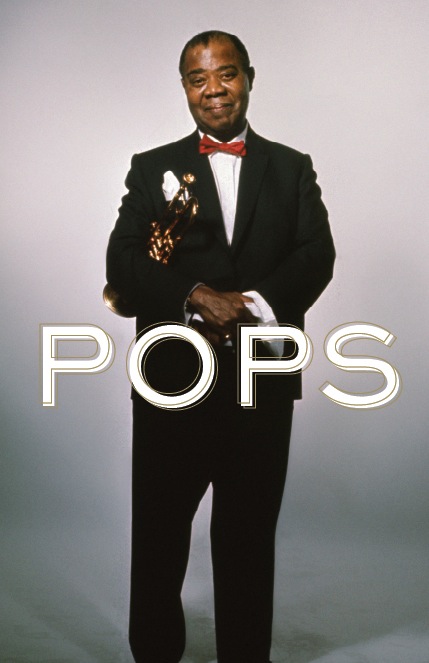
POPS%20COVER.jpgThis is what the dust jacket will look like. The picture is by Philippe Halsman. It was taken in 1966 at a photo shoot that also produced the better-known image that accompanied Life's cover story on Armstrong.

In case you're wondering, I couldn't be happier with the design for Pops. Not only does it have tremendous visual impact, but Halsman's photo is one of the few pictures of Armstrong taken by a professional photographer that captures something of the interior complexity to which I allude in the prologue:

The legend of Louis Armstrong is not the whole story, just as there was more to him than the grinning jester with the gleaming white handkerchief who sang "Hello, Dolly!" and "What a Wonderful World" night after night for adoring audiences. "To friend and foe alike," the trumpeter Humphrey Lyttelton wrote, "there was, deep below the surface of companionship and bonhomie, an impenetrable wall in which every stone was an enigma." His disposition was not always cloudless, either, though he preferred not to share his occasional sorrows with strangers. Armstrong taped dozens of his private conversations during the last quarter-century of his life, and these tapes, which until recently were inaccessible to scholars, show that his personality was tougher and more sharp-edged than his fans knew. Off stage he could be moody and profane, and he knew how to hold a grudge. "I got a simple rule about everybody," he told a journalist. "If you don't treat me right--shame on you!"

I've done my very best to penetrate Armstrong's inviting yet enigmatic surface in Pops. I hope you find the results illuminating.

Posted March 30, 12:00 AM

TT: Noise in the system

It's crunch time on Broadway--new shows are now opening back to back--and crunch time for me as well, what with The Letter and Pops: A Life of Louis Armstrong making their way down the pipeline. The result of all this nonstop activity is that I'm in a more or less constant frenzy, against which my body rebelled last week. Like many respectable gentlemen of a certain age, I get kidney stones on occasion, and one of them took an untimely bow midway through the preview of Eugène Ionesco's Exit the King that I reviewed in last Friday's Wall Street Journal. Much to my surprise, I managed to pay attention to what I was seeing and write about it before going to bed, but I was knocked out for the next couple of days and had to cancel a trip to Washington as a result.

As always I jumped back on the horse--I saw Irena's Vow, Happiness, Hair, and Reasons to Be Pretty this weekend--but for the moment I don't have a whole lot of time or energy to spare, so forgive me if I post a bit irregularly this week. I shall return!

Posted March 30, 12:00 AM

TT: Almanac

"As a priest, I've learned that people only cry over what they've lost, or missed getting, and I'm surely no exception to that."

Jon Hassler, A Green Journey

Posted March 30, 12:00 AM

March 27, 2009

TT: Beating up the bourgeoisie

The Broadway season is now in high gear, and so am I. In today's Wall Street Journal drama column I cover three openings, God of Carnage, Exit the King, and Impressionism. Here's an excerpt.

* * *

Yasmina Reza is back on Broadway with another of her slightly pretentious, consummately effective comedies of middle-class manners, and Jeff Daniels, Hope Davis, James Gandolfini (that's Tony Soprano to you) and Marcia Gay Harden are playing it for all it's worth. In "God of Carnage" we spend 90 action-packed minutes eavesdropping on two married couples whose children got into a schoolyard scrap that turned bloody. The couples have met in order to work things out in a civilized manner, but by play's end things have gotten way, way, way out of hand, everyone is more than half in the bag and the audience has laughed itself well past silly....

While "God of Carnage" is much funnier than "Life x 3," Ms. Reza's last Broadway outing, it bears a similar family resemblance to "Who's Afraid of Virginia Woolf?" The difference is that "God of Carnage" is much shorter and far less serious than "Virginia Woolf." It is, in truth, a knockabout farce whose "moral" is a spoonful of medicine to help the sugar go down, and Matthew Warchus ("Boeing-Boeing") has staged it with bristling vigor and hair-trigger timing. Everyone in the cast is terrific, especially Ms. Davis...

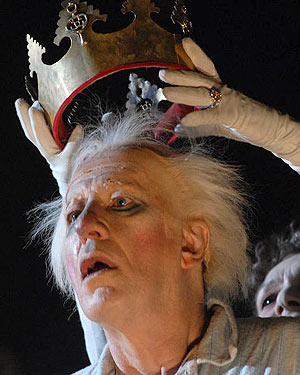
EXIT%20THE%20KING.jpgUnlike "God of Carnage," which pretends to be deeper than it is, Eugène Ionesco's "Exit the King" is the real thing, a full-fledged absurdist satire whose unlikely presence on Broadway can only be explained by the fact that Susan Sarandon is in the cast. The premise is thoroughly Ionescoan: King Berenger the First (Geoffrey Rush), a tyrant who is 400 years old and failing fast, is informed by his first wife (Ms. Sarandon) that he will die "in an hour and a half...at the end of the show." He declines to go quietly. Horrific hijinks ensue, followed by the king's scheduled demise. Blackout--and I do mean black.

Ionesco called "Exit the King" "an attempt at an apprenticeship in dying," a description which, though perfectly accurate as far as it goes, fails to convey the macabre gusto of this now-ludicrous, now-terrifying parable of dissolution and resignation. Mr. Rush, however, gets the point right in the heart: The decayed flamboyance of his performance as the dying king is the stuff Tonys are made of....

Next to nothing need be said about Michael Jacobs' "Impressionism," an off-the-rack weeper-with-jokes about an August-October romance between a lonely art dealer (Joan Allen) and a washed-up photographer (Jeremy Irons). Mr. Jacobs writes TV scripts, and "Impressionism" plays like one--the scene changes are too frequent and too slow--but the chemistry between Ms. Allen and Mr. Irons is strong enough to obscure the fact that their lines are as predictable as the décor in a chain motel....

* * *

Read the whole thing here.

Posted March 27, 12:00 AM

TT: Almanac

"I do not wish to be any more busy with my hands than is necessary."

Henry David Thoreau, Walden

Posted March 27, 12:00 AM

March 26, 2009

BOOK

Richard Stark, The Mourner/The Score/The Jugger (University of Chicago, $14 each). The University of Chicago Press has just published the second batch of titles in its ongoing uniform edition of the early Parker novels of Richard Stark (that's Donald Westlake to you). Regular readers of this blog know all about Parker, the toughest career criminal ever to inhabit the pages of a paperback, so suffice it to say that if you have yet to make his acquaintance, now's the time. When it comes to crime fiction, these hard, laconic novels are as good as it gets (TT).

Posted March 26, 9:37 AM

TT: Told you so

I wrote this "Sightings" column for The Wall Street Journal three years ago. Many of my friends snorted at the time. Now that the rest of the world has caught up with me, perhaps it's worth revisiting what I had to say in 2006.

* * *

The e-book is back. So are the technophobes who swear it'll never catch on. They were right last time, and they might be right this time, too. Sooner or later, though, they'll be wrong--and when they are, your life will change.
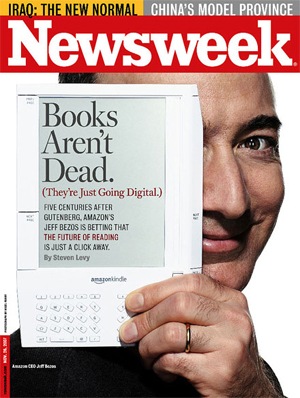
kindle_2.jpgThe word "e-book" is short for "electronic book." The concept isn't new--the complete texts of countless classics have long been available on the Web in digitized form. (Seventeen thousand of them can be downloaded for free at www.gutenberg.org.) The catch is that until now, there hasn't been a user-friendly way to read e-books. Few people enjoy reading book-length documents on a conventional computer screen, and though hand-held e-book readers went on the market six years ago, they were insufficiently convenient to use and failed to interest the book-buying public.

Now Sony has announced plans to market a paperback-sized e-book reader that makes use of E Ink, a new display technology whose makers say it duplicates "the experience of reading from paper." The Sony Reader, which fits comfortably in one hand, will hold hundreds of e-books in its memory, and its internal battery allows for 7,500 page turns per charge.

It remains to be seen whether the Sony Reader and E Ink are capable of delivering on their fine-sounding technological promises. But Sony has made another promise that is at least as significant: It will also open an iMusic-style online store from which purchasers can download e-books as easily as they download music onto their iPods. Three major publishers, HarperCollins, Random House and Simon & Schuster have agreed to sell their books through Sony, and HarperCollins and Simon & Schuster plan to make their entire backlists available for downloading as soon as they negotiate royalty rights with the authors.

If the Sony Reader (which goes on sale this spring) takes off where previous ventures fell flat, it will be because Sony is offering what marketers call an "end-to-end" solution to the problem of the e-book. That kind of one-stop shopping is what made Apple's iPod so successful: You don't just buy the iPod itself, but an easy-to-use system that allows you to download any one of tens of thousands of popular songs within minutes of taking your iPod out of the box.

So will it fly? I don't know. Still, I'm certain that something like the Sony Reader will catch on, if not this year then in a short time. The phenomenal success of the iPod strongly suggests that many, perhaps most consumers are ready to start buying digital books on the Web and storing and reading them electronically.

And what happens after that? It goes without saying that the economic impact of the e-book on publishers and booksellers will be dramatic (I wouldn't want to own a brick-and-mortar bookstore these days). But I'm more interested in how the e-book will affect the way we read--and write. New technologies, after all, change art, often in profound and unpredictable ways. I doubt the inventor of the electric guitar foresaw Jimi Hendrix, any more than Thomas Edison foresaw chick flicks. The only thing of which you can be certain is that the existence of the e-book will cause the authors of the 21st century to go about their business very differently than did their 20th-century predecessors.

Many of these differences will arise from the way in which the e-book encourages self-publishing. Best-selling novelists, for instance, will soon be in a position to "publish" their own books, pocketing all the profits--but so will niche-market authors whose books don't sell in large enough quantities to interest major publishers.

Might the e-book make the writing of serious literary fiction more economically viable? Consider the experience of Maria Schneider, the jazz composer whose CDs are sold exclusively on her Web site, www.mariaschneider.com. Ms. Schneider uses ArtistShare, a new Web-based technology that makes it easier for musicians to sell self-produced recordings online. Not only did she win a Grammy for her first ArtistShare release, "Concert in the Garden," but she kept all the proceeds as well. Several other well-known jazz musicians, including the guitarist Jim Hall and the trombonist Bob Brookmeyer, have since signed up with ArtistShare, which frees them from the need to compromise with money-conscious record-company executives. Will e-books have a similarly liberating effect on authors? I wouldn't be surprised.

Yes, I miss the bookstores of my youth, and I'm sure I'll miss the handsomely bound volumes that fill the shelves in my apartment as well (though I won't miss dusting them, or toting them around by the half-dozen whenever I go on vacation). The printed book is a beautiful object, "elegant" in both the aesthetic and mathematical senses of the word, and its invention was a pivotal moment in the history of Western culture. But it is also a technology--a means, not an end. Like all technologies, it has a finite lifespan, and its time is almost up.

Posted March 26, 12:00 AM

TT: So you want to see a show?

Here's my list of recommended Broadway, off-Broadway, and out-of-town shows, updated weekly. In all cases, I gave these shows favorable reviews (if sometimes qualifiedly so) in The Wall Street Journal when they opened. For more information, click on the title.

Warning: Broadway shows marked with an asterisk were sold out, or nearly so, last week.

BROADWAY:
Alfred Hitchcock's The 39 Steps (comedy, G, suitable for bright children, reviewed here)
August: Osage County (drama, R, adult subject matter, reviewed here)
Avenue Q * (musical, R, adult subject matter and one show-stopping scene of puppet-on-puppet sex, reviewed here)
The Little Mermaid * (musical, G, entirely suitable for children, reviewed here)
South Pacific * (musical, G/PG-13, some sexual content, brilliantly staged but unsuitable for viewers acutely allergic to preachiness, reviewed here)

OFF BROADWAY:
Distracted (serious comedy, PG-13, extended through May 17, reviewed here)
The Fantasticks (musical, G, suitable for children capable of enjoying a love story, reviewed here)
Love/Stories (or But You Will Get Used to It) (one-act plays, PG-13, vastly too complicated for children, extended through Apr. 25, reviewed here)
Our Town (drama, G, suitable for mature children, reviewed here)
Ruined (drama, PG-13/R, sexual content and suggestions of extreme violence, extended through May 3, reviewed here)

IN WARREN, R.I.:
The Dark at the Top of the Stairs (drama, PG-13, reviewed here)

CLOSING SUNDAY OFF BROADWAY:
Aristocrats (drama, G/PG-13, too complicated for children, reviewed here)

Posted March 26, 12:00 AM

TT: Almanac

"Translators can be considered as busy matchmakers who praise as extremely desirable a half-veiled beauty. They arouse an irresistible yearning for the original."

Goethe, Art and Antiquity

Posted March 26, 12:00 AM

March 25, 2009

CAAF: Family inheritances

070905.1_0717.jpg

Sorry to have been so scarce. Lowell's younger brother, Bob, died on Monday. It was unexpected, and it's been a sad time. Bob was a good and amiable soul, more outgoing and jovial than Lowell on the surface but with a similar sense of thoughtfulness underneath. Same quick humor, same gentleness -- whatever the opposite of grasping is, their mother managed to raise two sons with that same generous quality. They grew up in Reidsville, a little tobacco town a few hours east of Asheville. Lowell left; Bob stayed. On a trip home a few years ago, he and Bob stayed up drinking beer on the porch of their mom's old house. That house, which by then had passed along to Bob, looks out on an old highway. I asked Lowell what they had stayed up so late talking about and he said space and time and loop quantum gravity.

This picture is one of my favorites of Lowell's. It's of the kitchen at their aunt Mildred's. Mildred was one of their father's older sisters and a much beloved person. She used to make pancakes on her woodstove every morning for Lowell and Bob to pick up on their way to school.

Posted March 25, 2:02 PM

TT: Snapshot

Denise Duval sings arias from Francis Poulenc's Dialogues of the Carmelites and La Voix Humaine in 1959, with the composer at the piano:

(This is the latest in a weekly series of arts-related videos that appear in this space each Wednesday.)

Posted March 25, 12:00 AM

TT: Almanac

"There are only the pursued, the pursuing, the busy, and the tired."

F. Scott Fitzgerald, The Great Gatsby

Posted March 25, 12:00 AM

March 24, 2009

TT: Too much everything

I'm in over my head. See you tomorrow.

Posted March 24, 12:00 AM

TT: Almanac

"The mother of excess is not joy but joylessness."

Friedrich Nietzsche, Mixed Opinions and Maxims

Posted March 24, 12:00 AM

March 23, 2009

TT: Fifteen keepers

Time was when the American musical looked and sounded very different from the Disney-style shows that now dominate Broadway. Its subject matter was (usually) more traditional, its musical language as yet untouched by the rock-and-roll revolution that was to transform American popular culture. Yet the standard musical-comedy repertoire still consists in the main of works that were written before Stephen Sondheim tore up the rules in 1970 with Company. Needless to say, most of the shows that preceded Company were forgettable commodities, but a fair number of them are both theatrically effective and musically distinguished, which is why they continue to be revived.

I see a good many pre-1970 musicals as part of my duties as drama critic of The Wall Street Journal, and it occurred to me the other day to draw up a list of the best ones. Here, then, are the fifteen American musicals that I believe to be of indisputably permanent interest:

• Jerome Kern and Oscar Hammerstein II, Show Boat (1927). The first Broadway musical in which book and score were fully integrated, Show Boat remains viable to this day, though it is rarely revived, presumably for reasons of race-related political correctness. Fortunately, virtually all of the show's essence comes through clearly in James Whale's splendid 1936 film version, which is mysteriously unavailable on DVD but pops up from time to time on Turner Classic Movies. David Thomson calls it "wonderful," and he's right. See it and marvel.

paljoey_genekelly.jpg• Richard Rodgers, Lorenz Hart, and John O'Hara, Pal Joey (1940). The recent Broadway revival of Pal Joey was a slicked-up, watered-down caricature of the original show, which was arguably the first truly modern musical to open on Broadway. The real Pal Joey is as corrosively cynical as Billy Wilder at his nastiest, which undoubtedly explains why it failed to go over in 1940, even though Rodgers and Hart wrote a first-rate score full of standards-to-be like "I Could Write a Book" and "Bewitched, Bothered, and Bewildered." No original-cast album was made, alas, but Columbia Records taped a studio-only version of the score in 1950 that comes reasonably close to what Broadway audiences heard--and misunderstood--a decade earlier.

• Richard Rodgers and Oscar Hammerstein II, Oklahoma! (1943). As far as most theatergoers are concerned, modern musical comedy starts with Oklahoma! It's effective to the point of infallibility--even amateurs can make it work--though the 1955 wide-screen film version is more than a little bit overblown. If you know only the movie, you'll be surprised by how much more touching Oklahoma! is on stage.

• Leonard Bernstein, Betty Comden, and Adolph Green, On the Town (1944). I have yet to see a successful stage revival of On the Town, and the popular 1949 film version is a what-were-they-thinking stinker (MGM scrapped most of the original songs and dances). Be that as it may, it's a truly great show, a sophisticated melding of music and choreography that to my mind is more artistically satisfying than West Side Story, heretical though that opinion may sound to most people, Mrs. T very much included.

• Irving Berlin, Dorothy Fields, and Herbert Fields, Annie Get Your Gun (1946). Berlin's other musicals are dramatically inert and so are never revived, but this one continues to ring the gong effortlessly. Never before or since has a Broadway composer written a score with a wider hit-to-filler ratio.

• Cole Porter, Bella Spewack, and Samuel Spewack (after Shakespeare), Kiss Me, Kate (1948). Like Berlin, Porter learned his craft in the pre-Oklahoma! era, but managed late in life to write one show whose book is as dramatically sound as its score is musically impeccable. Even Evelyn Waugh, than whom few customers were tougher, loved Kiss Me, Kate. So do I, and it's about due for another Broadway revival, though it'll be hard to better Michael Blakemore's 1999 staging. (As usual, skip the movie--it has its moments, but not enough to make it fly.)

guyspgm.jpg• Frank Loesser, Abe Burrows, and Jo Swerling, Guys and Dolls (1950). If there's a flawless Broadway musical, this is it. Not only is every song a polished gem, but the book, like that of Kiss Me, Kate, works like a charm. Stay as far away as possible from the current Broadway revival, which somehow manages, like the appalling 1955 film version, to get just about everything wrong about a show whose authors took infinite care to get everything right.

• Frederick Loewe and Alan Jay Lerner (after George Bernard Shaw), My Fair Lady (1956). Is My Fair Lady better than Pygmalion? I (sometimes) think so, as do a surprisingly large number of Shavians. I'm not usually a fan of the shows of Lerner and Loewe, most of which strike me as a bit on the sugary side, but My Fair Lady is an exception, a consummately well-made piece of stage carpentry whose operetta-like score is resplendently lovely. The film is awfully good, too, though it does go on a bit.

• Leonard Bernstein, Stephen Sondheim, and Arthur Laurents, West Side Story (1957). Jerome Robbins' choreography isn't quite indispensable to the effect of West Side Story, but it comes damned close. Fortunately, Robbins supervised the filming of most of the dance numbers in the 1961 film version, which is not entirely successful--the casting is erratic--but still comes across with tremendous force when seen on a large screen. Yes, it's sentimental, but so what? Even as is, it still beats hell out of the current Broadway revival, in which Arthur Laurents mistakenly tried to toughen the show up, in the process distorting Robbins' dances almost beyond recognition.

• Meredith Willson, The Music Man (1957). The 1961 movie version of this irresistibly corny show is the most representative and effective film of a Broadway musical ever made, give or take Show Boat and How to Succeed in Business Without Really Trying. It has a few flaws--I could do without Buddy Hackett--but you can easily see why Robert Preston's magnetic stage performance made him a star overnight.

• Harvey Schmidt and Tom Jones, The Fantasticks (1960). I called The Fantasticks "the perfect musical" in my Wall Street Journal review of the 2006 revival, and I haven't changed my mind. Modest, simple, and surprisingly subtle, the best of all possible small-scale musicals hasn't aged a day since it opened off Broadway a half-century ago.

• Jule Styne, Stephen Sondheim, and Arthur Laurents, Gypsy (1959). The great dance critic Arlene Croce called Gypsy "the best Broadway show I ever saw...a masterpiece of poetic theater and radical design." None of these qualities made it into the maladroit 1962 film version, but the original-cast album, like the show's four successful Broadway revivals, leaves no doubt of why Gypsy is widely regarded as the ultimate musical comedy, a vade mecum of everything that makes musicals work.

• Frank Loesser, Abe Burrows, Jack Weinstock, and Willie Gilbert, How to Succeed in Business Without Really Trying (1961). The 1967 film version is close to ideal, and it also preserves the justly celebrated stage performances of Robert Morse and Rudy Vallée. The show itself is a wonder, one of the last indisputably classic pre-Sondheim Broadway musicals, as well as the only one that engages with postwar American life in a witty, clear-eyed way.

180px-SheLovesMePoster.JPG• Jerry Bock, Sheldon Harnick, and Joe Masteroff, She Loves Me (1963). More a cult show than a full-fledged hit, She Loves Me is, like My Fair Lady, a near-operetta that is directly comparable in quality to The Shop Around the Corner, the fluffy Ernst Lubitsch film on which it is closely based. Unlike any other cult musical, though, it has been successfully revived both on Broadway and in numerous regional-theater productions, and I dare say that it has more fans now than when it was new.

• Jerry Bock, Sheldon Harnick, and Joseph Stein, Fiddler on the Roof (1964). Fiddler might just be the quintessential Broadway musical, more unabashedly popular (and poignant) than Gypsy and almost as well crafted. Unlike West Side Story, it doesn't need Jerome Robbins' dances to make its effect, though they rank high among his choreographic landmarks.

Needless to say, this short list doesn't exhaust the roster of revivable classics, some of which, like A Funny Thing Happened on the Way to the Forum, 110 in the Shade, Peter Pan, and Wonderful Town, are of very high quality. Most of the rest of the really big golden-age shows, however, are theatrically effective but ultimately uninteresting--Bye Bye Birdie, Damn Yankees, Man of La Mancha, and The Pajama Game come to mind--while the cult shows, of which Anyone Can Whistle, Fiorello!, House of Flowers, and The Yearling head my personal list, typically have striking scores that are sunk by problematic books.

What else is missing? Porgy and Bess, obviously, and for the obvious reason, which is that it's an opera, not a musical. Nor did any of the Gershwin brothers' other shows make my list. I don't think they work on stage, not even Of Thee I Sing, which was revolutionary in 1931 but is creaky now. Likewise Irving Berlin and Cole Porter, who only wrote one show apiece that is revivable today. As for the later Rodgers and Hammerstein musicals, their books are too earnest for my taste, though Carousel and The King and I can be enlivened by imaginative direction. Cabaret is the only pre-Company musical that works better on screen than on the stage. (The book is full of holes.) I omitted Candide, everybody's favorite cult musical, because it has no definitive stage version--we remember it solely because of the score--and I passed over Hello, Dolly!, one of the most popular shows ever to hit Broadway, because Jerry Herman's songs are catchy but banal.

And there you have it: the permanent repertory of the Terry Teachout Musical Theater Company. I'd be more than happy to see and review these fifteen shows in regular rotation each year for the rest of my working life--though it happens that I've only had the opportunity to write about ten of them in my Wall Street Journal drama column. So if you're the artistic director or publicist of a professional theater company that's planning to mount Show Boat, On the Town, Annie Get Your Gun, The Music Man, or How to Succeed in Business Without Really Trying next season, kindly drop me a line. It's never too soon to get your bid in.

Posted March 23, 12:00 AM

TT: Almanac

"The theater is so endlessly fascinating because it's so accidental. It's so much like life."

Arthur Miller (quoted in the New York Times, May 9, 1984)

Posted March 23, 12:00 AM

March 22, 2009

WHY NOT BOO?

"Since many theater companies now encourage playgoers to recycle their programs, why not place two transparent recycling containers in the lobby after the show, one marked CHEERS and the other JEERS? That strikes me as a neat and practical method of reaping the benefits of booing while simultaneously minimizing its incivility..."

Posted March 22, 3:48 PM

March 21, 2009

TT: Why not boo?

ambulaspan.jpgMary Zimmerman's new production of Bellini's La Sonnambula got booed--loudly--when it opened at the Met the other day. (To hear what happened, go here.) I didn't see the production, but I was struck by the fact that such booing is surprisingly rare in this country, whereas automatic standing ovations for mediocre performances are very much the rule, at least on Broadway.

I'm not crazy about booing, but there's one thing to be said in its favor. And what, pray tell, might that one thing be? Pick up a copy of Saturday's Wall Street Journal and turn to my "Sightings" column to find out the answer. This week's column also features a modest proposal for a method of allowing unhappy audiences to register their disapproval of a performance without throwing tomatoes. Producers, take note!

UPDATE: Here's an excerpt:

Is there a kinder, gentler way for an audience to make its displeasure felt? After reflecting on Ms. Zimmerman's tumultuous curtain call, I came up with a substitute that I call "The Silent Boo." Since many theater companies now encourage playgoers to recycle their programs, why not place two transparent recycling containers in the lobby after the show, one marked CHEERS and the other JEERS? That strikes me as a neat and practical method of reaping the benefits of booing while simultaneously minimizing its incivility. Wouldn't your emotional investment in a performance be heightened if you could "vote" on its merits in a simple and convenient manner that was easily visible both to the performers and to your fellow audience members?...

Read the whole thing here.

Posted March 21, 12:00 AM

March 20, 2009

TT: Tough guys don't dance

I review three shows in today's Wall Street Journal drama column, the new Broadway versions of West Side Story and Blithe Spirit and a Rhode Island revival, 2nd Story Theatre's production of William Inge's The Dark at the Top of the Stairs. The first two are so-so, the third a treat. Here's an excerpt.

* * *

Having staged an all-but-unimprovable revival of "Gypsy," Arthur Laurents has upped the ante by bringing "West Side Story" back to Broadway. Mr. Laurents' "West Side Story" is a spruced-up version of the show that took New York by storm 52 years ago, revised and reconfigured to appeal to a new generation of theatergoers. Nothing wrong with that--"West Side Story" is a musical, not a sacred text--but the results are disappointing, not just by comparison with the original "West Side Story" but in their own unconvincing right.

West1span.jpgThe most talked-about change is that the 91-year-old Mr. Laurents, who wrote the book, has made the Sharks, the Manhattan street gang whose members come from Puerto Rico, speak and sing partly in Spanish. The purpose of this new wrinkle is to add dramatic muscle to a musical that he now believes to be too ballet-pretty for modern audiences. For the same reason, Joey McKneely, who restaged Jerome Robbins' dances for this production, has altered them in ways that will be immediately apparent to anyone who knows "West Side Story" more than casually....

The show's bilingual aspect comes across as a gimmick, one that works well in some spots and less so in others. The second act, for instance, starts out with a long, bumpy stretch of untranslated Spanish that feels like an opera without supertitles. The changes in the dances are far more fundamental and problematic. The steps remain familiar, but the feel is entirely different--the men dance as though they were on steroids--and almost entirely untrue to the spirit of the original show. According to Mr. Laurents, the real-life counterparts of the Jets and Sharks were "vicious little killers" whose brutality was softened in the 1957 production. But that, of course, is the whole point of "West Side Story": It's not a cinéma-vérité documentary but a poem, a piece of lyric theater. The hyper-masculine faux-realism that Mr. Laurents has ladled over it simply doesn't square with the idealized romanticism of Robbins' choreography and Leonard Bernstein's jazzy score...

Few modern farces are as bulletproof as Noël Coward's "Blithe Spirit," which doesn't have to be done especially well to make a willing audience laugh. Michael Blakemore's revival is better than good enough, but its virtues are mainly to be found in the indispensable persons of Angela Lansbury and Rupert Everett. Ms. Lansbury, needless to say, is Madame Arcati, the dotty medium who inadvertently summons up the ghost of Mr. Everett's first wife (Christine Ebersole), much to the displeasure of his second wife (Jayne Atkinson)....

I wish I had more good things to say, but Ms. Ebersole proves to be both unexpectedly unseductive and unsatisfyingly shrill, while Mr. Blakemore's staging, a couple of slick bits of slapstick notwithstanding, is efficient rather than inspired....

William Inge was a great American playwright whose work is rarely done in New York nowadays, so I drove up to Rhode Island to catch a revival of "The Dark at the Top of the Stairs," a family drama that hasn't been seen on Broadway since the original production closed in 1959. I'm happy to report that 2nd Story Theatre, an ambitious little troupe whose 130-seat upstairs auditorium is located in a harbor town not far from Providence, is performing "The Dark at the Top of the Stairs" with exceptional sensitivity and understanding....

* * *

Read the whole thing here.

This is my video review of West Side Story:

Posted March 20, 12:00 AM

TT: Almanac

"Jealousy is often the tribute artists pay one another."

Harold Clurman, All People Are Famous (Instead of an Autobiography)

Posted March 20, 12:00 AM

March 19, 2009

TT: So you want to see a show?

Here's my list of recommended Broadway, off-Broadway, and out-of-town shows, updated weekly. In all cases, I gave these shows favorable reviews (if sometimes qualifiedly so) in The Wall Street Journal when they opened. For more information, click on the title.

Warning: Broadway shows marked with an asterisk were sold out, or nearly so, last week.

BROADWAY:
Alfred Hitchcock's The 39 Steps * (comedy, G, suitable for bright children, reviewed here)
August: Osage County (drama, R, adult subject matter, reviewed here)
Avenue Q * (musical, R, adult subject matter and one show-stopping scene of puppet-on-puppet sex, reviewed here)
The Little Mermaid * (musical, G, entirely suitable for children, reviewed here)
South Pacific * (musical, G/PG-13, some sexual content, brilliantly staged but unsuitable for viewers acutely allergic to preachiness, reviewed here)

OFF BROADWAY:
Distracted (serious comedy, PG-13, extended through May 17, reviewed here)
The Fantasticks (musical, G, suitable for children capable of enjoying a love story, reviewed here)
Love/Stories (or But You Will Get Used to It) (one-act plays, PG-13, vastly too complicated for children, newly extended through Apr. 25, reviewed here)
Our Town (drama, G, suitable for mature children, reviewed here)
Ruined (drama, PG-13/R, sexual content and suggestions of extreme violence, extended through May 3, reviewed here)

CLOSING NEXT WEEK OFF BROADWAY:
Aristocrats (drama, G/PG-13, too complicated for children, closes Mar. 29, reviewed here)

CLOSING FRIDAY OFF BROADWAY:
Enter Laughing (musical, PG-13, closes Mar. 20, reviewed here)

Posted March 19, 12:00 AM

TT: Almanac

"Today every invention is received with a cry of triumph, which soon turns into a cry of fear."

Bertolt Brecht (quoted in Harold Clurman, All People Are Famous)

Posted March 19, 12:00 AM

March 18, 2009

TT: The house that Satchmo built

LA%27S%20HOUSE%20IN%201965.jpgMy friend and colleague Ricky Riccardi, who blogs to indispensable effect about the life and work of Louis Armstrong, recently posted a photograph of Armstrong's house in Queens that was taken in 1965. The Armstrong house, which is now a museum, looks slightly more imposing today--but not much.

I first visited the Armstrong House in 2001, a number of years before I first got the idea to write Pops: A Life of Louis Armstrong. I was writing a piece about Armstrong for the Sunday New York Times--the occasion was his hundredth birthday--and though his house was not yet open to the public, I was given a private tour. That tour was part of what inspired me to become Armstrong's biographer, and the passage from my Times article in which I described the interior made it all the way into Pops with only the slightest of changes:

It is a three-story frame house whose interior is reminiscent of Graceland, Elvis Presley's gaudy Memphis mansion. From the Jetsons-style kitchen-of-the-future to the silver wallpaper and golden faucets of the master bathroom, the Armstrong house looks like what it is: the residence of a poor boy who cast down his bucket and pulled it up overflowing. Unlike Graceland, though, the house is neither oppressive nor embarrassing, and as you stand in the smallish study, whose decorations include a portrait of the artist painted by Tony Bennett, it is impossible not to be touched by the aspiration visible wherever you look. This, it is clear, was the home of a working man, bursting with a pride that came not from what he had but what he did. "I never want to be anything more than I am, what I don't have I don't need," Armstrong wrote in his old age. "My home with Lucille [his fourth and last wife] is good, but you don't see me in no big estates and yachts, that ain't gonna play your horn for you."

If you've never been to the Armstrong House, I strongly suggest a visit. For more information, go here.

Posted March 18, 12:00 AM

TT: Snapshot

Ezio Pinza and Mary Martin sing "Some Enchanted Evening" on TV in 1954:

(This is the latest in a weekly series of arts-related videos that appear in this space each Wednesday.)

Posted March 18, 12:00 AM

TT: Almanac

"The slaughter of reputations in the cultural life of this country is scandalous. (It's funny how, as I write it, the very phrase 'cultural life' strikes me as archaie.) The fact is, all too few reputations remain intact among us. We erase history even as we make it--'we cancel our experience.' Reverence is rare, even for the most renowned; instead, there is a fundamental indifference toward those vociferiously touted, and the ones who have 'made it' are soon enough unmade."

Harold Clurman, All People Are Famous (Instead of an Autobiography)

Posted March 18, 12:00 AM

March 17, 2009

TT: Long ago and far away

blues.jpg"West End Blues" is Louis Armstrong's best-known recording. Made in 1928, it opens with a spectacular unaccompanied trumpet cadenza that I discuss in detail in Pops: A Life of Louis Armstrong:

"West End Blues," recorded on June 28, starts with a surprise, an unaccompanied cadenza in which Armstrong snaps out four biting quarter notes by way of fanfare, then vaults upward through a chain of interlocking triplet arpeggios to a fiery high C embellished with a touch of vibrato. It was the most technically demanding passage to have been recorded by a jazz trumpeter up to that time, and for this reason alone it was bound to have displeased the old-school New Orleans musicians of Armstrong's youth, one of whom grumbled that "because Louis was up North making records and running up and down like he's crazy don't mean that he's that great. He is not playing cornet on that horn; he is imitating a clarinet. He is showing off." Armstrong admitted that he had aspired when young to the facility of the great New Orleans clarinetists: "I was just like a clarinet player, like the guys run up and down the horn nowadays, boppin' and things." But his introduction to "West End Blues" has at least as much in common with the florid bel canto cadenzas he had heard in the operatic recordings of Amelita Galli-Curci and Luisa Tetrazzini, and listeners acquainted with turn-of-the-century American band music will also spot the mark of the elaborate unaccompanied passages in the solos of Herbert L. Clarke, John Philip Sousa's star cornetist, several of whose records Armstrong owned and cherished. "I've heard trumpet solos from 1908 up to the present day--Herbert Clarke and all those boys that really used to blow them horns and it sounds like it was recorded yesterday," he told Leonard Feather in 1954....

Everybody who knows about jazz knows about "West End Blues." I doubt, though, that most people know where the song, written by Joe Oliver, Armstrong's mentor, got its name. Nowadays West End is a lakefront neighborhood of New Orleans, but in Armstrong's time it was a popular summer resort and amusement park on the shore of Lake Pontchartrain that looked like this:

WEST%20END%20RESORT.JPG

Not far from West End was the Pontchartrain Beach Amusement Park, the place where Mitch takes Blanche DuBois on a date in Tennessee Williams' A Streetcar Named Desire. The stage directions give the clue: "They have probably been out to the amusement park on Lake Pontchartrain, for Mitch is bearing, upside down, a plaster statuette of Mae West, the sort of prize won at shooting-galleries and carnival games of chance."

Needless to say, the scene pictured above vanished long ago, and what remained of West End Park was destroyed at last by Hurricane Katrina. But now that I've seen that delicately tinted period postcard, I'll never be able to hear "West End Blues" without imagining a happy crowd of revelers clustered around a Ferris wheel.

Posted March 17, 12:00 AM

TT: Almanac

"If an American had the choice between encountering God and attending a lecture on Him, he would choose the lecture."

Alfred Stieglitz (quoted in Harold Clurman, All People Are Famous)

Posted March 17, 12:00 AM

March 16, 2009

CAAF: Also, they're "furry"

A great, cool thing happened this morning. Lately, before I get started with work in the morning, I've been doing this exercise meant to improve my "precision of natural description" -- which means, basically, I stare at some point in the yard and try to describe what I see as fully as I can without lapsing into metaphor. It's all very low stakes. Just something to do while waking up and drinking coffee. But last night I was reading Martin Chuzzlewit before bed and was struck by this description of a landscape near Salisbury:

On the motionless branches of some trees, autumn berries hung like clusters of coral beads, as in some fabled orchards where the fruits were jewels; others, stripped of all their garniture, stood, each the centre of its little heap of bright red leaves, watching their slow decay; others again, still wearing theirs, had them all crunched and crackled up, as though they had been burnt; about the stems some were piled, in ruddy mounts, the apples they had borne that year; while others (hardy evergreens this class) showed somewhat stern and gloomy in their vigour, as charged by nature with the admonition that it is not to her more sensitive and joyous favourites she grants the longest term of life.

The passage is precise about the different stages of the berries (maybe too precise), but it's the line about the evergreens as "stern and gloomy in their vigour" that leapt out -- because it's impressionistic but true. That is how evergreens come across in a crowd. And so this morning I was staring particularly hard at the trees in our backyard trying to describe them a little less lazily than usual. It was early and still dark out. There's been rain so it was misty, especially around the woods, and as I was staring at the trees ("tall, green, leafy") a snout materialized in the mist, then some strong shoulders -- and well, it was not a dog, it was a bear ("big and brown").

Bears frequent our neighborhood -- as I've mentioned, we live near the forest, and there's an orchard up the street that the bears are also fond of -- but I haven't seen one in a couple years. The neighborhood itself is fairly Southern suburban: a lot of ranches and split-levels, school buses and pick-ups, a couple bouffants, one excellent mullet, several aged beagles and a pit bull named Ashanti. I took a walk the other week and the two most pronounced scents in the air were fabric softener and cigarette smoke, which just about sums it up. So it's still surprising, even though it shouldn't be, whenever a bear comes ambling through. What I was mostly surprised about, though, is how electric I went on seeing it, even though I was inside the house. Also surprising -- and this amazes me every time I've seen one -- is how fast a bear can clip along, despite its size, even when, as this one was, it's in no particular hurry. You want to say a bear "lumbers" but it doesn't.

One last link to Martin Chuzzlewit. Last week I finished Great Expectations and was casting around for which Dickens to read next. I chose MC because of this line that I had read somewhere: "For there is a poetry in wildness, and every alligator basking in the slime is in himself an Epic, self-contained." Which if it is true of alligators is also true of bears.

Posted March 16, 4:33 PM

CAAF: Afternoon coffee

Laila Lalami weighs in on The Kindly Ones for the LA Times. Over at The Literary Saloon, they've been tracking the novel's antipodal reception in the press; if you're at all interested you'll particularly want to read Daniel Mendelsohn's essay in the New York Review of Books. Also noteworthy and via the Lit Saloon: Translator Charlotte Mandell describes the process she followed to translate the novel from the French.

• "Read Cecil's Life of Cowper. ... Very bad. But what a life! It depressed & terrified me. How did he ever manage to write such bad poetry?"

Posted March 16, 2:50 PM

TT: De la crème

Pops: A Life of Louis Armstrong, my forthcoming biography, includes an appendix of thirty "key recordings" by Armstrong, all of which figure prominently in the text of the book and can be downloaded from iTunes. Here's the list:

1. "Chimes Blues" (Gennett, 1923, with King Oliver's Creole Jazz Band)

2. "Texas Moaner Blues" (OKeh, 1924, with Sidney Bechet
and Clarence Williams' Blue Five)

3. "St. Louis Blues" (Columbia, 1925, with Bessie Smith)

4. "Heebie Jeebies" (OKeh, 1926, with the Hot Five)

5. "Cornet Chop Suey" (OKeh, 1926, with the Hot Five)

6. "Potato Head Blues" (OKeh, 1927, with the Hot Seven)

7. "Hotter Than That" (OKeh, 1927, with Lonnie Johnson and the Hot Five)

715981.jpg8. "West End Blues" (OKeh, 1928, with Earl Hines and the Hot Five)

9. "Weather Bird" (OKeh, 1928, with Earl Hines)

10. "I Can't Give You Anything but Love" (OKeh, 1929)

11. "Ain't Misbehavin'" (OKeh, 1929)

12. "Sweethearts on Parade" (OKeh, 1930)

13. "Star Dust" (OKeh, 1931, first take)

14. "I Gotta Right to Sing the Blues" (Victor, 1933)

15. "Darling Nelly Gray" (Decca, 1937, with the Mills Brothers)

16. "Jubilee" (Decca, 1938)

17. "Struttin' With Some Barbecue" (Decca, 1938)

18. "Jeepers Creepers" (Decca, 1939, with Sid Catlett)

19. "Sleepy Time Down South" (Decca, 1941)

20. "Snafu" (Victor, 1946, with the Esquire All-American 1946 Award Winners)

21. "Back o' Town Blues" (Victor, 1947, with Jack Teagarden, Bobby Hackett, and Sid Catlett, recorded live at New York's Town Hall)

22. "Blueberry Hill" (Decca, 1949)

FUNCTION.jpg23. "New Orleans Function" (Decca, 1950, with Earl Hines, Jack Teagarden, and the All Stars)

24. "You Rascal You" (Decca, 1950, with Louis Jordan and His Tympany Five)

25. "Mack the Knife" (Columbia, 1955, with the All Stars)

26. "King of the Zulus" (Decca, 1957, with the All Stars, from Satchmo: A Musical Autobiography)

27. "How Long Has This Been Going On?" (Verve, 1957, with the Oscar Peterson Trio, from Louis Armstrong Meets Oscar Peterson)

28. "Black and Tan Fantasy" (Impulse, 1961, with Duke Ellington and the All Stars, from Louis Armstrong and Duke Ellington)

29. "Summer Song" (Columbia, 1961, with Dave Brubeck, from The Real Ambassadors)

30. "Hello, Dolly!" (Kapp, 1963, with the All Stars)

Posted March 16, 12:00 AM

TT: Almanac

"I understood now why I loved to go to the theatre, even when I did not respect it in the way I respected the very idea of a concert. When I had been contemptuous of the stage I had generally been displeased by the emptiness of the plays. But I loved to go to the theatre because the presence of the actors--their aliveness, the closeness of the audience, and the anticipation of a communion between all of them in terms of imagination, embodied through their actual movement in tangible space--was the very flower of large social contact, even when the occasion for this contact, in terms of literature, was a silly anecdote. At each performance in the theatre something happened between contemporaries that was a deep pleasure for those who loved the human vibration of people in their common play and enthusiasm."

Harold Clurman, The Fervent Years: The Group Theatre and the Thirties

Posted March 16, 12:00 AM

March 13, 2009

CAAF: Afternoon coffee

The theme of today's coffee break is "ideal readers." It was occasioned by Flannery O'Connor's quote about the "monstrous reader" who always sat beside her as she wrote muttering, "I don't get it, I don't see it, I don't want it." I would think most writers have a Monstrous Reader living in their home -- tall and shambling with a ghastly complexion and seersucker pants, who sleeps on the couch and eats all the chips at night.

But Ideal Readers exist as well, and here's proof!:

• Nicholas Spice's review of Elfriede Jelinek's Greed ran in the London Review of Books many, many moons ago -- but it's stayed with me as a great piece of criticism. Remember hearing that Jelinek had won the Nobel Prize in 2004? Remember the excitement? Your gasp of "?????" I've read a few essays and articles about her since, but none of them has done so much to help me understand her books and what about her work gets lost in translation, both literally and culturally. It's an example to me of a writer finding an Ideal Reader out there -- always nice to see, but even more heartening when it's an author whose work is as unconventional and thorny as Jelinek's.

I remember when the prize was announced, Jelinek gave several interviews that really delighted me with their dolefulness (a performance by a Nobel Prize winner unchallenged until Doris Lessing's "Oh Christ, I couldn't care less" in 2007). At the time I thought it'd be nice to start a line of coffee mugs with inspirational wisdom from Jelinek printed on them, my favorites being, "I feel more despair than happiness" and "I have a social phobia, an illness known to doctors." You know, something nice for around the office. (This is why I'm not Elfriede Jelinek's Ideal Reader.)

• In this profile, Dave Cole comes across as a writer's Romantic Ideal of a copy editor. Such tender, gentle hands! (Via sarahw.)

By the way, enjoy the dream, writers, but you should probably know: This is what your copy editor is really thinking about you.

Posted March 13, 1:36 PM

TT: Me Ludwig, you Jane

Today's Wall Street Journal drama column is devoted in its entirety to the Broadway premiere of Moisés Kaufman's 33 Variations, starring Jane Fonda. Here's an excerpt.

* * *

Fifty years ago, Jane Fonda was the most promising ingenue on Broadway. Then she went to Hollywood and became the most promising screen actress of the '70s. Then she discovered radical politics, made a workout video, married Ted Turner, and metamorphosed into an all-purpose second-tier celebrity who occasionally acts on the side. It's been a long, long time since she made a halfway serious film, and longer still since she set foot on a stage. So it was with astonishment and a certain amount of trepidation that I went to the Eugene O'Neill Theatre to see her perform in Moisés Kaufman's "33 Variations."

33%20VARIATIONS.JPGMr. Kaufman's play, alas, is a sudsy cross between "Amadeus" and "Terms of Endearment," a sentimental, uplifting family drama in which none other than Ludwig van Beethoven (Zach Grenier) plays a major supporting role. It's not at all the sort of play with which I would have expected the creator of "The Laramie Project" and "Gross Indecency: The Three Trials of Oscar Wilde" to have made his Broadway debut, and I regret to say that it's not very good. Nor does Ms. Fonda make a strong impression in it, though she gives a thoroughly competent performance as Katherine Brandt, a brisk, emotionally distant musicologist who comes down with amyotrophic lateral sclerosis (the neurological disorder popularly known as Lou Gehrig's disease), ends up in a wheelchair and discovers en route to the grave that she really, truly loves her brisk, emotionally distant daughter (Samantha Mathis).

And where does Beethoven enter the picture? It seems that Dr. Brandt is obsessed with his "Diabelli" Variations, and has decided to spend her final days examining the composer's sketchbooks in order to find out what inspired him to write an hour-long set of variations on an ordinary little waltz tune. Beethoven and Anton Diabelli (Don Amendolia), who wrote the waltz, thereupon materialize to supply comic relief, while yet another subplot is introduced when Dr. Brandt's daughter falls for her male nurse (Colin Hanks).

What we have here, in short, is a good old-fashioned middlebrow play, the kind in which a high-culture icon is made accessible to the masses by turning him into a semiregular guy. I don't mean for this description to sound quite so dismissive: Peter Shaffer's "Amadeus" is that kind of show, more or less, but it is also a perfectly serious work of theatrical art that succeeds in illuminating the creative process and the nature of genius. I think that Mr. Kaufman probably meant to write a show not unlike "Amadeus" or "The Invention of Love," Tom Stoppard's play about A.E. Housman, but a funny thing happened on the way to the stage door, and what we got was a 12-hankie weeper with punch lines....

* * *

Read the whole thing here.

Posted March 13, 12:00 AM

TT: Almanac

"Avoiding humiliation is the core of tragedy and comedy."

John Guare (quoted in The Independent, Oct. 17, 1988)

Posted March 13, 12:00 AM

March 12, 2009

CAAF: All exultation is a dangerous thing

Bitter Fame, Anne Stevenson's biography of Sylvia Plath, is often maligned, but it has its wonderful points. One of the best sections is on Plath's residency at Yaddo (which she shared with Ted Hughes) -- a period when Plath was reading a lot of Jung and Theodore Roethke and, under the latter's influence, wrote "Poem for a Birthday" (representative line: I housekeep in Time's gut-end / Among emmets and mollusks, / Duchess of Nothing, / Hairtusk's bride.; the poem's entire seven-part sequence can be read online here. It's the last poem listed under "1959").

In her own (excellent) biography of the Plath-Hughes marriage, Her Husband, Diane Middlebrook passes over "Poem for a Birthday" quickly, dismissing it as overly imitative of Roethke. But Stevenson spends a significant amount of time on the sequence, and her interpretation of the poem's imagery is sensitive and stirring. She writes, "These are poems of nightmarish regression comparable to Roethke's 'mad sequences,' attempting to reproduce in infantile images and language the mute appetites of babies and beasts."

In college I'd been exposed to a few poems from Roethke's "mad sequences," but they never took -- other people's nightmares are sometimes too opaque -- and up until recently the only poem of his I knew well was "My Pap's Waltz." But lately, I've been reading a lot of him. Here's one of my favorite bits to re-visit. It's the fourth part of "The Dying Man," a poem in five sections written in memory of Yeats. This part is called "The Exulting"*:

Once I delighted in a single tree;
The loose air sent me running like a child--
I love the world; I want more than the world,
Or after-image of the inner eye.
Flesh cries to flesh; and bone cries out to bone;
I die into this life, alone yet not alone.

Was it a god his suffering renewed?--
I saw my father shrinking in his skin;
He turned his face; there was another man
Walking the edge, loquacious, unafraid.
He quivered like a bird in birdless air,
Yet dared to fix his vision anywhere.

Fish feed on fish according to their need:
My enemies renew me, and my blood
Beats slower in my careless solitude.
I bare a wound, and dare myself to bleed.
I think a bird, and it begins to fly.
By dying daily, I have come to be.

All exultation is a dangerous thing.
I see you, love, I see you in a dream;
I hear a noise of bees, a trellis hum,
And that slow humming rises into song.
A breath is but a breath: I have the earth;
I shall undo all dying by my death.

*Taken from The Collected Poems of Theodore Roethke.

Posted March 12, 3:01 PM

CAAF: Morning coffee

• An excerpt from the title story of Mary Gaitskill's new collection, Don't Cry, which comes out in a couple weeks. Yay! The story appeared last June in the New Yorker; the magazine's website is now registration required but if you're a subscriber, you can read the full story here. (I can't remember from whom I purloined that first link -- if it was you, sorry.)

• Wikicuriosities: Book curses and fakelore. (Via Gwenda & The Millions.)

• The Cinetrix presents a compelling reason to re-watch All About Eve this weekend. As if you needed one.

Posted March 12, 12:30 AM

TT: So you want to see a show?

Here's my list of recommended Broadway, off-Broadway, and out-of-town shows, updated weekly. In all cases, I gave these shows favorable reviews (if sometimes qualifiedly so) in The Wall Street Journal when they opened. For more information, click on the title.

Warning: Broadway shows marked with an asterisk were sold out, or nearly so, last week.

BROADWAY:
Alfred Hitchcock's The 39 Steps (comedy, G, suitable for bright children, reviewed here)
August: Osage County (drama, R, adult subject matter, reviewed here)
Avenue Q (musical, R, adult subject matter and one show-stopping scene of puppet-on-puppet sex, reviewed here)
The Little Mermaid (musical, G, entirely suitable for children, reviewed here)
South Pacific * (musical, G/PG-13, some sexual content, brilliantly staged but unsuitable for viewers acutely allergic to preachiness, reviewed here)

OFF BROADWAY:
Distracted (serious comedy, PG-13, extended through May 17, reviewed here)
The Fantasticks (musical, G, suitable for children capable of enjoying a love story, reviewed here)
CROMER%20OUR%20TOWN.jpgOur Town (drama, G, suitable for mature children, reviewed here)
Ruined (drama, PG-13/R, sexual content and suggestions of extreme violence, closes Apr. 12, reviewed here)

CLOSING SOON OFF BROADWAY:
Aristocrats (drama, G/PG-13, too complicated for children, closes Mar. 29, reviewed here)
Love/Stories (or But You Will Get Used to It) (one-act plays, PG-13, vastly too complicated for children, closes Mar. 30, reviewed here)

CLOSING NEXT WEEK OFF BROADWAY:
Enter Laughing (musical, PG-13, closes Mar. 20, reviewed here)

CLOSING SUNDAY OFF BROADWAY:
The Cripple of Inishmaan (black comedy, PG-13, reviewed here)

Posted March 12, 12:00 AM

TT: Almanac

"The stuff of which tragedy and comedy are made is the same stuff. The foibles of mankind work up more easily into comedy than into tragedy, and this is the chief difference between the two."

John Jay Chapman, Learning and Other Essays

Posted March 12, 12:00 AM

March 11, 2009

TT: Snapshot

Tom Lehrer sings "Wernher von Braun" in 1967:

(This is the latest in a weekly series of arts-related videos that appear in this space each Wednesday.)

Posted March 11, 12:00 AM

TT: Almanac

"It is comedy which typifies, where it is tragedy which individualizes; where tragedy observes the nice distinctions between man and man, comedy stresses those broad resemblances which make it difficult to tell people apart."

Harry Levin, Refractions: Essays in Comparative Literature

Posted March 11, 12:00 AM

March 10, 2009

CAAF: Describe, depict, illustrate

Last week I got a copy of the Oxford American Writer's Thesaurus, and I've been having an entertaining time leafing through it. The allure of the book, even if you already have a good thesaurus, comes from the contributing notes by David Foster Wallace, Zadie Smith, Bryan Garner, Francine Prose and others.

These "word notes" are scattered throughout the text and marked by the contributors' initials. They're a mixed bag; some are useful and interesting, while others seem overly cute or casual, and I wish this latter group had been juried out or made to O.E.D.-up. After a while I found myself gravitating to certain contributors' initials and skipping others as reliably irritating. (In that way it's like scanning the table of contents of a new New Yorker to choose which articles you'll read.)

But there are amusements and entertainments. Here is Michael Dirda's note on "limn":

This is the phoniest word in the critic's vocabulary, aside from luminous to describe a writer's prose (and usually rather gushy prose at that). People are unsure of limn's pronunciation, uncertain of its actual meaning, and generally pretentious when they use it. Most of the time journalists resort to limn because they want something fancier than describe. Yet while describe slips smoothly by without calling much attention to itself, limn jumps off the page to strut about and show off. It's one of those words that want to be urbane and debonair but are somehow really ugly, pushy, and nouveau riche. But maybe I'm going out on a limb by saying that. So let's just call limn fundamentally, almost viscerally, rebarbative.

I don't agree with parts of it -- "limn" is a great word for getting at a particular thing that "describe" doesn't -- but it's always bracing to come across a good rant in one's reference materials. I hope journalists listen.

RELATED:
For a contrary take on "limn" and a defense of one notable critic's use of it, see here.

Posted March 10, 4:42 PM

CAAF: I walked in town on silver spurs that jingled to ...

The sound quality isn't the best, but if you're a fan of Nancy Sinatra and Lee Hazlewood's version of "Summer Wine," this clip is pretty wonderful. I've watched it about a dozen times over the last month, and I do not grow tired of Hazlewood's bassetty gaze at the camera nor his delivery of the last line of the first lyric as "whoa-whoa, summer wine." (On the album Nancy & Lee, this line is more like, "Oh-oh-oh, summer wine." Who knew he was holding back?) Anyway, despite the title, a good (and cautionary!) song for that hectic yet languorous spring feeling.

Posted March 10, 3:02 PM

TT: Step away from the car, sir

Over every operatic collaboration an occasional hush must fall. Work is proceeding apace on The Letter, but Paul Moravec and I don't have anything to do with it. The Santa Fe Opera is busily planning the July 25 premiere of The Letter, which goes into rehearsal on June 29. Meanwhile, Paul and I are working on various publicity-related activities that will take place between now and then. I'll be flying to Santa Fe on July 13 to attend the last two weeks of rehearsals and make any last-minute changes that might prove necessary. For all intents and purposes, though, my work is done. From here on out, the responsibility for getting The Letter on stage belongs to the cast and the production team, not the librettist or composer. It's up to Jonathan Kent, the director of The Letter, to figure out how best to bring my words to life, in the same way that it was up to Hildegard Bechtler, the designer, to create a suitable setting for them.

Even if I were in a position to stick my nose into Jonathan's business, I wouldn't do so. I'm a writer, not a director, and it's his task, not mine, to move The Letter from the page to the stage. Of course I have strong opinions about how The Letter ought to be staged, but they're fully embodied in my libretto, which Jonathan shows every sign of taking seriously. He discussed the opera with Paul and me last November, and we soon discovered that the three of us were all on the same page: The Letter is a melodrama, and that's how it ought to be played.

wJonathanKent2_jpg_444x321_q85.jpgWhen Jonathan directed Angela Gheorghiu in Tosca at London's Royal Opera House in 1996, he gave an interview to the BBC in which he talked about the opera's dramaturgy:

What I admire about it, quite apart from the thrilling music, is its theatre craft. It's a taut, sinewy melodrama, exquisitely put together. There isn't an ounce of flesh on it. Puccini stripped the play down until it was an unstoppable arrow. That's what interested me: to find a way within that hurtling narrative to examine the relationships and its themes of sex, power and death.

Those words were music to my ears.

The only suggestion that I offered to Jonathan was that I thought the first production of The Letter ought to be played relatively straight. "I don't think it makes a lot of sense to superimpose any kind of high directorial concept on a brand-new opera," I told him. "It's not like we're doing a piece like Carmen that everybody already knows. I imagine the production as being fairly naturalistic--but in a heightened, poetic way." He agreed, and that was that.

Do I expect to be surprised by what I'll see for the first time on July 13? You bet. The whole point of working with a director like Jonathan is to let him surprise you instead of trying to second-guess him at every twist and turn. Just as I couldn't begin to imagine what Hildegard's set would look like before I saw the scale model, so am I incapable of envisioning how Jonathan will set the cast of The Letter in motion and help them develop their characterizations. That's his job. Of course I'll put in my two cents' worth if invited to do so, but I wouldn't dream of meddling, any more than I'd give unsolicited interpretative advice to Patricia Racette, the star of The Letter. To be sure, Pat has questioned me in the closest possible detail about the role of Leslie Crosbie, and I've told her what I think about why Leslie does what she does. In the end, though, it's her job, not mine, to turn Leslie into a living, breathing creature whose onstage behavior makes dramatic sense, and I haven't the slightest doubt of her ability to do so.

All of which means that after two years of intense and unremitting creative activity, I've dropped the reins and stepped back from The Letter. Now I'm simply going to let it happen--and I can't wait to see what it becomes.

Posted March 10, 1:29 PM

TT: Step by step

I spent Monday night going over the typographical design of Pops: A Life of Louis Armstrong with the finest of fine-tooth combs. Unlike most authors, I take a passionate interest in the interior design of my books. I believe that the typeface in which a book is set is the accent in which a writer speaks to his readers, and I want every page of Pops to be both easy to read and unobtrusively pleasing to the eye. I'll show you the fruits of my labors as soon as we've locked in the final design, but I can already promise you that Pops is going to be an exceedingly good-looking book.

Posted March 10, 12:00 AM

TT: Almanac

"For Beethoven, as for the greatest literary artists, above all his beloved Shakespeare, comedy is not a lesser form than tragedy but is its true counterpart, the celebration of the human in all things."

Lewis Lockwood, Beethoven: The Music and the Life

Posted March 10, 12:00 AM

March 9, 2009

TT: Their towns

I recently flew down to Raleigh, North Carolina, to see Carolina Ballet perform Tempest Fantasy and The Kreutzer Sonata, a beautiful pair of ballets choreographed by Robert Weiss, the company's artistic director. The first, a one-act dance version of Shakespeare's play, is set to the Pulitzer-winning Tempest Fantasy of Paul Moravec, my friend and operatic collaborator. The second, a stage version of Tolstoy's novella in which dancing is tightly integrated with the spoken word, is set to a score sculpted by J. Mark Scearce out of Beethoven's "Kreutzer" Sonata, the work that inspired Tolstoy, and Janacek's First String Quartet, which was inspired by Tolstoy.

Paul and Mark were on hand for the opening-night performance, to which I also invited Zephyr Teachout, who teaches law at Duke University and to whom I am undoubtedly (if obscurely) related. Zephyr had never before seen any classical ballet, and Tempest Fantasy and The Kreutzer Sonata knocked her for a loop.

annerusseltheatfl.jpgI would gladly have tarried in Raleigh, but I had to fly to Orlando, Florida, where I gave two speeches that weekend. Actually, it wasn't there that I did my star turns: I spoke in Winter Park, a smallish community (pop. 24,090) on the outskirts of Orlando that is part college town and part old-fashioned resort town. My destination was Rollins College, a liberal-arts school that is home to the Winter Park Bach Festival and the Winter Park Institute. The Bach Festival, which has been in business since 1935, puts on polished performances of large-scale choral and symphonic works in the college's Knowles Memorial Chapel, a gorgeous little Spanish Gothic edifice designed in 1931 by none other than Ralph Adams Cram. The Winter Park Institute, by contrast, is a brand-new enterprise that brings artists, scholars, and general-purpose eggheads (guess who?) to the campus to speak, perform, write, and hang out.

I came to Winter Park at the invitation of John and Gail Sinclair, two fellow Missourians who, like me, have ended up far from home. John is the chairman of Rollins' music department and the music director of the Bach Institute. Gail is the executive director of the Winter Park Institute and a literary scholar with a double-barreled field of fire: she writes about F. Scott Fitzgerald and Ernest Hemingway, which is sort of like simultaneously specializing in Stravinsky and Schoenberg. They've been married for half their lives, have two near-grown children, and show every sign of being entirely happy. I can see why.

John and I went to college together, but we'd been out of touch for three decades, and I was amazed to discover that he'd turned himself into an accomplished conductor who led the Bach Festival Chorus and Orchestra in brisk-tempoed, impressively direct performances of Brahms' German Requiem and Dvorak's "New World" Symphony. In between concerts and speeches, he and Gail showed me around the campus and the town that surrounds it, a handsome place whose Spanish-style architecture is quintessentially Floridian. The faculty members and townspeople whom I met were smart and friendly, the weather warm and inviting, the restaurants varied and excellent.

Visiting Winter Park and Raleigh reminded me of what I gave up by moving to Manhattan a quarter-century ago. It goes without saying that the cultural offerings in such places are less numerous than those of my adopted home town, but the residents treasure what's there precisely for that reason, and become vested in it to a degree that New Yorkers, with their what-have-you-done-for-me-lately mentality, can't easily imagine. In any case there are additional compensating virtues, many of them not unlike the ones that led my brother to settle down in Smalltown, U.S.A., instead of doing as I did and seeking his fortune elsewhere. I've never doubted that the life I chose was the one I needed at the time, but whenever I visit a place like Winter Park, I find myself wondering whether I'll always feel the same urgent need for the ever-shifting crosscurrents of big-city life.

The weather in central Florida started out balmy and ended up crisp, at least by southern standards (I think it got all the way down to sixty degrees by the time I left). In the meantime a blizzard had blown into the New York area, and by the time I arrived at the Orlando airport on Monday morning, I was starting to doubt the wisdom of flying to LaGuardia. I called Mrs. T, who told me to be sensible and wait a day before coming home, so that's what I did: I rebooked my return flight, checked into Orlando International Airport's in-terminal hotel, invited myself to dinner with the Sinclairs, and spent the rest of the morning strolling around the mall-sized shopping area of the best-run, best-designed airport I've ever seen. Unaccustomed to finding myself in a strange place with no shows to see or deadlines to hit, I wallowed in the unfamiliar sensation of having nothing to do, and decided that there was much to be said for it.

les-chefs-de-france1.jpgOrlando is, of course, the home of Disney World, a place I'd never been. John conducts there as well as at Rollins College, so he and Chuck Archard, a top-notch jazz bassist who also teaches at Rollins, picked me up at five-thirty and drove me to Epcot Center, where we dined at a first-class French restaurant and marveled at the absence of small children. I could easily have spent another hour wandering up and down Epcot's spacious, orderly boulevards, but I'd booked an early flight on Tuesday, so instead I returned to my hotel room, called Mrs. T to let her know that her advice had served me well, and got a good night's sleep.

Twelve hours later I was on the Upper West Side of Manhattan, where the temperature was fifty degrees colder, the sidewalks were covered with sooty snow, and a bagful of mail awaited me. I'd throttled back up to my usual urban ground speed by the time I caught a cab to Broadway that night to see Guys and Dolls, but I couldn't shake the feeling that I'd just caught a fleeting glimpse of a parallel universe, one in which I could almost imagine myself at home.

Posted March 09, 12:00 AM

TT: Almanac

"No one forces you to ply the trade you follow. But if you do choose it, then acquit yourself to the best of your ability. And above all, you should not think of writing as a way of earning your living. If you do, your work will smell of your poverty. It will be coloured by your weakness and be as thin as your hunger. There are other trades which you can take up: make boots, not books. Our opinion of you will not be any poorer, and since you will be sparing us acres of boredom, we may even think better of you."

Marquis de Sade, The Crimes of Love (trans. David Coward)

Posted March 09, 12:00 AM

March 7, 2009

POET OF THE ORDINARY

"It took far too long for the worm to turn, but the world finally caught up with Horton Foote, just in time for him to revel in its acclaim. Not that relative obscurity had ever stopped him from working. On the contrary, he kept on getting better and better..."

Posted March 07, 10:10 AM

March 6, 2009

TT: One more once

This afternoon I reached another milestone on the long and winding road to the publication of Pops: A Life of Louis Armstrong. Barbara Wood, my copyeditor, sent me an e-mail containing eight "final questions" arising from my responses to her detailed editing queries. All were reassuringly trivial, a simple matter of changing a word here and there. I replied five minutes later, and that was that. I'll read the page proofs in a month or so and will doubtless make a few last-minute changes at that point, but otherwise I'm through with Pops. As of today, what I've written is what will be published on December 2.

If you should find a hitherto-unknown Armstrong letter in your attic next week in which he confesses to having held up a bank in 1921...burn it. I don't want to know.

Posted March 06, 1:25 PM

TT: Dull guys, hot dolls

I'm on and off Broadway in today's Wall Street Journal drama column, in which I review Des McAnuff's revival of Guys and Dolls and the Roundabout Theatre Company's production of Distracted, a new play by Lisa Loomer. Here's an excerpt.

* * *

Never underestimate the power of a director to louse up a good show. That's what Des McAnuff has done to "Guys and Dolls," a pop-culture masterwork so bulletproof that it's never failed to make its effect, even when performed by amateurs--until now. Mr. McAnuff, the director of "Jersey Boys," has taken Frank Loesser's timeless tale of New York in the '30s and turned it into a shrink-wrapped, over-designed piece of high-dollar plastic that belongs in a warm-weather theme park, not on Broadway....

Mr. McAnuff and his collaborators seem not to have realized that there's nothing stale about Loesser's raffish songs or Abe Burrows' wisecrack-studded book. All you have to do is perform them with the same hard-nosed punch that you can hear on the original-cast album of George S. Kaufman's 1950 production and you've got yourself a hit. That punch is what's missing from this revival, and in particular from most of the men in the cast. It's as though none of them had ever seen a Jimmy Cagney movie....

Guys1190.jpgThe women come off much better, especially Lauren Graham, who is making her Broadway debut as Adelaide, the hapless chorus girl who's been engaged to Nathan for 14 years. Ms. Graham, lately of "Gilmore Girls," is a musical-comedy newcomer, but you couldn't tell it by her work in "Guys and Dolls." Not only is she a terrific singer, but but she plays Adelaide with a rueful, leggy charm that is wholly endearing...

Lisa Loomer made a well-deserved splash six years ago with "Living Out," an impressively intelligent dramedy about an impeccably liberal entertainment lawyer who hires an illegal immigrant from El Salvador to tend her newborn child. Then Ms. Loomer dropped off the scope, much to my dismay. Now she's back in town with the New York premiere of "Distracted," another sharp-toothed satire set in upper-middle-class suburbia. In "Distracted" Cynthia Nixon and Josh Stamberg play the parents of Jesse (Matthew Gumley), a bright, energetic child of nine whose inappropriate behavior in the classroom and at home causes him to be diagnosed with Attention Deficit Disorder. Appalled by the possibility that Jesse might need to be put on Ritalin, the amphetamine-like stimulant that is widely prescribed for children suffering from ADD, they embark on a desperate search for a more palatable alternative to drug therapy, one so frenzied that they find themselves spending more time with doctors than with their increasingly unhappy boy....

Distract600.jpg"Distracted" isn't nearly as taut or disciplined a piece of work as "Living Out." It's journalistic to a fault--the characters are forever telling us interesting things about ADD instead of interacting with one another--and it also succumbs at annoyingly frequent intervals to the kind of self-conscious humor that makes you wonder whether Ms. Loomer lacks confidence in her ability to hold an audience's attention by being serious. And while it's easy to see what she's trying to do by cramming "Distracted" full of fast-paced dialogue, the play's hectic pace makes it seem longer than it really is. Especially during the first act, I kept wanting to nudge the author in the ribs and say, "O.K., O.K., we get it already! Let's move on!"

On the other hand, "Distracted" is also smart, funny and genuinely felt, and Mark Brokaw, the director, keeps the action flying by so fast that the weaker parts of the script are gone almost before you know it....

* * *

Read the whole thing here.

This is my Wall Street Journal video review of Guys and Dolls:


Posted March 06, 12:00 AM

TT: Horton Foote, American master

In place of the "Sightings" column about Harold Clurman that I filed earlier in the week, I've written a tribute to Horton Foote for Saturday's Journal in which, among other things, I talk about why it took so long for so widely admired a playwright to score a decisive success on Broadway. (The Clurman column will run at a later date.)

Pick up a copy of tomorrow's paper and see what I have to say.

UPDATE: Read the whole thing here.

Posted March 06, 12:00 AM

TT: Almanac (last in a week-long series)

"Deep thinkers of the theatre who refuse to relate to its vulgar pleasures are off balance: they lack that essential ingredient of wisdom--the ordinary."

Harold Clurman, "Never Too Late" (The Nation, Dec. 15, 1962, reprinted in The Collected Works of Harold Clurman)

Posted March 06, 12:00 AM

March 5, 2009

CAAF: The Poet is dead in me

Our household is in a sad, squalorous state. Last Saturday I met a significant, if arbitrary, deadline for my book and it was a very productive week -- tired and raw at times, but also immersive and good. After I got everything mailed off I said to Lowell, "I feel married to the book now." But Sunday I rested, and Monday I didn't write well, and Tuesday either, and now it's Thursday and I have nothing but a couple notebook pages and I've reached that hard, jangling mood that -- in flashes of self-awareness -- I realize is making me act like the cokehead at the party who no one wants to talk to because he/she is an ***hole. It is one of the most bewildering things about writing (I find), how one can be in the book one week, and then expelled from it the next.

Lowell is under a programming deadline and keeps talking about nervous breakdown. He needs a haircut. There's a heating bill on the counter that's been there for a month like a significant presence in the house, and everyone everywhere seems to be ahead of us in getting their taxes started. We're out of groceries but Lowell can't go because he's legitimately working and I can't go because I need to stay near my computer not writing. This morning a small but pivotal piece of the coffee-maker broke off and our mutual consternation was astounding. Lowell got out a flashlight and was shining it up into the interior of the machine to see if he could re-attach the small, pivotal piece. He couldn't but found, shining the light up in there, that the interior of the machine is laced with dog hair. Neither of us knows how this happened -- the dog generally isn't allowed up on the kitchen counters. Meanwhile, not to be outdone, the cat has had an upset stomach all week and keeps walking to the back door, catching my eye, and throwing up.

(It has taken me two paragraphs to describe this. Yesterday, on Twitter, Hit Song linked to this clip that summarizes the entire domestic mood in just :18 seconds.)

Terry and OGIC have their own terrible deadlines, and so this morning I was thinking I would have to put up a post today that said in effect, "Sorry, I am too busy NOT WRITING to write anything here." And that reminded me of all of Samuel Taylor Coleridge's great writing about not writing, which is incredibly artful and beautiful and often funny, even when the source was painful.

One painful source, of course, was the rupture with Wordsworth, and the letter I'm going to quote was written shortly after it occurred. (If you're not up on your early Romantics, Wordsworth and Coleridge originally were to produce Lyrical Ballads together. But then Wordsworth limited Coleridge's influence on the first edition, refusing to allow "Christabel" to appear in it, and then further boxed him out of the second. All of this sounds comic and arcane as one types it up for the Internet in 2009 but when you read about this period of Coleridge's life in the Richard Holmes biography, it is like seeing someone get lopped off at the knees or taking some other terrible blow.) Coleridge entirely lost his confidence, and (as Holmes observes -- this isn't my insight) stopped for a time being able to write about anything but not writing. But even these submerged bits of creativity are masterpieces, and here is one:

In my long Illness I had compelled into hours of Delight many a sleepless, painful hour of Darkness by chasing down metaphysical Game -- and since then I have continued the Hunt, till I found myself unaware at the Root of Pure Mathematics -- and up that tall smooth Tree, whose few poor branches are all at its very summit, am I climbing by pure adhesive strength of arms and thighs -- still slipping down, still renewing my ascent. -- You would not know me -- ! all sounds of similitude keep at such a distance from each other in my mind, that I have forgotten how to make a rhyme -- I look at the Mountains (that visible God Almighty that looks in at all my windows) I look at the Mountains only for the Curves of their outlines; the Stars, as I behold them, form themselves into Triangles -- and my hands are scarred with scratches from a Cat, whose back I was rubbing in the Dark in order to see whether the sparks were refrangible by a Prism. The Poet is dead in me -- my imagination (or rather the Somewhat that had been imaginative) lies, like a Cold Snuff on the circular Rim of a Brass Candle-stick, without even a stink of Tallow to remind you that it was once cloathed and mitred with Flame. That is past by! -- I was once a Volume of Gold Leaf, rising & riding on every breath of Fancy -- but I have beaten myself back into weight and density, & now I sink in quicksilver, yea, remain squat & square on the earth amid the hurricane, that makes Oaks and Straws join in one Dance, fifty yards high in the Element.

Posted March 05, 1:59 PM

TT: Horton Foote, R.I.P.

43718049.jpgOne of America's greatest playwrights has died at the age of ninety-two, mere months after scoring his first full-fledged Broadway success. Horton Foote's Dividing the Estate transferred to Broadway last November, having previously received rave reviews when it first opened off Broadway in 2007. I wrote about it with the utmost enthusiasm on both occasions, and am greatly pleased to report that Connecticut's Hartford Stage will be remounting that same production in May.

Three years ago I reviewed the Signature Theatre Company's exquisite revival of Foote's The Trip to Bountiful. This is part of what I wrote about it for The Wall Street Journal:

Mr. Foote's great gift is his ability to drain the sentimentality out of potentially mawkish situations (the way he did in his Oscar-winning screenplay for Tender Mercies). The Trip to Bountiful could easily have degenerated into heart-tugging manipulation, but it never does. The tears it evokes--and I heard quite a lot of crying from the audience at the end of last Sunday night's performance--are earned, not jerked....

I was sitting directly in front of Foote at that performance, and when it was over I wanted to tell him what it had meant to me. Alas, I was one of the many members of the audience who'd been moved to tears, and I was too choked up to say anything. Now I very much wish I had.

* * *

The New York Times obituary is here.

This is the trailer for the 1985 film version of The Trip to Bountiful:

Posted March 05, 12:32 AM

TT: So you want to see a show?

Here's my list of recommended Broadway, off-Broadway, and out-of-town shows, updated weekly. In all cases, I gave these shows favorable reviews (if sometimes qualifiedly so) in The Wall Street Journal when they opened. For more information, click on the title.

Warning: Broadway shows marked with an asterisk were sold out, or nearly so, last week.

BROADWAY:
Alfred Hitchcock's The 39 Steps * (comedy, G, suitable for bright children, reviewed here)
August: Osage County (drama, R, adult subject matter, reviewed here)
Avenue Q * (musical, R, adult subject matter and one show-stopping scene of puppet-on-puppet sex, reviewed here)
The Little Mermaid * (musical, G, entirely suitable for children, reviewed here)
South Pacific * (musical, G/PG-13, some sexual content, brilliantly staged but unsuitable for viewers acutely allergic to preachiness, reviewed here)

OFF BROADWAY:
Aristocrats (drama, G/PG-13, too complicated for children, closes Mar. 29, reviewed here)
Enter Laughing (musical, PG-13, closes Mar. 20, reviewed here)
The Fantasticks (musical, G, suitable for children capable of enjoying a love story, reviewed here)
Love/Stories (or But You Will Get Used to It) (one-act plays, PG-13, vastly too complicated for children, closes Mar. 30, reviewed here)
DAVID%20CROMER.jpgOur Town (drama, G, suitable for mature children, reviewed here)
Ruined (drama, PG-13/R, sexual content and suggestions of extreme violence, closes Apr. 12, reviewed here)

CLOSING NEXT WEEK OFF BROADWAY:
The Cripple of Inishmaan (black comedy, PG-13, closes Mar. 15, reviewed here)

CLOSING SUNDAY OFF BROADWAY:
The Cherry Orchard (elegiac comedy, G, not suitable for children or immature adults, reviewed here)

CLOSING SUNDAY IN CHICAGO:
The Little Foxes (drama, PG-13, adult subject matter, reviewed here)
Macbeth (tragedy, PG-13/R, nudity and graphic violence, reviewed here)

CLOSING SUNDAY IN LENOX, MASS:
Bad Dates (comedy, PG-13, reviewed here)

Posted March 05, 12:00 AM

TT: Almanac (fourth in a week-long series)

"Though it is entirely proper to speak of the art of films, I find very little art in films except when artists make them--and they are exceedingly rare. I view most films--especially the American--as documentaries. They tell us more of the time and place in which we dwell than any of the other media. As fiction, drama, or art, they lie."

Harold Clurman, "Reflections on Movies" (Harper's, May 1971, reprinted in The Collected Works of Harold Clurman)

Posted March 05, 12:00 AM

March 4, 2009

TT: Snapshot

UPA's 1953 animated version of Edgar Allan Poe's "The Tell-Tale Heart," narrated by James Mason:

(This is the latest in a weekly series of arts-related videos that appear in this space each Wednesday.)

Posted March 04, 12:00 AM

TT: Almanac (third in a week-long series)

"The truth is that what I prefer is a 'swinging' theatre, by which I mean--Shakespeare! I love movement color, physical excitement, bravura as much as 'thoughtfulness.' Since Ibsen, drama has become ever more introverted: this tendency has now reached the static. The atmospheric or social oppression of our day has brought about an explosive reaction to this: a theatre that is chiefly movement, sound, hectic imagery, in which ideas, when they exist at all, may be inferred. We are bound to accept these opposing trends in the theatre--they both mirror realities--providing we find them in one way or another meaningful."

Harold Clurman, "70, Girls, 70" (The Nation, May 3, 1971, reprinted in The Collected Works of Harold Clurman)

Posted March 04, 12:00 AM

March 3, 2009

TT: Missed connections

I returned to New York this morning to discover that I was having problems connecting to the Web from my apartment. The gremlins may not be exorcised until Saturday, so until then I'll be hanging out at Starbucks once a day, catching up with my e-mail and doing the necessaries. In the meantime, don't be surprised if you fail to hear back from me as punctually as you--or I--might like.

Posted March 03, 4:09 PM

CAAF: Magical democracies

At the start of this year I began, as a sort of unofficial reading project, to read through the Dickens catalog. This opposed to what I'd been doing the past several years, which was mooning over the same old favorites (Bleak House, Pickwick Papers, David Copperfield). I was inspired by the excellent Jane Smiley biography of Dickens I mentioned the other week, which (among other critical points) makes a case for Our Mutual Friend as an underrated novel in the Dickens oeuvre. I had read Our Mutual Friend in college, retained few fond memories of it, but decided to re-read it on the strength of Smiley's passion for it--and while not as convinced as she is of its overall dark genius, was glad I did. It was a far greater novel than I remembered, and so now I'm shuffling through the rest of them to see what else I've missed.

Right now I'm midway through Great Expectations, and it's the minor characters and bit players who are interesting me. At the close of a lecture on Bleak House, Nabokov talks about the qualities that make Dickens "a great writer" and he points as an example to one of the novel's walk-on characters, one who is never named and whose only function in the plot is to act (briefly) as a bearer for Grandfather Smallweed's chair. Dickens describes the man this way: "The person, who is one of those extraordinary specimens of human fungus that spring up spontaneously in the western streets of London, ready dressed in an old red jacket, with a 'Mission' for holding horses and calling coaches, receives his twopence with anything but transport, tosses the money into the air, catches it over-handed, and retires."

Nabokov observes:

This gesture, this one gesture with its epithet "over-handed"--a trifle--but the man is alive forever in a good reader's mind.

A great writer's world is indeed a magic democracy where even some very minor character, even the most incidental character like the person who tosses the twopence has the right to live and breed.

Of course, Great Expectations isn't a democracy--it's a monarchy ruled over by Miss Havisham. But still the minor characters manage to live and breed. When Pip comes into his expectations he goes to see a tailor about a new set of clothes. The tailor, Mr. Trabb, is having breakfast in a room behind his shop:

Mr. Trabb had sliced his hot roll into three feather-beds, and was slipping butter in between the blankets, and covering it up. He was a prosperous old bachelor, and his open window looked into a prosperous little garden and orchard, and there was a prosperous iron safe let into the wall at the side of his fireplace, and I did not doubt that heaps of his prosperity were put away in it in bags.

"Mr. Trabb," said I, "it's an unpleasant thing to have to mention, because it looks like boasting, but I have come into a handsome property."

A change passed over Mr. Trabb. He forgot the butter in bed, got up from the bedside, and wiped his fingers on the table-cloth, exclaiming, "Lord bless my soul!"

It's the wiping the fingers on the table-cloth I love. (Also, that's how I used to eat biscuits when I was a kid. It's so gluttonous & satisfying.)

Contrast this to how, some fifty pages later, the law clerk Mr. Wemmick disposes of a similar meal:

Wemmick, was at his desk, lunching--and crunching--on a dry hard biscuit, pieces of which he threw from time to time into his slit of a mouth, as if he were posting them.

Everything is dryer, not just the biscuit.

Posted March 03, 12:18 AM

CAAF: Loose notes

The sheep know where they are,
Browsing in their dirty wool-clouds,
Gray as the weather.
The black slots of their pupils take me in.
It is like being mailed into space,
A thin, silly message.

Sylvia Plath, "Wuthering Heights"

Posted March 03, 12:17 AM

TT: Almanac (second in a week-long series)

"An audience aware of the importance of its own opinion can be dangerous. An audience that seeks above all to have an opinion--and to parade it--is a menace. The audience that believes that one goes to the theatre to form an opinion--that opinion is what the theatre aims to create--is destructive of all real values in the theatre even when its opinion is favorable. The theatre is a place for experience rather than for judgment. An audience's merit is its capacity to feel rather than its disposition to hold court."

Harold Clurman, "Tryout" (New Republic, Aug. 2, 1948, reprinted in The Collected Works of Harold Clurman)

Posted March 03, 12:00 AM

March 2, 2009

TT: Going nowhere fast

normal_twachtman_winterls.jpgI was supposed to fly from Orlando, Florida, to LaGuardia Airport today. Alas, the weather in New York continues to look more than a little bit dicey. A WINTER STORM WARNING FOR HEAVY SNOW MEANS SIGNIFICANT AMOUNTS OF SNOW ARE EXPECTED OR OCCURRING, the National Weather Service explained an hour ago in its urgent all-caps style. STRONG WINDS ARE ALSO POSSIBLE. THIS WILL MAKE TRAVEL VERY HAZARDOUS OR IMPOSSIBLE.

Having recovered at long last from my once-acute fear of flying, I don't much feel like picking at my psychic scabs. I don't have a show to see in New York tonight, Orlando has a really nice airport hotel, and my hosts, John and Gail Sinclair of Rollins College, offered to take me to dinner this evening if I chose not to brave the storm. So...I'm sticking.

I'll return to New York first thing tomorrow morning. In the meantime, my schedule for the afternoon consists of a long nap.

Later.

Posted March 02, 10:33 AM

OGIC: Sorrow's springs are the same

A young married couple starts a bookstore and starts a family. They name the bookstore Goldengrove, after the Gerard Manley Hopkins poem. They name their first daughter Margaret, also after the Hopkins poem. They name their second daughter Nico, after the pop icon. Margaret, who has a heart defect, dies suddenly at 17. When Nico later happens upon the poem that begins "Margaret, are you grieving / Over Goldengrove unleaving," she is incensed at her parents.

For some reason, it infuriated me. I held the book open before me like a cross to ward off a vampire, like the surprise piece of evidence at my parents' trial for...what? What sadist would name a baby after such a depressing poem? Maybe they'd accidentally caused her death by naming her Margaret. Nancy or Suzie or Heather might still be alive and well. I slammed the book shut as if it were the poem's fault, though I knew that if I'd read the poem when Margaret was alive, it wouldn't have meant anything beyond some dead guy's weak attempt to sound gloomy and important.

In January I read Francine Prose's new novel Goldengrove, about this 13-year-old girl whose much-loved older sister has died. My interest was caught a bit by the title--I love that Hopkins poem--but mostly by a review by D. G. Myers at his blog A Commonplace Blog. I'd been aware of Prose since college when a friend wrote her BA thesis on her, but had never been tempted to read her. Myers's blog review changed that:

Goldengrove is a literary dimension, a world made of books, where it is not the trees whose "unleaving" is the occasion for grief. Prose successfully dissembles what she is up to by making her narrator a thirteen-year-old girl who has never heard of Hopkins, has never watched Vertigo, and is more absorbed with global warming than art. When she was a kid, her favorite reading was C. S. Lewis's Narnia books, because she "longed to enter another dimension through a wardrobe or a snow globe." After her sister's death, she pretty much gets her wish. Nico's emotions are thoroughly mediated by art--songs, films, her mother's piano pieces, Giovanni di Paolo's Saint Nicholas of Tolentino Saving a Shipwreck, which she finds in a "volume on Sienese painting so large that I had to spread it across the counter." And of course she becomes her sister's boyfriend's Galatea. The name of Mirror Lake in which Margaret drowns, and to which Nico returns every time she returns home, is appropriate. Human experience mirrors books, which mirror other books, which mirror other books, which mirror other books. . . . There is no original experience "out there"--not adolescent grief, not first love, not being Judy-ed--which the novel sets out to capture with perfect fidelity. There is only the illusion, the images, of experience and fidelity.

Before I ever picked up the novel, Myers's reading of it gave me a jolt and a lift. "One of us," it seemed to say. His point is about literature, but it has something to say about life too, at least the lives of readers. Prose's book is filled with characters who comprehend their experience of the world through the lenses that art--high art, popular art, and everything in between--offers up. Even though Goldengrove tells a sad story, I found great comfort and pleasure in reading about these characters and their attachments to and imitations of art, and appreciated Myers's identification of this kind of activity and attachment as a subject of the novel. "We learn what we were like as children from such books as The Mill on the Floss, C. S. Lewis's Narnia stories, and Goldengrove," he says. Our experience of art is as much a life experience as anything else.

In the book, much of the art that moves the main character Nico, and mediates and organizes her response to her sister's death, has itself been mediated for her by her sister. In life, Margaret was an authoritative judge and critic of songs, movies, pictures, and an infectious sharer of her enthusiasms. One of the most bitter moments for Nico comes when she discovers that Margaret never shared with her two favorite movies, Casablanca and Ninotchka, that were touchstones in her relationship with her boyfriend. And, as Myers notes above, part of the charge of reading this novel is spending time with an impressionable character who is only just discovering something like Casablanca, who isn't self-conscious about relaying her impressions, and who unabashedly--in fact, with a desperation--applies what she finds in art directly to life. On one hand her grief drives Nico to look for a key and a salve in everything at hand, and art speaks more urgently to her than most things. But in a sense she's just experiencing a heightened version of what many of us do with it all the time.

Posted March 02, 9:24 AM

TT: In transit

If you're trying to get hold of me today, forget it. I'm supposed to be flying back to New York later this morning from Orlando, Florida, where the weather is unexpectedly cool. Alas, I gather that New York is currently in the process of getting a foot of snow. Somehow I doubt that I'll reach LaGuardia Airport at two in the afternoon, or anywhere near it. Sigh and double sigh.

More after I finally get where I'm going, unpack, open the mail, bang my head against the wall, and ask myself why there's such a thing as winter....

Posted March 02, 12:00 AM

TT: Almanac (first in a week-long series)

"When I look at a painting for the first time, I never ask myself whether or not it is a good painting or even whether or not I like it. It is almost painful for me to answer the question: 'What do you think of it?' Thinking of it impedes my seeing it."

Harold Clurman, "A Month in the Arts" (Tomorrow, Jan. 1948, reprinted in The Collected Works of Harold Clurman)

Posted March 02, 12:00 AM

March 1, 2009

TT: Paul Harvey, R.I.P.

45328236-28174625.jpgMy friend Rick Brookhiser, who was born in upstate New York, recalled today that "I first heard Paul Harvey when my family drove cross country to California, c. 1960, in our black Comet. When the highways straightened out to long lines, and every intersection was a right angle, he took over the air waves."

I was born in southeast Missouri, the land of right angles, and I didn't have to drive anywhere to hear Paul Harvey News and Comment. I heard it every weekday morning on the kitchen radio as I wolfed down breakfast and prepared to go to school. It was my five-minute morning paper--the Daily Smalltown Standard came out in the afternoon--though even then I sensed that Harvey's program was a lot more like Reader's Digest than The Wall Street Journal. In fact Harvey was more quaint than I knew, for he was the last survivor of old-time radio, a voice from and of the past. The long, stagy pauses, the cornpone humor, the I-use-it-and-you'll-like-it commercials: all were the stuff radio was made of in the days when people like Arthur Godfrey and Bill Stern ruled the airwaves. Later on I saw Woody Allen's Radio Days, which contains a parody of one of Stern's Colgate Sports Newsreel broadcasts, and realized at once where Harvey, who began working in radio when Stern was at the height of his popularity, had drawn much of his inspiration.

It is amazing that so unabashedly old-fashioned a personality remained at the microphone all the way into the age of Facebook and Twitter, dying at the improbable age of ninety. Harvey came close to outliving network radio itself, which is now on its last legs, having made even more wrong choices than the newspaper business. And though his audience was dwindling toward the end of his fifty-eight-year run on ABC, it was, I suspect, as much because ill health had made it impossible for him to broadcast regularly as because small-town America had lost its taste for Paul Harvey News and Comment. Read the guestbook page of the Chicago Tribune's obituary and you'll see where his loyal listeners came from. The people who posted their memories of Harvey hail from places with names like Broken Arrow, Seal Beach, and--believe it or not--Middletown and Peoria. Right to the end, he played in Peoria.

As for me, I moved away from Smalltown, U.S.A., in 1974, and it's been years since I last heard Paul Harvey other than on the radio of a rented car. But every time I chanced to hear his rich, thick-grained voice when I was en route from Point A to Point G, I made a point of not touching that dial. It wasn't that I felt any particular need to know what he thought about the issues of the day: his right-of-center opinions on any given subject were rarely hard to predict. I listened because the comforting sound of his voice never failed to remind me of the lost world of my childhood, that great good place where nothing could possibly go wrong. It was as familiar--and reassuring--as the smell of bacon frying.

It fell to me to break the news of Harvey's death to my seventy-nine-year-old mother when I called her in Smalltown last night. "I loved him," she said after a long pause. Somehow I doubt that we'll see many more newsmen, on radio or TV or anywhere else, whose deaths will inspire their listeners to speak of them with love.

* * *

This is an aircheck of a Paul Harvey News and Comment broadcast that aired in 1963, complete with commercials. Give or take the names in the stories, it could have aired pretty much any time between then and now. Early or late, Harvey's delivery never changed.

Posted March 01, 12:43 PM

e="application/atom+xml" title="Atom" href="http://www.artsjournal.com/aboutlastnight/atom.xml" /> About Last Night: March 2009 Archives

« February 2009 | Main | April 2009 »

March 2009 Archives

March 1, 2009

TT: Paul Harvey, R.I.P.

45328236-28174625.jpgMy friend Rick Brookhiser, who was born in upstate New York, recalled today that "I first heard Paul Harvey when my family drove cross country to California, c. 1960, in our black Comet. When the highways straightened out to long lines, and every intersection was a right angle, he took over the air waves."

I was born in southeast Missouri, the land of right angles, and I didn't have to drive anywhere to hear Paul Harvey News and Comment. I heard it every weekday morning on the kitchen radio as I wolfed down breakfast and prepared to go to school. It was my five-minute morning paper--the Daily Smalltown Standard came out in the afternoon--though even then I sensed that Harvey's program was a lot more like Reader's Digest than The Wall Street Journal. In fact Harvey was more quaint than I knew, for he was the last survivor of old-time radio, a voice from and of the past. The long, stagy pauses, the cornpone humor, the I-use-it-and-you'll-like-it commercials: all were the stuff radio was made of in the days when people like Arthur Godfrey and Bill Stern ruled the airwaves. Later on I saw Woody Allen's Radio Days, which contains a parody of one of Stern's Colgate Sports Newsreel broadcasts, and realized at once where Harvey, who began working in radio when Stern was at the height of his popularity, had drawn much of his inspiration.

It is amazing that so unabashedly old-fashioned a personality remained at the microphone all the way into the age of Facebook and Twitter, dying at the improbable age of ninety. Harvey came close to outliving network radio itself, which is now on its last legs, having made even more wrong choices than the newspaper business. And though his audience was dwindling toward the end of his fifty-eight-year run on ABC, it was, I suspect, as much because ill health had made it impossible for him to broadcast regularly as because small-town America had lost its taste for Paul Harvey News and Comment. Read the guestbook page of the Chicago Tribune's obituary and you'll see where his loyal listeners came from. The people who posted their memories of Harvey hail from places with names like Broken Arrow, Seal Beach, and--believe it or not--Middletown and Peoria. Right to the end, he played in Peoria.

As for me, I moved away from Smalltown, U.S.A., in 1974, and it's been years since I last heard Paul Harvey other than on the radio of a rented car. But every time I chanced to hear his rich, thick-grained voice when I was en route from Point A to Point G, I made a point of not touching that dial. It wasn't that I felt any particular need to know what he thought about the issues of the day: his right-of-center opinions on any given subject were rarely hard to predict. I listened because the comforting sound of his voice never failed to remind me of the lost world of my childhood, that great good place where nothing could possibly go wrong. It was as familiar--and reassuring--as the smell of bacon frying.

It fell to me to break the news of Harvey's death to my seventy-nine-year-old mother when I called her in Smalltown last night. "I loved him," she said after a long pause. Somehow I doubt that we'll see many more newsmen, on radio or TV or anywhere else, whose deaths will inspire their listeners to speak of them with love.

* * *

This is an aircheck of a Paul Harvey News and Comment broadcast that aired in 1963, complete with commercials. Give or take the names in the stories, it could have aired pretty much any time between then and now. Early or late, Harvey's delivery never changed.

March 2, 2009

TT: Almanac (first in a week-long series)

"When I look at a painting for the first time, I never ask myself whether or not it is a good painting or even whether or not I like it. It is almost painful for me to answer the question: 'What do you think of it?' Thinking of it impedes my seeing it."

Harold Clurman, "A Month in the Arts" (Tomorrow, Jan. 1948, reprinted in The Collected Works of Harold Clurman)

TT: In transit

If you're trying to get hold of me today, forget it. I'm supposed to be flying back to New York later this morning from Orlando, Florida, where the weather is unexpectedly cool. Alas, I gather that New York is currently in the process of getting a foot of snow. Somehow I doubt that I'll reach LaGuardia Airport at two in the afternoon, or anywhere near it. Sigh and double sigh.

More after I finally get where I'm going, unpack, open the mail, bang my head against the wall, and ask myself why there's such a thing as winter....

OGIC: Sorrow's springs are the same

A young married couple starts a bookstore and starts a family. They name the bookstore Goldengrove, after the Gerard Manley Hopkins poem. They name their first daughter Margaret, also after the Hopkins poem. They name their second daughter Nico, after the pop icon. Margaret, who has a heart defect, dies suddenly at 17. When Nico later happens upon the poem that begins "Margaret, are you grieving / Over Goldengrove unleaving," she is incensed at her parents.

For some reason, it infuriated me. I held the book open before me like a cross to ward off a vampire, like the surprise piece of evidence at my parents' trial for...what? What sadist would name a baby after such a depressing poem? Maybe they'd accidentally caused her death by naming her Margaret. Nancy or Suzie or Heather might still be alive and well. I slammed the book shut as if it were the poem's fault, though I knew that if I'd read the poem when Margaret was alive, it wouldn't have meant anything beyond some dead guy's weak attempt to sound gloomy and important.

In January I read Francine Prose's new novel Goldengrove, about this 13-year-old girl whose much-loved older sister has died. My interest was caught a bit by the title--I love that Hopkins poem--but mostly by a review by D. G. Myers at his blog A Commonplace Blog. I'd been aware of Prose since college when a friend wrote her BA thesis on her, but had never been tempted to read her. Myers's blog review changed that:

Goldengrove is a literary dimension, a world made of books, where it is not the trees whose "unleaving" is the occasion for grief. Prose successfully dissembles what she is up to by making her narrator a thirteen-year-old girl who has never heard of Hopkins, has never watched Vertigo, and is more absorbed with global warming than art. When she was a kid, her favorite reading was C. S. Lewis's Narnia books, because she "longed to enter another dimension through a wardrobe or a snow globe." After her sister's death, she pretty much gets her wish. Nico's emotions are thoroughly mediated by art--songs, films, her mother's piano pieces, Giovanni di Paolo's Saint Nicholas of Tolentino Saving a Shipwreck, which she finds in a "volume on Sienese painting so large that I had to spread it across the counter." And of course she becomes her sister's boyfriend's Galatea. The name of Mirror Lake in which Margaret drowns, and to which Nico returns every time she returns home, is appropriate. Human experience mirrors books, which mirror other books, which mirror other books, which mirror other books. . . . There is no original experience "out there"--not adolescent grief, not first love, not being Judy-ed--which the novel sets out to capture with perfect fidelity. There is only the illusion, the images, of experience and fidelity.

Before I ever picked up the novel, Myers's reading of it gave me a jolt and a lift. "One of us," it seemed to say. His point is about literature, but it has something to say about life too, at least the lives of readers. Prose's book is filled with characters who comprehend their experience of the world through the lenses that art--high art, popular art, and everything in between--offers up. Even though Goldengrove tells a sad story, I found great comfort and pleasure in reading about these characters and their attachments to and imitations of art, and appreciated Myers's identification of this kind of activity and attachment as a subject of the novel. "We learn what we were like as children from such books as The Mill on the Floss, C. S. Lewis's Narnia stories, and Goldengrove," he says. Our experience of art is as much a life experience as anything else.

In the book, much of the art that moves the main character Nico, and mediates and organizes her response to her sister's death, has itself been mediated for her by her sister. In life, Margaret was an authoritative judge and critic of songs, movies, pictures, and an infectious sharer of her enthusiasms. One of the most bitter moments for Nico comes when she discovers that Margaret never shared with her two favorite movies, Casablanca and Ninotchka, that were touchstones in her relationship with her boyfriend. And, as Myers notes above, part of the charge of reading this novel is spending time with an impressionable character who is only just discovering something like Casablanca, who isn't self-conscious about relaying her impressions, and who unabashedly--in fact, with a desperation--applies what she finds in art directly to life. On one hand her grief drives Nico to look for a key and a salve in everything at hand, and art speaks more urgently to her than most things. But in a sense she's just experiencing a heightened version of what many of us do with it all the time.

TT: Going nowhere fast

normal_twachtman_winterls.jpgI was supposed to fly from Orlando, Florida, to LaGuardia Airport today. Alas, the weather in New York continues to look more than a little bit dicey. A WINTER STORM WARNING FOR HEAVY SNOW MEANS SIGNIFICANT AMOUNTS OF SNOW ARE EXPECTED OR OCCURRING, the National Weather Service explained an hour ago in its urgent all-caps style. STRONG WINDS ARE ALSO POSSIBLE. THIS WILL MAKE TRAVEL VERY HAZARDOUS OR IMPOSSIBLE.

Having recovered at long last from my once-acute fear of flying, I don't much feel like picking at my psychic scabs. I don't have a show to see in New York tonight, Orlando has a really nice airport hotel, and my hosts, John and Gail Sinclair of Rollins College, offered to take me to dinner this evening if I chose not to brave the storm. So...I'm sticking.

I'll return to New York first thing tomorrow morning. In the meantime, my schedule for the afternoon consists of a long nap.

Later.

March 3, 2009

TT: Almanac (second in a week-long series)

"An audience aware of the importance of its own opinion can be dangerous. An audience that seeks above all to have an opinion--and to parade it--is a menace. The audience that believes that one goes to the theatre to form an opinion--that opinion is what the theatre aims to create--is destructive of all real values in the theatre even when its opinion is favorable. The theatre is a place for experience rather than for judgment. An audience's merit is its capacity to feel rather than its disposition to hold court."

Harold Clurman, "Tryout" (New Republic, Aug. 2, 1948, reprinted in The Collected Works of Harold Clurman)

CAAF: Loose notes

The sheep know where they are,
Browsing in their dirty wool-clouds,
Gray as the weather.
The black slots of their pupils take me in.
It is like being mailed into space,
A thin, silly message.

Sylvia Plath, "Wuthering Heights"

CAAF: Magical democracies

At the start of this year I began, as a sort of unofficial reading project, to read through the Dickens catalog. This opposed to what I'd been doing the past several years, which was mooning over the same old favorites (Bleak House, Pickwick Papers, David Copperfield). I was inspired by the excellent Jane Smiley biography of Dickens I mentioned the other week, which (among other critical points) makes a case for Our Mutual Friend as an underrated novel in the Dickens oeuvre. I had read Our Mutual Friend in college, retained few fond memories of it, but decided to re-read it on the strength of Smiley's passion for it--and while not as convinced as she is of its overall dark genius, was glad I did. It was a far greater novel than I remembered, and so now I'm shuffling through the rest of them to see what else I've missed.

Right now I'm midway through Great Expectations, and it's the minor characters and bit players who are interesting me. At the close of a lecture on Bleak House, Nabokov talks about the qualities that make Dickens "a great writer" and he points as an example to one of the novel's walk-on characters, one who is never named and whose only function in the plot is to act (briefly) as a bearer for Grandfather Smallweed's chair. Dickens describes the man this way: "The person, who is one of those extraordinary specimens of human fungus that spring up spontaneously in the western streets of London, ready dressed in an old red jacket, with a 'Mission' for holding horses and calling coaches, receives his twopence with anything but transport, tosses the money into the air, catches it over-handed, and retires."

Nabokov observes:

This gesture, this one gesture with its epithet "over-handed"--a trifle--but the man is alive forever in a good reader's mind.

A great writer's world is indeed a magic democracy where even some very minor character, even the most incidental character like the person who tosses the twopence has the right to live and breed.

Of course, Great Expectations isn't a democracy--it's a monarchy ruled over by Miss Havisham. But still the minor characters manage to live and breed. When Pip comes into his expectations he goes to see a tailor about a new set of clothes. The tailor, Mr. Trabb, is having breakfast in a room behind his shop:

Mr. Trabb had sliced his hot roll into three feather-beds, and was slipping butter in between the blankets, and covering it up. He was a prosperous old bachelor, and his open window looked into a prosperous little garden and orchard, and there was a prosperous iron safe let into the wall at the side of his fireplace, and I did not doubt that heaps of his prosperity were put away in it in bags.

"Mr. Trabb," said I, "it's an unpleasant thing to have to mention, because it looks like boasting, but I have come into a handsome property."

A change passed over Mr. Trabb. He forgot the butter in bed, got up from the bedside, and wiped his fingers on the table-cloth, exclaiming, "Lord bless my soul!"

It's the wiping the fingers on the table-cloth I love. (Also, that's how I used to eat biscuits when I was a kid. It's so gluttonous & satisfying.)

Contrast this to how, some fifty pages later, the law clerk Mr. Wemmick disposes of a similar meal:

Wemmick, was at his desk, lunching--and crunching--on a dry hard biscuit, pieces of which he threw from time to time into his slit of a mouth, as if he were posting them.

Everything is dryer, not just the biscuit.

TT: Missed connections

I returned to New York this morning to discover that I was having problems connecting to the Web from my apartment. The gremlins may not be exorcised until Saturday, so until then I'll be hanging out at Starbucks once a day, catching up with my e-mail and doing the necessaries. In the meantime, don't be surprised if you fail to hear back from me as punctually as you--or I--might like.

March 4, 2009

TT: Almanac (third in a week-long series)

"The truth is that what I prefer is a 'swinging' theatre, by which I mean--Shakespeare! I love movement color, physical excitement, bravura as much as 'thoughtfulness.' Since Ibsen, drama has become ever more introverted: this tendency has now reached the static. The atmospheric or social oppression of our day has brought about an explosive reaction to this: a theatre that is chiefly movement, sound, hectic imagery, in which ideas, when they exist at all, may be inferred. We are bound to accept these opposing trends in the theatre--they both mirror realities--providing we find them in one way or another meaningful."

Harold Clurman, "70, Girls, 70" (The Nation, May 3, 1971, reprinted in The Collected Works of Harold Clurman)

TT: Snapshot

UPA's 1953 animated version of Edgar Allan Poe's "The Tell-Tale Heart," narrated by James Mason:

(This is the latest in a weekly series of arts-related videos that appear in this space each Wednesday.)

March 5, 2009

TT: Almanac (fourth in a week-long series)

"Though it is entirely proper to speak of the art of films, I find very little art in films except when artists make them--and they are exceedingly rare. I view most films--especially the American--as documentaries. They tell us more of the time and place in which we dwell than any of the other media. As fiction, drama, or art, they lie."

Harold Clurman, "Reflections on Movies" (Harper's, May 1971, reprinted in The Collected Works of Harold Clurman)

TT: So you want to see a show?

Here's my list of recommended Broadway, off-Broadway, and out-of-town shows, updated weekly. In all cases, I gave these shows favorable reviews (if sometimes qualifiedly so) in The Wall Street Journal when they opened. For more information, click on the title.

Warning: Broadway shows marked with an asterisk were sold out, or nearly so, last week.

BROADWAY:
Alfred Hitchcock's The 39 Steps * (comedy, G, suitable for bright children, reviewed here)
August: Osage County (drama, R, adult subject matter, reviewed here)
Avenue Q * (musical, R, adult subject matter and one show-stopping scene of puppet-on-puppet sex, reviewed here)
The Little Mermaid * (musical, G, entirely suitable for children, reviewed here)
South Pacific * (musical, G/PG-13, some sexual content, brilliantly staged but unsuitable for viewers acutely allergic to preachiness, reviewed here)

OFF BROADWAY:
Aristocrats (drama, G/PG-13, too complicated for children, closes Mar. 29, reviewed here)
Enter Laughing (musical, PG-13, closes Mar. 20, reviewed here)
The Fantasticks (musical, G, suitable for children capable of enjoying a love story, reviewed here)
Love/Stories (or But You Will Get Used to It) (one-act plays, PG-13, vastly too complicated for children, closes Mar. 30, reviewed here)
DAVID%20CROMER.jpgOur Town (drama, G, suitable for mature children, reviewed here)
Ruined (drama, PG-13/R, sexual content and suggestions of extreme violence, closes Apr. 12, reviewed here)

CLOSING NEXT WEEK OFF BROADWAY:
The Cripple of Inishmaan (black comedy, PG-13, closes Mar. 15, reviewed here)

CLOSING SUNDAY OFF BROADWAY:
The Cherry Orchard (elegiac comedy, G, not suitable for children or immature adults, reviewed here)

CLOSING SUNDAY IN CHICAGO:
The Little Foxes (drama, PG-13, adult subject matter, reviewed here)
Macbeth (tragedy, PG-13/R, nudity and graphic violence, reviewed here)

CLOSING SUNDAY IN LENOX, MASS:
Bad Dates (comedy, PG-13, reviewed here)

TT: Horton Foote, R.I.P.

43718049.jpgOne of America's greatest playwrights has died at the age of ninety-two, mere months after scoring his first full-fledged Broadway success. Horton Foote's Dividing the Estate transferred to Broadway last November, having previously received rave reviews when it first opened off Broadway in 2007. I wrote about it with the utmost enthusiasm on both occasions, and am greatly pleased to report that Connecticut's Hartford Stage will be remounting that same production in May.

Three years ago I reviewed the Signature Theatre Company's exquisite revival of Foote's The Trip to Bountiful. This is part of what I wrote about it for The Wall Street Journal:

Mr. Foote's great gift is his ability to drain the sentimentality out of potentially mawkish situations (the way he did in his Oscar-winning screenplay for Tender Mercies). The Trip to Bountiful could easily have degenerated into heart-tugging manipulation, but it never does. The tears it evokes--and I heard quite a lot of crying from the audience at the end of last Sunday night's performance--are earned, not jerked....

I was sitting directly in front of Foote at that performance, and when it was over I wanted to tell him what it had meant to me. Alas, I was one of the many members of the audience who'd been moved to tears, and I was too choked up to say anything. Now I very much wish I had.

* * *

The New York Times obituary is here.

This is the trailer for the 1985 film version of The Trip to Bountiful:

CAAF: The Poet is dead in me

Our household is in a sad, squalorous state. Last Saturday I met a significant, if arbitrary, deadline for my book and it was a very productive week -- tired and raw at times, but also immersive and good. After I got everything mailed off I said to Lowell, "I feel married to the book now." But Sunday I rested, and Monday I didn't write well, and Tuesday either, and now it's Thursday and I have nothing but a couple notebook pages and I've reached that hard, jangling mood that -- in flashes of self-awareness -- I realize is making me act like the cokehead at the party who no one wants to talk to because he/she is an ***hole. It is one of the most bewildering things about writing (I find), how one can be in the book one week, and then expelled from it the next.

Lowell is under a programming deadline and keeps talking about nervous breakdown. He needs a haircut. There's a heating bill on the counter that's been there for a month like a significant presence in the house, and everyone everywhere seems to be ahead of us in getting their taxes started. We're out of groceries but Lowell can't go because he's legitimately working and I can't go because I need to stay near my computer not writing. This morning a small but pivotal piece of the coffee-maker broke off and our mutual consternation was astounding. Lowell got out a flashlight and was shining it up into the interior of the machine to see if he could re-attach the small, pivotal piece. He couldn't but found, shining the light up in there, that the interior of the machine is laced with dog hair. Neither of us knows how this happened -- the dog generally isn't allowed up on the kitchen counters. Meanwhile, not to be outdone, the cat has had an upset stomach all week and keeps walking to the back door, catching my eye, and throwing up.

(It has taken me two paragraphs to describe this. Yesterday, on Twitter, Hit Song linked to this clip that summarizes the entire domestic mood in just :18 seconds.)

Terry and OGIC have their own terrible deadlines, and so this morning I was thinking I would have to put up a post today that said in effect, "Sorry, I am too busy NOT WRITING to write anything here." And that reminded me of all of Samuel Taylor Coleridge's great writing about not writing, which is incredibly artful and beautiful and often funny, even when the source was painful.

One painful source, of course, was the rupture with Wordsworth, and the letter I'm going to quote was written shortly after it occurred. (If you're not up on your early Romantics, Wordsworth and Coleridge originally were to produce Lyrical Ballads together. But then Wordsworth limited Coleridge's influence on the first edition, refusing to allow "Christabel" to appear in it, and then further boxed him out of the second. All of this sounds comic and arcane as one types it up for the Internet in 2009 but when you read about this period of Coleridge's life in the Richard Holmes biography, it is like seeing someone get lopped off at the knees or taking some other terrible blow.) Coleridge entirely lost his confidence, and (as Holmes observes -- this isn't my insight) stopped for a time being able to write about anything but not writing. But even these submerged bits of creativity are masterpieces, and here is one:

In my long Illness I had compelled into hours of Delight many a sleepless, painful hour of Darkness by chasing down metaphysical Game -- and since then I have continued the Hunt, till I found myself unaware at the Root of Pure Mathematics -- and up that tall smooth Tree, whose few poor branches are all at its very summit, am I climbing by pure adhesive strength of arms and thighs -- still slipping down, still renewing my ascent. -- You would not know me -- ! all sounds of similitude keep at such a distance from each other in my mind, that I have forgotten how to make a rhyme -- I look at the Mountains (that visible God Almighty that looks in at all my windows) I look at the Mountains only for the Curves of their outlines; the Stars, as I behold them, form themselves into Triangles -- and my hands are scarred with scratches from a Cat, whose back I was rubbing in the Dark in order to see whether the sparks were refrangible by a Prism. The Poet is dead in me -- my imagination (or rather the Somewhat that had been imaginative) lies, like a Cold Snuff on the circular Rim of a Brass Candle-stick, without even a stink of Tallow to remind you that it was once cloathed and mitred with Flame. That is past by! -- I was once a Volume of Gold Leaf, rising & riding on every breath of Fancy -- but I have beaten myself back into weight and density, & now I sink in quicksilver, yea, remain squat & square on the earth amid the hurricane, that makes Oaks and Straws join in one Dance, fifty yards high in the Element.

March 6, 2009

TT: Almanac (last in a week-long series)

"Deep thinkers of the theatre who refuse to relate to its vulgar pleasures are off balance: they lack that essential ingredient of wisdom--the ordinary."

Harold Clurman, "Never Too Late" (The Nation, Dec. 15, 1962, reprinted in The Collected Works of Harold Clurman)

TT: Horton Foote, American master

In place of the "Sightings" column about Harold Clurman that I filed earlier in the week, I've written a tribute to Horton Foote for Saturday's Journal in which, among other things, I talk about why it took so long for so widely admired a playwright to score a decisive success on Broadway. (The Clurman column will run at a later date.)

Pick up a copy of tomorrow's paper and see what I have to say.

UPDATE: Read the whole thing here.

TT: Dull guys, hot dolls

I'm on and off Broadway in today's Wall Street Journal drama column, in which I review Des McAnuff's revival of Guys and Dolls and the Roundabout Theatre Company's production of Distracted, a new play by Lisa Loomer. Here's an excerpt.

* * *

Never underestimate the power of a director to louse up a good show. That's what Des McAnuff has done to "Guys and Dolls," a pop-culture masterwork so bulletproof that it's never failed to make its effect, even when performed by amateurs--until now. Mr. McAnuff, the director of "Jersey Boys," has taken Frank Loesser's timeless tale of New York in the '30s and turned it into a shrink-wrapped, over-designed piece of high-dollar plastic that belongs in a warm-weather theme park, not on Broadway....

Mr. McAnuff and his collaborators seem not to have realized that there's nothing stale about Loesser's raffish songs or Abe Burrows' wisecrack-studded book. All you have to do is perform them with the same hard-nosed punch that you can hear on the original-cast album of George S. Kaufman's 1950 production and you've got yourself a hit. That punch is what's missing from this revival, and in particular from most of the men in the cast. It's as though none of them had ever seen a Jimmy Cagney movie....

Guys1190.jpgThe women come off much better, especially Lauren Graham, who is making her Broadway debut as Adelaide, the hapless chorus girl who's been engaged to Nathan for 14 years. Ms. Graham, lately of "Gilmore Girls," is a musical-comedy newcomer, but you couldn't tell it by her work in "Guys and Dolls." Not only is she a terrific singer, but but she plays Adelaide with a rueful, leggy charm that is wholly endearing...

Lisa Loomer made a well-deserved splash six years ago with "Living Out," an impressively intelligent dramedy about an impeccably liberal entertainment lawyer who hires an illegal immigrant from El Salvador to tend her newborn child. Then Ms. Loomer dropped off the scope, much to my dismay. Now she's back in town with the New York premiere of "Distracted," another sharp-toothed satire set in upper-middle-class suburbia. In "Distracted" Cynthia Nixon and Josh Stamberg play the parents of Jesse (Matthew Gumley), a bright, energetic child of nine whose inappropriate behavior in the classroom and at home causes him to be diagnosed with Attention Deficit Disorder. Appalled by the possibility that Jesse might need to be put on Ritalin, the amphetamine-like stimulant that is widely prescribed for children suffering from ADD, they embark on a desperate search for a more palatable alternative to drug therapy, one so frenzied that they find themselves spending more time with doctors than with their increasingly unhappy boy....

Distract600.jpg"Distracted" isn't nearly as taut or disciplined a piece of work as "Living Out." It's journalistic to a fault--the characters are forever telling us interesting things about ADD instead of interacting with one another--and it also succumbs at annoyingly frequent intervals to the kind of self-conscious humor that makes you wonder whether Ms. Loomer lacks confidence in her ability to hold an audience's attention by being serious. And while it's easy to see what she's trying to do by cramming "Distracted" full of fast-paced dialogue, the play's hectic pace makes it seem longer than it really is. Especially during the first act, I kept wanting to nudge the author in the ribs and say, "O.K., O.K., we get it already! Let's move on!"

On the other hand, "Distracted" is also smart, funny and genuinely felt, and Mark Brokaw, the director, keeps the action flying by so fast that the weaker parts of the script are gone almost before you know it....

* * *

Read the whole thing here.

This is my Wall Street Journal video review of Guys and Dolls:


TT: One more once

This afternoon I reached another milestone on the long and winding road to the publication of Pops: A Life of Louis Armstrong. Barbara Wood, my copyeditor, sent me an e-mail containing eight "final questions" arising from my responses to her detailed editing queries. All were reassuringly trivial, a simple matter of changing a word here and there. I replied five minutes later, and that was that. I'll read the page proofs in a month or so and will doubtless make a few last-minute changes at that point, but otherwise I'm through with Pops. As of today, what I've written is what will be published on December 2.

If you should find a hitherto-unknown Armstrong letter in your attic next week in which he confesses to having held up a bank in 1921...burn it. I don't want to know.

March 7, 2009

POET OF THE ORDINARY

"It took far too long for the worm to turn, but the world finally caught up with Horton Foote, just in time for him to revel in its acclaim. Not that relative obscurity had ever stopped him from working. On the contrary, he kept on getting better and better..."

March 9, 2009

TT: Almanac

"No one forces you to ply the trade you follow. But if you do choose it, then acquit yourself to the best of your ability. And above all, you should not think of writing as a way of earning your living. If you do, your work will smell of your poverty. It will be coloured by your weakness and be as thin as your hunger. There are other trades which you can take up: make boots, not books. Our opinion of you will not be any poorer, and since you will be sparing us acres of boredom, we may even think better of you."

Marquis de Sade, The Crimes of Love (trans. David Coward)

TT: Their towns

I recently flew down to Raleigh, North Carolina, to see Carolina Ballet perform Tempest Fantasy and The Kreutzer Sonata, a beautiful pair of ballets choreographed by Robert Weiss, the company's artistic director. The first, a one-act dance version of Shakespeare's play, is set to the Pulitzer-winning Tempest Fantasy of Paul Moravec, my friend and operatic collaborator. The second, a stage version of Tolstoy's novella in which dancing is tightly integrated with the spoken word, is set to a score sculpted by J. Mark Scearce out of Beethoven's "Kreutzer" Sonata, the work that inspired Tolstoy, and Janacek's First String Quartet, which was inspired by Tolstoy.

Paul and Mark were on hand for the opening-night performance, to which I also invited Zephyr Teachout, who teaches law at Duke University and to whom I am undoubtedly (if obscurely) related. Zephyr had never before seen any classical ballet, and Tempest Fantasy and The Kreutzer Sonata knocked her for a loop.

annerusseltheatfl.jpgI would gladly have tarried in Raleigh, but I had to fly to Orlando, Florida, where I gave two speeches that weekend. Actually, it wasn't there that I did my star turns: I spoke in Winter Park, a smallish community (pop. 24,090) on the outskirts of Orlando that is part college town and part old-fashioned resort town. My destination was Rollins College, a liberal-arts school that is home to the Winter Park Bach Festival and the Winter Park Institute. The Bach Festival, which has been in business since 1935, puts on polished performances of large-scale choral and symphonic works in the college's Knowles Memorial Chapel, a gorgeous little Spanish Gothic edifice designed in 1931 by none other than Ralph Adams Cram. The Winter Park Institute, by contrast, is a brand-new enterprise that brings artists, scholars, and general-purpose eggheads (guess who?) to the campus to speak, perform, write, and hang out.

I came to Winter Park at the invitation of John and Gail Sinclair, two fellow Missourians who, like me, have ended up far from home. John is the chairman of Rollins' music department and the music director of the Bach Institute. Gail is the executive director of the Winter Park Institute and a literary scholar with a double-barreled field of fire: she writes about F. Scott Fitzgerald and Ernest Hemingway, which is sort of like simultaneously specializing in Stravinsky and Schoenberg. They've been married for half their lives, have two near-grown children, and show every sign of being entirely happy. I can see why.

John and I went to college together, but we'd been out of touch for three decades, and I was amazed to discover that he'd turned himself into an accomplished conductor who led the Bach Festival Chorus and Orchestra in brisk-tempoed, impressively direct performances of Brahms' German Requiem and Dvorak's "New World" Symphony. In between concerts and speeches, he and Gail showed me around the campus and the town that surrounds it, a handsome place whose Spanish-style architecture is quintessentially Floridian. The faculty members and townspeople whom I met were smart and friendly, the weather warm and inviting, the restaurants varied and excellent.

Visiting Winter Park and Raleigh reminded me of what I gave up by moving to Manhattan a quarter-century ago. It goes without saying that the cultural offerings in such places are less numerous than those of my adopted home town, but the residents treasure what's there precisely for that reason, and become vested in it to a degree that New Yorkers, with their what-have-you-done-for-me-lately mentality, can't easily imagine. In any case there are additional compensating virtues, many of them not unlike the ones that led my brother to settle down in Smalltown, U.S.A., instead of doing as I did and seeking his fortune elsewhere. I've never doubted that the life I chose was the one I needed at the time, but whenever I visit a place like Winter Park, I find myself wondering whether I'll always feel the same urgent need for the ever-shifting crosscurrents of big-city life.

The weather in central Florida started out balmy and ended up crisp, at least by southern standards (I think it got all the way down to sixty degrees by the time I left). In the meantime a blizzard had blown into the New York area, and by the time I arrived at the Orlando airport on Monday morning, I was starting to doubt the wisdom of flying to LaGuardia. I called Mrs. T, who told me to be sensible and wait a day before coming home, so that's what I did: I rebooked my return flight, checked into Orlando International Airport's in-terminal hotel, invited myself to dinner with the Sinclairs, and spent the rest of the morning strolling around the mall-sized shopping area of the best-run, best-designed airport I've ever seen. Unaccustomed to finding myself in a strange place with no shows to see or deadlines to hit, I wallowed in the unfamiliar sensation of having nothing to do, and decided that there was much to be said for it.

les-chefs-de-france1.jpgOrlando is, of course, the home of Disney World, a place I'd never been. John conducts there as well as at Rollins College, so he and Chuck Archard, a top-notch jazz bassist who also teaches at Rollins, picked me up at five-thirty and drove me to Epcot Center, where we dined at a first-class French restaurant and marveled at the absence of small children. I could easily have spent another hour wandering up and down Epcot's spacious, orderly boulevards, but I'd booked an early flight on Tuesday, so instead I returned to my hotel room, called Mrs. T to let her know that her advice had served me well, and got a good night's sleep.

Twelve hours later I was on the Upper West Side of Manhattan, where the temperature was fifty degrees colder, the sidewalks were covered with sooty snow, and a bagful of mail awaited me. I'd throttled back up to my usual urban ground speed by the time I caught a cab to Broadway that night to see Guys and Dolls, but I couldn't shake the feeling that I'd just caught a fleeting glimpse of a parallel universe, one in which I could almost imagine myself at home.

March 10, 2009

TT: Almanac

"For Beethoven, as for the greatest literary artists, above all his beloved Shakespeare, comedy is not a lesser form than tragedy but is its true counterpart, the celebration of the human in all things."

Lewis Lockwood, Beethoven: The Music and the Life

TT: Step by step

I spent Monday night going over the typographical design of Pops: A Life of Louis Armstrong with the finest of fine-tooth combs. Unlike most authors, I take a passionate interest in the interior design of my books. I believe that the typeface in which a book is set is the accent in which a writer speaks to his readers, and I want every page of Pops to be both easy to read and unobtrusively pleasing to the eye. I'll show you the fruits of my labors as soon as we've locked in the final design, but I can already promise you that Pops is going to be an exceedingly good-looking book.

TT: Step away from the car, sir

Over every operatic collaboration an occasional hush must fall. Work is proceeding apace on The Letter, but Paul Moravec and I don't have anything to do with it. The Santa Fe Opera is busily planning the July 25 premiere of The Letter, which goes into rehearsal on June 29. Meanwhile, Paul and I are working on various publicity-related activities that will take place between now and then. I'll be flying to Santa Fe on July 13 to attend the last two weeks of rehearsals and make any last-minute changes that might prove necessary. For all intents and purposes, though, my work is done. From here on out, the responsibility for getting The Letter on stage belongs to the cast and the production team, not the librettist or composer. It's up to Jonathan Kent, the director of The Letter, to figure out how best to bring my words to life, in the same way that it was up to Hildegard Bechtler, the designer, to create a suitable setting for them.

Even if I were in a position to stick my nose into Jonathan's business, I wouldn't do so. I'm a writer, not a director, and it's his task, not mine, to move The Letter from the page to the stage. Of course I have strong opinions about how The Letter ought to be staged, but they're fully embodied in my libretto, which Jonathan shows every sign of taking seriously. He discussed the opera with Paul and me last November, and we soon discovered that the three of us were all on the same page: The Letter is a melodrama, and that's how it ought to be played.

wJonathanKent2_jpg_444x321_q85.jpgWhen Jonathan directed Angela Gheorghiu in Tosca at London's Royal Opera House in 1996, he gave an interview to the BBC in which he talked about the opera's dramaturgy:

What I admire about it, quite apart from the thrilling music, is its theatre craft. It's a taut, sinewy melodrama, exquisitely put together. There isn't an ounce of flesh on it. Puccini stripped the play down until it was an unstoppable arrow. That's what interested me: to find a way within that hurtling narrative to examine the relationships and its themes of sex, power and death.

Those words were music to my ears.

The only suggestion that I offered to Jonathan was that I thought the first production of The Letter ought to be played relatively straight. "I don't think it makes a lot of sense to superimpose any kind of high directorial concept on a brand-new opera," I told him. "It's not like we're doing a piece like Carmen that everybody already knows. I imagine the production as being fairly naturalistic--but in a heightened, poetic way." He agreed, and that was that.

Do I expect to be surprised by what I'll see for the first time on July 13? You bet. The whole point of working with a director like Jonathan is to let him surprise you instead of trying to second-guess him at every twist and turn. Just as I couldn't begin to imagine what Hildegard's set would look like before I saw the scale model, so am I incapable of envisioning how Jonathan will set the cast of The Letter in motion and help them develop their characterizations. That's his job. Of course I'll put in my two cents' worth if invited to do so, but I wouldn't dream of meddling, any more than I'd give unsolicited interpretative advice to Patricia Racette, the star of The Letter. To be sure, Pat has questioned me in the closest possible detail about the role of Leslie Crosbie, and I've told her what I think about why Leslie does what she does. In the end, though, it's her job, not mine, to turn Leslie into a living, breathing creature whose onstage behavior makes dramatic sense, and I haven't the slightest doubt of her ability to do so.

All of which means that after two years of intense and unremitting creative activity, I've dropped the reins and stepped back from The Letter. Now I'm simply going to let it happen--and I can't wait to see what it becomes.

CAAF: I walked in town on silver spurs that jingled to ...

The sound quality isn't the best, but if you're a fan of Nancy Sinatra and Lee Hazlewood's version of "Summer Wine," this clip is pretty wonderful. I've watched it about a dozen times over the last month, and I do not grow tired of Hazlewood's bassetty gaze at the camera nor his delivery of the last line of the first lyric as "whoa-whoa, summer wine." (On the album Nancy & Lee, this line is more like, "Oh-oh-oh, summer wine." Who knew he was holding back?) Anyway, despite the title, a good (and cautionary!) song for that hectic yet languorous spring feeling.

CAAF: Describe, depict, illustrate

Last week I got a copy of the Oxford American Writer's Thesaurus, and I've been having an entertaining time leafing through it. The allure of the book, even if you already have a good thesaurus, comes from the contributing notes by David Foster Wallace, Zadie Smith, Bryan Garner, Francine Prose and others.

These "word notes" are scattered throughout the text and marked by the contributors' initials. They're a mixed bag; some are useful and interesting, while others seem overly cute or casual, and I wish this latter group had been juried out or made to O.E.D.-up. After a while I found myself gravitating to certain contributors' initials and skipping others as reliably irritating. (In that way it's like scanning the table of contents of a new New Yorker to choose which articles you'll read.)

But there are amusements and entertainments. Here is Michael Dirda's note on "limn":

This is the phoniest word in the critic's vocabulary, aside from luminous to describe a writer's prose (and usually rather gushy prose at that). People are unsure of limn's pronunciation, uncertain of its actual meaning, and generally pretentious when they use it. Most of the time journalists resort to limn because they want something fancier than describe. Yet while describe slips smoothly by without calling much attention to itself, limn jumps off the page to strut about and show off. It's one of those words that want to be urbane and debonair but are somehow really ugly, pushy, and nouveau riche. But maybe I'm going out on a limb by saying that. So let's just call limn fundamentally, almost viscerally, rebarbative.

I don't agree with parts of it -- "limn" is a great word for getting at a particular thing that "describe" doesn't -- but it's always bracing to come across a good rant in one's reference materials. I hope journalists listen.

RELATED:
For a contrary take on "limn" and a defense of one notable critic's use of it, see here.

March 11, 2009

TT: Almanac

"It is comedy which typifies, where it is tragedy which individualizes; where tragedy observes the nice distinctions between man and man, comedy stresses those broad resemblances which make it difficult to tell people apart."

Harry Levin, Refractions: Essays in Comparative Literature

TT: Snapshot

Tom Lehrer sings "Wernher von Braun" in 1967:

(This is the latest in a weekly series of arts-related videos that appear in this space each Wednesday.)

March 12, 2009

TT: Almanac

"The stuff of which tragedy and comedy are made is the same stuff. The foibles of mankind work up more easily into comedy than into tragedy, and this is the chief difference between the two."

John Jay Chapman, Learning and Other Essays

TT: So you want to see a show?

Here's my list of recommended Broadway, off-Broadway, and out-of-town shows, updated weekly. In all cases, I gave these shows favorable reviews (if sometimes qualifiedly so) in The Wall Street Journal when they opened. For more information, click on the title.

Warning: Broadway shows marked with an asterisk were sold out, or nearly so, last week.

BROADWAY:
Alfred Hitchcock's The 39 Steps (comedy, G, suitable for bright children, reviewed here)
August: Osage County (drama, R, adult subject matter, reviewed here)
Avenue Q (musical, R, adult subject matter and one show-stopping scene of puppet-on-puppet sex, reviewed here)
The Little Mermaid (musical, G, entirely suitable for children, reviewed here)
South Pacific * (musical, G/PG-13, some sexual content, brilliantly staged but unsuitable for viewers acutely allergic to preachiness, reviewed here)

OFF BROADWAY:
Distracted (serious comedy, PG-13, extended through May 17, reviewed here)
The Fantasticks (musical, G, suitable for children capable of enjoying a love story, reviewed here)
CROMER%20OUR%20TOWN.jpgOur Town (drama, G, suitable for mature children, reviewed here)
Ruined (drama, PG-13/R, sexual content and suggestions of extreme violence, closes Apr. 12, reviewed here)

CLOSING SOON OFF BROADWAY:
Aristocrats (drama, G/PG-13, too complicated for children, closes Mar. 29, reviewed here)
Love/Stories (or But You Will Get Used to It) (one-act plays, PG-13, vastly too complicated for children, closes Mar. 30, reviewed here)

CLOSING NEXT WEEK OFF BROADWAY:
Enter Laughing (musical, PG-13, closes Mar. 20, reviewed here)

CLOSING SUNDAY OFF BROADWAY:
The Cripple of Inishmaan (black comedy, PG-13, reviewed here)

CAAF: Morning coffee

• An excerpt from the title story of Mary Gaitskill's new collection, Don't Cry, which comes out in a couple weeks. Yay! The story appeared last June in the New Yorker; the magazine's website is now registration required but if you're a subscriber, you can read the full story here. (I can't remember from whom I purloined that first link -- if it was you, sorry.)

• Wikicuriosities: Book curses and fakelore. (Via Gwenda & The Millions.)

• The Cinetrix presents a compelling reason to re-watch All About Eve this weekend. As if you needed one.

CAAF: All exultation is a dangerous thing

Bitter Fame, Anne Stevenson's biography of Sylvia Plath, is often maligned, but it has its wonderful points. One of the best sections is on Plath's residency at Yaddo (which she shared with Ted Hughes) -- a period when Plath was reading a lot of Jung and Theodore Roethke and, under the latter's influence, wrote "Poem for a Birthday" (representative line: I housekeep in Time's gut-end / Among emmets and mollusks, / Duchess of Nothing, / Hairtusk's bride.; the poem's entire seven-part sequence can be read online here. It's the last poem listed under "1959").

In her own (excellent) biography of the Plath-Hughes marriage, Her Husband, Diane Middlebrook passes over "Poem for a Birthday" quickly, dismissing it as overly imitative of Roethke. But Stevenson spends a significant amount of time on the sequence, and her interpretation of the poem's imagery is sensitive and stirring. She writes, "These are poems of nightmarish regression comparable to Roethke's 'mad sequences,' attempting to reproduce in infantile images and language the mute appetites of babies and beasts."

In college I'd been exposed to a few poems from Roethke's "mad sequences," but they never took -- other people's nightmares are sometimes too opaque -- and up until recently the only poem of his I knew well was "My Pap's Waltz." But lately, I've been reading a lot of him. Here's one of my favorite bits to re-visit. It's the fourth part of "The Dying Man," a poem in five sections written in memory of Yeats. This part is called "The Exulting"*:

Once I delighted in a single tree;
The loose air sent me running like a child--
I love the world; I want more than the world,
Or after-image of the inner eye.
Flesh cries to flesh; and bone cries out to bone;
I die into this life, alone yet not alone.

Was it a god his suffering renewed?--
I saw my father shrinking in his skin;
He turned his face; there was another man
Walking the edge, loquacious, unafraid.
He quivered like a bird in birdless air,
Yet dared to fix his vision anywhere.

Fish feed on fish according to their need:
My enemies renew me, and my blood
Beats slower in my careless solitude.
I bare a wound, and dare myself to bleed.
I think a bird, and it begins to fly.
By dying daily, I have come to be.

All exultation is a dangerous thing.
I see you, love, I see you in a dream;
I hear a noise of bees, a trellis hum,
And that slow humming rises into song.
A breath is but a breath: I have the earth;
I shall undo all dying by my death.

*Taken from The Collected Poems of Theodore Roethke.

March 13, 2009

TT: Almanac

"Avoiding humiliation is the core of tragedy and comedy."

John Guare (quoted in The Independent, Oct. 17, 1988)

TT: Me Ludwig, you Jane

Today's Wall Street Journal drama column is devoted in its entirety to the Broadway premiere of Moisés Kaufman's 33 Variations, starring Jane Fonda. Here's an excerpt.

* * *

Fifty years ago, Jane Fonda was the most promising ingenue on Broadway. Then she went to Hollywood and became the most promising screen actress of the '70s. Then she discovered radical politics, made a workout video, married Ted Turner, and metamorphosed into an all-purpose second-tier celebrity who occasionally acts on the side. It's been a long, long time since she made a halfway serious film, and longer still since she set foot on a stage. So it was with astonishment and a certain amount of trepidation that I went to the Eugene O'Neill Theatre to see her perform in Moisés Kaufman's "33 Variations."

33%20VARIATIONS.JPGMr. Kaufman's play, alas, is a sudsy cross between "Amadeus" and "Terms of Endearment," a sentimental, uplifting family drama in which none other than Ludwig van Beethoven (Zach Grenier) plays a major supporting role. It's not at all the sort of play with which I would have expected the creator of "The Laramie Project" and "Gross Indecency: The Three Trials of Oscar Wilde" to have made his Broadway debut, and I regret to say that it's not very good. Nor does Ms. Fonda make a strong impression in it, though she gives a thoroughly competent performance as Katherine Brandt, a brisk, emotionally distant musicologist who comes down with amyotrophic lateral sclerosis (the neurological disorder popularly known as Lou Gehrig's disease), ends up in a wheelchair and discovers en route to the grave that she really, truly loves her brisk, emotionally distant daughter (Samantha Mathis).

And where does Beethoven enter the picture? It seems that Dr. Brandt is obsessed with his "Diabelli" Variations, and has decided to spend her final days examining the composer's sketchbooks in order to find out what inspired him to write an hour-long set of variations on an ordinary little waltz tune. Beethoven and Anton Diabelli (Don Amendolia), who wrote the waltz, thereupon materialize to supply comic relief, while yet another subplot is introduced when Dr. Brandt's daughter falls for her male nurse (Colin Hanks).

What we have here, in short, is a good old-fashioned middlebrow play, the kind in which a high-culture icon is made accessible to the masses by turning him into a semiregular guy. I don't mean for this description to sound quite so dismissive: Peter Shaffer's "Amadeus" is that kind of show, more or less, but it is also a perfectly serious work of theatrical art that succeeds in illuminating the creative process and the nature of genius. I think that Mr. Kaufman probably meant to write a show not unlike "Amadeus" or "The Invention of Love," Tom Stoppard's play about A.E. Housman, but a funny thing happened on the way to the stage door, and what we got was a 12-hankie weeper with punch lines....

* * *

Read the whole thing here.

CAAF: Afternoon coffee

The theme of today's coffee break is "ideal readers." It was occasioned by Flannery O'Connor's quote about the "monstrous reader" who always sat beside her as she wrote muttering, "I don't get it, I don't see it, I don't want it." I would think most writers have a Monstrous Reader living in their home -- tall and shambling with a ghastly complexion and seersucker pants, who sleeps on the couch and eats all the chips at night.

But Ideal Readers exist as well, and here's proof!:

• Nicholas Spice's review of Elfriede Jelinek's Greed ran in the London Review of Books many, many moons ago -- but it's stayed with me as a great piece of criticism. Remember hearing that Jelinek had won the Nobel Prize in 2004? Remember the excitement? Your gasp of "?????" I've read a few essays and articles about her since, but none of them has done so much to help me understand her books and what about her work gets lost in translation, both literally and culturally. It's an example to me of a writer finding an Ideal Reader out there -- always nice to see, but even more heartening when it's an author whose work is as unconventional and thorny as Jelinek's.

I remember when the prize was announced, Jelinek gave several interviews that really delighted me with their dolefulness (a performance by a Nobel Prize winner unchallenged until Doris Lessing's "Oh Christ, I couldn't care less" in 2007). At the time I thought it'd be nice to start a line of coffee mugs with inspirational wisdom from Jelinek printed on them, my favorites being, "I feel more despair than happiness" and "I have a social phobia, an illness known to doctors." You know, something nice for around the office. (This is why I'm not Elfriede Jelinek's Ideal Reader.)

• In this profile, Dave Cole comes across as a writer's Romantic Ideal of a copy editor. Such tender, gentle hands! (Via sarahw.)

By the way, enjoy the dream, writers, but you should probably know: This is what your copy editor is really thinking about you.

March 16, 2009

TT: Almanac

"I understood now why I loved to go to the theatre, even when I did not respect it in the way I respected the very idea of a concert. When I had been contemptuous of the stage I had generally been displeased by the emptiness of the plays. But I loved to go to the theatre because the presence of the actors--their aliveness, the closeness of the audience, and the anticipation of a communion between all of them in terms of imagination, embodied through their actual movement in tangible space--was the very flower of large social contact, even when the occasion for this contact, in terms of literature, was a silly anecdote. At each performance in the theatre something happened between contemporaries that was a deep pleasure for those who loved the human vibration of people in their common play and enthusiasm."

Harold Clurman, The Fervent Years: The Group Theatre and the Thirties

TT: De la crème

Pops: A Life of Louis Armstrong, my forthcoming biography, includes an appendix of thirty "key recordings" by Armstrong, all of which figure prominently in the text of the book and can be downloaded from iTunes. Here's the list:

1. "Chimes Blues" (Gennett, 1923, with King Oliver's Creole Jazz Band)

2. "Texas Moaner Blues" (OKeh, 1924, with Sidney Bechet
and Clarence Williams' Blue Five)

3. "St. Louis Blues" (Columbia, 1925, with Bessie Smith)

4. "Heebie Jeebies" (OKeh, 1926, with the Hot Five)

5. "Cornet Chop Suey" (OKeh, 1926, with the Hot Five)

6. "Potato Head Blues" (OKeh, 1927, with the Hot Seven)

7. "Hotter Than That" (OKeh, 1927, with Lonnie Johnson and the Hot Five)

715981.jpg8. "West End Blues" (OKeh, 1928, with Earl Hines and the Hot Five)

9. "Weather Bird" (OKeh, 1928, with Earl Hines)

10. "I Can't Give You Anything but Love" (OKeh, 1929)

11. "Ain't Misbehavin'" (OKeh, 1929)

12. "Sweethearts on Parade" (OKeh, 1930)

13. "Star Dust" (OKeh, 1931, first take)

14. "I Gotta Right to Sing the Blues" (Victor, 1933)

15. "Darling Nelly Gray" (Decca, 1937, with the Mills Brothers)

16. "Jubilee" (Decca, 1938)

17. "Struttin' With Some Barbecue" (Decca, 1938)

18. "Jeepers Creepers" (Decca, 1939, with Sid Catlett)

19. "Sleepy Time Down South" (Decca, 1941)

20. "Snafu" (Victor, 1946, with the Esquire All-American 1946 Award Winners)

21. "Back o' Town Blues" (Victor, 1947, with Jack Teagarden, Bobby Hackett, and Sid Catlett, recorded live at New York's Town Hall)

22. "Blueberry Hill" (Decca, 1949)

FUNCTION.jpg23. "New Orleans Function" (Decca, 1950, with Earl Hines, Jack Teagarden, and the All Stars)

24. "You Rascal You" (Decca, 1950, with Louis Jordan and His Tympany Five)

25. "Mack the Knife" (Columbia, 1955, with the All Stars)

26. "King of the Zulus" (Decca, 1957, with the All Stars, from Satchmo: A Musical Autobiography)

27. "How Long Has This Been Going On?" (Verve, 1957, with the Oscar Peterson Trio, from Louis Armstrong Meets Oscar Peterson)

28. "Black and Tan Fantasy" (Impulse, 1961, with Duke Ellington and the All Stars, from Louis Armstrong and Duke Ellington)

29. "Summer Song" (Columbia, 1961, with Dave Brubeck, from The Real Ambassadors)

30. "Hello, Dolly!" (Kapp, 1963, with the All Stars)

CAAF: Afternoon coffee

Laila Lalami weighs in on The Kindly Ones for the LA Times. Over at The Literary Saloon, they've been tracking the novel's antipodal reception in the press; if you're at all interested you'll particularly want to read Daniel Mendelsohn's essay in the New York Review of Books. Also noteworthy and via the Lit Saloon: Translator Charlotte Mandell describes the process she followed to translate the novel from the French.

• "Read Cecil's Life of Cowper. ... Very bad. But what a life! It depressed & terrified me. How did he ever manage to write such bad poetry?"

CAAF: Also, they're "furry"

A great, cool thing happened this morning. Lately, before I get started with work in the morning, I've been doing this exercise meant to improve my "precision of natural description" -- which means, basically, I stare at some point in the yard and try to describe what I see as fully as I can without lapsing into metaphor. It's all very low stakes. Just something to do while waking up and drinking coffee. But last night I was reading Martin Chuzzlewit before bed and was struck by this description of a landscape near Salisbury:

On the motionless branches of some trees, autumn berries hung like clusters of coral beads, as in some fabled orchards where the fruits were jewels; others, stripped of all their garniture, stood, each the centre of its little heap of bright red leaves, watching their slow decay; others again, still wearing theirs, had them all crunched and crackled up, as though they had been burnt; about the stems some were piled, in ruddy mounts, the apples they had borne that year; while others (hardy evergreens this class) showed somewhat stern and gloomy in their vigour, as charged by nature with the admonition that it is not to her more sensitive and joyous favourites she grants the longest term of life.

The passage is precise about the different stages of the berries (maybe too precise), but it's the line about the evergreens as "stern and gloomy in their vigour" that leapt out -- because it's impressionistic but true. That is how evergreens come across in a crowd. And so this morning I was staring particularly hard at the trees in our backyard trying to describe them a little less lazily than usual. It was early and still dark out. There's been rain so it was misty, especially around the woods, and as I was staring at the trees ("tall, green, leafy") a snout materialized in the mist, then some strong shoulders -- and well, it was not a dog, it was a bear ("big and brown").

Bears frequent our neighborhood -- as I've mentioned, we live near the forest, and there's an orchard up the street that the bears are also fond of -- but I haven't seen one in a couple years. The neighborhood itself is fairly Southern suburban: a lot of ranches and split-levels, school buses and pick-ups, a couple bouffants, one excellent mullet, several aged beagles and a pit bull named Ashanti. I took a walk the other week and the two most pronounced scents in the air were fabric softener and cigarette smoke, which just about sums it up. So it's still surprising, even though it shouldn't be, whenever a bear comes ambling through. What I was mostly surprised about, though, is how electric I went on seeing it, even though I was inside the house. Also surprising -- and this amazes me every time I've seen one -- is how fast a bear can clip along, despite its size, even when, as this one was, it's in no particular hurry. You want to say a bear "lumbers" but it doesn't.

One last link to Martin Chuzzlewit. Last week I finished Great Expectations and was casting around for which Dickens to read next. I chose MC because of this line that I had read somewhere: "For there is a poetry in wildness, and every alligator basking in the slime is in himself an Epic, self-contained." Which if it is true of alligators is also true of bears.

March 17, 2009

TT: Almanac

"If an American had the choice between encountering God and attending a lecture on Him, he would choose the lecture."

Alfred Stieglitz (quoted in Harold Clurman, All People Are Famous)

TT: Long ago and far away

blues.jpg"West End Blues" is Louis Armstrong's best-known recording. Made in 1928, it opens with a spectacular unaccompanied trumpet cadenza that I discuss in detail in Pops: A Life of Louis Armstrong:

"West End Blues," recorded on June 28, starts with a surprise, an unaccompanied cadenza in which Armstrong snaps out four biting quarter notes by way of fanfare, then vaults upward through a chain of interlocking triplet arpeggios to a fiery high C embellished with a touch of vibrato. It was the most technically demanding passage to have been recorded by a jazz trumpeter up to that time, and for this reason alone it was bound to have displeased the old-school New Orleans musicians of Armstrong's youth, one of whom grumbled that "because Louis was up North making records and running up and down like he's crazy don't mean that he's that great. He is not playing cornet on that horn; he is imitating a clarinet. He is showing off." Armstrong admitted that he had aspired when young to the facility of the great New Orleans clarinetists: "I was just like a clarinet player, like the guys run up and down the horn nowadays, boppin' and things." But his introduction to "West End Blues" has at least as much in common with the florid bel canto cadenzas he had heard in the operatic recordings of Amelita Galli-Curci and Luisa Tetrazzini, and listeners acquainted with turn-of-the-century American band music will also spot the mark of the elaborate unaccompanied passages in the solos of Herbert L. Clarke, John Philip Sousa's star cornetist, several of whose records Armstrong owned and cherished. "I've heard trumpet solos from 1908 up to the present day--Herbert Clarke and all those boys that really used to blow them horns and it sounds like it was recorded yesterday," he told Leonard Feather in 1954....

Everybody who knows about jazz knows about "West End Blues." I doubt, though, that most people know where the song, written by Joe Oliver, Armstrong's mentor, got its name. Nowadays West End is a lakefront neighborhood of New Orleans, but in Armstrong's time it was a popular summer resort and amusement park on the shore of Lake Pontchartrain that looked like this:

WEST%20END%20RESORT.JPG

Not far from West End was the Pontchartrain Beach Amusement Park, the place where Mitch takes Blanche DuBois on a date in Tennessee Williams' A Streetcar Named Desire. The stage directions give the clue: "They have probably been out to the amusement park on Lake Pontchartrain, for Mitch is bearing, upside down, a plaster statuette of Mae West, the sort of prize won at shooting-galleries and carnival games of chance."

Needless to say, the scene pictured above vanished long ago, and what remained of West End Park was destroyed at last by Hurricane Katrina. But now that I've seen that delicately tinted period postcard, I'll never be able to hear "West End Blues" without imagining a happy crowd of revelers clustered around a Ferris wheel.

March 18, 2009

TT: Almanac

"The slaughter of reputations in the cultural life of this country is scandalous. (It's funny how, as I write it, the very phrase 'cultural life' strikes me as archaie.) The fact is, all too few reputations remain intact among us. We erase history even as we make it--'we cancel our experience.' Reverence is rare, even for the most renowned; instead, there is a fundamental indifference toward those vociferiously touted, and the ones who have 'made it' are soon enough unmade."

Harold Clurman, All People Are Famous (Instead of an Autobiography)

TT: Snapshot

Ezio Pinza and Mary Martin sing "Some Enchanted Evening" on TV in 1954:

(This is the latest in a weekly series of arts-related videos that appear in this space each Wednesday.)

TT: The house that Satchmo built

LA%27S%20HOUSE%20IN%201965.jpgMy friend and colleague Ricky Riccardi, who blogs to indispensable effect about the life and work of Louis Armstrong, recently posted a photograph of Armstrong's house in Queens that was taken in 1965. The Armstrong house, which is now a museum, looks slightly more imposing today--but not much.

I first visited the Armstrong House in 2001, a number of years before I first got the idea to write Pops: A Life of Louis Armstrong. I was writing a piece about Armstrong for the Sunday New York Times--the occasion was his hundredth birthday--and though his house was not yet open to the public, I was given a private tour. That tour was part of what inspired me to become Armstrong's biographer, and the passage from my Times article in which I described the interior made it all the way into Pops with only the slightest of changes:

It is a three-story frame house whose interior is reminiscent of Graceland, Elvis Presley's gaudy Memphis mansion. From the Jetsons-style kitchen-of-the-future to the silver wallpaper and golden faucets of the master bathroom, the Armstrong house looks like what it is: the residence of a poor boy who cast down his bucket and pulled it up overflowing. Unlike Graceland, though, the house is neither oppressive nor embarrassing, and as you stand in the smallish study, whose decorations include a portrait of the artist painted by Tony Bennett, it is impossible not to be touched by the aspiration visible wherever you look. This, it is clear, was the home of a working man, bursting with a pride that came not from what he had but what he did. "I never want to be anything more than I am, what I don't have I don't need," Armstrong wrote in his old age. "My home with Lucille [his fourth and last wife] is good, but you don't see me in no big estates and yachts, that ain't gonna play your horn for you."

If you've never been to the Armstrong House, I strongly suggest a visit. For more information, go here.

March 19, 2009

TT: Almanac

"Today every invention is received with a cry of triumph, which soon turns into a cry of fear."

Bertolt Brecht (quoted in Harold Clurman, All People Are Famous)

TT: So you want to see a show?

Here's my list of recommended Broadway, off-Broadway, and out-of-town shows, updated weekly. In all cases, I gave these shows favorable reviews (if sometimes qualifiedly so) in The Wall Street Journal when they opened. For more information, click on the title.

Warning: Broadway shows marked with an asterisk were sold out, or nearly so, last week.

BROADWAY:
Alfred Hitchcock's The 39 Steps * (comedy, G, suitable for bright children, reviewed here)
August: Osage County (drama, R, adult subject matter, reviewed here)
Avenue Q * (musical, R, adult subject matter and one show-stopping scene of puppet-on-puppet sex, reviewed here)
The Little Mermaid * (musical, G, entirely suitable for children, reviewed here)
South Pacific * (musical, G/PG-13, some sexual content, brilliantly staged but unsuitable for viewers acutely allergic to preachiness, reviewed here)

OFF BROADWAY:
Distracted (serious comedy, PG-13, extended through May 17, reviewed here)
The Fantasticks (musical, G, suitable for children capable of enjoying a love story, reviewed here)
Love/Stories (or But You Will Get Used to It) (one-act plays, PG-13, vastly too complicated for children, newly extended through Apr. 25, reviewed here)
Our Town (drama, G, suitable for mature children, reviewed here)
Ruined (drama, PG-13/R, sexual content and suggestions of extreme violence, extended through May 3, reviewed here)

CLOSING NEXT WEEK OFF BROADWAY:
Aristocrats (drama, G/PG-13, too complicated for children, closes Mar. 29, reviewed here)

CLOSING FRIDAY OFF BROADWAY:
Enter Laughing (musical, PG-13, closes Mar. 20, reviewed here)

March 20, 2009

TT: Almanac

"Jealousy is often the tribute artists pay one another."

Harold Clurman, All People Are Famous (Instead of an Autobiography)

TT: Tough guys don't dance

I review three shows in today's Wall Street Journal drama column, the new Broadway versions of West Side Story and Blithe Spirit and a Rhode Island revival, 2nd Story Theatre's production of William Inge's The Dark at the Top of the Stairs. The first two are so-so, the third a treat. Here's an excerpt.

* * *

Having staged an all-but-unimprovable revival of "Gypsy," Arthur Laurents has upped the ante by bringing "West Side Story" back to Broadway. Mr. Laurents' "West Side Story" is a spruced-up version of the show that took New York by storm 52 years ago, revised and reconfigured to appeal to a new generation of theatergoers. Nothing wrong with that--"West Side Story" is a musical, not a sacred text--but the results are disappointing, not just by comparison with the original "West Side Story" but in their own unconvincing right.

West1span.jpgThe most talked-about change is that the 91-year-old Mr. Laurents, who wrote the book, has made the Sharks, the Manhattan street gang whose members come from Puerto Rico, speak and sing partly in Spanish. The purpose of this new wrinkle is to add dramatic muscle to a musical that he now believes to be too ballet-pretty for modern audiences. For the same reason, Joey McKneely, who restaged Jerome Robbins' dances for this production, has altered them in ways that will be immediately apparent to anyone who knows "West Side Story" more than casually....

The show's bilingual aspect comes across as a gimmick, one that works well in some spots and less so in others. The second act, for instance, starts out with a long, bumpy stretch of untranslated Spanish that feels like an opera without supertitles. The changes in the dances are far more fundamental and problematic. The steps remain familiar, but the feel is entirely different--the men dance as though they were on steroids--and almost entirely untrue to the spirit of the original show. According to Mr. Laurents, the real-life counterparts of the Jets and Sharks were "vicious little killers" whose brutality was softened in the 1957 production. But that, of course, is the whole point of "West Side Story": It's not a cinéma-vérité documentary but a poem, a piece of lyric theater. The hyper-masculine faux-realism that Mr. Laurents has ladled over it simply doesn't square with the idealized romanticism of Robbins' choreography and Leonard Bernstein's jazzy score...

Few modern farces are as bulletproof as Noël Coward's "Blithe Spirit," which doesn't have to be done especially well to make a willing audience laugh. Michael Blakemore's revival is better than good enough, but its virtues are mainly to be found in the indispensable persons of Angela Lansbury and Rupert Everett. Ms. Lansbury, needless to say, is Madame Arcati, the dotty medium who inadvertently summons up the ghost of Mr. Everett's first wife (Christine Ebersole), much to the displeasure of his second wife (Jayne Atkinson)....

I wish I had more good things to say, but Ms. Ebersole proves to be both unexpectedly unseductive and unsatisfyingly shrill, while Mr. Blakemore's staging, a couple of slick bits of slapstick notwithstanding, is efficient rather than inspired....

William Inge was a great American playwright whose work is rarely done in New York nowadays, so I drove up to Rhode Island to catch a revival of "The Dark at the Top of the Stairs," a family drama that hasn't been seen on Broadway since the original production closed in 1959. I'm happy to report that 2nd Story Theatre, an ambitious little troupe whose 130-seat upstairs auditorium is located in a harbor town not far from Providence, is performing "The Dark at the Top of the Stairs" with exceptional sensitivity and understanding....

* * *

Read the whole thing here.

This is my video review of West Side Story:

March 21, 2009

TT: Why not boo?

ambulaspan.jpgMary Zimmerman's new production of Bellini's La Sonnambula got booed--loudly--when it opened at the Met the other day. (To hear what happened, go here.) I didn't see the production, but I was struck by the fact that such booing is surprisingly rare in this country, whereas automatic standing ovations for mediocre performances are very much the rule, at least on Broadway.

I'm not crazy about booing, but there's one thing to be said in its favor. And what, pray tell, might that one thing be? Pick up a copy of Saturday's Wall Street Journal and turn to my "Sightings" column to find out the answer. This week's column also features a modest proposal for a method of allowing unhappy audiences to register their disapproval of a performance without throwing tomatoes. Producers, take note!

UPDATE: Here's an excerpt:

Is there a kinder, gentler way for an audience to make its displeasure felt? After reflecting on Ms. Zimmerman's tumultuous curtain call, I came up with a substitute that I call "The Silent Boo." Since many theater companies now encourage playgoers to recycle their programs, why not place two transparent recycling containers in the lobby after the show, one marked CHEERS and the other JEERS? That strikes me as a neat and practical method of reaping the benefits of booing while simultaneously minimizing its incivility. Wouldn't your emotional investment in a performance be heightened if you could "vote" on its merits in a simple and convenient manner that was easily visible both to the performers and to your fellow audience members?...

Read the whole thing here.

March 22, 2009

WHY NOT BOO?

"Since many theater companies now encourage playgoers to recycle their programs, why not place two transparent recycling containers in the lobby after the show, one marked CHEERS and the other JEERS? That strikes me as a neat and practical method of reaping the benefits of booing while simultaneously minimizing its incivility..."

March 23, 2009

TT: Almanac

"The theater is so endlessly fascinating because it's so accidental. It's so much like life."

Arthur Miller (quoted in the New York Times, May 9, 1984)

TT: Fifteen keepers

Time was when the American musical looked and sounded very different from the Disney-style shows that now dominate Broadway. Its subject matter was (usually) more traditional, its musical language as yet untouched by the rock-and-roll revolution that was to transform American popular culture. Yet the standard musical-comedy repertoire still consists in the main of works that were written before Stephen Sondheim tore up the rules in 1970 with Company. Needless to say, most of the shows that preceded Company were forgettable commodities, but a fair number of them are both theatrically effective and musically distinguished, which is why they continue to be revived.

I see a good many pre-1970 musicals as part of my duties as drama critic of The Wall Street Journal, and it occurred to me the other day to draw up a list of the best ones. Here, then, are the fifteen American musicals that I believe to be of indisputably permanent interest:

• Jerome Kern and Oscar Hammerstein II, Show Boat (1927). The first Broadway musical in which book and score were fully integrated, Show Boat remains viable to this day, though it is rarely revived, presumably for reasons of race-related political correctness. Fortunately, virtually all of the show's essence comes through clearly in James Whale's splendid 1936 film version, which is mysteriously unavailable on DVD but pops up from time to time on Turner Classic Movies. David Thomson calls it "wonderful," and he's right. See it and marvel.

paljoey_genekelly.jpg• Richard Rodgers, Lorenz Hart, and John O'Hara, Pal Joey (1940). The recent Broadway revival of Pal Joey was a slicked-up, watered-down caricature of the original show, which was arguably the first truly modern musical to open on Broadway. The real Pal Joey is as corrosively cynical as Billy Wilder at his nastiest, which undoubtedly explains why it failed to go over in 1940, even though Rodgers and Hart wrote a first-rate score full of standards-to-be like "I Could Write a Book" and "Bewitched, Bothered, and Bewildered." No original-cast album was made, alas, but Columbia Records taped a studio-only version of the score in 1950 that comes reasonably close to what Broadway audiences heard--and misunderstood--a decade earlier.

• Richard Rodgers and Oscar Hammerstein II, Oklahoma! (1943). As far as most theatergoers are concerned, modern musical comedy starts with Oklahoma! It's effective to the point of infallibility--even amateurs can make it work--though the 1955 wide-screen film version is more than a little bit overblown. If you know only the movie, you'll be surprised by how much more touching Oklahoma! is on stage.

• Leonard Bernstein, Betty Comden, and Adolph Green, On the Town (1944). I have yet to see a successful stage revival of On the Town, and the popular 1949 film version is a what-were-they-thinking stinker (MGM scrapped most of the original songs and dances). Be that as it may, it's a truly great show, a sophisticated melding of music and choreography that to my mind is more artistically satisfying than West Side Story, heretical though that opinion may sound to most people, Mrs. T very much included.

• Irving Berlin, Dorothy Fields, and Herbert Fields, Annie Get Your Gun (1946). Berlin's other musicals are dramatically inert and so are never revived, but this one continues to ring the gong effortlessly. Never before or since has a Broadway composer written a score with a wider hit-to-filler ratio.

• Cole Porter, Bella Spewack, and Samuel Spewack (after Shakespeare), Kiss Me, Kate (1948). Like Berlin, Porter learned his craft in the pre-Oklahoma! era, but managed late in life to write one show whose book is as dramatically sound as its score is musically impeccable. Even Evelyn Waugh, than whom few customers were tougher, loved Kiss Me, Kate. So do I, and it's about due for another Broadway revival, though it'll be hard to better Michael Blakemore's 1999 staging. (As usual, skip the movie--it has its moments, but not enough to make it fly.)

guyspgm.jpg• Frank Loesser, Abe Burrows, and Jo Swerling, Guys and Dolls (1950). If there's a flawless Broadway musical, this is it. Not only is every song a polished gem, but the book, like that of Kiss Me, Kate, works like a charm. Stay as far away as possible from the current Broadway revival, which somehow manages, like the appalling 1955 film version, to get just about everything wrong about a show whose authors took infinite care to get everything right.

• Frederick Loewe and Alan Jay Lerner (after George Bernard Shaw), My Fair Lady (1956). Is My Fair Lady better than Pygmalion? I (sometimes) think so, as do a surprisingly large number of Shavians. I'm not usually a fan of the shows of Lerner and Loewe, most of which strike me as a bit on the sugary side, but My Fair Lady is an exception, a consummately well-made piece of stage carpentry whose operetta-like score is resplendently lovely. The film is awfully good, too, though it does go on a bit.

• Leonard Bernstein, Stephen Sondheim, and Arthur Laurents, West Side Story (1957). Jerome Robbins' choreography isn't quite indispensable to the effect of West Side Story, but it comes damned close. Fortunately, Robbins supervised the filming of most of the dance numbers in the 1961 film version, which is not entirely successful--the casting is erratic--but still comes across with tremendous force when seen on a large screen. Yes, it's sentimental, but so what? Even as is, it still beats hell out of the current Broadway revival, in which Arthur Laurents mistakenly tried to toughen the show up, in the process distorting Robbins' dances almost beyond recognition.

• Meredith Willson, The Music Man (1957). The 1961 movie version of this irresistibly corny show is the most representative and effective film of a Broadway musical ever made, give or take Show Boat and How to Succeed in Business Without Really Trying. It has a few flaws--I could do without Buddy Hackett--but you can easily see why Robert Preston's magnetic stage performance made him a star overnight.

• Harvey Schmidt and Tom Jones, The Fantasticks (1960). I called The Fantasticks "the perfect musical" in my Wall Street Journal review of the 2006 revival, and I haven't changed my mind. Modest, simple, and surprisingly subtle, the best of all possible small-scale musicals hasn't aged a day since it opened off Broadway a half-century ago.

• Jule Styne, Stephen Sondheim, and Arthur Laurents, Gypsy (1959). The great dance critic Arlene Croce called Gypsy "the best Broadway show I ever saw...a masterpiece of poetic theater and radical design." None of these qualities made it into the maladroit 1962 film version, but the original-cast album, like the show's four successful Broadway revivals, leaves no doubt of why Gypsy is widely regarded as the ultimate musical comedy, a vade mecum of everything that makes musicals work.

• Frank Loesser, Abe Burrows, Jack Weinstock, and Willie Gilbert, How to Succeed in Business Without Really Trying (1961). The 1967 film version is close to ideal, and it also preserves the justly celebrated stage performances of Robert Morse and Rudy Vallée. The show itself is a wonder, one of the last indisputably classic pre-Sondheim Broadway musicals, as well as the only one that engages with postwar American life in a witty, clear-eyed way.

180px-SheLovesMePoster.JPG• Jerry Bock, Sheldon Harnick, and Joe Masteroff, She Loves Me (1963). More a cult show than a full-fledged hit, She Loves Me is, like My Fair Lady, a near-operetta that is directly comparable in quality to The Shop Around the Corner, the fluffy Ernst Lubitsch film on which it is closely based. Unlike any other cult musical, though, it has been successfully revived both on Broadway and in numerous regional-theater productions, and I dare say that it has more fans now than when it was new.

• Jerry Bock, Sheldon Harnick, and Joseph Stein, Fiddler on the Roof (1964). Fiddler might just be the quintessential Broadway musical, more unabashedly popular (and poignant) than Gypsy and almost as well crafted. Unlike West Side Story, it doesn't need Jerome Robbins' dances to make its effect, though they rank high among his choreographic landmarks.

Needless to say, this short list doesn't exhaust the roster of revivable classics, some of which, like A Funny Thing Happened on the Way to the Forum, 110 in the Shade, Peter Pan, and Wonderful Town, are of very high quality. Most of the rest of the really big golden-age shows, however, are theatrically effective but ultimately uninteresting--Bye Bye Birdie, Damn Yankees, Man of La Mancha, and The Pajama Game come to mind--while the cult shows, of which Anyone Can Whistle, Fiorello!, House of Flowers, and The Yearling head my personal list, typically have striking scores that are sunk by problematic books.

What else is missing? Porgy and Bess, obviously, and for the obvious reason, which is that it's an opera, not a musical. Nor did any of the Gershwin brothers' other shows make my list. I don't think they work on stage, not even Of Thee I Sing, which was revolutionary in 1931 but is creaky now. Likewise Irving Berlin and Cole Porter, who only wrote one show apiece that is revivable today. As for the later Rodgers and Hammerstein musicals, their books are too earnest for my taste, though Carousel and The King and I can be enlivened by imaginative direction. Cabaret is the only pre-Company musical that works better on screen than on the stage. (The book is full of holes.) I omitted Candide, everybody's favorite cult musical, because it has no definitive stage version--we remember it solely because of the score--and I passed over Hello, Dolly!, one of the most popular shows ever to hit Broadway, because Jerry Herman's songs are catchy but banal.

And there you have it: the permanent repertory of the Terry Teachout Musical Theater Company. I'd be more than happy to see and review these fifteen shows in regular rotation each year for the rest of my working life--though it happens that I've only had the opportunity to write about ten of them in my Wall Street Journal drama column. So if you're the artistic director or publicist of a professional theater company that's planning to mount Show Boat, On the Town, Annie Get Your Gun, The Music Man, or How to Succeed in Business Without Really Trying next season, kindly drop me a line. It's never too soon to get your bid in.

March 24, 2009

TT: Almanac

"The mother of excess is not joy but joylessness."

Friedrich Nietzsche, Mixed Opinions and Maxims

TT: Too much everything

I'm in over my head. See you tomorrow.

March 25, 2009

TT: Almanac

"There are only the pursued, the pursuing, the busy, and the tired."

F. Scott Fitzgerald, The Great Gatsby

TT: Snapshot

Denise Duval sings arias from Francis Poulenc's Dialogues of the Carmelites and La Voix Humaine in 1959, with the composer at the piano:

(This is the latest in a weekly series of arts-related videos that appear in this space each Wednesday.)

CAAF: Family inheritances

070905.1_0717.jpg

Sorry to have been so scarce. Lowell's younger brother, Bob, died on Monday. It was unexpected, and it's been a sad time. Bob was a good and amiable soul, more outgoing and jovial than Lowell on the surface but with a similar sense of thoughtfulness underneath. Same quick humor, same gentleness -- whatever the opposite of grasping is, their mother managed to raise two sons with that same generous quality. They grew up in Reidsville, a little tobacco town a few hours east of Asheville. Lowell left; Bob stayed. On a trip home a few years ago, he and Bob stayed up drinking beer on the porch of their mom's old house. That house, which by then had passed along to Bob, looks out on an old highway. I asked Lowell what they had stayed up so late talking about and he said space and time and loop quantum gravity.

This picture is one of my favorites of Lowell's. It's of the kitchen at their aunt Mildred's. Mildred was one of their father's older sisters and a much beloved person. She used to make pancakes on her woodstove every morning for Lowell and Bob to pick up on their way to school.

March 26, 2009

TT: Almanac

"Translators can be considered as busy matchmakers who praise as extremely desirable a half-veiled beauty. They arouse an irresistible yearning for the original."

Goethe, Art and Antiquity

TT: So you want to see a show?

Here's my list of recommended Broadway, off-Broadway, and out-of-town shows, updated weekly. In all cases, I gave these shows favorable reviews (if sometimes qualifiedly so) in The Wall Street Journal when they opened. For more information, click on the title.

Warning: Broadway shows marked with an asterisk were sold out, or nearly so, last week.

BROADWAY:
Alfred Hitchcock's The 39 Steps (comedy, G, suitable for bright children, reviewed here)
August: Osage County (drama, R, adult subject matter, reviewed here)
Avenue Q * (musical, R, adult subject matter and one show-stopping scene of puppet-on-puppet sex, reviewed here)
The Little Mermaid * (musical, G, entirely suitable for children, reviewed here)
South Pacific * (musical, G/PG-13, some sexual content, brilliantly staged but unsuitable for viewers acutely allergic to preachiness, reviewed here)

OFF BROADWAY:
Distracted (serious comedy, PG-13, extended through May 17, reviewed here)
The Fantasticks (musical, G, suitable for children capable of enjoying a love story, reviewed here)
Love/Stories (or But You Will Get Used to It) (one-act plays, PG-13, vastly too complicated for children, extended through Apr. 25, reviewed here)
Our Town (drama, G, suitable for mature children, reviewed here)
Ruined (drama, PG-13/R, sexual content and suggestions of extreme violence, extended through May 3, reviewed here)

IN WARREN, R.I.:
The Dark at the Top of the Stairs (drama, PG-13, reviewed here)

CLOSING SUNDAY OFF BROADWAY:
Aristocrats (drama, G/PG-13, too complicated for children, reviewed here)

TT: Told you so

I wrote this "Sightings" column for The Wall Street Journal three years ago. Many of my friends snorted at the time. Now that the rest of the world has caught up with me, perhaps it's worth revisiting what I had to say in 2006.

* * *

The e-book is back. So are the technophobes who swear it'll never catch on. They were right last time, and they might be right this time, too. Sooner or later, though, they'll be wrong--and when they are, your life will change.

kindle_2.jpgThe word "e-book" is short for "electronic book." The concept isn't new--the complete texts of countless classics have long been available on the Web in digitized form. (Seventeen thousand of them can be downloaded for free at www.gutenberg.org.) The catch is that until now, there hasn't been a user-friendly way to read e-books. Few people enjoy reading book-length documents on a conventional computer screen, and though hand-held e-book readers went on the market six years ago, they were insufficiently convenient to use and failed to interest the book-buying public.

Now Sony has announced plans to market a paperback-sized e-book reader that makes use of E Ink, a new display technology whose makers say it duplicates "the experience of reading from paper." The Sony Reader, which fits comfortably in one hand, will hold hundreds of e-books in its memory, and its internal battery allows for 7,500 page turns per charge.

It remains to be seen whether the Sony Reader and E Ink are capable of delivering on their fine-sounding technological promises. But Sony has made another promise that is at least as significant: It will also open an iMusic-style online store from which purchasers can download e-books as easily as they download music onto their iPods. Three major publishers, HarperCollins, Random House and Simon & Schuster have agreed to sell their books through Sony, and HarperCollins and Simon & Schuster plan to make their entire backlists available for downloading as soon as they negotiate royalty rights with the authors.

If the Sony Reader (which goes on sale this spring) takes off where previous ventures fell flat, it will be because Sony is offering what marketers call an "end-to-end" solution to the problem of the e-book. That kind of one-stop shopping is what made Apple's iPod so successful: You don't just buy the iPod itself, but an easy-to-use system that allows you to download any one of tens of thousands of popular songs within minutes of taking your iPod out of the box.

So will it fly? I don't know. Still, I'm certain that something like the Sony Reader will catch on, if not this year then in a short time. The phenomenal success of the iPod strongly suggests that many, perhaps most consumers are ready to start buying digital books on the Web and storing and reading them electronically.

And what happens after that? It goes without saying that the economic impact of the e-book on publishers and booksellers will be dramatic (I wouldn't want to own a brick-and-mortar bookstore these days). But I'm more interested in how the e-book will affect the way we read--and write. New technologies, after all, change art, often in profound and unpredictable ways. I doubt the inventor of the electric guitar foresaw Jimi Hendrix, any more than Thomas Edison foresaw chick flicks. The only thing of which you can be certain is that the existence of the e-book will cause the authors of the 21st century to go about their business very differently than did their 20th-century predecessors.

Many of these differences will arise from the way in which the e-book encourages self-publishing. Best-selling novelists, for instance, will soon be in a position to "publish" their own books, pocketing all the profits--but so will niche-market authors whose books don't sell in large enough quantities to interest major publishers.

Might the e-book make the writing of serious literary fiction more economically viable? Consider the experience of Maria Schneider, the jazz composer whose CDs are sold exclusively on her Web site, www.mariaschneider.com. Ms. Schneider uses ArtistShare, a new Web-based technology that makes it easier for musicians to sell self-produced recordings online. Not only did she win a Grammy for her first ArtistShare release, "Concert in the Garden," but she kept all the proceeds as well. Several other well-known jazz musicians, including the guitarist Jim Hall and the trombonist Bob Brookmeyer, have since signed up with ArtistShare, which frees them from the need to compromise with money-conscious record-company executives. Will e-books have a similarly liberating effect on authors? I wouldn't be surprised.

Yes, I miss the bookstores of my youth, and I'm sure I'll miss the handsomely bound volumes that fill the shelves in my apartment as well (though I won't miss dusting them, or toting them around by the half-dozen whenever I go on vacation). The printed book is a beautiful object, "elegant" in both the aesthetic and mathematical senses of the word, and its invention was a pivotal moment in the history of Western culture. But it is also a technology--a means, not an end. Like all technologies, it has a finite lifespan, and its time is almost up.

BOOK

Richard Stark, The Mourner/The Score/The Jugger (University of Chicago, $14 each). The University of Chicago Press has just published the second batch of titles in its ongoing uniform edition of the early Parker novels of Richard Stark (that's Donald Westlake to you). Regular readers of this blog know all about Parker, the toughest career criminal ever to inhabit the pages of a paperback, so suffice it to say that if you have yet to make his acquaintance, now's the time. When it comes to crime fiction, these hard, laconic novels are as good as it gets (TT).

March 27, 2009

TT: Almanac

"I do not wish to be any more busy with my hands than is necessary."

Henry David Thoreau, Walden

TT: Beating up the bourgeoisie

The Broadway season is now in high gear, and so am I. In today's Wall Street Journal drama column I cover three openings, God of Carnage, Exit the King, and Impressionism. Here's an excerpt.

* * *

Yasmina Reza is back on Broadway with another of her slightly pretentious, consummately effective comedies of middle-class manners, and Jeff Daniels, Hope Davis, James Gandolfini (that's Tony Soprano to you) and Marcia Gay Harden are playing it for all it's worth. In "God of Carnage" we spend 90 action-packed minutes eavesdropping on two married couples whose children got into a schoolyard scrap that turned bloody. The couples have met in order to work things out in a civilized manner, but by play's end things have gotten way, way, way out of hand, everyone is more than half in the bag and the audience has laughed itself well past silly....

While "God of Carnage" is much funnier than "Life x 3," Ms. Reza's last Broadway outing, it bears a similar family resemblance to "Who's Afraid of Virginia Woolf?" The difference is that "God of Carnage" is much shorter and far less serious than "Virginia Woolf." It is, in truth, a knockabout farce whose "moral" is a spoonful of medicine to help the sugar go down, and Matthew Warchus ("Boeing-Boeing") has staged it with bristling vigor and hair-trigger timing. Everyone in the cast is terrific, especially Ms. Davis...

EXIT%20THE%20KING.jpgUnlike "God of Carnage," which pretends to be deeper than it is, Eugène Ionesco's "Exit the King" is the real thing, a full-fledged absurdist satire whose unlikely presence on Broadway can only be explained by the fact that Susan Sarandon is in the cast. The premise is thoroughly Ionescoan: King Berenger the First (Geoffrey Rush), a tyrant who is 400 years old and failing fast, is informed by his first wife (Ms. Sarandon) that he will die "in an hour and a half...at the end of the show." He declines to go quietly. Horrific hijinks ensue, followed by the king's scheduled demise. Blackout--and I do mean black.

Ionesco called "Exit the King" "an attempt at an apprenticeship in dying," a description which, though perfectly accurate as far as it goes, fails to convey the macabre gusto of this now-ludicrous, now-terrifying parable of dissolution and resignation. Mr. Rush, however, gets the point right in the heart: The decayed flamboyance of his performance as the dying king is the stuff Tonys are made of....

Next to nothing need be said about Michael Jacobs' "Impressionism," an off-the-rack weeper-with-jokes about an August-October romance between a lonely art dealer (Joan Allen) and a washed-up photographer (Jeremy Irons). Mr. Jacobs writes TV scripts, and "Impressionism" plays like one--the scene changes are too frequent and too slow--but the chemistry between Ms. Allen and Mr. Irons is strong enough to obscure the fact that their lines are as predictable as the décor in a chain motel....

* * *

Read the whole thing here.

March 30, 2009

TT: Almanac

"As a priest, I've learned that people only cry over what they've lost, or missed getting, and I'm surely no exception to that."

Jon Hassler, A Green Journey

TT: Noise in the system

It's crunch time on Broadway--new shows are now opening back to back--and crunch time for me as well, what with The Letter and Pops: A Life of Louis Armstrong making their way down the pipeline. The result of all this nonstop activity is that I'm in a more or less constant frenzy, against which my body rebelled last week. Like many respectable gentlemen of a certain age, I get kidney stones on occasion, and one of them took an untimely bow midway through the preview of Eugène Ionesco's Exit the King that I reviewed in last Friday's Wall Street Journal. Much to my surprise, I managed to pay attention to what I was seeing and write about it before going to bed, but I was knocked out for the next couple of days and had to cancel a trip to Washington as a result.

As always I jumped back on the horse--I saw Irena's Vow, Happiness, Hair, and Reasons to Be Pretty this weekend--but for the moment I don't have a whole lot of time or energy to spare, so forgive me if I post a bit irregularly this week. I shall return!

TT: Man and legend

Pops: A Life of Louis Armstrong, which will be published by Houghton Mifflin Harcourt on December 2, is now listed on amazon.com.

POPS%20COVER.jpgThis is what the dust jacket will look like. The picture is by Philippe Halsman. It was taken in 1966 at a photo shoot that also produced the better-known image that accompanied Life's cover story on Armstrong.

In case you're wondering, I couldn't be happier with the design for Pops. Not only does it have tremendous visual impact, but Halsman's photo is one of the few pictures of Armstrong taken by a professional photographer that captures something of the interior complexity to which I allude in the prologue:

The legend of Louis Armstrong is not the whole story, just as there was more to him than the grinning jester with the gleaming white handkerchief who sang "Hello, Dolly!" and "What a Wonderful World" night after night for adoring audiences. "To friend and foe alike," the trumpeter Humphrey Lyttelton wrote, "there was, deep below the surface of companionship and bonhomie, an impenetrable wall in which every stone was an enigma." His disposition was not always cloudless, either, though he preferred not to share his occasional sorrows with strangers. Armstrong taped dozens of his private conversations during the last quarter-century of his life, and these tapes, which until recently were inaccessible to scholars, show that his personality was tougher and more sharp-edged than his fans knew. Off stage he could be moody and profane, and he knew how to hold a grudge. "I got a simple rule about everybody," he told a journalist. "If you don't treat me right--shame on you!"

I've done my very best to penetrate Armstrong's inviting yet enigmatic surface in Pops. I hope you find the results illuminating.

March 31, 2009

TT: Almanac

"In default of a smell the next best mnemonic is a tune. I have got tunes in my head for every war I have been to, and indeed for every critical or exciting phase in my life. Some day when my ship comes home, I am going to have them all collected in gramophone records, and then I will sit in a chair and smoke my cigar, while pictures and faces, moods and sensations long vanished return; and pale but true there gleams the light of other days."

Winston Churchill, My Early Life (courtesy of Michael Greenspan)

About March 2009

This page contains all entries posted to About Last Night in March 2009. They are listed from oldest to newest.

February 2009 is the previous archive.

April 2009 is the next archive.

Many more can be found on the main index page or by looking through the archives.

Powered by
Movable Type 3.33