
« August 2008 | Main | October 2008 »
September 30, 2008
PLAY
Equus (Broadhurst, 235 W. 44, closes Feb. 8). A masterpiece it's not, but Peter Shaffer's 1973 play about a mentally disturbed stableboy and the psychatrist who has second thoughts about curing him is a spectacular piece of theater-for-its-own-sake, impressive enough that it's easy to overlook the creakiness of the play's intellectual underpinnings. This is the first Broadway revival of Equus, for which Daniel Radcliffe presumably deserves credit. Not surprisingly, the presence of Harry Potter in the cast has captured the imagination of the mass media--especially since he strips to the buff and runs around the stage in the next-to-last scene--but Radcliffe turns out to be a damned fine actor, while Richard Griffiths, lately of The History Boys, is as good as it gets (TT).Posted September 30, 8:40 PM
CD
The Soprano Summit in 1975 and More (Arbors). No, not that kind of soprano. This two-CD set contains fifteen previously unissued concert recordings by Soprano Summit, the celebrated jazz combo that featured Kenny Davern and Bob Wilber on soprano saxophone and clarinet. Soprano Summit was one of the finest traditional jazz groups of the Seventies--maybe ever--and these piping-hot performances show why it made so lasting an impression. (Marty Grosz's wonderfully old-fashioned rhythm guitar is especially prominent in the mix.) If this CD doesn't make you smile, get your face fixed. Also included are nine additional live tracks separately featuring Davern and Wilber in the company of Dick Wellstood and Ruby Braff (TT).Posted September 30, 8:39 PM
TT: Almanac
"Stuff a cold and starve a cold are but two ways. They are the two practices, both always in full blast. Yet you must take the advice of the one school as if there was no other."
Henry David Thoreau, A Week on the Concord and Merrimack Rivers
Posted September 30, 12:00 AM
September 29, 2008
TT: Sorry, but...
...I have a cold and am feeling miserable. See you tomorrow, maybe.
Posted September 29, 12:00 AM
TT: Almanac
"I grew up in Berkeley. Which instilled me both with an uninformed liberal bias and with enormous skepticism of uninformed liberal biases. Berkeley taught me that tolerance can be a kind of fascism."
Itamar Moses, "Writer in a Jar: Moses on Moses" (Salt, Nov. 9, 2005)
Posted September 29, 12:00 AM
September 27, 2008
TT: Paul Newman, R.I.P.
The Hustler was Paul Newman's best and most serious movie--one of the few, in fact, that was fully worthy of his talents. Be that as it may, I prefer to remember Newman not as Fast Eddie Felson, the self-hating wizard of the poolroom, but as Cool Hand Luke, a loser of a distinctly different sort. That is the way I suspect most of us will be remembering him today:
Posted September 27, 11:17 AM
September 26, 2008
TT: Attention, John Sayles
John Sayles, I hear, is working on the script for an HBO miniseries about the life of Louis Armstrong.
I, as you know, am putting the finishing touches on a major primary-source biography of Armstrong that will be published next fall by Harcourt. It is, in the words of a music-business insider who knew Armstrong well, "the best book ever written about a musical personality." (No names yet, but you'll be impressed.)
I'm also a great fan of Sayles' films, as I explained in an essay called "Pictures of Words" that's collected in A Terry Teachout Reader:
The only American writer-director I can think of whose work is at all like Sayles' is Whit Stillman, and the comparison says a lot about both men, since their films don't seem at first glance to have much in common....But Sayles, like Stillman, is unafraid to plant his camera firmly in one spot, point it at his characters, and let them talk. He knows that two people talking can be every bit as dramatic--and as visually rich--as two people trying to kill one another with digitally enhanced light sabers.
Might this be a match made in heaven? Very possibly--except that I don't know how to get in touch with Sayles. Hence this posting.
If you know John Sayles, or know someone who knows him and can bring us together, or are in a position to make my interest in meeting him widely known, would you please do something about it? Write to me, or him, or whoever, or post something on your blog, or send up a flare.
Right away, please.
Posted September 26, 7:48 AM
TT: Ride 'em, Harry!
In today's Wall Street Journal column I review two excellent shows, the Broadway revival of Equus and the Shakespeare Theatre of New Jersey's production of A Streetcar Named Desire. Here's an excerpt.
* * *
Whatever happened to Peter Shaffer? It's been nine years since a play by the author of "Amadeus" was last produced on Broadway, and it took Harry Potter to get his name back up in lights. "Equus," which was the play to see in 1974, returned to New York last night in a big-budget revival that has already wowed the London critics. Would it have made it here without Daniel Radcliffe? No. Does that matter? No. For this is not a tawdry exercise in stunt casting: Mr. Radcliffe gives a self-effacing yet strong performance that serves the play, not his fans.
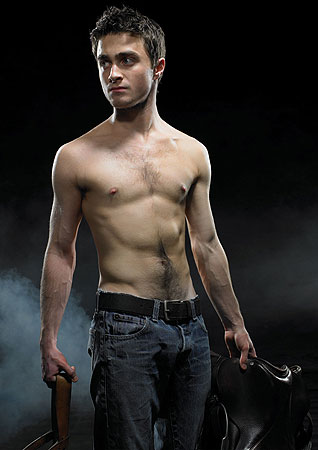
Though Mr. Radcliffe has no previous stage experience, he more than holds his own opposite Richard Griffiths, the real star of "Equus," who is known to "Harry Potter" buffs as Uncle Vernon and to theatergoers as the tortured schoolmaster of "The History Boys." Here Mr. Griffiths plays Martin Dysart, a child psychiatrist charged with the task of curing Alan Strang (Mr. Radcliffe), a stableboy who blinded six horses for no apparent reason. On the surface the play is an upside-down mystery in which the doctor tries to figure out what made his troubled patient--who turns out to have been sexually attracted to the horses he assaulted--do what he did. At the same time, though, Dysart simultaneously reveals himself to the audience as a middle-aged man suffering from "professional menopause" and trapped in a loveless marriage, and it is his own journey of self-discovery, not Alan's, that lies at the play's heart.
Mr. Griffiths' role was played on Broadway in the '70s by Anthony Hopkins, Richard Burton and Anthony Perkins. Unlike them, he is a character actor, albeit one of the first rank, and that is how he plays Dysart, as a fat, shambling, unkempt eccentric who is incapable of leading the more emotionally abundant life of his dreams....
I've always had trouble with Tennessee Williams' "A Streetcar Named Desire," in which poetic fantasy and rough-edged naturalism are uneasily yoked. That is, of course, the point of the play: Blanche DuBois, Williams' fanciful heroine, is driven mad by her refusal to accept the coarse truth of her own desires. But it is impossible to strike a stable balance between the two aspects of "Streetcar," and until now I'd never seen a staging that didn't swerve too far in the direction of overemotional extravagance. Not so the new production being mounted by the Shakespeare Theatre of New Jersey, in which Bonnie J. Monte, the company's artistic director, keeps it real from start to finish, aided by the breathtakingly fine acting of Laila Robins, the best Blanche I've ever seen....
* * *
Read the whole thing here. (You can also see my first Journal video review, a piece on Equus that I taped earlier this week.)
Posted September 26, 12:00 AM
TT: Payday for Tony Kushner
Tony Kushner, the author of Angels in America, will be the recipient of the first Steinberg Distinguished Playwright Award, a $200,000 cash prize awarded by the Harold and Mimi Steinberg Charitable Trust to "an American playwright whose body of work has made significant contributions to the American theater." Question: why? What's the point of giving a six-figure prize whose purpose is to support "the growth and development of outstanding playwrights...and encourage them to remain in their chosen field" to a man who has already knocked down a Pulitzer, an Emmy, and two Tonys?
Yep, it's "Sightings" time, and in Saturday's Wall Street Journal you'll find me in high dudgeon over what the Steinberg Trust hath wrought--but not because I don't care for Tony Kushner's plays, just as he doesn't care for my reviews. I have better reasons, and you can find out what they are by picking up a copy of tomorrow's Journal and turning to my column.
UPDATE: Read the whole thing here.
Posted September 26, 12:00 AM
TT: Almanac
"Everything we feel is made of Time. All the beauties of life are shaped by it."
Peter Shaffer, The Royal Hunt of the Sun
Posted September 26, 12:00 AM
September 25, 2008
OGIC: Fortune cookie
"Imagine a Carthage sown with salt, and all the sowers gone, and the seeds lain however long in the earh, till there rose finally in vegetable profusion leaves and trees of rime and brine. What flowering would there be in such a garden? Light would force each salt calyx to open in prisms, and to fruit heavily with bright globes of water--peaches and grapes are little more than that, and where the world was salt there would be greater need of slaking. For need can blossom into all the compensations it requires. To crave and to have are as like as a thing and its shadow. For when does a berry break upon the tongue as sweetly as when one longs to taste it, and when is the taste refracted into so many hues and savors of ripeness and earth, and when do our senses know anything so utterly as when we lack it? And here again is a foreshadowing--the world will be made whole. For to wish for a hand in one's hair is all but to feel it. So whatever we may lose, very craving gives it back to us again. Though we dream and hardly know it, longing, like an angel, fosters us, smooths our hair, and brings us wild strawberries."
Marilynne Robinson, Housekeeping
Posted September 25, 1:39 AM
TT: So you want to see a show?
Here's my list of recommended Broadway, off-Broadway, and out-of-town shows, updated weekly. In all cases, I gave these shows favorable reviews (if sometimes qualifiedly so) in The Wall Street Journal when they opened. For more information, click on the title.
Warning: Broadway shows marked with an asterisk were sold out, or nearly so, last week.
BROADWAY:
• Alfred Hitchcock's The 39 Steps (comedy, G, suitable for bright children, reviewed here)
• August: Osage County (drama, R, adult subject matter, reviewed here)
• Avenue Q (musical, R, adult subject matter and one show-stopping scene of puppet-on-puppet sex, reviewed here)
• Boeing-Boeing (comedy, PG-13, cartoonishly sexy, reviewed here)
• Gypsy (musical, PG-13, adult subject matter, reviewed here)
• The Little Mermaid * (musical, G, entirely suitable for children, reviewed here)
• South Pacific * (musical, G/PG-13, some sexual content, brilliantly staged but unsuitable for viewers acutely allergic to preachiness, reviewed here)
OFF BROADWAY:
• Enter Laughing (musical, PG-13, extended through Oct. 26, reviewed here)
• The Fantasticks (musical, G, suitable for children capable of enjoying a love story, reviewed here)
IN CAPE MAY, N.J.:
• To the Ladies (comedy, G, closes Oct. 18, reviewed here)
CLOSING SOON IN HARTFORD, CONN.:
• A Midsummer Night's Dream (comedy, G, surprisingly child-friendly, closes Oct. 5, reviewed here)
CLOSING SOON IN SPRING GREEN, WISC.:
• A Midsummer Night's Dream/Widowers' Houses (comedies, G, playing in repertory through Oct. 5, reviewed here)
CLOSING SATURDAY IN CAPE MAY, N.J.:
• Doubt (drama, PG-13, adult subject matter, reviewed here)
CLOSING SUNDAY OFF BROADWAY:
• Around the World in 80 Days (comedy, G, reviewed here)
Posted September 25, 12:00 AM
TT: Almanac
"The reader deserves an honest opinion. If he doesn't deserve it, give it to him anyhow."
John Ciardi, "The Reviewer's Duty to Damn"
Posted September 25, 12:00 AM
September 24, 2008
CAAF: Morning coffee
David Foster Wallace appreciations, remembrances and re-prints abound right now. A few addenda you may have missed: The syllabus to a Literary Interpretations class he taught at Pomona (via Book Bench; via Crooked House); the text to the commencement address he gave at Kenyon College in 2005 (if you're at all interested in DFW you've probably already read this one but it merits a re-read); and an old interview he gave to Amherst College's alumni magazine, where he talks about his five-draft method.
If you didn't catch it at the time, I also urge you to go read author Erin Hogan's fine piece on Wallace, which appeared in this space last Friday. Erin notes that DFW didn't use footnotes to appear clever but "because they are the closest approximations in a literary form to the mass of nonlinear parenthetical thoughts that is the monkey brain of all of us doing its job," an observation that made my monkey brain cough up these two footnoted thoughts:
1. It was strange, wasn't it, how the layout of "The Host" in The Atlantic, in which the footnotes were color-coded and looked like molecular globules floating on the page, was an almost too-literal progression of this idea of diagramming thought on paper.
2. I've always thought DFW cold-mugged Wittgenstein's Mistress for parts of Infinite Jest, particularly David Markson's technique of having a character's (seemingly) abandoned thoughts re-surface as non sequiturs in later pages. Very rhythmic, like a swimmer surfacing then disappearing then resurfacing again. If it hasn't already been done, someone should write a paper on that.
Posted September 24, 1:00 AM
TT: Almanac
Be calm in arguing: for fierceness makes
Error a fault, and truth discourtesy.
George Herbert, "The Church-Porch"
Posted September 24, 12:00 AM
September 23, 2008
OGIC: Type me up, type me down
Typewriters knew things. Long before the word-processor actually stored information, many writers felt that their Remingtons, or Smith-Coronas, or Adlers contained the sum of their knowledge of eastern Europe, or the plot of their novel. A typewriter was a friend and collaborator whose sickness was catastrophe.
It's surprising to recall that in college, in the late 1980s, I still owned a typewriter, along with my standard-issue Mac Classic. I must have lugged it with me from dorm room to dorm room each year--and to and from different apartments each summer--but I can only remember using it in one context, a poetry writing course my junior year. Typing my poems made me feel more like part of an ongoing tradition (itself relatively recent, of course), and it called for a precision and a decisiveness in the act of composition that were bracing. It pleased my senses, and bolstered my sense of making something real and substantial, to see and hear the keys strike the page with a physical, really a violent impact. My longest poem ran only a page and a half, so I wasn't exactly suffering for my art. Anything longer I wrote on the Mac, but it felt like a more evanescent affair.
Maybe I hang out with too many writer types, but it seems to me the memory of typewriters sends lots of us into giddy, almost moon-eyed reverie. This lovely obituary of typewriter whisperer Martin Tytell, in the Economist, is no exception. I love how it finds room amidst the extraordinary facts of Mr. Tytell's life to wear its heart on its sleeve about the magnificent machine:
Anyone who had dealings with manual typewriters--the past tense, sadly, is necessary--knew that they were not mere machines. Eased heavily from the box, they would sit on the desk with an air of expectancy, like a concert grand once the lid is raised. On older models the keys, metal-rimmed with white inlay, invited the user to play forceful concertos on them, while the silvery type-bars rose and fell chittering and whispering from their beds. Such sounds once filled the offices of the world, and Martin Tytell's life.Everything about a manual was sensual and tactile, from the careful placing of paper round the platen (which might be plump and soft or hard and dry, and was, Mr Tytell said, a typewriter's heart) to the clicking whirr of the winding knob, the slight high conferred by a new, wet, Mylar ribbon and the feeding of it, with inkier and inkier fingers, through the twin black guides by the spool. Typewriters asked for effort and energy. They repaid it, on a good day, with the triumphant repeated ping! of the carriage return and the blithe sweep of the lever that inched the paper upwards.
Posted September 23, 1:00 AM
CAAF: Anxiety of influence
When I heard Junot Díaz read last spring, he mentioned how when he started writing he was "stealing from the writers I loved the best. I cold-mugged the books." Cold-mugging your favorite writers -- a fine literary tradition. Reading John Updike's appreciation of William Maxwell, it was nice to learn this anecdote about Maxwell's first novel, Bright Center of Heaven, which was first published in 1934 and later suppressed by the author on the grounds it was "stuck fast in it is period" and "hopelessly imitative."
In a Paris Review interview, [Maxwell] said, "My first novel . . . is a compendium of all the writers I loved and admired." Virginia Woolf's "To the Lighthouse," especially, is imitated in the drifting weave of action and interior reflection, and in the rhythms, paced by commas, of the long descriptive sentences. Ten years after the novel's publication, he reread it and wrote, "I . . . discovered to my horror that I had lifted a character--the homesick servant girl--lock, stock, and barrel from 'To the Lighthouse.' "
Posted September 23, 12:05 AM
TT: Almanac
"One begins to see, for instance, that painting a picture is like fighting a battle; and trying to paint a picture is, I suppose, like trying to fight a battle. It is, if anything, more exciting than fighting it successfully. But the principle is the same. It is the same kind of problem as unfolding a long, sustained, interlocked argument. It is a proposition which, whether of few or numberless parts, is commanded by a single unity of conception. And we think--though I cannot tell--that painting a great picture must require an intellect on the grand scale. There must be that all-embracing view which presents the beginning and the end, the whole and each part, as one instantaneous impression retentively and untiringly held in mind. When we look at the larger Turners--canvases yards wide and tall--and observe that they are all done in one piece and represent one single second of time, and that every innumerable detail, however small, however distant, however subordinate, is set forth naturally and in its true proportion and relation, without effort, without failure, we must feel in the presence of an intellectual manifestation the equal in quality and intensity of the finest achievements of warlike action, of forensic argument, or of scientific or philosophical adjudication."
Winston Churchill, Painting as a Pastime (courtesy of Eric Gibson)
Posted September 23, 12:00 AM
September 22, 2008
TT: Almanac (in memoriam)
At once a voice arose among
The bleak twigs overhead
In a full-hearted evensong
Of joy illimited;
An aged thrush, frail, gaunt, and small,
In blast-beruffled plume,
Had chosen thus to fling his soul
Upon the growing gloom.
So little cause for carolings
Of such ecstatic sound
Was written on terrestrial things
Afar or nigh around,
That I could think there trembled through
His happy good-night air
Some blessed Hope, whereof he knew
And I was unaware.
Thomas Hardy, "The Darkling Thrush"
* * *
Dick Sudhalter plays Bix Beiderbecke's "Davenport Blues" with the New York Jazz Repertory Company at Carnegie Hall in 1975:
Posted September 22, 12:00 AM
September 19, 2008
TT: Richard M. Sudhalter, R.I.P.
Dick Sudhalter wrote three of the most important books ever published about jazz and American popular music, Bix: Man and Legend, Lost Chords: White Musicians and Their Contribution to Jazz, 1915-1945, and Stardust Melody: The Life and Music of Hoagy Carmichael. He was also a trumpet player of great elegance and distinction who didn't make nearly as many records as he should have, though Melodies Heard, Melodies Sweet showed him off to the best possible advantage.
In private life Dick was as dapper as his playing, and old-fashioned in all the best ways. He liked Chicago-style jazz, British tailoring, black-and-white movies, Marmite, and The New Yorker before Tina Brown got her hands on it. Not surprisingly, he was more than a little bit at odds with much of the modern world, and I suspect that he would have been vastly happier had he been born in 1908 instead of 1938. He was also a pessimist by nature, but like many such folks, he gave more pleasure than he got--and, I suspect, got more pleasure than he usually cared to admit.
Dick and I were close friends, and so it grieved me deeply when his body began to betray him a few years ago. First came a stroke that robbed him of the power to play his horn and left him increasingly slow of speech (though never of mind). Then he fell victim to multiple system atrophy, an appalling disease that in time made it impossible for him to talk at all. That such an ailment should have struck down so brilliantly articulate a man was one of those horrific ironies with which life likes to remind us that it holds the whip hand.
I knew that Dick wanted to die--he told me so while he still could--and so I suppose I should be glad that his suffering is now over. Yet I find it impossible to greet the news of his death with anything other than black sorrow, though I know that it will someday be a comfort to have his books to read and his records to play. When I heard that he was dying, I sat quietly in my hotel room for a few minutes, then opened up my iBook and listened to the sweetly elegiac performance of Duke Ellington's "Black Butterfly" that he recorded with Roger Kellaway in 1999 (it's on Melodies Heard, Melodies Sweet). It isn't given to very many of us to write our own epitaphs, much less play them, but I can't think of a better way to sum up what Dick Sudhalter was all about than to listen to that song.
UPDATE: Doug Ramsey, another of Dick's friends, pays eloquent tribute to him here.
This posting from the Chicago Reader's media blog tells of another slice of Dick's life, one about which I knew little--his work as a foreign correspondent.
The New York Times obituary is here.
The Washington Post obituary is here.
Further thoughts from Patrick Kurp at Anecdotal Evidence.
Posted September 19, 11:30 AM
OGIC: A friend remembers Wallace
Adding to Carrie's thoughts about David Foster Wallace's shocking suicide is my friend Erin Hogan, author of the land-art travelogue Spiral Jetta and the most impassioned Wallace reader I know.
It seems only fair to start a few words about David Foster Wallace by talking about myself. No other writer was as deeply invested in individual consciousness--and its ridiculously messy, digressive, splintering course--as DFW. The individual consciousness that is me received so many condolence calls about Wallace's suicide on Saturday and Sunday that I began to feel I had some sort of friendship with him, though I never met him.I was an early proponent of Infinite Jest, probably gifting it over the years to at least 20 people. As a former coworker wrote to remind me, I made familiarity with IJ a condition of employment in my department. I believed--and still believe--that no other novel comes close to engaging with the welter of sights, sounds, fears, smells, absurdities, and beauty of our time. It's a sprawling, sickening, hilarious mess, and many people have taken it to be DFW's definite work. And why wouldn't they? At nearly 1100 pages, the last leg of them footnotes, it is a magnum opus. Others have pointed to his essays--on tennis, cruise ships, television, language, state fairs--where DFW seemingly harnessed his impulses to overwhelm and emerged with biting, incisive, and yet sympathetic views of contemporary life. They were essays in the truest sense, essais, attempts, tries to explain, to elucidate arcane sports skills or how vacation alienation points to a fundamental human pathos.
But I always found DFW most in his short stories. I should say immediately that I am not a natural fan of the genre. Even the best short stories seem to me too short. They don't allow a reader an immersive experience, which is the kind of experience I am always looking for. DFW's story collections--particularly Brief Interviews with Hideous Men--remain for me the epitome of the genre. They push the story form to its limits, though with mixed results. There are stories that are two sentences or two paragraphs long, stories that are answers to unvoiced questions, stories that include their own scaffolding of craft, stories in the second and third person, stories that are pure dialogue. They are stories of nearly unspeakable tragedy and horror, and stories of unbearable beauty. Sentences I first read in these stories--"Metal flowers bloom on your tongue" ("Forever Overhead"), "All this according to Dirk of Fresno" (which always makes me laugh, from "Tri-Stan: I Sold Sissee Nar to Ecko"), "His own forehead snaps clear" ("Think")--are still with me.
I could say that I think Wallace loved language and detail and work, prolific work, all of which are clear in everything he did. But it is in his stories that his ethical agenda is clear. He's not racking up these gruesome details to disgust us; he is empathetically portraying the worst that humans can offer to each other. He's not using footnotes because it's clever; he's using footnotes because it they are the closest approximations in a literary form to the mass of nonlinear parenthetical thoughts that is the monkey brain of all of us doing its job. He's not using that vocabulary of his to show off; he's using it because the world is bursting to be described fully. I think I once heard him say that literature teaches us how to be human. By this I think he meant that the role of literature is to stretch our understanding of the hideous and the glorious; embrace the ambivalence, the mess; be attentive even when the stimuli are too much to bear; and understand that beneath all of this--these words, these betrayals and misdeeds, this ugliness and absurdity--lies the essentially human.
Maybe I didn't hear him say this, but he probably wouldn't care. I'm a reader, not a writer, so many more people will have a lot more intelligent things to say about him. But I cried when I heard the news. It was only then that I realized I was looking forward to growing old with him, hearing what he had to say about aging, Obama, the millennium, California, Rafael Nadal, cookies, anxiety, reality television, love, hybrid cars--everything under his sun. I am so grateful that he shared what he had, that he suffered through his struggles long enough to gift us with what he did.
Terry wrote about Spiral Jetta for Commentary's blog here. This New York Times review found the book pretty great, too. Thanks to Erin for sharing her thoughts.
Posted September 19, 9:26 AM
TT: Revolutionary bore
This week I review three shows in my Wall Street Journal drama colum, one on Broadway and two in Cape May, New Jersey. The Broadway premiere of A Tale of Two Cities is an expensive dud, while Cape May Stage's Doubt and the East Lynne Theatre Company's To the Ladies are both top-notch. Go figure! Here's an excerpt.
* * *
If you loved "Les Misérables," you'll like "A Tale of Two Cities." The book is earnest, the décor elaborate, the cast hard-working. I wish I could summon up somewhat more enthusiasm for Jill Santoriello's musical version of Charles Dickens' great novel of the French Revolution, but except for Tony Walton's ingenious quick-change sets and James Barbour's magnetic performance as Sydney Carton, the first show of the Broadway season is a protracted exercise in plodding mediocrity that's as sincere as a Sunday sermon and several times longer to boot.
Authorially speaking, "A Tale of Two Cities" is a one-woman show. Ms. Santoriello, a Broadway debutante, wrote the book, an overstuffed digest of Dickens' eventful novel, and the songs, whose lyrics are gimcrack and whose music consists of dull tunes that have been bulked up in vain with rolling cymbals and thundering timpani....
Cape May Stage performs in a deconsecrated Presbyterian church whose ecclesiastical yet intimate air enhances the effectiveness of its superb production of "Doubt," John Patrick Shanley's Pulitzer Prize-winning play about a Roman Catholic priest (Paul Bernardo) who may or may not have molested a child in his care. I saw "Doubt" at what I took for granted would be a disadvantage, since Brían F. O'Byrne, Cherry Jones, Heather Goldenhersh and Adriane Lenox, the stars of the original New York production, gave bravura performances that still stand out in my memory. Imagine my surprise, then, when Mr. Bernardo, Mary Baird, Abby Royle and Sameerah Luqmaan-Harris, all of whose names are new to me, turned out to be every bit as good as their better-known predecessors....
Unlike Cape May Stage, which offers the usual summer-theater mix of straight plays and small-scale musicals, the East Lynne Theater Company specializes in shows that "deal with the uniquely American experience," including revivals of forgotten American plays from the first half of the 20th century. This year the company has exhumed "To the Ladies," a 1922 comedy by George S. Kaufman and Marc Connelly. All Kaufman-Connelly revivals are rare--Kaufman is now remembered solely for his later collaborations with Moss Hart--but "To the Ladies" hasn't been staged anywhere since 1926, which makes this production significant by definition.
To be sure, I expected that "To the Ladies" would be a historical curiosity, but it turns out to be a thoroughly likable piece of proto-feminist fluff about a pair of bumbling businessmen (John Morton and Ken Glickfeld) and the brainy wives (Tiffany-Leigh Moskow and Suzanne Dawson) who repeatedly pull them out of the holes they dig for themselves.
* * *
Read the whole thing here.
Posted September 19, 12:00 AM
TT: Almanac
"Criticism is a study by which men grow important and formidable at very small expense. The power of invention has been conferred by nature upon few, and the labour of learning those sciences which may, by mere labour, be obtained, is too great to be willingly endured; but every man can exert some judgment as he has upon the works of others; and he whom nature has made weak, and idleness keeps ignorant, may yet support his vanity by the name of critic."
Samuel Johnson, The Idler, No. 60
Posted September 19, 12:00 AM
September 18, 2008
OGIC: Second stories
Patrick Kurp, whose blog I recommended yesterday, posted the other day about the necessity of gratitude and about W. H. Auden: "Auden's instinct was to offer thanks for the gifts he, like all of us, had done nothing to deserve." The post resonated with an almost throwaway sentence I read recently in Edward P. Jones's The Known World. This is very much how it is, reading Jones: peripheral details about peripheral characters, mentioned in passing, have the weight and pull of miniature stories in their own right. These stories might, in a half-sentence, be told, or they might be only gestured at. Through them a sense of the whole vast, connected world slips in, of its enormity and of the numberless threads of human plots therein. The effect, over pages and chapters, is not only of richness and plenitude but of a great humaneness--Jones's and, the more you read of him, your own.
Jones's novel is about slaves and slave owners in pre-Civil War America. In the passage I was reminded of, the young Virginian John Skiffington, who on principle owns no slaves, has just married a Northern woman. To the profound discomfort of half the wedding party, a cousin of the groom has made a wedding gift of a nine-year-old slave girl, Minerva. The next morning, her first in the house, Minerva rises early and tiptoes around her new surroundings.
The child now took more steps, passing her own room, and came to a partly opened door. She could see John Skiffington's father on his knees praying in a corner of his room. Fully dressed with his hat on, the old man, who would find another wife in Philadelphia, had been on his knees for nearly two hours: God gave so much and yet asked for so little in return.
This fleeting narrative detour is lovely and painful at once: lovely for the humble and surprising act of gratitude it records, painful for being observed by someone not so fortunate. We don't hear a lot more about the elder Mr. Skiffington, at least not as far as I've read, and that only makes this impromptu glimpse the more poignant.
Nobody else I've read is like Jones. He's an unmatched teller of stories big and small--he'll hook you on the stuff. His short stories in All Aunt Hagar's Children had me over the moon when I read and reviewed them two years ago. The stories and the novel deal with some of the darker aspects of human experience; they look at this material hard and straight on. But there are always points of grace amidst the pain that are the most indelible moments, and the whole enterprise is characterized by a generosity toward humanity that isn't ever blindered or phony. Definitely a writer to be grateful for.
Posted September 18, 1:45 PM
TT: So you want to see a show?
Here's my list of recommended Broadway, off-Broadway, and out-of-town shows, updated weekly. In all cases, I gave these shows favorable reviews (if sometimes qualifiedly so) in The Wall Street Journal when they opened. For more information, click on the title.
Warning: Broadway shows marked with an asterisk were sold out, or nearly so, last week.
BROADWAY:
• Alfred Hitchcock's The 39 Steps (comedy, G, suitable for bright children, reviewed here)
• August: Osage County (drama, R, adult subject matter, reviewed here)
• Avenue Q (musical, R, adult subject matter and one show-stopping scene of puppet-on-puppet sex, reviewed here)
• Boeing-Boeing (comedy, PG-13, cartoonishly sexy, reviewed here)
• Gypsy (musical, PG-13, adult subject matter, reviewed here)
• The Little Mermaid * (musical, G, entirely suitable for children, reviewed here)
• South Pacific * (musical, G/PG-13, some sexual content, brilliantly staged but unsuitable for viewers acutely allergic to preachiness, reviewed here)
OFF BROADWAY:
• Enter Laughing (musical, PG-13, closes Oct. 12, reviewed here)
• The Fantasticks (musical, G, suitable for children capable of enjoying a love story, reviewed here)
IN HARTFORD, CONN.:
• A Midsummer Night's Dream (comedy, G, surprisingly child-friendly, closes Oct. 5, reviewed here)
IN SPRING GREEN, WISC.:
• A Midsummer Night's Dream/Widowers' Houses (comedies, G, playing in repertory through Oct. 5, reviewed here)
CLOSING NEXT WEEK OFF BROADWAY:
• Around the World in 80 Days (comedy, G, closes Sept. 28, reviewed here)
CLOSING FRIDAY IN EAST HADDAM, CONN.:
• Half a Sixpence (musical, G, reviewed here)
Posted September 18, 12:00 AM
TT: Almanac
"Comedy has to be done en clair. You can't blunt the edge of wit or the point of satire with obscurity. Try to imagine a famous witty saying that is not immediately clear."
James Thurber, letter to Malcolm Cowley, March 11, 1954
Posted September 18, 12:00 AM
September 17, 2008
OGIC: Morning coffee
After ages and ages away, I'm going to ease back into this blogging business with a few good links.
• Are you reading Patrick Kurp's literary blog Anecdotal Evidence every day? Patrick is a widely traveled and discerning reader whose posts I've begun to regard as almost a fourth daily meal: I leave them feeling not only delighted but somehow substantially fed. Here he is on the evolution of literary taste with age, on Chekhov and oysters, and on our newest poet laureate. Essential.
• An editor friend sends along Brian Doyle's Kenyon Review essay on the art of saying no--and yes--to writers. Doyle is the editor of one of the most distinctive university magazines in the country, Portland Magazine from the University of Portland. Here's a bit from Doyle's essay:
Many magazines lean on a form letter, a printed note, a card, and I study them happily. The New Yorker, under the gentle and peculiar William Shawn, sent a gentle yellow slip of paper with the magazine's logo and a couple of gentle sentences saying, gently, no. Under the brisker Robert Gottlieb, the magazine sent a similar note, this one courteously mentioning the "evident quality" of your submission even as the submission is declined. Harper's and the Atlantic lean on the traditional Thank You But; Grand Street, among other sniffy literary quarterlies, icily declines to read your submission if it has not been solicited; the Sun responds some months later with a long friendly note from the editor in which he mentions that he is not accepting your piece even as he vigorously commends the writing of it; the Nation thanks you for thinking of the Nation; and the Virginia Quarterly Review sends, or used to send, a lovely engraved card, which is worth the price of rejection. The only rejection notice I keep in plain view is that one, for the clean lines of its limbs and the grace with which it delivers its blow to the groin.
In addition to its tales of rejection and acceptance--experienced from both sides of the editor's desk--the essay is notable for containing this account of the author's proposal to his wife:
She did say yeah, or I thought she said yeah, the wind was really blowing, and then she slapped her forehead and went off on a long monologue about how she couldn't believe she said yeah when she wanted to say yes, her mom had always warned her that if she kept saying yeah instead of yes there would come a day when she would say yeah instead of yes and really regret it, and indeed this very day had come to pass, one of those rare moments when your mom was exactly right and prescient, which I often think my mom was when she said to me darkly many years ago I hope you have kids exactly like you, the ancient Irish curse.
Posted September 17, 10:21 AM
TT: Snapshot
A brief silent film of Pierre-Auguste Renoir at work, shot circa 1917. For more information about the clip, go here:
(This is the latest in a weekly series of arts-related videos that appear in this space each Wednesday.)
Posted September 17, 12:00 AM
TT: Almanac
"When a friend speaks to me, whatever he says is interesting."
Jean Renoir (quoted in the New York Times, Sept. 28, 1969)
Posted September 17, 12:00 AM
September 16, 2008
TT: Excuse my dust
Mrs. T and I have resumed our travels. At present we're in Cape May, an island resort town at the southern tip of New Jersey, where we'll be seeing two shows, Cape May Stage's Doubt and the East Lynne Theatre Company's To the Ladies. Both companies are new to me--I've never seen any theater in Cape May--and I'm looking forward to making their acquaintance. We're staying at Rhythm of the Sea, a wonderful oceanside inn of which we already have the fondest possible memories, and I mean to take off enough time between shows to recover from a severe case of chronic overwork.
From Cape May we travel to Madison, New Jersey, home of the Shakespeare Theatre of New Jersey, which is presenting Laila Robins, an actress I admire greatly, in a revival of Tennessee Williams' A Streetcar Named Desire, a play about which, as some of you will recall, I have long had my doubts. Be that as it may, the role of Blanche DuBois was made for Robins, and I wouldn't dream of missing this production.
On Friday we return to New York, and the next morning I fly down to Raleigh, North Carolina, where Carolina Ballet, a company for which I have the utmost admiration, is giving the premiere of Robert Weiss' Time Gallery, which is set to the music of Paul Moravec, who needs no introduction to regular readers of this blog. According to Carolina Ballet's Web site, "Time Gallery explores the many facets of time--the cycles of life, the cycle of the day, how our memories affect our relationship to time's passing. Pulitzer Prize-winning composer Paul Moravec's rhythmically complex score provides the texture upon which to build a dance through time."
Weiss, a Balanchine-trained choreographer whose work I've championed for many years, is very excited about Time Gallery, whose score is a work of the same name that was premiered by Eighth Blackbird in 2001 and recorded by them for Naxos five years later. I covered the premiere for the Washington Post in my old "Second City" column:
Eighth Blackbird is a spiffy sextet from Chicago that specializes in avant-garde music of the old-fashioned, hyper-complicated sort, while Moravec is one of the accessibility-conscious "new tonalists" who are giving contemporary classical music a much-needed makeover. It's an odd match, but Moravec had the clever idea to write a piece that deploys the whole avant-garde bag of tricks--a multimedia slide show, electronic-music interludes, even a touch of performance art--in support of a score that is unabashedly tonal and breathtakingly beautiful. I sat on the edge of my seat as each movement unfolded, acutely aware that I was hearing an important new work, perhaps even a masterpiece, for the very first time....
I couldn't very well miss the world premiere of a ballet based on a piece like that, could I? Not hardly. So I'll be in Raleigh long enough to catch two performances of Time Gallery on Saturday.
Then it's back to New York for...but enough about me! Our Girl and CAAF are about to return to the blog after a long absence, so I'm going to take a week and a half off (except for the usual almanac entries and theater-related postings) and leave things to them.
Later.
Posted September 16, 12:00 AM
TT: Almanac
"Work as joy, inaccessible to the psychologists."
Franz Kafka, notebook entry, 1918
Posted September 16, 12:00 AM
September 15, 2008
TT: Submerged

Some Ike-related art news, by way of Modern Art Notes: Mies van der Rohe's Farnsworth House is flooded. As of today, the house is accessible only by boat, and tours have been suspended indefinitely. Mrs. T, Our Girl, and I visited the house last year and found it both beautiful and fascinating, though we also found it hard to imagine living there. Be that as it may, the fact that this landmark of architectural modernism is under siege saddens me greatly.
For a detailed report on the damage--which I fear will be considerable--go here.
Posted September 15, 10:34 AM
TT: Words to the wise
• In case you missed my previous posting on the subject, the Hudson Valley Shakespeare Festival's production of Shakespeare's Twelfth Night will be telecast on WNET this Thursday at nine p.m. It will be preceded by Shakespeare on the Hudson, a backstage documentary on the making of Twelfth Night, which airs at eight.
I raved about this production when I reviewed it in The Wall Street Journal earlier this year, and I'm delighted that it's going to be seen on TV--though grieviously disappointed that it will only be seen in the New York area. My advice to those who live elsewhere: complain to PBS!
For more information, go here.
Both shows will also be telecast by WLIW on September 26 starting at nine p.m.
• An exhibition of woodcuts by Neil Welliver, a representational artist who, like Fairfield Porter, was deeply influenced by abstract expressionism, has just opened at the Alexandre Gallery, where it will be on view through September 27. Welliver, who died three years ago, was one of America's great printmakers, and his woodcuts (one of which I own) were among his very best work.
For more information about the show, go here. To see a selection of Welliver's prints, go here.
• The Metropolitan Museum's eagerly awaited Giorgio Morandi retrospective opens tomorrow and will be on view through December 24. I hope I don't need to tell you how important this show is, but if so, here's what the Met has to say about it:
This is a comprehensive survey--the first in this country--of the career of Giorgio Morandi, one of the greatest 20th-century masters of still-life and landscape painting in the tradition of Chardin and Cézanne. The exhibition presents approximately 110 paintings, watercolors, drawings, and etchings from his early "metaphysical" works to his late evanescent still lifes, culled mainly from Italian collections, including those formed with Morandi's help by his friends and by renowned scholars of his art.
For more information, go here.
In addition to the Met's exhibition, two New York galleries are putting on Morandi shows of their own. Lucas Schoormans Gallery, to whose 2004 Morandi exhibition I gave an ecstatic review in the Washington Post, is putting on a new show of paintings and works on paper that opened last week. And Pace Master Prints' "The Etchings of Giorgio Morandi," which consists of twenty-five works, opens on Thursday.
For more information, go here and here. Both shows are up through October 18.
Posted September 15, 12:00 AM
TT: Almanac
"Excess on occasion is exhilarating. It prevents moderation from acquiring the deadening effect of habit."
W. Somerset Maugham, The Summing Up
Posted September 15, 12:00 AM
September 14, 2008
MAKE ROOM FOR SURPRISE
"The much-derided but nonetheless hugely influential historical narrative that the Museum of Modern Art has been promulgating ever since its opening in 1929 is full of holes--and if you peer carefully through them, you'll see some of the best art of the 20th century, even though it's nowhere to be found on MoMA's bright white walls. Consider the case of Richard Diebenkorn..."Posted September 14, 11:38 PM
CAAF: I don't know anyone who doesn't feel socked in the stomach today
I haven't allowed myself to read David Foster Wallace's work for the past few years. He's one of the writers I love best, but I found that whenever I read him, I inevitably started to ape his voice in my own writing, and if you've ever written in that style (intentionally or unintentionally) or read a story or essay by someone in the grip of his or her own DFW enthrallment, you know how impossible it is to do what he does as well as he does it, how in lesser hands those crazy sentences -- stilted, stacked, lurching and clanking along on their ugly-beautiful legs before suddenly lapsing forward in some improbable, graceful glissade -- become just messy, neurotic, overly footnoted whorls. Because the classic DFW sentence, tic-ish as it may be, is when broken down a wonder of precision: The object (person, thing) is observed fully, describing exactingly. The $10 vocabulary words are slotted into place not to be grandiose but because that word is the precise word, the only word, to describe that particular object or action.
The news of Wallace's death is heartbreaking, and the circumstances make one grieve for him and his family and friends. When speaking about books, I was trained to stick close to the text, to revere it and leave the poor writer alone. And yet with DFW I can't. I hold him in such great affection (who, among his fans, doesn't?) -- and I feel ... well, a terrible sense of loss and sorrow tonight. I have looked to him for so long (forgive the homeliness here but I've thought of him more than once as like a favorite quarterback: someone who you look to to see how the game is going), I always thought I'd know him some day, or if I didn't, that I would at the very least get to see him grow old.
In formulating my sense of DFW character over the years, I've enjoyed picking out what points in it seemed the most Midwestern. In interviews and the "The Charlie Rose" appearances, it amused me to see deep Midwestern-ness - e.g., the earnestness, the homely collegial good manners, the clear desire to keep things on an even social footing (rather than to shock and awe), the occasional terrible haircut -- commingled with such great genius. And yet these same Midwestern qualities also seemed part and parcel of the writing, manifesting there not as quaintness or some godawful aw-shucksiness, but in a palpable belief in the reader and the reader's ability to keep up, to get it -- that is, to place the reader on an equal footing with himself. Read him and he never panders, he never condescends (even if he does show off). To write and experiment so boldly, to choose to bring home the whole pig whenever you go to market and invite the reader to the table with you as an equal, is to show the greatest respect and generosity. Bless him for that, and bless him as he moves on ahead.
Posted September 14, 9:00 PM
September 12, 2008
TT: Into the woods (again)
I review two shows in this week's Wall Street Journal drama column, one in Connecticut and one in New York: Hartford Stage's A Midsummer Night's Dream and the York Theatre Company's off-Broadway revival of Enter Laughing: The Musical. Both are excellent. Here's an excerpt.
* * *
If it's summer, somebody's doing "A Midsummer Night's Dream." I've seen two very different productions in the past two weeks, and I'd hate to have to choose between them. Fortunately, art isn't sports, so I'm not required to pick a winner. Suffice it to say that Connecticut's Hartford Stage, like Wisconsin's American Players Theatre before it, has done exceptionally well by Shakespeare's best-loved comedy.
Lisa Peterson, a well-established director whose work is new to me, has put a winningly new spin on the timeless tale of two troubled young couples who wander into an enchanted wood, run into a gaggle of mischief-making fairies and emerge unscathed and happy. In Ms. Peterson's modern-dress version, the mere mortals reside in the never-never land of '50s family sitcoms, while Fairyland is a cross between "Peter Pan" and "Lord of the Flies," a land of raucous, grubby-faced children who speak and sing in unison and tumble about the stage with unholy glee.
Sometimes a set makes a show, and Rachel Hauck, who designed the Pissarro-influenced production of "The Winter's Tale" that I saw and loved at the Oregon Shakespeare Festival two seasons ago, has outdone herself this time around. Her décor is simple--a forest, a small platform, a window that seems to float in mid-air and a trapdoor that is put to ingenious use--but magical....
Remember Carl Reiner? You do if you owned a TV back in the days when he was a regular and welcome presence on "Your Show of Shows" and "The Dick Van Dyke Show." Now Mr. Reiner is an elder statesman of comedy, and the York Theatre Company, which usually specializes in small-scale Off-Broadway mountings of new musicals, has revived "Enter Laughing," the 1976 musical version of his semi-autobiographical 1958 novel about David Kolowitz (Josh Grisetti), a geeky, star-struck kid from the Bronx who longs to become an actor. It's a charmer, cleverly staged and choreographed by Stuart Ross ("Forever Plaid") and acted by the best cast in town....
Mr. Ross' cast includes such familiar faces as Jill Eikenberry and Michael Tucker, formerly of "L.A. Law," and George S. Irving, the oldest of old pros, who made his Broadway debut in the original cast of "Oklahoma!" and appeared 33 years later in the original cast of "So Long, 174th Street," as "Enter Laughing: The Musical" was originally known. Then as now, Mr. Irving plays Harrison Marlowe, a plummy-voiced, deeply fraudulent director who casts David in his new show, and every word that comes out of his mouth is a joy to hear.
* * *
Read the whole thing here.
Posted September 12, 12:00 AM
TT: Make room for surprise
The most important American art exhibition of the 2008-09 season, Richard Diebenkorn: The Ocean Park Series, 1967 to 1985, goes up on October 11 at the Orange County Museum of Art in Newport Beach, California. Not New York, not Philadelphia, not Chicago, not even San Francisco. What gives here? The answer, as those who esteem Diebenkorn know all too well, is that his greatness has yet to be fully acknowledged by large tracts of the American art establishment. Why? Because he doesn't fit into the Cézanne-Picasso-Pollock narrative that many critics and curators use to "explain" the history of twentieth-century art. He switched from abstraction to figurative painting when the New York School was at the peak of its popularity, then switched back just as abstract expressionism was giving way to Pop Art. As if all that weren't bad enough, he had the poor taste to live in...California. How déclassé is that?
In this week's "Sightings" column, which appears in tomorrow's Wall Street Journal, I use the Orange County retrospective as an occasion to discuss the insidious effect of historical narratives on the immediate experience of art. Too many people believe what they read instead of seeing what they see, and Diebenkorn is one of many artists whose reputation has suffered as a result. If you want to know why that happens, pick up a copy of Saturday's Journal and read what I have to say.
UPDATE: Read the whole thing here.
Alas, I made a not-so-little mistake in this week's column: Orange County's Diebenkorn show goes up next October 11, not this October 11. Sorry about that. Plan ahead!
Posted September 12, 12:00 AM
TT: Moving on
Dana Gioia is announcing today that in January he will be leaving the National Endowment for the Arts, which he has chaired for the past six years. "Six years is a long time in a job," he told the Washington Post. "I have done most of the things I set out to do. I really want to go back to writing. I haven't had time for my own writing. I write all the time for the NEA, official writing. Since I have become chairman, I have not published a poem."
As readers of this blog know, President Bush nominated me to sit on the National Council on the Arts, and the Senate confirmed me unanimously to a six-year term in 2004. It was, of course, Dana's idea that I should serve on the NCA--we are old friends--and I accepted unhesitatingly, albeit a little nervously. Since then, though, I've seen from the inside how the NEA operates, and I've been very impressed. As for Dana, I recently told a colleague of mine that I thought he might well be remembered as the Bush administration's single most effective appointee. The Post says that he is "credited with helping revitalize" the NEA. That's putting it mildly.
Be that as it may, it also happens that Dana is a marvelous poet, and it strikes me that the world is more in need of poets than administrators. To be sure, one of his most beautiful poems, "Words," questions the importance of poetry itself:
The world does not need words. It articulates itself
in sunlight, leaves, and shadows. The stones on the path
are no less real for lying uncatalogued and uncounted.
The fluent leaves speak only the dialect of pure being.
The kiss is still fully itself though no words were spoken.
True enough--but a man who can write like that ought not to spend too long in the stony wilderness of bureaucratic endeavor, no matter how worthy the cause may be. So hit the road, Dana, and don't forget to bring your pad and pencil! You have work to do.
* * *
The Post story announcing Dana's departure is here.
Posted September 12, 12:00 AM
TT: Almanac
"Comedy is tragedy that happens to other people."
Angela Carter, Wise Children
Posted September 12, 12:00 AM
September 11, 2008
TT: So you want to see a show?
Here's my list of recommended Broadway, off-Broadway, and out-of-town shows, updated weekly. In all cases, I gave these shows favorable reviews (if sometimes qualifiedly so) in The Wall Street Journal when they opened. For more information, click on the title.
Warning: Broadway shows marked with an asterisk were sold out, or nearly so, last week.
BROADWAY:
• Alfred Hitchcock's The 39 Steps (comedy, G, suitable for bright children, reviewed here)
• August: Osage County (drama, R, adult subject matter, reviewed here)
• Avenue Q (musical, R, adult subject matter and one show-stopping scene of puppet-on-puppet sex, reviewed here)
• Boeing-Boeing (comedy, PG-13, cartoonishly sexy, reviewed here)
• Gypsy (musical, PG-13, adult subject matter, reviewed here)
• The Little Mermaid (musical, G, entirely suitable for children, reviewed here)
• South Pacific * (musical, G/PG-13, some sexual content, brilliantly staged but unsuitable for viewers acutely allergic to preachiness, reviewed here)
OFF BROADWAY:
• The Fantasticks (musical, G, suitable for children capable of enjoying a love story, reviewed here)
IN SPRING GREEN, WISC.:
• A Midsummer Night's Dream/Widowers' Houses (Shakespeare/Shaw, G, playing in repertory through Oct. 5, reviewed here)
CLOSING SOON OFF BROADWAY:
• Around the World in 80 Days (comedy, G, closes Sept. 28, reviewed here)
CLOSING NEXT WEEK IN EAST HADDAM, CONN.:
• Half a Sixpence (musical, G, closes Sept. 19, reviewed here)
Posted September 11, 12:00 AM
TT: Almanac
"Forgetfulness. A gift of God bestowed upon debtors in compensation for their destitution of conscience."
Ambrose Bierce, The Devil's Dictionary
Posted September 11, 12:00 AM
September 10, 2008
TT: Snapshot
The Gerry Mulligan Quartet plays "Open Country," with Bob Brookmeyer on valve trombone:
(This is the latest in a weekly series of arts-related videos that appear in this space each Wednesday.)
Posted September 10, 12:00 AM
TT: Almanac
"The dullard's envy of brilliant men is always assuaged by the suspicion that they will come to a bad end."
Max Beerbohm, Zuleika Dobson
Posted September 10, 12:00 AM
September 9, 2008
TT: Becoming an artist
I sent the following e-mail to the Santa Fe Opera yesterday afternoon:
Attached is the complete revised libretto of The Letter, incorporating various changes to the text (all of them small) that I have made in consultation with Paul Moravec since the first version of the piano-vocal score was printed by Subito Music earlier this year....This version of the libretto supersedes all previous versions. Paul will be using it to prepare the revised piano-vocal score and the orchestral score. I am not planning to make any further changes until the opera goes into rehearsal.
Writing that last sentence felt almost as fateful as writing the last paragraph of Rhythm Man: A Life of Louis Armstrong. Needless to say, it doesn't mean that I'm done with The Letter--not by the longest of long shots--but it does mean that my libretto is now officially in its final form. For the next few months, the ball will be in my colleague's court. Paul started orchestrating The Letter last week, and I went over to his apartment yesterday to listen to the first part of the first scene (he played a synthesized version for me on his computer). Up to now I've only heard The Letter accompanied by a piano, and the difference is staggering. To hear the opening pages of our not-so-little opera reconceived in orchestral terms is like seeing a black-and-white movie reshot in Technicolor and CinemaScope. I can't even begin to imagine what it will feel like to hear a live orchestra playing Paul's score next summer.
I celebrated by going to the Jewish Museum to see Action/Abstraction: Pollock, de Kooning, and American Art, 1940-1976, which closes on September 21, then travels to the St. Louis Art Museum, where it will be on view from October 19 to January 11. It's a remarkable show, not least because of the clarity with which it shows how Clement Greenberg and Harold Rosenberg, the two most important American art critics of the Forties and Fifties, influenced the reception of abstract expressionism in postwar America. Anyone who believes, as I do, in the power of criticism to do good cannot help but be stirred by Action/Abstraction.
Still, I confess to having been more stirred by the words of an actress I know whom I encountered in a theater lobby a couple of months ago. She introduced me to her boyfriend as follows: "Terry isn't just a writer and a critic--he's an artist, too. He's writing an opera!"
This is a distinction whose significance I unhesitatingly admit. As far as I'm concerned, critics aren't artists. In my capacity as a critic and biographer, I think of myself as an artisan--a craftsman. One of the reasons why I believe this to be so is because I used to be an artist back in the days when I was a professional musician. That fact has conditioned my approach to criticism.
As I wrote early in the life of this blog:
It's not a popular view among my colleagues, but I think most of the best critics--not all, but most--have had at least some professional experience in at least one of the arts about which they write. I know I try to write not as a lofty figure from on high, smashing stone tablets over the heads of ballerinas and prima donnas, but as someone who has spent his entire adult life immersed in the world of art, both as a critic and as a practitioner. I was also fortunate to have served my apprenticeship as a critic in a middle-sized city, because it taught me that criticism is not written in a vacuum. It touches real people, people of flesh and blood, and sometimes it hurts them. If you don't know that--and I mean really know it--you shouldn't be a critic....That's another reason why critics should ideally have hands-on experience in the areas about which they write: It teaches them proper respect for what Wilfrid Sheed calls "the simple miracle of getting the curtain up every night." It's hard to sing Tatyana in Yevgeny Onegin, or to dance in Concerto Barocco. It's scary to go out in front of a thousand people in a dumb-looking costume and put your heart and soul on the line. Unless you have some personal experience of what that feels like--of the problems, both psychological and practical, that stand in the way of getting the curtain up--then you may err on the side of an unrealistic perfectionism, and your reviews will be sterile and uncomprehending as a result.
What is true in the case of the interpretative artist is even more so when it comes to creative artists. Those who paint paintings or write poems are doing something essentially different--different in kind--from those who merely write about other people's paintings and poems. I know this all too well, for I lack the gift of creativity, and it was the greatest disappointment of an otherwise charmed life when I realized that this was so. Unable to make something out of nothing, I decided instead to become a professional appreciator. I think I'm pretty good at it, but I'd much rather have been a pretty good novelist.
That's why it means so much to me to be working on a project like The Letter. For the first time since my college days, I'm becoming an artist again, and the sensation is both terrifying and wonderful. I've never been to a casino, but I can't help but think that this is what it feels like to place a very large bet.
"Would that I were a poet or a philosopher, but I'm only a critic!" I wrote in my last posting about The Letter. A few days later, a reader wrote to remind me of the following lines from one of my favorite movies, High Fidelity: "You're making something. You--the critic, the professional appreciator--put something new into the world. And the second one of those things gets sold to someone, you're officially a part of it."
So I am--and I'm proud to be a part of it, prouder than I've ever been of anything in my professional life, though Rhythm Man comes pretty damn close.
Somehow I have a feeling that 2009 is going to be a good year.
Posted September 09, 12:00 AM
TT: Almanac
"In criticising the work of a creative artist whom he admires, a man may devote himself to reverent interpretation. Indeed, that is always the highest kind of criticism--to translate, through one's own temperament and intellect, the fine work of another man, to cast new lights on its beauties, to reveal things hidden in it, to illustrate and to extend its meanings."
Max Beerbohm, Around Theatres
Posted September 09, 12:00 AM
September 8, 2008
TT: A friendlier piece of advice to publicists
Forgive my testiness in the earlier version of this posting that I decided to scrap--I got a little bit too much mail today, and it made me a little bit crazy. Allow me to replace it with this kinder, gentler pair of suggestions:
• Please don't send me unsolicited review copies of books or CDs. I don't have time to examine them, or room in my small Upper West Side apartment to store them. I keep a close eye on publishers' catalogues and listings of new releases, and if I want something, I'll let you know.
• Please don't send mass-mailed press releases to my public e-mailboxes. I get so much spam that I have no choice but to delete all such mail without reading it.
Posted September 08, 10:48 AM
TT: Three days in the life
FRIDAY I drove out to Queens College with Ariel Davis, my research assistant, and spent the day at the Louis Armstrong Archives. We're putting together the photo insert for Rhythm Man: A Life of Louis Armstrong, so we looked through box after box of prints, publicity stills, contact sheets, and one-of-a-kind snapshots. I'd already tracked down a wonderful photograph by Weegee of Armstrong on stage in 1940 that I'm thinking of using on the dust jacket.
At day's end Ariel guessed that we'd gone through some two thousand photos, which seemed a bit high but not implausible. It certainly felt as though we had. Fortunately, Satchmo was as photogenic as it's possible for a human being to be, and we brought home copies of thirty-five choice images, many of them previously unpublished.
SATURDAY I was supposed to meet Mrs. T in Fairfield, Connecticut, at a surprise birthday party for a friend, but Tropical Storm Hanna got in the way, so I stayed home and spent the afternoon and evening putting one last coat of polish on the final draft of Rhythm Man. It was three in the morning by the time I was finished.
This is the last paragraph of the afterword:
I thank my mother, who called me into the living room of our Missouri home one Sunday night and sat me down in front of the TV, on which Louis Armstrong was singing "Hello, Dolly!" on The Ed Sullivan Show. "This man won't be around forever," she said. "Someday you'll be glad you saw him." That was back when the public schools in my home town were still segregated, two decades after a black man had been dragged from our city jail, hauled through the streets at the end of a rope, and set afire. Yet even in a place where such a monstrous evil had been wrought, my mother came to love Armstrong--and, just as important, to respect him--not merely for the beauty of the music he made but also for the goodness of the man who made it. I wrote this book so that she, and others like her, might know more about the man they loved.
SUNDAY Don't ever try to finish a primary-source biography and an opera libretto at the same time! I got up at eight and put in four uninterrupted hours of work on The Letter. I had a few tiny kinks to straighten out before we send the revised piano-vocal score off to Subito Music, Paul Moravec's publisher. Most were passages written in haste with which I'd never been fully satisfied, and it was a relief to get them fixed at last.
As soon as I was done, I threw on my clothes, caught a cab, and headed downtown to Film Forum to look at a new print of François Truffaut's Shoot the Piano Player, which I last saw a couple of decades ago. Since then I've read David Goodis' Down There, the pulp novel on which Truffaut's 1960 film was based. I like Down There, but it's one of the most humorless books ever written, a exercise in nihilistic despair. Not so Shoot the Piano Player, which infuses Goodis' grim plot with fey touches of romance and frivolity that make the final disaster all the more terrible by contrast.
David Thomson, my favorite film critic, included Shoot the Piano Player in "Have You Seen...?": A Personal Introduction to 1,000 Films. As always, his comments are very much to the point:
The speed with which asides and inserts could come and go, and the electric shift in mood from romantic to absurd, from lyrical to tragic--those things are still models for any filmmaker and a sign of how quickly film can work (this is a complicated movie of only 80 minutes). Marie Dubois is warm, Nicole Berger haunting, and the gangsters are so funny and yet so alarming. I find an extraordinary nostalgia in the mere sound of [Georges] Delerue's music--and something just as compelling in the young man's amazed rapture at finding he could do anything with film.
Me, too, and I also reveled in seeing a classic film in a theater for the first time in...well, I don't know how long. I remember when I used to go to Film Forum once or twice a month to see old movies, but now I stay home, send out for pizza, curl up on my couch, and watch them on TV, sometimes with Mrs. T or a friend and sometimes by myself.
Thomson has this to say about home moviegoing in "Have You Seen...?":
I see fewer films in real dark, in great prints, on enormous screens. I watch the videos on television, and try to adjust to the diminution....I lament the loss, but know that everything in the business and in the treatment of movies is shifting toward small-screen study. Otherwise sensible people write Ph.D. theses on particular movies without ever seeing them on a large screen. And if their writing is a little dry, or a little short of what I recall as magical effects, well, the Ph.D. is a professional achievement. Is it possible that the movies are going to end up as museum pieces--like the way we now study old newspapers? We should remember that the "meaning" of newspaper content had to do not just with the "news" preserved but with the dailiness of the paper, its feel in the hands, its smell, and its illusion of opening up the grubby world.
As for me, I loved seeing Shoot the Piano Player surrounded by silent, enthralled people huddled together in a darkened room. The experience was a miniature vacation, a present that I gave myself as a reward for the successful completion of two pieces of hard labor and a month and a half of theater-related travel. Now I wish I could take a whole week off and do nothing but go to the movies.
No such luck, of course--duty calls--but at least I was able to remind myself of what I've been missing.
* * *
If you've never seen Shoot the Piano Player, here's a trailer:
Posted September 08, 12:00 AM
TT: Almanac
"Remember that the solitary mortal is certainly luxurious, probably superstitious, and possibly mad."
Samuel Johnson (quoted in Hester Piozzi, Anecdotes of the Late Samuel Johnson)
Posted September 08, 12:00 AM
September 7, 2008
GALLERY
Adrienne Farb: Recent Paintings and Works on Paper (Mary Ryan Gallery, 527 W. 26, closes Saturday). Complex explosions of color from a New York-based abstract painter who fills her canvases with slashing, tightly packed vertical stripes that pulse and throb. Farb's work recalls the purity of the color-field painters of the Sixties, reimagined in wholly contemporary terms (TT).Posted September 07, 10:02 PM
September 5, 2008
TT: A bitter pill, candy-coated
In this morning's Wall Street Journal drama column, I give the good word on the two shows I saw last week at American Players Theatre in Spring Green, Wisconsin, Widowers' Houses and A Midsummer Night's Dream. Here's an excerpt.
* * *
George Bernard Shaw called "Widowers' Houses" one of his "unpleasant" plays, by which he meant that it dealt in what he believed to be unpalatable truths about the world. But Shaw, like Mary Poppins, knew that a spoonful of sugar helps the medicine go down, and so his first play, written in 1892, is a bubbly boulevard comedy about the causes of poverty, a dramatized debate strewn with sly epigrams: "I dislike feeling at home when I am abroad. It is not precisely what one goes to the expense for." Think Karl Marx rewritten by Oscar Wilde and you'll get the idea. Shaw didn't care much for "Widowers' Houses" in later years, but he was, as usual, wrong: It's one of the most startlingly effective debuts ever made by a modern playwright, and Wisconsin's American Players Theatre has revived it with splashy élan. Economics 101 was never this much fun....
American Players Theatre is a classical repertory company that performs in an outdoor amphitheater built high atop a wooded hill in Spring Green, the tiny rural town (pop. 1,444) best known as the home of Frank Lloyd Wright. (Taliesin, the house Wright built for himself in 1911, is just up the road.) Many of the company's actors, directors and production staffers come from Chicago, which is three hours away by car. This helps to explain the quality of its productions--Chicago is one of the two best theater towns in America--but the unpretentiously inviting atmosphere of its rustic hilltop theater is something you won't find in any big city. From the smell of the pines to the sound of the crickets, APT has a festive, near-Edenic feel. When you go there, you know you're not at home.
Like most summer festivals, APT does a lot of Shakespeare, sometimes straight and sometimes fancy. This season William Brown, who is best known for his work with Chicago's Writers' Theatre, has staged "A Midsummer Night's Dream" more or less in the manner of "My Big Fat Greek Wedding," and to say that it comes off is to greatly understate the case. The members of Mr. Brown's excellent cast dip their toes into a variety of other contemporary cinematic genres along the way--Oberon, the king of the fairies, is dressed up like Conan the Barbarian, while the young lovers could have come straight out of a high-school romcom...
* * *
Read the whole thing here.
Posted September 05, 12:00 AM
TT: Almanac
"Good sense about trivialities is better than nonsense about things that matter."
Max Beerbohm, quoted in S.N. Behrman, Portrait of Max (courtesy of John Pancake)
Posted September 05, 12:00 AM
September 4, 2008
TT: So you want to see a show?
Here's my list of recommended Broadway, off-Broadway, and out-of-town shows, updated weekly. In all cases, I gave these shows favorable reviews (if sometimes qualifiedly so) in The Wall Street Journal when they opened. For more information, click on the title.
Warning: Broadway shows marked with an asterisk were sold out, or nearly so, last week.
BROADWAY:
• Alfred Hitchcock's The 39 Steps (comedy, G, suitable for bright children, reviewed here)
• August: Osage County (drama, R, adult subject matter, reviewed here)
• Avenue Q (musical, R, adult subject matter and one show-stopping scene of puppet-on-puppet sex, reviewed here)
• Boeing-Boeing (comedy, PG-13, cartoonishly sexy, reviewed here)
• Gypsy (musical, PG-13, adult subject matter, reviewed here)
• The Little Mermaid * (musical, G, entirely suitable for children, reviewed here)
• South Pacific * (musical, G/PG-13, some sexual content, brilliantly staged but unsuitable for viewers acutely allergic to preachiness, reviewed here)
OFF BROADWAY:
• Around the World in 80 Days (comedy, G, closes Sept. 28, reviewed here)
• The Fantasticks (musical, G, suitable for children capable of enjoying a love story, reviewed here)
CLOSING SOON IN EAST HADDAM, CONN.:
• Half a Sixpence (musical, G, closes Sept. 19, reviewed here)
CLOSING SATURDAY IN OGUNQUIT, ME.:
• My Fair Lady (musical, G, reviewed here)
Posted September 04, 12:00 AM
TT: Almanac
"Dimly he perceived the thing that had happened to him--how the great, stupid machine of retail trade had caught his life into its wheels, a vast, irresistible force which he had neither strength of will nor knowledge to escape. This was to be his life until his days should end. No adventures, no glory, no change, no freedom."
H.G. Wells, Kipps: The Story of a Simple Soul
Posted September 04, 12:00 AM
September 3, 2008
TT: Snapshot
Flanders & Swann perform "Madeira M'Dear" in the 1967 Broadway production of At the Drop of Another Hat:
(This is the latest in a weekly series of arts-related videos that appear in this space each Wednesday.)
Posted September 03, 12:00 AM
TT: Almanac
"Comedy deflates the sense precisely so that the underlying lubricity and malice may bubble to the surface."
Paul Goodman, In Creator Spirit Come
Posted September 03, 12:00 AM
September 2, 2008
TT: Does beauty matter?
As I mentioned yesterday, I'm taking the rest of the week off from blogging (though not from work!). In lieu of new postings, I've exhumed a couple of uncollected and long-forgotten pieces from my archives, both of them originally published in Opera News. This one is an essay called "Does Beauty Matter?" that ran in 1998. I gather it irked some people back then, and no doubt it will do the same thing now.
* * *
Leafing through the first two volumes of Michael Scott's The Record of Singing the other day, I was struck by the comparatively low incidence of pretty faces among golden-age singers. Most of the attractive women singers from the first part of the twentieth century turn out to have been vocally undistinguished (anybody here remember Zélie de Lussan?), and judging by the photographs in Scott's book, the only major female singers of the period whom I would describe as great beauties were Frances Alda and Julia Culp. As for the men, not many of the indisputably great male singers of the past would have won any blue ribbons for looks.
It's hard to pinpoint when this started to change. No doubt the rise of Elisabeth Schwarzkopf had something to do with it, as did the shrinking of Maria Callas. But change it most definitely did. When I think of the women singers of the past quarter-century whom I most admire, I'm more than a little surprised by how good-looking so many of them are. I think this points to a larger shift in operatic priorities: though contemporary audiences are still willing to look the other way for the sake of a really big voice, they now seem more inclined than ever before to expect major-house singers to meet at least minimal standards of pulchritude.
What's going on here? Several factors are at work, one of which is the extent to which the classical-music business has lately become media-driven. A soprano I know tells me that a record-company executive recently informed a very successful singer that he wouldn't think of signing her to a contract, not because there was anything wrong with her singing but because she was too ugly to promote. I don't know whether this story is true, but I've certainly noticed that the vast majority of young singers with recital discs are decidedly attractive, or have been made to seem so by their photographs.
More important, I suspect, is the great emphasis now placed on theatrical values by opera companies. Time was when you could get away with murder in this area, but contemporary audiences expect opera productions to be dramatically plausible as well as musically satisfying, in large part because of the now-common use of projected titles. Especially at the Met, whose productions of popular operas tend to be ultra-realistic, it's become a risky proposition to send a 300-pound soprano thundering onto the set of Madama Butterfly, not least because everybody in the house will be reminded by Met Titles that she's supposed to be fifteen.
You don't have to be a feminist to wonder if this change is entirely for the better. I'm all for opera as drama, but I'm also for opera as music. Given the choice between an opera that is badly sung and brilliantly staged or the converse, I'll almost always take the latter. What interests me more is a subtler issue: to what extent is a singer's appearance a legitimate factor in casting a role? Should we care whether singers are beautiful? Can we even help it?
These questions do not lend themselves to simple answers. Librettists frequently stack the deck: when Radamès sings "Celeste Aida, forma divina," he doesn't mean maybe. Composers are more likely to be practical about such things, but even they sometimes yearn for the impossible. Though Richard Strauss knew perfectly well that his Salome is difficult for a slender young woman to sing successfully, that didn't stop him from trying to finagle Elisabeth Schumann into taking it on, swearing that he'd transpose and rescore her music, personally conduct the production, and hold the orchestra down. Fortunately for Schumann, she knew her first Salome would also be her last, and she declined with thanks.
To be sure, the stage is a great deceiver. Veteran balletomanes know that some of the most beautiful ballerinas are not so good-looking at close range, and I know a number of singers who are no less adept at acting pretty, especially in large houses. But in most cases, the line separating beauty and its absence is clear indeed, and--reluctant though I am to say it--there are times when the presence of uncomplicated physical beauty makes all the difference. When Renée Fleming sings Desdemona, something happens onstage that simply wouldn't happen were she plain. The fact that she is not only a first-rate singer but very attractive is part and parcel of the total experience of seeing her perform, and it should be treasured, not held in high-minded contempt.
I hope opera buffs never become so obsessed with such matters as to forget the eternal verities of bel canto, but only a fool would pretend that human nature can be changed by fiat. The mere existence of such creatures as Susan Graham and Frederica von Stade is a salutary reminder that life is unfair. Besides, if the militant egalitarians among us were to contrive to require opera houses to conduct blind auditions, the next step would surely be for some tone-deaf, ideology-crazed judge to rule that merely because you can't squeeze out a high C is no reason why an opera house shouldn't be forced to cast you as Aida.
Better, then, to accept the inevitable, and to be comforted by the thought that nobody ever called Kirsten Flagstad a megababe. In opera, looks aren't everything. Sometimes they aren't even anything.
Posted September 02, 12:00 AM
TT: Almanac
"Beauty, like all other qualities presented to human experience, is relative; and the definition of it becomes unmeaning and useless in proportion to its abstractness. To define beauty not in the most abstract, but in the most concrete terms possible, not to find a universal formula for it, but the formula which expresses most adequately this or that special manifestation of it, is the aim of the true student of aesthetics."
Walter Pater, Studies in the History of the Renaissance
Posted September 02, 12:00 AM
September 1, 2008
TT: Here be dragons
I've been reading Thomas A. Heinz's Frank Lloyd Wright Field Guide, a book that describes every surviving building designed by Wright, tells you how to get to them, and assigns each one a five-star rating.
The Field Guide also includes a brief discussion of the relative accessibility of each building. In most cases it's a single sentence, usually either "The house can be seen from the street" or "The house cannot be seen from the street." In certain cases, however, Heinz goes a bit further, and on occasion he really lets himself ago.
Some of his entries speak of bitter disappointment:
• "Visible from street and backyard but little to see" (Charles L. Manson House, Wausau, Wisconsin).
• "The station can be seen at all times and in all conditions. However, there is little to recommend a trip so far north unless visiting Duluth or the Boundary Waters" (Lindholm Service Station, Cloquet, Minnesota).
• "The front of the house is screened by evergreen trees. One can see only glimpses of the building, making photography of the subject frustrating" (Frank J. Baker House, Wilmette, Illinois).
Others hint at acute embarrassment:
• "The house is set well back on the site and cannot be seen from the street. Walking down the drive is not a good idea as it would disturb the occupants" (Carlton D. Wall House, Plymouth, Michigan).
• "The house can only be approached via the long driveway and by the time the house becomes visible one is nearly at the front door" (Duey Wright House, Wausau, Wisconsin).
I bet Mr. Heinz had some 'splainin' to do that day.
Like all Wright devotees, Thomas Heinz is a determined and tenacious fellow who will go to considerable trouble to see whatever there is to see:
• "The house is over a small hill on the river slope. Only the garage doors can be seen from the roadside. The front of the house can be seen from across the river and the filtration plant. A fence with a gate obscures the house" (Luis Marden House, McLean, Virginia).
On occasion, though, he seems to have gotten himself into hot water. Some of the latter entries are devastatingly succinct:
• "Not visible. Beware of the dogs" (Maurice Greenberg House, Dousman, Wisconsin).
Others supply a proliferation of alarming detail:
• "The house is very difficult to see in both summer and winter because of the profusion of small trees and shrubs. There is an electric eye across the driveway that alerts the occupants to anyone approaching the house" (John O. Carr House, Glenview, Illinois).
• "The house is set almost a mile back from the public road, behind several gates and fences, and is extremely difficult to locate. It is still a private home and is not worth pursuing unless invited" (Amy Alpaugh Studio, Northport, Michigan).
• "The house cannot be seen from the street. There are barbed wire fences and dogs for the cattle and the occasional trespasser" (Arnold Friedman House, Pecos, New Mexico).
• "The compound is not accessible because of the narrow private road and ferocious animals kept by the owners. Unless invited, it would be better to avoid this house" (Donald Lovness House and Cottage, Stillwater, Minnesota).
One entry is so rich in implication as to suggest an unwritten short story:
• "The island is approachable only by boat. The island is guarded by dogs and a gate prevents getting past the dock. Only a small portion of the building can be seen from the water. The trained dogs are ever-present and have been known to chase passing boats" (A.K. Chahroudi Cottage, Mahopac, New York).
Here's my favorite piece of cautionary advice:
• "Only a small portion of the top floor can be seen across the concrete court. The house can be seen from Highway 9 above the waterworks" (Frank Bott House, Kansas City, Missouri).
Talk about nostalgia! I used to go parking in the hills above the Kansas City Waterworks, some thirty-odd years ago. I don't remember looking for any Frank Lloyd Wright houses, though....
Posted September 01, 12:00 AM
TT: I don't do Wagner
I've returned to New York after a long absence, and it will be a while longer before I'm ready to start blogging regularly again. Aside from everything else, I have a lot of snail mail to open and digest. So while I'm playing catch-up, I've decided to post a couple of long-lost pieces of mine that date from the Nineties and have never been reprinted since their original publication in Opera News, for which I used to write once upon a time.
The first one is an essay called "I Don't Do Wagner" that dates from 1997. In case you're wondering--and I doubt you are--I haven't changed my mind since then.
* * *
When Opera News asked me to review performances at the Met. I happily agreed, with a single caveat: "Please don't ask me to cover Wagner." And I never have. Nor do I review Wagner performances in the New York Daily News, for which I cover classical music and dance. I got caught a couple of years ago, when the New York Philharmonic opened its season with a Wagner-Strauss bill featuring Jessye Norman--there was no way I could wiggle out of that one--but otherwise, I have yet to write a word for either publication on the heated subject of the Beast of Bayreuth.
Spare me your angry letters, dear Perfect Wagnerites: one of the advantages of no longer being young is that you're expected to start making up your mind about certain things. Time was when I pretended to keep an open mind about Richard Wagner--but no more. He is not now and never has been my cup of tea, and I plan, insofar as possible, to go through the remainder of my life without ever attending another public performance of his music. Nor do I see any reason to explain why. You've heard it all before, from others if not from me: countless distinguished critics and composers have been staunch anti-Wagnerians, publishing reams of articulate prose about his aesthetic demerits. Instead, I propose to talk about the lifestyle of a Wagner-hater, a subject which, to the best of my knowledge, has yet to be discussed in print.
It seems to me that those of us who don't do Wagner deserve a certain amount of sympathy. As a passionate devotee of old records, for example, I'm constantly obliged to listen to Wagner in order to savor the singing of such artists as Lauritz Melchior, Friedrich Schorr and Kirsten Flagstad, which is rather like eating the lettuce to get at the dressing. I suppose I could stick to those singers' recordings of other music, but it really wouldn't be the same, would it? Aside from the fact that you can only enjoy hearing Grieg's "Haugtussa" so many times, I can't deny that Wagner knew better than any other composer how to make a big voice ring and shine.
Conductors pose a similar problem. Arturo Toscanini's 1946 recording with the NBC Symphony of the Meistersinger Overture figures on my short list of the best recordings of all time, and Wilhelm Furtwängler's 1938 Parsifal excerpts with the Berlin Philharmonic aren't far behind. To expel such classic performances from my CD collection simply because I don't like Wagner would be throwing the bath water out with the baby.
I'd also feel sorely deprived if I couldn't read about Wagner, whose life and character I find endlessly fascinating. I read Wagner biographies the way good liberals read Nixon biographies, and I suspect I get a lot more pleasure out of Wagner scholarship than the average Wagnerite, precisely because the old boy was so awful: the deeper you dig, the blacker the dirt. I also dote on Wagner parodies, from Bugs Bunny's "What's Opera, Doc?" to Emanuel Chabrier's "Souvenirs de Munich," a madly funny quadrille for piano duet on themes from Tristan. Chabrier, of course, was an eminent Wagnerian, and a goodly number of other musicians who shared his mistaken views composed music in which the repulsive influence of their idol was miraculously put to good use. Merely because Pelléas et Melisande was profoundly influenced by Wagner is no reason not to like it.
As it happens, I really do like some Wagner: the Siegfried Idyll (especially in Otto Klemperer's marvelously austere one-player-to-a-part recording), certain orchestral preludes and interludes, the odd vocal excerpt. I can even remember a month-long stretch when I found myself mysteriously drawn to the first act of Die Walküre, though I think this had more to do with the fact that I was listening to the Melchior-Lotte Lehmann-Bruno Walter recording than with the actual merits of the music itself. And there are times when it occurs to me--strictly in theory, you understand--that I might be able to stomach a whole performance of Die Meistersinger.
Still, I'd never actually break down and go. I know I'd be squirming in my seat hours before the final curtain. I am simply not susceptible to the magic spell of which Neville Cardus, the great English music critic, wrote so eloquently in a review of a 1933 Wagner night at Covent Garden: "A music critic's life is hard when he is compelled, in order to get his work done in time, to leave a performance of Die Walküre at the peak of magnificence. Tonight I found myself in the squalor of Bow Street just after the end of the second act, and the contrast of reality with the splendor of Wagner's remote world was too great to bear. Still bereft of ordinary senses, I wandered about the maze of Long Acre and Drury Lane until I woke up and discovered myself a mile from where I ought to have been."
Reading that majestic paragraph, I feel almost capable of peering through the cloudy scrim and understanding what it is that hypnotizes the thousands of hopeless masochists who turn out night after night when the Met is doing the Ring. Almost--but not quite. For I don't do Wagner, and surely this is no time to start. A newly middle-aged man has his dignity to consider. Aside from everything else, what if liked it? How could I face my friends? And worst of all, where would I find the time to listen to all those damn operas? Life's too short for Götterdämmerung, especially when you've already lived half of yours.
Posted September 01, 12:00 AM
TT: Almanac
"Wagner's art is the most sensational self-portrayal and self-critique of German nature that it is possible to conceive."
Thomas Mann, "Suffering and Greatness of Richard Wagner"
Posted September 01, 12:00 AM