AJ Logo an ARTSJOURNAL weblog | ArtsJournal Home | AJ Blog Central

« April 2008 | Main

May 16, 2008

TT: Toga party

The 2007-08 Broadway season (about which more here) is over at last, and I'm on the road again. My first stop was Washington, D.C., where the Shakespeare Theatre Company is performing Antony and Cleopatra and Julius Caesar in repertory in its new theater. I saw both productions last Saturday and reviewed them in this morning's Wall Street Journal. Here's an excerpt.

* * *

What does a "traditional" Shakespeare production look like? If the phrase still makes you think of Brits in tights, then it's a pretty safe bet that you haven't been to a theater lately. Ever since Orson Welles tossed convention out the window in 1936 and turned "Macbeth" into a voodoo orgy set in Haiti, the old-fashioned way of staging the Bard has grown less and less common with every passing season. Nearly all modern-day directors now treat his plays as unfinished canvases on which they paint their own up-to-date theatrical pictures, sometimes to unforgettably individual effect and sometimes to unforgettably fatuous effect. Most of the best Shakespeare productions I've reviewed in this space--and all of the worst ones--have been revisionist stagings executed along Wellesian lines. As far as my generation of playgoers is concerned, this is what it means to be traditional.

That's why I was excited to hear that the Shakespeare Theatre Company would be performing "Antony and Cleopatra" and "Julius Caesar" in repertory at its brand-new 775-seat downtown theater here--and that the two productions would feature a single cast dressed in traditional Roman costumes. The idea of presenting these plays in tandem may seem obvious, since they share some of the same characters, but I've never seen it done before, and Michael Kahn, the company's artistic director, has opted to emphasize their commonality still further by using the same costume designer, Jennifer Moeller, for both shows and performing them on the same unit set, a stylized rendering of an Elizabethan open stage created by James Noone....

ANTONY%20AND%20CLEOPATRA.jpgMr. Kahn, who directed "Antony and Cleopatra," is a smart craftsman whose past productions include a straight-down-the-center "Othello" that ranks high on my list of memorable Shakespeare productions--as well as an unintentionally comical Gen-X "Hamlet" that ranks near the bottom. This time around he's skipped the nonsense and opted for a speedy, uncommonly vivid staging in which Suzanne Bertish plays Cleopatra as a woman of a certain age who is sexually besotted with a visibly younger Mark Antony (Andrew Long). Ms. Bertish, who made a tremendous splash on Broadway a quarter-century ago in the Royal Shakespeare Company's stage version of "Nicholas Nickleby," gives a performance of thrilling and alarming intensity...

David Muse, the company's associate artistic director, has staged "Julius Caesar" to somewhat less potent effect, in part because his production lacks the clean, uncluttered directness of Mr. Kahn's "Antony and Cleopatra." But the results still work very well, and the cast is every bit as impressive....

* * *

Read the whole thing here.

Posted May 16, 12:00 AM

TT: Almanac

"A man who has been the indisputable favorite of his mother keeps for life the feeling of conqueror, that confidence of success that often induces real success."

Sigmund Freud (quoted in Ernest Jones, Life and Works of Sigmund Freud)

Posted May 16, 12:00 AM

May 15, 2008

THE ALL-AMERICAN CHOREOGRAPHER

"Jerome Robbins is still so much with us ten years after his death that it's possible to take his achievements for granted--and easy to forget how startling they looked when they were new..."

Posted May 15, 9:10 AM

BOOK

Richard Stark, Dirty Money (Grand Central, $23.99). Flash: Parker's back. The ruthless burglar you hate to love is out to retrieve, launder, and spend the money he stole and stashed four years ago in Nobody Runs Forever, and--as usual--he'll do anything to get what he wants. Cold, amoral, and impeccably professional, Parker is Donald E. Westlake's most memorable and disturbing creation, and the twenty-fourth of his published capers is every bit as satisfying as its predecessors. Mr. Anecdotal Evidence had an instant conversion experience after reading No. 23, Ask the Parrot. What are you waiting for? (TT).

Posted May 15, 9:03 AM

TT: So you want to see a show?

Here's my list of recommended Broadway, off-Broadway, and out-of-town shows, updated weekly. In all cases, I gave these shows favorable reviews (if sometimes qualifiedly so) in The Wall Street Journal when they opened. For more information, click on the title.

Warning: Broadway shows marked with an asterisk were sold out, or nearly so, last week.

BROADWAY:
Alfred Hitchcock's The 39 Steps (comedy, G, suitable for bright children, reviewed here)
August: Osage County (drama, R, adult subject matter, reviewed here)
Avenue Q (musical, R, adult subject matter and one show-stopping scene of puppet-on-puppet sex, reviewed here)
Boeing-Boeing (comedy, PG-13, cartoonishly sexy, reviewed here)
A Chorus Line (musical, PG-13/R, adult subject matter, reviewed here)
Cry-Baby (musical, PG-13, mildly naughty and very cynical, reviewed here)
Grease * (musical, PG-13, some sexual content, reviewed here)
LUPONE%20IN%20GYPSY.jpgGypsy (musical, PG-13, adult subject matter, reviewed here)
In the Heights (musical, PG-13, some sexual content, reviewed here)
The Little Mermaid * (musical, G, entirely suitable for children, reviewed here)
Macbeth * (drama, PG-13, unsuitable for children, closes May 24, reviewed here)
November (comedy, PG-13, profusely spattered with obscene language, reviewed here)
Passing Strange (musical, PG-13, adult subject matter, reviewed here)
South Pacific * (musical, G/PG-13, some sexual content, brilliantly staged but unsuitable for viewers acutely allergic to preachiness, reviewed here)
Sunday in the Park with George (musical, PG-13, too complicated for children, closes June 29, reviewed here)

OFF BROADWAY:
Adding Machine (musical, PG-13, adult subject matter, too musically demanding for youngsters, closes Aug. 31, reviewed here)
CLOSING SOON OFF BROADWAY:
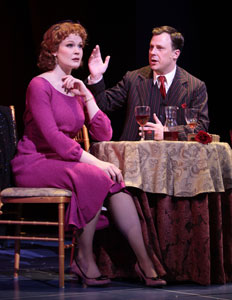
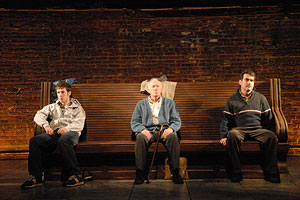
From Up Here (drama, PG-13, closes June 8, reviewed here)

CLOSING SUNDAY OFF BROADWAY:
Endgame (drama, PG-13, adult subject matter, reviewed here)
The Four of Us (comedy, PG-13, adult subject matter, reviewed here)

CLOSING SUNDAY IN MILLBURN, N.J.:
Kiss Me, Kate (musical, PG-13, far too sophisticated for children, reviewed here)

Posted May 15, 12:00 AM

TT: Almanac

"A belief in a supernatural source of evil is not necessary; men alone are quite capable of every wickedness."

Joseph Conrad, Under Western Eyes

Posted May 15, 12:00 AM

May 14, 2008

OGIC: So eternally Green

There's a lot that's amazing about Henry Green's novel Loving, which I continue to read in small doses. I pick it up infrequently enough that my grasp of many plot points is less than firm, but no matter. The draw is Green's minute observation and inimitable style. Rendering the teeming emotional and social life below stairs on an Irish estate during the second world war, Green goes right to the verge of sensuous overload in his impressionistic descriptions but pulls back in his plainspoken, practical dialogue. In a way his characters' talk functions itself as description or atmosphere--doggedly true to the way he heard people talk, it's not meant to explain anything and in fact often serves to obfuscate the matter.

In this terribly moving small vignette from the novel, I'm interested in how colors run a little wild. To say they have symbolic weight is an understatement; more than symbolic, they're active players in the miniature drama that plays out here, seeming to struggle with each other for supremacy over the mood of the scene and ergo its outcome.

Edith feared for Raunce's neck. She said those draughts in the servant's hall might harm him. Now coal was so short it was only a small peat fire she could lay each morning in the butler's room, and she insisted that the grate Raunce had was too narrow for peat. This no doubt could be her excuse to get him to take his cup along with her to one of the living rooms where huge fires were kept stoked all day to condition the old masters.

So it came about next afternoon that Charley and Edith had drawn up deep leather armchairs of purple in the Red Library. A ledge of more purple leather on the fender supported Raunce's heels next his you-and-me in a gold Worcester cup and saucer. Pointed french windows were open onto the lawn about which peacocks stood pat in the dry as though enchanted. A light summer air played in from over massed geraniums, toyed with Edith's curls a trifle. Between the books the walls were covered cool in green silk. But she seemed to have no thought to the draught.

"You ever noticed that little place this side of the East Gate?" he was asking.

"Well can't say I've looked over it if that's what you're after," she replied. He hooked a finger into the bandage round his throat as though to ease himself.

"Next time you pass that way you have a look, see."

"Why Charley?"

"It's empty that's why."

"It's empty is it?" she echoed dull but with a sharp glance.

"The married butlers used to live there at one time," he explained. Then he lied. "Yesterday mornin'," he went on canny, "Michael stopped me as he came out of the kitchen. You'll never guess what he was onto."

"Not something for one of his family again?" she enquired.

"That's right," he said. "It was only he's goin' to ask Mrs. T. for it when she gets back, that's all. The roof of their pig sty of a hovel 'as gone an' fallen on 'is blessed sister-in-law's head and's crushed a finger of one of their kids."

"The cheek," she exclaimed.

"A horrid liar the man is," Charley commented. "But it's not the truth that matters. It's what's believed," he added.

"You think she'll credit such a tale?" Edith wanted to know.

"Now love," he began then paused. He was dressed in black trousers and a stiff shirt with no jacket, the only colour being in his footman's livery waistcoat of pink and white stripes. He wore no collar on account of his neck. Lying back he squinted into the blushing rose of that huge turf fire as it glowed, his bluer eye azure on which was a crescent rose reflection. "Love," he went on toneless, "what about you an' me getting married? There I've said it."

"That's want thinking over Charley," she replied at once. Her eyes left his face and with what seemed a quadrupling in depth came following his to rest on those rectangles of warmth alive like blood. From this peat light her great eyes became invested with rose incandescence that was soft and soft and soft.

"There's none of this love nonsense," he began again appearing to strain so as not to look at her. "It's logical dear that's what. You see I thought to get my old mother over out of the bombers."

"And quite right too," she answered prompt.

"I'm glad you see it my way," he took her up. "Oh honey you don't know what that means."

"I've always said a wife that can't make a home for her man's mother doesn't merit a place of her own," she announced gentle.

"Then you don't say no?" he asked glancing her way at last. His white face was shot with green from the lawn.

"I haven't said yes have I?" she countered and looked straight at him, her heart opening about her lips. Seated as she was back to the light he could see only a blinding space for her head framed in dark hair and inhabited by those great eyes on her, fathoms deep.

"No that's right," he murmured obviously lost.

In the introduction to my edition (which is the same one linked above), John Updike points to Green's "love of work and laughter; his absolute empathy; his sense of splendour amid loss, of vitality within weakness" and points to a further contradiction: "with upper-class obliquity he champions the demotic in language and in everything."

Posted May 14, 9:19 AM

TT: The unsurprising Tonys

This year's Tony Award nominations were announced on Tuesday, and The Wall Street Journal asked me to comment on them in this morning's paper:

The nominations for the 62nd annual Tony Awards were announced yesterday morning. They weren't surprising. They almost never are. Take, for instance, the Best Musical category. Eight new musicals opened on Broadway this season, and one of them, "Glory Days," closed after a single performance. "A Catered Affair," "Cry-Baby," "The Little Mermaid" and "Young Frankenstein" got sharply mixed reviews, leaving "In the Heights," "Passing Strange" and "Xanadu," all of which received nominations, with "Cry-Baby" thrown in to fill the obligatory fourth slot. That's about as exciting as ordering a Big Mac and waiting breathlessly to see if it contains an extra pickle....

The Tony nominations, in short, have become an exercise in ratifying the obvious--and how could they be anything else? Broadway consists of 39 houses, four of which are run by Lincoln Center Theater, the Manhattan Theatre Club and the Roundabout Theatre Company, a trio of non-profit outfits that are marginally more adventurous than their commercial counterparts. As for the remaining 35, they're so costly to operate that anyone who dares to bring a new show into one of them is all but begging to throw his money away. That's why today's theatrical producers usually play it very, very safe, importing road-tested productions that have been developed by out-of-town companies. The days when an unknown author could hope to take Broadway by storm are over.

All this explains why the Tonys have grown so lackluster in recent years: Their unsurprising nature merely reflects the safety-first institutional culture of Broadway....

Read the whole thing here.

Posted May 14, 12:00 AM

TT: Almanac

"There are only two or three human stories, and they go on repeating themselves as fiercely as if they had never happened before."

Willa Cather, O Pioneers!

Posted May 14, 12:00 AM

May 13, 2008

CAAF: 5 x 5 Books Beloved Books I Fear Re-reading by Mark Sarvas

5 x 5 Books ... is a recommendation of five books that appears regularly in this space. Today's installment comes from my friend Mark Sarvas, proprietor of The Elegant Variation and author of the new novel Harry, Revised. New York magazine gave Harry a thumbs up, praising the author's "sure hand for vivisecting 21st-century absurdities." New York readers can catch Mark when he reads tomorrow night -- that's Wednesday! -- at the Barnes & Noble in Tribeca (more info).

Here Mark shares five beloved books he's afraid to re-read for fear they won't hold up.

1. Of Mice and Men by John Steinbeck. John Steinbeck's legacy hasn't held up particularly well. Robert Gottlieb just took several thousand words in the New York Review of Books to bury him, not to praise him. "The extraordinary thing about John Steinbeck," he began, "is how good he can be when so much of the time he's so bad." I have fond memories of Of Mice and Men, one of the first "serious" literary works I read at a young age. Besides being proud of myself for my leaps in reading comprehension, I was completely drawn in by Lenny, George and those damned rabbits. I cried for hours when I finished the book but felt I had glimpsed something about friendship that was rare and true. But I've had my own love/hate with Steinbeck since -- I think he's better than Gottlieb allows but he can frequently be astonishingly ham-fisted. So I think I'm going to leave this one untouched in the well of memory.

2. The Princess Bride by William Goldman. I've read this one well over a dozen times but not in the last ten years or so. Rob Reiner famously did a fine job, but, for me as for many others, he simply could not compete with the Inigo and Fezzik of my own memory. Of course, in my first youthful reading, I didn't realize Goldman was funning with us with all that Florin/Guilder stuff -- until I went to Holland and handled actual florins and guilders. My fear here is all the stuff I thought was cool before -- the breaking of the fourth wall, the book within the book stuff -- is likely to just read like bits of business now and, knowing Goldman, the emotion I found back then would probably come off as mawkishness today. It's another one I daren't touch, though the hard-cover reissue sits proudly on the shelf.

3. The Tanglewood Murder by Lucille Kallen. Although I seem to have a reputation as an anti-genre snob, I retain very fond memories of this whodunit written by a former "Your Show of Shows" writer, who died in 1999. I actually enjoyed the whole C.B. Greenfield series so much that I had her sign first editions of all her books years ago at Murder Ink, the now-defunct New York mystery bookstore. But this one was always my favorite, and I'd picked up a paperback copy on my way up to Tanglewood one summer with my family. The mystery includes a Stradivarius, Ravel and Shakespeare and is forever associated in my mind with those summer evenings with the Boston Symphony Orchestra -- and I tend to be suspicious of reading experiences too steeped in nostalgia. But I do remember it as a witty and surprising mystery.

4. White Teeth by Zadie Smith. Like most of the free world, I was completely blown away when I read White Teeth, and the initial first flurry of pages I wrote of my own novel came out in a sort of Zadie Smith-soaked haze. (Those pages, thankfully, no longer exist.) What I admired most was her sheer fearlessness -- no turn of phrase seemed to outrageous, no outré scenario off limits, and yet she had the chops to pull them all off -- or so it seemed at the time. Those are precisely the bits I fear might not read as well today. Smith herself has disavowed the book, characterizing it as "the literary equivalent of a hyperactive, ginger-haired tap-dancing 10-year-old," and though I think she goes overboard there, her prose has matured and quieted down in a way that fulfills the promise of her debut without making me eager to revisit it.

5. The English Patient by Michael Ondaatje. I mentioned this "5 x 5" idea last week to a novelist friend, who immediately piped up with The English Patient, a book which wasn't in my original list but one she had recently re-read. But she was so convincing in her case, suggesting that what I fondly remember as the book's lush lyricism read to her as overripe, and that the absence of the plot that I swear I remember being there adds up to a book that's a lovely slog. I trust and respect her enough that I'm suddenly terrified to crack this one open.

Posted May 13, 12:02 AM

TT: Almanac

"It may be that when the angels go about their task praising God, they play only Bach. I am sure, however, that when they are together en famille, they play Mozart."

Karl Barth, Wolfgang Amadeus Mozart

Posted May 13, 12:00 AM

May 12, 2008

TT: Another envelope, please

The New York Drama Critics' Circle made its annual awards today. The best-play award went to August: Osage County, the best-musical award to Passing Strange.

To find out how all the judges voted, myself included, go here.

Posted May 12, 8:24 PM

CAAF: Morning coffee

This is the world we made edition:

• Virginia Heffernan reports that the Oxford English Dictionary may soon be out of print as it moves to a web-only format. Luddites cry, "O.E.D. no!" Relatedly, in this week's Publishers Weekly, Gwenda Bond explores how Wikipedia's dominance is affecting the publishing model for encyclopedias and other reference works.

• Janet Maslin gives James Frey's new novel a rave. But the review is written in a bad James Frey imitation. Which made this reader squirm, cringe.

Posted May 12, 10:34 AM

TT: Conjugal leave

Now that Rhythm Man is finished and the Broadway season is over, I'm blowing town for a few days of much-needed rest. Tonight I'll be dining with Mrs. T somewhere in deepest Connecticut, and anybody who wants to get in touch with me there for any reason not involving a four-figure advance cash payment is out of luck.

Blogging? Fugedaboudit. Except for the usual almanac entries and theater-related postings, I intend to leave you in the hands of OGIC and CAAF all week long. If I break my word, throw stones.

See you next Monday.

P.S. I've freshened the Top Five and "Out of the Past" picks, and my colleagues will be adding still more new stuff this week. Take a peek.

Posted May 12, 12:00 AM

TT: Right turn at Albuquerque

SIDE%20VIEW%20OF%20OPERA%20HOUSE.jpg"When I know how long a piece must take, then it excites me," Igor Stravinsky said to George Balanchine. That's sort of how I felt when I finally got a look at the stage on which the Santa Fe Opera will give The Letter its first performance next July.

The Crosby Theater is a 2,166-seat open-air house built atop a 7,500-foot-high desert mesa. Here's how the construction company that built the theater describes it:

The most unique feature of the project is the enormous, and very complex, steel roof structure. The roof rod tensioning system and huge mast assemblies support the roof structure and balcony steel, with the roof connected in tension, and resting on the four existing star columns.

The opera seating is a concrete riser on grade and the balcony seating is a pre-cast riser set on structural steel. The architectural finish is the traditional New Mexican stucco. Special systems that were added include a state-of-the-art theatrical lighting system running throughout 750 lineal feet of catwalk erected above the stage, and computerized dimming capabilities both within the theater and throughout the plaza grounds.

DURING%20A%20PERFORMANCE.jpgAll this is true enough, I suppose, but only in the limited sense that it would also be true to describe the Empire State Building as rather tall. It's more to the point, if less exact, to say that the Crosby Theater is the most gorgeous-looking open-air theater I've seen in my life--and I've seen some beauties. The setting is part of it, of course, but the theater itself is a humdinger, at once spacious and arrestingly intimate. Now that I'm a drama critic, I spend much of my time watching performances in small theaters, and in the process I've become impatient with giant-sized auditoriums like the 3,800-seat Metropolitan Opera House, where even the best seats are far removed from the singers on stage. Not so the Crosby Theater. When you stand on the stage, you feel as though you're in the lap of the audience, and when you sit in the orchestra seats, you feel as though you're being thrust toward the performers.

To build such a theater in so naturally beautiful a place all but ensures a festive atmosphere, and by most accounts the opera buffs who come to Santa Fe do so in the expectation of having a rip-roaringly good time:

I learned these things when I flew out to Santa Fe two weeks ago to attend the press conference at which the cast and production team of The Letter were announced. I'd never been to Santa Fe before, and didn't know how complicated it is to get there from New York: you fly into Dallas or Denver, change planes for Albuquerque, then spend an hour driving to Santa Fe. The connections can be dicey, and if you try to cut it close, you're likely to end up spending the night somewhere else. I flew out of Newark, and my flight left two hours late, the same amount of time I'd allowed myself to change planes in Dallas. Since I was booked onto the last flight to Albuquerque, I assumed that I wasn't going to get to Santa Fe until the next day, but American Airlines, God bless them, held my plane, and I made it to New Mexico in one piece, more or less on time.

STAGE%20%28DAYTIME%2C%20NO%20SET%29.jpgPaul Moravec, my collaborator on The Letter, picked me up at my hotel the following morning and drove me to the opera house, where the company's production chief gave us a tour of the grounds. The more I saw, the bigger my eyes grew. Of course I knew perfectly well that Santa Fe Opera is a large-scale operation, but you can't fully appreciate the implications of that statement until you see the company's headquarters spread out before you. As I explained to Mrs. T when I got back to New York, Santa Fe Opera is not so much a summer opera company as a major opera company that performs in the summer. Paul told me this after he went there last year--he compared it to Bayreuth--but it wasn't until I stood on the stage that I understood what he meant.

Paul and I did our best to act like grownups, but as soon as the tour was over and the production chief left us to ourselves, we looked at one other and broke out in mile-wide grins.

"Is this cool or what?" Paul said.

"Dude," I replied, "we have soooo hit the big time!"

Then we started laughing uncontrollably.

PRESS%20CONFERENCE.jpgOnce we got ourselves pulled together, we strolled over to the rehearsal hall. We had an hour to kill before the press conference, so Paul found a piano and played through his preliminary sketches for the last scene of The Letter. At length the reporters started drifting in, and we closed the piano and made ready to be introduced to the world. What followed was later described on the front page of the Santa Fe New Mexican under the wonderful headline "Opera's 2009 Season Takes Film Noir Turn":

The Santa Fe Opera announced Wednesday that its 2009 season will include the world premiere of The Letter, an opera based on a 1927 stage adaptation of a W. Somerset Maugham short story.

The SFO commissioned the opera by Pulitzer Prize-winning composer Paul Moravec and critic, biographer and blogger Terry Teachout.

Tom Ford, fashion designer and legendary former creative director of Gucci, whose new house atop Talaya Hill is still under construction, is making his debut as a costume designer for The Letter.

The 90-minute opera in eight scenes has "blood and sex, everything you want in opera," Teachout said.

Patricia Racette and Anthony Michaels-Moore star as an unhappy couple whose life in the jungle of Malaya is torn apart by adultery that leads to murder, blackmail and revenge.

Moravec said he and Teachout intend the opera to be as "fast, concise and hard-hitting as a film noir."

The characters in the opera are more likely to be wearing khaki or white duck suits (including one soaked in blood) than Ford's signature cowboy boots, blazers, unbuttoned shirts (and 5-o'clock shadows). But, Moravec said, "anything Tom Ford wants to do is fine with us as long as the labels aren't showing."

Read the whole thing here--there's lots more, all of it accurate, including the quotes.

When the show was over, I wolfed down lunch, then headed back to New York by way of Albuquerque, Denver, and Newark. Paul stayed behind to work on the last scene and confer with Richard Gaddes, the company's outgoing general manager, and Charles MacKay, who will be replacing him this fall. I would have liked to stay on for a few more days, too, but I had four shows to see on Broadway and no time to spare, so I left with the utmost reluctance.

The good news is that I'll be returning to Santa Fe in July to spend a week seeing four of this season's productions (one of them staged by Jonathan Kent, who is directing The Letter) and meeting with more of the people with whom we'll be working next year. I can't wait. Paul and I have been thinking about The Letter for the better part of two years, but now, at long last, it seems absolutely real to us--and we're excited. Very, very excited.

UPDATE: A friend writes:

You said "Dude"? For realsies?

Way.

Posted May 12, 12:00 AM

TT: MIA (concluded)

It took long enough and then some, but Elaine Dundy finally made it onto the obituary page of the New York Times last Friday. Kindly note the last paragraph:

The Dud Avocado, reissued last year by The New York Review of Books, remains Ms. Dundy's most popular book, flawed but vital, like its heroine. "The plot is helter-skelter, and the end trails off into vapor," the critic Terry Teachout wrote, "but the narrator's utterly feminine voice redeems all."

Sure enough.

Posted May 12, 12:00 AM

TT: Almanac

"Reality does not conform to the ideal, but confirms it."

Gustave Flaubert, Pensées

Posted May 12, 12:00 AM

May 9, 2008

FILM

The Westerner. Gary Cooper has been largely overlooked by postmodern film buffs, but a new DVD reissue of this 1940 film might help break through the wall of silence. Directed by William Wyler, The Westerner is a fictionalized retelling of the not-entirely-legendary tale of Roy Bean, the hard-drinking self-made Texas judge who dispensed Law West of the Pecos and had a thing for Lillie Langtry, the celebrated turn-of-the-century British actress. Walter Brennan won and earned an Oscar for his scene-stealing performance as Judge Bean, but Cooper gets plenty of licks in as a dryly amusing drifter who slips out of the judge's noose by falsely claiming to know the Jersey Lily. Hijinks ensue, climaxing in a spectacular showdown. You'll know who wins well before the first shot is fired, but all the fun is getting there. Gorgeous cinematography by Gregg "Citizen Kane" Toland (TT).

Posted May 09, 12:30 PM

PLAY

Boeing-Boeing (Longacre Theatre, 220 W. 48). Bliss comes to Broadway in the unlikely form of a half-remembered French comedy that crashed and burned when it last played the Great White Way in 1965. Marc Camoletti's seven-door farce, in which two hapless bachelors juggle three sexy stewardesses and a haughty Parisian maid, is feather-light, totally dated, utterly irrelevant, and rib-crackingly funny, in large part because of the brilliant performances of Mark Rylance and Christine Baranski. Give your brain a night off and do some serious laughing (TT).

Posted May 09, 12:09 PM

CD

Hilary Hahn, Schoenberg/Sibelius Violin Concertos (DGG). America's best young classical violinist has taken on a real nutcracker this time around: Arnold Schoenberg's 1936 concerto, a finger-twistingly hard piece of twelve-tone neoromanticism that sounds like Brahms gone bonkers. Even if you don't buy Schoenberg's music--which I don't--you'll find this specimen perversely fascinating, and Hahn has taken out a gilt-edged accident insurance policy by coupling it with Sibelius' ever-popular D Minor Concerto. Needless to say, the violin playing is fabulous, and Esa-Pekka Salonen and the Swedish Radio Symphony Orchestra provide immaculate support (TT).

Posted May 09, 12:09 PM

BOOK

William Maxwell, Early Novels and Stories (Library of America, $35). How did I fail to laud this collection when it came out earlier this year? Too busy, I guess, but it's never too late to sing the praises of Maxwell, a legendary New Yorker fiction editor who doubled as one of this country's most remarkable and least appreciated novelists. The Folded Leaf, written in 1945 and included in this collection, is the place to start, a deeply intelligent tale of adolescence angst that avoids all the pitfalls common to that genre. Also included is "The Writer as Illusionist," a 1955 essay in which Maxwell discussed his soft-spoken art with characteristic acuteness (TT).

Posted May 09, 12:08 PM

TT: Seven girls grumbling

The 2007-08 Broadway season is now officially over, and in today's Wall Street Journal column I report on the last show to open in time for this year's Tony nominations, Top Girls. I didn't think much of it.

I also had a few words to say about Glory Days, the sensitive-teen musical that opened--and closed--on Tuesday.

Here's an excerpt.

* * *

topgirlsmarquee460c.jpgI can't tell you how "Top Girls" looked in 1983, but today it is a creaky period piece, by turns clever-clever and brutally heavy-handed, in which Ms. Churchill strenuously endeavors to portray the upwardly mobile career women of the Thatcher era as bitchy, self-hating beasts who have fallen victim to the virus of American individualism and so lost their souls. Marlene (Elizabeth Marvel), the head of the bitch pack, runs an employment agency that finds high-paying jobs for monsters of ambition. In due course we learn that she has deserted her working-class family--and her illegitimate daughter--in order to come to London to shinny up the greasy pole. At play's end she visits her home in Suffolk, where her sister (Marisa Tomei) spits venom in her eye: "I suppose you'd have liked Hitler if he was a woman. Ms. Hitler. Got a lot done, Hitlerina." No doubt Ms. Churchill meant for us to be stunned into agreement by the pungency of this assault on the evils of Thatcherism, but all it did was make me look at my watch....

Many Broadway shows have closed after just one night, but only a few have been musicals. The last new musical to explode as soon as the key was turned was Alan Jay Lerner's "Dance a Little Closer" in 1983. Thus "Glory Days" has won itself a place in history: Henceforth it will be mentioned alongside such famous flops as Leonard Bernstein's "1600 Pennsylvania Avenue" (seven performances), Mickey Leonard's "The Yearling" (four performances), Stephen Sondheim's "Anyone Can Whistle" (nine performances) and "Merrily We Roll Along" (16 performances), Charles Strouse's "Nick & Nora" (nine performances) and Jule Styne's "The Red Shoes" (five performances).

What all these older flops have in common is that, like "Dance a Little Closer," they were the work of distinguished artists, and some had memorable scores to boot. "The Yearling" actually yielded up a standard, "I'm All Smiles," while "Anyone Can Whistle" and "Merrily We Roll Along" have both turned out to be much hardier than they looked at first glance. As for Nick Blaemire and James Gardiner, the authors of "Glory Days," they are 23 and 24 years old respectively, young enough to someday earn themselves a second grab at the brass ring of theatrical success. Stranger things have happened: Six years after "Anyone Can Whistle" blew up in Mr. Sondheim's face, he wrote "Company" and became immortal. So I'll keep my opinion of "Glory Days" to myself and instead wish its makers the best of luck in their future endeavors. They'll need it, and maybe they'll get it.

* * *

Read the whole thing here.

Posted May 09, 12:00 AM

TT: The all-American choreographer

robbins.jpgJerome Robbins is all over the place these days. New York City Ballet is presenting a month-long Robbins Celebration at Lincoln Center, while Patti LuPone is burning up the stage of the St. James Theatre in an Arthur Laurents-staged revival of Gypsy that incorporates the dances choreographed by Robbins for the show's original 1959 production.

The coincidence of these two events struck me as a highly suitable occasion for a "Sightings" column in which I take a retrospective look at Jerome Robbins' place in postwar American culture. During his lifetime, Robbins was America's most famous choreographer--but ten years after his death, does the co-creator of Fancy Free, West Side Story, and Dances at a Gathering still matter? Or has the ever-changing Zeitgeist finally passed him by?

To find out, pick up a copy of Saturday's Wall Street Journal, turn to the "Weekend Journal" section, and see what I have to say in "Sightings."

UPDATE: Read the whole thing here.

Posted May 09, 12:00 AM

TT: Almanac

"I did deeply want to create, by means both austere and rich--means always disciplined by a central aesthetic--an experience that was entirely and only theatrical."

Peter Shaffer, preface to The Royal Hunt of the Sun (courtesy of Marissabidilla)

Posted May 09, 12:00 AM

May 8, 2008

TT: So you want to see a show?

Here's my list of recommended Broadway, off-Broadway, and out-of-town shows, updated weekly. In all cases, I gave these shows favorable reviews (if sometimes qualifiedly so) in The Wall Street Journal when they opened. For more information, click on the title.

Warning: Broadway shows marked with an asterisk were sold out, or nearly so, last week.

BROADWAY:
Alfred Hitchcock's The 39 Steps (comedy, G, suitable for bright children, reviewed here)
August: Osage County (drama, R, adult subject matter, reviewed here)
Avenue Q (musical, R, adult subject matter and one show-stopping scene of puppet-on-puppet sex, reviewed here)
070222theatre_boeing.jpgBoeing-Boeing (comedy, PG-13, cartoonishly sexy, reviewed here)
A Chorus Line (musical, PG-13/R, adult subject matter, reviewed here)
Cry-Baby (musical, PG-13, mildly naughty and very cynical, reviewed here)
Grease * (musical, PG-13, some sexual content, reviewed here)
Gypsy (musical, PG-13, adult subject matter, reviewed here)
In the Heights (musical, PG-13, some sexual content, reviewed here)
The Little Mermaid * (musical, G, entirely suitable for children, reviewed here)
Macbeth * (drama, PG-13, unsuitable for children, closes May 24, reviewed here)
November (comedy, PG-13, profusely spattered with obscene language, reviewed here)
Passing Strange (musical, PG-13, adult subject matter, reviewed here)
South Pacific * (musical, G/PG-13, some sexual content, brilliantly staged but unsuitable for viewers acutely allergic to preachiness, reviewed here)
Sunday in the Park with George (musical, PG-13, too complicated for children, closes June 29, reviewed here)

OFF BROADWAY:
Adding Machine (musical, PG-13, adult subject matter, too musically demanding for youngsters, closes Aug. 31, reviewed here)
From Up Here (drama, PG-13, closes June 8, reviewed here)

CLOSING SOON OFF BROADWAY:
Endgame (drama, PG-13, adult subject matter, closes May 18, reviewed here)
The Four of Us (comedy, PG-13, adult subject matter, closes May 18, reviewed here)

CLOSING SOON IN MILLBURN, N.J.:
Kiss Me, Kate (musical, PG-13, far too sophisticated for children, closes May 18, reviewed here)

Posted May 08, 12:00 AM

TT: MIA (III)

Finally, a major American newspaper has run an obituary of Elaine Dundy--and guess where it is? In Los Angeles. Another raspberry to the New York Times!

I note with pleasure the following paragraph about The Dud Avocado:

When the book was reissued last year in the New York Review Books classics series, critic Terry Teachout described Sally Jay as the "spiritual grandmother of Bridget Jones," a characterization that Dundy relished.

I'm glad to know that.

Posted May 08, 12:00 AM

TT: Almanac

"You know, I've been thinking an awful lot about you and me. I love you with my whole being, solemnly and seriously. These last times have made me realise how serious love is, what a great responsibility and what a sharing of personalities--it's not just a pleasure & a self indulgence. Our love must be complete and a creation in itself, a gift which we must be fully conscious of & responsible for."

Peter Pears, letter to Benjamin Britten (c. December 1942)

Posted May 08, 12:00 AM

May 7, 2008

TT: Air Farce One

The Broadway season ends tomorrow, and the openings have been coming so fast and furious in recent days that I've been forced to double up on this week's Wall Street Journal drama columns. In today's paper I review two very different shows, the Broadway revival of Boeing-Boeing and BAM Harvey's production of Endgame. Here's an excerpt.

* * *

20070325ho_rylanceA_230.jpgLet us now praise farce, the most ruthless form of comedy, in which a hubristically self-satisfied character (usually male) is faced with the prospect of imminent humiliation (usually sexual) and does all he can to avoid it, thereby making matters worse. I love farce, but for some reason New York producers steer clear of it, and it's been some years since a slamming-door farce last played on Broadway. Now the drought is over: "Boeing-Boeing," which was a hit in London last year, has crossed the Atlantic in time for this year's Tony nominations, of which it will surely receive a hatful.

"Boeing-Boeing" is a seven-door farce set in the Paris bachelor pad of Bernard (Bradley Whitford), a businessman with three fiancées, all of them stewardessses. They're never in town at the same time, which permits him to bed them seriatim. This being a farce, such well-laid plans are naturally predestined to collapse into a heap of smoking rubble. The dégringolade begins when Bernard's mousy buddy Robert (Mark Rylance) drops by for a visit just as Fiancée No. 1, a cheerfully promiscuous New Yorker named Gloria (Kathryn Hahn), departs through Door No. 4, making way for Fiancée No. 2, a jealous Italian babe named Gabriella (Gina Gershon). Then Fiancée No. 3, a German giantess named Gretchen (Mary McCormack), shows up--her plane landed early--and within mere minutes things are way, way, way out of hand.

The plot of "Boeing-Boeing" is a skein of silliness and the characters ethnic cartoons, meaning that the show must be flawlessly cast and directed with ultra-finicky timing in order to work. The good news--make that great news--is that these conditions are seen and raised in Matthew Warchus' staging. Top honors go to Mr. Rylance, a Shakespearean actor-director whose lunatic performance as Robert startled the hell out of the London critics. Imagine (if you can) a balding, adenoidal milksop with mismatched eyebrows who strolls into Bernard's ménage à quatre, sees what he's been missing and decides that the time has come for him to embrace the more abundant sexual life....

Endgame184.jpgThe last time I saw "Endgame," 9/11 loomed three years nearer in the rear-view mirror, which added an extra twist of relevance to Samuel Beckett's post-apocalyptic 1957 comedy about four people who appear to be all alone in what is left of the world. I use the term "comedy" loosely, but much of "Endgame" really is supposed to be laughable--if grimly so--which is what gives the play its mordant punch.

Rightly or wrongly, though, New Yorkers are feeling rather less anxious these days, and I wonder whether that might explain why I found BAM Harvey's star-studded new production of "Endgame" to be somewhat less compelling than the potent revival mounted by the Irish Repertory Theatre in 2005. Or perhaps the play itself isn't quite as good as I once thought it was. Nobody ever accused Beckett of being obvious, but "Endgame," much to my surprise, now seems to me to border on heavy-handedness in its portrayal of the dark encounter that awaits us all...

* * *

Read the whole thing here.

Posted May 07, 12:00 AM

TT: MIA (cont'd)

At last, an Elaine Dundy obit--from England. (Arrgh.)

Posted May 07, 12:00 AM

TT: Almanac

INTERVIEWER: You've said that one of the things you like about theater is that it's a collaborative art and that you in a sense have a family. Again, to the layperson, it's amazing, with all those people involved, that a musical ever gets on. In your experience as a collaborator in the process, when it works, what makes it successful?

SONDHEIM: The answer is so obvious that it will not seem like an answer. You have to be sure that you're writing the same show. That's something that I didn't discover about [A Funny Thing Happened on the Way to the Forum] until too late. We weren't writing the same show, even after we'd spent the better part of four years on it. They were writing a certain kind of show, and I was writing a certain kind of score, and none of us recognized that they were slightly different. I learned from that, and so the preliminary discussions for any show I do with my collaborators are to be sure that we're writing the same show. That's what makes it work.

Stephen Sondheim (quoted in Jackson R. Bryer and Richard A. Davison, The Art of the American Musical: Conversations with the Creators)

Posted May 07, 12:00 AM

May 6, 2008

TT: MIA

Still no Elaine Dundy obituary in the New York Times--or any other newspaper, so far as I know. Don't these people read blogs? Or books published prior to 1995? Or anything?

Posted May 06, 10:29 AM

TT: Half a loaf

art_satchmo.jpgDoing nothing no longer comes naturally to me, but I gave it my best shot yesterday. To be sure, I didn't spend the whole day doing nothing. I couldn't--I had a deadline to hit. I got up at seven, wrote and filed my Wall Street Journal drama column, answered my e-mail, and took note of the death of Elaine Dundy. But by noon I was through with the day's work, so I put on my clothes (yes, I write in dishabille) and strolled over to Columbus Avenue. I caught a cab and told the driver to take me to Danal, where my old friend Rick Brookhiser stood me to a champagne luncheon in honor of the completion of Rhythm Man: A Life of Louis Armstrong.

"So, what are the first and last words of the book?" Rick asked.

"Ah, the Jane Chord!" I replied.

The Jane Chord, to which Bill Buckley introduced us years ago, is a concept originally promulgated by Hugh Kenner. The idea is that if you make a two-word sentence out of the first and last words of a book, it will tell you something revealing about the book in question. Or not: the Jane Chord of Pride and Prejudice is It/them. But every once in a while you run across a Jane Chord so resonant that it makes the room shiver--the chord for Death Comes for the Archbishop is One/built--and even when a famous book yields up nonsense, it's still a good game to play.

It had been ages since I'd last struck a Jane Chord, but no sooner did Rick remind me of the rules than I started racking my memory to see if I could recall the chord for Rhythm Man. A moment later I came up with the first and last sentences of the book, and I let out a whoop of delight as I realized that I'd unconsciously put together a humdinger: New/whole.

After lunch I came straight home, curled up on the couch, and spent the next couple of hours listening to Al Cohn and Zoot Sims and rereading Doug Ramsey's Paul Desmond biography, at which I hadn't looked since I reviewed it for the Journal three years ago:

You may not know Paul Desmond's name, but you've almost certainly heard his music. He wrote "Take Five," a sinuous minor-key tune in the once-exotic time signature of 5/4 (marches are in 2/4, waltzes in 3/4, pop songs in 4/4) that was recorded by the Dave Brubeck Quartet in 1959. It shot up the charts a year and a half later, becoming the first jazz instrumental to sell a million copies.

In addition to making its composer rich, "Take Five" also introduced the public at large to the inimitable sound of Desmond's cool-toned, unsentimentally lyrical alto saxophone playing, which he aptly described as the musical equivalent of a dry martini. In part because of the unexpected popularity of "Take Five," Brubeck and Desmond became the most famous jazz musicians of the '60s, and "Time Out," from which the song was drawn, remains to this day one of jazz's top-selling albums.

As if being rich and famous weren't enough, Desmond was also a talented writer of prose (usually in the form of wryly witty liner notes for his solo albums), a preternaturally successful ladies' man (he preferred fashion models, though he made an exception for the young Gloria Steinem) and a seemingly inexhaustible bon vivant (Elaine's was his after-hours hangout of choice). He also managed to consume far more than his lifetime quota of cigarettes, alcohol and other, more strictly controlled substances, the combined effect of which presumably contributed to his death from lung cancer in 1977. His friends have been telling tales out of school about him ever since, and one of his closest companions, the jazz critic Doug Ramsey, has now woven the best ones into a biography.

While "Take Five: The Public and Private Lives of Paul Desmond" contains plenty of show-stopping gossip, it is in no way a pathography. Scrupulously researched and written with an attractive combination of affection and candor, it casts a bright light on Desmond's troubled psyche without devaluing his considerable achievements as an artist. "Any of the great composers of melodies--Mozart, Schubert, Gershwin--would have been gratified to have written what Desmond created spontaneously," Mr. Ramsey says. Strong words, but "Take Five" makes them stick.

I got so comfy that instead of going out for dinner, I stayed home, ordered a pizza, and watched a movie. I chose Kevin Smith's Chasing Amy, which I hadn't seen since shortly after I wrote about it in the New York Times in 1997, back in the long-lost days of innocence when I had only just crossed the fortieth meridian (Shall I part my hair behind? Do I dare to eat a peach?). It's very much a young man's film, and the denouement still doesn't quite parse, but I was pleased to see how well the performances and the rest of the script have held up, and it felt downright luxurious to be able to watch a plot unfold without having to think about how to boil it down into a one-paragraph synopsis.

71492772_650c9a7343_o.jpgWatching Chasing Amy put me in mind of the brief gaudy hour when sharp-witted indie and indieish flicks like Clerks, Election, Ghost World, Kicking and Screaming, Living in Oblivion, Metropolitan, Next Stop Wonderland, Panic, Pi, Swingers, and You Can Count on Me seemed to be coming out every month or so. Back then I was writing about movies regularly, and I went so far as to predict in 1999 that the independent film was the wave of the narrative future:

Americans under thirty are habituated to the characteristic narrative style of film--it is far more familiar to them than that of prose fiction--and many talented young American storytellers who once might have chosen to write novels are instead making small-scale movies of considerable artistic merit....it is only a matter of time before similar films are routinely released directly to videocassette and marketed like books (or made available in downloadable form over the Internet), thus circumventing the current blockbuster-driven system of film distribution. Once that happens, my guess is that the independent movie will replace the novel as the principal vehicle for serious storytelling in the twenty-first century.

I made that bold prophecy in The Wall Street Journal, then included it in A Terry Teachout Reader five years later. And what happened? I became a drama critic--and I've seen exactly two movies in a theater since the fall of 2005. So much for my prescience.

Be that as it may, I enjoyed my nostalgic wallow so much that I briefly considered watching another movie, but in the end I decided not to press my luck. For once I'm going to bed early, I told myself. So I called Mrs. T in Connecticut, then turned off the lights and clambered up the ladder to my loft, feeling as contented as it's possible for me to feel when she's there and I'm here.

Now what? Well, I've got another Journal column to write this morning, but once it's done I'm finished until tomorrow. A walk in Central Park? An afternoon nap? The Metropolitan Museum? More Al and Zoot? Call me irresponsible! Why didn't anybody ever tell me that it's fun to do nothing?

Posted May 06, 12:00 AM

CAAF: Krook go boom

Remember that point in Bleak House when Krook, the drunken rag-and-bone guy, spontaneously combusts in his shop? In my mind I always related the fatal combustion less to Krook's drinking than to his oiliness and the general blackness of his soul, as if he were a one-man grease fire lit by his own evil (as it were).

Then a couple weeks ago, Wait Wait... Don't Tell Me! had a segment on Prohibition, and one of the questions had to do with the claim of early temperance activists that alcohol consumption could lead to spontaneous combustion, the logic being that alcohol burns.* And I thought, "Krook! Krook!"

Sure enough, that's the folk belief that Dickens drew on to plot Krook's end. Although, according to this website (be warned: there's a spooky photograph there that Will Haunt Your Dreams), Dickens maintained that Spontaneous Human Combustion (SHC) wasn't superstition but fact:

Krook was a heavy alcoholic, true to the popular belief at the time that SHC was caused by excessive drinking. The novel caused a minor uproar; George Henry Lewes, philosopher and critic, declared that SHC was impossible, and derided Dickens' work as perpetuating an uneducated superstition. Dickens responded to this statement in the preface of the 2nd edition of his work, making it quite clear that he had researched the subject and knew of about thirty cases of SHC. The details of Krook's death in Bleak House were directly modeled on the details of the death of the Countess Cornelia de Bandi Cesenate by this extraordinary means; the only other case that Dickens actually cites details from is the Nicole Millet account that inspired Dupont's book about 100 years earlier.

Now, you have to consider any Google search that has already delivered the sentence, "Over the past 300 years, there have been more than 200 reports of persons burning to a crisp for no apparent reason," as a clear success. But there's more!** The incidents surrounding the death of the Countess are covered in detail here. Meanwhile, the BBC website sheds light on the other case Dickens mentioned in his preface, Nicole Millet's death:

However, the first reliable documentation of SHC dates back to 1763 when Frenchman Jonas Dupont compiled a casebook of SHC cases in a book called De Incendiis Corporis Humani Spontaneis, having been compelled by the Nicole Millet case, which involved a man who was acquitted of the murder of his wife when the court ruled that the unfortunate woman's death had been due to spontaneous combustion.

Nicole Millet was the wife of the landlord of the Lion d'Or in Rheims, who was supposedly found burnt to death in an unburnt chair in February, 1725 (on Whit Monday). Her husband was accused of her murder and arrested; however, a young surgeon named Nicholas le Cat managed to convince the court that her death was caused by SHC. The court ultimately ruled her death as 'by a visitation of God.' However, the investigative author Joe Nickell stated in his book, Secrets of the Supernatural, that Millet's body was not actually found in the chair, but that a portion of her head, several vertebrae and portions of her lower extremities were found on the kitchen floor, the surrounding ground of which had also been burnt. Three accounts were cited: Theodric and John Becks's Elements of Medical Jurisprudence (1835), George Henry Lewes's Spontaneous Combustion from Blackwoods Edinburgh Magazine No. 89 (April 1861) and Thomas Stevenson's Principals and Practice of Medical Jurisprudence (1883). Strangely, there was no mention of Nicholas le Cat.


Emphasis mine.

* Another rationale for the belief, proferred at the BBC website, is that "a body saturated with such combustible fluids would be prone to combustion at the slightest spark." However, the article continues reassuringly, "the concentration of alcohol in a body would never be high enough for ignition to occur."

** If this post is tending a little ghoulish, my apologies. I spent most of the summer of 1978 (age 7) suffering from a morbid fear/hope that I might spontaneously combust at any moment after my best friend J. brought up the possibility during a sleepover. So, in addition to clarifying all things Krook, this research was psychologically cathartic.

Posted May 06, 12:00 AM

TT: Almanac

"I once asked Ben Britten what he thought was the most important requisite in composing opera. I was sure he would say a sense of drama, ability to indicate the meaning of a scene musically in a matter of seconds. What he said was that the most important thing a composer must have is the ability to write many kinds of music--chorus alone, chorus with orchestra, soloists separately, soloists in ensemble, and so on. The needs are so varied that one must have terrific facility to handle them all."

Aaron Copland, Copland Since 1943

Posted May 06, 12:00 AM

May 5, 2008

TT: Elaine Dundy, R.I.P.

product-thumbnail-140.jpgElaine Dundy, author of The Dud Avocado, died four days ago. No obituaries as of this hour, but the news is up on her Web site.

It was my privilege to be asked to write an introduction to last year's new edition of The Dud Avocado, published by New York Review Books, and Dundy made it known to me in due course that she liked what I wrote, a fact of which I am very proud.

Here's how it starts:

It is the destiny of some good novels to be perpetually rediscovered, and Elaine Dundy's The Dud Avocado, I fear, is one of them. Like William Maxwell's The Folded Leaf or James Gould Cozzens's Guard of Honor, it bobs to the surface every decade or so, at which time somebody writes an essay about how good it is and somebody else clamors for it to be returned to print, followed in short order by the usual slow retreat into the shadows. In a better-regulated society, of course, the authors of such books would be properly esteemed, and on rare occasions one of them does contrive to clamber into the pantheon--Dawn Powell, the doyenne of oft-rediscovered authors, finally made it into the Library of America in 2001--but in the normal course of things, such triumphs are as rare as an honest stump speech.

The Dud Avocado is further handicapped by being funny. Americans like comedy but don't trust it, a fact proved each year when the Oscars are handed out: our national motto seems to be Lord Byron's "Let us have wine and women, mirth and laughter/Sermons and soda-water the day after." To be sure, The Dud Avocado is perfectly serious, but it preaches no sermons, and what it has to say about life must be read between the punch lines. That was what kept Powell under wraps for so long--nobody thought that a writer so amusing could really be any good, especially if she was also a woman--and it has been working against Elaine Dundy ever since she published The Dud Avocado, her first novel, in 1958. I don't think it's a coincidence that The Dud Avocado has never been out of print in England. I'm no Anglophile, but I readily admit that the Brits are better at this sort of thing. Unlike us, they treat their comic novelists right, perhaps because Shakespeare and Jane Austen taught them early on that (as Constant Lambert once observed apropos of the delicious music of Chabrier) "seriousness is not the same as solemnity."

Maud Newton posted the entire introduction here last June. I invite you to read it in lieu of an obituary.

UPDATE: Here's an obit in an unlikely place. I think it would have amused her.

Quiet Bubble has a brief tribute.

More from Dundy's last publisher.

Posted May 05, 10:57 AM

TT: R&R from A to Z

I'd planned to tell you all about my recent trip to Santa Fe today, but the truth is that after flying back to New York by way of Albuquerque, Denver, and Newark, then seeing four new shows in a row, one of them in Brooklyn and two of them very serious, I'm just too damn tired. Besides, I've got to knock out three Wall Street Journal columns between now and Thursday, the first of which is due at noon today if not sooner. So...no posting.

What will I do instead? I'll start by writing Column No. 1, then go have lunch with a friend, after which I propose to spend the rest of the afternoon unwinding by listening to Al Cohn and Zoot Sims, which is (as Paul Desmond put it) the musical equivalent of getting your back scratched.

Join me if you like. Al is the one on the left:

Mmmmm.

I promise to file a full and detailed report on my recent operatic adventures as soon as I get myself pulled together again. Meanwhile, it might amuse you to know that some anonymous, exceedingly well-meaning soul has gone to the trouble of writing a Wikipedia entry on The Letter. Take a look!

If that's not enough to keep you busy while I recuperate, go here to read a 1965 interview with Al and Zoot. You might also enjoy this piece by Dave Frishberg, who played piano for them once upon a time:

Zoot and Al were majestic in the way they commanded their horns, and they played rings around that music. They were locked into each other's playing like no other two musicians I ever heard. During their solos they were really composing as they played--they couldn't help it. They were compulsive composers, and it would be totally out of character for either of them to play reflexive licks, or to quote from nursery rhymes or corny pop songs, or to trivialize their music in any way. Jazz critics can probably point to certain "influences" in Al's playing, or Zoot's--Lester Young is the obvious point of departure. But the fire and the swing, and the way they swarmed over the changes and discovered ever fresher and more lyrical ways to navigate them resembles nothing else that came before or followed after.

What he said.

UPDATE: You'll also find me here.

Posted May 05, 12:00 AM

TT: Almanac

"I come to the conclusion that it is a mistake to try to write highly 'poetical' and 'literary' librettos. The poet ought to concentrate entirely on drama and absolute truth to human nature, however unreal or fantastic the story may be; and always to use the very simplest words which everybody can understand at first hearing. Secondly, always to make the characters talk in their own character, and to avoid carefully all temptation to put the author's own private philosophy of life into their mouths. This if properly carried out does not at all prevent the poet's own personality coming through the whole drama, as the great dramatists of the past have shown us. Prospero for instance talks of a good deal of 'philosophy' but it is all within the character of Prospero himself."

Edward J. Dent, letter to Bernard Stevens (June 12, 1950)

Posted May 05, 12:00 AM

May 2, 2008

TT: Bright stars, dim casting

Broadway has entered the home stretch of the 2007-08 season, and opening nights are coming fast and furious. I review three new shows in today's Wall Street Journal column, The Country Girl, Les Liaisons Dangereuses, and Thurgood. All, alas, proved to be disappointments. Here's an excerpt.

* * *

13706a.jpgTwo of America's best actors opened on Broadway this week in a pair of plays that don't suit their talents. Such disappointments are a necessary part of the career of every serious artist who is brave enough to take chances, but some chances are better than others, and I wish that Morgan Freeman and Laura Linney had chosen more suitable vehicles for their long-awaited returns to the New York stage.

Mr. Freeman, who hasn't set foot on any stage in two decades, is starring in Mike Nichols' revival of "The Country Girl," one of the last plays by Clifford Odets to do well on Broadway. Written in 1950 and most recently revived there 36 years ago, it's best known in George Seaton's 1954 film version, which won Grace Kelly an Oscar, though it was Bing Crosby who gave the more interesting performance. Like Crosby, Mr. Freeman is playing the part of Frank Elgin, an over-the-hill actor-alcoholic who has been given one last chance to redeem himself. It's a challenging role: Elgin starts off scared and ingratiating, then goes on a bender, at last pulling himself together and becoming the man he used to be. The trouble is that Elgin is a weak man, and weakness is not one of the more interesting colors in Mr. Freeman's palette. Once Elgin recovers his courage in the second act, Mr. Freeman snaps into focus and starts making sense, but until then you never quite believe him....

Laura Linney has the twin gifts of simplicity and sincerity: It is impossible to doubt anything she says, whether on screen or onstage. Hence it is hard to see why she would have wanted to play the Marquise de Merteuil, the elaborately deceitful anti-heroine of "Les Liaisons Dangereuses," Christopher Hampton's "Masterpiece Theatre"-style stage version of Choderlos de Laclos' 1782 epistolary novel about a pair of aristocratic immoralists who make the fatal mistake of putting their heads in a noose of their own knotting. Ms. Linney, doubtless to her credit, lacks the sharp, supercilious edge of hypocrisy without which the Marquise cannot be portrayed convincingly, and though she does all she can to simulate it, the results too often suggest a very, very smart young girl playing dress-up....

Thurgood Marshall was by all accounts a peerless raconteur, full to overflowing of blunt, salty tales about the troubles he'd seen. George Stevens, Jr.'s "Thurgood," in which Laurence Fishburne plays the man who argued Brown v. Board of Education before the U.S. Supreme Court, then became its first black justice, shows us that side of him--and nothing more. Like most one-man shows about historical figures, it's a shallow exercise in hagiography: Mr. Stevens' script turns Marshall into a smug, self-satisfied storyteller whom we are invited to admire, and the fact that he did so many admirable things does not make this one-dimensional portrait any more credible, much less dramatic....

* * *

Read the whole thing here.

Posted May 02, 12:00 AM

TT: Almanac

"This was a time in which you were always meeting people who caught politics just as a person catches religion. It was probably the last time in this century when politics in our country will be evangelical, and if a man was once intensely religious, he was bound to be wide open to a mood like that of the Thirties. But why waste time explaining the pattern? It is obvious now, and dozens of books have been written about it. Less obvious have been some of the attendant passions that went along with this neo-religious faith. Passion has a way of spilling over into all aspects of the human mind and feelings. It is the most dangeorus thing in the world whether it focuses itself on love, religion, reform, politics or art. Without it the world would die of dry rot. But though it creates it also destroys. Having seldom been its victim I have only pity for those who are, and I would be a hypocrite if I judged them by the standards you can safely apply to a man at peace with himself and his circumstances."

Hugh MacLennan, The Watch That Ends the Night

Posted May 02, 12:00 AM

May 1, 2008

CAAF: Morning coffee

• At MetaxuCafé, a cadre of great contributors are providing ongoing coverage of the PEN World Voices Festival, which continues through Sunday.

• A short film inspired by Leonora Carrington's "The Debutante." In a very modern piece of addenda, there's a note from one of Carrington's grandsons in the comments. Like the Mansfield and Keogh stories I linked to Tuesday, "The Debutante" is another very, very short story about what it's like to be a young girl, though it's the only one of the three to feature a hyena. I smell a bit strong, eh?

If you're not familiar with Carrington, you can start with this profile; and I wrote a little about her amazing novel, The Hearing Trumpet here.

• His novel is still two weeks from publication, and my James Frey fatigue has already set in.

Posted May 01, 8:00 AM

TT: I'll call you

Note the time stamp on this posting. I got back from my trip to Santa Fe (about which much, much more later) ten minutes ago, and I slept roughly three hours out of the past forty-eight.

I'm turning off my computer and phone for the next eight hours. Or twelve.

Posted May 01, 1:59 AM

TT: So you want to see a show?

Here's my list of recommended Broadway, off-Broadway, and out-of-town shows, updated weekly. In all cases, I gave these shows favorable reviews (if sometimes qualifiedly so) in The Wall Street Journal when they opened. For more information, click on the title.

Warning: Broadway shows marked with an asterisk were sold out, or nearly so, last week.

BROADWAY:
Alfred Hitchcock's The 39 Steps (comedy, G, suitable for bright children, reopened Tuesday, reviewed here)
August600.jpgAugust: Osage County (drama, R, adult subject matter, reopened Tuesday, reviewed here)
Avenue Q (musical, R, adult subject matter and one show-stopping scene of puppet-on-puppet sex, reviewed here)
A Chorus Line * (musical, PG-13/R, adult subject matter, reviewed here)
Cry-Baby * (musical, PG-13, mildly naughty and very cynical, reviewed here)
Grease * (musical, PG-13, some sexual content, reviewed here)
Gypsy * (musical, PG-13, adult subject matter, reviewed here)
In the Heights (musical, PG-13, some sexual content, reviewed here)
The Little Mermaid * (musical, G, entirely suitable for children, reviewed here)
Macbeth * (drama, PG-13, unsuitable for children, closes May 24, reviewed here)
November (comedy, PG-13, profusely spattered with obscene language, reviewed here)
Passing Strange (musical, PG-13, adult subject matter, reviewed here)
South Pacific * (musical, G/PG-13, some sexual content, brilliantly staged but unsuitable for viewers acutely allergic to preachiness, reviewed here)
Sunday in the Park with George * (musical, PG-13, too complicated for children, closes June 29, reviewed here)

OFF BROADWAY:
Adding Machine (musical, PG-13, adult subject matter, too musically demanding for youngsters, extended through Aug. 31, reviewed here)
The Four of Us (comedy, PG-13, adult subject matter, extended through May 18, reviewed here)
From Up Here (drama, PG-13, closes June 8, reviewed here)

IN MILLBURN, N.J.:
Kiss Me, Kate (musical, PG-13, far too sophisticated for children, close May 18, reviewed here)

ON TOUR:
Moby-Dick--Rehearsed (drama, G, not suitable for children, touring the U.S. through May 17, reviewed here)

Posted May 01, 12:00 AM

TT: Almanac

"Oh, pity every man who comes hard to the knowledge that underneath his bright, sure consciousness he is not himself but Everyman.

"Fate, I thought. Who is equal to it? For to be equal to fate is to be equal to the knowledge that everything we have achieved, endured and been proud and ashamed of is nothing."

Hugh MacLennan, The Watch That Ends the Night

Posted May 01, 12:00 AM

e="application/atom+xml" title="Atom" href="http://www.artsjournal.com/aboutlastnight/atom.xml" /> About Last Night: May 2008 Archives

« April 2008 | Main

May 2008 Archives

May 1, 2008

TT: Almanac

"Oh, pity every man who comes hard to the knowledge that underneath his bright, sure consciousness he is not himself but Everyman.

"Fate, I thought. Who is equal to it? For to be equal to fate is to be equal to the knowledge that everything we have achieved, endured and been proud and ashamed of is nothing."

Hugh MacLennan, The Watch That Ends the Night

TT: So you want to see a show?

Here's my list of recommended Broadway, off-Broadway, and out-of-town shows, updated weekly. In all cases, I gave these shows favorable reviews (if sometimes qualifiedly so) in The Wall Street Journal when they opened. For more information, click on the title.

Warning: Broadway shows marked with an asterisk were sold out, or nearly so, last week.

BROADWAY:
Alfred Hitchcock's The 39 Steps (comedy, G, suitable for bright children, reopened Tuesday, reviewed here)
August600.jpgAugust: Osage County (drama, R, adult subject matter, reopened Tuesday, reviewed here)
Avenue Q (musical, R, adult subject matter and one show-stopping scene of puppet-on-puppet sex, reviewed here)
A Chorus Line * (musical, PG-13/R, adult subject matter, reviewed here)
Cry-Baby * (musical, PG-13, mildly naughty and very cynical, reviewed here)
Grease * (musical, PG-13, some sexual content, reviewed here)
Gypsy * (musical, PG-13, adult subject matter, reviewed here)
In the Heights (musical, PG-13, some sexual content, reviewed here)
The Little Mermaid * (musical, G, entirely suitable for children, reviewed here)
Macbeth * (drama, PG-13, unsuitable for children, closes May 24, reviewed here)
November (comedy, PG-13, profusely spattered with obscene language, reviewed here)
Passing Strange (musical, PG-13, adult subject matter, reviewed here)
South Pacific * (musical, G/PG-13, some sexual content, brilliantly staged but unsuitable for viewers acutely allergic to preachiness, reviewed here)
Sunday in the Park with George * (musical, PG-13, too complicated for children, closes June 29, reviewed here)

OFF BROADWAY:
Adding Machine (musical, PG-13, adult subject matter, too musically demanding for youngsters, extended through Aug. 31, reviewed here)
The Four of Us (comedy, PG-13, adult subject matter, extended through May 18, reviewed here)
From Up Here (drama, PG-13, closes June 8, reviewed here)

IN MILLBURN, N.J.:
Kiss Me, Kate (musical, PG-13, far too sophisticated for children, close May 18, reviewed here)

ON TOUR:
Moby-Dick--Rehearsed (drama, G, not suitable for children, touring the U.S. through May 17, reviewed here)

TT: I'll call you

Note the time stamp on this posting. I got back from my trip to Santa Fe (about which much, much more later) ten minutes ago, and I slept roughly three hours out of the past forty-eight.

I'm turning off my computer and phone for the next eight hours. Or twelve.

CAAF: Morning coffee

• At MetaxuCafé, a cadre of great contributors are providing ongoing coverage of the PEN World Voices Festival, which continues through Sunday.

• A short film inspired by Leonora Carrington's "The Debutante." In a very modern piece of addenda, there's a note from one of Carrington's grandsons in the comments. Like the Mansfield and Keogh stories I linked to Tuesday, "The Debutante" is another very, very short story about what it's like to be a young girl, though it's the only one of the three to feature a hyena. I smell a bit strong, eh?

If you're not familiar with Carrington, you can start with this profile; and I wrote a little about her amazing novel, The Hearing Trumpet here.

• His novel is still two weeks from publication, and my James Frey fatigue has already set in.

May 2, 2008

TT: Almanac

"This was a time in which you were always meeting people who caught politics just as a person catches religion. It was probably the last time in this century when politics in our country will be evangelical, and if a man was once intensely religious, he was bound to be wide open to a mood like that of the Thirties. But why waste time explaining the pattern? It is obvious now, and dozens of books have been written about it. Less obvious have been some of the attendant passions that went along with this neo-religious faith. Passion has a way of spilling over into all aspects of the human mind and feelings. It is the most dangeorus thing in the world whether it focuses itself on love, religion, reform, politics or art. Without it the world would die of dry rot. But though it creates it also destroys. Having seldom been its victim I have only pity for those who are, and I would be a hypocrite if I judged them by the standards you can safely apply to a man at peace with himself and his circumstances."

Hugh MacLennan, The Watch That Ends the Night

TT: Bright stars, dim casting

Broadway has entered the home stretch of the 2007-08 season, and opening nights are coming fast and furious. I review three new shows in today's Wall Street Journal column, The Country Girl, Les Liaisons Dangereuses, and Thurgood. All, alas, proved to be disappointments. Here's an excerpt.

* * *

13706a.jpgTwo of America's best actors opened on Broadway this week in a pair of plays that don't suit their talents. Such disappointments are a necessary part of the career of every serious artist who is brave enough to take chances, but some chances are better than others, and I wish that Morgan Freeman and Laura Linney had chosen more suitable vehicles for their long-awaited returns to the New York stage.

Mr. Freeman, who hasn't set foot on any stage in two decades, is starring in Mike Nichols' revival of "The Country Girl," one of the last plays by Clifford Odets to do well on Broadway. Written in 1950 and most recently revived there 36 years ago, it's best known in George Seaton's 1954 film version, which won Grace Kelly an Oscar, though it was Bing Crosby who gave the more interesting performance. Like Crosby, Mr. Freeman is playing the part of Frank Elgin, an over-the-hill actor-alcoholic who has been given one last chance to redeem himself. It's a challenging role: Elgin starts off scared and ingratiating, then goes on a bender, at last pulling himself together and becoming the man he used to be. The trouble is that Elgin is a weak man, and weakness is not one of the more interesting colors in Mr. Freeman's palette. Once Elgin recovers his courage in the second act, Mr. Freeman snaps into focus and starts making sense, but until then you never quite believe him....

Laura Linney has the twin gifts of simplicity and sincerity: It is impossible to doubt anything she says, whether on screen or onstage. Hence it is hard to see why she would have wanted to play the Marquise de Merteuil, the elaborately deceitful anti-heroine of "Les Liaisons Dangereuses," Christopher Hampton's "Masterpiece Theatre"-style stage version of Choderlos de Laclos' 1782 epistolary novel about a pair of aristocratic immoralists who make the fatal mistake of putting their heads in a noose of their own knotting. Ms. Linney, doubtless to her credit, lacks the sharp, supercilious edge of hypocrisy without which the Marquise cannot be portrayed convincingly, and though she does all she can to simulate it, the results too often suggest a very, very smart young girl playing dress-up....

Thurgood Marshall was by all accounts a peerless raconteur, full to overflowing of blunt, salty tales about the troubles he'd seen. George Stevens, Jr.'s "Thurgood," in which Laurence Fishburne plays the man who argued Brown v. Board of Education before the U.S. Supreme Court, then became its first black justice, shows us that side of him--and nothing more. Like most one-man shows about historical figures, it's a shallow exercise in hagiography: Mr. Stevens' script turns Marshall into a smug, self-satisfied storyteller whom we are invited to admire, and the fact that he did so many admirable things does not make this one-dimensional portrait any more credible, much less dramatic....

* * *

Read the whole thing here.

May 5, 2008

TT: Almanac

"I come to the conclusion that it is a mistake to try to write highly 'poetical' and 'literary' librettos. The poet ought to concentrate entirely on drama and absolute truth to human nature, however unreal or fantastic the story may be; and always to use the very simplest words which everybody can understand at first hearing. Secondly, always to make the characters talk in their own character, and to avoid carefully all temptation to put the author's own private philosophy of life into their mouths. This if properly carried out does not at all prevent the poet's own personality coming through the whole drama, as the great dramatists of the past have shown us. Prospero for instance talks of a good deal of 'philosophy' but it is all within the character of Prospero himself."

Edward J. Dent, letter to Bernard Stevens (June 12, 1950)

TT: R&R from A to Z

I'd planned to tell you all about my recent trip to Santa Fe today, but the truth is that after flying back to New York by way of Albuquerque, Denver, and Newark, then seeing four new shows in a row, one of them in Brooklyn and two of them very serious, I'm just too damn tired. Besides, I've got to knock out three Wall Street Journal columns between now and Thursday, the first of which is due at noon today if not sooner. So...no posting.

What will I do instead? I'll start by writing Column No. 1, then go have lunch with a friend, after which I propose to spend the rest of the afternoon unwinding by listening to Al Cohn and Zoot Sims, which is (as