

« March 2008 | Main | May 2008 »
April 30, 2008
TT: The envelope, please
At this hour I'm in Santa Fe, New Mexico, where Paul Moravec and I are joining with Richard Gaddes, the general director of the Santa Fe Opera, and Charles MacKay, who will be succeeding Gaddes in October, to announce the details of the company's 2009 premiere of The Letter at a press conference.
This is the press release describing the opera and its cast and production team.
* * *
THE LETTER
Composer: Paul Moravec
Librettist: Terry Teachout
Sung in English
World Premiere
Commissioned by The Santa Fe Opera
July 25, 29, August 3, 7, 15, 18
Conductor: Patrick Summers
Director: Jonathan Kent
Scenic Designer: Hildegard Bechtler
Costume Designer: Tom Ford
Patricia Racette Leslie Crosbie
Anthony Michaels-Moore Robert Crosbie
James Maddalena Howard Joyce
Roger Honeywell Geoff Hammond
Ning Liang Chinese Woman
Rodell Rosel Ong Chi Seng
Keith Jameson John Withers
The Letter is based on W. Somerset Maugham's 1927 stage adaptation of one of his best-known short stories. It has been filmed twice, the second time in 1940 in an Oscar-nominated version starring Bette Davis and directed by William Wyler. Paul Moravec, the composer, won the 2004 Pulitzer Prize for Music for Tempest Fantasy and is currently Artist-in-Residence at the Institute for Advanced Study in Princeton and University Professor at Adelphi University. Terry Teachout, the librettist, is the drama critic of The Wall Street Journal and the author of a forthcoming biography of Louis Armstrong. The opera is ninety minutes long.
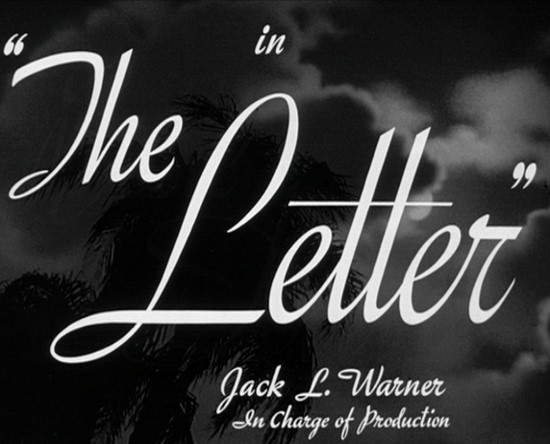
"The Letter is an opera noir, a story of ordinary people who make a few mistakes and suddenly find themselves swept into very deep emotional water, way over their heads," says Moravec. "It combines the aesthetic of American verismo with dream-like qualities often characteristic of a psychological drama. We intend it to be as fast-moving and hard-hitting as a Hollywood film noir from the '40s."
"Our goal," says Teachout, "has been to write a work that's firmly rooted in traditional operatic practice--one that will make dramatic sense to mainstream audiences."
Patricia Racette and Anthony Michaels-Moore star as Leslie and Robert Crosbie, an unhappily married expatriate couple whose life in the jungle of Malaya is torn apart by passion, violence, and revenge. Racette appeared most recently in the 2005 Turandot. Michaels-Moore will be singing the title role in this year's Falstaff. Other members of the cast include Roger Honeywell, last seen in the 2007 production of Tea: A Mirror of Soul, and James Maddalena, Ning Liang, and Rodell Rosel, all making their company debuts. Patrick Summers, music director of the Houston Grand Opera, also in his company debut, will conduct.
The production will be directed by Jonathan Kent, who staged the critically acclaimed Broadway revival of Brian Friel's Faith Healer in 2006. Kent has directed three operas in Santa Fe, most recently Thomas Adès' The Tempest in 2006. He is staging the 2008 Marriage of Figaro. Hildegard Bechtler, the set designer, created the set for Primo, Anthony Sher's stage version of Primo Levi's If This Is a Man, which played on Broadway in 2005. Tom Ford, the award-winning New York fashion designer, will design the costumes. One of the nation's best-known fashion figures, his oeuvre includes men's clothing, perfume and accessories. A longtime Santa Fean, Ford graduated from Santa Fe Prep and keeps a home here.
* * *
Opera buffs will need no further introduction to the stars of The Letter, but for those of you who don't follow the business that closely, suffice it to say that Patricia Racette and Anthony Michaels-Moore starred in the Metropolitan Opera's new production of Benjamin Britten's Peter Grimes, which opened earlier this year, while James Maddalena is best known for having created the role of Richard Nixon in John Adams' Nixon in China. As for Jonathan Kent, Hildegard Bechtler, Tom Ford, and Patrick Summers, I think the press release speaks quite well for itself.
I'll fill you in after I get back to New York tonight, but for the moment I doubt I need to say much more than that Paul and I are honored--actually, "staggered" might be a better word--to have our very first opera produced and performed by such an illustrious group of collaborators. (I've written about Pat, Jonathan, and Hildegard in my capacity as a critic, so my admiration for their work is a matter of record.) It isn't often that you get to start at the top, but that's what's happened to us, and we don't need to be told what that means.
Now, if you'll excuse me, I have to catch a plane. Broadway is calling!
Posted April 30, 3:00 PM
TT: Almanac
"The last line uttered by the Devil in the first part of Goethe's Faust is the abrupt command, Her zu mir! Faust's adventure is over, his dream of eternal happiness gone. The Devil, who had been waiting ironically, says 'Come to me!' and it is over. I think of that line whenever I hear the first movement of Beethoven's Ninth where, time and again with a compulsive beauty, the key changes to that ominous note of pity and terror against which all but courage and art quails. From the statement of the opening theme this key-change has been inevitable. One senses, even if one does not know, that it is sure to come, and it does."
Hugh MacLennan, The Watch That Ends the Night
Posted April 30, 12:00 AM
April 29, 2008
CAAF: Afternoon coffee
• Maud points the way to a Theodora Keogh story, published in 1957, called "The Man Who Loved Old Ladies ." It's a short-short story, easily readable online, and it's interesting to place it in tandem with another short-short story, Katherine Mansfield's "The Young Girl", especially in the way both stories close.
Keogh is a new author to me -- I hadn't heard of her before reading an obituary that ran in the Telegraph this January -- but Maud, who along with others is agitating that Keogh's books be brought back into print, can tell you more.
Mansfield's story, by the by, is included in the Angela Carter-edited anthology Wayward Girls and Wicked Women, put out by Virago in the '80s. The collection's out of print but you can still pick up a used copy dirt cheap.
• Lately, I've been re-reading David Copperfield as my before-bed, literary-cup-of-Ovaltine book. Last night I hit the chapter called "My First Dissipation." It's such a funny set piece and can be read as a stand-alone excerpt if you start here, where David first decides to have a few friends over to his new apartment for dinner (Mrs. Crupp is his landlady).
A taste of the dissipation:
I began, by being singularly cheerful and light-hearted; all sorts of half-forgotten things to talk about, came rushing into my mind, and made me hold forth in a most unwonted manner. I laughed heartily at my own jokes, and everybody else's; called Steerforth to order for not passing the wine; made several engagements to go to Oxford; announced that I meant to have a dinner-party exactly like that, once a week, until further notice; and madly took so much snuff out of Grainger's box, that I was obliged to go into the pantry, and have a private fit of sneezing ten minutes long.I went on, by passing the wine faster and faster yet, and continually starting up with a corkscrew to open more wine, long before any was needed. I proposed Steerforth's health. I said he was my dearest friend, the protector of my boyhood, and the companion of my prime. I said I was delighted to propose his health. I said I owed him more obligations than I could ever repay, and held him in a higher admiration than I could ever express. I finished by saying, 'I'll give you Steerforth! God bless him! Hurrah!' We gave him three times three, and another, and a good one to finish with. I broke my glass in going round the table to shake hands with him, and I said (in two words) 'Steerforth -you'retheguidingstarofmyexistence.'
Personal aside: Whenever my book club meets, there's inevitably some point in the evening where we all start making plans to go on a trip to Cuba together, or Budapest, or else, you know, start a bowling team. So the "made several engagements to go to Oxford" bit hits home.
Posted April 29, 1:21 PM
OGIC: Rookie season
Consider yourselves warned: this is not a post about the arts, but one of those occasional yet inevitable posts about the life of the blogger that are delightful to some and obnoxious to others. Proceed or click away accordingly.
My absence from this space recently, excepting the occasional fortune cookie, can be explained in two short words: work and hockey. Behind these words lie a very boring story and a semi-interesting one. The first goes like this: work is busy. I know you know all about it. The second? I think it's pretty cool, actually. I haven't trotted out this particular obsession for a matter of years, maybe, but longtime readers will remember that alongside the interests that brought me here, interests in books, movies, criticism, and to a more limited extent the performing arts, stands a less elevated but equally passionate love for ice hockey--for the professional variety, from a strictly spectatorial perspective. Until recently.
The more hockey I watched over the years, the more a question or possibility gnawed at me: what does it feel like--to fly across the ice like that, to deliver a pass or receive one, to shoot and, in my very wildest dreams, score? Until a couple of years ago, the question seemed purely theoretical and made me increasingly melancholy. I was on the far side of 35 and I didn't know how to ice-skate, let alone do things with pucks. Even if I learned some of this, somehow acquiring skates and the bulky, mysterious-to-me carapace of a hockey player, and finding ice to play on and other people to play with who would not laugh me off said ice--even if I overcame all of these obstacles, I would certainly never be capable of performing any of the highly-skilled on-ice feats that most piqued this niggling desire to capture a feeling. There was perhaps a remote possibility that I could pursue this, but no question that anything transcendently gorgeous would always be beyond my grasp. So why bother? It would have to be more frustrating than gratifying, right?
(Speaking of ungraspable beauty in hockey, the nonpareil hockey blogger E, who runs A Theory of Ice, once posted a great little paragraph by William Faulkner on first witnessing this strange northern game. Read the whole thing here, but a bit of it goes like this: "it seemed discorded and inconsequent, bizarre and paradoxical like the frantic darting of the weightless bugs which run on the surface of stagnant pools. Then it would break, coalesce through a kind of kaleidoscopic whirl like a child's toy, into a pattern, a design almost beautiful....")
Something had to happen to change my mind. And, as with many consequential and fortunate turning points in my life, the difference was made by my dad. At the age of 64, just after Christmas, he went out and bought new skates, suited up, and took to the ice for the first time in about four decades. True, he had years of real, competitive experience as a teenager and young man. But he also was almost thirty years older than me. Part of me was envious, part inspired. By March I had new skates too and was enrolled in beginning figure-skating lessons in a fairly distant suburb. I made the 45-minute drive every Monday evening, right after work, spent half an hour on the ice, and turned around to head back. Behind-wheel to on-ice ratio: 3 to 1, but worth it. I learned some basic skating that would help later, and some kid-level figure-skating stuff that wouldn't. I earned a turquoise ribbon with a penguin on it certifying my mastery of 1/2 level of skating expertise.
This was all extremely exciting, but it didn't feel like it was getting me much closer to playing hockey.
I kept skating wistfully, trying to work diligently on my stride and my backwards with dim hope of someday, somehow, getting a stick and a game. And this winter, wouldn't you know, the stars aligned and I found myself becoming friends with someone whose friend was about to begin teaching a beginner's hockey class. By now I've had maybe ten lessons. I am entirely incompetent and thoroughly addicted.
Some amateur observations:
• Many things in ice-skating are easier with a stick in your hands and an urgent purpose.
• Stopping is not one of those things. Did you ever see a lot of beginning skaters play a hockey scrimmage? Everyone goes into big loops or dire spin-o-ramas to get to the puck facing in the right direction. I can't imagine it's not very funny to observe. "Frantic darting of the weightless bugs" indeed.
• No matter how wretchedly you play, the hunger to get the puck is all-consuming. In my case, the need to get rid of it once I have it is equally urgent. One-half of this attitude needs changing.
• Playing hockey means developing a deeper relationship with velcro.
• A one-minute shift in scrimmage is almost enough to kill me.
But most of all: I love this game and already can't imagine life without it, even though I clearly will never be any good at any part of it and what I'm doing is to the real thing what fingerpainting is to Frankenthaler. I remind myself, in fact, a bit of Terry when he finally put paint to canvas a few years ago, after years of wondering what it felt like: "It was, as I'd hoped, completely absorbing fun, and though I fear I have no obvious aptitude for the making of visual art, I still can't wait to do it again."
Posted April 29, 8:54 AM
TT: Almanac
"I looked at her and knew she was sincere, and I remembered what else Catherine had said about her, and my world rocked, for this was the first time--I had always been slow on the uptake--when I realized that under certain circumstances sincerity is the most dangerous thing in the world."
Hugh MacLennan, The Watch That Ends the Night
Posted April 29, 12:00 AM
April 28, 2008
CAAF: Morning coffee
• Last week, Slate reported that The Mount, Edith Wharton's home in Lenox, would face foreclosure unless the historic site managed to raise $3 million by April 24. According to The Mount's website, that deadline's now been extended to May 31. So far $816,753 has been raised.
• Seems like old times: Another new novel from Curtis Sittenfeld, another round of commentary re: the writerly abilities of "Mr. Sittenfeld."
From the vaults of Web .2, an early story of Sittenfeld's, one I'm still fond of, about New Year's at the office.
• A history of literary tattoos. The Gutenberg Bible tats seem like an especially dedicated way to salute the printed word. (Via Bookslut.)
Posted April 28, 10:00 AM
TT: Northward glance
I sent Rhythm Man: A Life of Louis Armstrong off to Harcourt, my publisher, last Friday, and I also sent it to two people who knew Armstrong and offered to read the manuscript. So begins the long and complicated process that will lead to the book's publication a year or so from now.
In a perfect world I'd celebrate by going on a vacation, but I haven't had much luck with that in the past--I took a week off to visit my mother when I finished my Mencken biography, only to be stranded in Smalltown, U.S.A., by 9/11--and in any case a New York drama critic doesn't get to take any time off at this time of year. I saw Cry-Baby the night I finished writing Rhythm Man, The Country Girl two days later, and two more shows, Thurgood and Les Liaisons Dangereuses, the day after that. Yesterday I wrote a 2,500-word essay about Gustav Mahler for Commentary, and today I have to write Friday's Wall Street Journal drama column. Tomorrow I fly to Santa Fe by way of Dallas and Albuquerque, about which more later, and on Thursday night I'll be in Brooklyn, watching Endgame at BAM Harvey, with three more shows to come on Friday, Saturday, and Sunday.
Contrary to popular belief, my life isn't always this hectic, but as I pointed out last week, I didn't plan to be finishing Rhythm Man and The Letter at the same moment, much less to have that moment occur simultaneously with the peak of the Broadway season. In the ever-relevant words of James Burnham, if there's no alternative, there's no problem, and since there's definitely no alternative, I'm at least trying to behave as if there's no problem.
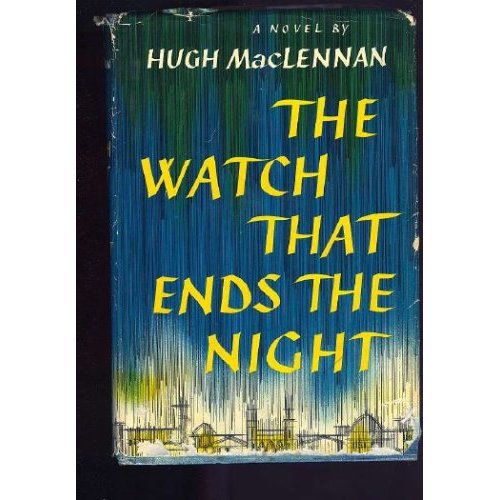
One of the ways in which I cling to normality in the midst of frenzy is to read something each day that is irrelevant to my proximate concerns. For the past week I've been periodically immersed in a book I've long wanted to read, Hugh MacLennan's The Watch That Ends the Night. MacLennan, a Canadian novelist and essayist who died in 1990, is all but unknown in this country. (You can read about him here.) So, of course, are most Canadian artists who stubbornly insist on living in their native land instead of moving south, which says more about America than it does about Canada. Edmund Wilson praised his writing in O Canada: An American's Notes on Canadian Culture, perhaps the least well known of his books, in which he compared MacLennan to Balzac and said that The Watch That Ends the Night was "invested with a kind of poetry that, to a reader living in the United States, makes Canada seem almost exotic." But even though I read O Canada many years ago, I didn't remember what Wilson had to say about MacLennan--I had to look it up on my New Yorker CD-ROM set--and the only reason why I knew about The Watch That Ends the Night, which was published in 1959, is that I once ran across a mention of it in a biography of Glenn Gould.
At any rate I finally got around to reading The Watch That Ends the Night last week, and I was knocked flat by it, so much so that I had to ration the number of pages I allowed myself each day so that I wouldn't be distracted from my deadlines. I intend at some point in the next couple of weeks to discuss it in the weekly book column that I write for Commentary's Web site, so I won't jump the gun here. Suffice it for the moment to say that I feel inclined to rank it alongside Peter de Vries' The Blood of the Lamb, an equally ill-remembered novel of similar vintage and subject matter (both books have at their center a woman who is suffering from a fatal illness and are narrated by a man who loves her).
A few years ago I quoted from The Blood of the Lamb in one of my daily almanac entries:
We live this life by a kind of conspiracy of grace: the common assumption, or pretense, that human existence is "good" or "matters" or has "meaning," a glaze of charm or humor by which we conceal from one another and perhaps even ourselves the suspicion that it does not, and our conviction in times of trouble that it is overpriced--something to be endured rather than enjoyed.
That quote caught the eye of my friend Maud Newton, who subsequently read The Blood of the Lamb and later cited the University of Chicago's paperback reprint as her favorite novel of 2005. I don't know whether The Watch That Ends the Night would hit Maud as hard as did The Blood of the Lamb, but I do know that it hit me as hard as any novel I've read in the past decade. I plan to devote all of this week's almanac entries to it.
The Watch That Ends the Night is out of print, but a new edition is about to be published in Canada, and in the meantime used copies are easy to order. I commend it to your attention.
Posted April 28, 12:00 AM
TT: Almanac
"Some people have within themselves a room so small that only a minuscule amount of the thing we call the spirit can find a home in them. Others have so much that what the world calls their characters explodes from the pressure. I think of it as a force. I have recognized--and I am no mystic--an immense amount of this spiritual force in people whose characters, judged by the things they do, are bad. In others who are blameless I have found hardly any. Probably I will never be able to know what its real nature is; all I do know is that I know it is there. Call it the Life-Force if you prefer the modern term; call it anything you like. But whatever it is, this thing refuses to be bounded, circumscribed or even judged. It creates, it destroys, it re-creates. Without it there can be no life; with much of it no easy life. It seems to me the sole force which equals the merciless fate which binds a human being to his mortality."
Hugh MacLennan, The Watch That Ends the Night
Posted April 28, 12:00 AM
April 25, 2008
CAAF: Poets and flying rollergirls
The big deal arts-wise in Asheville this weekend is the inaugural WordFest, a poetry festival featuring a number of local and visiting poets at readings and talks around the city. It kicked off last night, and events continue through Sunday night. The website features live video so, if you can't make it, you can tune in remotely.
I tend not to share my jetting-around calendar here because, as you may have gathered from all the excitement about the Jane Austen marathon on PBS a while back, there's usually not much to report. But I'm looking forward to this weekend:
• Friday: Drinks with my friend Robert McGee, who has a new story in the just-launched Raleigh Quarterly.
• Saturday afternoon: Blue Ridge Rollergirls recruitment session at Malaprop's.*
• Saturday night: Fatemeh Keshavarz and Galway Kinnell reading at Asheville WordFest.
• Sunday: Harold and Kumar Escape From Guatanamo Bay!!
* This has bad idea written all over it, but I can't help it: I want to roll! I went to a match last weekend and it was, not to put too fine a point on it, awesome. Also, I seem to have come to the point in writing the book where even getting body-checked sounds more appealing than sitting in front of the computer any longer.
Posted April 25, 9:00 AM
TT: Just add Waters
Two raves in today's Wall Street Journal drama column, one on Broadway (Cry-Baby) and one out of town (Paper Mill Playhouse's Kiss Me, Kate). Yay! Here's an excerpt.
* * *
You want funny? I'll give you funny, or at least tell you where to find it: "Cry-Baby," the new John Waters musical, is campy, cynical, totally insincere and fabulously well crafted. And funny. Madly, outrageously funny. It is, in fact, the funniest new musical since "Avenue Q," give or take "The Drowsy Chaperone." If laughter is the best medicine, then "Cry-Baby" is the whole damn drugstore.
Like the 1990 film on which it is based, "Cry-Baby" is a teen-musical spoof in which the standard bad-boy-meets-nice-girl plot is put through the shredder and turned into a zany spoof of buttoned-down '50s conformism.....
This way lies trouble, for nothing in musical comedy is harder to bring off than a pure parody, since it deliberately omits the magic ingredient that makes most successful musicals run forever, which is sentiment. An unfelt musical is by definition emotionally hollow at the core, and so it lives or dies on the strength of its wit. If it isn't brilliant but merely clever, it loses steam and limps past the finish line. That's the great thing about "Cry-Baby": It never goes limp. Broadway debutants David Javerbaum (the executive producer of "The Daily Show") and Adam Schlesinger (the bassist of the brainy rock band Fountains of Wayne) have written an unbroken string of super-smart pop-music genre send-ups that are both unexpectedly hummable and full of neat rhymes...
Cole Porter launched his career by writing old-fashioned musicals with tissue-thin plots and immortal songs, and lived just long enough to see the coming of shows whose books were dramatically sound--and to write one himself. "Kiss Me, Kate," the musical version of "The Taming of the Shrew" that Porter wrote in 1948 in collaboration with Sam and Bella Spewack, is one of the three or four best Broadway musicals of the "Oklahoma!" era, a masterpiece of tunefulness and charm. It doesn't get performed nearly often enough, though, so I urge you to head out to New Jersey to see Paper Mill Playhouse's new revival, which couldn't be more satisfying....
James Brennan, who directed Paper Mill's superb 2004 production of "She Loves Me," has done even better by "Kiss Me, Kate," working closely with Patti Colombo, whose dance numbers are seamlessly interwoven with the dialogue scenes. Ms. Colombo is one of the most imaginative musical-comedy choreographers around--her staging of "Too Darn Hot" stopped the show--and I can't see why Broadway hasn't snapped her up.
* * *
Read the whole thing here.
Posted April 25, 12:00 AM
TT: Copland in Hollywood
It's always puzzled me why Aaron Copland's film music isn't better known. He wrote the scores for four major Hollywood films, Of Mice and Men, Our Town, The Red Pony, and The Heiress, the last of which won him a best-score Oscar in 1949. These scores were hugely influential in Hollywood--Copland more or less created the "American sound" that can be heard in such better-known scores as Hugo Friedhofer's The Best Years of Our Lives and Jerome Moross' The Big Country--and the films themselves attracted a fair amount of critical attention, The Heiress in particular. Yet none of Copland's film scores has been recorded in its entirety, nor has anyone written a book specifically devoted to his film music. Why not?
You guessed it--Copland's film music is the subject of my "Sightings" column in Saturday's Wall Street Journal. Pick up a copy of tomorrow's paper, turn to the "Weekend Journal" section, and read all about it.
UPDATE: Read the whole thing here.
Posted April 25, 12:00 AM
TT: Almanac
LLOYD: That bitter cynicism of yours is something you've acquired since you left Radcliffe.
KAREN: That cynicism you refer to I acquired the day I discovered I was different from little boys.
Joseph L. Mankiewicz, screenplay for All About Eve
Posted April 25, 12:00 AM
April 24, 2008
TT: A pair of hats
I'm used to being busy, but somehow it failed to occur to me when I agreed two years ago to collaborate with Paul Moravec on The Letter that I might find myself finishing an opera libretto and a book at the same time. Yet that's what happened, and the time is now. I finished writing the final chapter of Rhythm Man: A Life of Louis Armstrong yesterday afternoon, and Paul is composing the final scene of The Letter. All this is happening at the height of the New York theater season, which means that I'll be seeing three or four shows a week between now and May 7, the cutoff date after which Broadway shows are no longer eligible for this year's Tony Awards.
The bad part about being so busy is that I'm occasionally tired enough to fall on my face. The good part is that I haven't had time to worry about the book, the opera, or anything else. If it's a virtue to live in the moment--and I'm not so sure it is--then right now I'm the most virtuous guy in New York City. For the past couple of weeks I've been getting up, going to work, eating, going back to work, going to bed, then starting over again the next day.
I finished my last book four years ago, on which occasion I had this to say:
Three months ago, All in the Dances didn't exist. Over the years I'd told dozens of people all about George Balanchine's life and work, but every time I had to start fresh. Now there's an inch-thick pile of paper on my kitchen table with a title page on top, the gateway to a world I made, and even though I'll be reviewing a Broadway play tomorrow morning, then writing my Washington Post column in the afternoon, part of me is still back in that world of shadows.
Since then I've constructed a brand-new world of shadows, and spent large chunks of my waking hours living in it. Most of them have been happy--Satchmo is a very agreeable man with whom to pass your days--but once Santa Fe Opera commissioned The Letter and told Paul and me that they wanted to give the premiere in the summer of 2009, I've been tied to a pair of not-quite-parallel tracks. It was around then that Mrs. T and I decided to get married, which added yet another layer of happy complication to my life. So now I'm trying to get used to the fact that once I finish editing and polishing Rhythm Man and deliver the manuscript to Andrea Schulz, my editor at Harcourt, that same life, full though it is, will have a book-sized hole in it.
Four years ago I recalled the lyric to a song by Stephen Sondheim as I wrote the last page of All in the Dances:
Finishing the hat,
How you have to finish the hat.
How you watch the rest of the world
From a window
While you finish the hat....
Making art--and a biography is a work of art, more or less--is a strange sensation. During your working hours you really do watch the rest of the world from a window, yet at the same time you don't fully feel the act of creation in which you're involved. Hours slip by without your being aware of their passing, and all at once you look up and the sun has set. On Wednesday I got up at eight, went to work at eight-thirty, and stopped writing at six-forty-five to dress for the theater, and the only person I spoke to during that time (except for a brief call to Mrs. T in Connecticut at midday) was the waitress from whom I ordered my lunch. When I was done I'd written eight thousand words, the equivalent of eight Wall Street Journal drama columns, yet I barely noticed that I was writing them until I was through. I was thinking about the last eight years of Louis Armstrong's life and turning my thoughts into words and sentences and paragraphs, and by then I was so deeply immersed in the process of finishing my book that I was all but unconscious of it.
I blogged about this sensation, or lack of it, three years ago:
I write fast. It takes me, for example, two and a half hours to knock out a thousand-word Wall Street Journal drama column (except when I'm sick). This isn't exactly freakish, but it's quick enough to stagger many of my friends and colleagues. I can't explain my facility, so I joke about it, but the fact is that I, too, find it mystifying, though it's not the speed that puzzles me--it's that I don't really know where all those words come from in the first place. On occasion I may spend a few minutes tinkering with a punch line until I hear it go click, and of course I edit and polish the surfaces of my pieces as painstakingly as time permits, but beyond that I have next to no insight into the thought processes that cause them to pour out of my fingers.
It occurs to me that this seeming incomprehension may have something to do with the fact that I am (or was) as much a musician as a writer. Music, after all, is a non-verbal art form, and the only descriptions of the creative experience that ring true to my ear are those of composers. "I am the vessel through which Le Sacre passed," Igor Stravinsky said of the writing of The Rite of Spring. When I first ran across that remark I thought, That's exactly how it feels when I write a piece--it passes through me.
Now Rhythm Man has passed through me, and from here on out my involvement with its creation will be conscious. Editing and polishing are acts of which I am entirely aware, and which I find highly pleasurable. I wouldn't exactly say, by contrast, that writing is pleasurable, any more than breathing is pleasurable. It's what I do.
The first thing I did after finishing the book, by the way, was back up my hard drive. (Never let it be said that I don't learn from experience, sometimes.) Then I called Mrs. T in Connecticut, followed by my mother in Smalltown, U.S.A. Then I took a shower and went out to get some dinner. Then I sat around for a couple of hours, pretending to look at a movie. Then I went to bed. Today I have a "Sightings" column to write for Saturday's Wall Street Journal, after which Mrs. T will be arriving in New York. Yes, we'll celebrate--and then I'll get back to work on The Letter. There's always another hat.
Posted April 24, 12:00 AM
TT: So you want to see a show?
Here's my list of recommended Broadway, off-Broadway, and out-of-town shows, updated weekly. In all cases, I gave these shows favorable reviews (if sometimes qualifiedly so) in The Wall Street Journal when they opened. For more information, click on the title.
Warning: Broadway shows marked with an asterisk were sold out, or nearly so, last week.
BROADWAY:
• Avenue Q (musical, R, adult subject matter and one show-stopping scene of puppet-on-puppet sex, reviewed here)
• A Chorus Line (musical, PG-13/R, adult subject matter, reviewed here)
• Grease * (musical, PG-13, some sexual content, reviewed here)
• Gypsy * (musical, PG-13, adult subject matter, reviewed here)
• In the Heights (musical, PG-13, some sexual content, reviewed here)
• The Little Mermaid * (musical, G, entirely suitable for children, reviewed here)
• Macbeth * (drama, PG-13, unsuitable for children, closes May 24, reviewed here)
• November (comedy, PG-13, profusely spattered with obscene language, reviewed here)
• Passing Strange (musical, PG-13, adult subject matter, reviewed here)
• South Pacific * (musical, G/PG-13, some sexual content, brilliantly staged but unsuitable for viewers acutely allergic to preachiness, reviewed here)
• Sunday in the Park with George * (musical, PG-13, too complicated for children, closes June 29, reviewed here)
OFF BROADWAY:
• Adding Machine (musical, PG-13, adult subject matter, too musically demanding for youngsters, extended through Aug. 31, reviewed here)
• The Four of Us (comedy, PG-13, adult subject matter, extended through May 18, reviewed here)
• From Up Here (drama, PG-13, closes June 8, reviewed here)
ON TOUR:
• Moby-Dick--Rehearsed (drama, G, not suitable for children, touring the U.S. through May 17, reviewed here)
CLOSING SATURDAY IN WESTPORT, CONN.:
• Time of My Life (serious comedy, PG-13, adult subject matter, closes Apr. 26, reviewed here)
CLOSING SUNDAY IN PROVIDENCE, R.I.:
• Blithe Spirit (comedy, G/PG-13, some adult subject matter, closes Apr. 27, reviewed here)
REOPENING NEXT WEEK ON BROADWAY:
• Alfred Hitchcock's The 39 Steps * (comedy, G, suitable for bright children, reopens Apr. 29 at the Cort Theatre for an open-ended run, reviewed here)
• August: Osage County (drama, R, adult subject matter, reopens Apr. 29 at the Music Box Theatre for an open-ended run, reviewed here)
Posted April 24, 12:00 AM
TT: Almanac
"The labor of keeping house is labor in its most naked state, for labor is toil that never finishes, toil that has to be begun again the moment it is completed, toil that is destroyed and consumed by the life process."
Mary McCarthy, "The Vita Activa"
Posted April 24, 12:00 AM
April 23, 2008
CAAF: Afternoon coffee
• Jessa Crispin files a great, candid dispatch from the London Book Fair:
If Book Expo America is a carnival -- full of people desperately trying to draw attention to themselves with costumes, sway, and the occasional barely dressed woman -- then the London Book Fair has all the atmosphere of an accountancy seminar. We are here at Earl's Court to make deals and sell product, with brief breaks to discuss why we are not selling much product anymore.
• Small Beer Press is making Maureen McHugh's book of short stories, Mothers & Other Monsters, available for free download. This news has already been widely linked to, but it's a fantabulous book, one of my favorite collections of the last few years, and so I wanted to draw your attention there just in case. If you follow that link, you'll see it's the third book the press is making available this way -- the two others are Kelly Link's Stranger Things Happen (which I trust you've read, but David Orr fears you haven't) and John Kessel's The Baum Plan for Financial Independence and Other Stories (which I haven't read yet, but which comes highly recommended from a trusted source.)
• "He'd dead, Jim."
Here's where I can insert that at our local Asheville Pizza & Brewing Company, a very good pizza joint with a dollar theater attached (and a place where you should always tip handsomely because my stepson works there), there's a menu item called the William Shatner Cheese Quesadilla. If you click through and watch the item above, there's a moment that's like a giant, delicious mouthful of William Shatner Cheese Quesadilla.
• While you were asleep last night, William T. Vollmann was hopping a train with a couple bums in Taipei. While you were brushing your teeth, he was sleeping with a hooker in Mexico City. And while you ate your cereal this morning, he banged out 10,000 pages on his next book. (Even as I type this he is teaching some Filipino convicts the routine to "Thriller.") So, maybe it's not too surprising that with a writer of such profligacy, sometimes he lands his metaphor ... and sometimes he misses.
Posted April 23, 1:59 PM
TT: Brinksmanship
I wrote eight thousand more words of Chapter Twelve of Rhythm Man: A Life of Louis Armstrong yesterday before leaving for the theater at 7:20.
Stand by for an announcement....
Posted April 23, 12:00 AM
TT: Almanac
"The biographer who writes the life of his subject's self-concept passes through a façade into the inner house of life."
Leon Edel, "The Figure Under the Rug"
Posted April 23, 12:00 AM
April 22, 2008
CAAF: Afternoon coffee
Howdy, and sorry so quiet here. Like Terry, I've been working like crazy on my book although unlike Terry (I suspect) my definition of "like crazy" includes time for Scrabulous. It's a brave new world for me, Scrabulous. And it turns out, a fairly addictive one! I keep wondering how much games like this will figure in future literary biographies, i.e., "Work on the trilogy then halted as he strove to get under 5 minutes on the Hard level of Web Sudoku." But mostly, I've been concentrating -- I want to be finished with this thing by summer. Till then, full warning, I'll be a little tired and not as polished as I wish I were (not to claim that I've ever operated like a ray-gun of insight and incisive comment) -- because really, when I take a break lately, all I want to do is stand around & chat nonsense & have nonsense chatted back at me.
• Edith Wharton's The Mount needs to raise $3 million to stay open after April 24 (Thursday). The situation sounds dire; the worst part of the story is that Wharton's personal library, which was re-acquired by the estate only a couple years ago, may have to be sold to make up the funds. I've been hoping to visit The Mount for a while now, and so was glad the story includes a slideshow tour of its interiors. So many author houses are a disappointment -- you go there looking for something that's only in the books -- but with Wharton, with her love of design and ornamentation, it doesn't seem so extracurricular.
• Isabel Fonseca, author of the incredible Bury Me Standing and the new novel Attachment, and who I feel oddly protective over as people seem bent on dismissing her as being only Martin Amis's pretty wife when Bury Me Standing is a formidable, great piece of nonfiction, profiled by Charles McGrath for The New York Times. Going over her history, McGrath compares her entertainingly to the Max Beerbohm character Zuleika Dobson, "a beautiful young woman who turns up at Oxford and makes all the undergrads suicidal with longing." (Via TEV.)
Posted April 22, 1:00 PM
TT: Progress report
Yesterday I finished writing Chapter Eleven--the next-to-last chapter--of Rhythm Man: A Life of Louis Armstrong. Then, after dinner, I wrote the first two thousand words of the final chapter, in which I tell the story of the making of Armstrong's 1963 recording of Hello, Dolly! The end is now in sight.
I'm wired far too tight to tell you how it feels to be so close to the finish line, so instead I'll simply share with you the unedited draft of the opening of Chapter Twelve, hot off the word processor and still smoking.
* * *
On December 3, 1963, Louis Armstrong and the All Stars showed up at a New York studio for their first recording session in two years. Not since they finished work on Dave Brubeck's The Real Ambassadors had anyone shown any interest in making a new record by the most famous jazz musician in the world. It was taken for granted that Armstrong no longer had anything new to say, and in 1963 nobody wanted to hear anything that wasn't new: that was the year of Charles Mingus' The Black Saint and the Sinner Lady, Bill Evans' Conversations With Myself, The Freewheelin' Bob Dylan, Getz/Gilberto, Johnny Cash's "Ring of Fire," Miles Davis' Seven Steps to Heaven, and the Beatles' "She Loves You." And while Armstrong was undoubtedly grateful to have been given an opportunity to cut a record after so long a hiatus, this one didn't add up to much. Instead of an ambitious album-length project like The Real Ambassadors or Louis Armstrong and Duke Ellington, all that Joe Glaser, his manager, had managed to scrape up for him this time around was a single for Kapp Records, an independent label run by Dave Kapp. The session was to be produced by Dave's son Mickey, and the A side was a cheery little ditty from a new musical by a little-known Broadway songwriter named Jerry Herman who so far had only one show under his belt. The new show had yet to open, and no one had any idea how it would do. For the flip side, Armstrong and the band knocked out a lightly swinging cover version of "A Lot of Livin' to Do," a song from Bye Bye Birdie, which had closed two years earlier.
It was, in short, a job of work, a one-shot affair that had been thrown together by Jack Lee, a song-plugger for E.H. Morris, Herman's publishing company, and Armstrong and his sidemen set to it with their customary professionalism but no great enthusiasm. According to Jack Bradley, a friend who came to the session, the trumpeter "shook his head in dismay" when he looked at the lead sheet for the new song. He preferred "A Lot of Livin' to Do," and so did everybody else in the studio. Herman's square-cut tune, by contrast, was naggingly repetitive, his lyrics simple to the point of banality. Mickey Kapp decided that the record needed a little something extra to pep it up and brought in a seventh musician, a veteran session guitarist named Tony Gottuso who also doubled on banjo and lived close to the studio. Except for his sessions with the Dukes of Dixieland, Armstrong hadn't worked with a banjo player since the early Thirties, and the twangy-sounding instrument was now so totally identified with funny-hat Dixieland and bluegrass that the very thought of using one now must have struck him as embarrassingly old-fashioned. Once the two songs were in the can, he promptly forgot about them and went about his business, flying off to Puerto Rico three weeks later for a holiday engagement at the Hotel San Juan.
Meanwhile Mickey Kapp sent an acetate of the single to Joe Glaser's office. Cork O'Keefe, an old colleague, dropped by for a visit shortly afterward, and Glaser played the A side for him. "Listen to that, Cork, it's a fucking hit," he shouted. For once he was right on the money: "Hello, Dolly!" is a near-perfect pop record, at least as catchy as "Mack the Knife" and very nearly as well played. Like all hits, it is concise (two and a half minutes) and wholly to the point. A crisply played upward glissando by Gottuso leads into a no-nonsense eight-bar introduction by the band, at the end of which Armstrong enters with an equally straightforward vocal in which he loosens up the four-square rhythms of Herman's melody and puts an even more distinctively personal stamp on his lyric: Hello, Dolly/This is LEW-issss, Dolly/It's so nice to have you back where you belong. Next comes a rocking ensemble chorus in the band's very best New Orleans style, after which Armstrong comes back to sing another half-chorus, wrapping it up with a neat little tag that sells the song's title one last time: Dolly, never go away/Promise you'll never go away/Dolly, never go away again! In addition to adding Gottuso's banjo, Kapp had discreetly sweetened the mix with an occasional hint of overdubbed strings, but otherwise "Hello, Dolly!" was a pure product of Louis Armstrong and the All Stars, as plain and tasty as a plateful of red beans and rice....
* * *
More as it happens.
UPDATE: A friend writes:
What a wonderful story about the recording of "Hello, Dolly!" But why are you reading e-mails? The faster you finish, the faster we can all read it!
Hey, I've already written 1,600 more words so far today--a fellow has to have some rest!
Posted April 22, 12:00 AM
TT: Almanac
"In playing for contemporary composers, I've always felt that the ones I respected were not inflexible about what you did to their music. They permitted a certain degree of freedom. I've found that the lesser composers were the ones who insisted, no, I said mezzo piano and that's not my conception of mezzo piano. I think the great composers believe their work will endure even if one does not adhere to the exact indications of the music."
Isidore Cohen (quoted in Nicholas Delbanco, The Beaux Arts Trio: A Portrait)
Posted April 22, 12:00 AM
April 21, 2008
TT: Almost, but not quite
I'll be finishing the next-to-last chapter of my Louis Armstrong biography sometime today. No blogging until then!
Posted April 21, 12:00 AM
TT: Almanac
"The first-person narrated movie rests on one dynamic. It is the story of a person reciting the one great event of their life, the one big adventure of their life."
James Ellroy, quoted in Shadows of Suspense
Posted April 21, 12:00 AM
April 18, 2008
TT: Mother knows worst
Two shows in this week's Wall Street Journal drama column, one on Broadway (Harvey Fierstein's A Catered Affair) and one off (Liz Flahive's From Up Here). Here's an excerpt.
* * *
If good intentions could keep a musical open, "A Catered Affair" would run forever. I don't know when I've seen a show that looked better on paper, and I liked the idea of turning Richard Brooks' 1956 film into a stage musical so much that I was actively rooting for the results to give pleasure. Instead they're a disappointment--one so intelligently staged and performed, however, that at times you can almost believe the show is as good as its production. Almost, but not quite: Harvey Fierstein and John Bucchino, the creators of this new stage version, have missed the spirit of the movie by a mile, and no amount of creativity on the part of their collaborators is enough to make up for their own miscalculations.
The film, adapted by Gore Vidal from one of Paddy Chayefsky's "Philco Television Playhouse" kitchen-sink TV dramas, was a sequel of sorts to "Marty," the Chayefsky teleplay about a lonely butcher whose 1955 screen version knocked down four Oscars. Ernest Borgnine (whose performance in the film of "Marty" had just made him a star) and Bette Davis played Tom and Aggie Hurley, a Bronx cab driver and his sourpuss wife whose daughter is about to get married to her longtime beau. Mom foolishly decides to blow the family's savings on a fancy wedding, even though the daughter (played by Debbie Reynolds) would rather tie the knot at City Hall....
Mr. Fierstein was right to think that Mr. Vidal's screenplay had the stuff of a musical in it, but he made three big mistakes in adapting it for the stage. The first was to put an anachronistically contemporary spin on his book by turning Aggie's brother, played in the film by Barry Fitzgerald, into a more or less openly gay florist, and the second was to play the part himself. No doubt there were at least a couple of gay Irish Catholic florists living in the Bronx in the mid-1950s, but the notion that one of them would have had the nerve to camp it up in front of his kinfolk ("If you will kindly remove your peas and posteriors, I will take to the cloistered confines of my secret shame") strains credulity past the breaking point.
Mistake No. 3 was to invite Mr. Bucchino to write the score. I say this with regret, for I esteem him as one of the best cabaret songwriters around. The problem is that his songs, with their pastel harmonies and introspective lyrics, have nothing in common with the working-class setting...
Speaking of kitchen-sink dramas, Liz Flahive has gone all out in "From Up Here," setting her first Off-Broadway play in and around a Midwestern home whose costly-looking kitchen (designed by Allen Moyer) is equipped with every modern appliance known to man or woman. I can't remember the last time I saw a show with a set that contained a dishwasher and a clothes washer. Don't be deceived by the décor, though: Ms. Flahive is a playwright of promise who has contrived to find fresh things to say in the overworked dramatic language of domestic realism....
* * *
Read the whole thing here.
Posted April 18, 12:00 AM
TT: Almanac
"You don't get to be good-hearted by accident. You get kicked around long enough, you get to be a real professor of pain."
Paddy Chayefsky, Marty
Posted April 18, 12:00 AM
April 17, 2008
TT: In case you're wondering
I'm up to my ears in the next-to-last chapter of Rhythm Man: A Life of Louis Armstrong, and I'll probably stay that way until Sunday afternoon, when I head out to New Jersey to see a performance of Kiss Me, Kate. I don't intend to surface again until this chapter is wrapped up and put to bed. Wish me luck!
Posted April 17, 9:29 AM
TT: So you want to see a show?
Here's my list of recommended Broadway, off-Broadway, and out-of-town shows, updated weekly. In all cases, I gave these shows favorable reviews (if sometimes qualifiedly so) in The Wall Street Journal when they opened. For more information, click on the title.
Warning: Broadway shows marked with an asterisk were sold out, or nearly so, last week.
BROADWAY:
• Avenue Q (musical, R, adult subject matter and one show-stopping scene of puppet-on-puppet sex, reviewed here)
• A Chorus Line (musical, PG-13/R, adult subject matter, reviewed here)
• Grease * (musical, PG-13, some sexual content, reviewed here)
• Gypsy * (musical, PG-13, adult subject matter, reviewed here)
• In the Heights (musical, PG-13, some sexual content, reviewed here)
• The Little Mermaid * (musical, G, entirely suitable for children, reviewed here)
• Macbeth * (drama, PG-13, unsuitable for children, closes May 24, reviewed here)
• November (comedy, PG-13, profusely spattered with obscene language, reviewed here)
• Passing Strange (musical, PG-13, adult subject matter, reviewed here)
• South Pacific * (musical, G/PG-13, some sexual content, brilliantly staged but unsuitable for viewers acutely allergic to preachiness, reviewed here)
• Sunday in the Park with George * (musical, PG-13, too complicated for children, closes June 29, reviewed here)
OFF BROADWAY:
• Adding Machine (musical, PG-13, adult subject matter, too musically demanding for youngsters, reviewed here)
• The Four of Us (comedy, PG-13, adult subject matter, extended through May 18, reviewed here)
ON TOUR:
• Moby-Dick--Rehearsed (drama, G, not suitable for children, touring the U.S. through May 17, reviewed here)
CLOSING NEXT WEEK IN PROVIDENCE, R.I.:
• Blithe Spirit (comedy, G/PG-13, some adult subject matter, closes Apr. 27, reviewed here)
CLOSING NEXT WEEK IN WESTPORT, CONN.:
• Time of My Life (serious comedy, PG-13, adult subject matter, closes Apr. 26, reviewed here)
REOPENING THIS MONTH ON BROADWAY:
• Alfred Hitchcock's The 39 Steps * (comedy, G, suitable for bright children, reopens at the Cort Theatre on Apr. 29 for an open-ended run, reviewed here)
• August: Osage County (drama, R, adult subject matter, closes Sunday and reopens Apr. 29 at the Music Box Theatre for an open-ended run, reviewed here)
Posted April 17, 12:00 AM
TT: Almanac
"Perpetual devotion to what a man calls his business is only to be sustained by neglect of many other things."
Robert Louis Stevenson, "An Apology for Idlers"
Posted April 17, 12:00 AM
April 16, 2008
CAAF: Morning coffee
A couple cool watch-able things:
• PBS's American Experience is making its one-hour special on Walt Whitman available online. (Via SoT.)
• Yale's roster of open courses includes a modern poetry class with lectures on such poets as Yeats, Bishop, Eliot and Moore. (Via Crooked House.)
Posted April 16, 6:00 AM
TT: Almanac
"'Do you know any happy music?' asked Stephen. 'I do not.'"
Patrick O'Brian, The Hundred Days
Posted April 16, 12:00 AM
April 15, 2008
TT: Annals of failed flackery
People in my line of work have to sift through a lot of press releases and other forms of flackery, all of which we take with a stalactite or two of salt. It's part of the job. Nevertheless, I confess to having boggled at the blurbissimo I encountered on the back of my advance readers' copy of Andre Dubus III's The Garden of Last Days, which will be published by W.W. Norton in June.
Here it is, in its entirety:
One early September night in Florida, a stripper brings her daughter to work. April's usual babysitter is in the hospital, so she decides it's best to have her three-year-old daughter close by, watching children's videos in the office, while she works.Except that April works at the Puma Club for Men. And tonight she has an unusual client, a foreigner both remote and too personal, and free with his money. Lots of it, all cash. His name is Bassam. Meanwhile, another man, AJ, has been thrown out of the club for holding hands with his favorite stripper, and he's drunk and angry and lonely.
From these explosive elements come [sic] a relentless, raw, searing, passionate, page-turning narrative, a big-hearted and painful novel about sex and parenthood and honor and masculinity. Set in the seamy underside of American life at the moment before the world changed, it juxtaposes lust for domination with hunger for connection, sexual violence with family love. It seizes the reader by the throat with the same psychological tension, depth, and realism that characterized Andre Dubus's #1 bestseller, House of Sand and Fog--and an even greater sense of the dark and anguished places in the human heart.
Right.
I didn't read House of Sand and Fog, so I suppose it's within the realm of possibility that Andre Dubus III is a serious writer. Still, it isn't very likely that I'll be reading The Garden of Last Days, much less reviewing it. I don't mind having my intelligence insulted by publicists--some forms of suffering are hard to avoid--but a critic can only be expected to swallow so much guff, and the Norton publicity department just blew my quota for 2008.
Posted April 15, 12:00 AM
TT: Words to the wise
One of the most important theatrical events I've had the good luck to cover in my five years at The Wall Street Journal is coming to PBS later this month. Primo, Sir Anthony Sher's one-man stage version of If This Is a Man, Primo Levi's Holocaust memoir, airs on Great Performances April 24.
Here's what I wrote three years ago about the Broadway transfer of this extraordinary show:
"Primo" is a very great piece of theater, but the tale, not the teller, is what matters most, and it is to their credit that Sir Anthony and Richard Wilson, his director, have opted for stark simplicity in presenting "If This Is a Man" (originally published in the U.S. as "Survival in Auschwitz"). The set, designed by Hildegard Bechtler, consists of a few concrete walls, a shovelful of gravel and a single wooden chair. Into this cold, bare space walks the bespectacled Sir Anthony, wearing an old cardigan. "It was my good fortune," he says matter-of-factly, "to be deported to Auschwitz only in 1944...I was 24, with little wisdom, no experience, and a tendency--encouraged by the life of segregation forced on me by the racial laws--to live in an unrealistic world of my own." Then, without further ado, he flings you into the bowels of hell.As I sat in my aisle seat waiting for "Primo" to start, I wondered what so eloquent a book had to gain from dramatic presentation, however minimal. Might it not be even more effective for Sir Anthony merely to stand at a lectern and read it out loud? Within five minutes I knew better. The genius of his acting lies in its extreme understatement. When the Nazis order him to strip naked, he takes off his glasses and pushes up his sleeves, hinting at his humiliation by furtively sliding a hand over his crotch. His voice grows steadily higher in pitch--first quizzical, then astonished. That's all he does, and all it takes: Levi does the rest, recounting the unimaginable horrors of Auschwitz with the laconic poise of a man who knows his tale needs no embellishing.
The ultimate proof of the purity and immediacy of this performance is that you come away from it thinking not about Sir Anthony, or even Primo Levi, but the story they have told together. Resounding in my ears as I left the theater were the climactic words in which Levi described the Russian soldiers who liberated Auschwitz: "They seem overwhelmed, not just by compassion but something else, something that seals their lips and keeps their eyes fixed to the scene around them. It's shame. We know this shame. It's the same that swamped us after the selections, and every time we had to watch, or submit to, some outrage. It's the shame that the just man feels at another man's crime...a feeling of guilt, that such a thing even exists..."
Mark your calendar--now.
* * *
For more information, go here.
Posted April 15, 12:00 AM
TT: Almanac
"In order for the wheel to turn, for life to be lived, impurities are needed, and the impurities of impurities in the soil, too, as is known, if it is to be fertile. Dissension, diversity, the grain of salt and mustard are needed: Fascism does not want them, forbids them, and that's why you're not a Fascist; it wants everybody to be the same, and you are not. But immaculate virtue does not exist either, or if it exists it is detestable."
Primo Levi, The Periodic Table
Posted April 15, 12:00 AM
April 14, 2008
TT: Where the hearth is
I travel from coast to coast seeing plays for The Wall Street Journal, which means that I eat out a lot. Two weeks ago, for instance, I dined at Dressing Room, a restaurant in suburban Connecticut that is attached to the Westport Country Playhouse, where I saw a production of Alan Ayckbourn's Time of My Life that was very impressive. So was my dinner.
Dressing Room, which bills itself as "A Homegrown Restaurant," is a joint venture of Paul Newman (yes, that Paul Newman--his wife runs the theater next door) and celebrity chef Michel Nischan. Newman is by all accounts a hands-on boss, but his partner dreams up the dishes, most of which are gussied-up big-ticket versions of "regional American heirloom recipes." One of them, I noted with astonishment, was described on the dinner menu as "Niman Ranch baby back ribs, Scott County Missouri-style."
Why was I astonished? Because Smalltown, U.S.A., the place where I grew up and where most of my family still lives, is located in Scott County, where smoked meat is a food group. I've eaten plenty of barbecue there, much of it at a place called Dexter Bar-B-Que whose ribs are admired throughout southeast Missouri. It went without saying that I had to see for myself what manner of barbecued rib a celebrity chef and a movie star would attempt to fob off on a bunch of unsuspecting New Englanders, so I ordered an appetizer-sized portion, took a suspicious nibble, and commenced (as they say back where I come from) to hollering. M. Nischan's ribs are light-colored, delicately seasoned, meltingly tender, and ambrosially tasty. I've never tasted anything like them anywhere in the world--including Scott County.
I Googled "Scott County Missouri-style ribs" as soon as I got home and discovered that Nischan had published his rib recipe in Condé Nast Traveler a year ago. I immeditely e-mailed a copy of it to my brother David, a lifelong resident of Smalltown who is also a local authority on barbecue (he serves as a judge at regional cookoffs). This was his reply:
Your ribs intrigue me. I've never heard of anyone in southeast Missouri or Western Kentucky cooking ribs this way. People around here dry-rub seasoning into the meat and then smoke the ribs indirectly with heat. Nischan seems to be getting the color of his meat from searing over the fire. Our meat gets its color from the seasonings and the smoke from the wood fire. I would be interested in where and from whom in Scott County he got the recipe.
So would I, though my guess is that he's put it through a set of hoops so fancy that it bears little if any resemblance to the authentic Ur-recipe with which he presumably started. And while I liked his Scott County-style ribs a whole lot, I have to confess that I like the real thing even more.
I should add that I speak as one whose taste in barbecue is nothing if not inclusive. I've eaten it everywhere from Arthur Bryant's in Kansas City to Rub BBQ in Manhattan, my adopted home. I'm not a particularly fussy eater, and I like most of the better-known regional variations of barbecue that I've run across in my travels. When all is said and done, though, the kind I like best is the kind I grew up with, and I suspect that most people lucky enough to have grown up eating barbecue feel the same way about the kind they grew up with. I've never met anyone who underwent a full-tilt adult conversion to a different style of barbecue. Crushes, yes: I myself once experienced a brief but intense attraction to the vinegary-tasting pulled pork served in eastern North Carolina. But my underlying loyalty to the dry-rubbed rib remained, and remains, unshaken.
I further suspect that my own liking for honest-to-God Scott County-style ribs is less a matter of aesthetic preference than a manifestation of my enduring nostalgia for southeast Missouri. Hometown cooking gets in your blood: I moved away from Smalltown three decades ago, but I return home to visit my family two or three times a year, and whenever I do, I eat barbecue. My mother doesn't cook as much as she used to, so our visits to Dexter Bar-B-Que have become a replacement (of sorts) for the fried potatoes, baked beans, waffles, and stewed chicken and noodles that she dished up in my calorie-unconscious youth.
Paradoxical as it may sound, one of the things I love most about barbecue is that it tastes different wherever you go. Once upon a time America seemed to be evolving into a giant super-nation where everyone did everything alike. A half-century ago John Steinbeck bought a camper, drove it all over the country, and wrote up his adventures in a book called Travels With Charley. One of the things he noticed, or thought he noticed, was that local accents were dying out:
Regional speech is in the process of disappearing, not gone but going. Forty years of radio and twenty years of television must have this impact. Communications must destroy localness, by a slow, inevitable process. I can remember a time when I could almost pinpoint a man's place of origin by his speech. That is growing more difficult now and will in some foreseeable future become impossible....Just as our bread, mixed and baked, packaged and sold without benefit of accident or human frailty, is uniformly good and uniformly tasteless, so will our speech become one speech. I who love words and the endless possibility of words am saddened by this inevitability. For with local accent will disappear local tempo. The idioms, the figures of speech that make language rich and full of the poetry of place and time must go. And in their place will be a national speech, wrapped and packaged, standard and tasteless.
Maybe so, but my experience suggests otherwise. You couldn't spend thirty seconds listening to my brother without knowing that he grew up in southeast Missouri, and Mrs. T and I had occasion last week to spend a few hours with a very nice woman from Massachusetts whose accent is strong enough to cut sheet metal. And just as our regional speech has contrived to defy the flattening effects of radio and TV, so has our regional cooking retained its individuality in spite of the ubiquity of the Big Mac. Nor should that surprise anybody: a land big enough to contain multitudes has room enough for every imaginable kind of barbecue, up to and including the fancy kind.
So I don't mind admitting that I really, really liked Dressing Room's not-quite-Scott-County-style ribs--as well as the fact that Messrs. Newman and Nischan went out of their way to say where they came from, tenuous though the relationship between their ribs and ours may be. Note that I still say "ours," even though time has inevitably turned me into a Missouri-style New Yorker. I'm proud to be from Scott County. It isn't famous for much, but I love it anyway. I was happy there, and most of the time I knew it. Remembered happiness and dry-rubbed ribs: of such humble commodities is middle-aged bliss made.
Posted April 14, 12:00 AM
TT: Almanac
Guess I'll go back home this summer,
Leave this daily grind behind.
There's nothing wrong, I'm sure,
That going home won't cure,
I'll find my peace of mind.
Guess I'll go back home this summer,
"Home, Sweet Home"'s my favorite song.
Those folks will always be
The heart and soul of me,
I've stayed away too long.
Ray Mayer, "Guess I'll Go Back Home (This Summer)" (music by Willard Robison)
Posted April 14, 12:00 AM
April 11, 2008
TT: Enter Macbeth, with hammer and sickle
I have good news to report in this week's Wall Street Journal drama column, in which I speak well of two shows, the Broadway transfer of Patrick Stewart's Macbeth and Westport Country Playhouse's revival of Alan Ayckbourn's Time of My Life. Here's an excerpt.
* * *
It's been a long time since a Shakespeare play caused more talk among New York theatergoers than Rupert Goole's blood-soaked Chichester Festival Theatre version of "Macbeth," which has just transferred to Broadway from the Brooklyn Academy of Music for a commercial run. Patrick Stewart's presence in the cast explains much of the buzz, but not all of it: This is a remarkable "Macbeth," thrillingly acted and imaginatively directed, and it would be worth seeing even if Mr. Stewart weren't playing the title role.
Mr. Goole's staging is a prosy, purposefully unmagical updating of Shakespeare's tragedy in which the action is transplanted from ancient Scotland to the Soviet Union in the darkest days of the Great Terror. The setting is an anonymous, grimy-tiled chamber that serves by turns as an emergency room, a dining hall, a morgue, an unconvincing-looking battlefield and an even less plausible passenger train. Mr. Stewart's Macbeth is a Stalinesque soldier who seizes power by assassinating his leader, while the three Weird Sisters become renegade nurses who kill their patients on the operating table, a wonderfully alarming touch.
While I have no problem with Mr. Goole's conceptual overlay on Shakespeare's text--it makes sense to approach "Macbeth" as a tale of more or less contemporary tyranny--I can't say that I was completely convinced by the way in which he draws his historical parallels....
What really works in this "Macbeth" is the acting. Mr. Stewart is too old and too bluff to be altogether believable, but the freshness with which he delivers his well-worn speeches will still make you feel as though they'd just been written. Kate Fleetwood is terrifyingly vulpine as Lady Macbeth...
I'll go a long way to see an Alan Ayckbourn play, but Westport Country Playhouse, which is an hour-long train ride from Times Square, has saved me the trouble by mounting an outstanding revival of "Time of My Life," Mr. Ayckbourn's 1992 comedy about a family that thinks it's a lot happier than it really is.
To call "Time of My Life" a comedy is, of course, to miss the point. It is, like most of Mr Ayckbourn's plays, a deeply serious study of middle-class life whose jokes all cut to the quick. It is also, like many of his plays, a virtuoso piece of stagecraft. The curtain goes up on a birthday party whose six guests give every impression of having a perfectly marvelous time. "My intention," Mr. Ayckbourn has said, "was to perceive a single moment in life--in this case where the characters are apparently very happy. I then proceed to look at that moment through the eyes of the three pairs of protagonists. One pair remaining for two hours in the present, one pair proceeding two years into the future and one pair receding two months into the past." What sounds fearsomely knotty in the telling turns out to be brilliantly lucid in the playing...
* * *
Read the whole thing here.
Posted April 11, 12:00 AM
TT: Who cares what Mozart looked like?
A "new" portrait of Mozart painted from life in 1783 was recently authenticated by a British musicologist, and the media took respectful note. So did I. But then I asked myself: what difference does it make whether we know what the composer of The Marriage of Figaro looked like? Why do we care--and why does it matter? The result of my speculations was this week's "Sightings" column, which appears in Saturday's Wall Street Journal.
Part of my inspiration for the column was this posting by the ever-provocative Mr. Anecdotal Evidence, which reminded me of an exceedingly relevant Samuel Johnson quote recorded in Boswell's Journal of a Tour to the Hebrides: "I esteem biography, as giving us what comes near to ourselves, what we can turn to use." But how can we turn the presumed physiognomy of a classical composer to use? And what do we do in the case of a great artist like Shakespeare about whose personal life we know almost nothing?
For the answer, pick up a copy of tomorrow morning's Journal and turn to the "Weekend Journal" section.
* * *
Read the whole thing here.
Posted April 11, 12:00 AM
TT: Almanac
"In our way, Johnson strongly expressed his love of driving fast in a post-chaise. 'If (said he,) I had no duties, and no reference to futurity, I would spend my life in driving briskly in a post-chaise with a pretty woman, but she should be one who could understand me, and would add something to the conversation.'"
James Boswell, Life of Johnson
Posted April 11, 12:00 AM
April 10, 2008
CAAF: 5 x 5 Books With Joseph Conrad's Best Scenes by Michael Gorra
5 x 5 Books ... is a recommendation of five books that appears regularly in this space. Today's installment comes from critic Michael Gorra. Michael teaches at Smith College and is the editor of The Portable Conrad (Penguin). I'm about to embark on a bunch of Conrad reading and so prevailed on Michael to set out the perfect primer. As you may remember, he also recently obliged us with a 5 x 5 Books related to Henry James.
But is a scene an incident, or a setting? My list includes both, and while I don't know if that ambiguity obtains in other languages it seems entirely suited to Conrad. He thought that English words lacked hard edges. There was a fundamental lack of clarity to the language itself in a way that allowed one meaning to penetrate or maybe infiltrate another. So the simplest word might mean several different things -- and clearly that confusion suited him.
1. The Secret Agent. I could fill this list with my favorite moments from this novel -- it's sick, I know, but reading this book always cheers me up. Still, I've got to skip over the wonderful negatives in the prose of the opening page, or the police constable's report of his actions with a shovel. Let's go instead with that "Hyperborean swine," Mr. Vladimir, who in Chapter 2 instructs the title character to have "a go at astronomy" by bombing the Greenwich Observatory. He is the provocateur's provocateur, a comic -- indeed camp -- version of the great tempters of nineteenth-century fiction, like Balzac's Vautrin or Dostoevsky's Svidrigailov.
2. Lord Jim. A setting here -- the dinner Marlow gives to Jim at the Malabar House in Singapore. I haven't counted, but it seems to take a hundred pages, in which Jim unfolds his history, protests, doubts, talks entirely too much... And Marlow listens, and then talks to us, tells us of the impression the man has made, ruminates. I wrote that last word unthinkingly, but it's true: He does chew it all over a few times. It's the point at which Marlow takes over the narrative, and his voice is so powerful that almost everybody forgets that the book starts in a more-or-less (well, less) conventional third person.
3. Nostromo. Not the scene in the silver-laden boat at night, the one that all readers remember. I like the more grotesque moments. Nostromo -- our man -- has swum ashore from that boat into the middle of a revolution; everyone believes he is dead. He sleeps all day in the sun, and at night makes his way into the Custom House of the city, drawn by two lighted windows in what should be darkness. He makes his way upstairs, and then stops, arrested by the shadow of a man upon the wall. He is unarmed, and so waits for a moment before going forward. But the shadow is that of a corpse.
4. Victory. English fiction has lots of novels about white men falling to pieces in hot countries. That's a part of Conrad's legacy. But nobody ever did it better, not even Graham Greene, and this late novel has a wonderful sequence set in a shabby island hotel, where a ladies' orchestra plays to a crowd of colonial flotsam. The whole world is cheap and sweaty and shabby; there's a trio of fabulous villains; and the hotelkeeper is the most wonderfully mediocre of souls, the hollowest of the hollow men. There is a hero, who wants nobler things, but he's almost an afterthought; the book is most alive in its cheapest moments. I'm surprised Puccini never set it.
5. Under Western Eyes. The student Razumov, having betrayed a man who had trusted him with his secrets and his life, tells a police examiner that he wants "simply to retire." Which makes his confessor ask, softly, "Where to?" No reader of Conrad will be surprised to learn that what then happens both fulfills the literal terms of Razumov's desire and proves no retirement at all.
Posted April 10, 1:00 AM
CAAF: Loose notes
"One realizes that even in harmonious families there is this double life: the group life, which is the one we can observe in our neighbour's household, and, underneath, another--secret and passionate and intense--which is the real life. . . . One realizes that human relationships are the tragic necessity of human life; that they can never be wholly satisfactory, that every ego is half the time greedily seeking them, and half the time pulling away from them. In those simple relationships of loving husband and wife, affectionate sisters . . . there are innumerable shades of sweetness and anguish which make up the pattern of our lives."
Willa Cather, Not Under Forty (as quoted and elided in Nancy Mildford's Savage Beauty)
Posted April 10, 12:29 AM
TT: So you want to see a show?
Here's my list of recommended Broadway, off-Broadway, and out-of-town shows, updated weekly. In all cases, I gave these shows favorable reviews (if sometimes qualifiedly so) in The Wall Street Journal when they opened. For more information, click on the title.
Warning: Broadway shows marked with an asterisk were sold out, or nearly so, last week.
BROADWAY:
• August: Osage County (drama, R, adult subject matter, closes Apr. 20 and reopens Apr. 29 at the Music Box Theatre for an open-ended run, reviewed here)
• Avenue Q (musical, R, adult subject matter and one show-stopping scene of puppet-on-puppet sex, reviewed here)
• A Chorus Line (musical, PG-13/R, adult subject matter, reviewed here)
• Grease * (musical, PG-13, some sexual content, reviewed here)
• Gypsy * (musical, PG-13, adult subject matter, reviewed here)
• In the Heights (musical, PG-13, some sexual content, reviewed here)
• The Little Mermaid * (musical, G, entirely suitable for children, reviewed here)
• November (comedy, PG-13, profusely spattered with obscene language, reviewed here)
• Passing Strange (musical, PG-13, adult subject matter, reviewed here)
• South Pacific * (musical, G/PG-13, some sexual content, brilliantly staged but unsuitable for viewers acutely allergic to preachiness, reviewed here)
• Sunday in the Park with George * (musical, PG-13, too complicated for children, extended through June 29, reviewed here)
OFF BROADWAY:
• Adding Machine (musical, PG-13, adult subject matter, too musically demanding for youngsters, reviewed here)
• The Four of Us (comedy, PG-13, adult subject matter, extended through May 18, reviewed here)
IN PROVIDENCE, R.I.:
• Blithe Spirit (comedy, G/PG-13, some adult subject matter, closes Apr. 27, reviewed here)
CLOSING SUNDAY ON BROADWAY:
• The Homecoming (drama, R, adult subject matter, closes Apr. 13, reviewed here)
CLOSING SUNDAY OFF BROADWAY:
• The Seagull (drama, PG-13, adult subject matter, closes Apr. 13, reviewed here)
CLOSING SUNDAY IN BALTIMORE:
• A Little Night Music (musical, PG-13, adult subject matter, closes Apr. 13, reviewed here)
CLOSING SUNDAY IN CAMBRIDGE, MASS.:
• The Tempest (drama, G, possible for very intelligent tweens, closes Apr. 13, reviewed here)
ON TOUR:
• Moby-Dick--Rehearsed (drama, G, not suitable for children, touring the U.S. through May 17, reviewed here)
REOPENING THIS MONTH ON BROADWAY:
• Alfred Hitchcock's The 39 Steps * (comedy, G, suitable for bright children, reopens at the Cort Theatre on Apr. 29, reviewed here)
Posted April 10, 12:00 AM
TT: Almanac
"The quest for certainty blocks the search for meaning. Uncertainty is the very condition to impel man to unfold his powers."
Erich Fromm, Man for Himself
Posted April 10, 12:00 AM
April 9, 2008
CAAF: Morning coffee
• At Library Thing, a wiki-type group is cataloging the libraries of the great departed, including those of Samuel Johnson (Terry, I'm looking at you), Sylvia Plath, and Walker Percy. (Via The Mumpsimus, who hopes they get to Borges soon.)
• Asheville alert: Junot Díaz reads at Warren Wilson College this Friday, April 11. It'll be his first appearance since winning the Pulitzer for The Brief Wondrous Life of Oscar Wao. I expect it'll be a MADHOUSE, enough so that it's been a real war of conscience for me whether to even spread the word (and thus possibly lose a chance at a seat). What you're seeing here is the triumph of moral fiber.
Also worth a look, this charming interview with Díaz from Newsweek.
Posted April 09, 12:41 AM
TT: The rest is silence (until Thursday)
Haven't you heard enough from me this week? No? Well, ain't that too damn bad! I'm going to spend the day writing about Satchmo and playing in the sunshine (such as it is) with Mrs. T.
See you tomorrow.
Posted April 09, 12:00 AM
TT: Almanac
"The world is what it is; men who are nothing, who allow themselves to become nothing, have no place in it."
V.S. Naipaul, A Bend in the River
Posted April 09, 12:00 AM
April 8, 2008
TT: Minimalism (and the blues) in a nutshell
Three chords are a journey. Two chords are a ride on a seesaw.
Posted April 08, 12:00 AM
TT: Saith the preacher
I hope I'm not any more vain than I need to be in order to get through the day, but I won't deny that I find it encouraging to know that some people not only read my theater reviews but act on them. This posting, for instance, pleased me immensely. The author read what I wrote about the Acting Company, took her daughter to see their touring production of Moby-Dick Rehearsed, and enjoyed it immensely. Even better, so did her daughter.
It also pleases me to see my name in front of a Broadway theater. A blogfriend recently sent me a snapshot of the Gypsy marquee, beneath which hangs a sign on which my name and enthusiastic words can be seen by passers-by. Did it tickle me? You bet.
That, however, is mostly vanity, albeit of an innocent kind. Of course I like seeing my name in lights on Broadway, but I think I'm realistic about what it means, to me as well as others:
The kick I get out of seeing my name under a marquee is not to be confused--nor do I ever confuse it--with the justifiable pride a playwright or actor or director or producer takes in his work. It's simply the forgivable (I hope) vanity of a small-town boy turned big-city critic who never imagined that such things would happen to him, and it's a far cry from the vulturine posings of, say, Addison DeWitt.
I've lived in New York for twenty-three years, and I have yet to start feeling blasé about it. Nor do most of the New Yorkers I like best. As I wrote on the day this blog was launched in 2003, "I hear there are places to live that are almost as much fun as New York City, but I wouldn't know--I live here, and I'm not going anywhere."
The friend who sent me the snapshot of the Gypsy marquee moved here last year, and after we saw South Pacific together a couple of weeks ago, she told me that none of the excitement she felt on her arrival in Manhattan had diminished in the slightest.
May she always feel that way--and me, too.
Posted April 08, 12:00 AM
TT: Almanac
"When a man is tired of London he is tired of life; for there is in London all that life can afford."
Samuel Johnson (quoted in James Boswell, Life of Johnson)
Posted April 08, 12:00 AM
April 7, 2008
TT: After the fact
The big news in today's Pulitzer Prizes is that Bob Dylan was honored with a special citation for "his profound impact on popular music and American culture, marked by lyrical compositions of extraordinary poetic power." A little late, I'd say.
As for the other prizes awarded in the non-journalistic categories of "letters, drama, and music," I can only speak with authority about the awarding of the drama prize to Tracy Letts' August: Osage County, which was unquestionably superior to its competition. For what it's worth, here's what I wrote about it in The Wall Street Journal last year:
As an ardent supporter of Chicago theater, I'm overjoyed that one of that city's best-known troupes has come east to strut its stuff: The Steppenwolf Theatre Company is performing Tracy Letts's "August: Osage County" on Broadway. Mr. Letts's new play is a 13-character, 3½-hour monster about the Westons, an Oklahoma family so dysfunctional that it's a wonder they're not all dead. Repeat after me: adultery, alcoholism, drug addiction, incest. One of them is even a poet!No doubt it sounds like Tennessee Williams on a bender, but what makes "August: Osage County" so excitingly watchable is that Mr. Letts has (mostly) chosen to play these grim matters for laughs. The horrific family dinner at which Mom Weston (Deanna Dunagan) pops a double handful of downers and starts settling scores is a glittering piece of black comedy, and the cast, consummately well directed by Anna D. Shapiro, plays it to perfection. Ms. Dunagan and Amy Morton (who gives a commanding performance as Barbara, the oldest Weston daughter) will surely be remembered at Tony time, but everyone deserves a group award for ensemble acting above and beyond the call of duty.
There's a catch, and it's a huge one: The hour-long first act is a pretentious piece of superfluous exposition that could and should have been cut. I suppose I ought not to suggest that you come late (nudge, nudge), but if you do choose to see the whole thing, take my word that it gets better--a whole lot better--after the first intermission.
Is that the stuff Pulitzers are made of? I suppose so, though the drama prize has had a fairly impressive batting average in recent years. Anna in the Tropics, Doubt, and I Am My Own Wife all won--but, then, so, did the utterly unmemorable Rabbit Hole. August: Osage County isn't a great play, but we don't get many of those, and it's a solid, exciting piece of work, so I'm not complaining.
As for the other non-journalistic awards, I haven't read any of the books that won, nor had I heard David Lang's The Little Match Girl Passion, which won the music prize. You can listen to it here, which I did after the prizes were announced this afternoon. (It's pretty enough, but I wasn't impressed.) Truth to tell, I hadn't even heard of any of the winning titles, and I think of myself as being more or less culturally literate. I did read two of the finalists for the biography prize, Martin Duberman's The Worlds of Lincoln Kirstein and Zachary Leader's The Life of Kingsley Amis, neither of which I thought prizeworthy, and one of the finalists for general nonfiction, Alex Ross' The Rest Is Noise: Listening to the Twentieth Century, a brilliant and important book which I reviewed with the utmost enthusiasm in Commentary last year. (Alex's blog is here.)
All of which says...what? Not very much, I fear. Nor are the Pulitzers nearly as important, culturally speaking, as they used to be, though they continue to ensure that their winners will be mentioned at least once in every major newspaper in America, which beats hell out of a sharp stick in the eye. Still, I doubt that this year's winners will get much more traction in the media after the ink has dried on their citations, since American newspapers are increasingly turning their backs on high-culture coverage of all kinds. I wonder, for instance, what percentage of the papers that will be announcing the victory of John Matteson's Eden's Outcasts: The Story of Louisa May Alcott and Her Father in tomorrow morning's editions bothered to run a review of the book when it was published.
Incidentally, one Michael S. Malone informed the world the other day that my blogging ought to receive a Pulitzer Prize for cultural criticism. Alas, it was all too plain to see that he was using me, Matt Drudge, Arianna Huffington, Mickey Kaus, Markos Moulitsas, Glenn Reynolds, and Michael Yon (talk about mixed company!) as sticks with which to beat the Old Media. This had the inevitable effect of diluting his compliment: "On Tuesday, the Pulitzer Prizes will be announced. And if they are anything like last year, the journalism awards will go to the usual collection of dying newspapers...There will be the usual flurry of media, and then those newspapers will go back to dying."
Needless to say, the Pulitzers in journalism are for newspapers, not blogs (or magazines or radio documentaries, for that matter). And if I ever win one, it will presumably be for my work as a newspaperman, which takes up most of my time and energy. I love blogging, but I get paid to write for The Wall Street Journal, and far more people read me there than on "About Last Night." Yes, the newspaper business is in trouble--bad trouble--but it isn't dead yet.
At the same time, though, I wouldn't dream of denying that precious few newspapers (mine fortunately excepted) are doing their duty, or anything like it, to high culture in America and the world. Which is why it strikes me as faintly hypocritical that they should continue to devote one day out of the year to praising a playwright, a composer, and a half-dozen writers--and Bob Dylan, who needs a Pulitzer Prize a lot less than the Pulitzer Prizes need Bob Dylan.
Posted April 07, 4:23 PM
TT: A little traveling music, maestro
A couple of years ago I blogged about making a will:
It took me two days to figure out who was to get what. By the time I was done, I felt so ceremonial that I started drawing up a list of music to be played at my funeral. At that point my sense of humor finally kicked in...I've scrapped my plans for the Terry Teachout Memorial Concert. Should a pianist happen to be present when the time comes, I'd like her to play Aaron Copland's Down a Country Lane. (Remember that, Heather.) The rest I'll leave to whoever is in charge of disposing of my earthly remains, with the caveat that she keep it simple. I've never cared for funerals, nor do I wish to burden my friends with the chore of attending an elaborate one.
Since then I've had Down a Country Lane played at my wedding, thus rendering it unacceptable for mortuary purposes, and last week I attended a very elaborate memorial service in which classical music figured prominently. As I listened to the St. Patrick's Cathedral Choir sing Palestrina and Victoria, it suddenly occurred to me that The Letter, the opera that Paul Moravec and I are writing, contains an aria whose suitability for funereal occasions is self-evident. It is a lament that one of the characters sings for her dead lover: I am alone,/Lost, lost/In the dark, silent night,/Looking only for light.
Would it be too outrageously immodest to request that an aria you had written be sung at your own funeral? No more so, surely, than the last musical request of W.H. Auden, an opera buff with a sense of humor: "When my time is up, I want Siegfried's Funeral March and not a dry eye in the house." (He got his wish.) Alas, our aria is a bit too dramatic to be wholly appropriate to such an occasion. It would be nice to have one of Paul's pieces played, though, and I can think of two songs that would be just as appropriate, Copland's "The World Feels Dusty" (from Twelve Poems of Emily Dickinson) and Benjamin Britten's "The Choirmaster's Burial" (from Winter Words, a song cycle on poems by Thomas Hardy). Both are near to my heart, and it is pleasing to imagine them being sung to a group of friends gathered to see me off.
Needless to say, I couldn't imagine departing this life without the assistance of Louis Armstrong, who in 1950 obligingly made a wonderful recording called New Orleans Function in which he, Barney Bigard, Cozy Cole, Earl Hines, Arvell Shaw, and Jack Teagarden recreate an old-time jazz funeral. In addition to playing trumpet, Armstrong supplies the gleeful narration: "And now, folks, we gonna take you down to New Or-leans, Loosiana. Tell you the story about 'Didn't He Ramble.' 'Course you know there was a funeral march in front of 'Didn't He Ramble,' where they take the body to the cemetery and they lower ol' Brother Gate in the ground. And, uh...dig it!" I think that would fit in quite nicely after "The Choirmaster's Burial," don't you?
This is not to say that I've changed my mind about the remainder of the ceremony. "What
