AJ Logo an ARTSJOURNAL weblog | ArtsJournal Home | AJ Blog Central

« January 2008 | Main | March 2008 »

February 29, 2008

TT: "You kinda act too white"

In today's Wall Street Journal drama column I review two New York musicals, Passing Strange on Broadway and Adding Machine off Broadway, plus the last of the six shows I recently saw in California, Wishful Drinking. Here's a sample.

* * *

Passing%2BStrange.jpgStew, a 46-year-old singer-songwriter from California with no stage experience, has brought a semi-autobiographical show to Broadway that bears no resemblance to your standard-issue faux-pop musical. In fact, "Passing Strange," which comes to Broadway from the Berkeley Repertory Theatre by way of New York's Public Theater, is less like a book show than a rock concert with interpolated skits, and it's so rough-hewn in spots as to border on the naïve. It's also the freshest musical in town, in part because Stew (whose real-life name is Mark Stewart) and his songwriting collaborator, Heidi Rodewald, are either ignorant of the conventions of musical comedy or don't care about them. Most likely they're more knowing than they let on, but it doesn't matter: "Passing Strange" is the most original Broadway musical since "The Light in the Piazza," and my guess is that it is headed for a long, profitable and influential run.

The best thing about "Passing Strange" is the book, which shows us a side of black life in America that rarely gets talked about, much less sung about. The show's nameless hero (well played by Daniel Breaker) is a PBS-watching, guitar-strumming Los Angeles kid who knows nothing of street life and prefers punk rock to soul. Longing to escape the philistinism of his suburban life, he hops a plane to Europe, flings himself into the bohemian scene, and becomes a performance artist who plays the race card in order to wow his leftist friends ("Yeah, Mr. May 68: do you know what it's like to be the object of oppression living under police occupation in the ghetto?"). Not only does Stew skewer his youthful artiness with a self-mockery that makes the just-be-yourself-man earnestness of the last scene easier to stomach, but he is forthright about the pressure that the black community brings to bear on middle-class blacks who refuse to conform to its own racial clichés...

The only thing that "Adding Machine" has in common with "Passing Strange" is that it isn't a conventional musical. This Chicago-to-Off-Broadway transfer, adapted by Jason Loewith and Joshua Schmidt from the 1923 play, takes Elmer Rice's once-iconic, now-forgotten story of a beaten-down bookkeeper who hates his wife and murders his boss and turns it into a one-act techno-minimalist opera of near-arrogant sophistication. Would that Mr. Schmidt's score were as memorable as it is slick, but the small-scale production, directed with awesome self-assurance by David Cromer, is so effective that you almost forget how forgettable the music is....

Addiction, mental illness, movie-star parents, bad marriages, really bad hair...Carrie Fisher, right? You got it: Princess Leia has recycled her nightmarish life yet again, this time putting it onstage in the form of an exceedingly clever one-woman show called "Wishful Drinking." Berkeley Rep, which brought "Passing Strange" into the world a year and a half ago, is now giving the hapless daughter of Debbie Reynolds and Eddie Fisher an opportunity to be drop-dead funny about a string of personal crises so horrific that the only alternative to laughing at them is slashing your wrists in sympathy...

* * *

Read the whole thing here.

Posted February 29, 12:00 AM

TT: Almanac

"In America, the race goes to the loud, the solemn, the hustler. If you think you're a great writer, you must say that you are."

Gore Vidal, interview, Writers at Work, Fifth Series

Posted February 29, 12:00 AM

February 28, 2008

CAAF: Here's the church, and here's the steeple

whiterock_arrives.jpg

This is White Rock Hall, née White Rock Church, built in 1909 and located in Madison County, about an hour north of Asheville. It belongs to our friends Keith Flynn and Denise Petry. Keith is a poet, author, musician, and the editor of the Asheville Poetry Review, and the church is the first piece of a small arts retreat and conference center he and Denise are putting together. When the campus is complete, there'll be class spaces, a recording studio, and cottages for overnight stays.

On Saturday, Lowell and I were invited to watch the church get moved from its original spot, at a crossroads, to its new home on a nearby hillside, where it will preside over some beautiful rolling acreage. The morning was cold and gray with a steady drizzle, and the operation got halted a couple times due to wet conditions and an aggressive tree incursion. A couple officers from the Madison County Sheriff's Department were on hand to control (the nonexistent) traffic and, Keith said, to shoot the moving crew's foreman "if he drops my church."

The church had been shut up for a number of years before it went up for sale (it has no power or electricity, and there's a bigger brick church down the street); a neighbor who was watching the move, a Mr. Hensley in a green John Deere cap, told me he'd last been inside for a funeral in 1966. But the building is still lovely in its bones, with what Denise calls its witch's hat on top and a bell that clanged once -- loudly -- as the church got hoisted from its original spot.

Photo: "White Rock Hall Arrives" by Lowell Allen. If you squint you can see a lone figure standing on the hillside behind the church holding a beige umbrella. That's me! Catching a cold! More photos here.

Posted February 28, 9:49 AM

TT: So you want to see a show?

Here's my list of recommended Broadway, off-Broadway, and out-of-town shows, updated weekly. In all cases, I gave these shows favorable reviews in The Wall Street Journal when they opened. For more information, click on the title.

Warning: Broadway shows marked with an asterisk were sold out, or nearly so, last week.

BROADWAY:
Alfred Hitchcock's The 39 Steps * (comedy, G, suitable for bright children, closes Mar. 23, reviewed here)
August: Osage County (drama, R, adult subject matter, closes Apr. 20 and reopens Apr. 29 at the Music Box Theatre for an open-ended run, reviewed here)
Avenue Q * (musical, R, adult subject matter and one show-stopping scene of puppet-on-puppet sex, reviewed here)
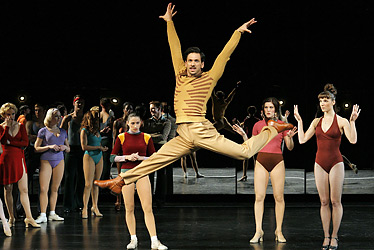
chorus_1006.jpgA Chorus Line (musical, PG-13/R, adult subject matter, reviewed here)
Grease * (musical, PG-13, some sexual content, reviewed here)
The Homecoming (drama, R, adult subject matter, closes Apr. 13, reviewed here)
The Little Mermaid * (musical, G, entirely suitable for children, reviewed here)
November (comedy, PG-13, profusely spattered with obscene language, here)
The Seafarer (drama, PG-13, adult subject matter, closes Mar. 30, reviewed here)
Sunday in the Park with George (musical, PG-13, extended through June 16, reviewed here)

IN LOS ANGELES:
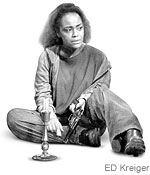
VICTORY.jpgVictory (drama, PG-13, adult subject matter, closes Mar. 23, reviewed here)

ON TOUR:
Moby-Dick--Rehearsed (drama, G, not suitable for children, touring the U.S. through May 17, reviewed here)

CLOSING SOON ON BROADWAY:
Come Back, Little Sheba (drama, PG-13, adult subject matter, closes Mar. 16, reviewed here)

CLOSING NEXT WEEK ON BROADWAY:
Is He Dead? (farce, G, reasonably family-friendly, closes Mar. 9, reviewed here)
Rock 'n' Roll (drama, PG-13, way too complicated for kids, closes Mar. 9, reviewed here)

CLOSING NEXT WEEK IN SAN FRANCISCO:
Blood Knot (drama, PG-13, closes Mar. 9, reviewed here)

CLOSING THIS WEEKEND IN NEW YORK:
The Farnsworth Invention (drama, PG-13, closes Sunday, reviewed here)
Hunting and Gathering (comedy, PG-13, adult subject matter, closes Saturday, reviewed here)

Posted February 28, 12:00 AM

TT: Almanac

"One always dies too soon--or too late. And yet, life is there, finished: the line is drawn, and it must all be added up. You are nothing other than your life."

Jean-Paul Sartre, No Exit

Posted February 28, 12:00 AM

February 27, 2008

TT: William F. Buckley, Jr., R.I.P.

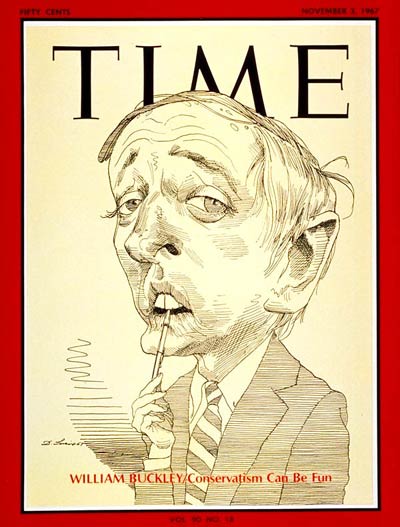
1101671103_400.jpgBill Buckley died this morning. In public life he was a witty, devastatingly effective spokesman for conservatism and the founder of National Review, one of the most influential political magazines of the twentieth century. In private life he was considerate beyond compare, a charismatic host with a magical gift for putting his guests at ease and a passionate amateur pianist who played Bach with fair skill and much love.

I had known him since 1981, when he published the first magazine piece I ever wrote, a review of a book about A.J. Liebling. A year later he wrote a syndicated column about another piece of mine, at a time in my life when I was still trying to find myself as a writer, and my path was smoothed by his generous words. On countless other occasions he helped me in ways I knew I would never be able to repay, though I made a token effort by dedicating my Mencken biography to him.

Pat, Bill's wife, died last April. They had been the closest of companions, and no one who knew him at all well expected him to survive her for long. Nor did he: Bill outlived Pat by less than a year. Now the obituarists will write of his place in the history of postwar American political thought, and they will have much to tell, for he was a very important man and an exceedingly good writer. At some point I will sit down and reread Cruising Speed: A Documentary, my favorite of his five dozen books and the one that best conveys his personality. But not yet: right now I want to think of him not as the great public figure he was but as the charming, funny man who once upon a time was unstintingly kind to an unknown young writer.

I thought the world of him, and I cannot imagine the world without him.

UPDATE: Bill was the friend (though not the pianist) to whom I referred in this posting from 2006:

I'm writing these words immediately after having returned from a private concert held in the art-laden living room of a friend of mine who owns a wonderful old Bösendorfer grand. The performer was a serious amateur pianist who played two Beethoven sonatas, Opp. 109 and 111 (frivolous amateurs don't play late Beethoven). I sat close enough to the keyboard to read the music over his shoulder. The audience consisted of twenty people, most of whom knew one another more or less well, and after Op. 111 we retired to the host's dining room for a sit-down meal. That's the way to hear classical music.

It sure was.

Posted February 27, 2:16 PM

OGIC: The dog is dead

If you check out the Top Fives this week you'll see that I've added an item specifically for Chicagoans or, I suppose, greater Midwesterners with weekend wanderlust. The item in question is a play that just opened at Strawdog Theatre here in town, where Terry and I so enjoyed Brian Friel's Aristocrats last autumn. Now Strawdog, which is in the midst of its 20th anniversary season, is offering Richard III with the company's Artistic Director, Nic Dimond, directing. It's another winner.

I'm a sucker for a good villain. Even more so, I'm a sucker for casting villains against type. It's not easy to pull off, but when successful creates a frisson like no other. Strawdog's John Henry Roberts, who plays the title role here, struck me as just such a case--his open features and essentially empathetic demeanor assert themselves even through Richard's blackest lines. And Roberts makes this work. He made me feel that I too would have been taken in. It makes the evil more insidious, the sting of its revelation in someone likable and trusted more devastating.

Strawdog's performance space is challengingly small but seems to bring out the ingenuity of set designers and directors alike. For this production, however, that ingenuity seemed more directed at emphasizing the closeness of the space than overcoming it. Before any lines are spoken, an opening party scene crowds seemingly every actor in the production into this space, nearly bursting its seams. This establishes a creeping sense of claustrophobia that meshes well this Richard's particularly insidious brand of malignancy.

In addition to Roberts's performance, Strawdog ensemble member Jennifer Avery's turn as Queen Elizabeth has to be singled out. In the earlier scenes, when she's not yet widowed--and worse--she's a perfect blithe Renaissance Heather. Later, she brings a quiet, heartbreaking conviction to Elizabeth's sorrow and her last line of defense against Richard's designs on her daughter. Nothing flashy here--just a thoroughly convincing and moving habitation of her character and flawless execution. Here and in Aristocrats, Avery did wonders with characters who start out hard and gradually are humanized. Whatever she does next, I hope to be there.

Posted February 27, 1:47 PM

TT: Incommunicado

You probably won't hear much from me this week or next. On Saturday The Letter begins five consecutive days of workshop rehearsals in Manhattan, which will soak up whatever spare time I have left over from the pieces I have to write, the lecture I have to give, and the opera I'm about to see (Mrs. T and I are going to the opening of the Metropolitan Opera's new production of Benjamin Britten's Peter Grimes, directed by John Doyle, tomorrow night). Needless to say, Rhythm Man: A Life of Louis Armstrong is still hanging over my head as well.

Blogging? I'll try. Really. I swear.

Posted February 27, 12:00 AM

TT: Almanac

"I never was an opera fan--about twenty-five musically supreme masterpieces in this curious medium apart."

Hans Keller, Criticism

Posted February 27, 12:00 AM

February 26, 2008

CAAF: Morning coffee

I hab a cold so we're favoring the light and amusing this morning.

• Daniel Kalder plumbs the Russian translation of his book, The Lost Cosmonaut. (Via.)

• All the ladies swoon for the man with the silver tongue: "... and it seems to me that this sprang like a golden sapling
out of the mad, beautiful head of Paul Thomas Anderson." (Relatedly, I appreciated the theory advanced here for Rebecca Miller's bordello-co-co dress.

• Maybe it's the Alka-Seltzer Cold talking but Garfield minus Garfield is kind of great? (Via.)

Posted February 26, 9:04 AM

TT: Almanac

The already known had once more been confirmed
By psychological experiment.

Robert Frost, "At Woodward's Gardens"

Posted February 26, 12:00 AM

February 25, 2008

TT: The enemy of the best

My friend Rick Brookhiser recently posed this memeworthy notion: "It would make an exercise to say what are your least favorite works by artists you mostly, or sometimes, love." So it would, and I've been thinking it over ever since. Here's my Top (or Bottom) Five:

bathers.jpg• Pierre-Auguste Renoir was a very great artist who painted far more than his share of very bad pictures, from the insipid young girls of his middle years to the deliquescent nudes of his old age. My first visit to the Barnes Collection, which owns more second- and third-rate Renoirs than any other museum in the world, was alarmingly instructive in this regard. To be sure, the competition is stiff, but the 1918 Bathers that I saw there in 2005 was without a doubt the worst Renoir that I've ever seen anywhere.

• Yes, Antony Tudor was a great choreographer--sometimes--but I confess without the slightest reluctance that Pillar of Fire, his heavy-breathing, deadly serious 1942 dance version of Schoenberg's Verklärte Nacht, makes me giggle.

assassins_art.jpg• My admiration for Stephen Sondheim is no secret to regular readers of this blog, but some of his musicals are better than others, and Assassins, in which he seeks to prove the essential falsehood of the American dream by portraying a group of successful and would-be presidential assassins, seems to me to be flawed beyond repair.

I wrote a review of the 2004 Broadway revival in which I summed up my reservations: "Do the lives of these misfits have any larger meaning? Perhaps, but you can't prove it by Assassins, which merely asserts their significance rather than demonstrating it--and that's where the show runs off the road. To be effective, political theater must deal in fact, not fancy, and most of America's presidential assassins were in fact driven not by ideology but madness. Assassins leaves no doubt of that, especially in 'The Ballad of Guiteau,' in which Charles Guiteau, who shot and killed James Garfield, displays his megalomania to spectacular effect. And what do such delusions tell us about the validity of the American dream? Nothing, which is why Assassins makes no sense."

• Howard Hawks was one of Hollywood's greatest directors, but when he was bad, he was perfectly awful, and I'd be hard pressed to think of a lamer Hawks comedy than Man's Favorite Sport? It's not the worst movie he ever made--that would be Red Line 7000--but it's bad enough to briefly make you wonder what you ever saw in him.

• "There are some sacrifices which should not be demanded twice of any man," George Bernard Shaw wrote, "and one of them is listening to Brahms' Requiem." I'm with him, and then some. It's been a quarter-century or so since I last sat through a complete performance of A German Requiem, and I hope and expect to go to my grave without voluntarily hearing that ponderous piece of musical mortuary science again.

Over to you, OGIC and CAAF.

Posted February 25, 12:00 AM

TT: Almanac

"A real failure does not need an excuse. It is an end in itself."

Gertrude Stein, Four in America

Posted February 25, 12:00 AM

February 22, 2008

TT: The politics of love and hate

In today's Wall Street Journal drama column I report on two more of the shows I saw during my recent trip to California, Victory in Hollywood and Blood Knot in San Francisco, plus the Broadway revival of Sunday in the Park with George. Here's a sample.

* * *

Victorypostcard2jpeg.jpgAthol Fugard wondered for a time whether the ending of apartheid in South Africa might also put an end to his playwriting career. Most of his best-known works, starting with "Blood Knot," the 1961 two-man play that brought him worldwide acclaim, had been set against the brutal backdrop of the racial segregation that the white minority of his native land imposed on its black majority in 1948. Would Mr. Fugard have anything of equal interest to say about the new South Africa brought into being by the demise of apartheid--and would that long-awaited deliverance from evil turn his older plays into stale period pieces? The answers can be found in two productions now playing on the West Coast, the American Conservatory Theater's San Francisco revival of "Blood Knot" and the American premiere of "Victory," Fugard's latest play, which is being presented not on Broadway but in a tiny theater located in--of all places--Hollywood.

The Fountain Theatre, one of California's best drama companies, performs in a 78-seat house whose front row of seats is three feet from the trapezoidal stage. You can't get much closer than that, and "Victory," an hour-long play about two angry young blacks (Lovensky Jean-Baptiste and Tinashe Kajese) who break into the home of an aging, demoralized white liberal (Morland Higgins) in the middle of the night, is well served by the miniature scale and fierce concentration of this production, which is supremely well acted by the three-person cast (Ms. Kajese in particular) and staged with relentless intensity by Stephen Sachs, the company's co-artistic director...

The natural intimacy of a house like the Fountain must necessarily be simulated on the American Conservatory Theater's large proscenium stage, and one of the things I liked best about that company's revival of "Blood Knot" was the precision with which Alexander V. Nichols, who designed the set, directs your eye to the pitiful one-room shack at center stage in which the action unfolds. The play itself is a rich character study in which Mr. Fugard passes the adamantine reality of apartheid through the refracting prism of Sartre and Camus to show us two black half-brothers cleaving uncomfortably together in the midst of a hostile world. The setting of "Blood Knot" is by definition political, but what takes place there is intensely, passionately personal, for what interests Mr. Fugard most is not politics but love. "You see, we're tied together," the light-skinned Morris (Jack Willis) tells the dark-skinned Zach (Steven Anthony Jones) at play's end. "It's what they call the blood knot...the bond between brothers." A metaphor, yes, but is it essentially public or private? Part of the beauty of "Blood Knot" is that Mr. Fugard doesn't make you choose.

I found A.C.T.'s 2007 production of "Hedda Gabler" to be competent but ordinary, but there is nothing at all commonplace about "Blood Knot." Mr. Jones and Mr. Willis dig deeply into their long, difficult roles...

Sunday-1.jpgThe original Broadway production of "Sunday in the Park with George" ran for 604 performances and won 10 Tonys and a Pulitzer Prize, but the show itself remains one of Stephen Sondheim's problem children. The first act, a fictionalized re-creation of the making of "A Sunday Afternoon on the Island of La Grande Jatte," Georges Seurat's 1886 pointillist masterpiece, is itself a masterpiece of musical theater, a light-textured yet profound parable of the mystery of creation and the self-imposed, single-minded isolation of the creative artist. Not so the second act, in which Mr. Sondheim and James Lapine tell a parallel tale of the modern-day art world that lapses into the same cloying sententiousness that mars the second act of "Into the Woods," their 1987 fairy-tale musical: Anything you do,/Let it come from you./Then it will be new.

In Sam Buntrock's London production, which the Roundabout Theatre Company has imported to Broadway for a three-month run, design is the key. David Farley's bare-walled set serves as the screen for a complex series of digitally animated projections executed by Timothy Bird that seek to simulate the lengthy process by which Seurat's great painting (which is now one of the glories of the Art Institute of Chicago) came into being. The results, which are spectacular enough to make a Manhattan crowd gasp, add up to the most aesthetically persuasive use of video technology ever to be seen on a Broadway stage. I have no doubt that they will soon be imitated the world over.

On occasion, though, Mr. Bird's bedazzling visual trickery gets between the actors and the audience, and sometimes I wondered whether so excellent a cast might not have been better served by a less elaborate production. Certainly Daniel Evans, who played George in London and is now repeating the role on Broadway, needs no electronic assistance to animate his part....

* * *

Read the whole thing here.

Posted February 22, 12:00 AM

TT: Almanac

And when the woman that you wanted goes,
You can say to yourself, "Well, I give what I give."
But the woman who won't wait for you knows
That, however you live,
There's a part of you always standing by,
Mapping out the sky,
Finishing a hat...
Starting on a hat...
Finishing a hat...

Look, I made a hat...
Where there never was a hat.

Stephen Sondheim, "Finishing the Hat" (from Sunday in the Park with George)

Posted February 22, 12:00 AM

February 21, 2008

TT: So you want to see a show?

Here's my list of recommended Broadway and off-Broadway shows, updated weekly. In all cases, I gave these shows favorable reviews in The Wall Street Journal when they opened. For more information, click on the title.

Warning: Broadway shows marked with an asterisk were sold out, or nearly so, last week.

BROADWAY:
Alfred Hitchcock's The 39 Steps * (comedy, G, suitable for bright children, closes Mar. 23, reviewed here)
august460.jpgAugust: Osage County (drama, R, adult subject matter, closes Apr. 20 and reopens Apr. 29 at the Music Box Theatre for an open-ended run, reviewed here)
Avenue Q * (musical, R, adult subject matter and one show-stopping scene of puppet-on-puppet sex, reviewed here)
A Chorus Line (musical, PG-13/R, adult subject matter, reviewed here)
Grease * (musical, PG-13, some sexual content, reviewed here)
The Homecoming (drama, R, adult subject matter, closes Apr. 13, reviewed here)
Is He Dead? (farce, G, reasonably family-friendly, reviewed here)
The Little Mermaid * (musical, G, entirely suitable for children, reviewed here)
November (comedy, PG-13, profusely spattered with obscene language, here)
The Seafarer (drama, PG-13, adult subject matter, closes Mar. 30, reviewed here)

ON TOUR:
Moby-Dick--Rehearsed (drama, G, not suitable for children, touring the U.S. through May 17, reviewed here)

CLOSING SOON:
Come Back, Little Sheba (drama, PG-13, adult subject matter, closes Mar. 16, reviewed here)
Rock 'n' Roll (drama, PG-13, way too complicated for kids, closes Mar. 9, reviewed here)

CLOSING NEXT WEEK:
The Farnsworth Invention (drama, PG-13, closing Mar. 2, reviewed here)
Hunting and Gathering (comedy, PG-13, adult subject matter, closes Mar. 1, reviewed here)

CLOSING SUNDAY:
The Fantasticks (musical, G, suitable for children old enough to enjoy a love story, closes Feb. 24, reviewed here)

Posted February 21, 12:00 AM

TT: Almanac

"And they write innumerable books; being too vain and distracted for silence: seeking every one after his own elevation, and dodging his emptiness."

T.S. Eliot, "Choruses from 'The Rock'"

Posted February 21, 12:00 AM

February 20, 2008

GALLERY

Diebenkorn in New Mexico (Grey Art Gallery, New York University, 100 Washington Square East, up through Saturday). Fifty glorious abstract paintings and drawings by Richard Diebenkorn, a great American artist who made the professional mistake of spending most of his career in California. No matter how good they are--and Diebenkorn was as good as it gets--West Coast artists find it hard to get East Coast critics, curators, and dealers to take them seriously. A case in point is this tightly focused show of works made between 1950 and 1952, when Diebenkorn was a graduate student at the University of New Mexico. It belongs in a major museum, but instead it's being exhibited in a university gallery. Go see it there, far from the madding crowd, and marvel at the impenetrable mysteries of art-world politics (TT).

Posted February 20, 11:14 AM

TT: Almanac

"A broad margin of leisure is as beautiful in a man's life as in a book. Haste makes waste, no less in life than in housekeeping. Keep the time, observe the hours of the universe, not of the cars. What are threescore years and ten hurriedly and coarsely lived to moments of divine leisure in which your life is coincident with the life of the universe?"

Henry David Thoreau, journal, Dec. 28, 1852

Posted February 20, 12:00 AM

February 19, 2008

CAAF: Book report

I had an idea that when we visited Biltmore House last Friday I'd just nip over to the library and have a good look around, and then we'd venture off to the gardens. But the tour though the house is more regulated than it used to be. As I remember it, you used to be able to sortie out a little bit on your own; but as it is now, you shuffle in a line on a prescribed one-way route through all four floors of the house, every so often pooling in an inlet to a particular room. No nipping, no darting, no backtracking. It's a well-organized tour, and I salute the estate's curators for succeeding where many other museums and historic sites have failed, by keeping me on track and in the main exhibit area and not off in some custodial closet or dead-end hallway or any of the other places I usually end up when left on my own to navigate-- but it's a little confining, especially for a repeat visitor.

This meant I revisited a lot of rooms I hadn't intended to. Not the worst thing but I was glad I'd reminded myself that morning about Henry James's comments about the house: Whenever I was going through a room I wasn't particularly interested in, I'd imagine Henry there looking disagreeable. The banquet hall -- an enormous, anachronistic room with great tapestries and flags on the walls and heads of deer and moose looking down -- has a Skinner pipe organ that occasionally blasts away, and it was nice to think of the dyspepsia it must have given Henry at his dinner.

biltmorelibrary.jpgAnother change: The estate's library is long and rectangular, and I believe you used to be able to traverse the length of it. Now visitors are kept to one end, while the majority of the books are on display on the other end, too far away to be able to see any of the titles. I craned, but it was no good. It was like trying to read something from across a ballroom. "You should have brought binoculars," Lowell said.

I was curious about the collection because it's supposed to be an unusually good one. Vanderbilt was a great reader and an avid collector of rare books. So the library wasn't assembled just for show, with one of those bought-in-lot collections that look impressive at first glance but are really dreary on closer inspection, all Julia, Country Nurse with a Heart and Prize-Winning Sheep of Hertfordshire, 1918, etc. But while you hear many numbers attached to Biltmore's collection -- the two most cited being: that there are more than 23,000 volumes in all (with about 10,000 displayed in the library), and that Vanderbilt started keeping a list when he was 12 of the books he'd read, and at the time of his death (at 52) the list was 3,159 books long -- details about the books themselves are harder to come by. I remember odd bits about the books from previous visits but I meant to record a little more on this trip.

As I said, the library's a long room with a high ceiling. Overhead is a ceiling painting by Pellegrini, The Chariot of Aurora, which came to the estate from a palace in Venice. A second level of books is reached by a spiral staircase. The shelving and paneling are walnut, and there's a good amount of natural light from windows and French doors that lead out to the patio. The couches and chairs are elegant although maybe not as comfy and luxe as you might expect. Off to one side is a giant globe, which I think we can all agree no self-respecting library should be without.

The part of the collection that was within my sight was beautifully bound, with lots of reds, golds and browns. On one low shelf were the "magnum" oversized books, mostly about art, including:
• A five-volume set of Fables de Fontaine bound in a gorgeous leaf green
• Two volumes of Drawings of the Florentine Painters
• Carter's Ancient Paintings and Sculptures in England
Gainsborough Works
• Two volumes on The Royal Collection of Paintings, with volume one devoted to Buckingham and volume two to Windsor
• A multi-volume set stamped in gold leaf with titles like Specimens of Ancient Sculpture, Penrose's Athenian Sculpture, and Ionian Antiquities by the Dilettanti, my favorite title of the day.

A representative smattering of titles from the shelves above:
• A two-volume set of Godwin's Life of Chaucer
Musical Instruments
Auguste Rodin: L'Oeuvre et L'Homme by Judith Cladel
Glimpses of Italian Court Life
• Holbein's Court of Henry VIII
• A 45-volume set, bound in a bright cherry red, of L'Art
Le Livre D'or de Victor Hugo shelved next door to a five-volume set on History of the Indian Tribes of the United States, right where you'd look for it
• And bound editions of Country Life magazine dating from 1896 to 1904 (this tickles me, as it both describes and completely fails to describe what Vanderbilt set up for himself at Biltmore)

The room's attendant, who was lovely, told me many of the rarer books are kept on the third floor of the house, which is climate-controlled. The hallway where this part of the collection is displayed is darker, so it was harder to make out titles -- also, my companion was looking a little rebellious -- but I was taken by one shelf of books by Andrew Lang, including The Blue Fairy Book, Green Fairy Book, Yellow Fairy Book, Violet Fairy Book, The Animal Story Book, and The Book of Dreams and Ghosts.

The estate offers a number of specialty tours, and I wish they'd start a Library Tour, where you'd get to romp around the library beyond the cordon as well as handle some of the books, to look at the illustrations, read a little, and maybe huff at the bindings when the curator was discreetly turned away.

Posted February 19, 5:22 PM

PLAY

Richard III (Strawdog Theatre, 3829 N. Broadway, Chicago, closes Mar. 29). Nic Dimond's lean, mean production of Richard III is anchored by a charismatic title role performance by Strawdog ensemble member John Henry Roberts and a soulful one by Jennifer Avery as Queen Elizabeth. The fine supporting cast barely fits all at once in Strawdog's tiny performance space, but Joe Schermoly's pared-down set makes the most of the claustrophobia. All in all, electrifying (OGIC)

Posted February 19, 12:27 PM

PLAY

The Trip to Bountiful (Goodman Theatre, 170 N. Dearborn, Chicago, closes Apr. 6). A Chicago revival of the off-Broadway production that was the talk of Manhattan playgoers two seasons ago. I praised it to the skies in The Wall Street Journal: "Horton Foote's The Trip to Bountiful is fully as worthy of regular revival as Our Town or The Glass Menagerie, and this production, directed by Harris Yulin and acted with quiet skill by Lois Smith and the best ensemble cast in town, leaves no doubt of its special quality....I doubt you'll ever see it performed better, especially by Smith, whose acting is so beautifully straightforward that you feel as though you're eavesdropping on her." It should have transferred to Broadway, but no theaters were open at the time, so instead it's being presented a second time as part of the Goodman Theater's Horton Foote Festival. Do not miss this extraordinary show under any circumstances, no matter how far you have to drive, fly, or ride a bus in order to see it (TT).

Posted February 19, 12:00 AM

TT: Almanac

"California is a place in which a boom mentality and a sense of Chekhovian loss meet in uneasy suspension; in which the mind is troubled by some buried but ineradicable suspicion that things had better work here, because here, beneath that immense bleached sky, is where we run out of continent."

Joan Didion, "Notes From a Native Daughter"

Posted February 19, 12:00 AM

February 18, 2008

TT: Speed demon

ca-coaststarlight2.jpgOn Friday Mrs. T and I took the Coast Starlight from Los Angeles to San Francisco. We spent eight hours of our eleven-hour trip sitting in the Sightseer Lounge Car, noshing on deli sandwiches from Canter's and looking out the window at the most beautiful view in California, or maybe the universe.

The only blot on the day was the intermittent presence of a teenager with a cellphone, a penetrating voice, and no interest in scenery:

TEENAGER WITH CELLPHONE So I'm like, I totally did not sleep with him! Woh! Eeuuww! Hel-lo!

ME (muttering grumpily) Stupid California robot girl.

MRS. T (stroking my arm soothingly) Don't be negative, darling.

ME I'd like to nail her tongue to her forehead.

Otherwise it was bliss.

diva21-tn.jpgWe spent the weekend seeing shows in San Francisco and Berkeley. We're staying at the Hotel Diva, which is handily located across the street from one of the shows I came to town to review. Our room, as befits the name of the hotel, is...well, let's just call it extensively decorated. No sooner had the bellman dropped off our bags than we discovered a printed list of official Diva Dos and Don'ts over which we're still giggling: DO throw on a cuff bracelet to complete an outfit. DON'T forget a smile is still the ultimate accessory.

Mission%2BDolores%2BGraveyard%2B1958%2B2.jpgOn Saturday we shopped and paid a visit to the de Young Museum, which I saw for the first time a year ago. I feel the same way now as when I wrote about it then: the building is remarkable, the collection spotty but by no means without interest, especially if you're into Richard Diebenkorn. Then we went to a late-afternoon service at Mission Dolores, where one of my blogfriends is the organist. Non-San Franciscans know the church from Alfred Hitchcock's Vertigo, in which it figures prominently.

250px-Mission_Delores.jpgThe Old Mission, which was built in 1791 and is the oldest surviving structure in San Francisco, makes a very different impression when filled with ordinary churchgoers than when you see Jimmy Stewart and Kim Novak passing through it on the way to the graveyard in back. In Vertigo it is subtly glamorized, if only by the presence of famous faces. In regular use it is no less beautiful, but also homelier--in every sense of the word. I was astonished, for instance, to see that the same man who had rented me a car only a few hours earlier was sitting three pews ahead of us. Perhaps I shouldn't have been: San Francisco is like that, a thoroughly, even self-consciously cosmopolitan community whose scale and pace are nonetheless far removed from the frenzied bustle of Manhattan.

Afterward Mrs. T and I took our organist friend out to dinner at Zuni Cafe, which needs no introduction to cookbook-collecting foodies, and ate very, very well. Should you go there, make a point of ordering something--anything--that has anchovies in it. Unless you have major anchovy-related issues, you won't be sorry.

Sunday was devoted to more playgoing, interspersed with meals shared with two other bloggers. Today we breakfast with yet another blogfriend, followed by a cable-car ride and whatever else tickles our mutual fancies. Tomorrow we fly back to New York, just in time, since we're both starting to feel a bit worn from our nonstop adventures.

And then? On Wednesday I write, followed by a taping with a CBS camera crew (about which more later, maybe) and a trip to Studio 54 to see Sunday in the Park with George. On Thursday I write. On Friday I write. On Saturday I write and see Passing Strange. On Sunday I write and see Adding Machine....

It's a living.

P.S. Yes, we ate at Pink's. And it was good.

Posted February 18, 12:00 AM

TT: Almanac

"In San Francisco, vulgarity, 'bad taste,' ostentation are regarded as a kind of alien blight, an invasion or encroachment from outside. In Los Angeles, there is so much money and power connected with ostentation that it is no longer ludicrous: it commands a kind of respect. For if the mighty behave like this, then quiet good taste means that you can't afford the conspicuous expenditures, and you become a little ashamed of your modesty and propriety."

Pauline Kael, I Lost It at the Movies

Posted February 18, 12:00 AM

February 16, 2008

TT: Importantitis, enemy of art

In today's Wall Street Journal "Sightings" column I consider the careers of Leonard Bernstein, Orson Welles, and Ralph Ellison. All were artists of extraordinary promise who failed to live up to it. What went wrong? Each of them contracted the same dread disease:

Stephen Sondheim, Bernstein's collaborator on "West Side Story," told Meryle Secrest, who wrote biographies of both men, that he developed "a bad case of importantitis." That sums up Bernstein's later years with devastating finality. Time and again he dove head first into grandiose-sounding projects, then emerged from the depths clutching such pretentious pieces of musical costume jewelry as the "Kaddish" Symphony and "A Quiet Place." In the end he dried up almost completely, longing to make Great Big Musical Statements--he actually wanted to write a Holocaust opera--but incapable of producing so much as a single memorable song.

Alan Greenspan recently proposed a constitutional amendment: "Anyone willing to do what is required to become president of the United States is thereby barred from taking that office." In a similar spirit--with tongue partway in cheek--I'd like to put forward Teachout's First Law of Artistic Dynamics: "The best way to make a bad work of art is to try to make a great one." That law was inspired at least as much by Orson Welles as by Bernstein....

Read the whole thing here.

Posted February 16, 12:00 AM

February 15, 2008

CAAF: Field trip

It's been a busy week with an unexpected flurry of deadlines. Lowell has a bad cold and looks and sounds like a mournful frog. The nice thing: We're playing hooky this morning. A friend gave us passes to Biltmore Estate, the French chateau that George Vanderbilt chose to build in Asheville. How unlikely it was that Vanderbilt would build here -- in some remote mountain town, only newly reachable by train, far from friends and family -- never occurred to me until I was researching Henry James' and Edith Wharton's stays at the estate for an article I wrote several years back. Here is James in a letter to Wharton:

We are 2,500 feet in the air; the cold, the climate, is well nigh all the 'company' in the strange, colossal heart-breaking house; & the desolation & discomfort of the whole thing -- whole scene -- are, in spite of the mitigating millions everywhere expressed, indescribable. ... It's, in effect, like a gorgeous practical joke -- but at one's own expense, after all, if one has to live in solitude in these league-long marble halls.

When I first moved here and knew hardly anyone, I spent a lot of time mooning around the estate, although tellingly the part I feel most at home in is the servants quarters, which are very simple and airy and remind me of my grandparents' farm. Today I'm looking forward to visiting the library (duh) and exploring the grounds, although I imagine they're a little stark and wind-swept this time of year. The estate was Frederick Law Olmsted's last great project, and this will be my first time visiting since reading a couple books by and about him.

Posted February 15, 9:07 AM

TT: From here to there, slowly

NEUTRA%20LOVELL%20HEALTH%20HOUSE3.jpgIn between plays Mrs. T and I have been tooling around Los Angeles and its environs, checking out art of various kinds. On Tuesday we fired up my Garmin StreetPilot c500 and set a course for Richard Neutra's "Health House," a legendary piece of mid-century modern domestic architecture that movie buffs will need no prompting to recognize as the residence of Pierce Patchett, the "powerful behind-the-scenes strange-o" of L.A. Confidential. It's privately owned, so you can only view it from the street, but that's a sufficiently cool thing to do if, like Mrs. T and me, you're into modern houses. We then tooled over to Neutra Place, a quiet side street that is lined with nine separate Neutra houses, and spent a few minutes goggling.

On Wednesday we stopped by a less well known but equally interesting residence, the home of Annette Kaufman. Regular readers of this blog may recall my recent posting about Annette, the widow of Louis Kaufman, the great American violinist and art collector. Annette and I had lunch in New York two months ago, at which time she invited Mrs. T and me to visit her in Los Angeles. We accepted with alacrity.

SUSPENDERS.jpgAnnette lives in a house that Lloyd Wright, Frank's son, designed for her and Louis in 1935. Though it looks nothing like the work of his famous father, it has the same clean and inviting interior lines that are familiar from Frank Lloyd Wright's Usonian houses, and it is infinitely better suited to the display of art--a major consideration for the Kaufmans, who amassed a huge collection of paintings and sculpture in the course of their long life together. Annette has given much of their collection away since Louis' death, but she still owns a goodly number of remarkable pieces, many of which were painted by Milton Avery.

SEA.jpgThe first thing you see when you open the door, for instance, is an Avery portrait of Louis wearing a pair of bright red suspenders. Stroll into the dining room and you'll find "California Landscape/Seascape," the 1942 painting that was one of the highlights of the Phillips Collection's great 2004 Avery retrospective. Beyond it in the breakfast nook is a brightly colored, strikingly Cézanne-like still life that the Kaufmans bought in 1926 for $25--the very first painting that Avery ever sold.

From there the three of us went to the Getty Museum, where we had an excellent lunch and chatted happily about art and music. It was the first time in my life that I've taken part in a mealtime conversation in which one of the participants reminisced about Milton Avery and Bernard Herrmann. We then took a stroll through Consuming Passion: Fragonard's Allegories of Love, a splendid little show that merely served to whet Annette's apparently inexhaustible appetite for art, which we slaked by driving straight to the Armand Hammer Collection. After that we returned to her house and put our feet up for an hour while she returned a couple of dozen phone calls. Did I mention that Annette is ninety-three years old? I hope I'm a quarter as energetic as she is if I should be lucky enough to live so long. (I wish I were half as energetic as she is right now.)

union%2Bstation%2Bext.jpgNow, two days and two shows later,
Mrs. T and I are getting ready to drive to Union Station--itself a destination of considerable splendor--and board the Coast Starlight for San Francisco. Amtrak brags that the Coast Starlight travels along "one of the most beautiful of all train routes...The scenery along the Coast Starlight route is unparalleled: snow-covered mountains, dense forests, fertile valleys and long stretches of Pacific Ocean shoreline provide a gorgeous backdrop for your journey." I am a middle-aged man mad about trains, and this is one I've always wanted to ride, even though I gather it's not quite what it used to be back in the days when trains were trains and planes were for rich people.

5404_cs11_040405_steilacoom.jpgAs for Mrs. T, she longs to sit in the Sightseer Lounge Car, with its floor-to-ceiling windows, and watch the world go by. She also plans to pack a meal, not caring for the indigenous fare. That's fine with me.

The really great thing about train travel, of course, is that it forces you into a different tempo of life, slower and less fraught. The fact that Amtrak's trains don't always get where they're going on time actually contributes to this unwinding effect. Sometimes your cellphone works, sometime it doesn't, and surfing the Web is out of the question. Instead you chat idly, read, listen to music, or--above all--look out the window.

I don't spend nearly enough time looking out the window. Today I plan to fix that.

Posted February 15, 12:00 AM

TT: The ghost of Daisy Mae

This morning I file the first of three Wall Street Journal drama columns from California. Today I review three shows, Reprise! Broadway's Best's Li'l Abner, Pasadena Playhouse's Orson's Shadow, and the Aurora Theatre Company's Satellites. Here's a sample.

* * *

Al_Capp_Time_Cover.jpgIf you know who Al Capp was, you're probably reading this review through bifocals. "Li'l Abner," the comic strip about hillbilly life that Capp wrote and drew, ran in newspapers across the country from 1934 to 1977. For much of that time it was enormously popular--enough so that it was made into a musical in 1956, which in turn was made into a movie in 1959. But defunct comic strips have a short shelf life, and "Li'l Abner" had already lost most of its audience by the time Capp retired...

So why is Reprise! Broadway's Best, the Los Angeles-based musical-comedy troupe led by "Seinfeld"'s Jason Alexander, reviving a half-forgotten show based on half-remembered comic-strip characters? On paper, at least, I can think of two good reasons: Johnny Mercer, who needs no introduction, wrote the score of "Li'l Abner" in collaboration with Gene De Paul, whose list of hits includes "I'll Remember April" and "Teach Me Tonight." But neither man had much theatrical experience, and the songs they cranked out for the show are dramatically static and musically flat....

As City Center's Encores! series of musical-comedy revivals has proved repeatedly, a stylish staging can make a B-minus musical look and sound better than it is. Alas, this production falls far short of the standards set by Encores! and Connecticut's Goodspeed Musicals. Too often it reminded me of a competent but dull college show...

Pasadena Playhouse knows a thing or two about celebrity. The list of stars who first shone on its handsome 1925 proscenium stage includes Dana Andrews, Raymond Burr, Gene Hackman, Dustin Hoffman, Robert Preston and Gig Young. That makes it a suitable place to see "Orson's Shadow," in which Austin Pendleton takes a real-life encounter between Orson Welles and Laurence Olivier (who met when Olivier invited Welles to direct a production of Eugène Ionesco's "Rhinoceros" in 1960) and spins it into a bitterly witty theatrical meditation on the self-destructive impulse that frequently goes hand in hand with great gifts.

I'm sorry to say that Pasadena Playhouse's revival, unlike the brilliant Off Broadway production of 2005, never catches fire. Part of the problem--for which Dámaso Rodriguez, the director, may be to blame--is that Bruce McGill plays Welles not as a genius whose character has been warped by frustration but as a blustering joker who somehow stays afloat in spite of everything....

I went to the Aurora this week for the West Coast premiere of Diana Son's "Satellites," whose 2006 Off Broadway run I missed. Ms. Son stirred up her share of buzz in 1998 with "Stop Kiss," then dropped out of sight to have a baby and write for "Law & Order: Criminal Intent." "Satellites," her first play since "Stop Kiss," is a glib, preachy dramedy about a biracial yuppie couple (he's black, she's Korean-American) who move into a rundown brownstone in a soon-to-be-gentrified Brooklyn neighborhood and discover that life in the real world is more complicated than they'd thought. Up to a point "Satellites" is bracingly honest about the deep-seated problems of can-we-all-get-along multiculturalism, but in the end it goes soft...

* * *

Read the whole thing here.

Posted February 15, 12:00 AM

TT: Almanac

"Trains are for meditation, for playing out long thought-processes, over and over; we trust them, perhaps because they have no choice but to go where they are going. Nowadays, however, they smack of a dying gentility. To travel by car makes journeys less mysterious, too much a matter of the will. One might as easily sit on a sofa and imagine a passing landscape. I doubt whether any truly absorbing conversation ever took place in a car; they are good only for word games and long, tedious narratives. We have come to regard cars too much as appendages of our bodies and will probably pay for it in the end by losing the use of our legs. We owe to them the cluttering of the landscape, the breakup of villages and towns."

Alastair Reid, Whereabouts: Notes on Being a Foreigner

Posted February 15, 12:00 AM

February 14, 2008

CAAF: Loose notes

"Lady Waters was quick to detect situations that did not exist. Living comfortably in Rutland Gate with her second husband, Sir Robert, she enlarged her own life into ripples of apprehension on everybody's behalf. Upon meeting, her very remarkable eyes sought one's own for those first intimations of crisis she was all tuned up to receive; she entered one's house on a current that set the furniture bobbing; at Rutland Gate destiny shadowed her tea-table. Her smallest clock struck portentously, her telephone trilled from the heart, her dinner-gong boomed a warning. When she performed introductions, drama's whole precedent made the encounter momentous. ... Only Sir Robert, who spent much of his time at his club, remained unaware of this atmosphere."

Elizabeth Bowen, To the North

Posted February 14, 8:00 AM

TT: So you want to see a show?

Here's my list of recommended Broadway, off-Broadway, and out-of-town shows, updated weekly. In all cases, I gave these shows favorable reviews in The Wall Street Journal when they opened. For more information, click on the title.

Warning: Broadway shows marked with an asterisk were sold out, or nearly so, last week.

BROADWAY:
Alfred Hitchcock's The 39 Steps * (comedy, G, suitable for bright children, closes Mar. 23, reviewed here)
August: Osage County (drama, R, adult subject matter, closes Apr. 13, reviewed here)
Avenue Q (musical, R, adult subject matter and one show-stopping scene of puppet-on-puppet sex, reviewed here)
A Chorus Line (musical, PG-13/R, adult subject matter, reviewed here)
rlittlesheeba_bway.jpgCome Back, Little Sheba (drama, PG-13, adult subject matter, closes Mar. 16, reviewed here)
The Farnsworth Invention (drama, PG-13, reviewed here)
Grease * (musical, PG-13, some sexual content, closes Mar. 2, reviewed here)
The Homecoming (drama, R, adult subject matter, closes Apr. 13, reviewed here)
Is He Dead? (farce, G, reasonably family-friendly, reviewed here)
The Little Mermaid * (musical, G, entirely suitable for children, reviewed here)
November (comedy, PG-13, profusely spattered with obscene language, here)
Rock 'n' Roll (drama, PG-13, way too complicated for kids, closes Mar. 9, reviewed here)
The Seafarer (drama, PG-13, adult subject matter, closes Mar. 30, reviewed here)

OFF BROADWAY:
12694a.jpgHunting and Gathering (comedy, PG-13, adult subject matter, closes Mar. 1, reviewed here)

ON TOUR:
Moby-Dick--Rehearsed (drama, G, not suitable for children, touring the U.S. through May 17, reviewed here)

CLOSING NEXT WEEK OFF BROADWAY:
The Fantasticks (musical, G, suitable for children old enough to enjoy a love story, closes Feb. 24, reviewed here)
The New Jerusalem (drama, G, too complicated for children but accessible to mature adolescents, closes Feb. 20, reviewed here)

CLOSING SUNDAY IN RED BANK, N.J.:
Macbeth (drama, PG-13, very violent, reviewed here)

Posted February 14, 12:00 AM

TT: Almanac

"California is a queer place--in a way, it has turned its back on the world, and looks into the void Pacific. It is absolutely selfish, very empty, but not false, and at least, not full of false effort."

D.H. Lawrence, letter, Sept. 24, 1923

Posted February 14, 12:00 AM

February 13, 2008

CAAF: Morning coffee

Two early stories by Nabokov at The Atlantic: "Cloud, Castle, Lake" and "The Aurelian."

• Kathryn Hughes writes an entertaining account of her attempts to "knock off" a Mills & Boon romance novel in the '80s:

This ambition to write a Mills & Boon ran round the magazine like a craze, the kind of thing that used to happen at school when everyone suddenly decided to dab their pulse points with musk oil or carry their books in a BOAC bag. And, just as at school, we all pretended that we were hardly aware that other people might have had the same idea. I'm pretty certain that there was a briefing pack we all sent off for: Mills & Boon has always been democratically alert to the ambition of its readers to become writers.

See also.

Posted February 13, 4:00 AM

CAAF: Loose notes

"Therefore, if we built splendid castles (phalansteries, perhaps, they might be more fitly called,) and pictured beautiful scenes, among the fervid coals of the hearth around which we were clustering -- and if all went to rack with the crumbling embers, and have never since arisen out of the ashes -- let us take to ourselves no shame. In my own behalf, I rejoice that I could once think better of the world's improvability than it deserved. It is a mistake into which men seldom fall twice, in a lifetime; or, if so, the rarer and higher is the nature that can thus magnanimously persist in error."

Nathaniel Hawthorne, The Blithedale Romance

Posted February 13, 3:59 AM

TT: Almanac

"California is a tragic country--like Palestine, like every Promised Land."

Christopher Isherwood, Exhumations

Posted February 13, 12:00 AM

February 12, 2008

FILM

The Red Pony. Lewis Milestone's uncommonly sensitive 1949 adaptation of John Steinbeck's quartet of short stories about a fanciful boy and the ranch hand he idolizes is a "children's movie" that adults can watch with enormous pleasure. The cast, led by Robert Mitchum, Myrna Loy, and Louis Calhern, is impeccable, Tony Gaudio's Technicolor cinematography is quietly handsome, and Aaron Copland's score is one of the major achievements of his middle period. Steinbeck wrote the script himself, proving yet again that his work plays better on screen than it reads on the page (TT).

Posted February 12, 5:58 PM

CD

Nancy LaMott, Ask Me Again (Midder Music, two CDs). Twenty previously unreleased cuts--airchecks, live performances, demo recordings--by the best cabaret singer of her generation. The songs include "Call Me Irresponsible," "Cheek to Cheek," "Easy to Love," "The Shadow of Your Smile," and a medley of Stephen Sondheim's "No One Is Alone" and "Not While I'm Around." Nancy and I were good friends, so I can't be objective about this one, but I'll be very surprised if you don't find Ask Me Again as beautiful and moving as the studio recordings that brought her brief but well-deserved fame. Also available is I'll Be Here With You, a companion DVD of live performances and interviews taped between 1978 and Nancy's untimely death in 1995 (TT).

Posted February 12, 11:53 AM

TT: Back here on a visit

This is what I wrote last February about my first visit to Los Angeles. Now I'm back in town, this time in the company of Mrs. T, and I continue to marvel at the infinitely puzzling place in which I once again find myself. I don't know whether I like it, and I can't imagine living here, but I've never been to a more improbable or fascinating city, and I'm more than glad that my duties as drama critic of The Wall Street Journal will henceforth be bringing me here once or twice a year.

Hollywood%20sign%20900.jpgNothing much to report. I flew down from San Francisco, yesterday, drove to Hollywood, collected Mrs. T, checked into our hotel, and let myself unwind a bit. No sooner did we unlock the door than we discovered that we could see the HOLLYWOOD sign from the window of our seventh-floor room. That amused us both no end.

The fun starts today. We're going to spend the afternoon driving around town, then meet our friend Stephanie Steward at the Pasadena Playhouse to see a revival of Orson's Shadow, a play I reviewed very enthusiastically when I first saw it off Broadway in 2005. It struck me that I couldn't do much better than to see a show about Orson Welles in Los Angeles, so that's my plan.

As for tomorrow, I'll get back to you....

Posted February 12, 11:29 AM

OGIC: Fortune cookie

"My theory is--we don't really go that far into other people, even when we think we do. We hardly ever go in and bring them out. We just stand at the jaws of the cave, and strike a match, and quickly ask if anybody's there."

Martin Amis, Money

Posted February 12, 10:39 AM

TT: Almanac

"One should not play for the people who sit in the front row--they are usually 'dead-heads,' but play for those up in the gallery that pay ten pfennigs for their tickets; they should not only hear, but they should see."

Franz Liszt (quoted in Carl Lachmund, Living with Liszt)

Posted February 12, 12:00 AM

February 11, 2008

TT: Southward bound

JBKCADT_Doubletree_Hotel_and_Executive_Meeting_Center-Berkeley_Marina_home_right.jpgMy flight to San Francisco was uneventful, and so was my drive from the airport to Berkeley, thanks to the GPS receiver that Mrs. T gave me for Christmas. It showed me exactly how to get to my hotel, which is located a few hundred yards from San Francisco Bay, and I did exactly what it told me to do. Once I got there, I did as little as possible, save for dining with a friend and taking her to a play that I'll be reviewing in Friday's Wall Street Journal. The rest of the time I read, listened to music, worked on Rhythm Man: A Life of Louis Armstrong, caught up with my accumulated e-mail, and slept. I watched the sun set over the bay as I ate dinner on Saturday night, and felt completely content.

Today I fly down to Los Angeles, where I have shows to see, people to meet, and pieces to write. I'll be busy, but at least I'll be busy in an exciting and unfamiliar place, and Mrs. T is waiting for me there, which will make everything more fun. Among other things, we're going to stay in a fancy Hollywood hotel, eat hot dogs at Pink's, and visit an art-collecting friend of mine who lives in a house designed by Frank Lloyd Wright's son. What's not to like?

I'll let you know how it's going in due course.

Posted February 11, 12:00 AM

TT: Almanac

"The place is wide open, but not in the way that New York is wide open--vulgarly, garishly, hoggishly. The business is achieved with an air, almost a grand manner. It is good-humored, engaging, innocent. There is no heavy attitude of raising the Devil. One may guzzle as one will, but one may also drink decently and in order, and shake a leg in the style of Haydn, and lift an eye to a pretty girl without getting knocked in the head or having one's pocket picked. It is a friendy place, a spacious and tolerant place, a place heavy with strangeness and charm. It is no more American, in the sense that American has come to carry, than a wine festival in Spain or the carnival at Nice."

H.L. Mencken, "San Francisco: A Memory"

Posted February 11, 12:00 AM

February 8, 2008

TT: Out the door

If you try to call me today, I probably won't answer. I'll be in Princeton, giving a talk called "Confessions of a Critic" at the Institute for Advanced Study. That's the place where Albert Einstein and J. Robert Oppenheimer used to hang out--it's located on Einstein Drive, believe it or not--and where Paul Moravec, my operatic collaborator, is currently serving as artist-in-residence.

Coast_Starlight_San_Jose_01.jpgTomorrow morning I depart for a week and a half in Los Angeles and California, where I'll be seeing six shows, dining with my favorite blogger and a small but choice assortment of other friends, hitting a couple of museums, and riding the Coast Starlight with Mrs. T, who is currently taking the sun in Chandlerland.

I'll try to keep you abreast of my adventures as they happen, and in between updates I'll leave you in the capable hands of CAAF and OGIC.

More anon.

Posted February 08, 12:00 AM

TT: Welles and the white whale

In this week's Wall Street Journal drama column I review two shows. One is a touring production of Orson Welles' Moby-Dick--Rehearsed that will be seen all over America before opening in New York this May. The other is a new off-Broadway play, Hunting and Gathering. Here's a sample.

* * *

mobydickweb.jpgFounded in 1972 by John Houseman and Margot Harley, the Acting Company gives promising young actors and actresses a chance to appear in high-quality professional productions that tour throughout the U.S. Kevin Kline, Patti LuPone and David Ogden Stiers are its best-known alumni, which speaks well for its track record. The sets are simple but good, the repertory highbrow. (I first saw Jean Anouilh's "Antigone," for instance, in an Acting Company production directed by Alan Schneider that came to Kansas City, Mo., in 1978.) The company wraps up its tours in New York instead of launching them there, which is why I've never reviewed any of its shows. This season, though, it hit the ground running at Connecticut's Fairfield University, close enough to Manhattan for me to drive up and catch "Moby-Dick--Rehearsed." I was greatly impressed.

First performed in London in 1955, Orson Welles' blank-verse adaptation of Herman Melville's novel is a product of his wilderness years, the period when the creator of "Citizen Kane" had become a pariah in Hollywood. Though he started out as a stage director, Welles later became drunk on the possibilities of the silver screen and never returned to the stage in earnest, preferring to make independent films on an increasingly frayed shoestring. "Moby-Dick--Rehearsed" was to be one of his rare midlife ventures into the medium that won him his first fame. Never a fluent writer, Welles was an editor of near-genius, and here he uses that skill to create a surprisingly postmodern piece of lyric theater.

The setting is not the Pequod but the near-bare stage of an American theater circa 1890, and the characters are not sailors but members of a touring troupe that is reading through a new stage version of the saga of Captain Ahab (Seth Duerr) and the Great White Whale. In Welles' hands this conceit is not coy but startlingly effective: The outlines of "Moby-Dick" emerge bit by bit out of the idle chatter of a rehearsal, and by intermission the actors, who at first had their doubts about the project, are swept up in the task at hand.

Casey Biggs, best known as a Washington-based stage actor who also played Damar in "Star Trek: Deep Space Nine," has directed "Moby-Dick--Rehearsed" with close and rewarding attention to its lyric quality: The first act is more or less naturalistic, the second act frankly expressionistic, and the transition from one mode to the other is made with seamless stealth....

H%26GPhoto%20copy.jpgSome plays are better--a lot better--than they look at first glance. For ten minutes or so, Brooke Berman's "Hunting and Gathering" feels like a four-character version of a one-woman play whose too-winsome Gen-X protagonist (Keira Naughton) can't figure out how to find a New York apartment or grow up. (The first is harder.) Up-to-the-second references to cellphones and couch-surfing flutter by like confetti in a wind tunnel. But then Ms. Berman starts digging deeper, and suddenly you realize that what started out as a piece of clever fluff has turned into a poignant portrait of romance in the age of Craigslist....

* * *

Read the whole thing here.

Posted February 08, 12:00 AM

TT: Almanac

"In the first fifteen minutes of a play, the audience is the most malleable group in the world. Give them the slightest token that they are going to be entertained or moved and they become a receptive instrument that both playright and actors can play upon at will. Then a curious thing happens. Somehow at the end of that first fifteen minutes an invisible bell seems to ring in the theatre, and if the play has not captured them by then en masse, they become a disparate group of people who are never welded together again. One can almost feel the moment when it arrives, and the inner ear can hear that bell tolling soundlessly."

Moss Hart, Act One

Posted February 08, 12:00 AM

February 7, 2008

CAAF: Afternoon coffee

• Francisco Goldman is profiled at The Guardian.

• A wonderful appreciation of Angela Carter in the Los Angeles Times. (Via the Lit Saloon.)

Which gives me an excuse to share an enjoyable, stray nugget from Rick Moody's essay about Carter in the Fantastic Women issue of Tin House: "... when I once admitted that I'd written one story while on Quaaludes, Angela said, 'Ah, Quaaludes, the aardvark of the drug world.'"

Posted February 07, 1:52 PM

CAAF: From the Dept. of It's Easier to View Art as a Gift When You Don't Have Bills to Pay

The drama surrounding the Willesden Herald Short Story Prize continues. A few days after the contest's judge, Zadie Smith, announced that no prize would be given, one of the contest's panel of short-listing judges has stepped forward to explain what happened behind the scenes with the judging process leading up to the decision. (Via Ed.)

A friend of mine was fatigued at "hello" by all this, saying, "I can already imagine the newspaper articles mocking Smith, Smith's injured reaction, the debates on the blogs..." but I remain riveted. In her decision to abstain from awarding the prize, Smith has elected to act as the voice of conscience; these aren't her words, but her position seems to be, in essence, "None of these stories are good enough, and I won't assign my name to anything second-rate. And I think we should all try harder to write and read well." Which is admirable, but then she is also -- as a tremendously successful, feted author -- able to exercise conscience in a way most others are not. Most of us live in a world of accommodation and make-do, but Smith doesn't have to; her talent and success have earned her a rank above that kind of shifting. She can make a stand for truth & beauty, and it won't hurt her book sales, or her ability to be considered for major prizes, or get reviewing gigs -- or any of the other considerations that a more mid-list author might have to make, and which would most likely end with him or her going with the flow and awarding the prize to whatever entry they deemed best.

And then here's poor Bilal Ghafoor, who is not at the top of the food chain, and so must write a beleaguered editorial explaining all the accommodations he and his fellow selection panelists have been forced to make. Read his note and there's some talk of truth and beauty in there, but mixed in with it are sad tales of data entry, crowded dining room tables, neglected families, logistics juggling, and cups of tea drunk: "We stayed up all night! We spent hours, hours!"

My interest in this is probably all out of proportion, but the entire situation seems to encapsulate some larger struggle about idealism versus accommodation in art. I keep thinking of Thoreau and Shelley, both agitators for purity and of throwing off the yoke of the status quo, and how they were both sons of gentlemen, and so, by inheritance, free from the everyday concerns that make compromisers of the rest of us. (Shelley especially was a great spinner of utopias on other people's dollars, with no provision for who -- once utopia was achieved -- would clean up there. You get the sense that Thoreau at least would do his own dishes.) Similarly, part of my long interest in Louisa May Alcott has to do with how she seems an embodiment of this struggle between exaltation and the quotidian: The daughter of a respected philosopher holed away in her room writing Gothic potboilers to support her family, because her father's high-flown, wildly impractical thought experiments had bankrupted them.

Which isn't to say I think Smith was wrong to act on principle (especially not having read the shortlisted stories myself, which, for all I know, were real dogs). Only that I find myself feeling for both ends of the equation: On the one side you have a great artist sounding the call for us all to pursue loftier goals, and on the other you have the quite natural irritation of people who, hearing such a call from on high, just want to say "Piss off."

Posted February 07, 1:17 PM

CAAF: The murkiest bloodlines since the House of Plantagenet

MenAndGods.jpgA while back I realized I'd bought several novels simply because their jacket copy invoked Nabokov in some shape or form, e.g., "reads like a crazy love child of Nabokov and Gogol" or "prose so dazzling you'll feel like Nabokov walks among us again."

It turns out I'll also buy anything that says "Illustrated by Edward Gorey" on the cover. Most recent example: Men and Gods, which NYRB just put out. It's a beautiful little book; it's a small hardcover and the whole presentation -- size, type style, the mint color of the cover -- is pleasingly reminiscent of old middle-school library books. (I can't help but think what a nice Valentine's Day present it would make.)

I've been reading a lot of Greek mythology lately, and with the more in-depth books - meaning here anything more difficult than D'Aulaires -- I'm finding certain bits hard-going before bed. Here is a typical passage from Warner, with a track of my comprehension:

Jason knew the story of Phrixus, since he had been told this and other stories of gods and heroes by the centaur Chiron. [We're good.] He also knew that Phrixus had been related to him, since his own grandfather had been the brother of Athamas, who in the end had been driven mad by Juno [Still good.], but who had had by his first wife, Nephele, two children who were called Phrixus and Helle. [Faltering but still following.] Later Athamas had married Cadmus's daughter Ino [and I'm out.]...

I blame my mother for not making me read the Bible more as a child.

Posted February 07, 8:00 AM

CAAF: Write up, not down

Last week, David Itzkoff started off a review in the NYT Book Review by observing, "I sometimes wonder how any self-respecting author of speculative fiction can find fulfillment in writing novels for young readers." It's a maddening lead, especially for people who write and love young adult literature. Neil Gaiman, whose novel InterWorld was one of the two YA books covered in Itzkoff's review, responded in a puzzled way on his blog, noting, "I think that rule number one for book reviewers should probably be Don't Spend The First Paragraph Slagging Off The Genre." And at Crooked House, Stephany also provides an eloquent response.

I like what Stephany writes so much I'd like to print it here except that wouldn't leave me room to share this lovely, sensible thing E.B. White said in his Paris Review interview that seems apropos:

Interviewer: Is there any shifting of gears in writing such children's books as Charlotte's Web and Stuart Little? Do you write to a particular age group?

White: Anybody who shifts gears when he writes for children is likely to wind up stripping his gears. But I don't want to evade your question. There is a difference between writing for children and for adults. I am lucky, though, as I seldom seem to have my audience in mind when I am at work. It is as though they didn't exist.

Anyone who writes down to children is simply wasting his time. You have to write up, not down. Children are demanding. They are the most attentive, curious, eager, observant, sensitive, quick, and generally congenial readers on earth. They accept almost without questions, anything you present them with, as long as it is presented honestly, fearlessly, and clearly. I handed them, against the advice of experts, a mouse-boy, and they accepted it without a quiver. In Charlotte's Web, I gave them a literate spider, and they took that.

Some writers for children deliberately avoid using words they think a child doesn't know. This emasculates the prose and, I suspect, bores the reader. Children are game for anything. I throw them hard words, and they backhand them over the net. They love words that give them a hard time, provided they are in a context that absorbs their attention. I'm lucky again: my own vocabulary is small, compared to most writers, and I tend to use the short words. So it's no problem for me to write for children. We have a lot in common.


I read White's interview last year -- shortly after Terry mentioned his enduring affection for Stuart Little -- and that part's stayed with me.

Posted February 07, 12:13 AM

TT: So you want to see a show?

Here's my list of recommended Broadway, off-Broadway, and out-of-town shows, updated weekly. In all cases, I gave these shows favorable reviews in The Wall Street Journal when they opened. For more information, click on the title.

Warning: Broadway shows marked with an asterisk were sold out, or nearly so, last week.

BROADWAY:
34753100.jpgAlfred Hitchcock's The 39 Steps * (comedy, G, suitable for bright children, closes Mar. 23, reviewed here)
August: Osage County (drama, R, adult subject matter, closes Apr. 13, reviewed here)
Avenue Q (musical, R, adult subject matter and one show-stopping scene of puppet-on-puppet sex, reviewed here)
A Chorus Line (musical, PG-13/R, adult subject matter, reviewed here)
Come Back, Little Sheba (drama, PG-13, adult subject matter, closes Mar. 16, reviewed here)
The Farnsworth Invention (drama, PG-13, reviewed here)
Grease (musical, PG-13, some sexual content, closes Mar. 2, reviewed here)
The Homecoming (drama, R, adult subject matter, closes Apr. 13, reviewed here)
Is He Dead? (farce, G, reasonably family-friendly, reviewed here)
The Little Mermaid (musical, G, entirely suitable for children, reviewed here)
November (comedy, PG-13, profusely spattered with obscene language, here)
Rock 'n' Roll (drama, PG-13, way too complicated for kids, closes Mar. 9, reviewed here)
The Seafarer (drama, PG-13, adult subject matter, closes Mar. 30, reviewed here)

CLOSING SOON IN RED BANK, N.J.:
njmacbeth2007.jpgMacbeth (drama, PG-13, very violent, closes Feb. 17, reviewed here)

CLOSING SOON OFF BROADWAY:
The Fantasticks (musical, G, suitable for children old enough to enjoy a love story, closes Feb. 24, reviewed here)
The New Jerusalem (drama, G, too complicated for children but accessible to mature adolescents, closes Feb. 20, reviewed here)

CLOSING SUNDAY:
The Devil's Disciple (drama, G/PG-13, not suitable for children, reviewed here)

Posted February 07, 12:00 AM

TT: Almanac

"The true way leads along a tightrope not stretched aloft but just above the ground. It seems designed more to trip one than to be walked along."

Franz Kafka, The Collected Aphorisms

Posted February 07, 12:00 AM

February 6, 2008

TT: 52 pickup

Two years ago...but you know all about that. Today I'm married, healthy, and happy. Most of the time, in fact, I'm happier than I've ever been, and most of the rest of the time I'm too busy to know the difference. I have the best of all possible wives, the best of all possible jobs, and the best of all possible co-bloggers. I'm finishing a book and working on the libretto of an opera. Not bad for a man who turns fifty-two today.

Mrs. T is in California this week, so we won't be celebrating jointly until I meet her there next Monday afternoon (I'll be reviewing a half-dozen shows in Los Angeles and San Francisco). But I'm already feeling festive--and very, very lucky. May you be so, too.

Posted February 06, 12:00 AM

TT: Almanac

"One must not only die daily, but every day we must be born again."

Dorothy L. Sayers, Creed or Chaos?

Posted February 06, 12:00 AM

February 5, 2008

CAAF: Afternoon coffee

• Zadie Smith explains why no prize will be given this year in the Willesden Herald's short story contest. Really provocative & interesting. (Via TEV.)

• The affair of the mind that may have inspired Possession. (See also.)

Posted February 05, 1:48 PM

TT: Almanac

"Almost any biographer, if he respects facts, can give us much more than another fact to add to our collection. He can give us the creative fact; the fertile fact; the fact that suggests and engenders."

Virginia Woolf, The Death of the Moth

Posted February 05, 12:00 AM

February 4, 2008

CAAF: Hindsight

Over at McSweeney's, great authors predict the outcome of the Super Bowl. The conceit's solid, and there's a good Raymond Carver/Gordon Lish joke in there, but the parody of Jane Austen is irritatingly off:

Hyacinth and amethyst adorned the landscape of her heart, betrothed to fragrant oakmoss and blazing scarlet within the amorous lovestrokes of an incandescent horizon. In the shade of the gray branches, she put pen to paper. "I love you, Tom Brady," it began. "Though others call you wicked."

Prediction: Handsome Tom 46, Stern Aunt Louisa 9


So much wrong, including that Austen would have been Giants all the way.

I missed last night's installment of PBS's Complete Jane Austen, Miss Austen Regrets due to the Super Bowl. The game was exhilarating but, unlike the Austen, could boast only one neat costume: Belicheck's fancy red sweatshirt. Did anyone see it (the Jane Austen, not the Super Bowl)? I admit as the series continues week after week what I've become most interested in is the cleavage of the actresses, which -- not to be vulgar or prudish, but strictly anatomical -- are undergoing some extraordinary effects that underwire alone can't explain. In Mansfield Park, poor "plain" Fanny and her cousin Maria had the most opulent displays of decolletage to appear on my TV screen since Madonna stopped by the Golden Globes after giving birth to Lourdes. And then, if I remember right, Jennifer Ehle's bosom in the Colin Firth edition of Pride and Prejudice, which begins re-airing this next Sunday, is located about four inches north of where you might expect it to be. It's all so mysterious.

Posted February 04, 1:31 PM

CAAF: Their struggle punctuated by cries

Buried in this Financial Times profile of critic James Wood is some interesting backstage stuff about the New Yorker's editing process:

At The New Yorker, whose sacerdotal approach to editing and mania for accuracy were derided in the 1960s by Tom Wolfe for leaving readers lost in "whichy thickets", Wood has now found himself at the fastidious end of the publishing scale, which on the whole is a good thing. As with The New Republic, the editing process is one where he is constantly being asked to go deeper. "I find it isn't the editors who put that qualification in," he says, "it's the fact-checkers. They have to be resisted, because they want to water down unprovable assertions. So you say: 'There is great disagreement about Cormac McCarthy's status' - this was a piece I wrote a couple of years ago when No Country For Old Men came out - and they'll say to you: 'Well, I've been on the internet and I haven't found much disagreement actually.' So you say: 'Well, for instance, Ian McEwan thinks he's complete shit.' 'Yeah, but we'll have to say then there's been "some" disagreement.' And already it's getting wimpish."
His only other peeve is the way the magazine treats the semi-colon. "The New Yorker will try as often as possible to change it into a colon," he says - ascribing it to an attempt to mimic English properness. "I love semi-colons," he says with all the enthusiasm of a 10-year-old talking about chocolate.

Otherwise the profile reveals little you didn't already know or suspect, forcing one to conclude that the lives of amiable, bookish men devoted to their families and the life of the mind don't make for the most colorful copy. I was thinking it was a shame the reporter couldn't borrow biographical details from actor James Woods's life to punch things up -- The critic was dismayed when he arrived at the Guardian one morning to find a disfigured doll had been left on his desk. -- but the colon/semi-colon skirmishes will have to do. (Via.)

Posted February 04, 1:28 PM

TT: Men at work (V)

Paul Moravec and I spent much of the past month slaving away at The Letter, our operatic version of Somerset Maugham's play. He's currently in Princeton, I in New York, so we've been collaborating via phone and e-mail, a process made infinitely easier by the fact that Paul writes his music on a computer, using a program called Sibelius. Every day or two he e-mails me an updated Sibelius file containing the latest revised version of the scene on which he's working. This allows me to read through the piano score on the screen of my MacBook while simultaneously listening to a synthesized playback. I go over the score measure by measure, edit the text as needed, and send my edited version back to him, along with any musical suggestions that may have occurred to me.

Most of my suggestions have to do with matters of accentuation and timing. The first is a purely technical matter: on which syllables of the text should the musical stress fall in a given phrase? This is especially important since The Letter will be sung in English. Ideally, we'd like for every word of the text to be immediately intelligible to the members of the audience, so that they won't have to look away from the stage to read the supertitles. One way to help bring this about is to make the accentuation of each phrase as natural-sounding as possible.

This is rarely a problem for Paul--he was an Episcopal chorister as a boy and has been writing vocal music for most of his life--but it always helps to have another pair of ears checking you out. Sometimes my comments are quite detailed: "'Really, Leslie' is not a question but a sarcastic statement. (Imagine Joyce shaking his head contemptuously as he says it.) It needs a strong emphasis on the first syllable of 'Real-ly,' and the pitches should go straight down from there, not back up."

As for timing, I've spent two or three nights each week sitting in an aisle seat watching plays for the past five years, which has given me a pretty reliable sense of how long it takes an actor to move from point A to point D while hanging up his coat on the way. Paul doesn't have that kind of nuts-and-bolts experience, so he trusts me when I tell him that he hasn't composed enough music to cover a particular piece of stage action.

Bette.jpgWe spent a fair amount of time, for example, tinkering with the timing of the climactic moment in Scene 4 when Leslie Crosbie (the character played by Bette Davis in the 1940 film version of The Letter) shoots Geoff Hammond, her faithless lover.

Here's how the scene in question reads in my version:

HAMMOND starts to leave.

LESLIE If you leave me now, I'll kill myself.

She crosses to the sideboard, pulls open a drawer, and takes out a revolver. HAMMOND opens the front door.

HAMMOND (not looking back) Then kill yourself and be damned.

Without warning, LESLIE shoots him twice.

Leslie, Leslie, what have you done?

He staggers and falls onto the veranda. She runs to the body and fires four more times, then pulls the trigger of the now-empty gun repeatedly. It falls from her hand.

On paper that looks simple enough, and it wouldn't take an experienced director long to stage it--but every move in an opera is accompanied by music, which means that Paul has to stage the scene in his head while writing the music in order to get the timing right. This led to a whole flurry of e-mails from me, most of which read more or less like this: "Measure 390: Give Geoff a little more time to stagger and collapse here--I'd stretch the measure, change that eighth-note triplet to a quarter-note triplet, and maybe add a couple more counts to measure 391 as well."

My impression is that most librettists don't get so closely involved in the compositional process, but then most librettists aren't trained musicians, meaning that they can't read a score and comment on it other than in the most general terms. I am, can, and do. By the same token, Paul feels equally free to alter my text in the heat of composition, usually by tightening it up. As soon as you start setting a piece of dramatic writing to music, you realize that certain words and phrases are no longer necessary--the music makes them superfluous--and so you cut or shorten them as needed.

On occasion, though, I also have to write extra "dialogue" for Paul when he feels that a particular moment in the opera requires a bit more music than I've allowed for in the libretto. Usually he simply goes ahead and writes the music and I fit words to it after the fact, but every once in a while he calls me up and asks for an extra line or two, as he did a few days ago.

The_Letter.jpg"Look at measures 267 and 268 of Scene 2," he said. "There's no vocal line yet, but I want Leslie to sing something there over the orchestra, right after her husband sings I'm not clever,/I'm not handsome,/Whatever did you see in me? Can you give me a couple of lines?"

Leslie's next line was My dearest, my darling,/I have always loved you, so I scratched my head for a moment and thought about the situation.

"I've got it," I said. "Have her sing How can you ask this?/How can you wonder?"

"Ooooh, yes," Paul said. "Just right. She's such a lying bitch. Let me write that down." And that was that.

So why are our knickers in such a twist over an opera that Santa Fe Opera won't be premiering until the summer of 2009? Because we were told a couple of weeks ago that the company plans to workshop The Letter (in theater, "workshop" is a verb) in March. This is a big deal--it will be the first time that either of us has heard any of the score performed by real live human beings other than ourselves--but it also means that in order for the singers to have time to learn their parts, we have to get the music in their hands as soon as possible. Brad Woolbright, Santa Fe Opera's artistic administrator, gave us a no-fooling deadline of February 4 (i.e., today) to send in the sections of the score that will be rehearsed at the workshop. At that point we'd already finished Scenes 1, 2, 3, 5, and 6 and were working on Scene 4, so we shifted into high gear and got cracking.

bjlaft.jpgNeedless to say, that wasn't the only thing I had to do in January. If you're a regular reader of this blog, you'll recall that I spent the week of January 20 up in Connecticut writing the ninth and tenth chapters of Rhythm Man: A Life of Louis Armstrong, and I've also been seeing shows and cranking out my regular pieces for The Wall Street Journal and Commentary. In between these varied and variously pressing activities, I switched hats and worked on The Letter as often as possible, and from time to time I also ate and slept.

By month's end I was starting to feel twitchy. On Saturday I took Lee Ann Westover of the Lascivious Biddies to an off-Broadway matinee, and she told me that I looked tired.

"You better believe I'm tired," I replied. "I keep working until two and waking up at seven-thirty. I can't shut my mind off. I'll be soooo glad when I get this damn book in the can so that I can concentrate on the opera."

"Don't try to kid me," she said. "You like being stressed out. You eat it up. You'll probably start writing another book the day after you finish this one."

I laughed. "Well, maybe not that soon," I said. "I think Mrs. T might like it if I took a week off. Or maybe even two."

Posted February 04, 12:00 AM

TT: Almanac

"An opera begins long before the curtain goes up and ends long after it has come down. It starts in my imagination, it becomes my life, and it stays part of my life long after I've left the opera house."

Maria Callas (quoted in Arianna Stassinopoulos, Maria Callas)

Posted February 04, 12:00 AM

February 2, 2008

TT: When lowbrows subsidize highbrows

My "Sightings" column in today's Wall Street Journal is about the Atlanta Symphony's decision to build a 12,000-seat suburban outdoor amphitheatre--in which classical music will rarely be performed. Instead the orchestra plans to book rock acts and Broadway shows into the new facility, then use the proceeds to underwrite its regular concerts and pay off its accumulated debt. Is that up-to-the-minute thinking for a post-highbrow age, or a decision the members of the Atlanta Symphony will live to regret?

Here's a sample:

By opting to acknowledge long-term demographic trends and follow its patrons to the suburbs, the Atlanta Opera helped to chart a course for what may well be the future of the arts in America. The Atlanta Symphony, by contrast, is acknowledging another, less encouraging aspect of that future, which is that fewer and fewer Americans seem to care for the fine arts. That's not true across the board--opera is drawing bigger crowds than ever before--but studies like the National Endowment for the Arts' recent "To Read or Not to Read" survey point to an overall decline in public interest in high culture....

That's why the ASO is opening Encore Park. If you can't make ends meet by selling tickets to classical concerts, why not sell tickets to rock concerts and use the proceeds to underwrite the classical end of your business? It makes sense on paper, and it's worked before. That's how the classical-recording business operated a half-century ago, when a label like Columbia would use part of the profits from its pop releases to cover the losses of its Masterworks classical division. The assumption was that great recordings of the classics by artists like Leonard Bernstein and Rudolf Serkin would sell enough copies over the long haul to pay for themselves--and that's just what happened. But then the major record labels were swallowed up by multinational corporations and had to justify the low short-term profits of their classical releases to their investors. That's when crossover was born, followed shortly thereafter by the decimation of the classical recording industry.

Might the same thing happen to fine-arts institutions like the ASO that seek to pay for their highbrow activities by getting into the pop-culture business? The answer is that it's already happening. Regional symphony orchestras and theater companies are increasingly finding themselves squeezed off the stages of performing-arts centers by high-grossing Broadway road shows....

Read the whole thing here.

Posted February 02, 12:00 AM

February 1, 2008

CAAF: No matter how long it takes, no matter how far

Sorry, work ate up my week, and I've felt toward my life like Daniel Day-Lewis getting swept away in Last of the Mohicans, all "You stay alive, no matter what occurs! I will find you!"

For one little project I had to compile a list of business jargon. Trolling around the Internet looking for lingo, I came across this bit of wisdom in an article about procrastination*:

Make up your own rewards. For example, promise yourself a piece of tasty flapjack at lunchtime if you've completed a certain task.

It's such a minor, random thing but I'm completely diverted by that "piece of tasty flapjack at lunchtime." At the paper where I used to work my friend M. and I went through a period where we tried to insert the phrase "in the ensuing melee" into all of our articles, e.g., "City Council debated the measure and in the ensuing melee the motion passed with a 7-2 vote." And as this article is otherwise sane, I'm just going to guess that the writers at MindTools have something similar going with "piece of tasty flapjack."

So, more here Monday. Until then, hope you have a good weekend with lots of tasty flapjacks!

* Also, can there be anything that smacks more of procrastination than reading an article about how not to procrastinate? The whole thing should be four words: "Get back to work."

Posted February 01, 1:40 PM

TT: There will be lots and lots of blood

On Wednesday I drove out to Red Bank, New Jersey, the home of Edmund Wilson and Count Basie to see a production of Macbeth, to which most of today's Wall Street Journal drama column is devoted. I also make brief but favorable mention of Classical Theatre of Harlem's Trojan Women. Here's a sample.

* * *

Abraham Lincoln, who knew a thing or two about writing, esteemed "Macbeth" above all other plays. "I think nothing equals 'Macbeth,'" he said. "It is wonderful." It's also concise--Shakespeare never penned a shorter tragedy--and full of supernatural skullduggery and R-rated violence. The words "blood," "bloody" and "bloodier" are used 36 times in the text. It is, in short, the perfect Shakespeare play for those who've never seen one, and Two River Theater Company's new production might have been made for such folk. Jointly staged by Aaron Posner, the company's artistic director, and Teller, the magician with the single-barreled name who lets his partner, Penn Jillette, do the talking, Two River's "Macbeth" is a spook show that sheds almost as much blood as Tim Burton's "Sweeney Todd," and does so with equally thrilling results.

27theatnj-190.jpgYes, there's plenty of stage trickery in this "Macbeth," but that isn't the main reason to see it. Between them, Mr. Posner and Mr. Teller have given us a production whose flamboyant theatricality is matched by its colloquial directness. The pace is brisk--several scenes are made to overlap with one another--and the staging sharply detailed without lapsing into fussiness. Atmospheric lighting, evocative music, believable swordplay: All are used not merely for their own sake but to give Shakespeare's poetry the explosive and overwhelming effect of a truck bomb.

Time and again individual lines and whole speeches are illuminated by action so appropriate that you'll sit up and catch your breath. "I'll fight till from my bones my flesh be hack'd," Macbeth (Ian Merrill Peakes) says, then flashes a sickly grin that gives away the fear he feels inside. A messenger tells Macduff (Cody Nickell) that his family has been murdered in cold blood, then puts his hand over his mouth in shock. "My wife kill'd too?" Macduff asks in reply, clasping his hands tightly behind his back as if to hold himself together. A little later another messenger informs Macbeth that his own wife (Kate Eastwood Norris) has committed suicide, and he grabs the man's bloody hand and smears her gore on his cheek....

Speaking of graphic violence, Classical Theatre of Harlem and Harlem Stage have collaborated on an updated version of Euripides' "Trojan Women" set in the ruins of a Manhattan train station that incorporates first-hand testimony from survivors of the atrocities committed in the recent civil wars in Liberia and Sierra Leone. Staged and freely adapted by Alfred Preisser and mounted in the attractive new performance space that has been carved out of the Harlem Gatehouse, which once served as a pumping station, it clocks in at 75 minutes flat. The chorus is uneven, but Mr. Preisser's adaptation is a potent brew of timeless tragedy and modern brutality...

* * *

Read the whole thing here.

Posted February 01, 12:00 AM

TT: Almanac

"Murder's never perfect. Always comes apart sooner or later. And when two people are involved, it's usually sooner."

Billy Wilder and Raymond Chandler, screenplay for Double Indemnity

Posted February 01, 12:00 AM

e="application/atom+xml" title="Atom" href="http://www.artsjournal.com/aboutlastnight/atom.xml" /> About Last Night: February 2008 Archives

« January 2008 | Main | March 2008 »

February 2008 Archives

February 1, 2008

TT: Almanac

"Murder's never perfect. Always comes apart sooner or later. And when two people are involved, it's usually sooner."

Billy Wilder and Raymond Chandler, screenplay for Double Indemnity

TT: There will be lots and lots of blood

On Wednesday I drove out to Red Bank, New Jersey, the home of Edmund Wilson and Count Basie to see a production of Macbeth, to which most of today's Wall Street Journal drama column is devoted. I also make brief but favorable mention of Classical Theatre of Harlem's Trojan Women. Here's a sample.

* * *

Abraham Lincoln, who knew a thing or two about writing, esteemed "Macbeth" above all other plays. "I think nothing equals 'Macbeth,'" he said. "It is wonderful." It's also concise--Shakespeare never penned a shorter tragedy--and full of supernatural skullduggery and R-rated violence. The words "blood," "bloody" and "bloodier" are used 36 times in the text. It is, in short, the perfect Shakespeare play for those who've never seen one, and Two River Theater Company's new production might have been made for such folk. Jointly staged by Aaron Posner, the company's artistic director, and Teller, the magician with the single-barreled name who lets his partner, Penn Jillette, do the talking, Two River's "Macbeth" is a spook show that sheds almost as much blood as Tim Burton's "Sweeney Todd," and does so with equally thrilling results.

27theatnj-190.jpgYes, there's plenty of stage trickery in this "Macbeth," but that isn't the main reason to see it. Between them, Mr. Posner and Mr. Teller have given us a production whose flamboyant theatricality is matched by its colloquial directness. The pace is brisk--several scenes are made to overlap with one another--and the staging sharply detailed without lapsing into fussiness. Atmospheric lighting, evocative music, believable swordplay: All are used not merely for their own sake but to give Shakespeare's poetry the explosive and overwhelming effect of a truck bomb.

Time and again individual lines and whole speeches are illuminated by action so appropriate that you'll sit up and catch your breath. "I'll fight till from my bones my flesh be hack'd," Macbeth (Ian Merrill Peakes) says, then flashes a sickly grin that gives away the fear he feels inside. A messenger tells Macduff (Cody Nickell) that his family has been murdered in cold blood, then puts his hand over his mouth in shock. "My wife kill'd too?" Macduff asks in reply, clasping his hands tightly behind his back as if to hold himself together. A little later another messenger informs Macbeth that his own wife (Kate Eastwood Norris) has committed suicide, and he grabs the man's bloody hand and smears her gore on his cheek....

Speaking of graphic violence, Classical Theatre of Harlem and Harlem Stage have collaborated on an updated version of Euripides' "Trojan Women" set in the ruins of a Manhattan train station that incorporates first-hand testimony from survivors of the atrocities committed in the recent civil wars in Liberia and Sierra Leone. Staged and freely adapted by Alfred Preisser and mounted in the attractive new performance space that has been carved out of the Harlem Gatehouse, which once served as a pumping station, it clocks in at 75 minutes flat. The chorus is uneven, but Mr. Preisser's adaptation is a potent brew of timeless tragedy and modern brutality...

* * *

Read the whole thing here.

CAAF: No matter how long it takes, no matter how far

Sorry, work ate up my week, and I've felt toward my life like Daniel Day-Lewis getting swept away in Last of the Mohicans, all "You stay alive, no matter what occurs! I will find you!"

For one little project I had to compile a list of business jargon. Trolling around the Internet looking for lingo, I came across this bit of wisdom in an article about procrastination*:

Make up your own rewards. For example, promise yourself a piece of tasty flapjack at lunchtime if you've completed a certain task.

It's such a minor, random thing but I'm completely diverted by that "piece of tasty flapjack at lunchtime." At the paper where I used to work my friend M. and I went through a period where we tried to insert the phrase "in the ensuing melee" into all of our articles, e.g., "City Council debated the measure and in the ensuing melee the motion passed with a 7-2 vote." And as this article is otherwise sane, I'm just going to guess that the writers at MindTools have something similar going with "piece of tasty flapjack."

So, more here Monday. Until then, hope you have a good weekend with lots of tasty flapjacks!

* Also, can there be anything that smacks more of procrastination than reading an article about how not to procrastinate? The whole thing should be four words: "Get back to work."

February 2, 2008

TT: When lowbrows subsidize highbrows

My "Sightings" column in today's Wall Street Journal is about the Atlanta Symphony's decision to build a 12,000-seat suburban outdoor amphitheatre--in which classical music will rarely be performed. Instead the orchestra plans to book rock acts and Broadway shows into the new facility, then use the proceeds to underwrite its regular concerts and pay off its accumulated debt. Is that up-to-the-minute thinking for a post-highbrow age, or a decision the members of the Atlanta Symphony will live to regret?

Here's a sample:

By opting to acknowledge long-term demographic trends and follow its patrons to the suburbs, the Atlanta Opera helped to chart a course for what may well be the future of the arts in America. The Atlanta Symphony, by contrast, is acknowledging another, less encouraging aspect of that future, which is that fewer and fewer Americans seem to care for the fine arts. That's not true across the board--opera is drawing bigger crowds than ever before--but studies like the National Endowment for the Arts' recent "To Read or Not to Read" survey point to an overall decline in public interest in high culture....

That's why the ASO is opening Encore Park. If you can't make ends meet by selling tickets to classical concerts, why not sell tickets to rock concerts and use the proceeds to underwrite the classical end of your business? It makes sense on paper, and it's worked before. That's how the classical-recording business operated a half-century ago, when a label like Columbia would use part of the profits from its pop releases to cover the losses of its Masterworks classical division. The assumption was that great recordings of the classics by artists like Leonard Bernstein and Rudolf Serkin would sell enough copies over the long haul to pay for themselves--and that's just what happened. But then the major record labels were swallowed up by multinational corporations and had to justify the low short-term profits of their classical releases to their investors. That's when crossover was born, followed shortly thereafter by the decimation of the classical recording industry.

Might the same thing happen to fine-arts institutions like the ASO that seek to pay for their highbrow activities by getting into the pop-culture business? The answer is that it's already happening. Regional symphony orchestras and theater companies are increasingly finding themselves squeezed off the stages of performing-arts centers by high-grossing Broadway road shows....

Read the whole thing here.

February 4, 2008

TT: Almanac

"An opera begins long before the curtain goes up and ends long after it has come down. It starts in my imagination, it becomes my life, and it stays part of my life long after I've left the opera house."

Maria Callas (quoted in Arianna Stassinopoulos, Maria Callas)

TT: Men at work (V)

Paul Moravec and I spent much of the past month slaving away at The Letter, our operatic version of Somerset Maugham's play. He's currently in Princeton, I in New York, so we've been collaborating via phone and e-mail, a process made infinitely easier by the fact that Paul writes his music on a computer, using a program called Sibelius. Every day or two he e-mails me an updated Sibelius file containing the latest revised version of the scene on which he's working. This allows me to read through the piano score on the screen of my MacBook while simultaneously listening to a synthesized playback. I go over the score measure by measure, edit the text as needed, and send my edited version back to him, along with any musical suggestions that may have occurred to me.

Most of my suggestions have to do with matters of accentuation and timing. The first is a purely technical matter: on which syllables of the text should the musical stress fall in a given phrase? This is especially important since The Letter will be sung in English. Ideally, we'd like for every word of the text to be immediately intelligible to the members of the audience, so that they won't have to look away from the stage to read the supertitles. One way to help bring this about is to make the accentuation of each phrase as natural-sounding as possible.

This is rarely a problem for Paul--he was an Episcopal chorister as a boy and has been writing vocal music for most of his life--but it always helps to have another pair of ears checking you out. Sometimes my comments are quite detailed: "'Really, Leslie' is not a question but a sarcastic statement. (Imagine Joyce shaking his head contemptuously as he says it.) It needs a strong emphasis on the first syllable of 'Real-ly,' and the pitches should go straight down from there, not back up."

As for timing, I've spent two or three nights each week sitting in an aisle seat watching plays for the past five years, which has given me a pretty reliable sense of how long it takes an actor to move from point A to point D while hanging up his coat on the way. Paul doesn't have that kind of nuts-and-bolts experience, so he trusts me when I tell him that he hasn't composed enough music to cover a particular piece of stage action.

Bette.jpgWe spent a fair amount of time, for example, tinkering with the timing of the climactic moment in Scene 4 when Leslie Crosbie (the character played by Bette Davis in the 1940 film version of The Letter) shoots Geoff Hammond, her faithless lover.

Here's how the scene in question reads in my version:

HAMMOND starts to leave.

LESLIE If you leave me now, I'll kill myself.

She crosses to the sideboard, pulls open a drawer, and takes out a revolver. HAMMOND opens the front door.

HAMMOND (not looking back) Then kill yourself and be damned.

Without warning, LESLIE shoots him twice.

Leslie, Leslie, what have you done?

He staggers and falls onto the veranda. She runs to the body and fires four more times, then pulls the trigger of the now-empty gun repeatedly. It falls from her hand.

On paper that looks simple enough, and it wouldn't take an experienced director long to stage it--but every move in an opera is accompanied by music, which means that Paul has to stage the scene in his head while writing the music in order to get the timing right. This led to a whole flurry of e-mails from me, most of which read more or less like this: "Measure 390: Give Geoff a little more time to stagger and collapse here--I'd stretch the measure, change that eighth-note triplet to a quarter-note triplet, and maybe add a couple more counts to measure 391 as well."

My impression is that most librettists don't get so closely involved in the compositional process, but then most librettists aren't trained musicians, meaning that they can't read a score and comment on it other than in the most general terms. I am, can, and do. By the same token, Paul feels equally free to alter my text in the heat of composition, usually by tightening it up. As soon as you start setting a piece of dramatic writing to music, you realize that certain words and phrases are no longer necessary--the music makes them superfluous--and so you cut or shorten them as needed.

On occasion, though, I also have to write extra "dialogue" for Paul when he feels that a particular moment in the opera requires a bit more music than I've allowed for in the libretto. Usually he simply goes ahead and writes the music and I fit words to it after the fact, but every once in a while he calls me up and asks for an extra line or two, as he did a few days ago.

The_Letter.jpg"Look at measures 267 and 268 of Scene 2," he said. "There's no vocal line yet, but I want Leslie to sing something there over the orchestra, right after her husband sings I'm not clever,/I'm not handsome,/Whatever did you see in me? Can you give me a couple of lines?"

Leslie's next line was My dearest, my darling,/I have always loved you, so I scratched my head for a moment and thought about the situation.

"I've got it," I said. "Have her sing How can you ask this?/How can you wonder?"

"Ooooh, yes," Paul said. "Just right. She's such a lying bitch. Let me write that down." And that was that.

So why are our knickers in such a twist over an opera that Santa Fe Opera won't be premiering until the summer of 2009? Because we were told a couple of weeks ago that the company plans to workshop The Letter (in theater, "workshop" is a verb) in March. This is a big deal--it will be the first time that either of us has heard any of the score performed by real live human beings other than ourselves--but it also means that in order for the singers to have time to learn their parts, we have to get the music in their hands as soon as possible. Brad Woolbright, Santa Fe Opera's artistic administrator, gave us a no-fooling deadline of February 4 (i.e., today) to send in the sections of the score that will be rehearsed at the workshop. At that point we'd already finished Scenes 1, 2, 3, 5, and 6 and were working on Scene 4, so we shifted into high gear and got cracking.

bjlaft.jpgNeedless to say, that wasn't the only thing I had to do in January. If you're a regular reader of this blog, you'll recall that I spent the week of January 20 up in Connecticut writing the ninth and tenth chapters of Rhythm Man: A Life of Louis Armstrong, and I've also been seeing shows and cranking out my regular pieces for The Wall Street Journal and Commentary. In between these varied and variously pressing activities, I switched hats and worked on The Letter as often as possible, and from time to time I also ate and slept.

By month's end I was starting to feel twitchy. On Saturday I took Lee Ann Westover of the Lascivious Biddies to an off-Broadway matinee, and she told me that I looked tired.

"You better believe I'm tired," I replied. "I keep working until two and waking up at seven-thirty. I can't shut my mind off. I'll be soooo glad when I get this damn book in the can so that I can concentrate on the opera."

"Don't try to kid me," she said. "You like being stressed out. You eat it up. You'll probably start writing another book the day after you finish this one."

I laughed. "Well, maybe not that soon," I said. "I think Mrs. T might like it if I took a week off. Or maybe even two."

CAAF: Their struggle punctuated by cries

Buried in this Financial Times profile of critic James Wood is some interesting backstage stuff about the New Yorker's editing process:

At The New Yorker, whose sacerdotal approach to editing and mania for accuracy were derided in the 1960s by Tom Wolfe for leaving readers lost in "whichy thickets", Wood has now found himself at the fastidious end of the publishing scale, which on the whole is a good thing. As with The New Republic, the editing process is one where he is constantly being asked to go deeper. "I find it isn't the editors who put that qualification in," he says, "it's the fact-checkers. They have to be resisted, because they want to water down unprovable assertions. So you say: 'There is great disagreement about Cormac McCarthy's status' - this was a piece I wrote a couple of years ago when No Country For Old Men came out - and they'll say to you: 'Well, I've been on the internet and I haven't found much disagreement actually.' So you say: 'Well, for instance, Ian McEwan thinks he's complete shit.' 'Yeah, but we'll have to say then there's been "some" disagreement.' And already it's getting wimpish."
His only other peeve is the way the magazine treats the semi-colon. "The New Yorker will try as often as possible to change it into a colon," he says - ascribing it to an attempt to mimic English properness. "I love semi-colons," he says with all the enthusiasm of a 10-year-old talking about chocolate.

Otherwise the profile reveals little you didn't already know or suspect, forcing one to conclude that the lives of amiable, bookish men devoted to their families and the life of the mind don't make for the most colorful copy. I was thinking it was a shame the reporter couldn't borrow biographical details from actor James Woods's life to punch things up -- The critic was dismayed when he arrived at the Guardian one morning to find a disfigured doll had been left on his desk. -- but the colon/semi-colon skirmishes will have to do. (Via.)

CAAF: Hindsight

Over at McSweeney's, great authors predict the outcome of the Super Bowl. The conceit's solid, and there's a good Raymond Carver/Gordon Lish joke in there, but the parody of Jane Austen is irritatingly off:

Hyacinth and amethyst adorned the landscape of her heart, betrothed to fragrant oakmoss and blazing scarlet within the amorous lovestrokes of an incandescent horizon. In the shade of the gray branches, she put pen to paper. "I love you, Tom Brady," it began. "Though others call you wicked."

Prediction: Handsome Tom 46, Stern Aunt Louisa 9


So much wrong, including that Austen would have been Giants all the way.

I missed last night's installment of PBS's Complete Jane Austen, Miss Austen Regrets due to the Super Bowl. The game was exhilarating but, unlike the Austen, could boast only one neat costume: Belicheck's fancy red sweatshirt. Did anyone see it (the Jane Austen, not the Super Bowl)? I admit as the series continues week after week what I've become most interested in is the cleavage of the actresses, which -- not to be vulgar or prudish, but strictly anatomical -- are undergoing some extraordinary effects that underwire alone can't explain. In Mansfield Park, poor "plain" Fanny and her cousin Maria had the most opulent displays of decolletage to appear on my TV screen since Madonna stopped by the Golden Globes after giving birth to Lourdes. And then, if I remember right, Jennifer Ehle's bosom in the Colin Firth edition of Pride and Prejudice, which begins re-airing this next Sunday, is located about four inches north of where you might expect it to be. It's all so mysterious.

February 5, 2008

TT: Almanac

"Almost any biographer, if he respects facts, can give us much more than another fact to add to our collection. He can give us the creative fact; the fertile fact; the fact that suggests and engenders."

Virginia Woolf, The Death of the Moth

CAAF: Afternoon coffee

• Zadie Smith explains why no prize will be given this year in the Willesden Herald's short story contest. Really provocative & interesting. (Via TEV.)

• The affair of the mind that may have inspired Possession. (See also.)

February 6, 2008

TT: Almanac

"One must not only die daily, but every day we must be born again."

Dorothy L. Sayers, Creed or Chaos?

TT: 52 pickup

Two years ago...but you know all about that. Today I'm married, healthy, and happy. Most of the time, in fact, I'm happier than I've ever been, and most of the rest of the time I'm too busy to know the difference. I have the best of all possible wives, the best of all possible jobs, and the best of all possible co-bloggers. I'm finishing a book and working on the libretto of an opera. Not bad for a man who turns fifty-two today.

Mrs. T is in California this week, so we won't be celebrating jointly until I meet her there next Monday afternoon (I'll be reviewing a half-dozen shows in Los Angeles and San Francisco). But I'm already feeling festive--and very, very lucky. May you be so, too.

February 7, 2008

TT: Almanac

"The true way leads along a tightrope not stretched aloft but just above the ground. It seems designed more to trip one than to be walked along."

Franz Kafka, The Collected Aphorisms

TT: So you want to see a show?

Here's my list of recommended Broadway, off-Broadway, and out-of-town shows, updated weekly. In all cases, I gave these shows favorable reviews in The Wall Street Journal when they opened. For more information, click on the title.

Warning: Broadway shows marked with an asterisk were sold out, or nearly so, last week.

BROADWAY:
34753100.jpgAlfred Hitchcock's The 39 Steps * (comedy, G, suitable for bright children, closes Mar. 23, reviewed here)
August: Osage County (drama, R, adult subject matter, closes Apr. 13, reviewed here)
Avenue Q (musical, R, adult subject matter and one show-stopping scene of puppet-on-puppet sex, reviewed here)
A Chorus Line (musical, PG-13/R, adult subject matter, reviewed here)
Come Back, Little Sheba (drama, PG-13, adult subject matter, closes Mar. 16, reviewed here)
The Farnsworth Invention (drama, PG-13, reviewed here)
Grease (musical, PG-13, some sexual content, closes Mar. 2, reviewed here)
The Homecoming (drama, R, adult subject matter, closes Apr. 13, reviewed here)
Is He Dead? (farce, G, reasonably family-friendly, reviewed here)
The Little Mermaid (musical, G, entirely suitable for children, reviewed here)
November (comedy, PG-13, profusely spattered with obscene language, here)
Rock 'n' Roll (drama, PG-13, way too complicated for kids, closes Mar. 9, reviewed here)
The Seafarer (drama, PG-13, adult subject matter, closes Mar. 30, reviewed here)

CLOSING SOON IN RED BANK, N.J.:
njmacbeth2007.jpgMacbeth (drama, PG-13, very violent, closes Feb. 17, reviewed here)

CLOSING SOON OFF BROADWAY:
The Fantasticks (musical, G, suitable for children old enough to enjoy a love story, closes Feb. 24, reviewed here)
The New Jerusalem (drama, G, too complicated for children but accessible to mature adolescents, closes Feb. 20, reviewed here)

CLOSING SUNDAY:
The Devil's Disciple (drama, G/PG-13, not suitable for children, reviewed here)

CAAF: Write up, not down

Last week, David Itzkoff started off a review in the NYT Book Review by observing, "I sometimes wonder how any self-respecting author of speculative fiction can find fulfillment in writing novels for young readers." It's a maddening lead, especially for people who write and love young adult literature. Neil Gaiman, whose novel InterWorld was one of the two YA books covered in Itzkoff's review, responded in a puzzled way on his blog, noting, "I think that rule number one for book reviewers should probably be Don't Spend The First Paragraph Slagging Off The Genre." And at Crooked House, Stephany also provides an eloquent response.

I like what Stephany writes so much I'd like to print it here except that wouldn't leave me room to share this lovely, sensible thing E.B. White said in his Paris Review interview that seems apropos:

Interviewer: Is there any shifting of gears in writing such children's books as Charlotte's Web and Stuart Little? Do you write to a particular age group?

White: Anybody who shifts gears when he writes for children is likely to wind up stripping his gears. But I don't want to evade your question. There is a difference between writing for children and for adults. I am lucky, though, as I seldom seem to have my audience in mind when I am at work. It is as though they didn't exist.

Anyone who writes down to children is simply wasting his time. You have to write up, not down. Children are demanding. They are the most attentive, curious, eager, observant, sensitive, quick, and generally congenial readers on earth. They accept almost without questions, anything you present them with, as long as it is presented honestly, fearlessly, and clearly. I handed them, against the advice of experts, a mouse-boy, and they accepted it without a quiver. In Charlotte's Web, I gave them a literate spider, and they took that.

Some writers for children deliberately avoid using words they think a child doesn't know. This emasculates the prose and, I suspect, bores the reader. Children are game for anything. I throw them hard words, and they backhand them over the net. They love words that give them a hard time, provided they are in a context that absorbs their attention. I'm lucky again: my own vocabulary is small, compared to most writers, and I tend to use the short words. So it's no problem for me to write for children. We have a lot in common.


I read White's interview last year -- shortly after Terry mentioned his enduring affection for Stuart Little -- and that part's stayed with me.

CAAF: The murkiest bloodlines since the House of Plantagenet

MenAndGods.jpgA while back I realized I'd bought several novels simply because their jacket copy invoked Nabokov in some shape or form, e.g., "reads like a crazy love child of Nabokov and Gogol" or "prose so dazzling you'll feel like Nabokov walks among us again."

It turns out I'll also buy anything that says "Illustrated by Edward Gorey" on the cover. Most recent example: Men and Gods, which NYRB just put out. It's a beautiful little book; it's a small hardcover and the whole presentation -- size, type style, the mint color of the cover -- is pleasingly reminiscent of old middle-school library books. (I can't help but think what a nice Valentine's Day present it would make.)

I've been reading a lot of Greek mythology lately, and with the more in-depth books - meaning here anything more difficult than D'Aulaires -- I'm finding certain bits hard-going before bed. Here is a typical passage from Warner, with a track of my comprehension:

Jason knew the story of Phrixus, since he had been told this and other stories of gods and heroes by the centaur Chiron. [We're good.] He also knew that Phrixus had been related to him, since his own grandfather had been the brother of Athamas, who in the end had been driven mad by Juno [Still good.], but who had had by his first wife, Nephele, two children who were called Phrixus and Helle. [Faltering but still following.] Later Athamas had married Cadmus's daughter Ino [and I'm out.]...

I blame my mother for not making me read the Bible more as a child.

CAAF: From the Dept. of It's Easier to View Art as a Gift When You Don't Have Bills to Pay

The drama surrounding the Willesden Herald Short Story Prize continues. A few days after the contest's judge, Zadie Smith, announced that no prize would be given, one of the contest's panel of short-listing judges has stepped forward to explain what happened behind the scenes with the judging process leading up to the decision. (Via Ed.)

A friend of mine was fatigued at "hello" by all this, saying, "I can already imagine the newspaper articles mocking Smith, Smith's injured reaction, the debates on the blogs..." but I remain riveted. In her decision to abstain from awarding the prize, Smith has elected to act as the voice of conscience; these aren't her words, but her position seems to be, in essence, "None of these stories are good enough, and I won't assign my name to anything second-rate. And I think we should all try harder to write and read well." Which is admirable, but then she is also -- as a tremendously successful, feted author -- able to exercise conscience in a way most others are not. Most of us live in a world of accommodation and make-do, but Smith doesn't have to; her talent and success have earned her a rank above that kind of shifting. She can make a stand for truth & beauty, and it won't hurt her book sales, or her ability to be considered for major prizes, or get reviewing gigs -- or any of the other considerations that a more mid-list author might have to make, and which would most likely end with him or her going with the flow and awarding the prize to whatever entry they deemed best.

And then here's poor Bilal Ghafoor, who is not at the top of the food chain, and so must write a beleaguered editorial explaining all the accommodations he and his fellow selection panelists have been forced to make. Read his note and there's some talk of truth and beauty in there, but mixed in with it are sad tales of data entry, crowded dining room tables, neglected families, logistics juggling, and cups of tea drunk: "We stayed up all night! We spent hours, hours!"

My interest in this is probably all out of proportion, but the entire situation seems to encapsulate some larger struggle about idealism versus accommodation in art. I keep thinking of Thoreau and Shelley, both agitators for purity and of throwing off the yoke of the status quo, and how they were both sons of gentlemen, and so, by inheritance, free from the everyday concerns that make compromisers of the rest of us. (Shelley especially was a great spinner of utopias on other people's dollars, with no provision for who -- once utopia was achieved -- would clean up there. You get the sense that Thoreau at least would do his own dishes.) Similarly, part of my long interest in Louisa May Alcott has to do with how she seems an embodiment of this struggle between exaltation and the quotidian: The daughter of a respected philosopher holed away in her room writing Gothic potboilers to support her family, because her father's high-flown, wildly impractical thought experiments had bankrupted them.

Which isn't to say I think Smith was wrong to act on principle (especially not having read the shortlisted stories myself, which, for all I know, were real dogs). Only that I find myself feeling for both ends of the equation: On the one side you have a great artist sounding the call for us all to pursue loftier goals, and on the other you have the quite natural irritation of people who, hearing such a call from on high, just want to say "Piss off."

CAAF: Afternoon coffee

• Francisco Goldman is profiled at The Guardian.

• A wonderful appreciation of Angela Carter in the Los Angeles Times. (Via the Lit Saloon.)

Which gives me an excuse to share an enjoyable, stray nugget from Rick Moody's essay about Carter in the Fantastic Women issue of Tin House: "... when I once admitted that I'd written one story while on Quaaludes, Angela said, 'Ah, Quaaludes, the aardvark of the drug world.'"

February 8, 2008

TT: Almanac

"In the first fifteen minutes of a play, the audience is the most malleable group in the world. Give them the slightest token that they are going to be entertained or moved and they become a receptive instrument that both playright and actors can play upon at will. Then a curious thing happens. Somehow at the end of that first fifteen minutes an invisible bell seems to ring in the theatre, and if the play has not captured them by then en masse, they become a disparate group of people who are never welded together again. One can almost feel the moment when it arrives, and the inner ear can hear that bell tolling soundlessly."

Moss Hart, Act One

TT: Welles and the white whale

In this week's Wall Street Journal drama column I review two shows. One is a touring production of Orson Welles' Moby-Dick--Rehearsed that will be seen all over America before opening in New York this May. The other is a new off-Broadway play, Hunting and Gathering. Here's a sample.

* * *

mobydickweb.jpgFounded in 1972 by John Houseman and Margot Harley, the Acting Company gives promising young actors and actresses a chance to appear in high-quality professional productions that tour throughout the U.S. Kevin Kline, Patti LuPone and David Ogden Stiers are its best-known alumni, which speaks well for its track record. The sets are simple but good, the repertory highbrow. (I first saw Jean Anouilh's "Antigone," for instance, in an Acting Company production directed by Alan Schneider that came to Kansas City, Mo., in 1978.) The company wraps up its tours in New York instead of launching them there, which is why I've never reviewed any of its shows. This season, though, it hit the ground running at Connecticut's Fairfield University, close enough to Manhattan for me to drive up and catch "Moby-Dick--Rehearsed." I was greatly impressed.

First performed in London in 1955, Orson Welles' blank-verse adaptation of Herman Melville's novel is a product of his wilderness years, the period when the creator of "Citizen Kane" had become a pariah in Hollywood. Though he started out as a stage director, Welles later became drunk on the possibilities of the silver screen and never returned to the stage in earnest, preferring to make independent films on an increasingly frayed shoestring. "Moby-Dick--Rehearsed" was to be one of his rare midlife ventures into the medium that won him his first fame. Never a fluent writer, Welles was an editor of near-genius, and here he uses that skill to create a surprisingly postmodern piece of lyric theater.

The setting is not the Pequod but the near-bare stage of an American theater circa 1890, and the characters are not sailors but members of a touring troupe that is reading through a new stage version of the saga of Captain Ahab (Seth Duerr) and the Great White Whale. In Welles' hands this conceit is not coy but startlingly effective: The outlines of "Moby-Dick" emerge bit by bit out of the idle chatter of a rehearsal, and by intermission the actors, who at first had their doubts about the project, are swept up in the task at hand.

Casey Biggs, best known as a Washington-based stage actor who also played Damar in "Star Trek: Deep Space Nine," has directed "Moby-Dick--Rehearsed" with close and rewarding attention to its lyric quality: The first act is more or less naturalistic, the second act frankly expressionistic, and the transition from one mode to the other is made with seamless stealth....

H%26GPhoto%20copy.jpgSome plays are better--a lot better--than they look at first glance. For ten minutes or so, Brooke Berman's "Hunting and Gathering" feels like a four-character version of a one-woman play whose too-winsome Gen-X protagonist (Keira Naughton) can't figure out how to find a New York apartment or grow up. (The first is harder.) Up-to-the-second references to cellphones and couch-surfing flutter by like confetti in a wind tunnel. But then Ms. Berman starts digging deeper, and suddenly you realize that what started out as a piece of clever fluff has turned into a poignant portrait of romance in the age of Craigslist....

* * *

Read the whole thing here.

TT: Out the door

If you try to call me today, I probably won't answer. I'll be in Princeton, giving a talk called "Confessions of a Critic" at the Institute for Advanced Study. That's the place where Albert Einstein and J. Robert Oppenheimer used to hang out--it's located on Einstein Drive, believe it or not--and where Paul Moravec, my operatic collaborator, is currently serving as artist-in-residence.

Coast_Starlight_San_Jose_01.jpgTomorrow morning I depart for a week and a half in Los Angeles and California, where I'll be seeing six shows, dining with my favorite blogger and a small but choice assortment of other friends, hitting a couple of museums, and riding the Coast Starlight with Mrs. T, who is currently taking the sun in Chandlerland.

I'll try to keep you abreast of my adventures as they happen, and in between updates I'll leave you in the capable hands of CAAF and OGIC.

More anon.

February 11, 2008

TT: Almanac

"The place is wide open, but not in the way that New York is wide open--vulgarly, garishly, hoggishly. The business is achieved with an air, almost a grand manner. It is good-humored, engaging, innocent. There is no heavy attitude of raising the Devil. One may guzzle as one will, but one may also drink decently and in order, and shake a leg in the style of Haydn, and lift an eye to a pretty girl without getting knocked in the head or having one's pocket picked. It is a friendy place, a spacious and tolerant place, a place heavy with strangeness and charm. It is no more American, in the sense that American has come to carry, than a wine festival in Spain or the carnival at Nice."

H.L. Mencken, "San Francisco: A Memory"

TT: Southward bound

JBKCADT_Doubletree_Hotel_and_Executive_Meeting_Center-Berkeley_Marina_home_right.jpgMy flight to San Francisco was uneventful, and so was my drive from the airport to Berkeley, thanks to the GPS receiver that Mrs. T gave me for Christmas. It showed me exactly how to get to my hotel, which is located a few hundred yards from San Francisco Bay, and I did exactly what it told me to do. Once I got there, I did as little as possible, save for dining with a friend and taking her to a play that I'll be reviewing in Friday's Wall Street Journal. The rest of the time I read, listened to music, worked on Rhythm Man: A Life of Louis Armstrong, caught up with my accumulated e-mail, and slept. I watched the sun set over the bay as I ate dinner on Saturday night, and felt completely content.

Today I fly down to Los Angeles, where I have shows to see, people to meet, and pieces to write. I'll be busy, but at least I'll be busy in an exciting and unfamiliar place, and Mrs. T is waiting for me there, which will make everything more fun. Among other things, we're going to stay in a fancy Hollywood hotel, eat hot dogs at Pink's, and visit an art-collecting friend of mine who lives in a house designed by Frank Lloyd Wright's son. What's not to like?

I'll let you know how it's going in due course.

February 12, 2008

TT: Almanac

"One should not play for the people who sit in the front row--they are usually 'dead-heads,' but play for those up in the gallery that pay ten pfennigs for their tickets; they should not only hear, but they should see."

Franz Liszt (quoted in Carl Lachmund, Living with Liszt)

OGIC: Fortune cookie

"My theory is--we don't really go that far into other people, even when we think we do. We hardly ever go in and bring them out. We just stand at the jaws of the cave, and strike a match, and quickly ask if anybody's there."

Martin Amis, Money

TT: Back here on a visit

This is what I wrote last February about my first visit to Los Angeles. Now I'm back in town, this time in the company of Mrs. T, and I continue to marvel at the infinitely puzzling place in which I once again find myself. I don't know whether I like it, and I can't imagine living here, but I've never been to a more improbable or fascinating city, and I'm more than glad that my duties as drama critic of The Wall Street Journal will henceforth be bringing me here once or twice a year.

Hollywood%20sign%20900.jpgNothing much to report. I flew down from San Francisco, yesterday, drove to Hollywood, collected Mrs. T, checked into our hotel, and let myself unwind a bit. No sooner did we unlock the door than we discovered that we could see the HOLLYWOOD sign from the window of our seventh-floor room. That amused us both no end.

The fun starts today. We're going to spend the afternoon driving around town, then meet our friend Stephanie Steward at the Pasadena Playhouse to see a revival of Orson's Shadow, a play I reviewed very enthusiastically when I first saw it off Broadway in 2005. It struck me that I couldn't do much better than to see a show about Orson Welles in Los Angeles, so that's my plan.

As for tomorrow, I'll get back to you....

CD

Nancy LaMott, Ask Me Again (Midder Music, two CDs). Twenty previously unreleased cuts--airchecks, live performances, demo recordings--by the best cabaret singer of her generation. The songs include "Call Me Irresponsible," "Cheek to Cheek," "Easy to Love," "The Shadow of Your Smile," and a medley of Stephen Sondheim's "No One Is Alone" and "Not While I'm Around." Nancy and I were good friends, so I can't be objective about this one, but I'll be very surprised if you don't find Ask Me Again as beautiful and moving as the studio recordings that brought her brief but well-deserved fame. Also available is I'll Be Here With You, a companion DVD of live performances and interviews taped between 1978 and Nancy's untimely death in 1995 (TT).

FILM

The Red Pony. Lewis Milestone's uncommonly sensitive 1949 adaptation of John Steinbeck's quartet of short stories about a fanciful boy and the ranch hand he idolizes is a "children's movie" that adults can watch with enormous pleasure. The cast, led by Robert Mitchum, Myrna Loy, and Louis Calhern, is impeccable, Tony Gaudio's Technicolor cinematography is quietly handsome, and Aaron Copland's score is one of the major achievements of his middle period. Steinbeck wrote the script himself, proving yet again that his work plays better on screen than it reads on the page (TT).

February 13, 2008

TT: Almanac

"California is a tragic country--like Palestine, like every Promised Land."

Christopher Isherwood, Exhumations

CAAF: Loose notes

"Therefore, if we built splendid castles (phalansteries, perhaps, they might be more fitly called,) and pictured beautiful scenes, among the fervid coals of the hearth around which we were clustering -- and if all went to rack with the crumbling embers, and have never since arisen out of the ashes -- let us take to ourselves no shame. In my own behalf, I rejoice that I could once think better of the world's improvability than it deserved. It is a mistake into which men seldom fall twice, in a lifetime; or, if so, the rarer and higher is the nature that can thus magnanimously persist in error."

Nathaniel Hawthorne, The Blithedale Romance

CAAF: Morning coffee

Two early stories by Nabokov at The Atlantic: "Cloud, Castle, Lake" and "The Aurelian."

• Kathryn Hughes writes an entertaining account of her attempts to "knock off" a Mills & Boon romance novel in the '80s:

This ambition to write a Mills & Boon ran round the magazine like a craze, the kind of thing that used to happen at school when everyone suddenly decided to dab their pulse points with musk oil or carry their books in a BOAC bag. And, just as at school, we all pretended that we were hardly aware that other people might have had the same idea. I'm pretty certain that there was a briefing pack we all sent off for: Mills & Boon has always been democratically alert to the ambition of its readers to become writers.

See also.

February 14, 2008

TT: Almanac

"California is a queer place--in a way, it has turned its back on the world, and looks into the void Pacific. It is absolutely selfish, very empty, but not false, and at least, not full of false effort."

D.H. Lawrence, letter, Sept. 24, 1923

TT: So you want to see a show?

Here's my list of recommended Broadway, off-Broadway, and out-of-town shows, updated weekly. In all cases, I gave these shows favorable reviews in The Wall Street Journal when they opened. For more information, click on the title.

Warning: Broadway shows marked with an asterisk were sold out, or nearly so, last week.

BROADWAY:
Alfred Hitchcock's The 39 Steps * (comedy, G, suitable for bright children, closes Mar. 23, reviewed here)
August: Osage County (drama, R, adult subject matter, closes Apr. 13, reviewed here)
Avenue Q (musical, R, adult subject matter and one show-stopping scene of puppet-on-puppet sex, reviewed here)
A Chorus Line (musical, PG-13/R, adult subject matter, reviewed here)
rlittlesheeba_bway.jpgCome Back, Little Sheba (drama, PG-13, adult subject matter, closes Mar. 16, reviewed here)
The Farnsworth Invention (drama, PG-13, reviewed here)
Grease * (musical, PG-13, some sexual content, closes Mar. 2, reviewed here)
The Homecoming (drama, R, adult subject matter, closes Apr. 13, reviewed here)
Is He Dead? (farce, G, reasonably family-friendly, reviewed here)
The Little Mermaid * (musical, G, entirely suitable for children, reviewed here)
November (comedy, PG-13, profusely spattered with obscene language, here)
Rock 'n' Roll (drama, PG-13, way too complicated for kids, closes Mar. 9, reviewed here)
The Seafarer (drama, PG-13, adult subject matter, closes Mar. 30, reviewed here)

OFF BROADWAY:
12694a.jpgHunting and Gathering (comedy, PG-13, adult subject matter, closes Mar. 1, reviewed here)

ON TOUR:
Moby-Dick--Rehearsed (drama, G, not suitable for children, touring the U.S. through May 17, reviewed here)

CLOSING NEXT WEEK OFF BROADWAY:
The Fantasticks (musical, G, suitable for children old enough to enjoy a love story, closes Feb. 24, reviewed here)
The New Jerusalem (drama, G, too complicated for children but accessible to mature adolescents, closes Feb. 20, reviewed here)

CLOSING SUNDAY IN RED BANK, N.J.:
Macbeth (drama, PG-13, very violent, reviewed here)

CAAF: Loose notes

"Lady Waters was quick to detect situations that did not exist. Living comfortably in Rutland Gate with her second husband, Sir Robert, she enlarged her own life into ripples of apprehension on everybody's behalf. Upon meeting, her very remarkable eyes sought one's own for those first intimations of crisis she was all tuned up to receive; she entered one's house on a current that set the furniture bobbing; at Rutland Gate destiny shadowed her tea-table. Her smallest clock struck portentously, her telephone trilled from the heart, her dinner-gong boomed a warning. When she performed introductions, drama's whole precedent made the encounter momentous. ... Only Sir Robert, who spent much of his time at his club, remained unaware of this atmosphere."

Elizabeth Bowen, To the North

February 15, 2008

TT: Almanac

"Trains are for meditation, for playing out long thought-processes, over and over; we trust them, perhaps because they have no choice but to go where they are going. Nowadays, however, they smack of a dying gentility. To travel by car makes journeys less mysterious, too much a matter of the will. One might as easily sit on a sofa and imagine a passing landscape. I doubt whether any truly absorbing conversation ever took place in a car; they are good only for word games and long, tedious narratives. We have come to regard cars too much as appendages of our bodies and will probably pay for it in the end by losing the use of our legs. We owe to them the cluttering of the landscape, the breakup of villages and towns."

Alastair Reid, Whereabouts: Notes on Being a Foreigner

TT: The ghost of Daisy Mae

This morning I file the first of three Wall Street Journal drama columns from California. Today I review three shows, Reprise! Broadway's Best's Li'l Abner, Pasadena Playhouse's Orson's Shadow, and the Aurora Theatre Company's Satellites. Here's a sample.

* * *

Al_Capp_Time_Cover.jpgIf you know who Al Capp was, you're probably reading this review through bifocals. "Li'l Abner," the comic strip about hillbilly life that Capp wrote and drew, ran in newspapers across the country from 1934 to 1977. For much of that time it was enormously popular--enough so that it was made into a musical in 1956, which in turn was made into a movie in 1959. But defunct comic strips have a short shelf life, and "Li'l Abner" had already lost most of its audience by the time Capp retired...

So why is Reprise! Broadway's Best, the Los Angeles-based musical-comedy troupe led by "Seinfeld"'s Jason Alexander, reviving a half-forgotten show based on half-remembered comic-strip characters? On paper, at least, I can think of two good reasons: Johnny Mercer, who needs no introduction, wrote the score of "Li'l Abner" in collaboration with Gene De Paul, whose list of hits includes "I'll Remember April" and "Teach Me Tonight." But neither man had much theatrical experience, and the songs they cranked out for the show are dramatically static and musically flat....

As City Center's Encores! series of musical-comedy revivals has proved repeatedly, a stylish staging can make a B-minus musical look and sound better than it is. Alas, this production falls far short of the standards set by Encores! and Connecticut's Goodspeed Musicals. Too often it reminded me of a competent but dull college show...

Pasadena Playhouse knows a thing or two about celebrity. The list of stars who first shone on its handsome 1925 proscenium stage includes Dana Andrews, Raymond Burr, Gene Hackman, Dustin Hoffman, Robert Preston and Gig Young. That makes it a suitable place to see "Orson's Shadow," in which Austin Pendleton takes a real-life encounter between Orson Welles and Laurence Olivier (who met when Olivier invited Welles to direct a production of Eugène Ionesco's "Rhinoceros" in 1960) and spins it into a bitterly witty theatrical meditation on the self-destructive impulse that frequently goes hand in hand with great gifts.

I'm sorry to say that Pasadena Playhouse's revival, unlike the brilliant Off Broadway production of 2005, never catches fire. Part of the problem--for which Dámaso Rodriguez, the director, may be to blame--is that Bruce McGill plays Welles not as a genius whose character has been warped by frustration but as a blustering joker who somehow stays afloat in spite of everything....

I went to the Aurora this week for the West Coast premiere of Diana Son's "Satellites," whose 2006 Off Broadway run I missed. Ms. Son stirred up her share of buzz in 1998 with "Stop Kiss," then dropped out of sight to have a baby and write for "Law & Order: Criminal Intent." "Satellites," her first play since "Stop Kiss," is a glib, preachy dramedy about a biracial yuppie couple (he's black, she's Korean-American) who move into a rundown brownstone in a soon-to-be-gentrified Brooklyn neighborhood and discover that life in the real world is more complicated than they'd thought. Up to a point "Satellites" is bracingly honest about the deep-seated problems of can-we-all-get-along multiculturalism, but in the end it goes soft...

* * *

Read the whole thing here.

TT: From here to there, slowly

NEUTRA%20LOVELL%20HEALTH%20HOUSE3.jpgIn between plays Mrs. T and I have been tooling around Los Angeles and its environs, checking out art of various kinds. On Tuesday we fired up my Garmin StreetPilot c500 and set a course for Richard Neutra's "Health House," a legendary piece of mid-century modern domestic architecture that movie buffs will need no prompting to recognize as the residence of Pierce Patchett, the "powerful behind-the-scenes strange-o" of L.A. Confidential. It's privately owned, so you can only view it from the street, but that's a sufficiently cool thing to do if, like Mrs. T and me, you're into modern houses. We then tooled over to Neutra Place, a quiet side street that is lined with nine separate Neutra houses, and spent a few minutes goggling.

On Wednesday we stopped by a less well known but equally interesting residence, the home of Annette Kaufman. Regular readers of this blog may recall my recent posting about Annette, the widow of Louis Kaufman, the great American violinist and art collector. Annette and I had lunch in New York two months ago, at which time she invited Mrs. T and me to visit her in Los Angeles. We accepted with alacrity.

SUSPENDERS.jpgAnnette lives in a house that Lloyd Wright, Frank's son, designed for her and Louis in 1935. Though it looks nothing like the work of his famous father, it has the same clean and inviting interior lines that are familiar from Frank Lloyd Wright's Usonian houses, and it is infinitely better suited to the display of art--a major consideration for the Kaufmans, who amassed a huge collection of paintings and sculpture in the course of their long life together. Annette has given much of their collection away since Louis' death, but she still owns a goodly number of remarkable pieces, many of which were painted by Milton Avery.

SEA.jpgThe first thing you see when you open the door, for instance, is an Avery portrait of Louis wearing a pair of bright red suspenders. Stroll into the dining room and you'll find "California Landscape/Seascape," the 1942 painting that was one of the highlights of the Phillips Collection's great 2004 Avery retrospective. Beyond it in the breakfast nook is a brightly colored, strikingly Cézanne-like still life that the Kaufmans bought in 1926 for $25--the very first painting that Avery ever sold.

From there the three of us went to the Getty Museum, where we had an excellent lunch and chatted happily about art and music. It was the first time in my life that I've taken part in a mealtime conversation in which one of the participants reminisced about Milton Avery and Bernard Herrmann. We then took a stroll through Consuming Passion: Fragonard's Allegories of Love, a splendid little show that merely served to whet Annette's apparently inexhaustible appetite for art, which we slaked by driving straight to the Armand Hammer Collection. After that we returned to her house and put our feet up for an hour while she returned a couple of dozen phone calls. Did I mention that Annette is ninety-three years old? I hope I'm a quarter as energetic as she is if I should be lucky enough to live so long. (I wish I were half as energetic as she is right now.)

union%2Bstation%2Bext.jpgNow, two days and two shows later,
Mrs. T and I are getting ready to drive to Union Station--itself a destination of considerable splendor--and board the Coast Starlight for San Francisco. Amtrak brags that the Coast Starlight travels along "one of the most beautiful of all train routes...The scenery along the Coast Starlight route is unparalleled: snow-covered mountains, dense forests, fertile valleys and long stretches of Pacific Ocean shoreline provide a gorgeous backdrop for your journey." I am a middle-aged man mad about trains, and this is one I've always wanted to ride, even though I gather it's not quite what it used to be back in the days when trains were trains and planes were for rich people.

5404_cs11_040405_steilacoom.jpgAs for Mrs. T, she longs to sit in the Sightseer Lounge Car, with its floor-to-ceiling windows, and watch the world go by. She also plans to pack a meal, not caring for the indigenous fare. That's fine with me.

The really great thing about train travel, of course, is that it forces you into a different tempo of life, slower and less fraught. The fact that Amtrak's trains don't always get where they're going on time actually contributes to this unwinding effect. Sometimes your cellphone works, sometime it doesn't, and surfing the Web is out of the question. Instead you chat idly, read, listen to music, or--above all--look out the window.

I don't spend nearly enough time looking out the window. Today I plan to fix that.

CAAF: Field trip

It's been a busy week with an unexpected flurry of deadlines. Lowell has a bad cold and looks and sounds like a mournful frog. The nice thing: We're playing hooky this morning. A friend gave us passes to Biltmore Estate, the French chateau that George Vanderbilt chose to build in Asheville. How unlikely it was that Vanderbilt would build here -- in some remote mountain town, only newly reachable by train, far from friends and family -- never occurred to me until I was researching Henry James' and Edith Wharton's stays at the estate for an article I wrote several years back. Here is James in a letter to Wharton:

We are 2,500 feet in the air; the cold, the climate, is well nigh all the 'company' in the strange, colossal heart-breaking house; & the desolation & discomfort of the whole thing -- whole scene -- are, in spite of the mitigating millions everywhere expressed, indescribable. ... It's, in effect, like a gorgeous practical joke -- but at one's own expense, after all, if one has to live in solitude in these league-long marble halls.

When I first moved here and knew hardly anyone, I spent a lot of time mooning around the estate, although tellingly the part I feel most at home in is the servants quarters, which are very simple and airy and remind me of my grandparents' farm. Today I'm looking forward to visiting the library (duh) and exploring the grounds, although I imagine they're a little stark and wind-swept this time of year. The estate was Frederick Law Olmsted's last great project, and this will be my first time visiting since reading a couple books by and about him.

February 16, 2008

TT: Importantitis, enemy of art

In today's Wall Street Journal "Sightings" column I consider the careers of Leonard Bernstein, Orson Welles, and Ralph Ellison. All were artists of extraordinary promise who failed to live up to it. What went wrong? Each of them contracted the same dread disease:

Stephen Sondheim, Bernstein's collaborator on "West Side Story," told Meryle Secrest, who wrote biographies of both men, that he developed "a bad case of importantitis." That sums up Bernstein's later years with devastating finality. Time and again he dove head first into grandiose-sounding projects, then emerged from the depths clutching such pretentious pieces of musical costume jewelry as the "Kaddish" Symphony and "A Quiet Place." In the end he dried up almost completely, longing to make Great Big Musical Statements--he actually wanted to write a Holocaust opera--but incapable of producing so much as a single memorable song.

Alan Greenspan recently proposed a constitutional amendment: "Anyone willing to do what is required to become president of the United States is thereby barred from taking that office." In a similar spirit--with tongue partway in cheek--I'd like to put forward Teachout's First Law of Artistic Dynamics: "The best way to make a bad work of art is to try to make a great one." That law was inspired at least as much by Orson Welles as by Bernstein....

Read the whole thing here.

February 18, 2008

TT: Almanac

"In San Francisco, vulgarity, 'bad taste,' ostentation are regarded as a kind of alien blight, an invasion or encroachment from outside. In Los Angeles, there is so much money and power connected with ostentation that it is no longer ludicrous: it commands a kind of respect. For if the mighty behave like this, then quiet good taste means that you can't afford the conspicuous expenditures, and you become a little ashamed of your modesty and propriety."

Pauline Kael, I Lost It at the Movies

TT: Speed demon

ca-coaststarlight2.jpgOn Friday Mrs. T and I took the Coast Starlight from Los Angeles to San Francisco. We spent eight hours of our eleven-hour trip sitting in the Sightseer Lounge Car, noshing on deli sandwiches from Canter's and looking out the window at the most beautiful view in California, or maybe the universe.

The only blot on the day was the intermittent presence of a teenager with a cellphone, a penetrating voice, and no interest in scenery:

TEENAGER WITH CELLPHONE So I'm like, I totally did not sleep with him! Woh! Eeuuww! Hel-lo!

ME (muttering grumpily) Stupid California robot girl.

MRS. T (stroking my arm soothingly) Don't be negative, darling.

ME I'd like to nail her tongue to her forehead.

Otherwise it was bliss.

diva21-tn.jpgWe spent the weekend seeing shows in San Francisco and Berkeley. We're staying at the Hotel Diva, which is handily located across the street from one of the shows I came to town to review. Our room, as befits the name of the hotel, is...well, let's just call it extensively decorated. No sooner had the bellman dropped off our bags than we discovered a printed list of official Diva Dos and Don'ts over which we're still giggling: DO throw on a cuff bracelet to complete an outfit. DON'T forget a smile is still the ultimate accessory.

Mission%2BDolores%2BGraveyard%2B1958%2B2.jpgOn Saturday we shopped and paid a visit to the de Young Museum, which I saw for the first time a year ago. I feel the same way now as when I wrote about it then: the building is remarkable, the collection spotty but by no means without interest, especially if you're into Richard Diebenkorn. Then we went to a late-afternoon service at Mission Dolores, where one of my blogfriends is the organist. Non-San Franciscans know the church from Alfred Hitchcock's Vertigo, in which it figures prominently.

250px-Mission_Delores.jpgThe Old Mission, which was built in 1791 and is the oldest surviving structure in San Francisco, makes a very different impression when filled with ordinary churchgoers than when you see Jimmy Stewart and Kim Novak passing through it on the way to the graveyard in back. In Vertigo it is subtly glamorized, if only by the presence of famous faces. In regular use it is no less beautiful, but also homelier--in every sense of the word. I was astonished, for instance, to see that the same man who had rented me a car only a few hours earlier was sitting three pews ahead of us. Perhaps I shouldn't have been: San Francisco is like that, a thoroughly, even self-consciously cosmopolitan community whose scale and pace are nonetheless far removed from the frenzied bustle of Manhattan.

Afterward Mrs. T and I took our organist friend out to dinner at Zuni Cafe, which needs no introduction to cookbook-collecting foodies, and ate very, very well. Should you go there, make a point of ordering something--anything--that has anchovies in it. Unless you have major anchovy-related issues, you won't be sorry.

Sunday was devoted to more playgoing, interspersed with meals shared with two other bloggers. Today we breakfast with yet another blogfriend, followed by a cable-car ride and whatever else tickles our mutual fancies. Tomorrow we fly back to New York, just in time, since we're both starting to feel a bit worn from our nonstop adventures.

And then? On Wednesday I write, followed by a taping with a CBS camera crew (about which more later, maybe) and a trip to Studio 54 to see Sunday in the Park with George. On Thursday I write. On Friday I write. On Saturday I write and see Passing Strange. On Sunday I write and see Adding Machine....

It's a living.

P.S. Yes, we ate at Pink's. And it was good.

February 19, 2008

PLAY

The Trip to Bountiful (Goodman Theatre, 170 N. Dearborn, Chicago, closes Apr. 6). A Chicago revival of the off-Broadway production that was the talk of Manhattan playgoers two seasons ago. I praised it to the skies in The Wall Street Journal: "Horton Foote's The Trip to Bountiful is fully as worthy of regular revival as Our Town or The Glass Menagerie, and this production, directed by Harris Yulin and acted with quiet skill by Lois Smith and the best ensemble cast in town, leaves no doubt of its special quality....I doubt you'll ever see it performed better, especially by Smith, whose acting is so beautifully straightforward that you feel as though you're eavesdropping on her." It should have transferred to Broadway, but no theaters were open at the time, so instead it's being presented a second time as part of the Goodman Theater's Horton Foote Festival. Do not miss this extraordinary show under any circumstances, no matter how far you have to drive, fly, or ride a bus in order to see it (TT).

TT: Almanac

"California is a place in which a boom mentality and a sense of Chekhovian loss meet in uneasy suspension; in which the mind is troubled by some buried but ineradicable suspicion that things had better work here, because here, beneath that immense bleached sky, is where we run out of continent."

Joan Didion, "Notes From a Native Daughter"

PLAY

Richard III (Strawdog Theatre, 3829 N. Broadway, Chicago, closes Mar. 29). Nic Dimond's lean, mean production of Richard III is anchored by a charismatic title role performance by Strawdog ensemble member John Henry Roberts and a soulful one by Jennifer Avery as Queen Elizabeth. The fine supporting cast barely fits all at once in Strawdog's tiny performance space, but Joe Schermoly's pared-down set makes the most of the claustrophobia. All in all, electrifying (OGIC)

CAAF: Book report

I had an idea that when we visited Biltmore House last Friday I'd just nip over to the library and have a good look around, and then we'd venture off to the gardens. But the tour though the house is more regulated than it used to be. As I remember it, you used to be able to sortie out a little bit on your own; but as it is now, you shuffle in a line on a prescribed one-way route through all four floors of the house, every so often pooling in an inlet to a particular room. No nipping, no darting, no backtracking. It's a well-organized tour, and I salute the estate's curators for succeeding where many other museums and historic sites have failed, by keeping me on track and in the main exhibit area and not off in some custodial closet or dead-end hallway or any of the other places I usually end up when left on my own to navigate-- but it's a little confining, especially for a repeat visitor.

This meant I revisited a lot of rooms I hadn't intended to. Not the worst thing but I was glad I'd reminded myself that morning about Henry James's comments about the house: Whenever I was going through a room I wasn't particularly interested in, I'd imagine Henry there looking disagreeable. The banquet hall -- an enormous, anachronistic room with great tapestries and flags on the walls and heads of deer and moose looking down -- has a Skinner pipe organ that occasionally blasts away, and it was nice to think of the dyspepsia it must have given Henry at his dinner.

biltmorelibrary.jpgAnother change: The estate's library is long and rectangular, and I believe you used to be able to traverse the length of it. Now visitors are kept to one end, while the majority of the books are on display on the other end, too far away to be able to see any of the titles. I craned, but it was no good. It was like trying to read something from across a ballroom. "You should have brought binoculars," Lowell said.

I was curious about the collection because it's supposed to be an unusually good one. Vanderbilt was a great reader and an avid collector of rare books. So the library wasn't assembled just for show, with one of those bought-in-lot collections that look impressive at first glance but are really dreary on closer inspection, all Julia, Country Nurse with a Heart and Prize-Winning Sheep of Hertfordshire, 1918, etc. But while you hear many numbers attached to Biltmore's collection -- the two most cited being: that there are more than 23,000 volumes in all (with about 10,000 displayed in the library), and that Vanderbilt started keeping a list when he was 12 of the books he'd read, and at the time of his death (at 52) the list was 3,159 books long -- details about the books themselves are harder to come by. I remember odd bits about the books from previous visits but I meant to record a little more on this trip.

As I said, the library's a long room with a high ceiling. Overhead is a ceiling painting by Pellegrini, The Chariot of Aurora, which came to the estate from a palace in Venice. A second level of books is reached by a spiral staircase. The shelving and paneling are walnut, and there's a good amount of natural light from windows and French doors that lead out to the patio. The couches and chairs are elegant although maybe not as comfy and luxe as you might expect. Off to one side is a giant globe, which I think we can all agree no self-respecting library should be without.

The part of the collection that was within my sight was beautifully bound, with lots of reds, golds and browns. On one low shelf were the "magnum" oversized books, mostly about art, including:
• A five-volume set of Fables de Fontaine bound in a gorgeous leaf green
• Two volumes of Drawings of the Florentine Painters
• Carter's Ancient Paintings and Sculptures in England
Gainsborough Works
• Two volumes on The Royal Collection of Paintings, with volume one devoted to Buckingham and volume two to Windsor
• A multi-volume set stamped in gold leaf with titles like Specimens of Ancient Sculpture, Penrose's Athenian Sculpture, and Ionian Antiquities by the Dilettanti, my favorite title of the day.

A representative smattering of titles from the shelves above:
• A two-volume set of Godwin's Life of Chaucer
Musical Instruments
Auguste Rodin: L'Oeuvre et L'Homme by Judith Cladel
Glimpses of Italian Court Life
• Holbein's Court of Henry VIII
• A 45-volume set, bound in a bright cherry red, of L'Art
Le Livre D'or de Victor Hugo shelved next door to a five-volume set on History of the Indian Tribes of the United States, right where you'd look for it
• And bound editions of Country Life magazine dating from 1896 to 1904 (this tickles me, as it both describes and completely fails to describe what Vanderbilt set up for himself at Biltmore)

The room's attendant, who was lovely, told me many of the rarer books are kept on the third floor of the house, which is climate-controlled. The hallway where this part of the collection is displayed is darker, so it was harder to make out titles -- also, my companion was looking a little rebellious -- but I was taken by one shelf of books by Andrew Lang, including The Blue Fairy Book, Green Fairy Book, Yellow Fairy Book, Violet Fairy Book, The Animal Story Book, and The Book of Dreams and Ghosts.

The estate offers a number of specialty tours, and I wish they'd start a Library Tour, where you'd get to romp around the library beyond the cordon as well as handle some of the books, to look at the illustrations, read a little, and maybe huff at the bindings when the curator was discreetly turned away.

February 20, 2008

TT: Almanac

"A broad margin of leisure is as beautiful in a man's life as in a book. Haste makes waste, no less in life than in housekeeping. Keep the time, observe the hours of the universe, not of the cars. What are threescore years and ten hurriedly and coarsely lived to moments of divine leisure in which your life is coincident with the life of the universe?"

Henry David Thoreau, journal, Dec. 28, 1852

GALLERY

Diebenkorn in New Mexico (Grey Art Gallery, New York University, 100 Washington Square East, up through Saturday). Fifty glorious abstract paintings and drawings by Richard Diebenkorn, a great American artist who made the professional mistake of spending most of his career in California. No matter how good they are--and Diebenkorn was as good as it gets--West Coast artists find it hard to get East Coast critics, curators, and dealers to take them seriously. A case in point is this tightly focused show of works made between 1950 and 1952, when Diebenkorn was a graduate student at the University of New Mexico. It belongs in a major museum, but instead it's being exhibited in a university gallery. Go see it there, far from the madding crowd, and marvel at the impenetrable mysteries of art-world politics (TT).

February 21, 2008

TT: Almanac

"And they write innumerable books; being too vain and distracted for silence: seeking every one after his own elevation, and dodging his emptiness."

T.S. Eliot, "Choruses from 'The Rock'"

TT: So you want to see a show?

Here's my list of recommended Broadway and off-Broadway shows, updated weekly. In all cases, I gave these shows favorable reviews in The Wall Street Journal when they opened. For more information, click on the title.

Warning: Broadway shows marked with an asterisk were sold out, or nearly so, last week.

BROADWAY:
Alfred Hitchcock's The 39 Steps * (comedy, G, suitable for bright children, closes Mar. 23, reviewed here)
august460.jpgAugust: Osage County (drama, R, adult subject matter, closes Apr. 20 and reopens Apr. 29 at the Music Box Theatre for an open-ended run, reviewed here)
Avenue Q * (musical, R, adult subject matter and one show-stopping scene of puppet-on-puppet sex, reviewed here)
A Chorus Line (musical, PG-13/R, adult subject matter, reviewed here)
Grease * (musical, PG-13, some sexual content, reviewed here)
The Homecoming (drama, R, adult subject matter, closes Apr. 13, reviewed here)
Is He Dead? (farce, G, reasonably family-friendly, reviewed here)
The Little Mermaid * (musical, G, entirely suitable for children, reviewed here)
November (comedy, PG-13, profusely spattered with obscene language, here)
The Seafarer (drama, PG-13, adult subject matter, closes Mar. 30, reviewed here)

ON TOUR:
Moby-Dick--Rehearsed (drama, G, not suitable for children, touring the U.S. through May 17, reviewed here)

CLOSING SOON:
Come Back, Little Sheba (drama, PG-13, adult subject matter, closes Mar. 16, reviewed here)
Rock 'n' Roll (drama, PG-13, way too complicated for kids, closes Mar. 9, reviewed here)

CLOSING NEXT WEEK:
The Farnsworth Invention (drama, PG-13, closing Mar. 2, reviewed here)
Hunting and Gathering (comedy, PG-13, adult subject matter, closes Mar. 1, reviewed here)

CLOSING SUNDAY:
The Fantasticks (musical, G, suitable for children old enough to enjoy a love story, closes Feb. 24, reviewed here)

February 22, 2008

TT: Almanac

And when the woman that you wanted goes,
You can say to yourself, "Well, I give what I give."
But the woman who won't wait for you knows
That, however you live,
There's a part of you always standing by,
Mapping out the sky,
Finishing a hat...
Starting on a hat...
Finishing a hat...

Look, I made a hat...
Where there never was a hat.

Stephen Sondheim, "Finishing the Hat" (from Sunday in the Park with George)

TT: The politics of love and hate

In today's Wall Street Journal drama column I report on two more of the shows I saw during my recent trip to California, Victory in Hollywood and Blood Knot in San Francisco, plus the Broadway revival of Sunday in the Park with George. Here's a sample.

* * *

Victorypostcard2jpeg.jpgAthol Fugard wondered for a time whether the ending of apartheid in South Africa might also put an end to his playwriting career. Most of his best-known works, starting with "Blood Knot," the 1961 two-man play that brought him worldwide acclaim, had been set against the brutal backdrop of the racial segregation that the white minority of his native land imposed on its black majority in 1948. Would Mr. Fugard have anything of equal interest to say about the new South Africa brought into being by the demise of apartheid--and would that long-awaited deliverance from evil turn his older plays into stale period pieces? The answers can be found in two productions now playing on the West Coast, the American Conservatory Theater's San Francisco revival of "Blood Knot" and the American premiere of "Victory," Fugard's latest play, which is being presented not on Broadway but in a tiny theater located in--of all places--Hollywood.

The Fountain Theatre, one of California's best drama companies, performs in a 78-seat house whose front row of seats is three feet from the trapezoidal stage. You can't get much closer than that, and "Victory," an hour-long play about two angry young blacks (Lovensky Jean-Baptiste and Tinashe Kajese) who break into the home of an aging, demoralized white liberal (Morland Higgins) in the middle of the night, is well served by the miniature scale and fierce concentration of this production, which is supremely well acted by the three-person cast (Ms. Kajese in particular) and staged with relentless intensity by Stephen Sachs, the company's co-artistic director...

The natural intimacy of a house like the Fountain must necessarily be simulated on the American Conservatory Theater's large proscenium stage, and one of the things I liked best about that company's revival of "Blood Knot" was the precision with which Alexander V. Nichols, who designed the set, directs your eye to the pitiful one-room shack at center stage in which the action unfolds. The play itself is a rich character study in which Mr. Fugard passes the adamantine reality of apartheid through the refracting prism of Sartre and Camus to show us two black half-brothers cleaving uncomfortably together in the midst of a hostile world. The setting of "Blood Knot" is by definition political, but what takes place there is intensely, passionately personal, for what interests Mr. Fugard most is not politics but love. "You see, we're tied together," the light-skinned Morris (Jack Willis) tells the dark-skinned Zach (Steven Anthony Jones) at play's end. "It's what they call the blood knot...the bond between brothers." A metaphor, yes, but is it essentially public or private? Part of the beauty of "Blood Knot" is that Mr. Fugard doesn't make you choose.

I found A.C.T.'s 2007 production of "Hedda Gabler" to be competent but ordinary, but there is nothing at all commonplace about "Blood Knot." Mr. Jones and Mr. Willis dig deeply into their long, difficult roles...

Sunday-1.jpgThe original Broadway production of "Sunday in the Park with George" ran for 604 performances and won 10 Tonys and a Pulitzer Prize, but the show itself remains one of Stephen Sondheim's problem children. The first act, a fictionalized re-creation of the making of "A Sunday Afternoon on the Island of La Grande Jatte," Georges Seurat's 1886 pointillist masterpiece, is itself a masterpiece of musical theater, a light-textured yet profound parable of the mystery of creation and the self-imposed, single-minded isolation of the creative artist. Not so the second act, in which Mr. Sondheim and James Lapine tell a parallel tale of the modern-day art world that lapses into the same cloying sententiousness that mars the second act of "Into the Woods," their 1987 fairy-tale musical: Anything you do,/Let it come from you./Then it will be new.

In Sam Buntrock's London production, which the Roundabout Theatre Company has imported to Broadway for a three-month run, design is the key. David Farley's bare-walled set serves as the screen for a complex series of digitally animated projections executed by Timothy Bird that seek to simulate the lengthy process by which Seurat's great painting (which is now one of the glories of the Art Institute of Chicago) came into being. The results, which are spectacular enough to make a Manhattan crowd gasp, add up to the most aesthetically persuasive use of video technology ever to be seen on a Broadway stage. I have no doubt that they will soon be imitated the world over.

On occasion, though, Mr. Bird's bedazzling visual trickery gets between the actors and the audience, and sometimes I wondered whether so excellent a cast might not have been better served by a less elaborate production. Certainly Daniel Evans, who played George in London and is now repeating the role on Broadway, needs no electronic assistance to animate his part....

* * *

Read the whole thing here.

February 25, 2008

TT: Almanac

"A real failure does not need an excuse. It is an end in itself."

Gertrude Stein, Four in America

TT: The enemy of the best

My friend Rick Brookhiser recently posed this memeworthy notion: "It would make an exercise to say what are your least favorite works by artists you mostly, or sometimes, love." So it would, and I've been thinking it over ever since. Here's my Top (or Bottom) Five:

bathers.jpg• Pierre-Auguste Renoir was a very great artist who painted far more than his share of very bad pictures, from the insipid young girls of his middle years to the deliquescent nudes of his old age. My first visit to the Barnes Collection, which owns more second- and third-rate Renoirs than any other museum in the world, was alarmingly instructive in this regard. To be sure, the competition is stiff, but the 1918 Bathers that I saw there in 2005 was without a doubt the worst Renoir that I've ever seen anywhere.

• Yes, Antony Tudor was a great choreographer--sometimes--but I confess without the slightest reluctance that Pillar of Fire, his heavy-breathing, deadly serious 1942 dance version of Schoenberg's Verklärte Nacht, makes me giggle.

assassins_art.jpg• My admiration for Stephen Sondheim is no secret to regular readers of this blog, but some of his musicals are better than others, and Assassins, in which he seeks to prove the essential falsehood of the American dream by portraying a group of successful and would-be presidential assassins, seems to me to be flawed beyond repair.

I wrote a review of the 2004 Broadway revival in which I summed up my reservations: "Do the lives of these misfits have any larger meaning? Perhaps, but you can't prove it by Assassins, which merely asserts their significance rather than demonstrating it--and that's where the show runs off the road. To be effective, political theater must deal in fact, not fancy, and most of America's presidential assassins were in fact driven not by ideology but madness. Assassins leaves no doubt of that, especially in 'The Ballad of Guiteau,' in which Charles Guiteau, who shot and killed James Garfield, displays his megalomania to spectacular effect. And what do such delusions tell us about the validity of the American dream? Nothing, which is why Assassins makes no sense."

• Howard Hawks was one of Hollywood's greatest directors, but when he was bad, he was perfectly awful, and I'd be hard pressed to think of a lamer Hawks comedy than Man's Favorite Sport? It's not the worst movie he ever made--that would be Red Line 7000--but it's bad enough to briefly make you wonder what you ever saw in him.

• "There are some sacrifices which should not be demanded twice of any man," George Bernard Shaw wrote, "and one of them is listening to Brahms' Requiem." I'm with him, and then some. It's been a quarter-century or so since I last sat through a complete performance of A German Requiem, and I hope and expect to go to my grave without voluntarily hearing that ponderous piece of musical mortuary science again.

Over to you, OGIC and CAAF.

February 26, 2008

TT: Almanac

The already known had once more been confirmed
By psychological experiment.

Robert Frost, "At Woodward's Gardens"

CAAF: Morning coffee

I hab a cold so we're favoring the light and amusing this morning.

• Daniel Kalder plumbs the Russian translation of his book, The Lost Cosmonaut. (Via.)

• All the ladies swoon for the man with the silver tongue: "... and it seems to me that this sprang like a golden sapling
out of the mad, beautiful head of Paul Thomas Anderson." (Relatedly, I appreciated the theory advanced here for Rebecca Miller's bordello-co-co dress.

• Maybe it's the Alka-Seltzer Cold talking but Garfield minus Garfield is kind of great? (Via.)

February 27, 2008

TT: Almanac

"I never was an opera fan--about twenty-five musically supreme masterpieces in this curious medium apart."

Hans Keller, Criticism

TT: Incommunicado

You probably won't hear much from me this week or next. On Saturday The Letter begins five consecutive days of workshop rehearsals in Manhattan, which will soak up whatever spare time I have left over from the pieces I have to write, the lecture I have to give, and the opera I'm about to see (Mrs. T and I are going to the opening of the Metropolitan Opera's new production of Benjamin Britten's Peter Grimes, directed by John Doyle, tomorrow night). Needless to say, Rhythm Man: A Life of Louis Armstrong is still hanging over my head as well.

Blogging? I'll try. Really. I swear.

OGIC: The dog is dead

If you check out the Top Fives this week you'll see that I've added an item specifically for Chicagoans or, I suppose, greater Midwesterners with weekend wanderlust. The item in question is a play that just opened at Strawdog Theatre here in town, where Terry and I so enjoyed Brian Friel's Aristocrats last autumn. Now Strawdog, which is in the midst of its 20th anniversary season, is offering Richard III with the company's Artistic Director, Nic Dimond, directing. It's another winner.

I'm a sucker for a good villain. Even more so, I'm a sucker for casting villains against type. It's not easy to pull off, but when successful creates a frisson like no other. Strawdog's John Henry Roberts, who plays the title role here, struck me as just such a case--his open features and essentially empathetic demeanor assert themselves even through Richard's blackest lines. And Roberts makes this work. He made me feel that I too would have been taken in. It makes the evil more insidious, the sting of its revelation in someone likable and trusted more devastating.

Strawdog's performance space is challengingly small but seems to bring out the ingenuity of set designers and directors alike. For this production, however, that ingenuity seemed more directed at emphasizing the closeness of the space than overcoming it. Before any lines are spoken, an opening party scene crowds seemingly every actor in the production into this space, nearly bursting its seams. This establishes a creeping sense of claustrophobia that meshes well this Richard's particularly insidious brand of malignancy.

In addition to Roberts's performance, Strawdog ensemble member Jennifer Avery's turn as Queen Elizabeth has to be singled out. In the earlier scenes, when she's not yet widowed--and worse--she's a perfect blithe Renaissance Heather. Later, she brings a quiet, heartbreaking conviction to Elizabeth's sorrow and her last line of defense against Richard's designs on her daughter. Nothing flashy here--just a thoroughly convincing and moving habitation of her character and flawless execution. Here and in Aristocrats, Avery did wonders with characters who start out hard and gradually are humanized. Whatever she does next, I hope to be there.

TT: William F. Buckley, Jr., R.I.P.

1101671103_400.jpgBill Buckley died this morning. In public life he was a witty, devastatingly effective spokesman for conservatism and the founder of National Review, one of the most influential political magazines of the twentieth century. In private life he was considerate beyond compare, a charismatic host with a magical gift for putting his guests at ease and a passionate amateur pianist who played Bach with fair skill and much love.

I had known him since 1981, when he published the first magazine piece I ever wrote, a review of a book about A.J. Liebling. A year later he wrote a syndicated column about another piece of mine, at a time in my life when I was still trying to find myself as a writer, and my path was smoothed by his generous words. On countless other occasions he helped me in ways I knew I would never be able to repay, though I made a token effort by dedicating my Mencken biography to him.

Pat, Bill's wife, died last April. They had been the closest of companions, and no one who knew him at all well expected him to survive her for long. Nor did he: Bill outlived Pat by less than a year. Now the obituarists will write of his place in the history of postwar American political thought, and they will have much to tell, for he was a very important man and an exceedingly good writer. At some point I will sit down and reread Cruising Speed: A Documentary, my favorite of his five dozen books and the one that best conveys his personality. But not yet: right now I want to think of him not as the great public figure he was but as the charming, funny man who once upon a time was unstintingly kind to an unknown young writer.

I thought the world of him, and I cannot imagine the world without him.

UPDATE: Bill was the friend (though not the pianist) to whom I referred in this posting from 2006:

I'm writing these words immediately after having returned from a private concert held in the art-laden living room of a friend of mine who owns a wonderful old Bösendorfer grand. The performer was a serious amateur pianist who played two Beethoven sonatas, Opp. 109 and 111 (frivolous amateurs don't play late Beethoven). I sat close enough to the keyboard to read the music over his shoulder. The audience consisted of twenty people, most of whom knew one another more or less well, and after Op. 111 we retired to the host's dining room for a sit-down meal. That's the way to hear classical music.

It sure was.

February 28, 2008

TT: Almanac

"One always dies too soon--or too late. And yet, life is there, finished: the line is drawn, and it must all be added up. You are nothing other than your life."

Jean-Paul Sartre, No Exit

TT: So you want to see a show?

Here's my list of recommended Broadway, off-Broadway, and out-of-town shows, updated weekly. In all cases, I gave these shows favorable reviews in The Wall Street Journal when they opened. For more information, click on the title.

Warning: Broadway shows marked with an asterisk were sold out, or nearly so, last week.

BROADWAY:
Alfred Hitchcock's The 39 Steps * (comedy, G, suitable for bright children, closes Mar. 23, reviewed here)
August: Osage County (drama, R, adult subject matter, closes Apr. 20 and reopens Apr. 29 at the Music Box Theatre for an open-ended run, reviewed here)
Avenue Q * (musical, R, adult subject matter and one show-stopping scene of puppet-on-puppet sex, reviewed here)
chorus_1006.jpgA Chorus Line (musical, PG-13/R, adult subject matter, reviewed here)
Grease * (musical, PG-13, some sexual content, reviewed here)
The Homecoming (drama, R, adult subject matter, closes Apr. 13, reviewed here)
The Little Mermaid * (musical, G, entirely suitable for children, reviewed here)
November (comedy, PG-13, profusely spattered with obscene language, here)
The Seafarer (drama, PG-13, adult subject matter, closes Mar. 30, reviewed here)
Sunday in the Park with George (musical, PG-13, extended through June 16, reviewed here)

IN LOS ANGELES:
VICTORY.jpgVictory (drama, PG-13, adult subject matter, closes Mar. 23, reviewed here)

ON TOUR:
Moby-Dick--Rehearsed (drama, G, not suitable for children, touring the U.S. through May 17, reviewed here)

CLOSING SOON ON BROADWAY:
Come Back, Little Sheba (drama, PG-13, adult subject matter, closes Mar. 16, reviewed here)

CLOSING NEXT WEEK ON BROADWAY:
Is He Dead? (farce, G, reasonably family-friendly, closes Mar. 9, reviewed here)
Rock 'n' Roll (drama, PG-13, way too complicated for kids, closes Mar. 9, reviewed here)

CLOSING NEXT WEEK IN SAN FRANCISCO:
Blood Knot (drama, PG-13, closes Mar. 9, reviewed here)

CLOSING THIS WEEKEND IN NEW YORK:
The Farnsworth Invention (drama, PG-13, closes Sunday, reviewed here)
Hunting and Gathering (comedy, PG-13, adult subject matter, closes Saturday, reviewed here)

CAAF: Here's the church, and here's the steeple

whiterock_arrives.jpg

This is White Rock Hall, née White Rock Church, built in 1909 and located in Madison County, about an hour north of Asheville. It belongs to our friends Keith Flynn and Denise Petry. Keith is a poet, author, musician, and the editor of the Asheville Poetry Review, and the church is the first piece of a small arts retreat and conference center he and Denise are putting together. When the campus is complete, there'll be class spaces, a recording studio, and cottages for overnight stays.

On Saturday, Lowell and I were invited to watch the church get moved from its original spot, at a crossroads, to its new home on a nearby hillside, where it will preside over some beautiful rolling acreage. The morning was cold and gray with a steady drizzle, and the operation got halted a couple times due to wet conditions and an aggressive tree incursion. A couple officers from the Madison County Sheriff's Department were on hand to control (the nonexistent) traffic and, Keith said, to shoot the moving crew's foreman "if he drops my church."

The church had been shut up for a number of years before it went up for sale (it has no power or electricity, and there's a bigger brick church down the street); a neighbor who was watching the move, a Mr. Hensley in a green John Deere cap, told me he'd last been inside for a funeral in 1966. But the building is still lovely in its bones, with what Denise calls its witch's hat on top and a bell that clanged once -- loudly -- as the church got hoisted from its original spot.

Photo: "White Rock Hall Arrives" by Lowell Allen. If you squint you can see a lone figure standing on the hillside behind the church holding a beige umbrella. That's me! Catching a cold! More photos here.

February 29, 2008

TT: Almanac

"In America, the race goes to the loud, the solemn, the hustler. If you think you're a great writer, you must say that you are."

Gore Vidal, interview, Writers at Work, Fifth Series

TT: "You kinda act too white"

In today's Wall Street Journal drama column I review two New York musicals, Passing Strange on Broadway and Adding Machine off Broadway, plus the last of the six shows I recently saw in California, Wishful Drinking. Here's a sample.

* * *

Passing%2BStrange.jpgStew, a 46-year-old singer-songwriter from California with no stage experience, has brought a semi-autobiographical show to Broadway that bears no resemblance to your standard-issue faux-pop musical. In fact, "Passing Strange," which comes to Broadway from the Berkeley Repertory Theatre by way of New York's Public Theater, is less like a book show than a rock concert with interpolated skits, and it's so rough-hewn in spots as to border on the naïve. It's also the freshest musical in town, in part because Stew (whose real-life name is Mark Stewart) and his songwriting collaborator, Heidi Rodewald, are either ignorant of the conventions of musical comedy or don't care about them. Most likely they're more knowing than they let on, but it doesn't matter: "Passing Strange" is the most original Broadway musical since "The Light in the Piazza," and my guess is that it is headed for a long, profitable and influential run.

The best thing about "Passing Strange" is the book, which shows us a side of black life in America that rarely gets talked about, much less sung about. The show's nameless hero (well played by Daniel Breaker) is a PBS-watching, guitar-strumming Los Angeles kid who knows nothing of street life and prefers punk rock to soul. Longing to escape the philistinism of his suburban life, he hops a plane to Europe, flings himself into the bohemian scene, and becomes a performance artist who plays the race card in order to wow his leftist friends ("Yeah, Mr. May 68: do you know what it's like to be the object of oppression living under police occupation in the ghetto?"). Not only does Stew skewer his youthful artiness with a self-mockery that makes the just-be-yourself-man earnestness of the last scene easier to stomach, but he is forthright about the pressure that the black community brings to bear on middle-class blacks who refuse to conform to its own racial clichés...

The only thing that "Adding Machine" has in common with "Passing Strange" is that it isn't a conventional musical. This Chicago-to-Off-Broadway transfer, adapted by Jason Loewith and Joshua Schmidt from the 1923 play, takes Elmer Rice's once-iconic, now-forgotten story of a beaten-down bookkeeper who hates his wife and murders his boss and turns it into a one-act techno-minimalist opera of near-arrogant sophistication. Would that Mr. Schmidt's score were as memorable as it is slick, but the small-scale production, directed with awesome self-assurance by David Cromer, is so effective that you almost forget how forgettable the music is....

Addiction, mental illness, movie-star parents, bad marriages, really bad hair...Carrie Fisher, right? You got it: Princess Leia has recycled her nightmarish life yet again, this time putting it onstage in the form of an exceedingly clever one-woman show called "Wishful Drinking." Berkeley Rep, which brought "Passing Strange" into the world a year and a half ago, is now giving the hapless daughter of Debbie Reynolds and Eddie Fisher an opportunity to be drop-dead funny about a string of personal crises so horrific that the only alternative to laughing at them is slashing your wrists in sympathy...

* * *

Read the whole thing here.

About February 2008

This page contains all entries posted to About Last Night in February 2008. They are listed from oldest to newest.

January 2008 is the previous archive.

March 2008 is the next archive.

Many more can be found on the main index page or by looking through the archives.

Powered by
Movable Type 3.33