« November 2007 | Main | January 2008 »
December 31, 2007
TT: Almanac
MRS. FINNEY: Can't we have some peace in this house, even on New Year's Eve?
SADIE: You got it mixed up with Christmas. New Year's Eve is when people go back to killing each other.
Joseph L. Mankiewicz, screenplay for A Letter to Three Wives
Posted December 31, 12:00 AM
December 28, 2007
TT: Life without Broadway
This week's Wall Street Journal drama column is devoted to my annual rundown of the shows and performances I liked best in the year just past.
It's a long list, consisting mainly (but by no means exclusively) of off-Broadway and out-of-town productions, though I did find room for several Broadway shows, including (no surprises here) Conor McPherson's The Seafarer, Tracy Letts' August: Osage County, the Roundabout Theatre Company's Pygmalion, and the revival of Harold Pinter's The Homecoming that I reviewed enthusiastically in last week's column.
As for the news from elsewhere, I make mention of the excellence of theater in Chicago, the acting of Hal Holbrook and James Whitmore, the funniest show I saw in 2007, and numerous other good things.
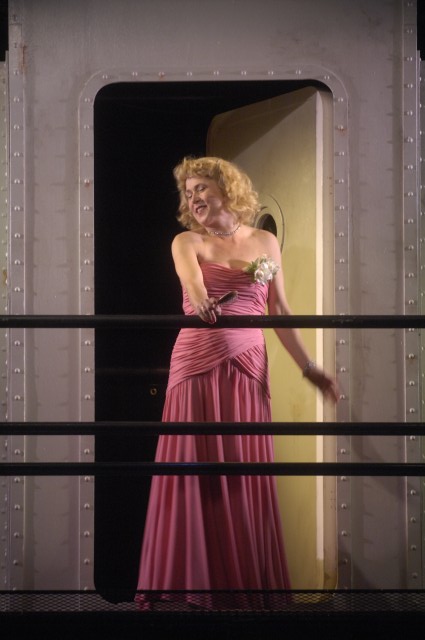
To read all about it--and to find out who the very amusing lady in the photo is--go here.
Posted December 28, 12:00 AM
TT: Almanac
"Man and wife, being two, are one in love."
William Shakespeare, Henry V
Posted December 28, 12:00 AM
December 27, 2007
TT: Oscar Peterson, R.I.P.
Oscar Peterson, who died on Sunday, was one of a handful of jazz musicians to have cultivated a virtuoso technique comparable to that of the greatest classical instrumentalists. In part for this reason, he never got along well with jazz critics, most of whom were (and are) too musically ignorant to appreciate the near-unique nature of his achievement. Peterson's peers knew better. He was very, very popular--every great virtuoso is--but it was his fellow artists who gauged his worth most accurately. Like Buddy Rich, he left a trail of collegial awe behind him wherever he went.
Peterson got more bad reviews than any other major jazz pianist, and on occasion he deserved them. Miles Davis, one of the few musicians of importance to have said anything unpleasant about him, famously remarked that Peterson "makes me sick because he copies everybody. He even had to learn how to play the blues." That was both nasty and untrue, but it did point to the chink in his armor. Unlimited virtuosity is a snare for the unwary artist. "Only in limitation," Goethe wrote, "is mastery revealed." Peterson's extreme technical facility, by contrast, sometimes lured him into the trap of glibness. When he was coasting, all you heard was the fireworks. Nor did it help that he recorded so prolifically throughout his seven-decade-long career. No one can make that many records save at the price of consistent inspiration, and Peterson paid that price too often for comfort.
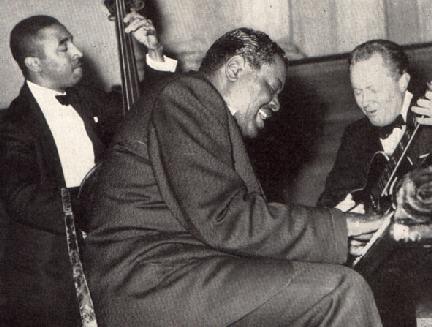
He was at his best from 1953 to 1958, when he led a drummerless trio featuring the guitarist Herb Ellis and the bassist Ray Brown that was celebrated for its aggressive, unrelenting swing. Peterson and his colleagues modeled themselves on the legendary King Cole Trio, but unlike that deliciously easy-going ensemble, the Peterson Trio was a straight-ahead group whose members favored fast tempos and liked nothing better than to light the afterburner and take off. Most of their recordings are out of print, but The Oscar Peterson Trio at Zardi's, a thrilling live album recorded in 1955 at a Los Angeles nightclub, captures them at their most characteristic.
When Ellis decided to quit the road, Peterson replaced him not with another guitarist but with a drummer, the tasteful and elegant Ed Thigpen, thereby recharging his creative batteries for another half-dozen years. It was this version of the Oscar Peterson Trio that recorded most frequently, and one must pick and choose carefully among its many albums to get a clear sense of how good the group could be. Fortunately--and not coincidentally--the most popular of its recordings, Night Train, is also one of the finest. An after-hours 1962 studio set devoted to blues tunes and blues-flavored pop songs, Night Train shows how deeply Peterson could dig when he felt like laying back instead of showing off.
Peterson's later albums are typically less interesting than the ones he made with Brown, Ellis, and Thigpen, but My Favorite Instrument, a 1968 collection of unaccompanied piano solos called that was privately recorded in Germany under optimal circumstances, is worthy of special mention. His playing here is both precisely controlled and consistently inspired, and even his harshest critics have singled it out as noteworthy. I also like The Trio, a live set from 1973 featuring the guitarist Joe Pass and the bassist Niels Pedersen, which contains a version of Nat Cole's "Easy Listening Blues" that shows how much Peterson learned from his nonpareil predecessor.
In addition to recording with his own groups, Peterson cut hundreds of albums as a sideman, most of them made in the days when he was barnstorming with Norman Granz's Jazz at the Philharmonic concert troupes and doubling as house pianist for Verve, Granz's record label. He recorded with everyone who worked for Granz--Louis Armstrong, Roy Eldridge, Ella Fitzgerald, Billie Holiday, Charlie Parker, Ben Webster, Lester Young, even Fred Astaire--and his sensitive, discreet support rarely failed to stimulate those for whom he played. Stan Getz and the Oscar Peterson Trio, recorded in 1957, is an especially choice example of his prowess as an accompanist.
Peterson also wrote a memoir, A Jazz Odyssey, about which I wrote in Commentary when it was published in 2002:
I can think of no other jazz autobiography that has made the mysteries of music-making so readily accessible to the lay reader. Even those who dislike Oscar Peterson's playing will find his book informative--surely a near-unprecedented achievement....Despite his gifts as a raconteur, Peterson is not a natural writer--his ghostwritten prose is too often stiff and ostentatious--but when he speaks of music, the results have a clarity and specificity rarely found in books of this genre. And unlike most jazz memoirists, he is even willing to be critical of other players, including some of the most admired musicians in jazz. Peterson's analysis of the "uneven and unfinished" playing of the bebop pianist Bud Powell, for instance, cuts sharply against the grain of conventional critical wisdom, and whether or not one agrees with his conclusions, they merit close scrutiny, not only in their own right but for the perspective they offer on his own remarkable technical achievements.
Alas, A Jazz Odyssey is out of print, but Gene Lees' Oscar Peterson: The Will to Swing is still available in paperback. An intelligent and warmly sympathetic biography by one of the few jazz critics who appreciated Peterson properly, it profits from Lees' close friendship with his subject.
Peterson was crippled by a stroke in 1993, and though he continued to play in public, his last performances added no luster to his reputation. Now that the long sunset of his post-stroke career is over, my guess is that he will fade from view for a time--perhaps even a long time. But sooner or later some patient and industrious critic will sift through the mountain of variably inspired recordings that he left behind, separate the wheat from the chaff, and tell a later generation of listeners what those who admired Oscar Peterson in his lifetime already know: when he was good, no one was better.
Posted December 27, 12:14 PM
TT: So you want to see a show?
Here's my list of recommended Broadway and off-Broadway shows, updated weekly. In all cases, I gave these shows favorable reviews in The Wall Street Journal when they opened. For more information, click on the title.
Tickets to all of these shows were available at the box office last week.
Because of the recently settled stagehands' strike, many Broadway shows are offering heavily discounted tickets to certain performances. For information, go here.
BROADWAY:
• August: Osage County (drama, R, adult subject matter, closes Mar. 9, reviewed here)
• Avenue Q (musical, R, adult subject matter and one show-stopping scene of puppet-on-puppet sex, reviewed here)
• A Chorus Line (musical, PG-13/R, adult subject matter, reviewed here)
• The Farnsworth Invention (drama, PG-13, reviewed here)
• Grease (musical, PG-13, some sexual content, reviewed here)
• The Homecoming (drama, R, adult subject matter, closes Apr. 13, reviewed here)
• Is He Dead? (farce, G, reasonably family-friendly, reviewed here)
• Rock 'n' Roll * (drama, PG-13, way too complicated for kids, reviewed here)
• The Seafarer (drama, PG-13, adult subject matter, reviewed here)
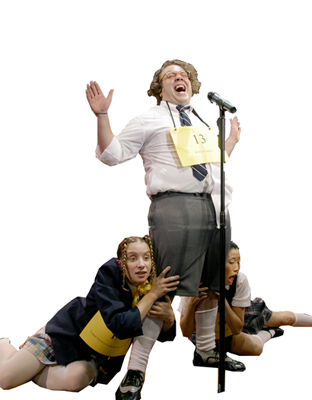
• The 25th Annual Putnam County Spelling Bee (musical, PG-13, mostly family-friendly but contains a smattering of strong language and a production number about an unwanted erection, closes Jan. 20, reviewed here)
OFF BROADWAY:
• The Devil's Disciple (drama, G/PG-13, not suitable for children, closes Jan. 27, reviewed here)
• The Fantasticks (musical, G, suitable for children old enough to enjoy a love story, reviewed here)
CLOSING NEXT WEEK:
• Cymbeline (drama, PG, too complicated for kids, closes Jan. 6, reviewed here)
• The Glorious Ones (musical, R, extremely bawdy, closes Jan. 6, reviewed here)
CLOSING SUNDAY:
• The Drowsy Chaperone (musical, G/PG-13, mild sexual content and a profusion of double entendres, reviewed here)
• Things We Want (drama, R, adult subject matter, reviewed here)
Posted December 27, 12:00 AM
TT: Almanac
KATHY: Eddie's the only fella in town who doesn't pass judgment on people.
ED: That's right. If I did, I wouldn't have any friends.
Scott Alexander and Larry Karaszewski, screenplay for Ed Wood
Posted December 27, 12:00 AM
December 26, 2007
TT: Almanac
These are enough
Left overs to do, warmed-up, for the rest of the week--
Not that we have much appetite, having drunk such a lot,
Stayed up so late, attempted--quite unsuccessfully--
To love all our relatives, and in general
Grossly overestimated our powers.
W.H. Auden, For the Time Being: A Christmas Oratorio
Posted December 26, 12:00 AM
December 25, 2007
TT: Almanac
"'Home' is any four walls that enclose the right person."
Helen Rowland, Reflections of a Bachelor Girl
Posted December 25, 12:00 AM
December 24, 2007
TT: Give and take
I'm writing these words at nine a.m. on Christmas Eve. Not a creature is stirring, not even Mrs. T, who isn't a morning person, or my mother, who went to bed gratefully last night and with any luck will sleep a little while longer. The sun is shining in Smalltown, U.S.A., something it evidently felt no need to do last week. I showed up on Thursday after a more than usually tedious eleven-hour journey and plunged myself into the complicated routine of taking care of my seventy-eight-year-old mother, who broke her pelvis two months ago. Mrs. T flew out to Smalltown to look after her while I wrapped up my remaining deadlines for 2007, and now I'm here, too, making coffee, running errands, and exuding all the good cheer I have in me.
The sunshine helps, as does the season. Mrs. T put up a Christmas tree in the living room last week, and I opened up the old spinet piano the other day and banged out carols and seasonal songs to the best of my now-limited ability. Still, I feel a bit like Othello right now: my occupation's gone. I'm too preoccupied with looking after my mother to work on my Louis Armstrong biography or do any serious reading, I don't have any pieces due until the second week in January, and the nearest theater is two hours away (though I heard the other day that the Smalltown Little Theater was holding auditions for its spring production of South Pacific).
So yes, I'm at loose ends--but very, very glad to be. What better way is there to spend Christmas, after all, than the way I'm spending this one? I'm with the people I love most, helping to take care of someone who not so long ago took loving care of me. As folks say around here, that's the reason for the season, and a good one, too.
I hear one of my housemates stirring, so I'll see you later. Merry Christmas to all!
Posted December 24, 2:00 PM
TT: Almanac
"Christmas is not a time or a season but a state of mind. To cherish peace and good will, to be plenteous in mercy, is to have the real spirit of Christmas. If we think on these things, there will be born in us a Savior and over us will shine a star sending its gleam of hope to the world."
Calvin Coolidge, presidential message, Dec. 25, 1927
Posted December 24, 12:00 AM
December 22, 2007
APPOINTMENT WITH BIG BROTHER
"Asked whether the Philharmonic would be handing North Korea a propaganda victory by playing in Pyongyang, Mr. Mehta replied, 'We're not going to do any propaganda. We're going there to create some joy.' Somehow I doubt that playing Gershwin's An American in Paris and Dvorak's New World Symphony for 1,500 hand-picked servants of the regime will bring joy to the inmates of the North Korean Gulag..."Posted December 22, 12:45 PM
TT: Appointment with Big Brother
My "Sightings" column in today's Wall Street Journal goes after the management of the New York Philharmonic for agreeing to send the orchestra to North Korea:
Zarin Mehta and Paul Guenther, the president and chairman of the Philharmonic...shared a platform with Pak Gil Yon, North Korea's ambassador to the United Nations, and announced that America's oldest orchestra would be playing in Pyongyang next February. It horrified me--no other word is strong enough--to see them sitting next to the smirking representative of Kim Jong Il, the dictator of a brutally totalitarian state in whose Soviet-style prison camps 150,000 political prisoners are currently doing slave labor.In public as well as in private, the management of the Philharmonic has made it clear that the orchestra is going to North Korea with "the encouragement and support of the U.S. Department of State" (to quote from the press release announcing the trip). While Mr. Mehta went out of his way to say that no pressure was put on the orchestra, it's widely believed that the White House means to use the concert as a bargaining chip in its ongoing negotiations with Pyongyang.
I leave it to more qualified observers to predict whether anything of value will emerge from these negotiations. But it is not the job of the New York Philharmonic to enact foreign policy, much less to besmirch its own honor by taking part in what, in a previous column on this topic, I called "a puppet show whose purpose is to lend legitimacy to a despicable regime." Nor do you have to be a diplomat to know that Mr. Guenther was blowing smoke when he compared the trip to the 1989 concert that Leonard Bernstein and members of the Philharmonic gave at the soon-to-be-dismantled Berlin Wall. Nobody is tearing any walls down in North Korea....
Read the whole thing here.
Posted December 22, 11:45 AM
December 21, 2007
CAAF: Christmas movies
It's A Wonderful Life leaves Mr. Tingle va klempt but I tend to wander off halfway through. However, there are a few movies we always watch together this time of year: Thin Man (for the Christmas party scene); Wonder Boys (not technically a Christmas movie but it feels like one, and not just because of all the snow and sleet); and the extended Lord of the Rings trilogy (because nothing says "Merry Christmas!" like 10,000 Orcs on your doorstep).
The other Christmas-watching tradition calls for Mr. Tingle (who is a tolerant man) to trundle an old television with VCR attachment from our attic so I can watch a VHS tape of Gelsey Kirkland and Mikhail Baryshnikov dancing The Nutcracker. This year I intended to pair it with Mark Morris's Hard Nut, which Terry recommended here a while back, but Netflix has alas, not obliged.
I plan to pop in here next week. But just in case: I wish you all a merry and joyful holiday!
Posted December 21, 12:04 PM
CAAF: Holiday tipples, fictional meals
• It's hard to read this list of drinks inspired by Dickens novels and not want to head immediately to the store to pick up the ingredients for some Smoking Bishops. (via Bookslut.)
• Absinthe makes the heart grow fonder (so secondeth Strindberg).
I've not yet had absinthe, and I long to try a thimbleful. My adult self feels about it the way my kid self once felt about Turkish delight. As you'll remember, Turkish delight is what the White Witch gives Edmund a packet of in The Lion, the Witch and the Wardrobe, and it sounded so mysterious and delectable. I have a distinct memory of standing in front of the candy counter at the Marshall-Fields in Chicago as a child looking in vain for the tray of Turkish delight. (A few years ago a friend brought some home from a cruise in Greece, and I finally got to try some. It turns out that Turkish delight is made up of oddly nubby, jelly-like candies covered in powdery sugar. Not quite what I imagined -- which was something even more snowy with a deep emerald center -- but still very satisfying to eat.)
It's funny how many of the food descriptions one reads as a child stick. For me it wasn't just the Turkish delight from The Lion, the Witch and The Wardrobe that I fancied, but also the buttery toast points and tea Lucy has with Mr. Tumnus. The blancmange Jo brings Laurie in Little Women. The acorn pancakes in My Side of the Mountain. And the chocolate river in Charlie and the Chocolate Factory as well as the toad in the hole in Danny the Champion of the World.
Meanwhile, the list of drinks inspired by Dickens novels makes me want to re-read Pickwick Papers and make a list of all the food consumed in it. The club eats so many gluttonous meals, many of the components of which, if I remember correctly, are pleasantly strange and slightly disgusting to read about now.
Posted December 21, 11:26 AM
TT: Home is where the hate is
I reviewed two plays in today's Wall Street Journal drama column, one on Broadway (Harold Pinter's The Homecoming) and one off (George Bernard Shaw's The Devil's Disciple, performed by the Irish Repertory Theatre). Here's a preview.
* * *
"What the hell was that all about?" said the friend who went with me to "The Homecoming" as we left the theater. The last scene of Harold Pinter's best-known play hasn't lost its power to reduce audiences to head-scratching confusion 40 years after it was first seen on Broadway. But even if you're not sure what all of "The Homecoming" is all about, you'll still get the message of the viciously comic revival now playing on Broadway--and you'll revel in the work of six actors who definitely know what's what....
Daniel Sullivan is one of New York's most uneven directors, but when he's hot, he's hot, and his staging of "The Homecoming" cuts like a hacksaw. Ian McShane, Eve Best (who is a very great actress in the making) and Raúl Esparza have the showiest parts and make the strongest impressions, though no apologies need be made for their colleagues, or for Eugene Lee's seedy set, which looks as though someone had worked it over with a wrecking ball....
Like so many of Shaw's plays, "The Devil's Disciple" is a sneaky piece of theatrical prestidigitation in which the shell of an old-fashioned Victorian melodrama is stuffed with decidedly un-Victorian notions about morality ("He has been too well brought up by a pious mother to have any sense or manhood left in him"). Director Tony Walton, who also designed the production, takes care to keep the pace brisk--not even the preacher is preachy--and the cast responds to his lightness of touch with acting to match. John Windsor-Cunningham comes close to stealing the show as the urbane General Burgoyne, but Lorenzo Pisoni and Curzon Dobell steal it right back from him, and Cristin Milioti catches the eye and ear in the supporting role of Essie, the bastard waif who loves Dick in her own desperate way....
* * *
To read the whole thing, go here.
Posted December 21, 12:00 AM
TT: Almanac
And though in tinsel chain and popcorn rope
My tree, a captive in your window bay,
Has lost its footing on my mountain slope
And lost the stars of heaven, may, oh, may
The symbol star it lifts against your ceiling
Help me accept its fate with Christmas feeling.
Robert Frost, "To a Young Wretch"
Posted December 21, 12:00 AM
December 20, 2007
TT: Holding pattern
I just learned that my flight from Newark will be departing fifty-five minutes late, up from a half-hour when I arrived at the airport. I'm too tired to be irritated, especially since I learned long ago that no matter what may happen along the way, it's going to take me at least nine hours to get from New York to Smalltown, U.S.A. Getting to the airport from the Upper West Side, flying from the New York area to St. Louis, traveling south by shuttle bus from there to Smalltown...that's a full day's travel any way you slice it, and most of it is destined to be wasted.
I can burn off a certain amount of time doing a certain amount of work now that I travel with a wireless-equipped MacBook, but while I'm capable of doing serious writing on a plane or in a departure lounge if absolutely necessary, what comes out in the absence of the spur of necessity tends not to be very good. So more often than not, I spend a significant part of the day standing in lines, looking out airplane windows, and pretending to read.
Would that it were possible to take a train from New York to Smalltown, but the last passenger train to stop in my hometown pulled out of the station more than forty years ago, and the old depot is now a museum. I love trains, so much so that I took a sleeper from New York to Chicago three years ago just so that I could write about it for The Wall Street Journal. Now that I'm cooling my heels in Newark, it strikes me that you might enjoy reading that piece--I know I would--so here is "Sleepless on the Lake Shore Limited."
For the record, the dateline, which I wrote with the utmost pleasure, was Between New York and Chicago.
* * *
I grew up dreaming of long-distance trains. They were in the songs I loved ("I took a trip on a train/And I thought about you") and the movies I watched ("I tipped the steward $5 to seat you here if you should come in"). Their tracks criss-crossed the main street of the small Missouri town where I spent my childhood, and their braying whistles cleaved the night air as they carried sleeping strangers to places I'd never been.
Alas, the highways and airlines were killing off passenger trains long before I figured out exactly what Cary Grant wanted to do to Eva Marie Saint on the Twentieth Century Limited. By the time I was old enough to travel alone, I took it for granted that I'd never spend a night in a sleeper car, watching the world rumble by. So when the Department of Homeland Security raised America's alert status from yellow to orange a few days before I had to fly from New York to Chicago to look at plays, it struck me that this might well be my last chance to satisfy a longtime craving. I tore up my plane ticket, paid a visit to www.amtrak.com, booked a Viewliner Standard Bedroom on the Lake Shore Limited, and prepared to find out what I'd been missing all these years.
Robert Frost once wrote a poem about a songbird whose autumnal task was to tell his listeners "what to make of a diminished thing." As I laid eyes on the cramped roomette in which I would be spending the next 20 hours, I knew that would be my job as well. A Viewliner Standard Bedroom stuffs two seats, a toilet and a foldaway sink into slightly more than 23 square feet of floor space, about the size of an Upper West Side walk-in closet. If you want a compartment similar in size to the one in which Grant wooed Saint in "North by Northwest," you'll have to shell out a lot more. (I paid $684 for my round-trip fare between New York and Chicago, meals included.)
The train slipped smoothly out of New York's Penn Station at 2:50 p.m., right on time, and within minutes we had popped out of the tunnel and were rattling northward along the Hudson River. That was when I understood why people still take sleepers. The windows in each compartment are huge, the view transfixing. I scarcely noticed that the compartment itself was shabby and rundown, or that the miniature TV on which Amtrak invited me to view "Seabiscuit" and "Pirates of the Caribbean" was out of order. I'd brought along a laptop, a DVD of "Strangers on a Train" and several books, but I spent every spare minute of daylight gazing out at bleak brown hills, ice-flecked brooks, tiny cemeteries and stations with names like Cold Springs and Breakneck Ridge, all made beautiful beyond imagining by the golden winter sunset.
The red carpets and fresh flowers of yesteryear are long gone, but Amtrak's cheerful porters do their best to pretend that things are what they used to be, and the dining car still serves its perfectly edible hot meals on china and white linen, seating strangers together in the snug booths. I didn't run across any footloose Hitchcock blondes, but I did meet a lot of nice fellow travelers, most of whom could be divided into four groups: train buffs, fearful flyers, grumpy Europeans who'd expected something fancier, and senior citizens who've been taking the train for a half-century and aren't about to quit now. Except for the Europeans, all were friendly and talkative.
The porter made up my hard, narrow berth after dinner. It was so uncomfortable that I barely slept, but I didn't care. Instead, I looked at the twinkling lights of the small towns of New York, Pennsylvania and Ohio, and as the whistle blew, I thought, I'm riding one of the trains I dreamed about when I was a boy. This is the whistle that made me wonder what the rest of the world was like--and now I know.
We pulled into Union Station an hour late. I caught a cab to the Art Institute of Chicago to see "Manet and the Sea." The driver sang along with Louis Armstrong and Ella Fitzgerald on the radio, and I sang along with him, unshowered, underslept and glowing with happiness. Train travel may not be what it used to be, and it definitely costs too much to do more than occasionally. But if you want a sweet taste of what America was like in a slower, quieter age, book a bedroom on the Lake Shore Limited. You can always sleep at home.
Posted December 20, 1:35 PM
TT: Over the river and through the woods
I'm off to Smalltown, U.S.A., where Mrs. T and my family are waiting impatiently for me.
I might possibly do a little blogging while I'm gone, but I expect to spend most of my time immersed in family-type holiday activities, especially since I just finished taping two TV segments and writing nine pieces in a row--five Wall Street Journal columns, three Contentions book columns, and a Commentary essay, believe it or not. (Don't try this at home!)
Seeing as how the point of all this frenzied literary activity was not to have to do any writing in Smalltown, it strikes me that to blog from there would be counterproductive. So except for the daily almanac entry and the usual theater-related postings, don't expect to be hearing too much from me until Mrs. T and I return to New York some time around the turn of the year.
In the meantime, may all your Christmases be bright--and may you spend them in the company of a loving family, traditional or otherwise.
Posted December 20, 12:00 AM
TT: So you want to see a show?
Here's my list of recommended Broadway and off-Broadway shows, updated weekly. In all cases, I gave these shows favorable reviews in The Wall Street Journal when they opened. For more information, click on the title.
Warning: Broadway shows marked with an asterisk were sold out, or nearly so, last week.
Because of the recently settled stagehands' strike, many Broadway shows are offering heavily discounted tickets to certain performances. For information, go here.
BROADWAY:
• August: Osage County (drama, R, adult subject matter, closes Mar. 9, reviewed here)
• Avenue Q (musical, R, adult subject matter and one show-stopping scene of puppet-on-puppet sex, reviewed here)
• A Chorus Line (musical, PG-13/R, adult subject matter, reviewed here)
• The Farnsworth Invention (drama, PG-13, reviewed here)
• Grease * (musical, PG-13, some sexual content, reviewed here)
• Is He Dead? (farce, G, reasonably family-friendly, reviewed here)
• Rock 'n' Roll (drama, PG-13, way too complicated for kids, reviewed here)
• The Seafarer (drama, PG-13, adult subject matter, reviewed here)
• The 25th Annual Putnam County Spelling Bee (musical, PG-13, mostly family-friendly but contains a smattering of strong language and a production number about an unwanted erection, closes Jan. 20, reviewed here)
OFF BROADWAY:
• The Fantasticks (musical, G, suitable for children old enough to enjoy a love story, reviewed here)
CLOSING SOON:
• Cymbeline (drama, PG, too complicated for children, closes Jan. 6, reviewed here)
• The Glorious Ones (musical, R, extremely bawdy, closes Jan. 6, reviewed here)
CLOSING NEXT WEEKEND:
• The Drowsy Chaperone (musical, G/PG-13, mild sexual content and a profusion of double entendres, closes Dec. 30, reviewed here)
• Things We Want (drama, R, adult subject matter, closes Dec. 30, reviewed here)
Posted December 20, 12:00 AM
TT: Almanac
So that the reverence and the gaiety
May not be forgotten in later experience,
In the bored habituation, the fatigue, the tedium,
The awareness of death, the consciousness of failure,
Or in the piety of the convert
Which may be tainted with a self-conceit.
T.S. Eliot, "The Cultivation of Christmas Trees"
Posted December 20, 12:00 AM
December 19, 2007
OGIC: More on Frau
After I posted last week about seeing Chicago Lyric's splendid production of Richard Strauss's Die Frau ohne Schatten, Lisa Hirsch, who blogs knowledgeably about such matters at Iron Tongue of Midnight, wrote to me with an assessment of the opera's plot that is just too brilliant not to be shared:
The plot drives me mad, between the idea that no one can possibly be fulfilled without children and the sheer ponderousness that results from taking "The Magic Flute," layering on another dozen characters, replacing the Masonic allegories with something Hoffmansthal made up, and carefully cutting out all the wit and humor of the Mozart. Still, the music glitters and thunders, and the Empress's transformation scene, done well, is one of the great scenes in all opera. But then I have to put my head in my hands during the damned chorus of unborn children--sheesh!
Hahahahaha! So it wasn't just me.
Lisa was also kind enough to recommend to me some recordings of the opera: this full recording of a Wolfgang Sawallisch production and two cut versions conducted by Karl Bohm and Herbert von Karajan.
Posted December 19, 11:33 PM
OGIC: The Netflix ten
Better late than never, right? It's been a little more than a week since Terry asked me and Carrie to supply the names of 10 movies released since fall 2005 that we most enjoyed. Carrie weighed in with five of hers here, with impressive annotation to boot. I'm offering mine in a straight-out list, sans commentary, but with the caveat that I'm not entirely sure I'm remembering everything. In no particular order, the top ten are:
1. Friends with Money
2. The Descent*
3. Half Nelson
4. Casino Royale ( great minds)
5. Serenity (ditto)
6. The Lives of Others
7. Once
8. Ratatouille
9. Killer of Sheep
10. No Country for Old Men
I asterisked The Descent because I know Terry won't like it: it's a bloody, terrifying horror movie that I happened to like enough to put on this list. Not Terry's cup of cocoa at all. Some honorable mentions that provided solid entertainment or better are Fracture, Dan in Real Life, Michael Clayton, Sunshine, and The Family Stone. And tomorrow you'll probably hear about the half dozen movies that I forgot!
Here are ten from that same stretch of time that I want to see:
1. The New World
2. Tristram Shandy
3. Brick
4. Clean
5. United 93
6. The Devil Wears Prada
7. The Science of Sleep
8. The Last King of Scotland
9. The Fountain
10. The Diving Bell and the Butterfly
Like Terry, I'll be pretty much dark for the extended Christmas. So until next time, happy holidays, one and all.
Posted December 19, 11:31 PM
TT: Still repenting
Last year I admitted that I'd guessed wrong about the future in an essay called The Myth of "Classic" TV that I wrote for the Sunday New York Times in 2001.
In that piece I argued that "there seems to be something in the nature of even the best TV dramas which renders them ephemeral," meaning that there could be no such thing as a "classic" TV show:
I can't tell you how many times I have looked at George Balanchine's The Four Temperaments, but though I suppose the day may come when it no longer has anything new to say to me, I still find it a source of apparently inexhaustible interest, and try to see it at least once a year. Every art form has produced innumerable masterpieces which, like The Four Temperaments, demand to be experienced repeatedly--every art form, that is, except for series television....
Season-long chunks of TV series like The Sopranos were just beginning to be released on videocassette in 2001, but I predicted that they wouldn't become popular. Needless to say, the market has proved me wrong, at least in the short run, though I was still arguing as late as last September that "[n]o matter how 'novel-like' [a TV show like] Homicide may seem to be, there's simply too much of it to embrace in the all-absorbing way we embrace a novel."
True? Let me quote once again from "The Myth of 'Classic' TV":
Hill Street Blues was the first TV drama I ever went out of my way to see, and were there world enough and time, I might even consider watching the first few dozen episodes again. But while I still remember how much I liked Hill Street Blues, I can't recall much else about it--only a few isolated moments from two or three episodes--whereas I could easily rattle off fairly complete synopses of, say, Citizen Kane or A Midsummer Night's Dream, or whistle the exposition to the first movement of Mozart's G Minor Symphony. To qualify as a classic, a work of art must first of all be good enough to make you want to get to know it at least that well. Will any TV series ever be good enough to fill that exalted bill?
I mention all this because American Life TV, a cable channel of whose existence I only just became aware, is now showing reruns of Hill Street Blues every Sunday. Hill Street Blues was, most TV historians agree, the first hour-long cop show to break with the old-fashioned style of TV drama. Every contemporary series whose plots are arranged in multi-episode "story arcs" and whose characters are photographed with hand-held cameras and portrayed with a combination of tough-minded realism and rough-edged humor is a direct descendant of Hill Street Blues, which I watched faithfully throughout most of its six-year run and thought at the time to be the best TV series ever made.
"Chipped Beef," which first aired on December 17, 1981, midway through the second season of Hill Street Blues, was one of the first episodes I saw--maybe even the first. Yet when I sat down to watch it a few weeks ago, I was astonished by how clearly I remembered bits and pieces of the plot, and--more important--by how fresh the show had remained after a quarter-century. I started watching it purely as an experiment, but in minutes I was completely engrossed all over again, and since then I've watched two more episodes and liked them even more.
Am I viewing Hill Street Blues through nostalgia-colored bifocals? Probably. I have no doubt whatsoever that part of the appeal it holds for me now is the way in which it reminds me of myself when young. That was half a lifetime ago and half a continent away, back in the days when I lived in a suburb of Kansas City, worked as a teller in an inner-city bank, reviewed concerts at night, played jazz on weekends, and had yet to visit an art gallery or eat a bagel or or meet any of the people who are now my best friends. I don't know whether the world was simpler then, but my world was both simpler and a good deal more innocent, and it was still possible for me to be pulled up short by a well-written, well-acted TV show whose makers reminded us each week that life is hard and the good guys don't always win.
Nowadays I spend too many nights on the aisle to commit myself to theater on the installment plan. Not even The Sopranos was capable of holding my attention over the long haul. When I gave it up midway through its fourth season, I also gave up series TV. Buffy and Gilmore Girls were my last such ventures, and I watched them in batches (courtesy of Our Girl) rather than week by week. But I intend to stick with Hill Street Blues for a little while longer. After all, man cannot live by masterpieces alone, and for now I find that it amuses me to spend the odd hour watching Frank Furillo, Phil Esterhaus, Captain Freedom, and the men and women of Hill Street Station doing battle with the lengthening shadow of urban decay. Even if it isn't exactly a classic, it definitely beats Law and Order all hollow.
* * *
The first and second seasons of Hill Street Blues are available on DVD, and the first three seasons can also be purchased from iTunes.
Posted December 19, 12:00 AM
TT: Almanac
Call a truce, then, to our labours--let us feast with friends and neighbours,
And be merry as the custom of our caste;
For if "faint and forced the laughter," and if sadness follow after,
We are richer by one mocking Christmas past.
Rudyard Kipling, "Christmas in India"
Posted December 19, 12:00 AM
December 18, 2007
PLAY
The Seafarer (Booth, 222 W. 45). What's the Broadway show to see if you're only seeing one? I strongly recommend Conor McPherson's uncommonly powerful fantasy about an unhappy Irishman (David Morse) who swears off the booze and finds himself standing face to face with the Divvil Himself. "The stuff of greatness," say the posters. "Do not miss this play!" Yes, that's what I wrote in The Wall Street Journal, except for the gratuitous exclamation point, and I meant every word (TT).Posted December 18, 11:05 PM
BOOK
David Parkinson, The Rough Guide to Film Musicals (Rough Guides, $14.99 paper). A decently written, unexpectedly sensible primer that walks you through the long and winding road that leads from The Jazz Singer to Chicago. Some films are undervalued, others overrated, but for the most part Parkinson plays it down the center, steering clear of the twin ditches of academic theory and camp silliness. If Sweeney Todd has you wondering whether there's more to the genre than Busby Berkeley, this is a good place to find out what it's all about (TT).Posted December 18, 11:05 PM
CD
Bill Evans, Conversations With Myself. Looking for the perfect Christmas present, either for yourself or someone you love? Try this classic 1963 album, on which the most influential jazz pianist of the postwar era overdubbed himself--twice. Listen to Evans Nos. 1, 2, and 3 playing Alex North's "Love Theme from Spartacus" and see if the hair on the back of your neck doesn't stand straight up. That was the first Bill Evans track I ever heard, and the impression it made on me back in high school has yet to fade (TT).Posted December 18, 10:55 PM
DVD
Get Carter. No, not the pointless Sylvester Stallone remake, but the original diamond-hard 1971 neo-noir masterpiece in which Michael Caine is out for revenge and doesn't care who gets hurt along the way. After making this astonishing film, Mike Hodges dropped off the scope for three decades of mostly unmemorable slogging, only to resurface in 1999 with the similarly gripping Croupier. If you liked Croupier, what are you waiting for? (TT).Posted December 18, 10:54 PM
TT: Present and accounted for
Regular readers of this blog will recognize the name of Louis Kaufman, the great American violinist and art collector who made the first long-playing recording of Vivaldi's Four Seasons, played on the soundtracks of Gone With the Wind, The Adventures of Robin Hood, The Best Years of Our Lives, and Psycho, performed with Aaron Copland, Francis Poulenc, and Darius Milhaud, bought the first painting that Milton Avery ever sold, and wrote a delightful memoir called A Fiddler's Tale: How Hollywood and Vivaldi Discovered Me. Alas, I never met Kaufman--he died in 1994 at the age of eighty-eight--but I've been corresponding with Annette, his wife and accompanist, for the past couple of years, and on Sunday I had the honor of showing her the Teachout Museum and taking her to lunch.
Annette Kaufman is ninety-three years old, but you wouldn't guess it to look at her--or talk to her. Not only is she still easily recognizable as the same woman who sat for Avery six decades ago, but she is a lively, bustling raconteuse who continues to consume art by the carload (she flew to New York from her Los Angeles home to see Prokofiev's War and Peace at the Met). Judging by our conversation, she remembers everything she's seen or heard with a clarity not even slightly diminished by age. I'd been careful to ask whether she could climb the stairs to my third-floor apartment, but it turned out that I was wasting my breath. Not only did she negotiate both flights of stairs with near-arrogant ease, but she took a cab straight from the Upper West Side bistro where we ate omelettes aux fines herbes to the Pissarro retrospective at the Jewish Museum. Spending three hours in her company made me feel...well, lazy.
In her youth Mrs. Kaufman was a wonderfully elegant and sensitive pianist, as you can hear for yourself on the bonus CD bound into A Fiddler's Tale. Nowadays she's too busy giving away the Louis and Annette Kaufman Collection to play much piano, but I have no doubt that if circumstances required her to do so, she could toss off the keyboard part to a Mozart violin sonata with the same casual grace that she brings to her reminiscences of the famous musicians, writers, and painters whom she and her husband knew. "A very interesting man," she said when I showed her "Apples on a Table," my 1923 Marsden Hartley lithograph. "Louis and I met him one day in Milton's studio." I did my best not to goggle.
I took it upon myself to suggest that Mrs. Kaufman pay a visit to the Martin Puryear show currently on display at the Museum of Modern Art, which felt a bit like offering advice to my grandmother on how to suck eggs. Be that as it may, she snapped up my recommendation with what I gather is her customary enthusiasm. "I just joined MoMA!" she replied. "That means I can take a friend with me!"
I also told her about The Letter, only to learn that she's been going to Santa Fe Opera every August since shortly after I was born.
"That's perfect timing," I said. "The premiere is on August 1, 2009."
"I'll be there," she replied.
I don't doubt it.
Posted December 18, 12:00 AM
TT: Almanac
Deck us all with Boston Charlie,
Walla Walla, Wash., an' Kalamazoo!
Nora's freezin' on the trolley,
Swaller dollar cauliflower alley-garoo!
Don't we know archaic barrel
Lullaby Lilla Boy, Louisville Lou?
Trolley Molly don't love Harold,
Boola boola Pensacoola hullabaloo!
Walt Kelly, Deck Us All With Boston Charlie
Posted December 18, 12:00 AM
December 17, 2007
TT: Men at work (IV)
Don't hold me to it, but The Letter may be the first opera in the history of classical music that's ahead of schedule. I finished drafting my libretto in August, and Paul Moravec, my collaborator, has now written the music for five of the opera's eight scenes. We have a director (Jonathan Kent) and a cast (no names yet, but you'll be impressed). Richard Gaddes, who runs Santa Fe Opera, tells us that everybody in his shop is pleased with the completed scenes that Paul sent them a few weeks ago. Since our contract calls for us to deliver the piano score next June in anticipation of a premiere date of August 1, 2009, I'd say we're cooking along fairly nicely. We've even gotten paid!
So what could possibly go wrong? Plenty. We like what we've written so far, but we won't know how well it works until we start to see and hear it sung, and we expect to do a lot of tinkering between now and the summer of 2009. In addition, Paul and I have already spent a great deal of time thinking and talking about exactly what we're trying to do, starting long before we actually began to write the opera and continuing to the present moment. Stephen Sondheim says that the first step in a successful collaboration is to make sure that everybody is writing the same show. We're doing our best to follow his advice.
One of the things we both realized early on was that the show we wanted to write was going to be different in theatrical effect from the Somerset Maugham play on which The Letter is based. Maugham's play, as I pointed out back in August, is both prosy and naturalistic. It's also exceedingly cynical in its portrayal of the thwarted love of the principal characters. The problem is that prosy, cynical naturalism is not the stuff of which great opera libretti are made. "Consistency of character and reality of events are qualities which need not be accompanied by music," Karl Kraus said. He got that right. To justify the extraordinary fact that the characters in an opera sing instead of speak, you have to give them something emotionally compelling enough to be worth singing about. Otherwise, you'll end up with a show in which words and music are at war with one another. Try to imagine, say, a musical version of The Narrow Margin and you'll see what I mean. Sure, the plot is exciting, and tough-guy lines like "She's a sixty-cent special--cheap, flashy, strictly poison under the gravy" sound great when rasped out by Charles McGraw--but can you really hear them being sung by Dietrich Fischer-Dieskau?
So in addition to making Maugham's flat-textured dialogue lyrical enough to sing, which meant rewriting it virtually from scratch, I also had to heighten the emotional climate of The Letter in such a way as to give Paul, whose music is very intense and dramatic, sufficient room to maneuver. One of the ways I did this was by adding "operatic" situations to the plot. The biggest change I made was to insert a courtroom scene in which Leslie Crosbie (the Bette Davis character, if you've seen the movie) is confronted by the ghost of Geoff Hammond, the man she killed in Scene 1. Of course he's really a hallucination, not a ghost, but the effect is the same, and Geoff's unexpected reappearance in Scene 7 also gives the tenor (yep, he's a tenor) a chance to sing a full-scale aria:
You told them that I raped you,
You spat upon my honor,
You bought back your letter,
You shamed my lover--
And for that you must die.
I hope they hang you, Leslie,
At the end of a long silk rope.
I'll watch you dangle,
Then I'll see you in hell!
Nothing remotely like this occurs in Maugham's play, but it is, needless to say, a quintessentially operatic situation, and I was inspired to create it by a remark made by E.M. Forster in a lecture he gave in 1948 about one of my favorite operas, Benjamin Britten's Peter Grimes: "It amuses me to think what an opera on Peter Grimes would have been like if I had written it. I should certainly have starred the murdered apprentices. I should have introduced their ghosts in the last scene, rising out of the estuary, on either side of the vengeful greybeard, blood and fire would have been thrown in the tenor's face, hell would have opened, and on a mixture of Don Juan and the Freischütz I should have lowered my final curtain."
That isn't quite what happens in the hallucination scene of The Letter, but you get the idea.
I don't want you to think, by the way, that Paul and I sit around all day quoting Karl Kraus and E.M. Forster to one another. Our collaboration to date has been both aesthetically harmonious and a whole lot of fun, and though we're both full-fledged eggheads, you wouldn't always guess it from the way we work together. At our last session, for instance, Paul was telling me about the flashback in Scene 4 in which Leslie tells her lawyer what really happened on the night she shot Geoff. He was explaining how his music will cover the transition from Leslie's jail cell in Singapore to the living room of her jungle bungalow.
"Remember Wayne's World?" Paul said. "I'll just make the orchestra go whoosh-whoosh-whoosh, and we'll be there."
"Somehow I don't think this is exactly the way that Otello got written," I replied.
Posted December 17, 12:00 AM
TT: Almanac
May all my enemies go to hell,
Noel, Noel, Noel, Noel.
Hilaire Belloc, "Lines For A Christmas Card"
Posted December 17, 12:00 AM
December 14, 2007
CAAF: To The Film Industry In Crisis
Earlier this week Terry asked OGIC and me to put together lists of ten films released since the fall of 2005 for he and Mrs. Teachout to watch. The one caveat: "No spinach, please: I'm out for pleasure, very broadly construed, so don't send me to anything I 'ought' to see (whatever that means) unless it's also something that you loved."
It has been fun to deliberate; and I've tried to be true to the no-spinach rule ("In times of crisis, we must all decide again and again whom we love."). Here are my first five, listed in no particular order, with the rest to follow next week. I note with some chagrin that Harold and Kumar Go To White Castle came out a year too early to make the 2005 cutoff, otherwise it would have a spot here. Which is a roundabout way of saying that I think you should see it too, if you haven't already.
1. Casino Royale: I'm a big Bond fan, so this movie was a great treat -- and a relief after the franchise's sad last installments, which were like watching video games. Lots of explosions, no feeling. This one seemed to return Bond to the physical realm. A lot of this is thanks to Daniel Craig, who plays the role rougher and with a lower center of gravity than anyone since Connery. Early on there's a fantastic chase sequence on foot -- showcasing freerunning star Sébastien Foucan -- that's so witty and exhilarating that I went back to see the movie twice. So much fun. And j'aime Eva Green.
2. Inside Man: A fresh, intelligent thriller that uses New York the way Collateral used L.A. Its bank robbery plot doesn't quite hang together but I love this movie for the life in it: There's a lot of delight in it for how everyday people talk and act. Plus, it's beautifully shot. The bit where a woman brought in to translate negotiates to get her parking tickets fixed is one of my favorite film scenes of recent years: I wish more movies used their bit characters so well and shined so much around the edges.
3. Pan's Labyrinth: Gorgeously conceived and wrought. I had to hide out for portions of it, though: It'll wring you out.
4. Serenity: Joss Whedon presents Cowboys In Space! Rethinks and improves on the Firefly TV series. The script's a little klunky with exposition in places but it's a nice little ride all the same.
5. The Devil Wears Prada: I liked this comedy: It's bitchy and tart, and there are some lovely clothes to look at (which I know matters a great deal to you, Terry). I also find it amusing to think of this film as a sort of Her Girl Friday, with Streep in the Cary Grant role. Lately, so many love stories on screen seem so neutered -- all hugs and sweaters and understanding gazes (it's like the heroines aren't searching for love so much as a good therapist) -- it's nice to see a romance with some pepper even if it's not, strictly speaking, a romance.
Posted December 14, 2:48 PM
CAAF: The second message was "Oh! My love to yo."
So, I was late to get a cell phone and I still don't really get texting or my phone's other features. Once in a while the phone will make a crazy tweet and I'll find a message on the screen, which I'll read and then phone or email the sender back.
Just now the phone made its crazy tweet and there was a message saying, "Fwd: We are at the hospital." I didn't recognize the number but managed to tap out my first-ever text message: "Sorry Wrong number." And then the phone tweeted again with the message: "Dear Dumbass: One of your dearest friends is currently in labor. Love, her husband."
Actually, that's not what he typed. But he should have.
Posted December 14, 2:35 PM
TT: Mark Twain tonight (sort of)
Things have calmed down--somewhat--on Broadway, so my Wall Street Journal drama column covers only two plays this week, Mark Twain's Is He Dead? and Mark Lamos' Lincoln Center Theater production of Cymbeline. Here's a preview.
* * *
"Is He Dead?" is a farce about the art world that vanished into the author's files and didn't reappear until it was discovered in 2001 by a scholar and optioned by a producer. Six years later, it has opened in a ritzy production directed by Michael Blakemore ("Noises Off") and starring Norbert Leo Butz ("Dirty Rotten Scoundrels"). The results are shriekingly funny--I don't know when I've heard a New York audience laugh louder or longer--in large part because of Mr. Butz, whose performance is a veritable masterpiece of mugging.
Don't be fooled by the flackery, though: "Is He Dead?" may be "by" Twain, but it's a quaintly amateurish piece of work that wouldn't have run for ten minutes on Broadway had David Ives not "adapted" the script to within an inch of its life. The author of "All in the Timing" and "Mere Mortals," is one of this country's smartest comic playwrights, and a line-by-line comparison between the published version of "Is He Dead?" and the one currently being performed at the Lyceum Theatre is the equivalent of a postgraduate course in How to Make Large Numbers of People Guffaw. Mr. Ives has retained Twain's original situations, most of his characters and a fair number of his lines, but he has cut, rearranged, punched up and otherwise transformed them so extensively as to deserve credit not as the play's adapter but as its co-author....
"Cymbeline," which Shakespeare wrote toward the end of his life, is an imaginative retrospective in which he simultaneously deployed all of the time-honored devices that drove his plots: the weak king, the spunky heroine who dresses up as a boy, the misguided husband induced by a scoundrel to test his wife's love. George Bernard Shaw called it "stagey trash of the lowest melodramatic order," and though that was mere envy speaking, there have been plenty of other equally knowledgeable commentators who failed to grasp what Shakespeare was up to. Henry James dismissed "Cymbeline" as "a florid fairy-tale, of a construction so loose and unpropped that it can scarce be said to stand upright at all," and it's true that most productions fail to weave the play's variegated strands into a convincing fabric.
Not so this one. Greatly aided by Michael Yeargan's sumptuously simple sets, Jess Goldstein's gorgeous costumes and Mel Marvin's savory incidental music, Mr. Lamos takes a cue from his parallel career as an opera director and gives us a "Cymbeline" that flows with the irresistible forward momentum of a piece of music. Resplendent pageantry, knockabout comedy, haunting lyricism: All are blended in just proportion, sweeping us toward a climax in which surprise after surprise is detonated like an extra-long string of firecrackers....
* * *
To read the whole thing, go here.
UPDATE: I took Maud with me to see Is He Dead? To find out what she thought of it, go here.
Posted December 14, 12:00 AM
TT: Almanac
"It is the will of God that we must have critics, and missionaries, and Congressmen, and humorists, and we must bear the burden. Meantime, I seem to have been drifting into criticism myself. But that is nothing. At the worst, criticism is nothing more than a crime, and I am not unused to that."
Samuel Clemens, Mark Twain's Own Autobiography
Posted December 14, 12:00 AM
December 13, 2007
TT: In living color
Here's my latest videoblog, produced by The Horizon, Commentary's artblog. In it I talk about the New York Philharmonic's planned visit to North Korea (about which I wrote here) and "The Cult of the Difficult," an essay about modernism that appears in the December issue of Commentary. I also pay a visit to a New York art gallery, Knoedler & Company, and discuss their exhibition of the late paintings of Jules Olitski. (Yes, that's Mrs. T who makes a cameo appearance at the end.)
Enjoy.
Posted December 13, 4:33 PM
CAAF: 5 x 5 Books by Writers that I've Tilted a Few Around by Matthew Eck
5 x 5 Books ... is a recommendation of five books that appears regularly in this space. This week's installment comes from Matthew Eck, whose novel The Farther Shore is the Lit Blog Co-op's Read This! Selection for winter. In a review for Salon, Stephen Elliott described Eck's book as "a truly great war novel by a writer of sizable talent who has come close to war." Keep up with the LBC discussion of the novel going on this week here.
It's that time of the year where we like to get depressed and we like to drink. We visit family and friends -- and pets are left alone for days on end with too little water. In the title I use the word "around" because not all the writers on this list drink. I use the word "few" because I've already embarrassed myself enough out there in the world. But never apologize -- even as you knock over the Christmas tree.
I'm not saying that writers have to drink either, don't get me wrong there. I never drink anything but coffee when I'm writing. Don't dull your senses. Don't introduce bad habits into your writing time.
I think I really chose these books because I must have somehow gotten a little depressed around all these writers at one point. But it's that little bit of depression I carried back to the beauty of their books, their work heavy with loss.
1. The Last Good Kiss by James Crumley. This is one of those novels where I'll let the writing speak for itself. It has one of the greatest first lines in all of literature: "When I finally caught up with Abraham Trahearne, he was drinking beer with an alcoholic bulldog named Fireball Roberts in a ramshackle joint just outside of Sonoma, California, drinking the heart right out of a fine spring afternoon."
The writing in the book is unbearably beautiful. Case in point, later in the book:
Behind her, the clouds surrendered their last crimson streaks to a soft, foggy gray. A single tall evergreen tilted against the falling sky. Behind me, the party began to rumble like thunder. Peggy relit the hash pipe, and this time I accepted it from her. We shared the smoke as the evening winds rose off the cold sea, rose up the wooded ridges, and herded the party inside, people muttering thin complaints like children called from play to the fuzzy dreams of the their early beds.
2. Thumbsucker by Walter Kirn. If you've ever wanted to be loved, read this book. And this next sentence has nothing to do with what I just said: Kirn has written some of the finest scenes about Mormon sex, in case that's what you're looking to give, or get, for Christmas. This is one of the few books that made me laugh until I cried -- and not because it's all funny.
3. A Stranger In This World by Kevin Canty. This is one of the few books that made me cry until I needed to laugh. I love to teach "Dogs" and "Pretty Judy." Besides, the man turned me on to Babel. I'll love him forever for that one.
4. The End of the Story by Lydia Davis. I do not know Lydia Davis -- let me make that clear. But I once sat in a room where fifteen or twenty MFA-ers were trying to talk to her. Okay, so I wasn't sitting, I was trying as well. I love this book for the way memory tumbles against memory. I love the "nothing" it offers.
5. Tom Thomson In Purgatory by Troy Jollimore. One of the notes I scribbled in the margins of this book reads, "Did you ever get laid on Christmas?" It's not a note to Tom Thomson either. It was fodder for the friend I gave the book to. This is a book you'll have to buy for someone else because it'll say so much to you.
Posted December 13, 12:30 AM
TT: Happy anniversaries
I got out of the hospital two years ago today. I didn't say so in this space at the time, but it was the woman now known as Mrs. T who escorted me home that afternoon. We'd met at a dinner in Baltimore a month or so before, and promptly made plans to see a play in New York (Waiting for Godot, believe it or not) on what ended up being the day after I called an ambulance for myself. Instead she came to visit me at Lenox Hill Hospital, and twenty-two months later we said I do in front of a boatful of astonished and delighted onlookers. Now she's in Smalltown, U.S.A., taking care of my mother. For some mysterious reason, Hilary seems to enjoy taking care of Teachouts.
I wish I were there, and a week from now I will be, but for the moment I still have shows to see and pieces to write. That's why I posted this picture today: I wanted you to see what I'm missing!
It's good to be alive.
Posted December 13, 12:18 AM
TT: So you want to see a show?
Here's my list of recommended Broadway, off-Broadway, and out-of-town shows, updated weekly. In all cases, I gave these shows favorable reviews in The Wall Street Journal when they opened. For more information, click on the title.
Warning: Broadway shows marked with an asterisk were sold out, or nearly so, last week.
Because of the recently settled stagehands' strike, many Broadway shows are offering heavily discounted tickets to certain performances. For information, go here.
BROADWAY:
• August: Osage County (drama, R, adult subject matter, closes Mar. 9, reviewed here)
• Avenue Q (musical, R, adult subject matter and one show-stopping scene of puppet-on-puppet sex, reviewed here)
• A Chorus Line (musical, PG-13/R, adult subject matter, reviewed here)
• The Drowsy Chaperone (musical, G/PG-13, mild sexual content and a profusion of double entendres, reviewed here)
• The Farnsworth Invention (drama, PG-13, reviewed here)
• Grease * (musical, PG-13, some sexual content, reviewed here)
• Rock 'n' Roll * (drama, PG-13, way too complicated for kids, reviewed here)
• The Seafarer (drama, PG-13, adult subject matter, reviewed here)
• The 25th Annual Putnam County Spelling Bee (musical, PG-13, mostly family-friendly but contains a smattering of strong language and a production number about an unwanted erection, closes Jan. 20, reviewed here)
OFF BROADWAY:
• The Fantasticks (musical, G, suitable for children old enough to enjoy a love story, reviewed here)
• The Glorious Ones (musical, R, extremely bawdy, closes Jan. 6, reviewed here)
MILLBURN, N.J.:
• Meet Me in St. Louis (musical, G, completely family-friendly, closes Sunday, reviewed here)
CLOSING SOON
IN NEW YORK:
• Pygmalion * (comedy, G, suitable for mature and intelligent young people, closes Dec. 16, reviewed here)
• Things We Want (drama, R, adult subject matter, closes Dec. 30, reviewed here)
• West Bank, UK (musical, R, adult subject matter, closes Sunday, reviewed here)
Posted December 13, 12:00 AM
TT: Almanac
"It fascinates me that O'Neill and Miller write so badly. They could never have been novelists. But James, Dickens and Joyce were simply too eloquent and abundant in language for the stage. It may be that after Shakespeare the link between theater and language begins to fray."
Harold Bloom (courtesy of Histriomastix)
Posted December 13, 12:00 AM
December 12, 2007
OGIC: Opera from the outside
It was a cold, wet, nasty weekend in Chicago last weekend, so for the most part I stayed in. However, I was lured out from under several blankets on Saturday night by the Lyric Opera's production of Richard Strauss's Die Frau ohne Schatten (The Woman Without a Shadow).
I love going to the opera but, to be honest, still can feel daunted on encountering an art form for which I lack any kind of competent critical apprehension or vocabulary. It's not as if I actually believe that aesthetic appreciation depends on the capacity to interpret or assess the work before one--but the habits you pick up during several long years in humanities graduate school do tend to breed a little anxiety on this count.
Plus I'm out of practice lately, not having been to an opera in two or three years. So the four-hour running time attached to a work I knew nothing about gave me a tiny bit of pause--just the most fleeting question as to my own staying power and capacity to appreciate what I saw and heard.
Well, this is the Lyric Opera, and I needn't have worried. While the story of Frau is an ornate fairy tale centered on procreation that seemed to me more than a little nuts (though reading Magda Krance's well-informed précis here after the show was a great help in sorting it out), the sheer beauty of the music and the singing made me forget myself, as well as forgetting any anxiety I might have had about appreciating it properly. Deborah Voigt in the lead, a character who is transformed over the course of the opera, was most affecting, particularly in the joy she conveys with real power and yet with tremendous delicacy after she's experienced her sea change. The whole thing, from the great voices assembled on one stage to the achingly beautiful orchestration to the fantastical set and choreography, was enough to make this reluctant operagoer embrace pure, unschooled aesthetic enjoyment again. (And if that isn't enough to convince you, the genuine opera buff who accompanied me found it just as wonderful as I did.)
There are still a few performances of Frau on Lyric's calendar, including one tonight. I'm told it's seldom staged, and even less frequently with an orchestra as fine as the Lyric's--so go to it, Chicago types. Find tickets here.
Posted December 12, 1:09 PM
TT: Sursum corda
I've lived in or near Manhattan for close to a quarter-century, yet there are still moments when I catch myself feeling that the life I lead on the Upper West Side can't possibly be real. I was walking back to my apartment one day last week when that sense of improbability swept over me without warning: how on earth did I end up living half a block from Central Park, reviewing Broadway plays for a living and popping into nightclubs and art galleries between deadlines? At various points along the way, I was sure I was going to be a lawyer, a high-school teacher, a jazz musician, and a psychotherapist, and I fully expected to pursue each of these professions within the borders of the Midwestern state where I was born. Instead I wake each morning, climb down from the cozy loft in which I sleep, turn on a small electronic device that in my youth was unimaginable save to science-fiction writers, and spend the day writing about the arts. I don't live in a house, don't own a car, don't have a lawn to mow, don't know any of my neighbors. I am, in short, a New Yorker, living an unreal life in an unreal city: I love it, but I don't quite believe it.
Later that same day I hailed a cab (a curious thing in and of itself for a small-town boy to do) and went to the Metropolitan Museum, which is directly across Central Park from the street where I live. I went there not to look at paintings but to hear a concert by Chanticleer, the twelve-man San Francisco vocal group that is currently celebrating its thirtieth anniversary. Each December they give a series of Christmastime concerts at the Met, and their president, who is a friend of mine, invited me to come hear them this time around. I accepted her offer weeks ago, long before the stagehands of Broadway went on strike, not knowing that the settling of the strike would force me to spend several nights in a row going to plays and that I would have to attend one of them, Conor McPherson's The Seafarer, on the same night that Chanticleer was singing. I didn't want to miss the concert and couldn't reschedule the play, so I decided to see them both.
I got to the Met at six-fifteen and found a seat in the back of the gallery where the concert was to take place, a huge hall packed with pre-Renaissance European art. A vitrine three feet from my elbow housed an exquisitely wrought oak sculpture of an angel carved in the thirteenth century, around the same time that the first piece on the program, a motet by Perotin, was composed. As I gazed at the angel and listened to the harsh, briny, bracingly angular sounds of "Ex semine Abrahae," two sentences flashed through my mind. One was said by the Hungarian composer Miklós Rózsa: "I have no time for any music which does not stimulate pleasure in life, and, even more importantly, pride in life." The other is the terrible line of Thomas Kyd that T.S. Eliot quoted at the end of "The Waste Land": These fragments I have shored against my ruins.
I've been to several of Chanticleer's Christmas concerts at the Met, but the one I remember best is the one I heard six winters ago and wrote about shortly afterward in the Washington Post:
On the Sunday after the World Trade Center crumbled into dust, I flew over the southern tip of Manhattan, transfixed by the insensate spectacle far below me, gaping in dumb wonder at the black hole in my city--my home.I have been thinking about that terrible day as I look back on the arts in New York in 2001. Somewhat to my surprise, I find it hard to recall what I saw a month ago, much less before September 11. It's as if the hole had been burned not just in the city, but in time itself....
So instead of dwelling on the year's highlights, I've chosen to embrace the present moment and the immediate experience. "One greatly needs beauty when death is so close," old King Arkel sings in Debussy's Pelléas et Mélisande. At last I understand what he meant: I went out nearly every night in December, searching for beauty, and most nights I managed to find some.
I can't imagine anything more purely beautiful, for instance, than Chanticleer singing in the shadow of the Northern European Christmas tree at the Metropolitan Museum of Art. These annual concerts by San Francisco's celebrated all-male chorus have become one of New York's toughest holiday tickets (I overheard somebody complaining that the early show was sold out six months in advance), and now I know why. Take twelve men who sing exquisitely in tune and put them in a biggish room with a high, vaulted ceiling--like a church, but not as boomy--and you get sounds that shimmer and cling like handbells on a chilly day.
My companion that evening was a young woman who had come to New York to seek her fortune as a jazz singer. We met in March and immediately became friends, and in the nervous weeks after 9/11 we went to many concerts together, looking for the comfort that great art can give. Since then my friend has moved to California, but she came back to Manhattan two months ago to sing Stephen Sondheim's "Anyone Can Whistle" at my wedding, and as Chanticleer filled the Medieval Sculpture Hall with the iridescent sounds of Praetorius, Josquin, Arvo Pärt, and Anton Bruckner, I remembered how we'd sat in that same room six years before, wondering what was to become of the city of our dreams.
I slipped out of the hall as the audience applauded "Es ist ein Ros' entsprüngen," collected my coat and shoulder bag from the checkroom, trotted down the front steps to Fifth Avenue, jumped into a cab, and headed for Broadway. Twenty minutes later I was sitting on the aisle of the Booth Theatre, a handsome 1913 building that is, like the Metropolitan Museum, something of a monument to the culture that came under attack on 9/11. The Booth has housed a long list of celebrated shows, among them You Can't Take It With You, The Time of Your Life, Come Back, Little Sheba, A Taste of Honey, The Birthday Party, and Sunday in the Park With George. To date I've reviewed eight plays there, including the 2006 revival of Brian Friel's Faith Healer that starred Ralph Fiennes and was directed by Jonathan Kent, who will be staging The Letter for Santa Fe Opera in 2009.
Like Faith Healer, The Seafarer is an Irish play that touches on matters supernatural, and its characters, as I wrote in last Friday's Wall Street Journal, are "frustrated men whose lives have come to naught." But it ends almost happily, which took me very much by surprise. As Daniel Patrick Moynihan remarked after John Kennedy was assassinated, "I don't think there's any point in being Irish if you don't think the world is going to break your heart eventually." Needless to say, you don't have to be Irish to know that, but life without hope is hardly livable, and in a way the most remarkable thing about The Seafarer is that it holds out the prospect--however remote and unsure--of redemption.
As I watched the final scene of The Seafarer unfold before my astonished eyes, I thought once more of what Miklós Rózsa said about the pride in life that art can make us feel. Two hours earlier I had listened with awe to a piece of music written seven hundred years ago, and looked with delight upon a wooden statuette so beautiful that generation upon generation of owners had felt moved to preserve it, until it made its way at last into a great museum, there to be preserved for all time--or until some life-denying madman should find a way to burn down the city that is its home.
Hope, Dr. Johnson tells us, is "a species of happiness, and, perhaps, the chief happiness which this world affords: but, like all other pleasures immoderately enjoyed, the excesses of hope must be expiated by pain; and expectations improperly indulged must end in disappointment." He was wrong about few things, and this was not one of them. Yet I felt the purest, truest kind of hope on the night that I listened to "Ex semine Abrahae," looked at "Angel Holding the Instruments of the Passion," and watched The Seafarer, and though I have no doubt that the world will break my heart a few more times before it is done with me, I find that knowledge--at least for now--unexpectedly easy to bear.
Posted December 12, 12:00 AM
TT: Almanac
"Hope is definitely not the same thing as optimism. It is not the conviction that something will turn out well, but the certainty that something makes sense, regardless of how it turns out."
Václav Havel, Disturbing the Peace
Posted December 12, 12:00 AM
December 11, 2007
TT: Film at five-thirty
A cameraman from WCBS-TV is taping me as I type these words.
Here's the backstory: No sooner did I return home from this morning's press conference at Avery Fisher Hall than I got a call from a TV producer who wanted to know if I'd do an on-camera interview about the New York Philharmonic's visit to North Korea for Channel 2's five-thirty newscast. I said I'd talk to them if (A) they sent the camera crew to my apartment and (B) the interview was wrapped up by three o'clock. (I'm taping a Contentions videoblog this afternoon.) The producer agreed, and an hour later Deborah Garcia was knocking on my door.
Once we'd finished taping the interview, Deborah's cameraman asked if he could shoot what in the TV news business is known as B-roll. He suggested that I walk into my office, sit down at my desk, and spend a minute or two clacking away on my laptop. I decided that it would be way meta if I were to blog on camera, which is what I'm doing.
To see how much of the interview (if any) makes it onto the air, tune into WCBS at 5:30 ET and cross your fingers. If you don't live in or near New York City, you can go here to watch me--or not--in streaming video.
Posted December 11, 2:26 PM
TT: The Philharmonic in Pyongyang
I just got back from a press conference at Lincoln Center's Avery Fisher Hall at which the New York Philharmonic officially announced its plans to play in Pyongyang on February 26. Present were Paul Guenther, the orchestra's chairman; Zarin Mehta, the orchestra's president and executive director; and Pak Gil Yon, North Korea's ambassador to the UN. Christopher Hill, an assistant secretary of state in the U.S. State Department's Bureau of East Asian and Pacific Affairs, was also supposed to be at the press conference, but sent his apologies, claiming that "responsibilities" in Washington prevented him from attending.
Highlights:
• The Philharmonic will spend two and a half days in North Korea. During that time it will give a single concert in Pyongyang in a hall seating 1,500 people. It will then fly to Seoul, the capital of South Korea, to give a second concert there.
• Lorin Maazel, the orchestra's music director, will conduct both performances.
• The Pyongyang program will consist of Gershwin's An American in Paris and Dvorak's "New World" Symphony, plus the national anthems of the U.S. and North Korea. Beethoven's Fifth Symphony will be played in Seoul.
• According to a statement released earlier this morning, the Philharmonic is making the trip with "the encouragement and support of the U.S. Department of State."
• Paul Guenther said that the orchestra's "somewhat unusual journey" to North Korea would be a reflection of its "calling to serve, which the New York Philharmonic has never shied away from."
• The concert will be broadcast, but as of this morning Zarin Mehta had no information on whether or how it would be heard inside North Korea, or who will be permitted to attend the performance. "I would guess they do not have the kind of system we have of advertising concerts and selling them," he said.
• Fifty members of the international media will accompany the orchestra to Pyongyang. Mehta does not know what restrictions will be placed on them by the North Korean government.
• The orchestra wants to give master classes in Pyongyang for "music students and other professionals," but so far no final arrangements have been made to do so.
• Ambassador Pak dodged the question of whether news of the concert has been released by North Korea's state-controlled media as of this hour.
• Asked whether the concert would be a propaganda coup for North Korea, Mehta replied, "We're not going to do any propaganda."
• More quotes from Mehta:
"One small symphony is a giant leap."
"All we can do is show the way that music can unite people."
"We're going there to create some joy."
* * *
To read "Serenading a Tyrant," my original October 27 Wall Street Journal column on the Philharmonic's trip to Pyongyang, go here.
Posted December 11, 12:11 PM
TT: Cram course
Dear OGIC and CAAF:
As you know, I haven't watched a film in a theater since Capote, and the only new films I saw on TV during that long interregnum were Coeurs, about which more below, and Little Miss Sunshine. (Things were a little hectic!) After I went to a screening of Sweeney Todd last week, I decided that the time had finally come to find out what I'd been missing. To this end, would both of you please be so kind as to post lists of the ten films released since the fall of 2005--current releases included--that you think Mrs. T and I might like best?
No spinach, please: I'm out for pleasure, very broadly construed, so don't send me to anything I "ought" to see (whatever that means) unless it's also something that you loved.
For purposes of calibration, the last ten then-new movies I watched with pleasure on a large screen were Bright Young Things, Capote, Collateral, Garden State, The Incredibles, Junebug, The Life Aquatic with Steve Zissou, Look at Me, Me and You and Everyone We Know, and Sideways.
Over to youse.
Posted December 11, 12:00 AM
TT: Words to the wise
Seeing as how I'm on an Alan Ayckbourn kick, I wanted to let you know that Coeurs, Alain Resnais' 2006 French-language film version of Ayckbourn's Private Fears in Public Places, is showing this week on IFC.
The play, which received its American premiere off Broadway in 2005, is one of Ayckbourn's most important works, and even though Resnais' bittersweet screen adaptation is very French, it's surprisingly faithful to the original and more than worth seeing in its own right. To read what I wrote about it earlier this year, go here.
Six showings are scheduled:
• Tonight at 11:05 p.m. ET
• Wednesday at 5:25 a.m. and 3:05 p.m. ET
• Saturday, December 22, at 11:40 a.m. and 5:05 p.m. ET
• Sunday, December 23, at 4:55 a.m. ET
For more information about Coeurs, or to view the trailer, go here.
Posted December 11, 12:00 AM
TT: Almanac
"Solitude would be an ideal state if one were able to pick the people one avoids."
Karl Kraus, Beim Word genommen (trans. Harry Zohn)
Posted December 11, 12:00 AM
December 10, 2007
TT: Never a dull moment
I dropped Mrs. T off at the Milwaukee train station a couple of hours ago, then checked my voice mail as I drove to the airport and found out that I had become the Flavor of the Day.
It seems that the New York Philharmonic has definitely decided to perform in North Korea next February, and that the New York Times ran a story this morning in which mention was made of "Serenading a Tyrant," the Wall Street Journal column I wrote in October arguing that this would be a mistake:
Some questions have been raised about the appropriateness of visiting a country run by one of the world's most repressive governments. North Korea's policies have been blamed in part for the famine-related starvation of perhaps two million people and it confines hundreds of thousands of people in labor camps.If the orchestra goes to Pyongyang, "it will be doing little more than participating in a puppet show whose purpose is to lend legitimacy to a despicable regime," Terry Teachout, an arts critic and blogger, wrote on the online opinion pages of The Wall Street Journal in late October.
Once I got to the airport and checked my e-mail and voice mail, I found a half-dozen increasingly urgent messages from a CNN producer who wanted to know if I could appear on The Situation Room this afternoon to talk about the Philharmonic's planned Pyongyang debut. Alas, it turned out that my flight from Milwaukee to New York had been delayed, so I e-mailed the producer to let her know that I'd be spending the next few hours cooling my heels in a departure lounge. She promptly called me on my cell phone to ask if I'd be willing to do a phone interview instead. Impressed by her persistence, I agreed, went through the security line, made my way to Gate 41, set up shop at a table in a nearby food kiosk, and turned my phone back on. Then I booted up my MacBook, plugged back into the Web, and read an e-mail from a BBC producer wanting to know if I'd do a phoner on the same subject.
As I waited to hear from CNN, I noticed that airports are very noisy places. Had I been giving a performance of John Cage's 4′33″ instead of a phone interview, it would have consisted of the following overheard sounds:
• Get-on-the-plane announcements
• In-the-interests-of-security announcements
• A pair of waitresses discussing their love lives in tones loud enough to shatter glass
• A tableful of men discussing their love lives over pizza
• A wide-ranging medley of kitchen-related noises
• Canned music (Milwaukee favors smooth jazz)
I fired off a e-mail to CNN warning the producer that she might have to do a bit of editing, and she wrote back to reassure me that all would be well. Five minutes later my cell phone rang, and a minute later we were off and running. A correspondent asked me five or six perfectly logical questions, all of which I answered in the manner to which my Wall Street Journal column had accustomed her. Then I e-mailed the producer a photo of myself sitting at a piano, and she told me that the segment would air at five p.m. Eastern. Needless to say, I won't be seeing it--I'll be somewhere over Pennsylvania, I hope--but you're more than welcome to tune in and hear what I had to say.
No sooner did I finish with CNN than I heard back from the BBC producer, who asked me to sit tight while she lined up an interviewer. Ten minutes later I was talking to London.
"Where are you speaking from?" the interviewer asked.
"The airport in Milwaukee," I replied. "I came out here to review an Alan Ayckbourn play." (I figured that would boggle him.)
"And what's the weather like?" he asked, imperturbable to a fault.
"Cold."
Now I have two hours (I hope!) to kill in a strange airport. How shall I spend them? I could start writing about Lincoln Center Theater's production of Cymbeline for my Friday Wall Street Journal drama column, put in a bit of work on my Louis Armstrong biography, catch up on my e-mail, or grab some lunch.
Such is a day in the life of a traveling opinionmonger in postmodern America.
Posted December 10, 2:17 PM
TT: Under separate cover
Mrs. T and I are both traveling today, I in a plane and she on a train.
The two of us flew to Wisconsin on Saturday morning to see the Milwaukee Repertory Theater's production of Alan Ayckbourn's The Norman Conquests, three free-standing full-length plays that share the same characters and take place during the same span of time but are set in different rooms of the same house. For obvious reasons, The Norman Conquests is rarely revived, and this is one of the few major-house stagings to be presented in America since the trilogy was produced on Broadway in the winter of 1975-76. Seeing as how I've become America's Drama Critic faute de mieux, I clearly had to review it, and the fact that I'm an adult convert to Ayckbourn's cause made the assignment all the more urgent.
I had another reason for wanting to go, which is that The Norman Conquests was the first Broadway show I ever saw. Moreover, I saw it--or rather, to be exact, one installment of it--on my very first trip to New York, about which I wrote in City Limits, the memoir I published in 1991:
New York, of course, isn't exactly full of people trying to get to Smalltown, U.S.A., in a hurry, and people from Smalltown aren't much more likely to go to New York, whether for a visit or for good. My father is a rare exception to this rule, for he went to a hardware convention in New York in 1964, returning with a reel of fuzzy home movies of the World's Fair, a plastic Statue of Liberty, and a commitment to never going back about which he has yet to change his mind. I listened to his tales of squalor and rudeness, but the home movies made a deeper impression on me, and I followed in his reluctant footsteps at the age of nineteen. My school, a Southern Baptist college just outside of Kansas City, sponsored a week-long expedition to New York every year, and I signed up as soon as I was eligible. It was a busy week. I haunted the museums. I went to the Metropolitan Opera. I saw my first Nutcracker. But my biggest adventure consisted of going by myself to the early show at the Café Carlyle, neatly dressed in a black suit that my mother and I had picked out at a factory outlet store...
You can read all about my visit to the Carlyle in City Limits, but you can't read anything about The Norman Conquests, for the simple reason that by the time I wrote City Limits I didn't remember anything about it. I don't even know which installment I saw. My first trip to New York had filled my head with so many memories that some of them inevitably got crowded out, and the complicated plot of The Norman Conquests was among the first to go. The only thing of which I'm sure was that I sat on the front row of the Morosco Theatre, which was torn down in 1982 to make way for the mammoth hotel-and-theater complex where The Drowsy Chaperone is now playing. I do remember being surprised by how small the theater seemed--it held a thousand people--and how close I was to Dick Benjamin and Paula Prentiss, whom I knew and loved from a short-lived but wonderful sitcom called He & She that was, alas, a few years ahead of its time.
It was the nearest I'd been to anyone famous, and I topped it a couple of nights later when I sat directly behind Lauren Bacall at an American Ballet Theatre program on which the young Mikhail Baryshnikov danced Spectre of the Rose, an experience that left me permanently star-struck. Small wonder that I moved to New York a decade later, though it never occurred to me that I'd end up becoming the drama critic of The Wall Street Journal. Back then I thought I was going to be...what? I wasn't yet sure, but the idea of playing jazz for a living was already starting to take shape in my mind.
Last week I went to the opening night of Aaron Sorkin's The Farnsworth Invention with a friend who (unlike me) has a knack for picking celebrities out of a crowd. The funny part is that my friend is herself a medium-gauge celebrity, but since she comes, as I do, from unspectacular circumstances, she isn't even slightly blasé about living in New York, and takes the greatest pleasure out of spotting familiar faces.
"Who's here?" I asked her.
She turned around in her seat and scanned the auditorium. "Ah, there's Mike Nichols three rows behind you--no, he's across the aisle. And that's Phil Donahue and Marlo Thomas. And over there...Steven Spielberg and Tony Kushner!"
I was duly impressed--but not nearly so much as I was in 1975.
Mrs. T and I have been holed up in Milwaukee's InterContinental Hotel, which happens, amazingly enough, to be in the same building as the theater--a great convenience when the temperature outside is well below freezing. You can see a skating rink from the window of our ninth-floor room, which is directly across the street from City Hall, a century-old building of superbly old-fashioned splendor that is now swathed in scaffolding as part of a complete restoration. The hotel itself has changed hands and been redecorated since my last visit. Our room is both very modern and very comfortable, the staff is attentive and friendly in the Midwestern manner, and the food is excellent. We'll come again.
I head back to New York today, but Mrs. T is going in a different direction. By the time you read these words, I'll have dropped her off at the Milwaukee train station, from which she will travel to St. Louis by way of